Archive for ‘living’

14/05/2020

China relocates villagers living in 800m-high cliffs in anti-poverty drive

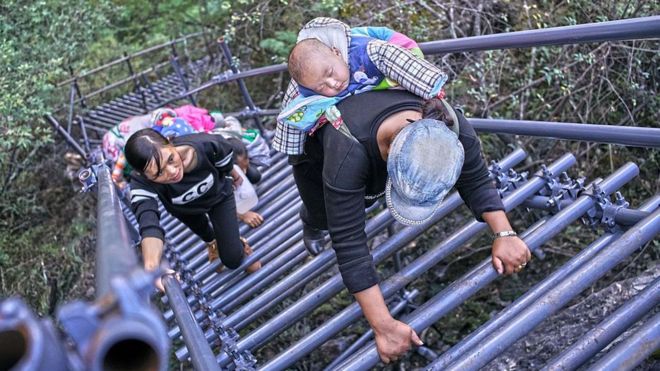
People climb on the newly-built metal ladder with hand railings to Ahtuler village on a cliff on November 11, 2016Image copyright GETTY IMAGES
Image caption The village made headlines after photos showed people scaling ladders to get home

They used to call an 800m-high cliff home, but dozens of villagers in China’s Sichuan province have now been relocated to an urban housing estate.

Atulie’er village became famous after photos emerged showing adults and children precariously scaling the cliff using just rattan ladders.

Around 84 households have now been moved into newly built flats as part of a local poverty alleviation campaign.

It’s part of a bigger national campaign to end poverty by the end of 2020.

‘So happy I got a house’

Atulie-er village made headlines in 2016 when it was revealed that its villagers had to scale precarious ladders to get home, carrying babies and anything the village needed.

Soon afterwards the government stepped in and replaced these with steel ladders.

The households have now been moved to the county town of Zhaojue, around 70km away.

They will be rehoused in furnished apartment blocks, which come in models of 50, 75 and 100 sq m – depending on the number of people in each household.

It’ll be a big change for many of these villagers, who are from the Yi minority and have lived in Atulie-er for generations.

Photos on Chinese state media showed villagers beaming, one of them telling state media outlet CGTN that he was “so happy that I got a good house today”.

‘Big financial burden’

According to Mark Wang, a human geography professor at the University of Melbourne, such housing schemes are often heavily subsidised by the government, typically up to 70%. However, in some instances families have been unable to afford the apartments despite the subsidies.

“For some really poor villages, the 30% may still be difficult for them to pay, so they end up having to borrow money – [ironically] causing them even more debt,” he told BBC News.

“For the poorest, it’s a big financial burden and so in some instances, they might have to stay.”

According to Chinese state media outlet China Daily, each person will have to pay 2,500 yuan ($352; £288) for this particular move – so for a family of four, the cost would come up to 10,000 yuan.
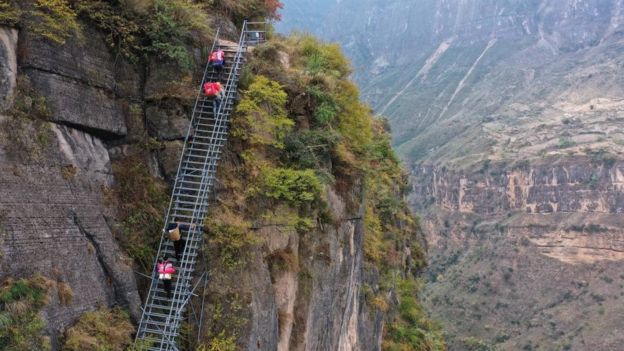
Villagers Living On Cliff Shop Online In LiangshanImage copyright GETTY IMAGES
Image caption This is the journey the villagers had to make to get home

This is quite a low price, says Mr Wang, as he had heard of people having to pay up to 40,000 yuan for other relocation projects.

Mr Wang says in most poverty resettlement campaigns, villagers are given a choice whether or not to move, and are not usually moved into cities from the countryside.

“In most instances it’s a move to a county town or a suburb. So it’s not like they’re moving to a big city. Not everyone wants an urban life and most of those who do would have already left these villages and moved to the big cities,” he says.

“Usually the government [puts a limit] on the resettlement distance. This is in most people’s favour because it means they can keep their farm land, so that’s very attractive.”

The Atulie’er villagers will share this new apartment complex with impoverished residents across Sichuan province.
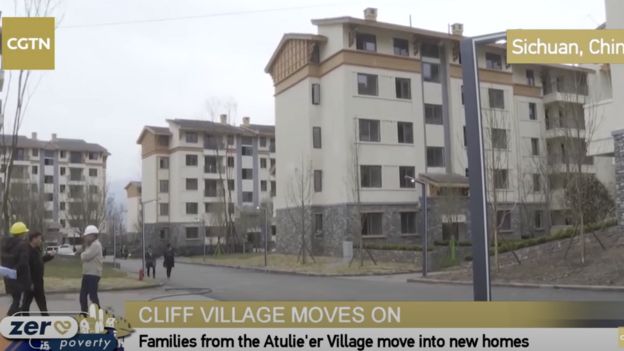
The new apartment blocksImage copyright CGTN/YOUTUBE
Image caption The villagers will be living in these apartment buildings

Around 30 households will remain in the Atulie’er village- which is set to turn into a tourism spot.

According to Chinese state media outlet China Daily, these households will effectively be in charge of local tourism, running inns and showing tourists around.

The county government has ambitious plans – planning to install a cable car to transport tourists to the village and to develop some surrounding areas. An earlier report said there were plans to turn the village into a vacation resort, with state media saying the state would pump 630 million yuan into investment.

Though these developments are likely to bring more jobs to the area, it’s not clear what safeguards are in place to make sure that the site’s ecological areas are protected and not at risk of being overdeveloped.
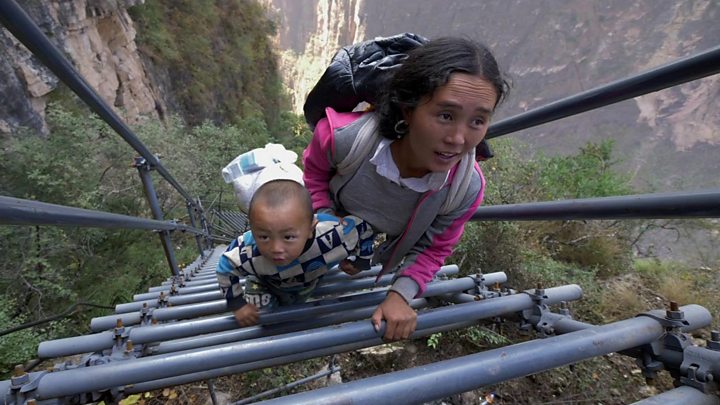
Media caption Do people in China’s rural communities think poverty reduction can work?

Chinese President Xi Jinping has declared that China will eradicate poverty in China by 2020.

There’s no one standard definition of poverty across all of China, as it differs from province to province.

One widely quoted national standard is 2,300 yuan ($331; £253) net income a year. Under that standard, there were around 30 million people living in poverty across the whole of China in 2017.

But the 2020 deadline is approaching fast – and Mr Wang says the plan could be derailed by the virus outbreak.

“Even without Covid-19 it would be hard to meet this deadline and now realistically, it has made it even more difficult.”

Source: The BBC

13/05/2020

Xinhua Headlines-Xi Focus: Xi stresses achieving moderately prosperous society in all respects

Chinese President Xi Jinping, also general secretary of the Communist Party of China Central Committee and chairman of the Central Military Commission, learns about poverty alleviation efforts at an organic daylily farm in Yunzhou District of Datong City, north China’s Shanxi Province, May 11, 2020. (Xinhua/Li Xueren)

— Xi stressed addressing the difficulties faced by enterprises in resuming production and operation.

— Xi underscored lifting the remaining poor population out of poverty.

— Xi required implementing pro-employment policies.

TAIYUAN, May 12 (Xinhua) — Chinese President Xi Jinping has stressed efforts to complete building a moderately prosperous society in all respects, and ride on the momentum to write a new chapter in socialism with Chinese characteristics for a new era.

Xi, also general secretary of the Communist Party of China (CPC) Central Committee and chairman of the Central Military Commission, made the remarks during an inspection tour in north China’s Shanxi Province.

Xi called for efforts to overcome the adverse impacts of the COVID-19 epidemic and make greater strides in high-quality transformation and development to ensure that the target of poverty eradication is reached and the building of a moderately prosperous society in all respects is completed.

During the tour from Monday to Tuesday, Xi inspected work on coordinating the regular epidemic response with economic and social development, and on consolidating the poverty eradication results.

While visiting an organic daylily farm in Yunzhou, Datong City, on Monday, Xi said what he cares about the most after poverty eradication is how to consolidate the achievements, prevent people from falling back into poverty, and make sure rural people’s incomes rise steadily.

He said an important benchmark to evaluate an official’s job performance is to see the amount of good and concrete services he or she has delivered to the people.

When visiting a community of relocated villagers, Xi said relocation is not only about better living conditions but also about chances to get rich. He called for follow-up support to residents with tailor-made rural business projects to ensure sustainable development.

Highlighting that whether the people can benefit shall be a top concern, Xi demanded more supporting policies be put in place in terms of industrial development, financing, agricultural insurance, among others.

Xi applauded the strenuous efforts made by primary-level officials on helping people fight poverty.

At the home of villager Bai Gaoshan, Xi chatted with Bai’s family as they sat on a “kang” — a bed-stove made out of clay or bricks in north China.

Chinese President Xi Jinping, also general secretary of the Communist Party of China Central Committee and chairman of the Central Military Commission, learns about poverty alleviation efforts in a village of Xiping Township in Datong City, north China’s Shanxi Province, May 11, 2020. (Xinhua/Xie Huanchi)

Xi said the CPC wholeheartedly seeks happiness for the Chinese people, having stopped collecting agricultural taxes and fees, helping the impoverished rural residents with housing and medical service, training them with skills, and finding ways for them to live a prosperous life.

“I believe our villagers will enjoy better days ahead,” Xi said.

On top of that, he called for consolidating achievements in poverty alleviation, and then focusing on rural vitalization to ensure a better life for rural residents.

He then went on to visit the 1,500-year Yungang Grottoes, a “treasure house” of artifacts featuring elements blending Chinese and foreign cultures, as well as cultures of China’s ethnic minorities and the Central Plains.

Xi stressed that historical and cultural heritages are irreplaceable precious resources, and protecting them should always be put in the first place in tourism development.

Noting that tourism should not be over-commercialized, Xi said tourism should become a way for the Chinese to understand and appreciate the culture of the nation and enhance their cultural confidence.

The historical implications of communication and integration behind the Yungang Grottoes should be further explored to enhance the sense of community for the Chinese nation, said Xi.

During a research tour in a stainless steel manufacturer in the provincial capital Taiyuan on Tuesday morning, Xi said products and technology are the lifeline of businesses, calling for more efforts in technological innovation to make a greater contribution to the development of advanced manufacturing.

He also called on businesses to strictly implement epidemic prevention and control measures to ensure the safety and health of their workers, while promoting the resumption of work and production to make up for the time lost.

Chinese President Xi Jinping, also general secretary of the Communist Party of China Central Committee and chairman of the Central Military Commission, waves to workers during a research tour in a stainless steel manufacturer in Taiyuan, capital city of north China’s Shanxi Province, May 12, 2020. (Xinhua/Li Xueren)

Later on, Xi went to check the ecological protection work of the Fenhe River in the city, and urged the incorporation of environment protection, energy revolution, green development, and economic transformation.

After hearing the work reports of the CPC Shanxi Provincial Committee and the provincial government on Tuesday afternoon, Xi stressed that no relaxation is allowed in epidemic prevention and control, noting that efforts should be made to guard against both imported infections and domestic rebounds, improve regular prevention and control mechanism, and prevent new outbreaks.

Xi called for efforts on more promptly and effectively addressing the difficulties faced by enterprises in resuming production and operation, on solid implementation of all the policies and measures for expanding domestic demand, and on strengthening the competitiveness and quality of the real economy, especially the manufacturing industry.

Chinese President Xi Jinping, also general secretary of the Communist Party of China Central Committee and chairman of the Central Military Commission, speaks with workers during a research tour in a stainless steel manufacturer in Taiyuan, capital city of north China’s Shanxi Province, May 12, 2020. (Xinhua/Xie Huanchi)

Continuous efforts should be made to promote the adjustment and optimization of China’s industrial structure, and scientific and technological innovations should be greatly enhanced to continue achieving breakthroughs in new infrastructures, technologies, materials, equipment as well as new products and business models, Xi said.

He stressed overcoming the difficulties and obstacles facing reforms in key areas, including state-owned enterprises and assets, the fiscal, tax, and financial system, business environment, the private sector, domestic demand expansion, and urban-rural integration.

Xi also highlighted efforts to improve the country’s system and mechanism for opening-up.

China will uphold the concept that lucid waters and lush mountains are invaluable assets, and steadily implement the national strategy for ecological protection and high-quality development of the Yellow River basin, he said.

More should be done to accelerate institutional innovation and strengthen the implementation of institutions to help form a green way of production and living, he said.

Efforts should be made to solidify the foundation for the development of agriculture and rural areas, beef up policy support for grain production and lift the remaining poor population out of poverty, Xi said.

Authorities should adhere to the people-centered development philosophy and ensure the bottom line of people’s livelihood, Xi said. He added that efforts should be made to implement pro-employment policies and facilitate the employment of key groups such as college graduates, veterans, rural migrant workers and urban people facing difficulties.

Efforts should be expedited to improve the weak areas in the public health system exposed by the epidemic and shift the focus of social governance to the primary levels, Xi said.

The rich and colorful local history and culture as well as revolutionary cultural resources should be fully drawn on and used to promote cultural advancement, Xi said.

He stressed consistent efforts to promote core socialist values to guide Party cadres as well as the public to enhance morality, cultivate good ethics and strengthen cultural confidence.

Xi also called for efforts to improve the Party’s political ecosystem, strictly observe the Party’s political discipline and rules and fight against corruption and undesirable conduct.

Source: Xinhua

20/04/2020

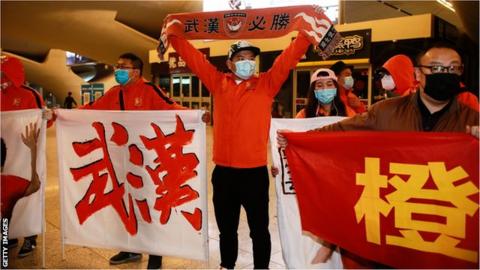
Coronavirus: Chinese Super League team return home to Wuhan after 104 days abroad

Fans greated the team as they arrived in Wuhan via train
Fans greeted the team as they arrived in Wuhan via train

Chinese Super League team Wuhan Zall made an emotional homecoming after being unable to return for three months because of the coronavirus pandemic.

Players had initially stayed at their winter training camp in Spain when the virus peaked in Wuhan in January.

After a prolonged transit in Germany, they landed in Shenzhen on 16 March and underwent three weeks’ quarantine.

They were greeted by fans when they arrived in Wuhan by train on Saturday evening.

“After more than three months of wandering, the homesick Wuhan Zall team members finally set foot in their hometown,” the team said on the Twitter-like Weibo.

Fans, dressed in the team’s orange colours, sang and gave the players flowers as they arrived home for the first time in 104 days.

Players will now spend time with their families before training resumes.

The team had first left Wuhan in early January to start preparing for the Super League season.

By the time they arrived in Malaga, residents in Wuhan were living under strict lockdown measures, and there were no planes or trains in or out of the capital.

Coach Jose Gonzalez told Spanish media at the time that the players “are not walking viruses, they are athletes” and asked for them not to be demonised.

The Chinese Super League was set to begin on 22 February but it has been postponed.

Wuhan raised its official Covid-19 death toll by 50% on Sunday, adding 1,290 fatalities.

Source: The BBC

30/09/2019

Fugitive on run for 17 years found living in cave by a drone

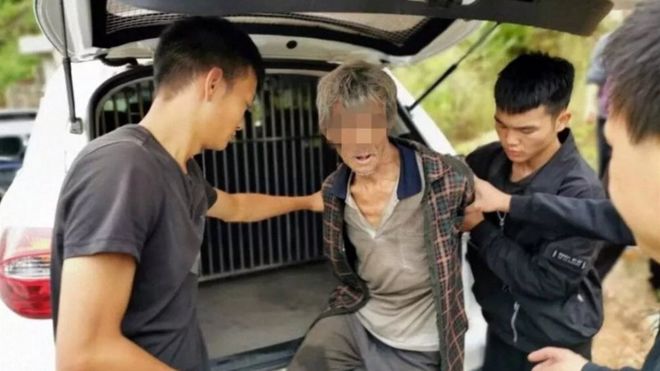
Fugitive arrested by policeImage copyright YONGSHAN POLICE
Image caption After 17 years, the fugitive was tracked down by a drone

Chinese police have arrested a fugitive who’d been on the run for 17 years, after they used drones to spot his cave hideout.

The 63-year old, named Song Jiang by the police, had been jailed for trafficking women and children but escaped from a prison camp in 2002.

He had been living in a tiny cave cut off from human interaction for years.

Yongshan police received clues about Song’s whereabouts in early September, they said on their WeChat account.

Those clues led them to the mountains behind his hometown in Yunnan province in south-west China.

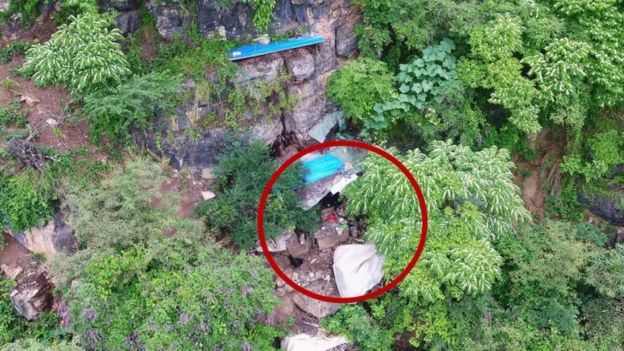
Aerial shot of the cave entranceImage copyright YONGSHAN POLICE
Image caption Drones spotted the cave on a steep hillside

After regular searches failed to find anything, authorities sent additional drones to help the officers.

The drones eventually spotted a blue-coloured steel tile on a steep cliff as well as traces of household rubbish nearby.

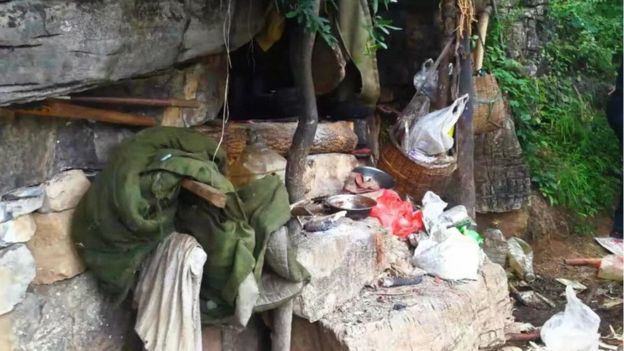
Police then moved in on foot and found Song in a small cave where he’d been hiding for years.

According to the police, the man had been living in seclusion for so long that it was difficult for him to communicate with the officers.

State media said Song had used plastic bottles to get drinking water from a river, and branches of trees to make fire.

He has been sent back to jail.

Outside of the caveImage copyright YONGSHAN POLICE
Image caption The inside of the cave was about 2 sq metres (6.6 sq feet)

Source: The BBC

Law of Unintended Consequences

continuously updated blog about China & India

ChiaHou's Book Reviews

continuously updated blog about China & India

What's wrong with the world; and its economy

continuously updated blog about China & India