Chindia Alert: You’ll be Living in their World Very Soon
aims to alert you to the threats and opportunities that China and India present. China and India require serious attention; case of ‘hidden dragon and crouching tiger’.
Without this attention, governments, businesses and, indeed, individuals may find themselves at a great disadvantage sooner rather than later.
The POSTs (front webpages) are mainly 'cuttings' from reliable sources, updated continuously.
The PAGEs (see Tabs, above) attempt to make the information more meaningful by putting some structure to the information we have researched and assembled since 2006.
BEIJING (Reuters) – Beijing’s new $63 billion Daxing airport began its first scheduled international flights on Sunday as it ramped up operations to help relieve pressure on the city’s existing Capital airport.
Shaped like a phoenix – though to some observers it is more reminiscent of a starfish – the airport was designed by famed Iraqi-born architect Zaha Hadid, and formally opened in late September ahead of the Oct. 1 celebrations of the 70th anniversary of the People’s Republic of China.
It boasts four runways and is expected to handle up to 72 million passengers a year by 2025, eventually reaching 100 million.
China Southern Airlines (600029.SS) and China Eastern Airlines (600115.SS) will be the main domestic carriers at Daxing, though Air China (601111.SS) will provide a small number of flights too.
An Air China flight to Bangkok was the first international flight to leave on Sunday, while British Airways (ICAG.L) will operate the first transcontinental flight, to London.
About 50 foreign airlines, including Finnair (FIA1S.HE), plan to move all or part of their China operations to the airport in the coming quarters.
The relocation of all the airlines which will use Daxing is to due to be completed by the winter of 2021. Air China and its Star Alliance partners will remain mostly at Capital airport.
The airport, roughly the size of 100 football fields and expected to become one of the world’s busiest, has come in for some criticism due to its distance from central Beijing.
By public transport it takes over an hour to reach it from Beijing’s central business district, more than double the time needed to reach Capital airport, which strains at the seams and is often hit by delays.
Officials say Daxing airport is not only designed to serve Beijing, but also the surrounding province of Hebei and next-door city of Tianjin, to boost regional development.
Train trips, Xinjiang and chartered flights among the growing holiday trends, travel agents say
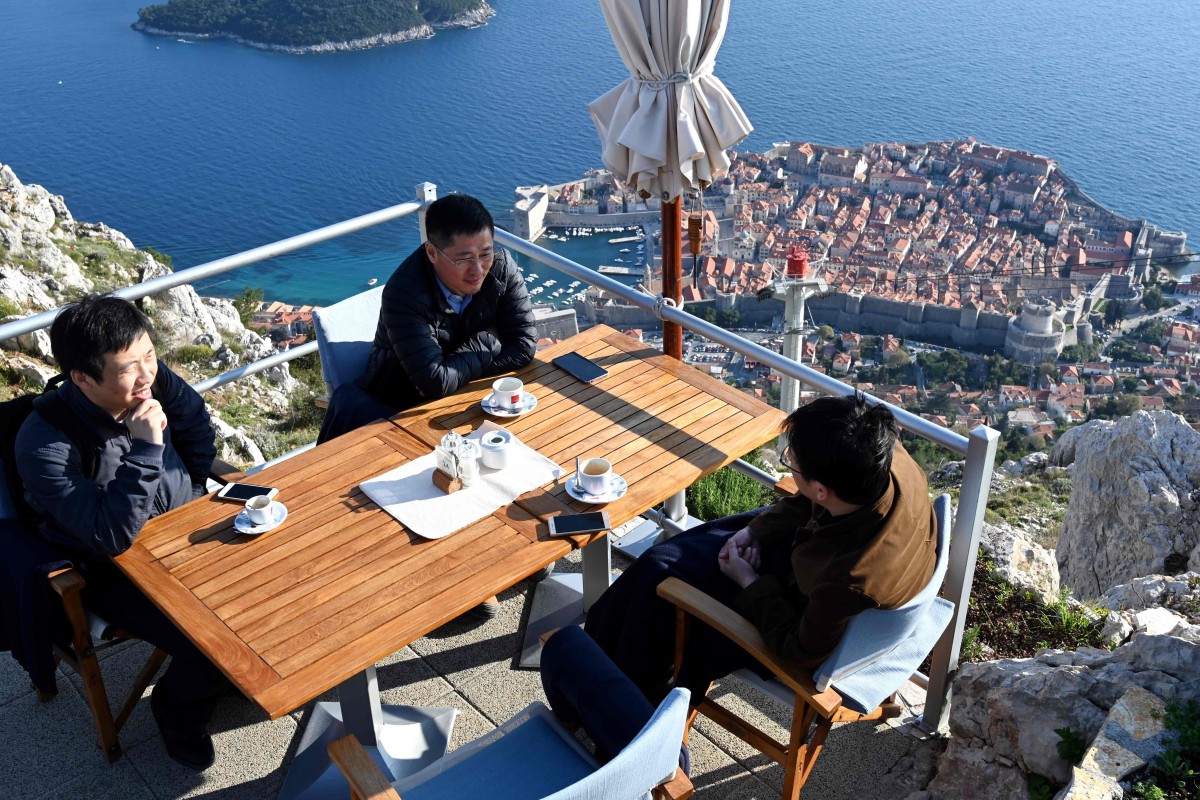
Destinations such as Dubrovnik, Croatia, are becoming more popular among mainland Chinese tourists, according to one of China’ s biggest travel services. Photo: AFP
Chartered flights and niche destinations such as Croatia and Malta are growing in popularity as Hong Kong falls out of favour for mainland Chinese holidaymakers over the National Day “golden week” break.
Japan has overtaken Thailand as the most searched overseas destination on the website of travel agency Ctrip, followed by Malaysia, the United States, Singapore, Australia, Macau, France, Italy and Russia.
Within the mainland places such as Beijing and Shanghai continued to be among the most popular searches but Urumqi, capital of Xinjiang Uygur autonomous region, is a fast-growing term, especially among people in Shanghai and Guangzhou.
“It could be that tourists want to see autumn leaves,” a Ctrip spokesman told the South China Morning Post.
October 1 marks the start of a week-long break on the mainland when millions of Chinese take the chance to travel. This year, an estimated 800 million people are expected to go on trips in China or overseas, about 10 per cent more than last year.
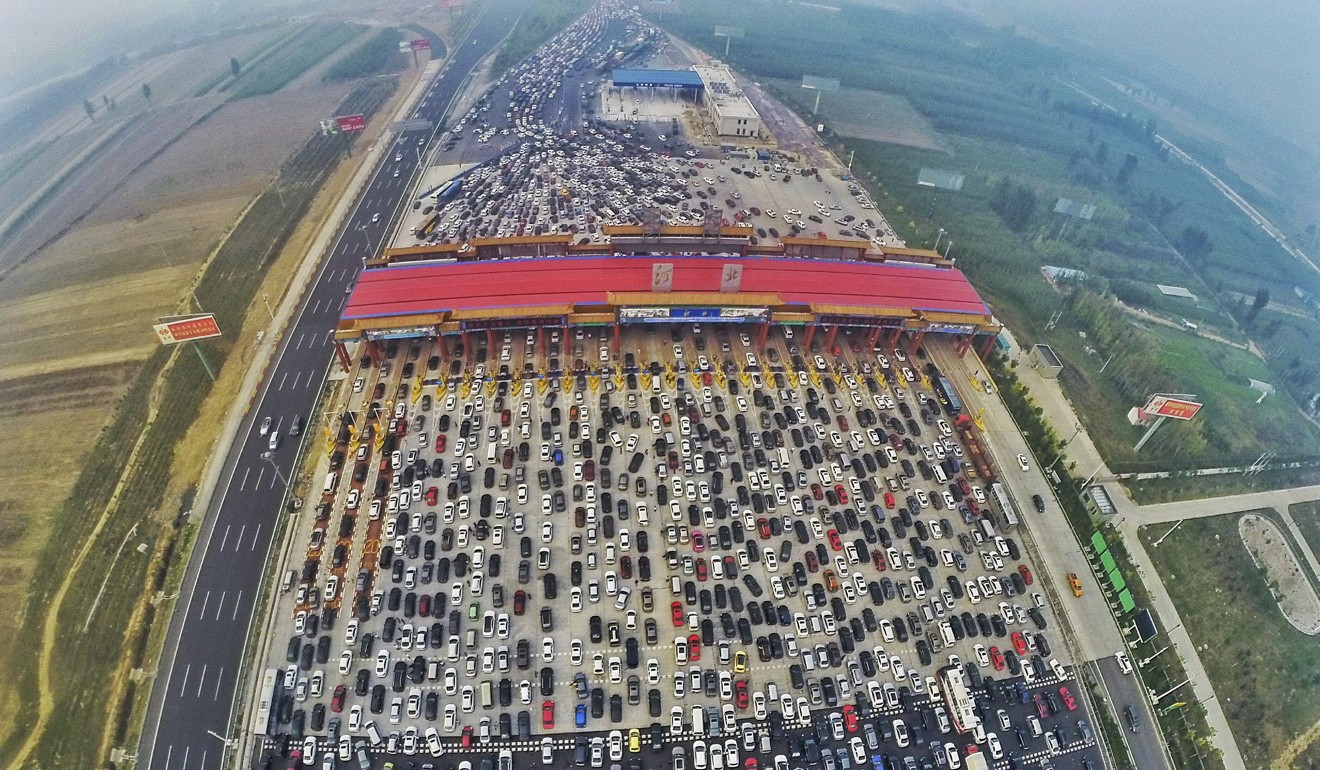
The country’s motorways are expected to be jammed from about 2pm on Monday, reaching a peak at around midnight, and again from 10am Tuesday, according to web mapping service Tencent Map.
China’s highways can expect heavy traffic as travellers head out for the holiday. Photo: Reuters
Ctrip said people heading overseas were increasingly seeking out new destinations, with bookings to places such as the Czech Republic, Austria, Croatia, Malta and Cambodia growing by 45 per cent this year.
“As Chinese people travel outside the country more and their experience of travel grows, many are more willing to go to smaller eastern European countries, such as the Czech Republic,” the spokesman said.
“Popular movies also have a strong influence. Many young people are willing to travel to see where films are shot, such as Croatia, one of the locations for Game of Thrones.”
Other noticeable trends this year include more people travelling with pets, by train and on chartered flights. The site said it sold 60 per cent more European train tickets and 10 times the number of train tickets for Japan for this golden week compared to last year.
The most popular routes in Asia were Tokyo to Kyoto in Japan, and Seoul to Busan in South Korea.
Hong Kong protests leave ‘golden week’ tourist boom in tatters as visitor arrivals during Chinese holiday period are set to be slashed by a third
Thousands of users also chose chartered flights, a service Ctrip introduced in September.
Ji Yu, head of chartered flights for Ctrip said most people thought chartered flights or helicopters were something only millionaires could afford, but in the internet age, they had become cheaper and more accessible.
“In the internet era, consumer needs vary from person to person, especially in terms of travel. There are products on the market to satisfy each customer’s personal needs.”
Among the more popular chartered routes were from Beijing or Shanghai to Tokyo, Bangkok, the Maldives and London.
More people are also going away for longer. Digital travel services giant Qunar said that 80 per cent of the travellers booking flights or hotels through its services were heading off for more than five days. And of those 41 per cent were travelling for more than a week.
Meanwhile, trips to Hong Kong have fallen substantially, with just 15 group tours expected to enter the city each day, down from 110 last year, according to the Travel Industry Council of Hong Kong.
Efforts to promote Hong Kong attractions have also increased in Shenzhen in recent weeks, with advertising videos scenic spots, popular restaurants and malls in Hong Kong playing on cross-border buses. Passengers can also get discounts to some stores and services with their tickets.
Image copyright HAMPSTEAD THEATREImage caption “Speaking out cost me my job, my marriage and my happiness at the time,” Dr Wang said
A whistleblower who exposed HIV and hepatitis epidemics in central China in the 1990s, potentially saving tens of thousands of lives, has died aged 59.
Dr Shuping Wang lost her job, was attacked, and had her clinic vandalised after she spoke out.
She died in Utah in the US, where she moved after the scandal.
A play inspired by her life is currently running in London, with the playwright calling her a “public health hero”.
Dr Wang never returned to China after leaving, saying it did not feel safe.
Why did Dr Wang speak out?
In 1991 in the Chinese province of Henan, Dr Wang was assigned to work at a plasma collection station. At the time, many locals sold their blood to local government-run blood banks.
It wasn’t long before she realised the station posed a huge public health risk.
Poor collection practices, including cross-contamination in blood-drawing, meant many donors were being infected with hepatitis C from other donors.
Undeterred, she reported the issue to the Ministry of Health. As a result, the ministry later announced that all donors would need to undergo hepatitis C screening – reducing the risk of the disease being spread.
But because of her whistleblowing, Dr Wang said, she was forced out of a job.
Her seniors said her actions had “impeded the business”. She was transferred, and assigned to work in a health bureau. But in 1995, she uncovered another scandal.
Image copyright HAMPSTEAD THEATRE
Dr Wang discovered a donor who had tested HIV positive – but had still sold blood in four different areas.
She immediately alerted her seniors to test for HIV in all the blood stations in Henan province. Again, she was told this would be too costly.
She decided to take things into her own hands, buying test kits and randomly collecting over 400 samples from donors.
She found the HIV positive rate to be 13%.
She took her results to officials in the capital, Beijing. But back home, she was targeted. A man she described as a “retired leader of the health bureau” came to her testing centre and smashed her equipment.
When she tried to block him, he hit her with his baton.
‘I’m not a man. I’m a woman’
In 1996, all the blood and plasma collection sites across the country were shut down for “rectification”. When they re-opened, HIV testing was added.
“I felt very gratified, because my work helped to protect the poor,” she said. But others were not happy.
At a health conference later that year, a high-ranking official complained about that “man in a district clinical testing centre [who] dared to report the HIV epidemic directly to the central government”.
“I stood up and said I’m not a man. I’m a woman and I reported this.”
Later that year, she was told by health officials that she ought to stop work. “I lost my job, they asked me to stay home and work for my husband,” Dr Wang said.
Her husband, who worked at the Ministry of Health, was ostracised by his colleagues. Their marriage eventually broke down.
Image copyright HAMPSTEAD THEATREImage caption A scene from The King of Hell’s Palace
In 2001, Dr Wang moved to the US for work, where she took the English name “Sunshine”.
Henan, the province that Dr Wang had worked in, was one of the worst hit.
The government later announced that a special clinic had been set up to care for those suffering from Aids-related illnesses.
Several years later, Dr Wang re-married and moved with her husband Gary Christensen to Salt Lake City, where she began working at the University of Utah as a medical researcher.
But her past followed her. In 2019, she said, Chinese state security officers made threatening visits to relatives and former colleagues in Henan, in an attempt to cancel the production of a play inspired by her life.
She refused, and the play titled “The King of Hell’s Palace” premiered at London’s Hampstead Theatre in September.
Dr Wang died on 21 September while hiking in Salt Lake City with friends and her husband. It’s thought she may have had a heart attack.
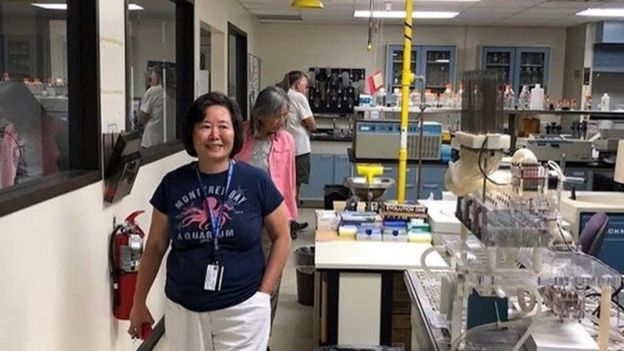
Image caption Dr Wang with playwright Frances Ya-Chu
“Speaking out cost me my job, my marriage and my happiness at the time, but it also helped save the lives of thousands and thousands of people,” she had told the Hampstead Theatre website in an interview just one month before her death.
“She was a most determined, relentless optimistic and most loving woman,” wrote her friend David Cowhig after news of her death.
“She chose the English name Sunshine for a reason. Perhaps her exuberance and love for the outrageous – made possible [the] perseverance she had.”
Chinese and Indian ethnic group workers have higher average earnings than their white British counterparts, the first detailed official figures show.
But the data on the ethnicity pay gap, showed all other ethnic groups have lower wages than white British workers.
The Office for National Statistics said employees in the Bangladeshi ethnic group have the largest pay gap, earning 20% less than white British employees.
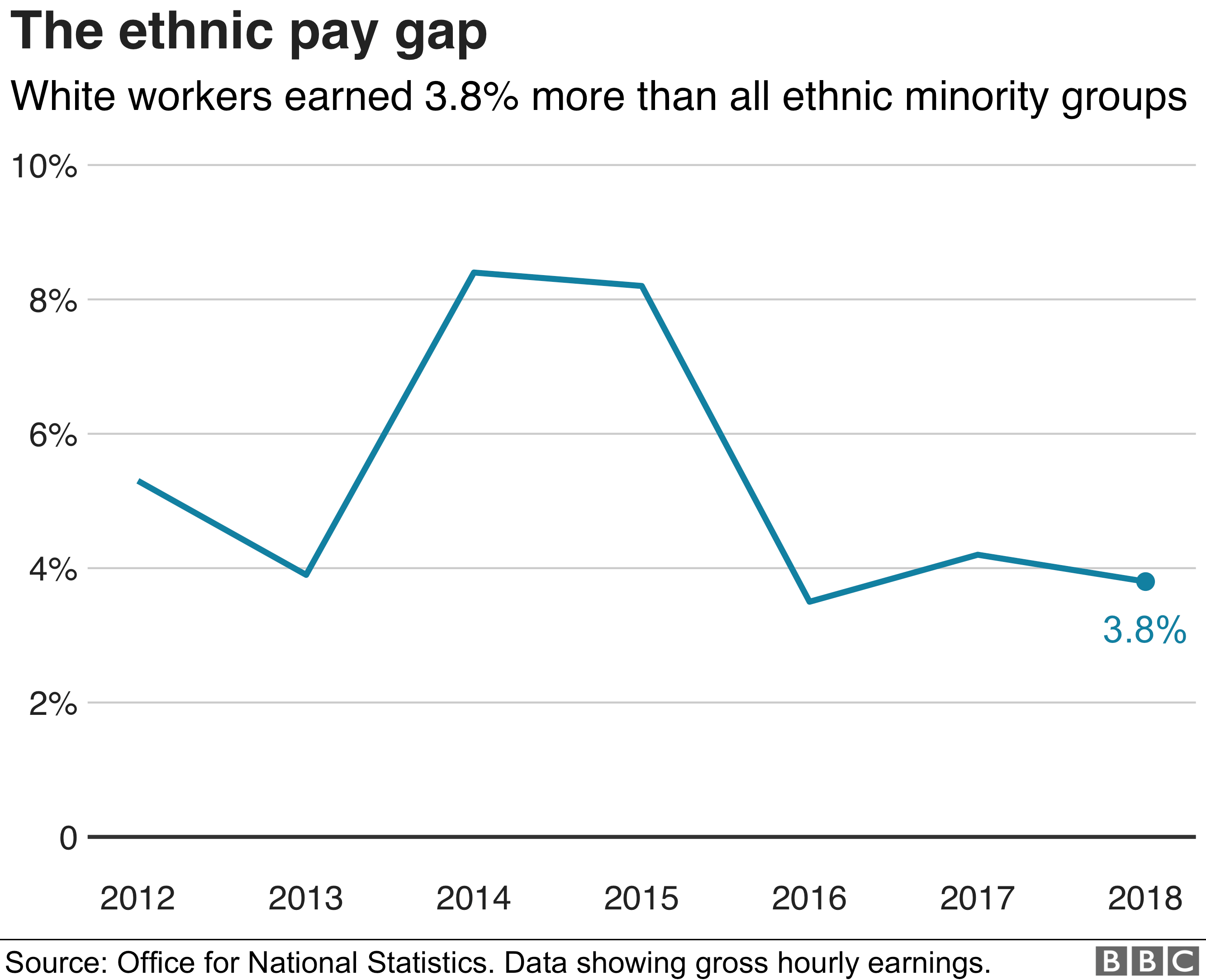
On average, ethnic minorities earn 3.8% less than white ethnic groups.
The categories are the official ones used by ONS.
In 2018, employees from the Chinese ethnic group earned 30.9% more than white British employees.
Hugh Stickland, senior ONS analyst, said: “Overall, employees from certain ethnic groups such as Indian and Chinese, have higher average earnings than their white British counterparts.
“However, all other ethnic groups have average wages lower than for white British employees, with employees from the Bangladeshi ethnic group having the largest pay gap.
“However, once characteristics such as education and occupation are taken into account, the pay gap between white British and most other ethnic groups becomes narrower, though significant differences still remain.”
Bangladeshis are the UK’s lowest earners
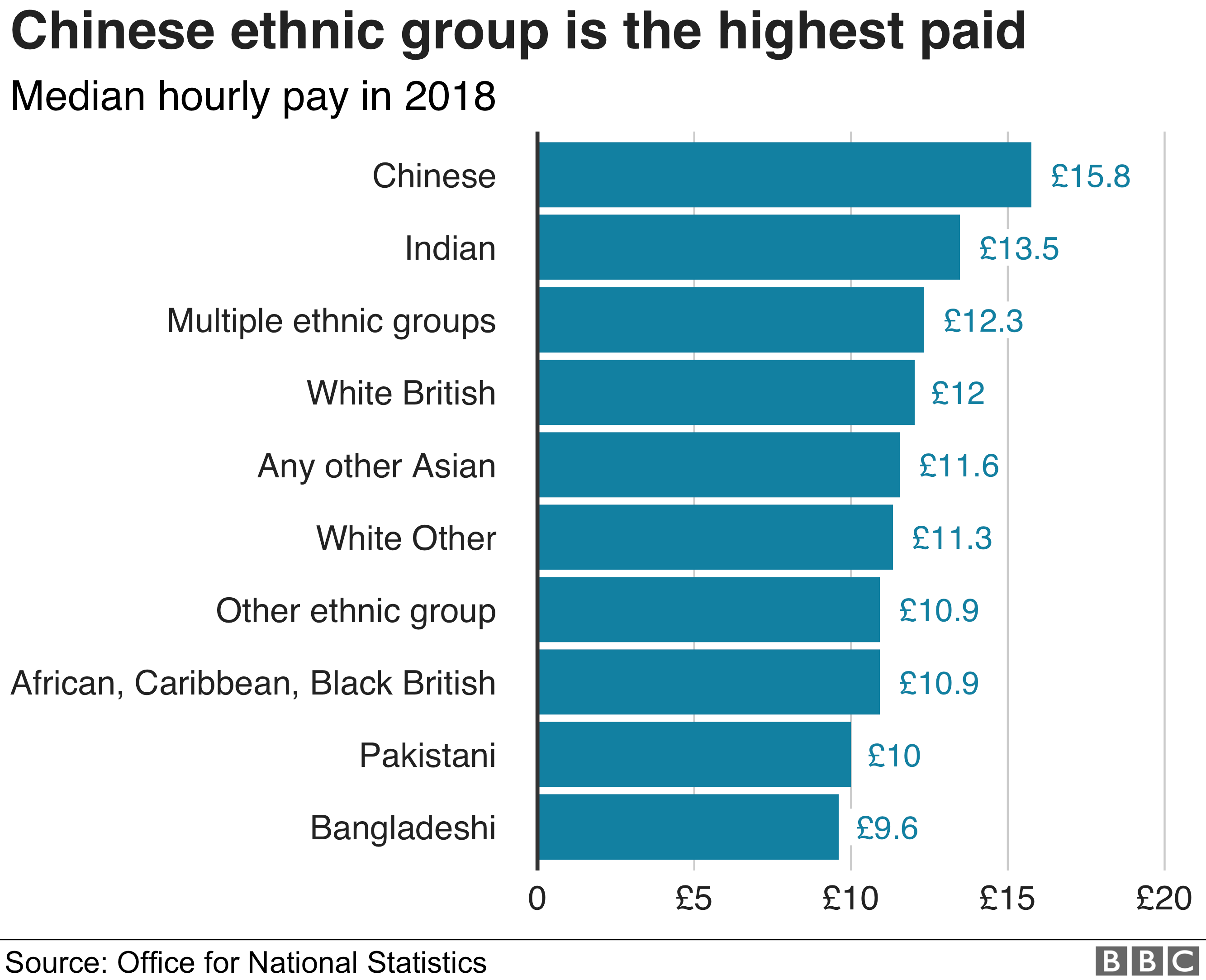
The data – based on median gross hourly earnings between 2012 and 2018 – shows that the Chinese ethnicity group is the highest paid, receiving £15.75 an hour in 2018.
That group is followed by the Indian ethnic group – which earns £13.47 an hour – and mixed/multiple ethnicity group, with a £12.33 hourly pay rate.
The median pay of the white British group was £12.03. The Bangladeshi group had the lowest median hourly pay of £9.60 with the second-lowest paid group being of Pakistani origin at £10 an hour.
“The harsh reality is that even today race still plays a real role in determining pay,” said Frances O’Grady, general secretary of the TUC.
“Ministers must take bold action to confront inequality and racism in the labour market. The obvious first step is to introduce mandatory ethnicity pay gap reporting without delay,” she said.
The government has already introduced mandatory reporting on the gender pay gap – which stands at 9.6% in favour of men – and the ONS data also shows discrepancies in male and female earnings in the ethnic groups.
The Chinese and Indian groups, which both have the highest rate of hourly pay, were among those with the biggest gender gaps.
Chinese men on average earned 19.1% more than women and Indian men earned 23.2% more than women.
But women in the Bangladeshi ethnic group earn more than their male counterparts – with a 10.5% gap.
The ONS said, though, that the sample size for the Bangladeshi group was smaller and susceptible to inaccuracy compared with other ethnic groups.
London’s gap
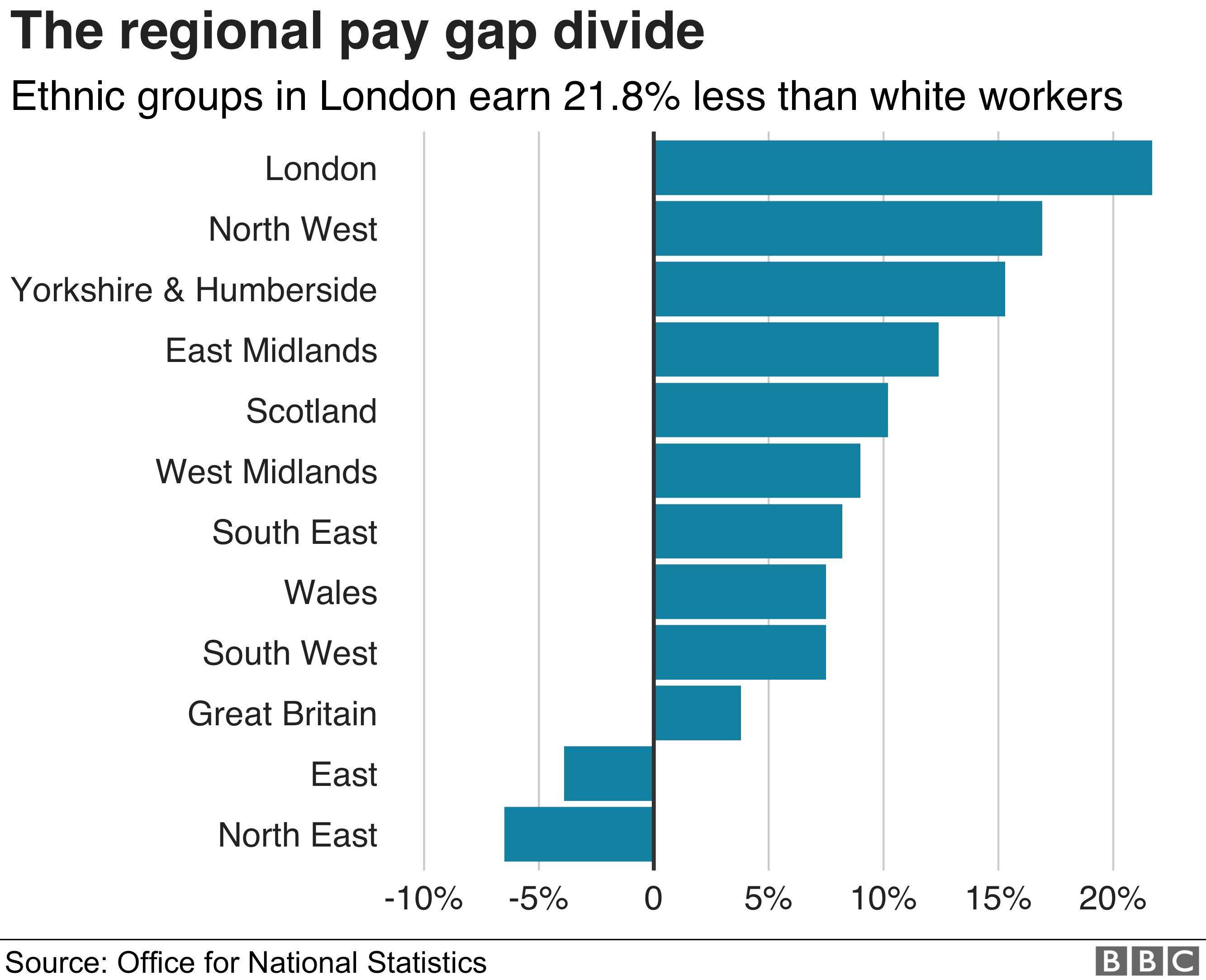
London, which has the highest proportion of its population classified as an ethnic minority group, also has the largest pay gap of 21.7%.
The ONS found this gap was reversed in other parts of Britain. In the north-east of England, for instance, employees from an ethnic minority group had average earnings that were 6.5% more than the average earnings of white employees.
Birth-place divide
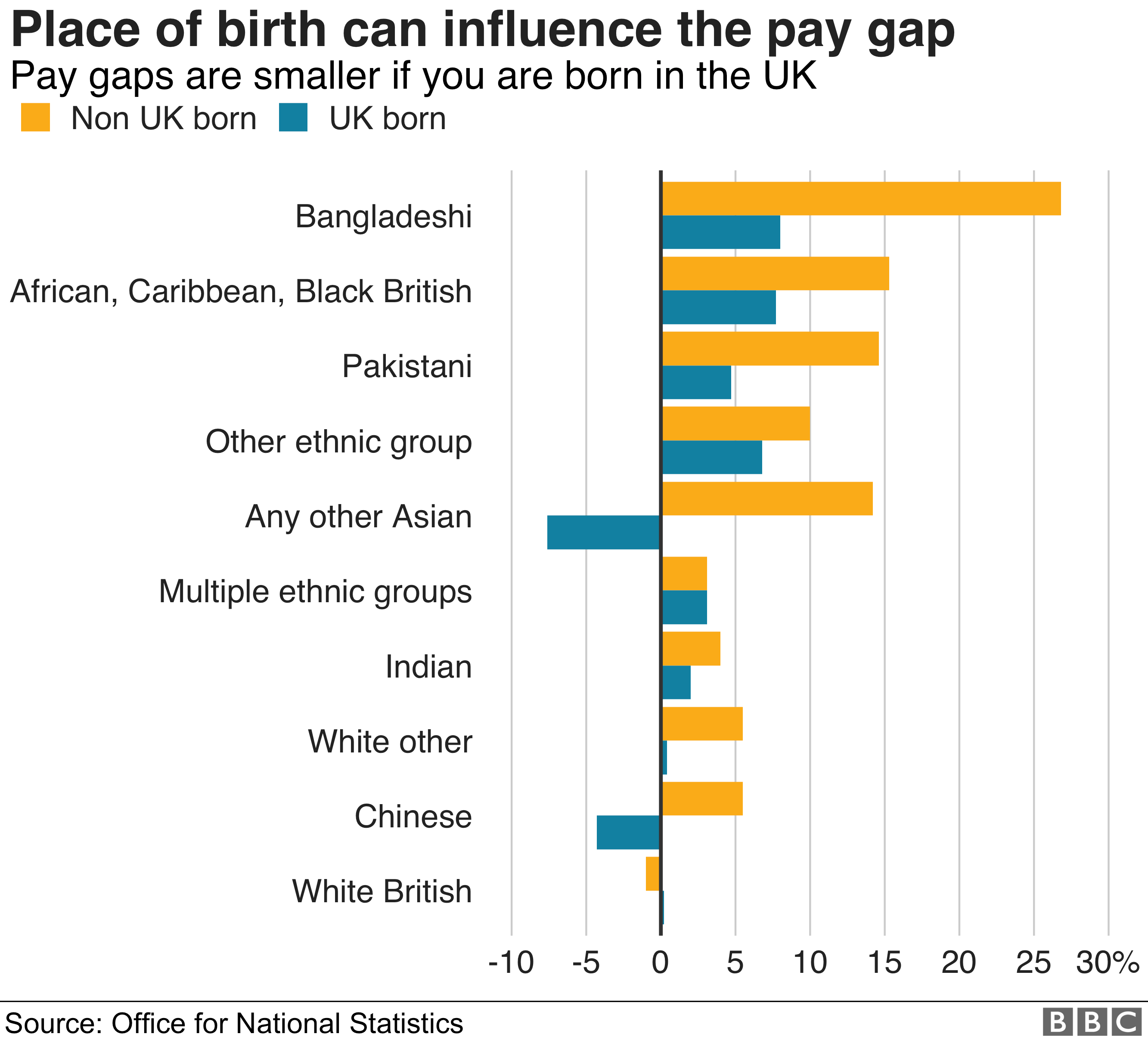
The ONS says that where someone is born can have an influence on how much they are paid.
“By comparing those who were born in the UK and those who were not, it may give us an idea of what sort of effect having a UK education and the higher likelihood of speaking English as a first language may have on those from an ethnic minority background,” the ONS said.
It found those in the Bangladeshi ethnic group – who had been born in the UK – earned 8% less than white British employees. But for Bangladeshi employees born outside the UK the gap was 26.8%.
When taking other factors into account, such as education, UK-born employees in the Indian and Chinese ethnic groups do not have pay gaps that are “statistically different” from the UK-born white British employees, the ONS found.
For example, almost a third of workers in the Indian ethnic group work in professional roles which means they tend to be higher-paid.
Documentary looks at the fantasy photo shoots of couples, including some who married decades ago when only drab clothing was allowed
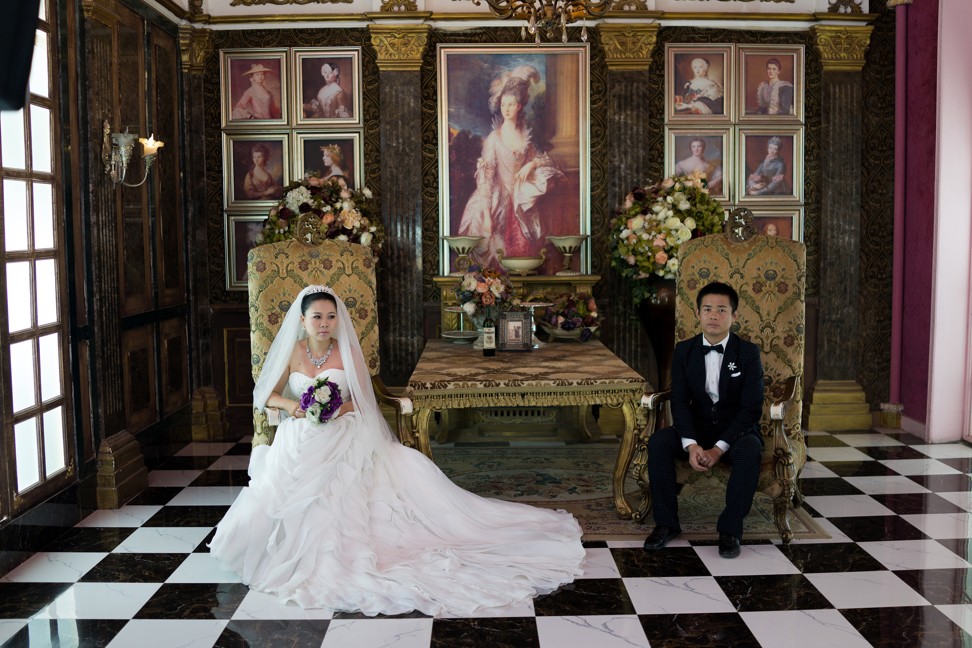
It looks beyond the colourful clothes to consider issues of freedom, status, money and the new ‘China dream’
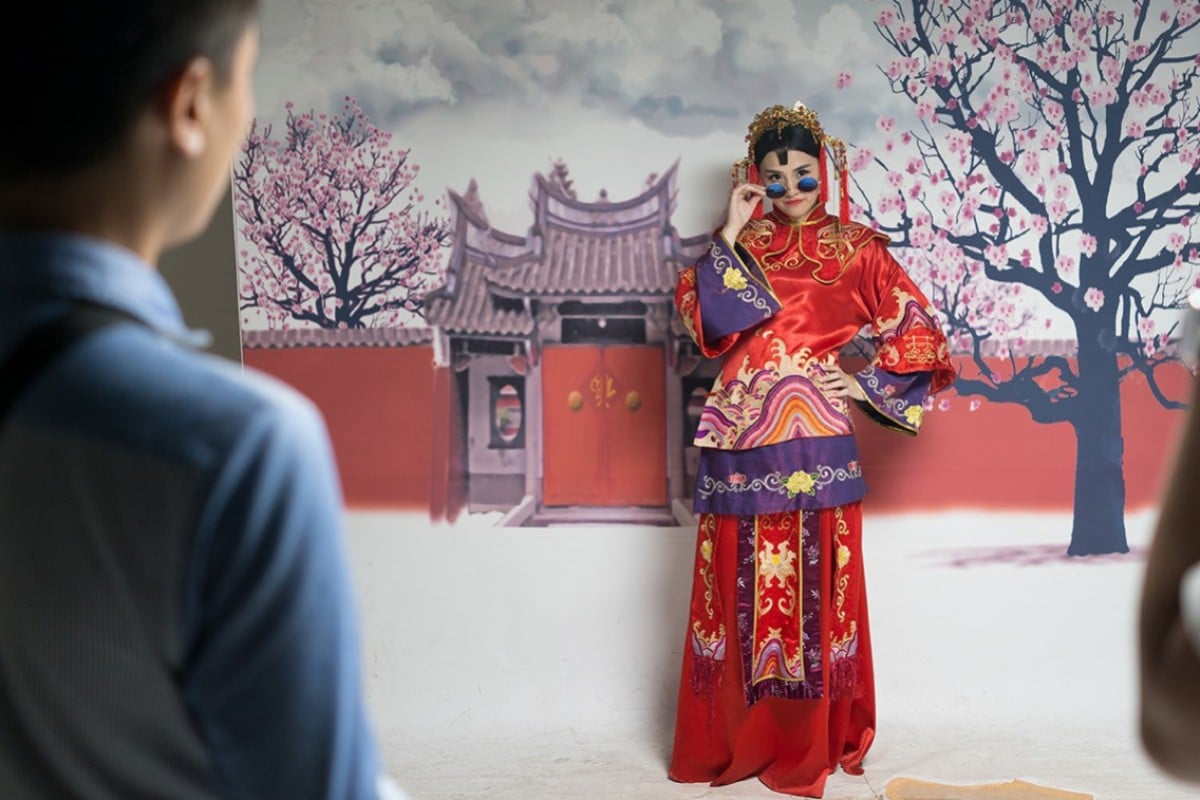
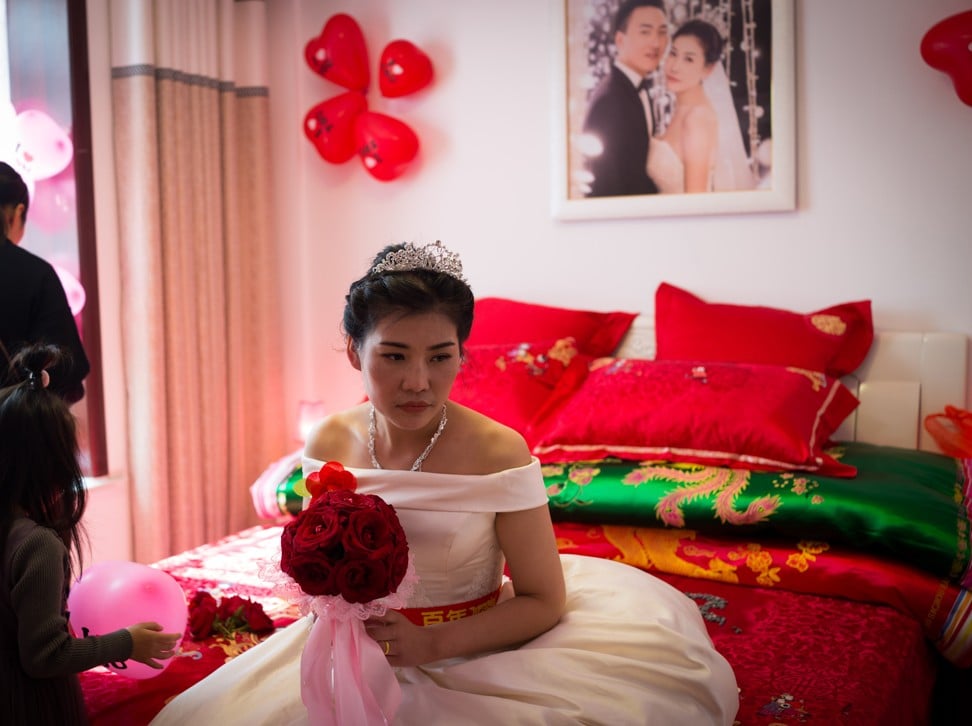
A still from China Love, a documentary by Olivia Martin-McGuire.
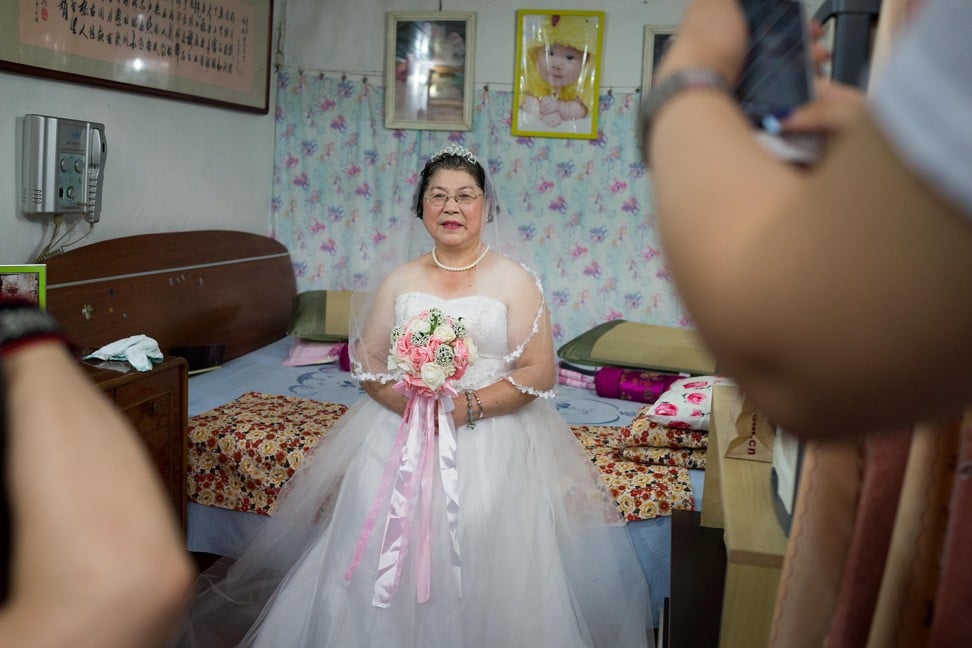
Pei-Pei and Xuezhong live in Shanghai’s French Concession. They married in 1968 and, as was typical for the time, have just one small black-and-white wedding photo.
“Pre-wedding photography could never have happened in 1968 because of the Cultural Revolution,” says Xuezhong, referring to the upheaval that took place under Mao Zedong, from 1966 to 1976. “Colourful clothing was not allowed. We had no choice.”
They did choose, however, to create new memories by having the wedding photos of their dreams taken decades later in a modern setting.
Their story is one of five featured in the documentary
, which explores relationships in contemporary China through the lens of the booming pre-wedding photo industry. It follows couples as they navigate love and family in the lead-up to the most important ritual in Chinese society: marriage.
The documentary debuts in Hong Kong this week, with a special screening on Thursday at the Asia Society, in Admiralty. Attending the screening will be the film’s Australian director, Olivia Martin-McGuire, who spent four years in Shanghai, where a series of photographs taken on the city’s streets developed into a fascination with matters of the heart.
“It started when I saw all these couples in amazingly colourful costumes – some hitching up their dresses to reveal trainers – having [pre-wedding] photos taken near The Bund,” she says.
But Martin-McGuire says the film is more than a commentary on the pre-wedding photography business. It delves into issues of freedom, status, money and the new “China dream”.
“Just over 40 years ago, marriage in China was arranged by the state. Romantic love was seen as a capitalist concept,” she says.
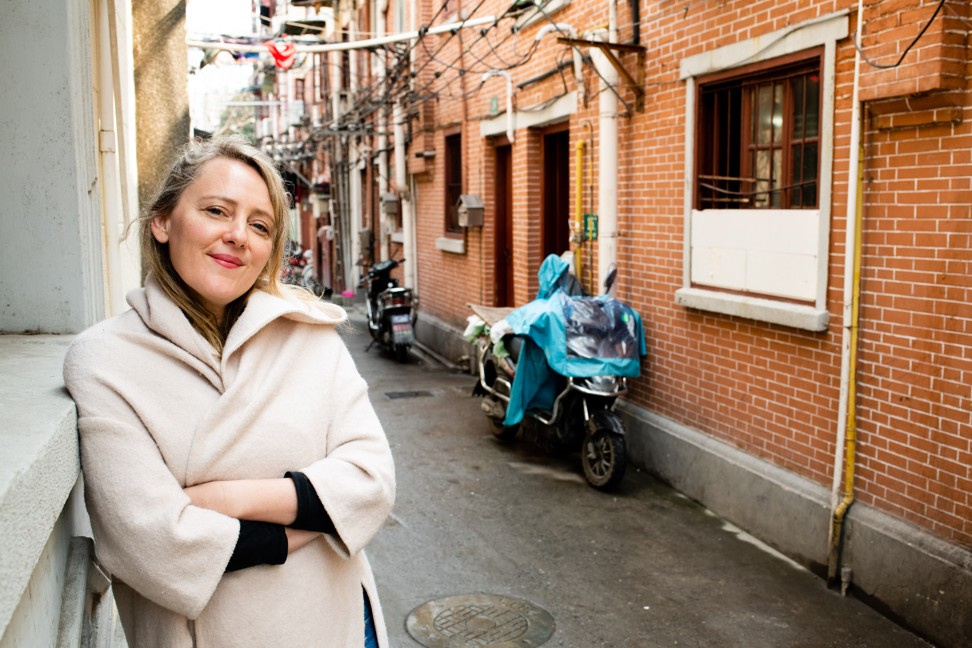
China Love director Olivia Martin-McGuire. Photo: Gráinne Quinlan
Fast forward a generation and the picture couldn’t be more different, with China’s wedding industry today worth a staggering US$80 billion, according to Martin-McGuire.
A big part of that goes on the pre-wedding photos, with some couples spending up to US$500,000 for shoots in exotic locations.
Shoots usually involve several costume and backdrop changes, and can see couples transform into characters from a fantasy. Take Jenny Cheng, born in Urumqi, capital of the Xinjiang Uygur autonomous region, and Australian-born David Shaw. The couple, who are featured in the film and will attend the screening in Hong Kong, had their wedding photos taken under water.
“I wanted the film to feel youthful, fun, and represent the sense of possibility that is infectious in China,” says Martin-McGuire.
China Love will be screened on Thursday, at 6.30pm, at the Asia Society, 9 Justice Drive, Admiralty, followed by a panel discussion. Visit
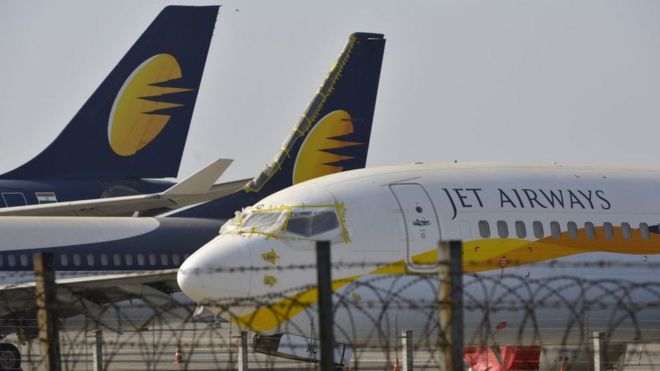
These were the latest flights to be grounded and it was not clear how many of its fleet of more than 100 planes was still in operation. Local reports suggested that it was barely a dozen.
The airline flies on 600 domestic and 380 international routes – but carriers in India must maintain a fleet of least 20 aircraft to continue to operate international services.
From London, the airline initially confirmed it had cancelled its flights between London, Paris and Amsterdam and India for 12 April, but later said that all international flights would be cancelled between 12 and 15 April.
It said it “regrets the inconvenience caused” to its passengers and was “working to minimise guest inconvenience”.
“In parallel, the airline’s management and its key stakeholders including its consortium of lenders, continue to work closely towards resolving the current situation,” it said.
There was no statement about the status of domestic flights.
Wedding party delay
Sandeep Kooner and her three children had been expecting to be on a flight from London to India on Friday evening to attend her niece’s wedding in Punjab.
But the 40 year-old who lives in Walsall will now miss the first few days of the week-long celebrations after her Jet Airways flight was cancelled.
“I had just sat down in the nail salon when I got a text message to say my flight had been cancelled,” she told the BBC.
She has now arranged to fly with Air India, but that will be days later and to Delhi – an eight hour drive to her destination – rather than a local one.
“I’m not 100% sure my problem is 100% sorted,” she says.
‘Necessary steps’
Television channels in India reported that the prime minister’s office had called for an urgent meeting to discuss the airline.
They also reported remarks by government officials saying Jet Airways only had funds to operate six to seven aircraft over the weekend.
India’s Aviation Minister, Suresh Prabhu, had tweeted that his ministry would “review issues related to Jet Airways” and “take necessary steps to minimise passenger inconvenience and ensure their safety”.
Jet Airways owes money to employees and suppliers and in recent weeks it has grounded aircraft and cancelled thousands of flights as its financial strains worsened.
The pilots union in India is planning a protest on Saturday and has written to the airline demanding that employees are paid. Staff of the airline were pictured by Priyanka Iyer of Business Television India marching to the company’s headquarters in Mumbai.
In March, when the crisis at Jet Airways led to thousands of flights being cancelled, the government immediately stepped in and asked public sector banks to rescue the private carrier.
It was a rare move. With India holding a national election, Prime Minister Narendra Modi’s government did not want the airline to be grounded as that would have affected 23,000 jobs.
The lenders which took control of the airline have only released a fraction of the amount they had promised so the airline has not been able to pay aircraft leasing companies. This means its fleet has shrunk further from the 100-plus it had at the start of the year.
The lenders have started accepting bids from potential investors, but that process will take a couple of months to complete. And many analysts fear that Jet Airways will not survive even a week if immediate cash is not provided to keep the operations running.
Investment sought
The airline was founded by Naresh Goyal more than 25 years ago and he and his family currently own 52% of the airline, although that majority stake is expected to be lost as lenders’ restructure the debt.
A consortium of investors led by the State Bank of India (SBI) took control of the airline in March.
The group is searching for a new investor to acquire a stake of up to 75% in Jet Airways. The deadline for bids had been extended to Friday, according to reports.
Ellis Taylor, deputy Asia editor of Flight Global, told the BBC the airline was in a “precarious position”.
“The interim lifeline that the carrier talked about two weeks ago looks like it won’t materialise any time soon, and that really leaves its future looking bleak,” he said.
There were reports in local media that India’s aviation ministry might review the regulations setting the fleet cap, which could allow the airline to resume international services.
BRUSSELS, April 6 (Xinhua) — China-European Union (EU) relations in tourism get a boost as the 2018 EU-China Tourism Year has scored a success, an official recently said.
During the tourism year, China and the EU held more than 100 promotional activities. It “has been extremely successful,” said Eduardo Santander, executive director of the European Travel Commission (ETC).
There was a 5.1-percent year-on-year increase in Chinese arrivals in EU destinations in 2018, and among the top ones in terms of the volume of Chinese arrivals were Britain, Germany and France, according to the latest figures from the ETC and the air travel analysis agency ForwardKeys.
“We continue to see the benefits in 2019,” Santander added. “The growth in Chinese travellers has been solid, and the near future, judging by current bookings, will see the EU continuing to increase its share of this valuable market, not just to traditional destinations, but lesser-known and emerging ones as well.”
Chinese bookings to the EU for the first four months of 2019 are 16.9 percent ahead of where they were at the end of 2017, said the ETC, adding that this compares very favorably to the global trend, which is 9.3 percent ahead.
According to a recent report by China Tourism Academy and China’s online travel agency Ctrip, 70 percent of Chinese tourists in 2018 chose “package tours” when traveling in Europe, due to language, visa, culture and other factors.
Nevertheless, the proportion of independent and customized travel continues to rise. In 2018, the demand for customized European tours booked by the travel website increased by 127 percent over the past year, far higher than the growth rate of the overall market, said the report.
In addition, a number of new routes were launched between China and Europe in 2018, including direct flights from Fuzhou to Moscow, Changsha to London, Jinan to Paris, and Shenzhen to Brussels. In 2018, there were more than 600 flights a week between China and Europe, according to the report.
Ctrip in 2018 forecast that consumption of each tourist in Europe will exceed 25,000 yuan (about 3,721 U.S. dollars) in two years, with the total annual consumption to reach 150 billion yuan (about 22.3 billion dollars).
“Our findings confirm what a concerted effort to boost tourism can achieve. It also appears to have lasting effects, as we can see in the forward booking figures,” said Olivier Jager, CEO of ForwardKeys.
China’s domestic travel agencies are also deepening the cooperation with Europe. For example, the SkyScanner, Ctrip’s online travel search platform, set up its first overseas calling service center in Edinburgh in April 2018.
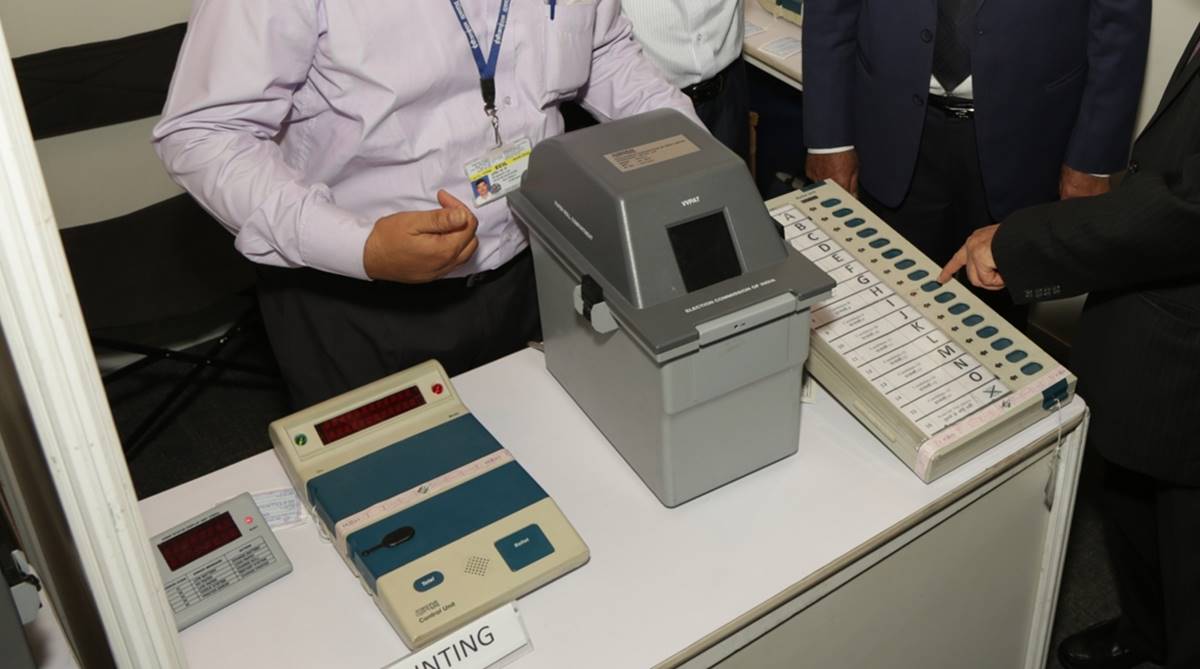
A senior EC official said on Monday evening, “ECI firmly stands by the empirical facts about foolproof nature of the ECI EVMs deployed in elections in India. Whereas, ECI has been wary of becoming a party to this motivated slugfest, ECI maintains that its EVMs are foolproof.”
SNS Web | New Delhi | January 22, 2019 5:38 pm
Election Commission of India (ECI) vehemently denied any possibility of tampering with the EVMs. (File Photo: IANS)
A day after Syed Shuja, a US-based man arranged an ‘EVM hackathon’ to ‘prove’ that the Electronic Voting Machines (EVMs) can be hacked, the Election Commission of India (ECI) has written to the Delhi Police, requesting it to lodge an FIR and investigate the claims made by Shuja during an event organized in London.
“Through media reports, it has come to the notice of the commission that allegedly one Mr Syed Shuja claimed (at the event in London) that he was part of the EVM design team and he can hack the EVMs used in elections in India,” Election Commission of India wrote to Delhi Police.
Sheyphali Sharan, the Official Spokesperson, Election Commission of India said in a tweet, “As follow up action, ECI has written to DCP New Delhi District to lodge an FIR & investigate the matter promptly for violation of Dec 505 (1) (b) of PIC.”
Soon after Syed Shuja had made the claims the Election Commission of India (ECI) vehemently denied any possibility of tampering with the EVMs.
Rubbishing his claims, a senior EC official said on Monday evening, “ECI firmly stands by the empirical facts about foolproof nature of the ECI EVMs deployed in elections in India. Whereas, ECI has been wary of becoming a party to this motivated slugfest, ECI maintains that its EVMs are foolproof.”
Addressing a press conference via video conference, Shuja made several explosive allegations regarding EVM tampering during 2014 Lok Sabha Elections.
Mr Mallya built his fortune from Kingfisher beer, before branching out into Indian cricket and Formula 1 racing. He set up the now defunct Kingfisher Airlines in 2005.
He faces a raft of charges relating to financial irregularities at Kingfisher Airlines. His monetary affairs are being investigated by India’s Central Bureau of Investigation and the Enforcement Directorate, which handles financial crimes.
Paul Blake, BBC Business Reporter, Westminster Magistrates Court
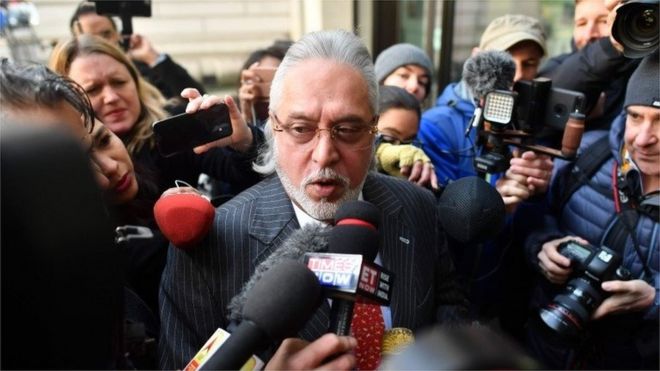
Vijay Mallya entered the court surrounded by a scrum of reporters shouting questions in English and Hindi.
As we stood in line for our turn at the x-ray machine, Mr Mallya told me that he believed “clearly this is extremely political, it’s really obvious”.
While awaiting his hearing, Mr Mallya paced around the corridors, intermittently sitting among reporters in the public gallery.
When his case was called, Mr Mallya heard a detailed judgement against him, which concluded with the judge saying he should be extradited to stand trial in India.
From the scrum to the judgement, Mallya appeared calm – relaxed even.
The case is now in the hands of Home Secretary, Sajid Javid.
In 2012, he sold a majority stake in his United Spirits group to UK drinks giant Diageo. The deal was supposed to help Mr Mallya reduce United Spirits’ debts and free up funds for Kingfisher Airlines.
But the airline, which was grounded in 2012, lost its flying permit the following year. It made annual losses for five years in a row and finally collapsed after lenders refused to give it fresh loans.
Mr Mallya’s total debts, including unpaid wages and operating costs, are estimated to exceed $1bn.
He is a high-profile figure who has in the past been called “India’s Richard Branson” and the “King of Good Times” for his lavish lifestyle.













 CHINDIA ALERT: You'll be living in their world, very soon