Chindia Alert: You’ll be Living in their World Very Soon
aims to alert you to the threats and opportunities that China and India present. China and India require serious attention; case of ‘hidden dragon and crouching tiger’.
Without this attention, governments, businesses and, indeed, individuals may find themselves at a great disadvantage sooner rather than later.
The POSTs (front webpages) are mainly 'cuttings' from reliable sources, updated continuously.
The PAGEs (see Tabs, above) attempt to make the information more meaningful by putting some structure to the information we have researched and assembled since 2006.
LUCKNOW, India (Reuters) – Police shot dead a man holding around 20 women and children hostage at his house in northern India after a 10-hour standoff, state officials said on Friday.
The hostages who were held at gunpoint were safe, principal secretary home Awanish Kumar Awasthi said after the raid at the house in a village in Farrukhabad in Uttar Pradesh state.
The hostage taker was serving a life sentence for murder and was out on parole, he added.
Two policemen and a villager were injured in the rescue operation.
After the siege, a group of incensed villagers stormed the house where the children had been kept and attacked the hostage-taker’s wife, Awasthi said. The woman died from her injuries early on Friday, he said.
The abduction took place after the man had invited some children and women from the village to his house, saying he was throwing a birthday party for his daughter.
Police said his motive for holding the children was not clear.
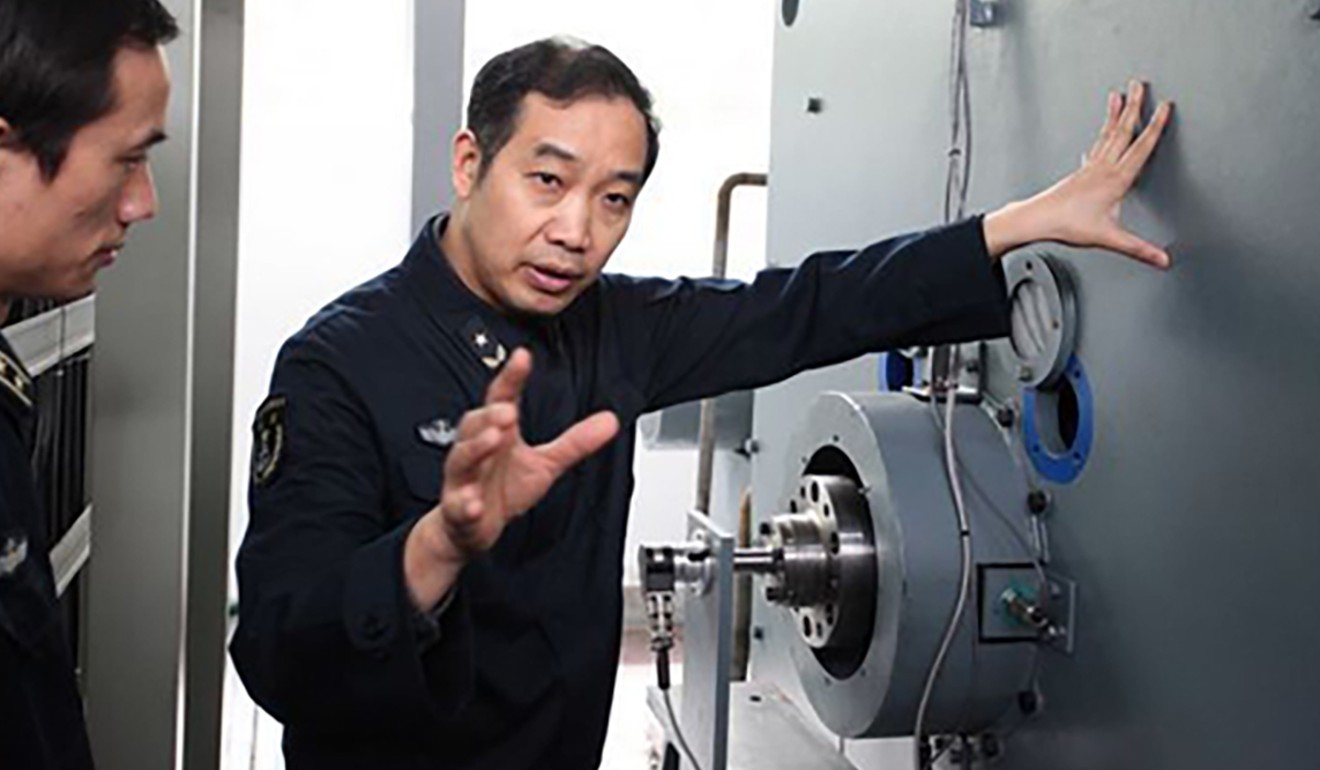
Rear Admiral Ma Weiming is seen as pioneer of electromagnetic aircraft launch system
Experts say Ma’s full membership of Central Committee shows how important sea power is to China’s strategic planning
An artist’s impression of China’s third aircraft carrier, the Type 002, which will incorporate an electromagnetic aircraft launch system developed by Rear Admiral Ma Weiming and his team. source: Photo: Handout
China’s Communist Party has elevated the senior naval engineer behind the development of a hi-tech launch system for the country’s next aircraft carriers, showing China’s ambition to increase its naval power.
Rear Admiral Ma Weiming, who is seen as the pioneer of China’s electromagnetic aircraft launch system (EMALS), was named as a full member, from alternate member, of the party’s Central Committee at the party plenary meeting which ended on Thursday.
The plenum sessions – attended by more than 300 full and alternate members of the Central Committee – provide an opportunity for the party’s most senior members to discuss and forge consensus on key policy issues.
Rear Admiral Ma Weiming (right) has been elevated to full membership of the Communist Party’s Central Committee. Photo: SCMP
Li Jie, a Beijing-based military specialist, said the move showed China’s ambition to continue expanding its naval military power.
“Ma’s promotion signals that Beijing will devote more resources to developing strategic military hardware like large warships and assault landing ships,” he said.
The EMALS is regarded as a breakthrough for the People’s Liberation Army, as it will enable China’s second home-grown aircraft carrier – known as the Type 002 – to launch larger jets with bigger payloads on longer missions.
The system could result in fuel savings of up to 40 per cent. With a higher launch energy capacity, it will also be more efficient than steam catapults, allowing for improvements in ease of maintenance, increased reliability, and more accurate end-speed control and smoother acceleration.
Why Chinese submarines could soon be quieter than US ones
Ma, who comes from Yangzhou in eastern Jiangsu province, graduated from the PLA Naval University of Engineering in Wuhan in 1987 and earned a PhD in electrical engineering from Beijing’s Tsinghua University in 1996.
A specialist in maritime propulsion, electrical engineering and related fields, he has mentored more than 400 masters and doctoral students at the naval university.
He and his team have often been recognised for their work as greater emphasis has been put on research and development amid the country’s military modernisation.
China’s first home-built carrier will use steam catapults and a ski-jump deck to launch aircraft. Photo: Handout
Ma has twice won the National Science and Technology Progress Award and in 2015 was awarded the science and technology achievement prize by the Hong Kong-based Ho Leung Ho Lee Foundation.
According to news reports, in the 1980s Ma spotted a potential flaw with an electrical component China planned to buy from overseas to use on its submarines that would have made the vessels easier to detect. Though the manufacturer denied any such problem, Ma spent five years tweaking the product so that submarines fitted with the part became harder to spot.
Three catapult launchers spotted in image of China’s new aircraft carrier
Beijing-based military expert Zhou Chenming said Ma’s promotion could be seen as a national endorsement of his work on EMALS.
“Ma was elected as a Central Committee member because the party and the country recognise the strategic importance of his work as China is expanding into a naval power with a huge maritime interest to protect,” he said.
Zhou, however, said Ma’s promotion was made two years ago, but he could not be formally made a full member until a vacancy opened up this year.
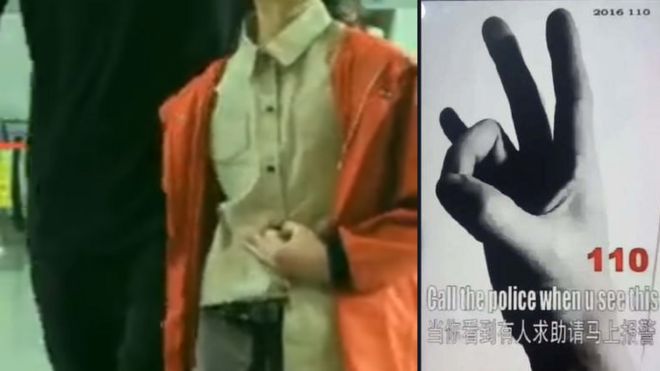
Image copyright TIKTOK/SINA WEIBOImage caption A video and associated posters went viral showing a girl making an OK signal as a subtle way of asking for help
A video showing a Chinese girl using a clever technique to signal she needs help has been widely shared on popular social network TikTok – and is making the authorities nervous.
She is shown being escorted away by a stranger in an airport. Unable to make a cry for help, she makes a subtle hand gesture that looks like the signal for “OK”.
This alerts a passerby, who immediately begins to argue with the man, and helps others recognise that the girl is being held against her will. She is then reunited with her parents.
So why has the video created such a big reaction on Chinese social media, and made the authorities so upset?
The hand gesture
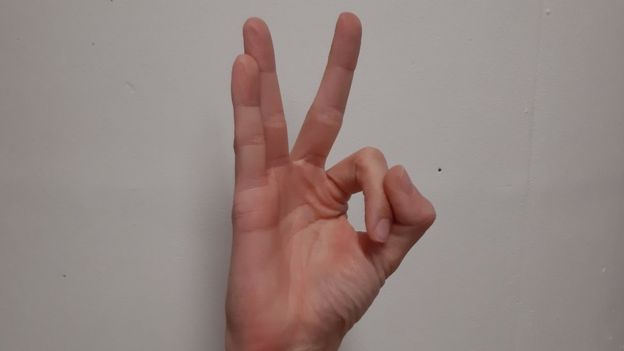
Image caption The “OK” hand gesture reversed looks like the number sequence “110”
While the “OK” gesture is pretty widely understood around the world as a positive gesture, simply turning your hand so that you are facing your palm conveys a subtle message in China.
If two fingers are pressed together, your hand can look like the numbers “110” – which in China is the emergency contact number for the police.
Consequently, the video, which features actors, shows a subtle way that a child can get a message out if they are in trouble.
To push this message home, at the end of the video, a man tells viewers to “spread this gesture” so that people can signal if they are in need of help “in the event of coercion, kidnapping, or fear of your life”.
The authorities don’t like it
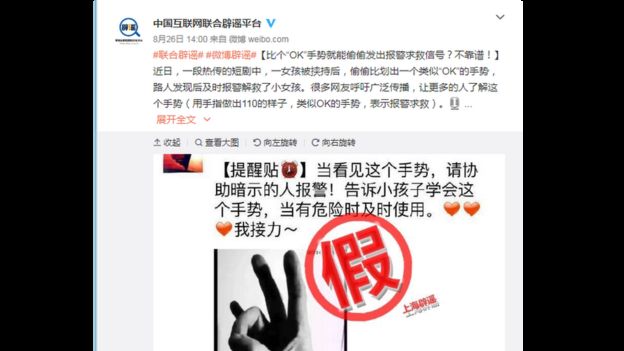
Image copyright PIYAOImage caption China’s top disinformation bureau said the ‘OK’ signal as a sign of distress was absolutely not OK
The video has the appearance of a public service announcement, so many social media users assumed it had the backing of the police.
The Chengdu Economic Daily says that videos being shared on TikTok predominantly attributed the footage to the police. However, the actual origins of the video are unknown.
Today, official media are spreading the message of China’s official disinformation platform Piyao, which criticises the video for being misleading, and says the police had no involvement with it.
“Such a gesture is meaningless as an alarm,” it says, and argues that it might actually be counter-productive in allowing an individual to find help if they need it.
It says that it has “never publicised or promoted such an alarm method in public”, and urges readers to follow the traditional method of calling the police if they need assistance or suspect someone else needs help.
Social media users think it’s a good idea
Despite the authorities distancing themselves from the footage and associated advertising campaigns that have suddenly sprung up on TikTok, a huge debate has broken out online about whether the simple signal might actually be effective in helping Chinese people understand if somebody is under duress.
Some on the popular Sina Weibo microblog say that “shouting for help is more practical than gestures”, and others note that the simple signal might “mislead people” and could lead to accidental interventions where none are necessary.
But in a country where tight authoritarian controls are in place and people are unable to freely speak openly, some are praising this seemingly small action to attract attention if someone’s under duress.
“In fact, this kind of gesture could really be promoted for help in the country”, one user says.
“As long as everyone is in agreement, we can still use it, it is still possible,” another says. “As long as we’re united in our understanding.”
Numbers as a symbol of rebellion
Image copyright TAOBAOImage caption Taylor Swift’s 1989 album caused problems for Chinese censors as the singer is popular, but the number “1989” is sensitive
Number sequences have long proven an effective way for social media users to criticise the authorities, without immediately alerting government censors, who regularly screen platforms for sensitive words.
People have found ways to talk about the Tiananmen Square massacre of 1989 – which the government has heavily censored for three decades – by using number sequences such as “46” (4 June), “64” (June 4) or “1989”.
The authorities have wised up to number sequences being used and are known for censoring many of these. But such strict censorship does mean that sometimes innocuous posts are removed by mistake.
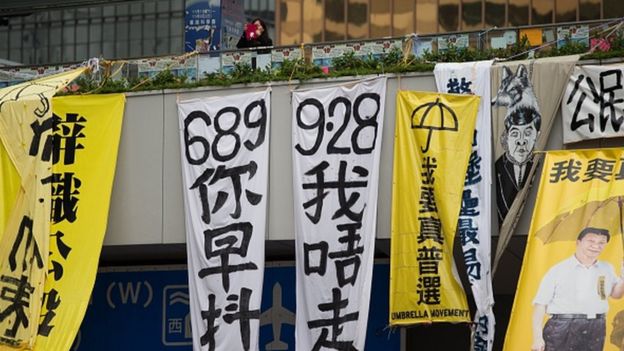
Image copyright AFPImage caption During the 2014 Hong Kong protests, demonstrators showed their anger for then-leader CY Leung by calling him “689”
Cryptic number sequences and hand gestures have proven particularly effective in helping protesters in Hong Kong unite on a shared message.
Online users have been able to voice criticism of their leadership in recent years by referring to them based on the number of votes that elected them into office.
Consequently, “777” has become a nickname for Hong Kong’s chief executive Carrie Lam. Her predecessor, CY Leung, was known as “689”.
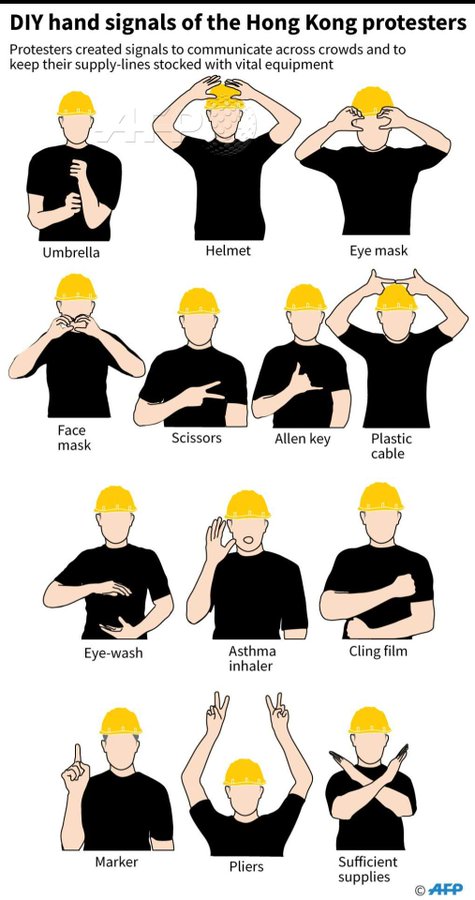
Graphic on hand signals used by protesters in Hong Kong to communicate and to keep their supply-lines stocked with vital equipment http://u.afp.com/Jsjm
As protests have dominated Hong Kong in recent months, it has also become apparent that demonstrators have been able to organise themselves by communicating subtle hand signals across crowds.
Graphics showing DIY hand signals that they can use if they need supplies such as eye masks, helmets or face masks, have circulated widely on platforms like Twitter.
Which is why a small, seemingly innocuous hand gesture, going viral in mainland China and getting huge public support, would undoubtedly unsettle the authorities.
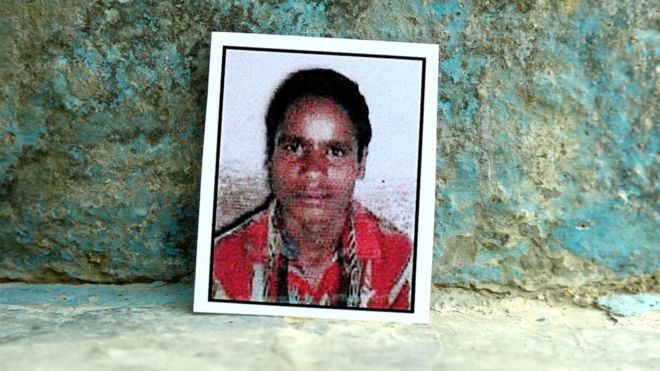
Image caption Jitendra was a carpenter and the only breadwinner in his family
A helpless anger pervades the Dalit community in the remote Indian village of Kot.
Last month, a group of upper-caste men allegedly beat up a 21-year-old Dalit resident, named Jitendra, so badly that he died nine days later.
His alleged crime: he sat on a chair and ate in their presence at a wedding.
Not even one of the hundreds of guests who attended the wedding celebration – also of a young Dalit man – will go on record to describe what happened to Jitendra on 26 April.
Afraid of a backlash, they will only admit to being at a large ground where the wedding feast was being held.
Only the police have publicly said what happened.
The wedding food had been cooked by upper-caste residents because many people in remote regions don’t touch any food prepared by Dalits, who are the bottom of the rigid Hindu caste hierarchy.
“The scuffle happened when food was being served. The controversy erupted over who was sitting on the chair,” police officer Ashok Kumar said.
The incident has been registered under the Scheduled Castes and Scheduled Tribes (Prevention of Atrocities Act) – a law meant to protect historically oppressed communities.
It is still common to see reports of Dalits being threatened, beaten and killed for seemingly mundane reasons.
The culture that pervades their community is visible everywhere – including in Kot, which is in the hilly northern state of Uttarakhand.
Local residents from the Dalit community allege that Jitendra was beaten and humiliated at the wedding.
They say he left the event in tears, but was ambushed again a short distance away and attacked again – this time more brutally.
Jitendra’s mother, Geeta Devi, found him injured outside their dilapidated house early the next morning.
“He had been perhaps lying there the entire night,” she said, pointing to where she found him. “He had bruises and injury marks all over his body. He tried to speak but couldn’t.”
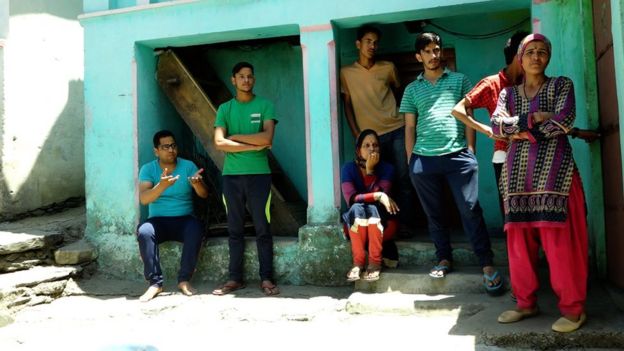
Image caption Dalits are outnumbered by upper-caste families in the village
She does not know who left her son outside their home. He died nine days later in hospital.
Jitendra’s death is a double tragedy for his mother – nearly five years ago her husband also died.
This meant that Jitendra, who was a carpenter, became the family’s only breadwinner and had to drop out of school to start working.
Family and friends describe him as a private man who spoke very little.
Loved ones have been demanding justice for his death, but have found little support among the community.
“There is fear. The family lives in a remote area. They have no land and are financially fragile,” Dalit activist Jabar Singh Verma said. “In surrounding villages too, the Dalits are outnumbered by families from higher castes.”
Of the 50 families in Jitendra’s village, only some 12 or 13 are Dalits.
Dalits comprise almost 19% of Uttarakhand’s population and the state has a history of atrocities committed against them.
Police have arrested seven men in connection with Jitendra’s death, but all of them deny any involvement.
Image caption Upper-caste villagers deny discriminating against the Dalit community
“It’s a conspiracy against our family,” said a woman whose father, uncles and brothers are among the accused. “Why would my father use caste slurs at a Dalit’s marriage?”
“He must have been embarrassed that he got beaten and popped dozens of pills that led to his death,” another local upper-caste person said.
But the Dalits in the village, who are livid over Jitendra’s death, hotly deny these claims.
They say Jitendra suffered from epilepsy, but insist there is no chance that he overdosed on his medication.
Apart from these expressions of anger, local Dalit families have largely remained silent.
“It is because they are economically dependent on families from the higher castes,” activist Daulat Kunwar said.
“Most Dalits are landless. They work the fields of their wealthy upper caste neighbours. They know the consequences of speaking out loud.”
Jitendra’s family has already experienced some of these consequences – Geeta Devi says they are under pressure to stop pushing for the truth.
“Some men came over to our house and tried to scare us,” she said. “There is no one to support us but I will never give up our quest for justice.”









 CHINDIA ALERT: You'll be living in their world, very soon