Archive for ‘Mass’

25/02/2020

South Korea to launch mass coronavirus testing, U.S. pledges $1 billion for vaccine

SEOUL/BEIJING (Reuters) – South Korea aims to test more than 200,000 members of a church at the centre of a surge in coronavirus cases, as countries stepped up efforts to stop a pandemic of the c that emerged in China and is now spreading in Europe and the Middle East.

More than 80,000 people have been infected in China since the outbreak began, apparently in an illegal wildlife market in the central city of Wuhan late last year.

China’s death toll was 2,663 by the end of Monday, up 71 from the previous day. But the World Health Organization (WHO) has said the epidemic in China peaked between Jan. 23 and Feb. 2 and has been declining since.

However, fast-spreading outbreaks in Iran, Italy and South Korea, and first cases in several Middle East countries, have fed worries of a pandemic, or worldwide spread of the virus.

“We are close to a pandemic, but there is still hope the epidemics in Iran, Italy, South Korea, etc. can be controlled,” said Raina MacIntyre, head of the Biosecurity Programme at the Kirby Institute at the University of New South Wales.

South Korea has the most virus cases outside China and reported its tenth death and 144 new cases, for a total of 977. President Moon Jae-in said the situation was “very grave”.

In Europe, Italy has become a new front line, with 220 cases reported on Monday, up from just three on Friday. The death toll in Italy is seven.

Global stock markets stabilised on Tuesday after a wave of early selling petered out and Wall Street futures managed a solid bounce after a sharp selloff the previous day on fears about the spreading coronavirus.

“If travel restrictions and supply chain disruptions spread, the impact on global growth could be more widespread and longer lasting,” said Jonas Goltermann, senior economist at research consultancy Capital Economics in London.

PUBLIC ANXIETY

About 68% of South Korea’s cases are linked to the Shincheonji Church of Jesus, where the outbreak is believed to have begun with a 61-year-old woman. It is not known how she became infected.

The church said it would provide authorities the names of all its members in South Korea, estimated by media at about 215,000 people. The government would test them all as soon as possible, the prime minister’s office said.

“It is essential to test all of the church members,” it said in a statement. Authorities said they were testing up to 13,000 people a day.

The U.S. and South Korean militaries have said they may cut back joint training due to the virus, in one of the first concrete signs of its fallout on global U.S. military activities.

The disclosure came during a visit to the Pentagon on Monday by South Korean Defence Minister Jeong Kyeong-doo, who said 13 South Korean troops had the virus.

The U.S. military said a woman who tested positive for the virus had visited one of its bases in the hard-hit city of Daegu. It was the first infection connected to U.S. Forces Korea, which has about 28,500 American troops on the peninsula.

The U.S. military urged troops to “use extreme caution” off base, while the U.S. Centers for Disease Control and Prevention said Americans should avoid non-essential travel to South Korea.

IRAN ISOLATION

Outside mainland China, the outbreak has spread to about 29 countries and territories, with a death toll of about three dozen, according to a Reuters tally.

Afghanistan, Bahrain, Iraq, Kuwait and Oman reported their first new coronavirus cases, all in people who had been to Iran where the toll was 14 dead, media said, and 61 infected.

The outbreak threatens to isolate Iran further. The United Arab Emirates, which has 13 virus cases, suspended all flights with Iran for at least a week, state media said.

Iraq extended an entry ban on travellers from China and Iran to those from five other countries over virus fears, its health ministry said.

In Japan, which has reported four deaths and 850 cases mostly linked to a cruise ship, Health Minister Katsunobu Kato said it was too early to talk about cancelling the Tokyo Olympics due to start on July 24.

The United States pledged $2.5 billion to fight the disease, with more than $1 billion going toward developing a vaccine, with other funds earmarked for therapeutics and the stockpiling of personal protective equipment such as masks.

China reported a rise in new cases in Hubei province, the epicentre of the outbreak. But excluding those, China had just nine new infections on Monday, its fewest since Jan. 20.

With the pace of new infections slowing, Beijing said restrictions on travel and movement that have paralysed economic activity should begin to be lifted.

“Low-risk areas … are to restore order in production and life, cancel transport restrictions and help enterprises,” state planner official Ou Xiaoli told a briefing.

Source: Reuters
28/08/2019

Chinese Catholic bishop ordained with Pope’s approval

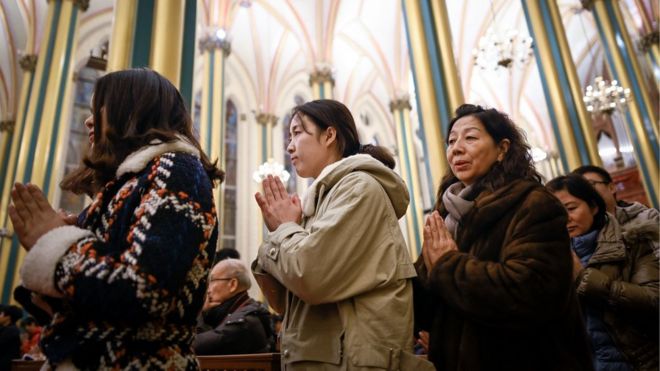
Chinese worshippers attend a mass during the Christmas Eve at a Catholic church in Beijing on December 24, 2018.Image copyright GETTY IMAGES
Image caption Christmas in Beijing: Catholics attend mass on 24 December 2018

A bishop has been ordained with the blessing of both the Pope and the Chinese state for the first time under a new deal.

Religious organisations in China must be approved by the state, leading to a decades-long row with the Vatican.

But a deal was agreed last September, giving the Vatican a say in the bishops appointed by the state church.

Yao Shun received the papal mandate for his ordination as bishop in China’s Inner Mongolia region.

The country is home to about 12 million Catholics – split between the Chinese Patriotic Catholic Association and an underground church loyal to the Vatican.

For decades, members of the underground church have only recognised the authority of the pope, while members of the state church have refused it. The relationship between the Holy See and Beijing has been strained by the disagreement since the 1950s.

In practice, the Vatican has recognised many Chinese bishops over the years on an individual, informal basis, including several last year as part of the deal.

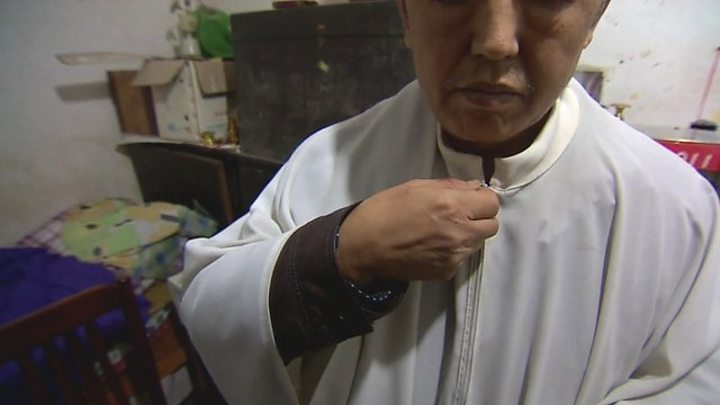
Media caption Father Dong Guanhua has been kicked out of the Chinese Catholic church for calling himself a bishop

The Vatican confirmed the new bishop’s ordination – referring to him as Antonio Yao Shun – as “the first to take place in the framework of the Provisional Agreement between the Holy See and the People’s Republic of China”.

But the deal between the two remains controversial among some Catholics.

Cardinal Joseph Zen from Hong Kong – where Chinese rules on state churches do not apply – accused the Vatican of “selling out” when details of the deal became clear in January 2018.

He said that the decision to reconcile with Beijing meant that retiring bishops of the underground church, faithful to Rome, would now be replaced by state-approved appointees.

Catholic news outlet Crux, meanwhile, reported that Bishop Shun had been chosen by the Vatican some time ago, before the agreement came into effect – and so his ordination is not a true test of the new mechanism.

But Bishop Shun’s ordination may be a notable moment in the reconciliation between the two countries.

In the past, Chinese state bishops were excommunicated from the Catholic Church for their role in ordaining new bishops outside of the papal mandate.

Vatican News, a media outlet owned by the Holy See, reports that “at present, all the Catholic bishops in China are in full communion with the Pope”.

The relationship between China and the Vatican is further complicated by the Vatican’s diplomatic relations with Taiwan, which China considers to be a breakaway province destined for reunification at some future date.

Source: The BBC

06/08/2019

Chinese police mass 12,000 anti-riot officers in Shenzhen for drill

  • Security forces shown tackling ‘demonstrators’ wearing black shirts
  • ‘Anti-mob’ tactics prepare forces for the 70th anniversary of the People’s Republic
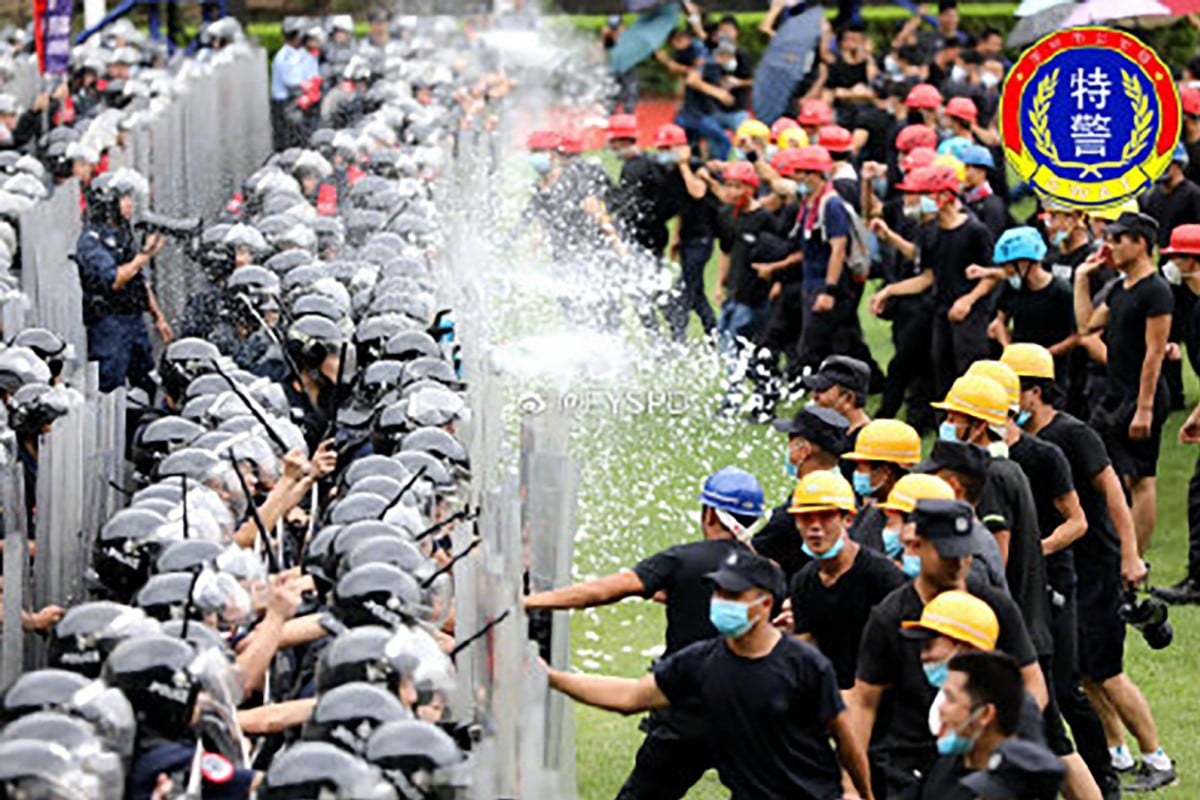
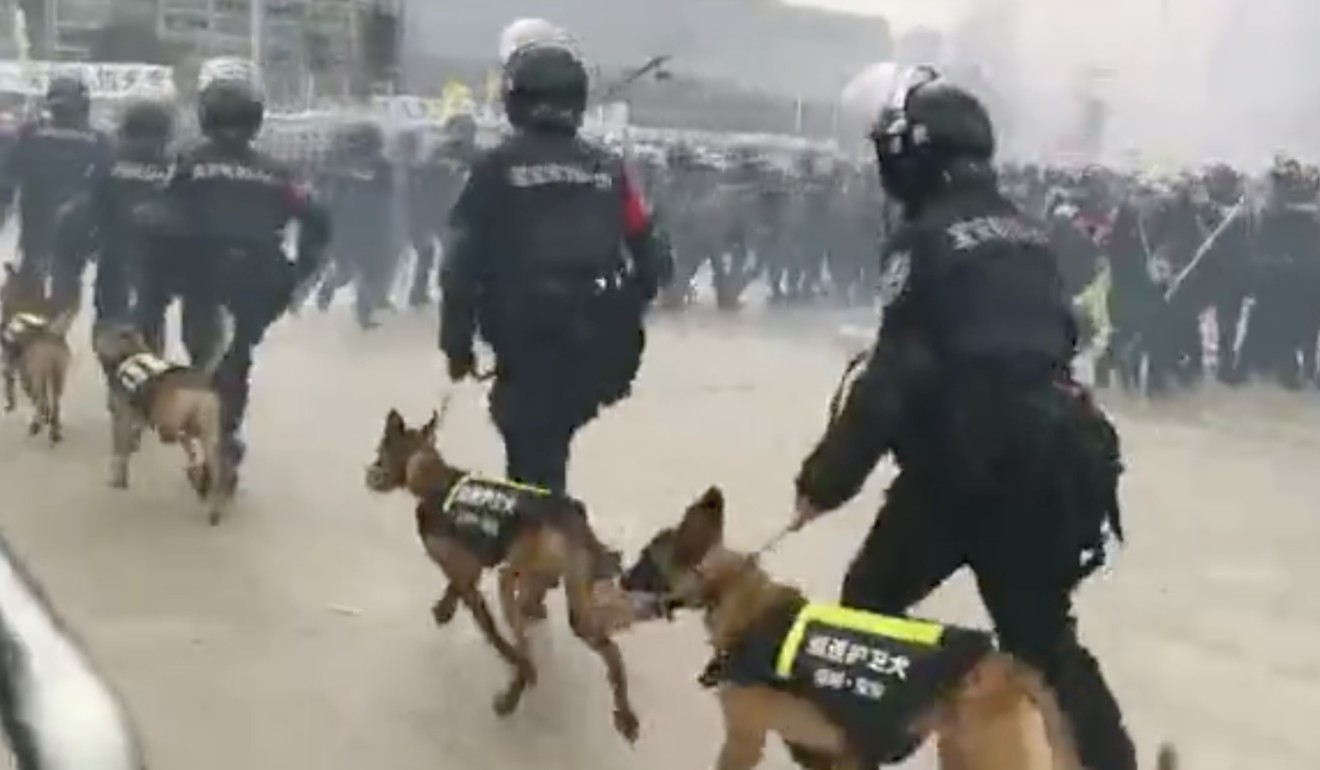
Shenzhen police broadcast live footage of a security exercise involving 12,000 officers rehearsing anti-riot drills. Photo: Weibo
More than 12,000 police officers assembled in Shenzhen in the southern Chinese province of Guangdong on Tuesday for a drill that included anti-riot measures similar to those seen on the streets of Hong Kong.
The drill was part of security preparations for the 70th anniversary of the People’s Republic of China on October 1, Shenzhen police said on the force’s Weibo newsfeed.

“A drill will be held to increase troop morale, practise and prepare for the security of celebrations, [and] maintain national political security and social stability,” police said.

China mobilises 190,000 police officers to prepare for 70th anniversary celebrations

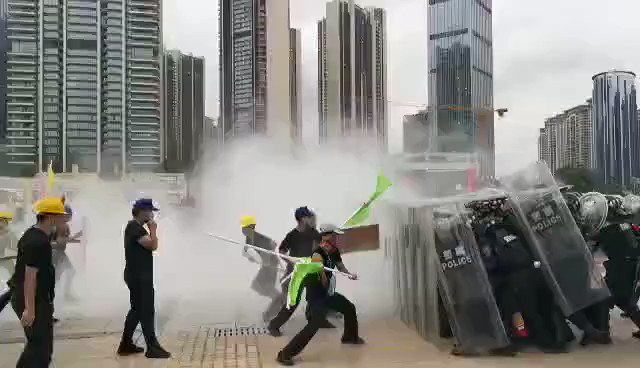
In live videos of the police drills shown on the Yizhibo network, officers in body armour, helmets and shields confronted groups of people in black shirts and red or yellow construction safety helmets – similar to those worn by Hong Kong protesters – who were holding flags, banners, batons and wooden boards.

“The practice is complete with mature anti-mob tactics. The police forces can present an anti-mob formation, which is flexible, suitable for different situations, with accurate aim and effective control,” a narrator said during the live broadcast.

As the drill escalated and more “rioters” were deployed, police fired tear gas and smoke covered the training ground.

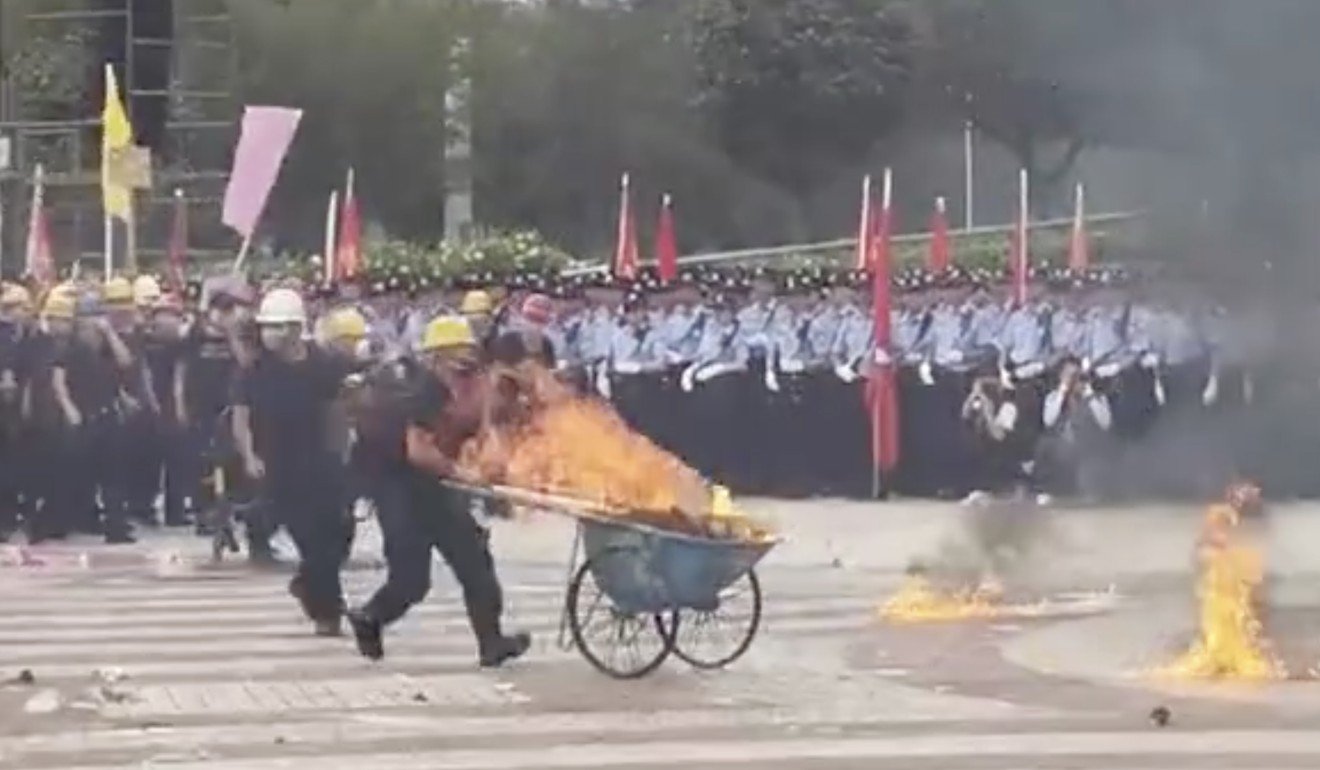
A few minutes later, the rioters fired home-made gas bombs then set bogies alight and drove them at the police lines. The officers changed formations and pressed the rioters, making arrests. Police handlers and their dogs were also on the scene.

A blazing bogie is driven towards police lines during Shenzhen police’s anti-riot exercise. Photo: Weibo

Other drills included anti-smuggling and search-and-rescue exercises involving personnel from the People’s Liberation Army.

The drill was presented as preparation for the 70th anniversary celebrations but it came amid continued violence in the streets of Hong Kong and two incidents of the Chinese national flag being thrown into Victoria Harbour.

Hong Kong has been engulfed in two months of turmoil stemming from opposition to the now-suspended extradition bill.

Police handlers and their dogs were deployed against people dressed like Hong Kong demonstrators. Photo: Weibo

“Is this hinting at Hong Kong?” a commenter on the Shenzhen police Weibo thread asked.

“We are doing drills today, and they can enter into real practice in Hong Kong in the future. We can send thousands of anti-mob squads over and strike hard at the radical traitors, those Hong Kong independence supporters,” another user said.

Since protests escalated in Hong Kong, Beijing has reiterated its “unflagging support” for embattled Hong Kong Chief Executive Carrie Lam Cheng Yuet-ngor and her administration to take lawful action to restore order, and warned that the city was entering “a most dangerous phase” with violence on the streets.

Source: SCMP

21/02/2019

India Catholic Cardinal Oswald Gracias ‘failed abuse victims’

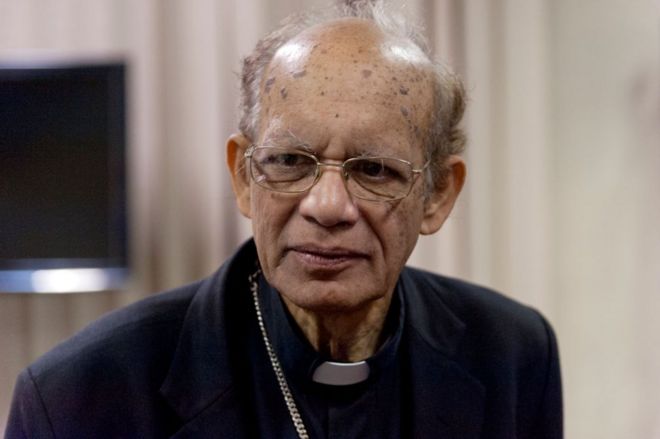
Cardinal Oswald Gracias, Archbishop of Bombay, during the launch of the bishops' declaration on climate justice on 26 October 2018 in Rome, Italy.Image copyrightGETTY IMAGES
Image captionCardinal Oswald Gracias told the BBC it pained him to hear accusations that he had neglected victims of alleged abuse

One of the Catholic Church’s most senior cardinals has admitted that he could have better handled sexual abuse allegations that were brought to him.

Oswald Gracias, the Archbishop of Mumbai is one of four men organising a major Vatican conference on child abuse this week.

We found two separate cases where the cardinal, who is tipped by some to possibly become the next Pope, is claimed to have failed to respond quickly or offer support to the victims.

Victims and those who supported them allege that Cardinal Gracias did not take allegations of abuse seriously when they were reported to him.

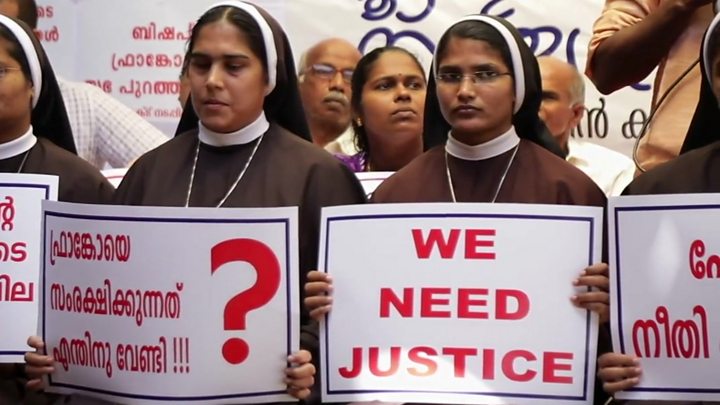
India’s Catholics say there is a culture of fear and silence in the Catholic Church about sexual abuse by priests. Those who have dared to speak out say it has been an ordeal.

‘My heart was hurt’

The first case dates back to 2015 in Mumbai.

A woman’s life changed when her son returned from Mass at the church and told her that the parish priest had raped him.

“I could not understand what should I do?” she said. She did not know this yet, but this event would put her on a collision course with the Catholic Church in India.

Media captionWhy is India’s Catholic church silent about sexual abuse?

The man she reached out to for help was and remains one of the most senior representatives of the Church.

It was nearly 72 hours after the alleged rape that the family briefly met Cardinal Gracias, then president of the Catholic Bishop’s Conference of India and Federation of Asian Bishops’ Conferences.

The issue of sexual abuse within the Church is being called the Vatican’s biggest crisis in modern times, and the integrity of the Catholic Church is said to ride on the outcome of this conference.

Pope Francis, flanked by Archbishop of Bombay Cardinal Oswald Gracias (L) and other bishops, arrives at Synod Hall in Vatican City on 24 October 2015Image copyrightGETTY IMAGES
Image captionPope Francis with Cardinal Oswald Gracias (fourth from left)

Over the past year, the Catholic Church has been reeling under multiple allegations of sexual abuse around the world.

But while abuse claims have made headlines in North and South America, Europe and Australia, very little is known about the problems in Asian countries. In countries such as India there is a social stigma about reporting abuse.

Among Christians, who are a minority of nearly 28 million people, a culture of fear and silence makes it impossible to gauge the true scale of the problem.

Cardinal Blase Cupich of Chicago – a colleague of Cardinal Gracias on the four-member organising committee – has promised that decisive action in Rome and in dioceses worldwide will follow after the meeting so as to safeguard children and bring justice to the victims.

Cardinal Gracias will open the second day of the summit with a conversation about accountability in the Church.

Media captionBrigitte, a survivor of child sex abuse by a chaplain, explains why she is ready to speak now

This vital role given to him during this crucial conference has made some in India unhappy.

They say his track record in protecting children and women from abusers is questionable. Those we have spoken to who have taken cases to him say they received little support from him.

The mother of the abused boy said: “I told the cardinal about what the priest had done to my child, that my child was in a lot of pain. So he prayed for us and told us he had to go to Rome…my heart was hurt in that moment.

“As a mother, I had gone to him with great expectations that he would think about my son, give me justice, but he said he had no time, he only cared about going to Rome.”

The family say they requested medical help but were offered none.

The cardinal told us it pained him to hear this, and that he was not aware that the boy needed medical help – and if he had been asked, he would have immediately offered it.

The Archbishop's house in Mumbai

The cardinal admits he left for Rome that night without alerting the authorities.

By failing to call the police, Cardinal Gracias may have violated India’s Protection of Children from Sexual Offences Act, 2012 (POCSO).

The provisions of this law state that if the head of any company or institution fails to report the commission of an offence in respect of a subordinate under his control, they shall be punished with imprisonment for a term which may extend to one year, and with a fine.

The cardinal told us he had telephoned his bishop the next day, who told him the family had subsequently informed the police themselves.

Asked if he regretted not calling the police personally at the time, he said: “You know I’m being honest, I’m not 100% sure… but I must reflect on that. I admit whether immediately, the police should have got involved, sure.”

He says he was under a duty to evaluate the credibility of accusations by speaking to the accused man.

Emerging from that meeting, the family decided to go to a doctor.

“He took one look at my boy and said that something has happened to him. This is a police case. Either you report it or I will… so we went to the police that night,” the mother said.

A police medical examination found that the child had been sexually assaulted.

Indian Catholics pray during Friday afternoon service at the Holy Name Cathedral in Mumbai on 15 March 2013.Image copyrightGETTY IMAGES
Image captionIndia is home to about 19 million Catholics

A current priest who spoke to us on the condition of anonymity said this was not the first time allegations about this priest had been brought to the cardinal’s attention.

“I met him some years before this [alleged] incident,” the priest told us.

“There were strong rumours about [the accused priest] in the diocese, and like these are about abuse that is taking place. And yet he seems to be moving from one place to another, one parish to another. The cardinal told me directly that he is not aware directly of all these things.”

The cardinal says he cannot recall the conversation. He says he did not recollect any “cloud of suspicion” over the man.

‘A lonely battle’

As part of our investigation, we wanted to see if there were other allegations of the cardinal being slow to act.

We found an instance dating back almost a decade, brought to his attention just a couple of years after becoming archbishop of Mumbai.

Virginia Saldanha.
Image captionCatholic activist Virginia Saldanha says three legal notices were sent to the cardinal, threatening court action unless took action about the claims of abuse

In March 2009, a woman approached him with accusations of sexual abuse by another priest who conducted retreats.

She says that he took no action against the priest so she reached out to a group of female Catholic activists, who say they forced the cardinal to act.

Under pressure, he finally set up an enquiry committee in December 2011. Six months after the enquiry, there was still no action and the accused priest continued working in his parish.

“We had to send the cardinal three legal notices to act, threaten to take the matter to the courts if he did not act,” said Virginia Saldanha, a devout Catholic who has worked on the women’s desk of multiple Church-affiliated positions for over two decades.

When the cardinal replied, he said: “The priest is not listening to me.”

Blurred image of family
Image captionThe family says they have been ostracised from the church and isolated within their communities since reporting the sexual assault

During the time, Saldanha said she had to leave the church because “I could not bear to see that man giving Mass in the church. I did not feel like going there.”

The priest was eventually removed from his parish, but the reasons for his departure were never made public.

The punishment, decided by the cardinal personally in October 2011, was a “guided retreat and therapeutic counselling”.

When we pressed him about the speed of process and punishment, the cardinal said it was a “complicated case”.

After a stay in the seminary, the accused priest was briefly given a parish again and still conducts retreats.

Meanwhile, the family of the allegedly raped minor feel abandoned by the institution that they had built their lives around.

“It has been a lonely battle,” the mother concedes. They say they have been ostracised from the church and isolated within their communities.

“After complaining to the police, when we would go into church, people would refuse to talk to us, to sit next to us during Mass. If I went to sit next to someone… they would get up and leave,” she said.

The hostility she encountered eventually “made us leave the church. But it got so difficult for us that we eventually had to change our home as well. We left it all behind”.

Church members say that it is this hostility that makes it harder for victims and their families to speak up.

Caught between an apparently unsupportive clergy and hostile social network, many find their voices faltering.

Source: The BBC

Law of Unintended Consequences

continuously updated blog about China & India

ChiaHou's Book Reviews

continuously updated blog about China & India

What's wrong with the world; and its economy

continuously updated blog about China & India