31/05/2020
BEIJING (Reuters) – China announced on Sunday two new confirmed cases of coronavirus and four new asymptomatic cases, including one person without symptoms of COVID-19 on a chartered flight from Germany.
The two confirmed cases in Shandong province on Saturday compared with four cases the day before, data from the country’s health authority showed.
The National Health Commission (NHC) confirmed three new asymptomatic cases on Saturday.
On Sunday, the Chinese city of Tianjin confirmed one asymptomatic person, a passenger arriving from Frankfurt on a chartered Lufthansa flight, LH342, to Tianjin. This case was discovered between midnight and 6 a.m. local time on Sunday, the city’s daily statements show.
These charter flights are part of an accelerated entry procedure offered by Beijing as China and Germany seek to reignite their economies after months of lockdown. The flight to Tianjin carried about 200 passengers, mostly German business executives.
Lufthansa has another charter flight scheduled for Shanghai on Wednesday.
A 34-year-old German engineer tested positive for the coronavirus after arriving in Tianjin but he does not have any symptoms, the Tianjin government said on its official social media platform Weibo.
The asymptomatic patient has been transferred to a local hospital to be placed under medical observation, the Tianjin government said, adding that the whole process was a “closed loop”, meaning posing no great risk to the Chinese public.
Source: Reuters
Posted in accelerated, announced, arriving, asymptomatic case, ASYMPTOMATIC CASES, “closed loop”, Beijing, business executives, charter, charter flights, chartered, chartered flight, China, Chinese city, Chinese public, confirmed, confirmed cases, coronavirus, coronavirus cases, COVID-19, daily statements, discovered, economies, engineer, entry procedure, flight, Frankfurt, German, Germany, Government, great risk, health authority, local hospital, local time, lockdown, Lufthansa, medical observation, midnight, months, National Health Commission (NHC), offered, Official, passenger, passengers, placed, posing, reignite, scheduled, shandong province, Shanghai, social media platform, tested positive, Tianjin, transferred, Uncategorized, Weibo, whole process |
Leave a Comment »
26/04/2020
- City at centre of outbreak finally able to declare itself clear of disease after months in lockdown and thousands of deaths
- Risk of infection remains, however, with some patients testing positive for coronavirus that causes disease without showing symptoms
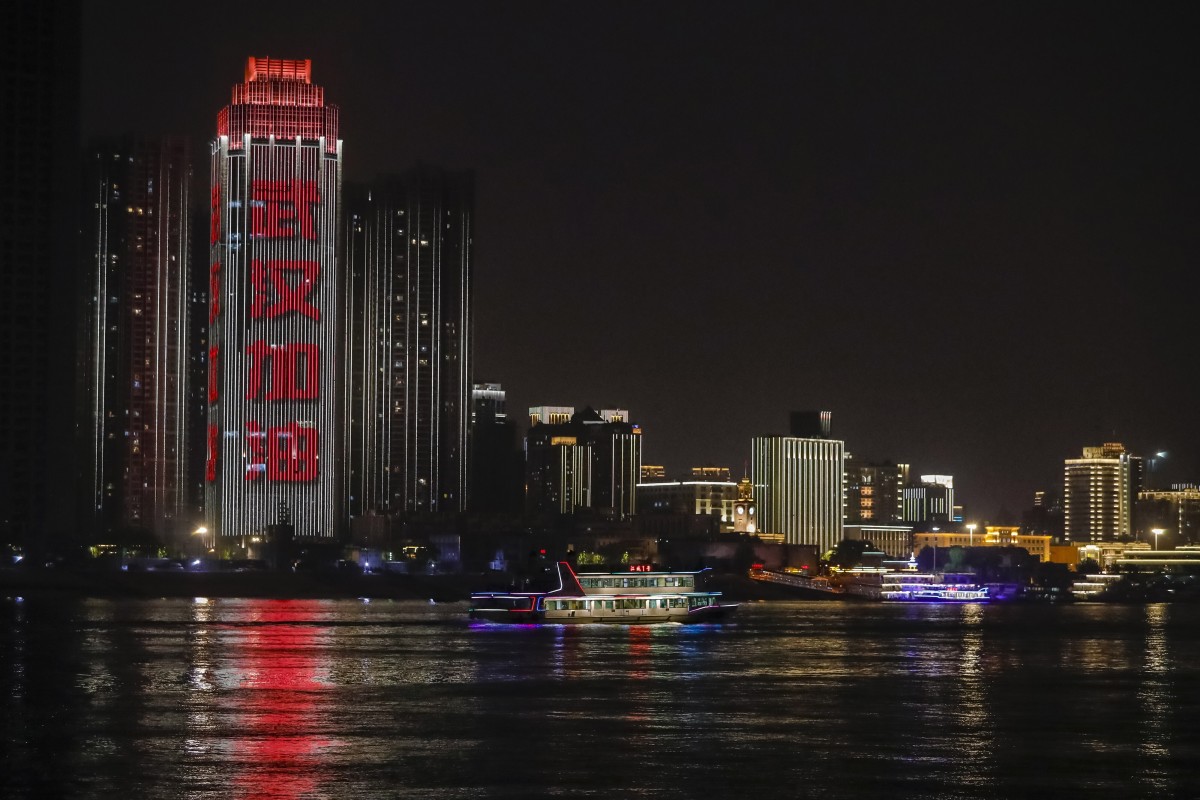
Ferries and other public transport services resumed in Wuhan last week. Photo: Xinhua
The city of Wuhan, the initial epicentre of the coronavirus pandemic, no longer has any Covid-19 patients in hospital after the last 12 were discharged on Sunday.
Their release ended a four-month nightmare for the city, where the disease was first detected in December. The number of patients being treated for Covid-19, the disease caused by a new coronavirus, peaked on February 18 at 38,020 – nearly 10,000 of whom were in severe or critical condition.
“With the joint efforts of Wuhan and the national medical aid given to Hubei province, all cases of Covid-19 in Wuhan were cleared as of April 26,” Mi Feng, a spokesman for the National Health Commission said on Sunday afternoon.
The announcement came only one day after the city discharged the last patient who had been in a severe condition. That patient also was the last severe case in Hubei province.
The last patient discharged from Wuhan Chest Hospital, a 77-year-old man surnamed Ding, twice tested negative for Sars-CoV-2, the virus that causes Covid-19, and was released at noon on Sunday.
“I missed my family so much!” Ding told Changjing Daily.
Another unidentified patient exclaimed as he left the hospital: “The air outside is so fresh! The weather is so good today!”
Wuhan faced a long journey to bring its patient count down to zero.
The city of 11 million, the capital of Hubei province and a transport hub for central China, was put under a strict lockdown on January 23 that barred anyone from entering or exiting the city without official approval for 76 days until it was officially lifted on April 8.
Coronavirus: Wuhan, Los Angeles officials discuss getting back to work after lockdown
22 Apr 2020
Residents were ordered to stay in their apartments as the city stopped public transport and banned private cars from city streets. As the epidemic worsened, more than 42,000 medical staff from across the country were sent to the city and to Hubei province to help ease the burden on the local health care system.
Wuhan was the hardest hit city in China, accounting for 50,333 of the 82,827 locally transmitted Covid-19 cases recorded in China. More than 4,600 died in the country from the disease.
On March 13, the city reported for the first time that there were no new suspected cases of the infection, and five days later there were no confirmed cases.
The number of discharged patients bottomed out at 39.1 per cent at the end of February, gradually climbing to 92.2 per cent by last Thursday.
“Having the patients in the hospital cleared on April 26 marks a major achievement for the city’s Covid-19 treatment,” the Wuhan Health Commission said in a statement.
However, having no severe cases in hospital does not mean all the discharged patients will require no further treatment as they may still need further care.
“Clearing all the severe cases marks a decisive victory for the battle to safeguard Wuhan,” health minister Ma Xiaowei told state broadcaster China Central Television on Saturday.
“Some patients who have other conditions are being treated in specialised hospitals. It has been properly arranged.”
Coronavirus: Chinese writer hit by nationalist backlash over diary about Wuhan lockdown
Ten patients aged between 42 and 85 who have been declared coronavirus-free are still in intensive care at the city’s Tongji Hospital where they are being treated for kidney problems and other complications arising from Covid-19. Some still need ventilators to help them breathe.
These 10 patients are under 24-hour care, with 190 nurses on four-hour rotations. There are other patients in a similar condition in two other hospitals in Wuhan, according to the Hubei Broadcasting and Television Network.
However, the discharge of the last batch of Covid-19 patients does not mean that the risk of infection is gone.
The city reported 20 new cases of people testing positive for Sars-CoV-2, the official name for the coronavirus that causes the disease, but who do not yet show symptoms.
There are 535 such carriers under medical observation. Past data shows some of these asymptomatic carriers will develop symptoms, and so will be counted as Covid-19 patients under China’s diagnosis and treatment plan.
China’s coronavirus infection curve has flattened out with about 694 imported cases of Covid-19 on top of about 800 locally transmitted ones now under treatment.
The national health commission spokesman warned that people still need to be on high alert as the virus is continuing to spread around the globe, with no sign yet of a slowdown.
“[We] must not drop our guard and loosen up. [We] must discover cases in time and deal with them quickly,” Mi said, citing the continued pressure from cases imported by people returning from overseas.
“The next step will be to implement the requirements of the central government and continue to guard against imported cases and a rebound of domestic transmitted cases.”
Source: SCMP
Posted in 10, 10,000, 12, 13, 18, 190, 2020, 22, 23, 24-hour, 26th, 76, 8, 800, able, across the country, after, afternoon, against, air, all cases, announcement, another, Anyone, apartments, approval, April, around the globe, arranged, asymptomatic, banned, barred, bottomed out, breathe, burden, capital, care, carriers, causes, Central China, Central government, centre, Changjing Daily, China Central Television, City, city streets, clear, climbing, complications, condition, conditions, confirmed cases, continuing, coronavirus, Coronavirus pandemic, Country, COVID-19, COVID-19 cases, critical, curve, days, deaths, December, declared, detected, develop, diagnosis and treatment plan, died, discharged, discover, discuss, Disease, domestic, drop, ease, end, ended, entering, epicentre, epidemic, exclaimed, exiting, Family, February, ferries, finally, first time, five days, flattened, four-hour, four-month, free, fresh, from, getting back, given, good, gradually, high alert, Hospital, hospitals, However, Hubei Broadcasting and Television Network, hubei province, implement, imported cases, infection, initial, intensive care, itself, January, joint efforts, kidney problems, last, last week, later, leave, left, lifted, local health care system, locally transmitted, lockdown, longer, loosen up, Los Angeles, March, medical observation, medical staff, million, missed, months, more than, National Health Commission, national medical aid, nearly, negative, new coronavirus, nightmare, no sign, noon, number, nurses, Official, officially, officials, one day, or, ordered, other, our guard, outbreak, outside, overseas, Past data, patients, peaked, People, positive, pressure, private cars, public transport, public transport services, put under, quickly, rebound, recorded, release, released, remains, requirements, residents, resumed, returning, Risk, rotations, Saturday, sent, severe, showing, slowdown, some, specialised, spokesman, spread, statement, stay, stopped, strict lockdown, struggle, Sunday, suspected cases, symptoms, testing, The National Health Commission, their, Thousands, Thursday, to help, to work, Today, Tongji Hospital, transmitted cases, transport hub, treated, twice, Uncategorized, unidentified, ventilators, warned, weather, whom, without, worsened, Wuhan, Wuhan Chest Hospital, Wuhan Health Commission, yet |
Leave a Comment »
07/04/2020
BEIJING (Reuters) – Mainland China reported no coronavirus deaths for the first time since the pandemic began, and a drop in new cases, a day before the central city of Wuhan, where the virus emerged late in December, is set to lift its lockdown.
China had 32 new infections by Monday, down from 39 a day earlier, the National Health Commission said.
For the first time since the commission began publishing nationwide data in late January, Hubei’s provincial capital of Wuhan saw no new deaths, joining the rest of mainland China, which has recorded none since March 31.
Wuhan, a city of 11 million that reported only two new infections in the past fortnight is due to allow residents to leave the city on Wednesday, for the first time since it was locked down on Jan. 23 to curb the spread of the virus.
With mainland China well past February’s peak of infections, authorities have turned their attention to imported cases and asymptomatic patients, who show no symptoms but can still pass on the virus.
Total infections in mainland China stood at 81,740 on Monday with 3,331 deaths, the commission said. It reported 30 new asymptomatic cases, nine involving incoming travellers. Of the new asymptomatic cases, 18 were in Hubei.
By the end of Monday, 1,033 asymptomatic patients were under medical observation.
TIGHTER LAND BORDERS
Overseas arrivals made up all 32 of the new cases with symptoms, down from 38 a day earlier. Total imported infections stand at 983, the commission said.
China faces the “dual risks” of imported infections and domestic cluster outbreaks, a commission spokesman told a briefing on Tuesday.
The northeast province of Heilongjiang reported 20 new cases, all in Chinese citizens returning from neighbouring Russia. It had reported 20 new infections on Sunday, all also cases imported from Russia.
On Tuesday, the Chinese consulate in the Russian city of Vladivostok near the border with China said it strongly reminded Chinese nationals not to return home through the border port of Suifenhe, which is to be closed to all arrivals from Tuesday.
China has shut its borders to foreigners as the virus spread globally, though most imported cases have involved Chinese nationals returning from overseas.
The number of inbound travellers through airports is fewer than 3,000 a day, down from about 25,000 in late March, before China slashed the number of international flights.
It also started testing all international arrivals for the virus this month.
Source: Reuters
Posted in asymptomatic patients, Beijing, cases, China, Chinese consulate, coronavirus, deaths, decline, domestic cluster, Heilongjiang province, Hubei, Hubei’s, imported infections, international flights, Mainland China, medical observation, National Health Commission, outbreaks, Overseas arrivals, pandemics, provincial capital, reports, Russia, Russian city, Suifenhe, travellers, Uncategorized, Virus, Wuhan |
Leave a Comment »
10/03/2020
- Woman becomes angry over long delay on tarmac waiting for health assessments
- Customs official says that Shanghai is stepping up medical checks as precaution against imported infection but that travellers need only wait one or two hours
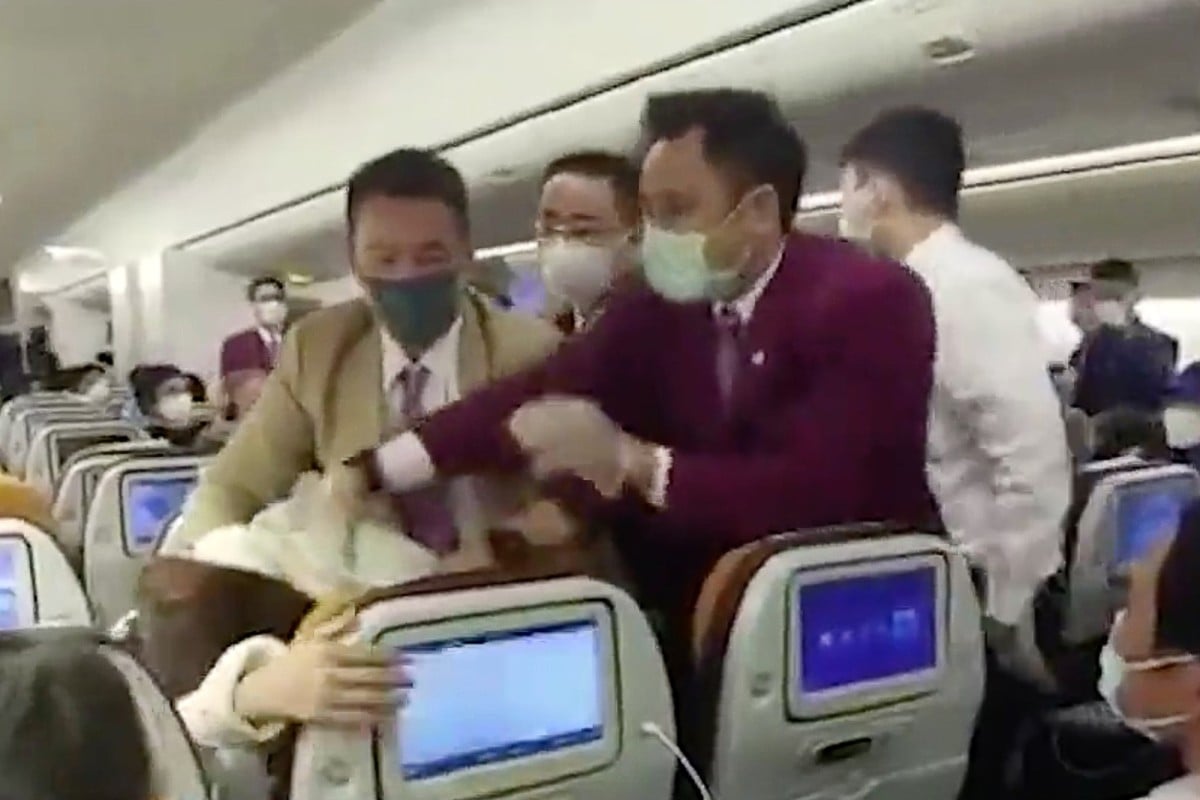
Video taken on board a Thai Airways flight at Shanghai on Friday purports to show flight attendants trying to control a passenger who coughed on one of their colleagues. Photo: Handout
Thai Airways staff had to restrain a Chinese woman after she coughed at a flight attendant while passengers waited for hours to get a
coronavirus check upon landing in Shanghai from Bangkok.
The carrier said the woman coughed deliberately at the attendant because she was angered about the long wait for a check on Friday. It said the passengers had to wait seven hours to be screened at Shanghai Pudong International Airport Thai Airways said that after the passenger coughed at the woman attendant, some of her colleagues approached the passenger to stop her “inappropriate” behaviour. They then explained the situation to her and asked her to cooperate and calm down, the airline said.
The woman had to be subdued and no further action was taken, the airline said in a statement.
In footage posted online, the woman is subdued by at least one male attendant, who presses her into her seat by her neck as two more male attendants stand nearby, saying “sit down” to her in English.
The woman then yells “What have I done?” in Chinese.
Thai Airways said that every passenger arriving in Shanghai or flying through the airport from countries with a high incidence of coronavirus cases such as Italy, South Korea, Japan and Iran must be examined by medical staff on the aircraft. Planes that were not checked were not permitted to open their doors to let passengers off.
The airline said the length of wait depended upon the number of passengers coming from those “key areas”.
An official from Shanghai Customs said that passengers on the flight had to be checked because some had transferred from Iran, where more than 7,000 cases and 230 fatalities have been reported.
The Thai Airways flight was on the ground at Shanghai for seven hours pending medical checks on passengers and crew. Photo: EPA
The woman’s behaviour divided opinion on social media.
“Shame on her!” a user of Weibo, China’s Twitter-like service, wrote. “It’s so shameful for her to act like that in front of foreigners.”
“I think the flight attendants were fairly gentlemanly,” another user wrote. “She should have been taken away.”
Coronavirus update: Xi Jinping makes first visit to Wuhan since outbreak began
A Weibo user who claimed to be on the plane at that time said it was not right for “three men” to subdue the woman.
“I don’t want to see my compatriot be bullied,” she wrote. “The attendants only stopped their action after two Chinese passengers stood up to intervene.”
Shanghai’s two airports have tightened medical checks on travellers from overseas, leading to complaints about long waiting times.
Health workers check passengers’ temperatures, screen their health disclaimer cards and check their travel histories.
Music video about Covid-19 safety released by rail operator in Thai capital Bangkok
Each passenger arriving from “key areas”, where there are a lot of infections, have to have their temperature checked twice after they get off the plane. Some may have to undergo simple physical checks.
Passengers who travelled to those key areas in the past 14 days, no matter their nationality, would be sent to designated places for 14 days of medical observation, authorities said.
The Shanghai Customs official said passengers were disembarked in batches to avoid crowding, making the examination process longer.
Egypt reports first coronavirus death; Iran toll jumps by nearly 50
She said that after the authorities allocated more than 300 customs staff to support monitoring at border ports at the end of last week, the examination process now took one to two hours.
“Many people blamed us for low speed and low efficiency, but didn’t ask why,” she said, adding that people’s messy handwriting on their health disclaimer cards and poor memory of where they had been in the past 14 days also complicated the clearance process.
“As a citizen, shouldn’t they cooperate in this critical moment?” she said.
Source: SCMP
Posted in check, China, coronavirus, cough, COVID-19, Egypt, health workers, iran, Italy, Japan, medical observation, passenger, plane, Shanghai, Shanghai Customs, Shanghai Pudong International Airport, South Korea, subdued, Thai Airways, Twitter, Uncategorized, Weibo |
Leave a Comment »





 CHINDIA ALERT: You'll be living in their world, very soon