Chindia Alert: You’ll be Living in their World Very Soon
aims to alert you to the threats and opportunities that China and India present. China and India require serious attention; case of ‘hidden dragon and crouching tiger’.
Without this attention, governments, businesses and, indeed, individuals may find themselves at a great disadvantage sooner rather than later.
The POSTs (front webpages) are mainly 'cuttings' from reliable sources, updated continuously.
The PAGEs (see Tabs, above) attempt to make the information more meaningful by putting some structure to the information we have researched and assembled since 2006.
The Legend of 1900 is taking more at the box office than the latest international and domestic blockbusters
An appetite for enhanced editions and 3D might have something to do with the surprise success of Giuseppe Tournatore’s forgotten flick
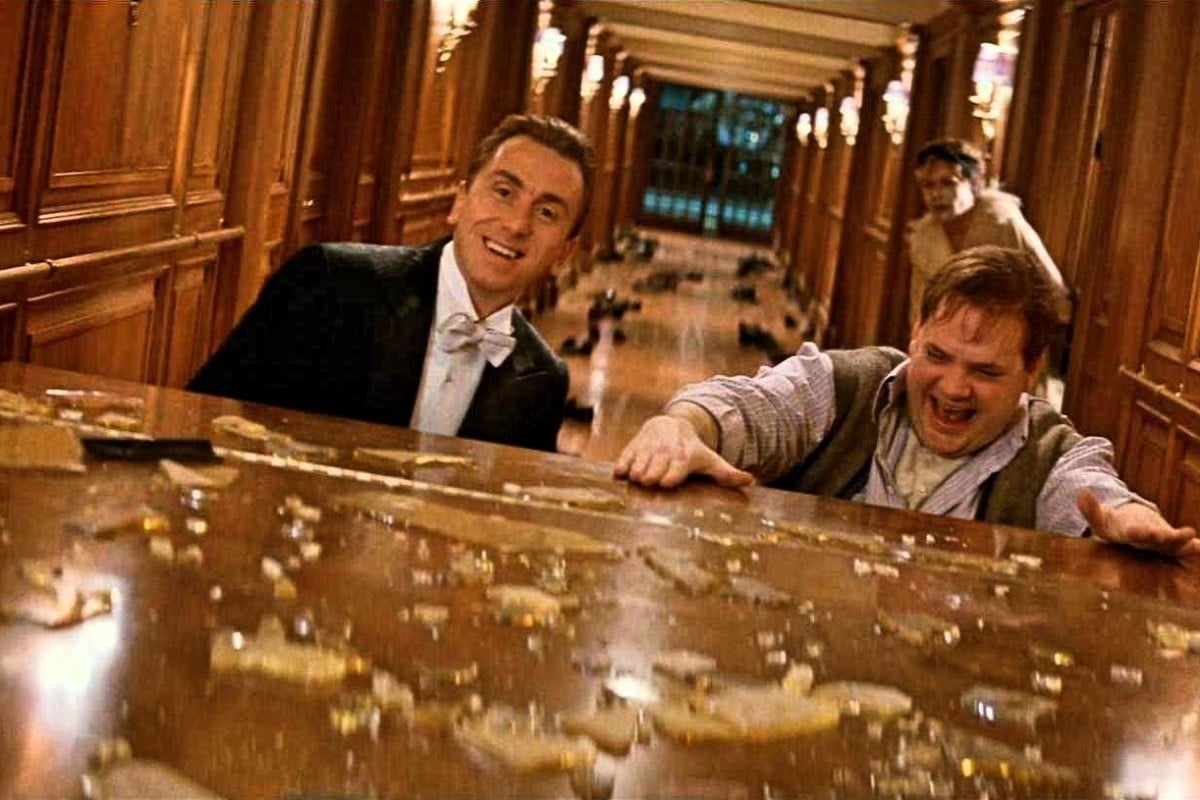
Tim Roth (left) stars in The Legend of 1900, the Giuseppe Tournatore that has taken Chinese cinema by storm.
China’s consumer class is always looking for the latest, most cutting-edge smartphone app or the most talked-about viral video. Who would have predicted, then, that a 21-year-old movie would take Chinese cinema by storm over the past few weeks?
What’s incredible is that The Legend of 1900 was hardly a classic in the first place.
Revolving around a piano prodigy (played by Tim Roth) who has spent his entire life on board an ocean liner, the movie received mixed reviews on its release in 1998, with disapproving critics lambasting it as “fragile” (Variety), “overwrought” (San Francisco Chronicle), schmaltz that “drowns in its own treacle” (Salon.com). The first English-language feature by Italian director Giuseppe Tornatore faded fast into obscurity, never reaching the heights of his revered Cinema Paradiso(1988).
And then Chinese audiences came to its rescue. Having never been released in China, Legend finally unspooled in mainland cinemas on November 15, alongside local romantic drama Somewhere Winter and Hollywood’s latest reboot, Charlie’s Angels.
Rather than becoming a sideshow to these two headlining blockbusters, the film broke out of the arthouse scene and crossed over to the mainstream: its opening weekend gross of 63.1 million yuan (HK$70.2 million) topped that of Angels, and its average of 13 viewers for each screening was higher than both Winter (11 viewers per screening) and Angels, which crashed with a mere eight.
A fortnight into its run, Legend had generated more than 130 million yuan, eclipsing its total takings of the past two decades. To put this into context, the film took in US$167,435 during its month-long release in the United States, in 1999. Adjusted for inflation, this figure would be about US$258,635 today, or 1.8 million yuan – that’s just 1.3 per cent of its gross during the first two weeks of its China run.
And it’s not just tills that are ringing: the rave online reviews must be music to Tornatore’s ears. On douban.com, China’s equivalent to Internet Movie Database, Legend secured an average rating of 9.3, far above those of current imports such as Knives Out
(8.5), Frozen II (7.3) and Midway (7.7), local blockbusters such as Better Days (8.4), or any of the flag-waving tub-thumpers that dominated Chinese cineplexes for weeks before and after National Day.
So the question is: why? One advantage Legend has over its box-office rivals is that it is a state-of-the-art 4K restoration of the original film. Chinese audiences have long been susceptible to enhanced editions of films: the 3D version of Titanic sailed into the record books with total takings of 946 million yuan during its two-month run in the country from April to June 2012.
The success of Legend could in part be attributed to young mainlanders’ pursuit of novelty: China is one of the few markets where 3D films, complete with their marked-up ticket prices, remain popular.
Chinese audiences have also embraced old films like never before, flocking to movies they could only hear or read about, or watch on pirated discs while the country lagged behind the rest of the world in the number of screens and foreign titles that could be shown on them.
There has also been a surge of interest in re-evaluating film heritage with festivals placing emphasis on introducing painstakingly restored films to viewers. In October, for example, the Pingyao International Film Festival hosted a programme of rarely seen titles from India’s socially conscious Parallel Cinema movement. The recent Hainan International Film Festival presented a more diverse offering, including classics such as Charlie Chaplin’s The Gold Rush (1925), Agnès Varda’s La Pointe Courte(1955) and Marc Webb’s (500) Days of Summer (2009).
It is in such programmes that legends are made and the old becomes the new.
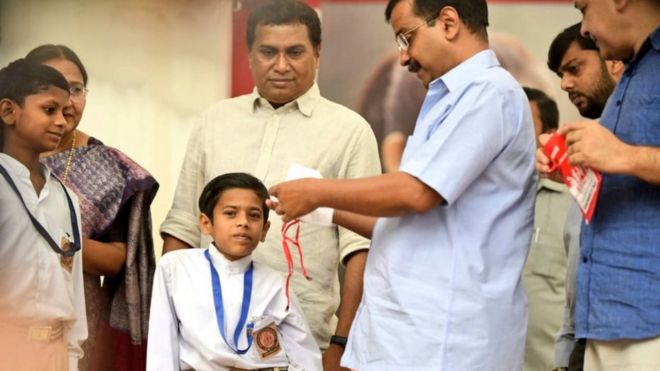
Image copyright TWITTER/@ARVINDKEJRIWALImage caption Delhi Chief MinisterArvind Kejriwal has been handing out masks to school students
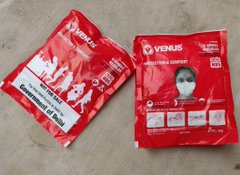
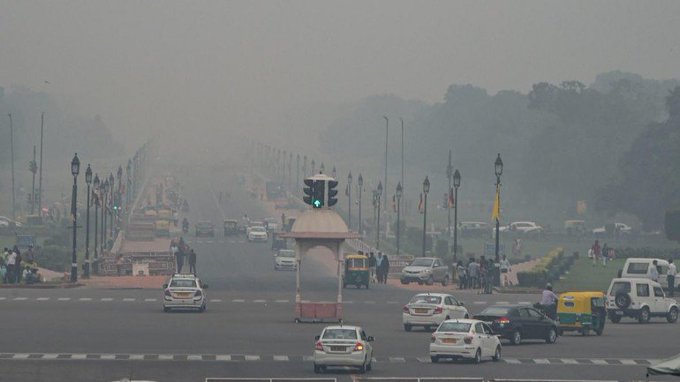
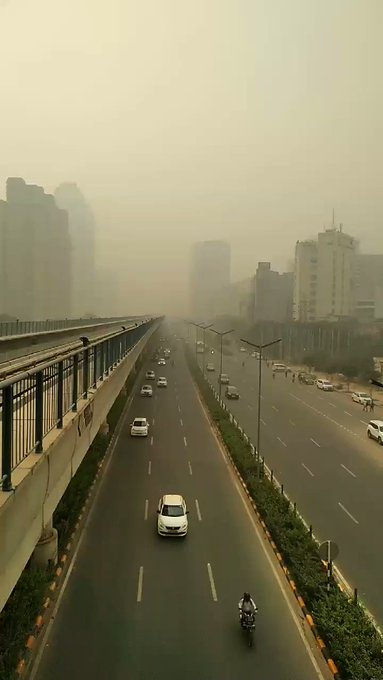
Five million masks are being distributed at schools in India’s capital, Delhi, after pollution made the air so toxic officials were forced to declare a public health emergency.
A Supreme Court mandated panel imposed several restrictions in the city and two neighbouring states, as air quality deteriorated to “severe” levels.
All construction has been halted for a week and fireworks have been banned.
The city’s schools have also been closed until at least next Tuesday.
Delhi’s Chief Minister Arvind Kejriwal said Delhi had been turned into a “gas chamber”.
The masks are being handed out to students and their parents, and Mr Kejriwal has asked people to use them as much as possible.
The levels of tiny particulate matter (known as PM2.5) that enter deep into the lungs are 533 micrograms per cubic metre in the city. The WHO recommends that the PM2.5 levels should not be more than 25 micrograms per cubic metre on average in 24 hours.
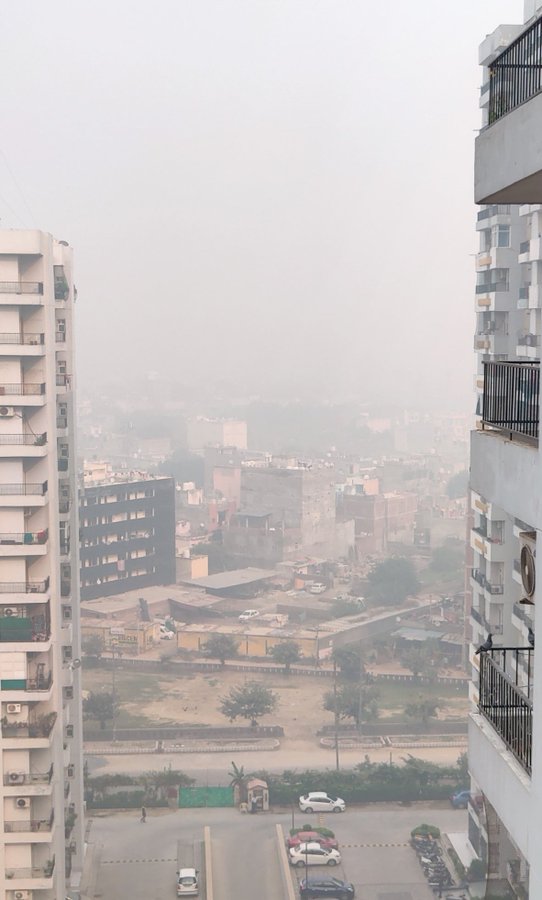
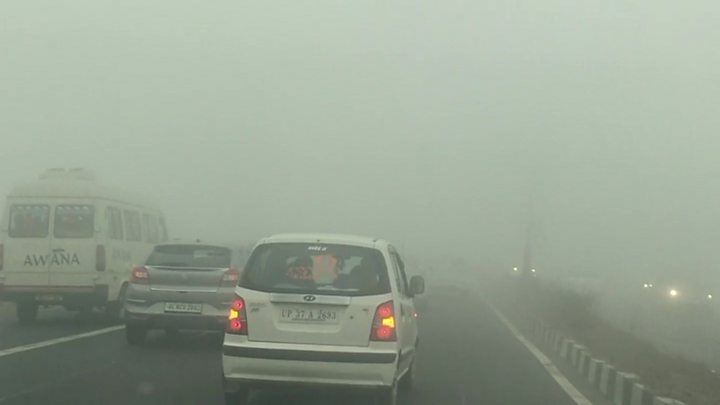
As thick white smog blanketed the city, residents started tweeting pictures of their surroundings. Many are furious that the situation remains the same year after year.
The hashtags #DelhiAirQuality and #FightAgainstDelhiPollition are trending on Twitter.
One of the main reasons for air quality in the city worsening every year in November and December is that farmers in the neighbouring states of Punjab and Haryana burn crop stubble to clear their fields. It’s made worse by the fireworks during the Hindu festival of Diwali.
There are other reasons too, including construction dust, factory and vehicular emissions, but farm fires remain the biggest culprit.
Media caption A hair-raising drive through the Delhi smog
More than two million farmers burn 23 million tonnes of crop residue on some 80,000 sq km of farmland in northern India every winter.
The stubble smoke is a lethal cocktail of particulate matter, carbon dioxide, nitrogen dioxide and sulphur dioxide.
Using satellite data, Harvard University researchers estimated that nearly half of Delhi’s air pollution between 2012 and 2016 was due to stubble burning.
The burning is so widespread that it even shows up in satellite photos from Nasa.
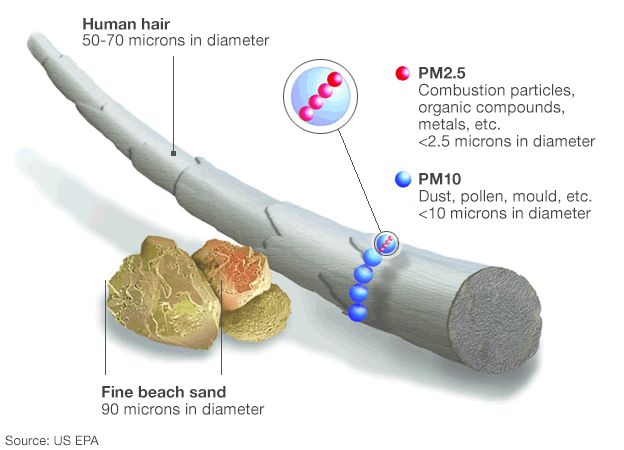
What are PM 2.5 particles?
Particulate matter, or PM, 2.5 is a type of pollution involving fine particles less than 2.5 microns (0.0025mm) in diameter
A second type, PM 10, is of coarser particles with a diameter of up to 10 microns
Some occur naturally – e.g. from dust storms and forest fires, others from human industrial processes
They often consist of fragments that are small enough to reach the lungs or, in the smallest cases, to cross into the bloodstream as well
Indian Prime Minister Narendra Modi told his country’s space scientists he was proud of a programme that had come so near to putting a probe on the Moon.
Contact with Chandrayaan-2 was lost moments before its Vikram module was due to touch down at the lunar south pole.
The fate of the craft is not yet known, but Mr Modi said there would be further opportunities.
India would have been the fourth nation to make a soft landing on the Moon.
“The best is yet to come in our space programme. India is with you,” said Mr Modi.
The Chandrayaan-2 approached the Moon as normal until an error occurred about 2.1km (1.3 miles) from the surface, officials said.
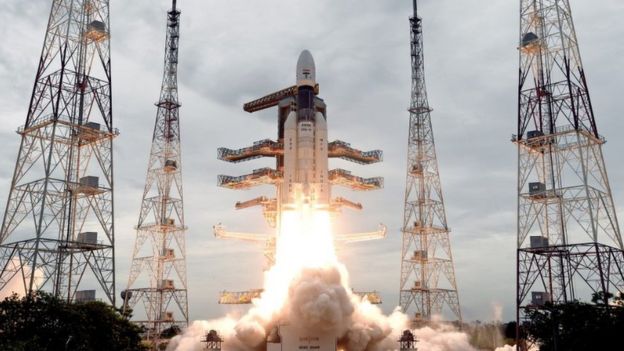
Image copyright ISROImage caption The mission’s lift-off was broadcast live to an audience of hundreds of millions
India’s Space Research Organization (Isro) said it lost contact seconds before the ship was expected to land.
The country’s first Moon mission – Chandrayaan-1, in 2008 – carried out the first and most detailed search for water on the lunar surface using radars.
What happened?
Chandrayaan-2 entered the Moon’s orbit on 20 August and was due to make a controlled descent to the surface early on Saturday, Indian time, over a month after it first took off.
Staff at mission control were glued to the screens at Isro’s Bangalore space centre as the spacecraft made its descent towards the surface.
The control room burst into applause during the so-called rough breaking phase of the descent, with Prime Minister Modi watching the action from behind a glass screen.
Isro chairman Kailasavadivoo Sivan announced to staff that the ship’s initial descent had been “normal,” and that the mission’s data would be analysed.
Mr Sivan had earlier described the final descent as “15 minutes of terror”.
The rover (called Pragyan – wisdom in Sanskrit) had the capacity to travel 500m from the lander in its 14-day life span, and would have sent data and images back to Earth for analysis.
The mission would have focused on the lunar surface, searching for water and minerals and measuring moonquakes, among other things.
Why would it have been significant?
A soft landing on another planetary body – a feat achieved by just three other countries so far – would have been a huge technological achievement for Isro and India’s space ambitions, writes science writer Pallava Bagla.
He adds that it would also have paved the way for future Indian missions to land on Mars, and opened up the possibility of India sending astronauts into space.
For the first time in India’s space history, the interplanetary expedition was led by two women – project director Muthaya Vanitha and mission director Ritu Karidhal.
Media caption Is India a space superpower?
It is also a matter of national pride – the satellite’s lift-off in July was broadcast live on TV and Isro’s official social media accounts.
The mission has also made global headlines because it’s so cheap – the budget for Avengers: Endgame, for instance, was more than double at an estimated $356m. But this isn’t the first time Isro has been hailed for its thrift. Its 2014 Mars mission cost $74m, a tenth of the budget for the American Maven orbiter.












 CHINDIA ALERT: You'll be living in their world, very soon