Chindia Alert: You’ll be Living in their World Very Soon
aims to alert you to the threats and opportunities that China and India present. China and India require serious attention; case of ‘hidden dragon and crouching tiger’.
Without this attention, governments, businesses and, indeed, individuals may find themselves at a great disadvantage sooner rather than later.
The POSTs (front webpages) are mainly 'cuttings' from reliable sources, updated continuously.
The PAGEs (see Tabs, above) attempt to make the information more meaningful by putting some structure to the information we have researched and assembled since 2006.
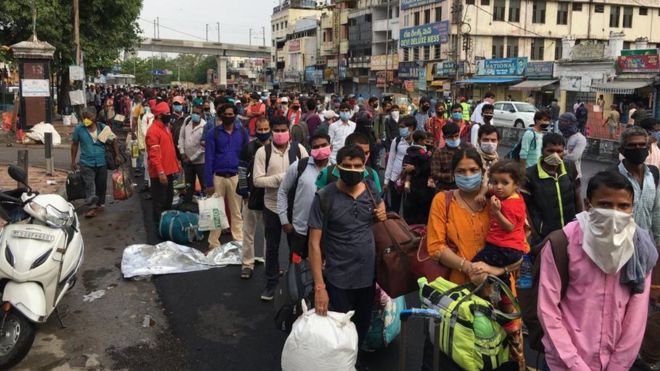
Image caption Passengers gathered outside Secundarabad station in Andhra Pradesh state
India has partially restored train services amid reports of chaos and overcrowding at some stations.
At least 145,000 people will travel in trains on Monday as the country starts to reopen after a prolonged lockdown.
Two hundred trains will now start operations – up from the existing 30 that are currently running.
But maintaining social distancing and cleanliness is proving to be a difficult task as huge crowds gathered outside some stations.
India’s mammoth railway network usually carries 25 million passengers every day.
The ministry of home affairs has issued specific guidelines for the smooth operation of train services. They say that all passengers will have to be screened, social distancing must be followed at the station and in trains and only passengers who have confirmed tickets will be allowed to travel.
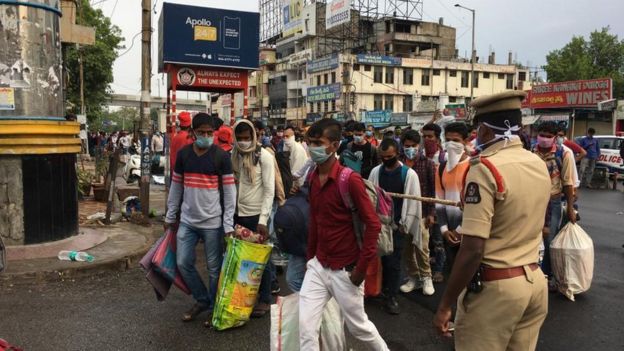
Image caption Police struggled to enforce social distancing due to large crowds
But some stations reported chaotic scenes as officials struggled to enforce these guidelines. BBC Telugu reported that people were standing much too close to each other at Secunderabad railway station in the southern state of Telangana.
“Railway staff and police didn’t allow passengers to go inside the station until at least one hour before the scheduled departure, citing physical distancing measures. This led to some chaos outside the railway station as a large number of passengers had gathered and there was no physical distance maintained. Police later arrived and organised the queues,” BBC Telugu’s Sharath Behara says.
Reporting from Delhi, BBC Hindi’s Salman Ravi said strict social distancing was being followed when passengers boarded trains, and all of them wore masks.
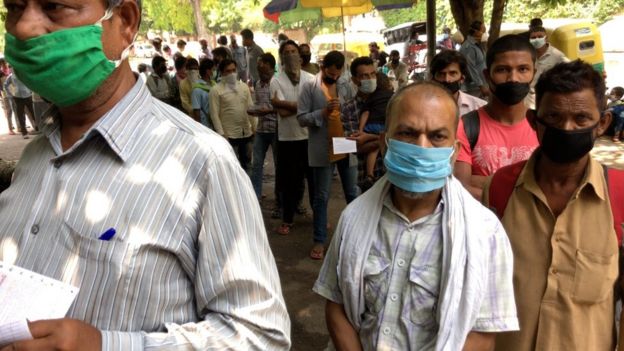
Image caption Passengers waiting outside the train station in Delhi
“But the same was not observed at ticket booking counters. Many people who did not have tickets also turned up at the station and that caused crowding,” he added.
Train services came to a grinding halt when Prime Minister Narendra Modi announced the lockdown on 24 March to stop the spread of coronavirus.
This left millions of daily-wage workers stranded as they desperately tried to go back to their villages from cities. Many of them decided to walk long distances – in some cases more than 1,000 kilometres.
As pressure and criticism mounted, the government started running special trains to ferry migrants. Some 30 trains restarted on 12 May, since then there has been a consistent demand to reopen more routes.
Getting the train network going again is part of the government’s wider strategy to slowly reopen the economy. Millions have lost jobs and factories are struggling to reopen as demand is likely to be sluggish in the coming weeks.
India has suspended trade across the Line of Control in Jammu and Kashmir with effect from Friday. The Ministry of Home Affairs issued the order to this effect on Thursday.
INDIAUpdated: Apr 18, 2019 20:20 IST
HT Correspondent
Hindustan Times, New Delhi
The Home Ministry said reopening of Line of Control trade will be revisited after placing a stricter regulatory and enforcement mechanism in place.(HT file photo)
India suspended trade across the Line of Control in Jammu and Kashmir over concern that the route was being misused by Pakistan-based elements to smuggle weapons, narcotics and fake currency, the Ministry of Home Affairs said on Thursday. New Delhi said the Centre will revisit the decision to suspend LoC trade at Jammu and Kashmir’s Salamabad and Chakkan-da-Bagh after putting in place a stricter regulatory and enforcement mechanism.
Cross-LoC trade is meant to facilitate exchange of goods of common use between local populations across the LoC in Jammu & Kashmir. The trade is allowed through two Trade Facilitation Centres located at Salamabad, Uri, District Baramulla and Chakkan-da-Bagh, District Poonch. The trade takes place four days a week. The Trade is based on Barter system and zero duty basis.
The home ministry decision comes after the federal anti-terror probe agency National Investigation Agency told the government that a “significant number of trading concerns engaged in LoC trade” were linked with banned terror organisations involved in fuelling terrorism”.
“Investigations have further revealed that some individuals, who have crossed over to Pakistan, and joined militant organizations have opened trading firms in Pakistan. These trading firms are under the control of militant organizations and are engaged in LoC trade,” a home ministry statement said.
The home ministry said there were also inputs to indicate the LoC route is likely to be misused to a “much larger extent” to evade higher duties after India withdrew the most favoured nation to Pakistan.
Relations between India and Pakistan have been under strain since Pulwama terror attack in February when 40 jawans of the Central Reserve Police Force were killed on Jammu-Srinagar highway.
The cross-LoC trade between Jammu and Kashmir and Pakistan-occupied Kashmir had resumed on Tuesday after nearly two weeks. The trade and travel across the LoC had been suspended on April 1 in the wake of heavy shelling from the Pakistani side. Three people including a Border Security Force officer, a woman and a five-year-old girl died in Poonch.
The relation between India and Pakistan has been under strain since Pulwama terror attack in February when 40 jawans of the Central Reserve Police Force were killed on Jammu-Srinagar highway.
Trade and travel across the LoC had been suspended on April 1 in the wake of heavy shelling from the Pakistani side. Three people including a Border Security Force officer, a woman and a five-year-old girl died in Poonch.
The cross-LoC trade between Jammu and Kashmir and Pakistan-occupied Kashmir had just resumed on Tuesday after nearly two weeks.
PM Modi and President Moon held constructive talks on enhancing bilateral cooperation in key areas including trade, investment, defence and security.
SNS Web | New Delhi | February 22, 2019 1:08 pm
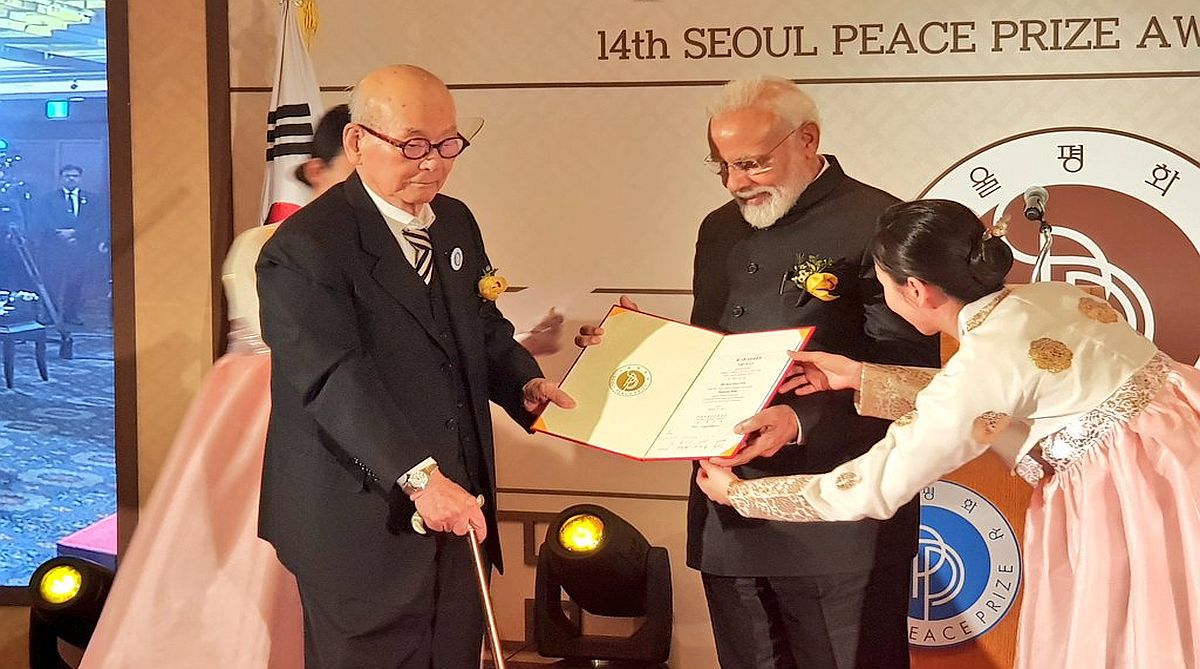
Prime Minister Narendra Modi conferred Seoul Peace Prize (Photo: @MEAIndia)
Prime Minister Narendra Modi was on Friday awarded the Seoul Peace Prize in recognition of his efforts aimed at raising global economic growth, accelerating the human development of the people of India and furthering the development of democracy through anti-corruption and social integration efforts.
Dedicating the award to the people of India, PM Modi said, “This award does not belong to me personally but to the people of India, the success India has achieved in the last 5 years, powered by the skill of 1.3 billion people”.
He further said he was honoured that the award was conferred on him in the year India celebrates the 150th birth anniversary of Mahatma Gandhi.
Talking at the 14th Seoul Peace Prize award ceremony, PM Modi said radicalisation and terrorism are the biggest threats to world peace and security in the present time.
He further called upon the need to join hands to completely eradicate terrorist networks. “Only by doing so, can we replace hate with harmony,” he said.
The Prime Minister also quoted a portion of the 1988 Olympics theme song, which goes as “Hand in hand, we stand, all across the land, we can make this world, a better place in which to live”.
PM Modi’s speech comes in the wake of the Pulwama terror attack that killed at least 44 CRPF personnel on February 14.
While choosing PM Modi, the award committee had recognised the Indian leader’s contributions to the growth of the Indian and global economies, crediting ‘Modinomics’ for reducing social and economic disparity between the rich and the poor.
The panel had also lauded Modi’s initiatives to make his government cleaner through anti-corruption measures and demonetisation. It also credited him for his contribution towards regional and global peace through a proactive foreign policy with countries around the world under the ‘Modi Doctrine’ and the ‘Act East Policy.’
Earlier in the day, PM Modi met South Korean President Moon Jae-in and expressed his gratitude to the President for his condolences on Pulwama attack and support against terror.
PM Modi and President Moon held constructive talks on enhancing bilateral cooperation in key areas including trade, investment, defence and security.
Addressing the media after the “productive talks” with President Moon, PM Modi said that South Korea is an important partner in India’s economic transformation.
He further said the defence sector was an important part of India’s growing partnership with South Korea. “An example of this is the induction of K-9 Vajra artillery gun in Indian Army,” the PM added.
Following the talks, India and South Korea signed seven agreements to enhance cooperation in key areas, including infrastructure development, media, start-ups and combating trans-border and international crime.
An important MoU was signed between the Korean National Police Agency and the Ministry of Home Affairs to enhance cooperation between the law enforcement agencies of the two countries and combat trans-border and international crimes.
Modi, who is on a two-day visit to South Korea to strengthen India’s strategic ties with the country, was accorded an official reception at the Blue House, the executive office and official residence of the South Korean President here. He also met First lady Kim Jung-sook.
PM Modi is visiting South Korea on the invitation of President Moon Jae-in. This is his second visit to the Republic of Korea since 2015 and a second summit meeting with President Moon Jae-in.
As the country mourned the Pulwama killings, there has been an increased demand for according ‘Shaheed’ status to the martyred jawans.
SNS Web | New Delhi | February 21, 2019 2:20 pm
In a fresh attack on Prime Minister Narendra Modi in the aftermath of the Pulwama terror attack, Congress president Rahul Gandhi said the “jawans gave their lives but have been denied the ‘Shaheed’ status.
In strong words, the Congress president said the “PM has never given and only taken”.
In an indirect reference to the government allegedly supporting industrialists like Anil Ambani, as accused by the opposition, Gandhi tweeted, “Jawans give their lives but are denied the status of “Shaheed”. While this man has never given & only taken. He’s gifted 30,000Cr of their money & will live happily ever after. Welcome to Modi’s NEW INDIA”.
As the country mourned the Pulwama killings, there has been an increased demand for according ‘Shaheed’ status to the martyred jawans.
The CRPF jawans were addressed as martyrs in resolutions passed in various state assemblies to condemn the terror attack and to announce compensation for the bereaved families from the respective states.
While the Madhya Pradesh government announced compensation of Rs 1 crore, the Uttar Pradesh and Uttarakhand governments announced Rs 25 lakh each.
Uttarakhand Chief Minister Trivendra Singh Rawat also assured government jobs to one member from each family.
According to the set rules, the Central Government provides Rs 10 lakh as ex gratia for the death of jawans due to accidents in the course of duty or death due to terrorist acts in the line of duty. Apart from this, the wife of the dead jawan would receive a pension, which would go to parents if he is not married.
The government does not recognise the term ‘martyr’.
In December 2017, the government had informed the Central Information Commission that there was no term as ‘martyr’ or ‘shaheed’ in the army or the police. Instead, a soldier or policeman killed in action is called ‘battle casualty’ or ‘operations casualty’, respectively.
In 2016, the Ministry of Home Affairs informed the Lok Sabha that the word ‘martyr’ is not used in reference to any casualties from the Indian armed forces during battle.
Earlier in 2015 too, the Government had informed the Parliament that the term ‘shaheed’ or martyr is not defined “anywhere” and that there is no official order to accord the same to defence or paramilitary personnel.
The CAPFs like CRPF, BSF, ITBP, CISF, SSB and NSG have made representations to the Union Home Ministry that ‘shaheed’ salutation is being demanded by the personnel of these forces.





 CHINDIA ALERT: You'll be living in their world, very soon