14/08/2019
- Developers say their prototype craft could dive to 1,000 metres in five minutes
- Liu Kaizhou, who also worked the Jiaolong submersible, says ‘We are in uncharted water’
Professor Liu Kaizhou, who developed the autopilot for China’s manned Jiaolong submersible, says his team has designed a vessel that can move through water like a plane moves through the air. Photo: Xinhua
Chinese engineers say they are developing a radical design for a super-fast robot submersible which the project leader, who worked on the manned deep-sea vessel Jiaolong, or Sea Dragon, claims can “fly” in water like a plane travels through the air.
At 3 metres (9.8ft) long, the prototype consists of a cigar-shaped body, with a guidance system in the bow and a jet plane style rudder and a propeller in the stern.
Outriggers house batteries and two more propellers. These are attached to the body by wing-like planes that the developers said will give the vessel the kind of lift in water that takes an aeroplane into the air and back to the earth.
Developers said the prototype will be capable of 10 knots and could dive to a depth of 1,000 metres (3,281 feet) – or surface from that depth – at about three metres a second, taking about 5½ minutes.
Professor Liu Kaizhou, lead scientist of the project at the Shenyang Institute of Automation, part of the Chinese Academy of Sciences in Liaoning province, said the design had great potential.
If a traditional submarine was like an air balloon, he said, the prototype was like an aircraft. “It is technically flying, fast and freely, like a plane for the water.”
The prototype has 20 major components on board, including a computer, and communications and surveillance equipment. These were all developed and tested by the team, but getting them to work together posed some unexpected challenges, Liu said, meaning the transition to operations in a tough marine environment was some time away.
Underwater station could be a game changer, Chinese scientist says
“We aim to make the first open sea test in about a year,” he said.
The submersible can be powered by conventional batteries or a chemical engine that mixes lithium and sulphur hexafluoride to produce heated steam for electrical generators – an energy source often used by torpedoes.
Funded by the Ministry of Science and Technology from 2017, the project was driven by China’s growing ambition to become a superpower in the world’s oceans.
The team said their submersible had the potential to become the backbone of China’s search-and-rescue operations at sea, naval intelligence gathering, high-precision sea floor mapping, or to transport minerals from the seabed to the surface.
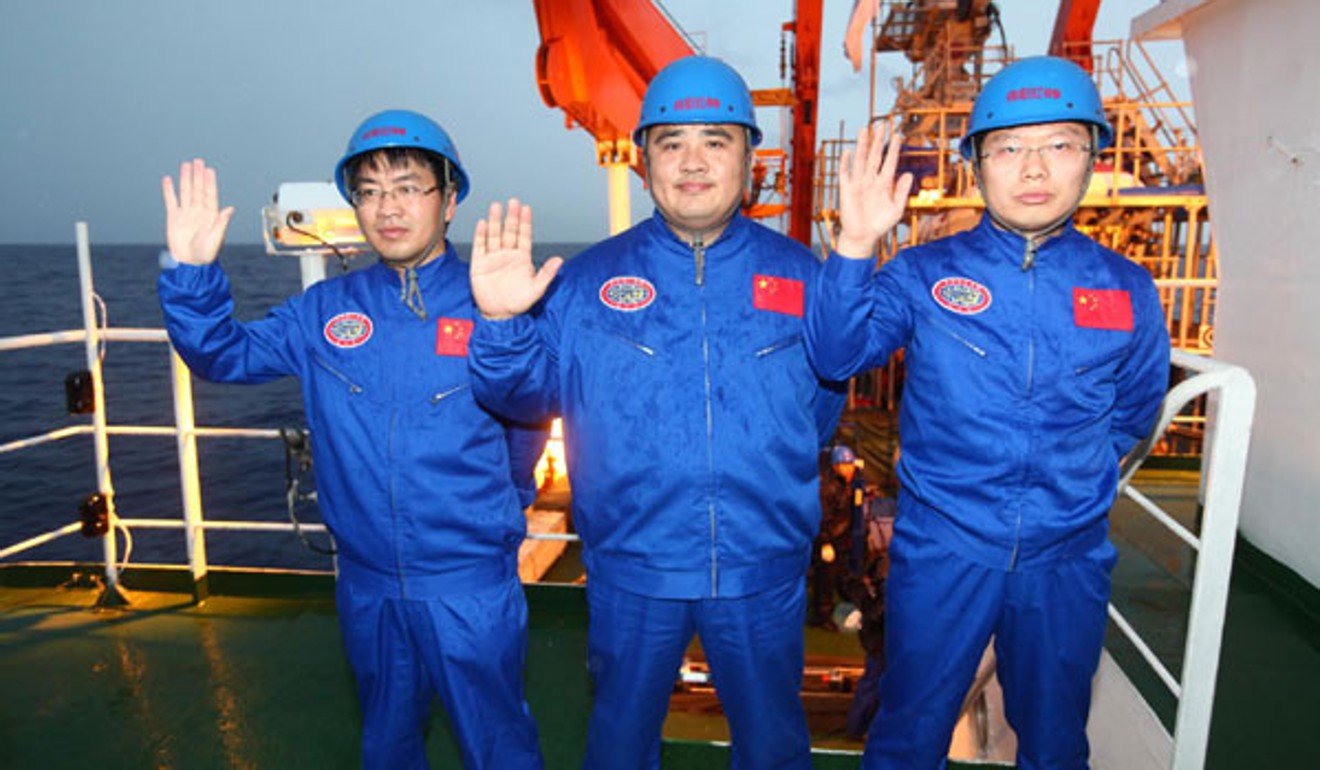
Professor Liu Kaizhou (left) with colleagues Ye Cong and Yang Bo, was instrumental in the success of China’s Jiaolong manned submersible. Photo: Xinhua
Professor Du Tezhuan, a researcher in fluid dynamics at the Institute of Mechanics of the Chinese Academy of Sciences in Beijing, said the design was a bold one but it posed the research team many hard questions.
The density of water was much higher than that of air, he said, which meant the vessel would encounter more drag and would need a strong power source.
“Without sufficient speed, the lift will be weak, and to reach high speeds, lots of energy will be needed. Flying in water is not as easy as flying in the air,” said Du, who was not involved in the project.
Why Beijing is speeding up underwater drone tests in the South China Sea
“But in theory it should work. It is worth a try.”
Liu – who led the design of the autopilot system that can take the Jiaolong to depths of more than 7,000 metres (23,000 ft) – said that after tests on the prototype were complete, other innovations were possible. These included covering the vessel with air bubbles to reduce friction.
“This technology is brand new,” he said. “We are in uncharted water and we are excited by the challenges.”
Source: SCMP
Posted in aeroplane, air, air bubbles, ambition, backbone, batteries, Beijing, bow, challenges, chemical engine, Chinese Academy of Sciences, Chinese engineers, Chinese Ministry of Science and Technology, cigar-shaped body, Communications equipment, computer, conventional batteries, covering the vessel, design, Earth, electrical generators, energy source, fly, friction, game changer, guidance system, heated steam, high-precision sea floor mapping, Institute of Mechanics, jet plane, Jiaolong submersible, Liaoning province, lithium, marine environment, Ministry of Science and Technology, naval intelligence gathering, new submersible, Outriggers, plane, propeller, propellers, prototype craft, robot submersible, rudder, search-and-rescue operations at sea, Shenyang Institute of Automation, South China Sea, stern, sulphur hexafluoride, superpower, surveillance equipment, the Sea Dragon, through water, torpedoes, transport minerals from the seabed, Uncategorized, uncharted water, Underwater station, wing-like planes, world's oceans |
Leave a Comment »
08/07/2019
BEIJING, July 7 (Xinhua) — China has built six National Supercomputing Centers (NSCC) since 2009, serving as a new driver for the country’s innovation, according to the NSCC in north China’s Tianjin Municipality, which celebrated the 10th anniversary of the founding of the center on Saturday.
Since the establishment of the NSCC in Tianjin was approved by the Ministry of Science and Technology in May 2009, other five supercomputing centers were founded one after another in Shenzhen, Jinan, Changsha, Guangzhou and Wuxi respectively.
As the first supercomputing center in China, the NSCC in Tianjin is not only where China’s first petaflop supercomputer the Tianhe-1 is located, but also responsible for developing China’s new generation of the exascale supercomputer the Tianhe-3.
Tianjin has established a complete autonomous information industry including high-performance chips, autonomous control system, high-performance server and database, setting up a model on the transformation of technologic innovation achievements, said Li Xiang, vice president of the National University of Defense Technology.
“The supercomputer has become a symbol of power reflecting the innovative capabilities of China. Next, we will connect these supercomputing centers and share the resources nationwide,” said Mei Jianping, deputy director-general of the Department of High and New Technology of the Ministry of Science and Technology.
Source: Xinhua
Posted in Changsha, Department of High and New Technology, Guangzhou, Jinan, Ministry of Science and Technology, National Supercomputing Centers (NSCC), National University of Defense Technology, new engine for innovation, Shenzhen, Supercomputing centers, Tianhe-1, Tianhe-3, Tianjin, Uncategorized, unveils, Wuxi |
Leave a Comment »
09/03/2019
- Researchers say they spend so much time on grant applications that they get no time to do science
- Funding applications are said to be too onerous and inflexible
Chinese scientists say funding applications are too onerous and restrictive. Photo: Xinhua
Chinese scientists are appealing for a bigger say over research funding as they buckle under a rigid and bureaucratic application system.
The appeal from delegates to the country’s peak advisory body, the Chinese People’s Political Consultative Conference, comes as the central government prepares to launch a pilot project that will give research teams greater flexibility in the way funds are used.
Despite slowing economic growth, the central government also plans to increase the budget for science and technology by 13.4 per cent this year to 354.31 billion yuan (US$52.7 billion) as Beijing tries to challenge the United States in the race for high technology.
But researchers have been hampered by a funding structure that demands they clearly state the use of their research and submit a detailed plan with a deadline for delivery of results.
Application rules have become stricter in the last few years, partly a result of a crackdown on corruption, which has led to a dozen university presidents and top scientists being arrested for embezzling research and infrastructure funding.
Chinese science minister warns scientists not to overstep ethical bounds after He Jiankui’s gene-edited babies scandal
CPPCC delegate Yuan Zhiming, an agricultural scientist from the Chinese Academy of Sciences in Wuhan, said he spent so much time filling out funding applications that he did not have time to do any research.
“It’s not easy to complete the budget with detailed outcomes, because I don’t already know my research results,” Yuan said in an open panel discussion on the sidelines of the CPPCC.
Wang Liming, a CPPCC delegate from China National Nuclear Corporation, agreed, saying funding applications were too onerous and inflexible. “Money earmarked for buying soy sauce cannot be used to buy vinegar,” he joked.
People’s Daily, the Communist Party’s mouthpiece, reported in December 2016 that it took a scientist a month to finish an annual report for a regular research project and much longer for a major one.
The fears about more bureaucracy in research intensified last year when the National Natural Science Foundation – which manages science funding and promotes research – was downgraded and put under the Ministry of Science and Technology.
The authorities said the change was aimed at strengthening the government’s “research-driven development strategy” and “optimising the distribution of funding on science and technology”, while scientists said it meant funding approval would be more stringent.
China’s science and tech minister calls on private enterprises to develop ‘core technologies’
But senior Chinese officials said they understood the need to speed up research for China to transform itself into an innovation powerhouse.
Science and Technology Minister Wang Zhigang said on Friday that China would overhaul the way funding was managed to give researchers more incentives.
“The ministry [of science and technology] has done a series of things to ease the burden on researchers, so that they will not be bothered by forms, reimbursements, titles and prizes and have more time to do real research,” Wang said.
“The upcoming reforms will be centred on how to ignite researchers’ enthusiasm, initiative and creativity.”
Source: SCMP
Posted in agricultural scientist, Beijing, buying soy sauce cannot be used to buy vinegar, China alert, China National Nuclear Corporation, Chinese Academy of Sciences, Chinese People's Political Consultative Conference, Chinese scientists, Communist Party’s mouthpiece, CPPCC delegate, He Jiankui, Ministry of Science and Technology, National Natural Science Foundatio, People’s Daily, Red tape, research funding, rigid and bureaucratic application system, science and tech minister, Science and Technology Minister, Uncategorized, United States, Wang Liming, Wang Zhigang, Wuhan, Yuan Zhiming |
Leave a Comment »



 CHINDIA ALERT: You'll be living in their world, very soon