Chindia Alert: You’ll be Living in their World Very Soon
aims to alert you to the threats and opportunities that China and India present. China and India require serious attention; case of ‘hidden dragon and crouching tiger’.
Without this attention, governments, businesses and, indeed, individuals may find themselves at a great disadvantage sooner rather than later.
The POSTs (front webpages) are mainly 'cuttings' from reliable sources, updated continuously.
The PAGEs (see Tabs, above) attempt to make the information more meaningful by putting some structure to the information we have researched and assembled since 2006.
This marks the latest mobile network upgrade on Mount Everest, where Chinese carriers had previously installed 2G, 3G and 4G equipment
China Mobile plans to deploy Huawei 5G gear at an altitude of 6,500 metres, providing network coverage to the mountain’s summit
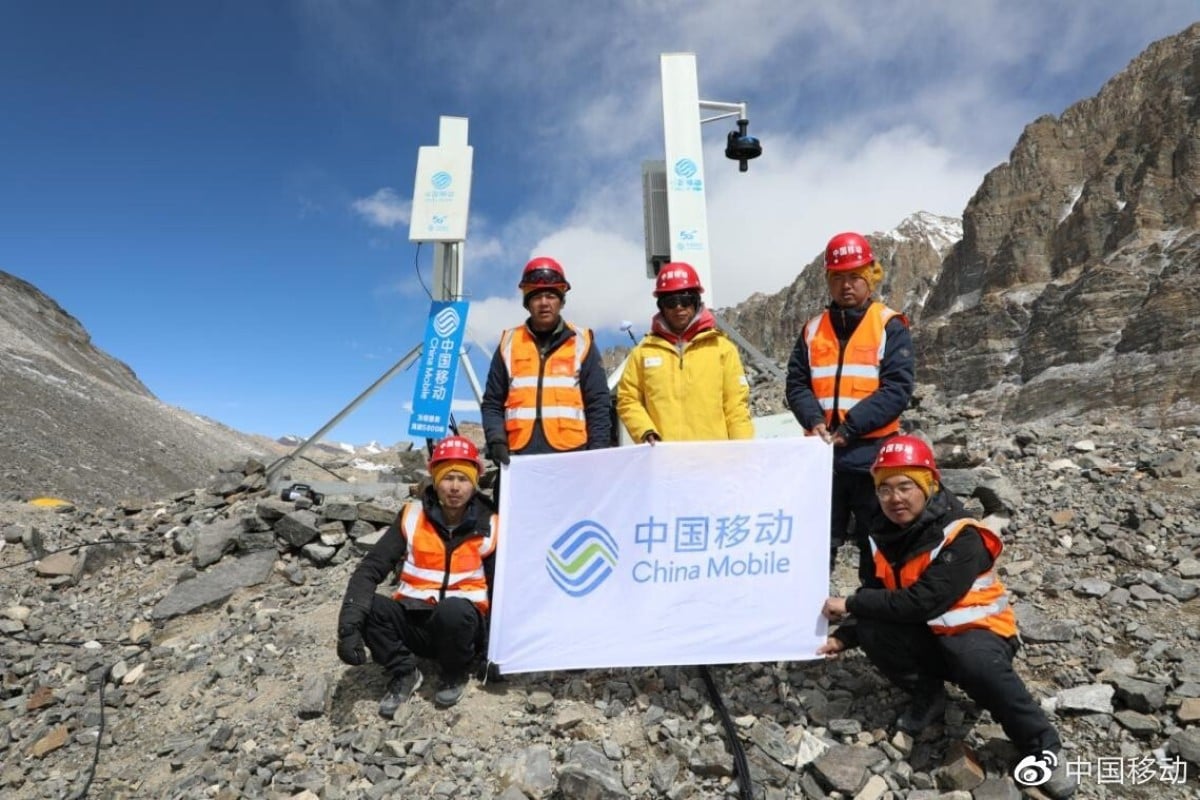
A team from China Mobile shows off the initial 5G base stations, supplied by Huawei Technologies, that the telecoms carrier deployed on Mount Everest this April. Photo: Weibo
Huawei Technologies has teamed up with wireless network operators China Mobile, China Unicom and China Telecom to roll out advanced 5G infrastructure on
The deployment of 5G base stations on the famous Himalayan mountain, with an elevation of 8,848 metres, has extended the reach of the next-generation mobile technology, which has been held up as “the connective tissue” for the Internet of Things, autonomous cars, smart cities and other new applications – providing the backbone for the industrial internet. The new 5G infrastructure roll-outs were announced by Huawei in a post on Chinese microblogging site Weibo on Monday and confirmed by its spokeswoman on Tuesday.
China Mobile, the world’s largest wireless network operator, said its 5G project on Mount Everest marked “not only another extreme challenge in a human life exclusion zone, but also laid a solid foundation for the later development of 5G smart tourism and 5G communications for scientific research”, according to the company’s post on Weibo on Monday.
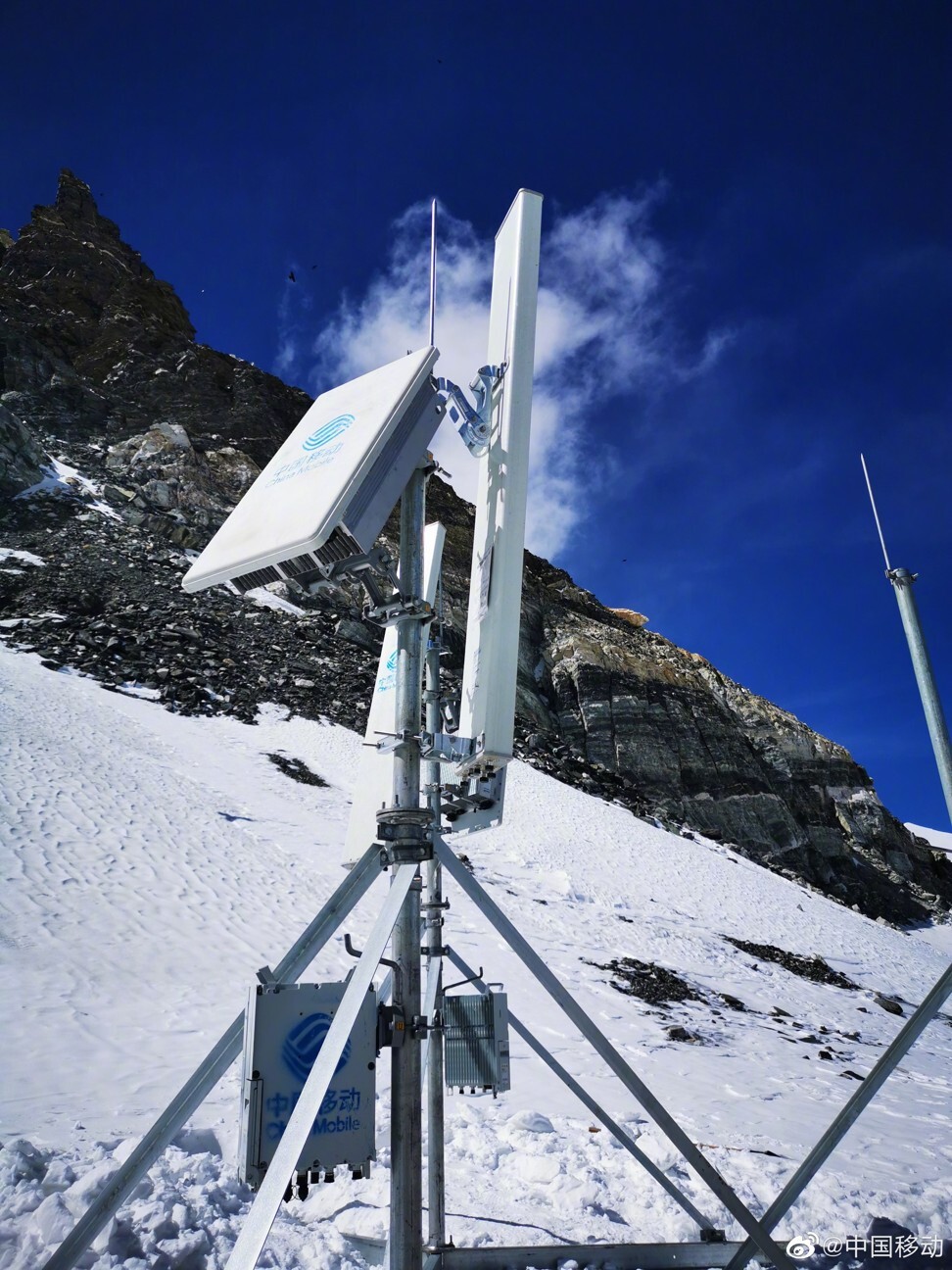
The Hong Kong and New York-listed carrier set up three 5G base stations – radio access gear that connects mobile devices to the broader telecommunications network – on April 19 in two camps at altitudes of 5,300 metres and 5,800 metres, which provide online download speed of about 1 gigabit per second.
China Mobile plans to install two more 5G base stations, supplied by telecommunications gear maker Huawei Technologies, on Mount Everest before April 25. Photo: Weibo
Installation of two more base stations are expected to be completed by China Mobile before April 25 in another camp at an altitude of 6,500 metres, providing 5G network coverage to the summit of Mount Everest. The international border between China and Nepal is 1,414 kilometres in length and runs across that summit.
More than 150 China Mobile employees are taking part on the construction and maintenance of the new 5G base stations as well as upgrading existing infrastructure on the surrounding areas, according to the company. It said 25 kms of new optical cables have also been laid out to support this project.
China Telecom confirmed its Mount Everest project on Tuesday in a statement, which said its 5G base stations were installed on April 13 at an altitude of 5,145 metres. It partnered with state-run China Central Television to broadcast a 24-hour live-streamed programme on April 14 from Mount Everest, which had an audience of more than six million people.
China Mobile did not immediately respond to a request for comment. China Unicom did not immediately reply to a separate request for comment.
Mobile network operators in China launched initial commercial 5G services last year. The country has already deployed more than 160,000 5G base stations, covering more than 50 cities, according to a report published last month by the GSMA, the trade body which represents mobile operators worldwide.
While initial commercial 5G mobile services were launched in countries like South Korea, the US, and Australia, the scale of China’s market is likely to dwarf the combined size of those economies, negating any first-mover advantage.
The steady annual deployment of new 5G base stations is critical to meet future demand in the world’s second largest economy and biggest smartphone market. China is expected to have 600 million 5G mobile users by 2025, which would make up 40 per cent of total global 5G subscribers, according to the GSMA.
Project will examine whether earthquake and changing wind speeds have affected peak’s snowcap
Survey team hoping the BeiDou satellite navigation system and other Chinese technology can help them find the answer
A Chinese team is preparing to determine the exact height of Mount Everest. Photo: AFP
China is sending a surveying and mapping team to the summit of Mount Everest this month in a bid to end the long-running debate over the precise height of the world’s tallest mountain.
The mission was announced on Wednesday at one of the mountain’s base camps in Tibet, where a team of 53 surveyors has been making technical preparations since March 2. The team will use China’s BeiDou navigation satellite system and Chinese surveying instruments for the project.
Mount Everest – known as Sagarmatha in Nepal and Qomolangma in Tibet – lies in the Himalayas on the border between China and Nepal. The two countries have long disputed whether measurements of the mountain should include its snowcap or be limited to the rock base.
Nepal suspends Everest permits over coronavirus
In 2005, a Chinese expedition assessed the peak and measured the height from both the rock base and from the top of the snowfall. The result, a rock height of 8,844.43 metres (29,017.2 feet), was declared by China to be the most accurate and precise measurement to date.
Nepal has long held that Everest’s snowcap should be included, putting the iconic peak at 8,848 metres, a height which is widely accepted. However, geologists believe the snowcap may have shrunk by several centimetres after the magnitude 8.1 earthquake in 2015. Changing wind speeds are also believed to have affected it.
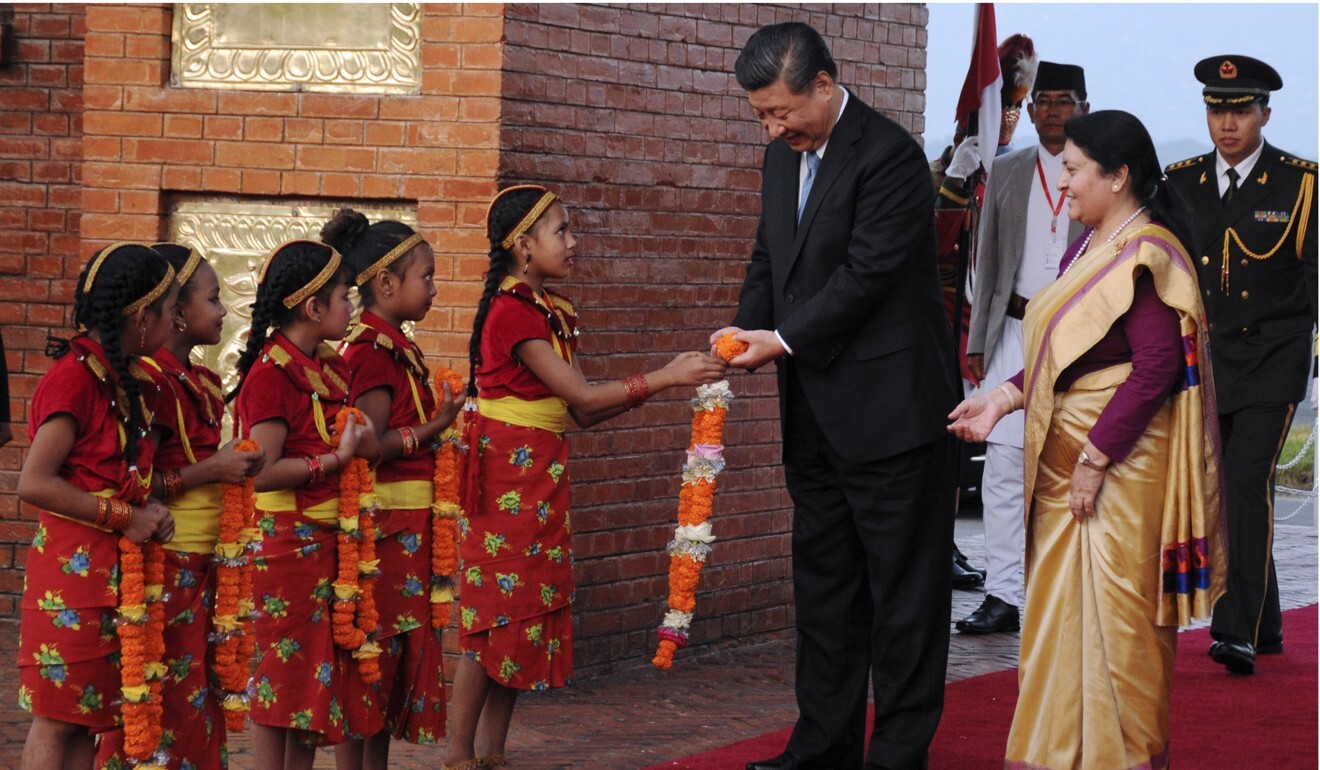
Chinese President Xi Jinping visited Nepal in October. Photo: EPA-EFE
Following a state visit to Nepal by Chinese President Xi Jinping in October, the two countries agreed to jointly launch a scientific research project to determine the exact height of Everest, recognising the peak as “an eternal symbol of the friendship between the two countries”.
China’s natural resources ministry said the project indicated a new step in the friendship and highlighted the historical significance of the mission, which coincides with the 60th anniversary of the first Chinese ascent of the mountain’s north side as well as the 45th anniversary of China’s first precise measurement of the peak.
The results of the survey will be used for geodynamics research and the precise depth of the summit’s snowcap, meteorological and wind speed data will offer first-hand materials for glacier monitoring and biological environment protection.
In a separate development, China Mobile said on Thursday that the entire peak now had 5G coverage.
In a joint project with Huawei, 5G antennas were installed at the mountain’s advance base camp, at a height of 6,500 metres. Antennas were installed earlier in April at the lower base camp, at 5,300 metres and at 5,800 metres.
Three films that opened on Monday morning rake in US$76.6 million by midday
Palme d’Or winner Chen Kaige heads bill with ensemble that has movie-goers in tears
My People, My Country looks at seven events in the past 70 years through the eyes of seven Chinese directors. Photo: Baidu
Three films that paid tribute to the People’s Republic of China on the eve of its 70th anniversary grossed a total of 546 million yuan (US$76.6 million) at the box offices hours after opening on Monday, Maoyan Entertainment, China’s largest movie ticketing app, said.
My People, My Country, consisting of seven short stories by seven directors led by Cannes Palme d’Or winner Chen Kaige, recounted major events since 1949. It took in 225 million yuan.
Milestones including the detonation of China’s atomic bomb in 1964; the handover of Hong Kong from the UK to China in 1997, and the staging of the Summer Olympics in Beijing in 2008, brought back many memories and stirred feelings of national pride, film-goers said.
“I went to see the movie today and saw many primary school students with their parents. Tears welled in my eyes, and I felt touched and proud at the same time. Go China!” one Weibo user wrote.
True-life drama The Captain has proved to a big screen hit with mainland cinema-goers. Photo: Baidu
“This movie used directors of commercial movies, and most of those born in the 1960s and 1970s lived through these moments. I think young people will bring their parents to see the film,” another Weibo user wrote.
True-life drama The Captain, directed by Hong Kong director Andrew Lau Wai-Keung, ran in second with a box office take of 175 million yuan by noon on Monday. The film was based on events in May 2018, when the cockpit window of a Sichuan Airlines flight was shattered at 30,000 feet over the Tibetan Plateau in western China. The decompression pulled the co-pilot halfway out of the cabin as the pilot fought to land the flight safely.
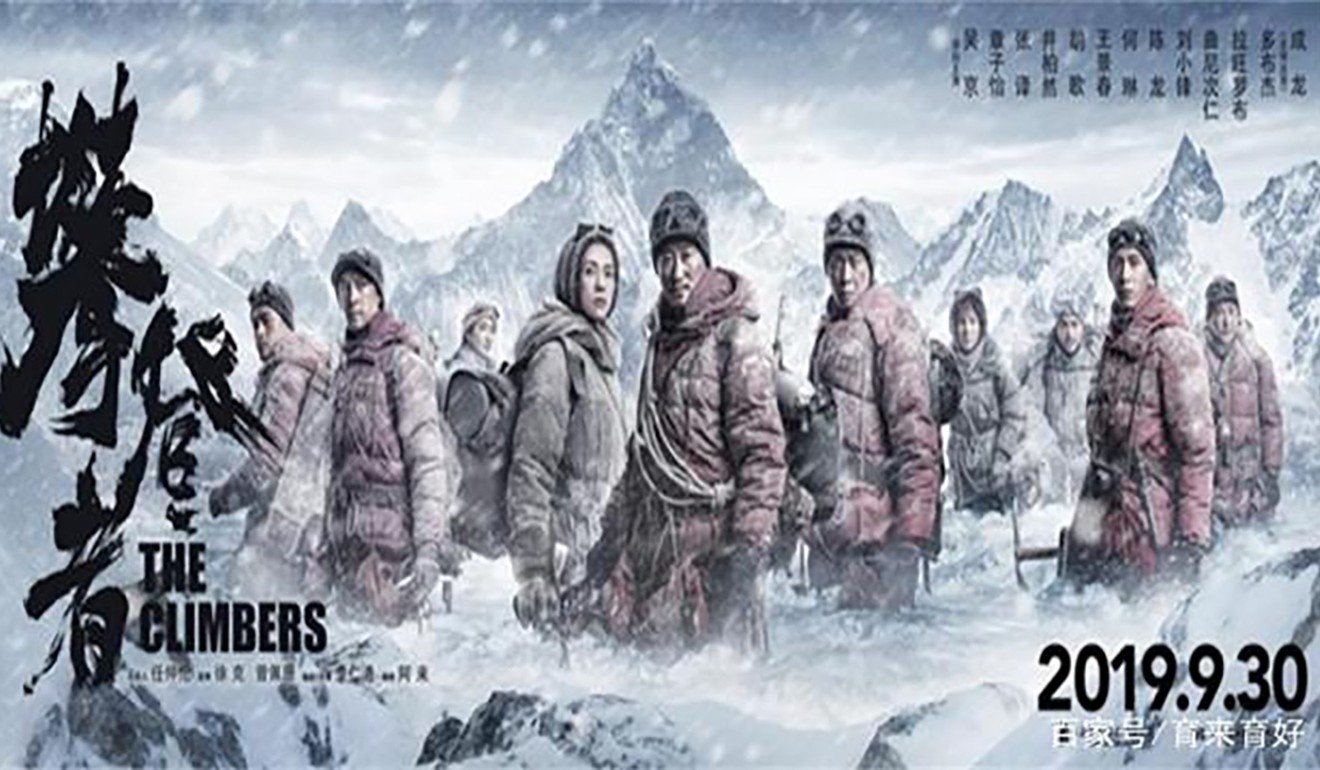
Big-budget film The Climbers, directed by Hong Kong’s Daniel Lee Yan-Kong and featuring stars such as Wu Jing and Zhang Ziyi, retraced the steps of two generations of Chinese mountaineers who scaled Mount Everest by the perilous North Ridge in 1960 and 1975. The film posted earnings of 146 million yuan.
Tencent’s homage to modern China tops gaming charts on eve of 70th anniversary celebrations
Patriotic feelings have been running high this week as the celebration of the 70th anniversary draws near.
My People, My Country’s theme song, Me and My Mother Country, an oldie recorded by Hong Kong’s Faye Wang, has been heard in shops, restaurants and workplaces all across the mainland.
The Climbers was directed by Hong Kong’s Daniel Lee Yan-Kong. Photo: Baidu
Last week, 200 million WeChat users responded to a campaign by internet company Tencent to add a national flag or Happy National Day sticker to their social media profile picture, The Beijing News reported. Demand was so heavy Tencent’s servers were overwhelmed for a short time.
NEW DELHI (Reuters) – Five bodies were spotted high on a mountain in the Indian Himalayas on Monday during an aerial search for eight climbers feared swept away in an avalanche last week, a government official said.
The climbers – four from Britain, two from the United States, and one each from Australia and India – were reported missing by colleagues on Friday after they failed to return to their base camp near Nanda Devi, India’s second highest mountain.
An air force helicopter spotted the five bodies on a flight over the area where they went missing, Vijay Kumar Jogdande, the top government official in the nearby Pithoragarh district.
“Four bodies can be seen together and a fifth slightly away from the others,” he said.
The search mission was now working on the assumption that all eight climbers had been killed, he said.
“We are trying to retrieve the bodies. We believe the other three will be nearby,” he said.
The climbers was attempting to climb an unnamed, previously unclimbed 6,477 metre (21,250 feet) peak near Nanda Devi when their route was hit by a “sizeable avalanche”, said the company that organised the expedition, Moran Mountain.
Jogdande, said the bodies were above 5,000 metres and the possibility of a second avalanche would make accessing the site difficult. It had not been decided whether a team would go in by air or on foot, he said.
“We’re considering both alternatives. Since the bodies are at high altitude it is inaccessible, it is still unstable terrain that could lead to a secondary avalanche. We’re working out a plan.”
“It has always been a dangerous place to go. Mount Everest is easier to climb,” he said.
A team would take at least a week to reach the area, Sanjay Gunjiyal, a senior police official involved in the mission, told Reuters.
Four climbers in the group had turned back and later raised the alarm about their missing colleagues. They were evacuated from their base camp by helicopter and were “fine and healthy”, said Tripti Bhatt, an official of the Uttarakhand State Disaster Response Force.
DEADLY SEASON
It has been one of the deadliest climbing seasons in the Himalayas for several years. More than 20 people have been killed in the mountains, including 11 on Mount Everest, the world’s highest peak that has been plagued by poor weather, inexperienced climbers and overcrowding.
Nanda Devi, at 7,816 metres (25,643 feet), and its sister mountain, Nanda Devi East, are among the world’s most challenging peaks and only a handful of people have climbed them.
The leader of the missing group, Martin Moran, was the first person to summit Changuch, another peak in the area, and was known as a “godfather” of guiding in the Himalayas, according to a video diary of Rob Jarvis, who accompanied him on that expedition in 2009.
“He was very well versed with the area, but the route they were taking is not usually travelled,” Gunjiyal said.
Many of the other missing climbers are veterans but with little experience of Nanda Devi and its surrounding peaks, he said.
Indian authorities have identified the eight missing as Moran, John McLaren, Rupert Whewell and Richard Payne, all from Britain, Anthony Sudekum and Ronald Beimel from the United States, Ruth McCance from Australia, and liaison officer Chetan Pandey from the Indian Mountaineering Foundation.
Image copyrightGETTY IMAGESImage captionMore and more people want to see the world’s tallest peak
China has closed the base camp on its side of Mount Everest to visitors who don’t have climbing permits.
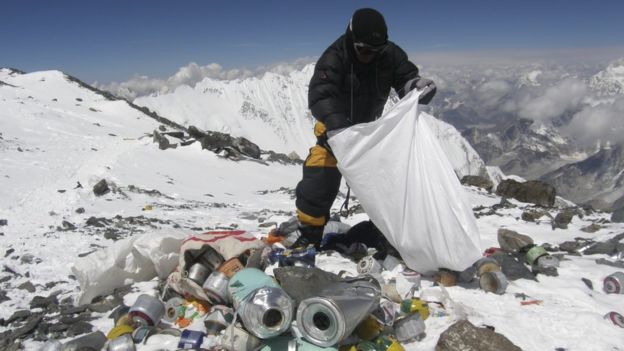
Authorities have resorted to the unusual move to deal with the mounting waste problem at the site.
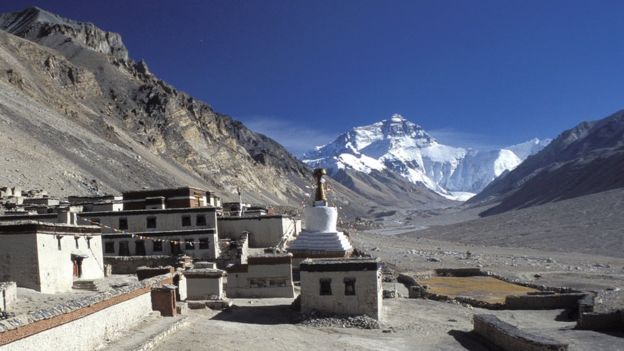
The ban means tourists can only go as far as a monastery slightly below the 5,200m (17,060ft) base camp level.
More people visit the mountain from the southern side in Nepal, but over the past years numbers have been rising steadily on the Chinese side as well.
The Chinese base camp, located in Tibet, is popular as it is accessible by car – whereas the Nepalese camp can only be reached by a hike of almost two weeks.
The world’s highest peak has been struggling with escalating levels of rubbish for years, as the number of visitors rises.
The Chinese Mountaineering Association says 40,000 visited its base camp in 2015, the most recent year with figures. A record 45,000 visited Nepal’s base camp in 2016-7 according to Nepal’s Ministry of Forests and Soil Conservation.
Image copyrightGETTY IMAGESImage captionTourists are still allowed to go as far as the Rongbuk monastery
Ordinary tourists will only be banned from areas above Rongbuk monastery, which is around 5,000m above sea level, according to China’s state news agency Xinhua.
Mountaineers who have a permit to climb the 8,848m peak will still be allowed to use the higher camp.
In January, authorities announced that they would limit the number of climbing permits each year to 300.
On Chinese social media, claims have spread in recent days that its base camp will be permanently closed to tourists – but Xinhua cited officials denying that.
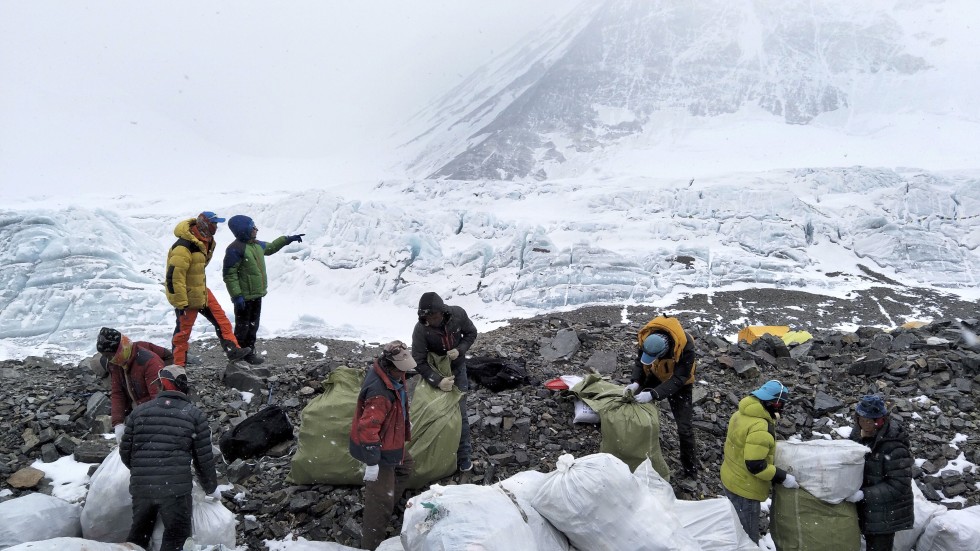
Image copyrightGETTY IMAGESImage captionThe temperature and high altitude make clean-up efforts on Everest a tough task
The official announcement about the closure was made in December, on the website of the Tibetan authorities.
It stated that three clean-up operations last spring had collected eight tonnes of waste, including human faeces and mountaineering equipment climbers had left behind.
This year’s clean-up efforts will also try to remove the bodies of mountaineers who have died in the so-called death zone above 8,000m, where the air is too thin to sustain life for long.
Due to the cold and high altitude, these bodies often remain on the mountain for years or even decades.
China will cut the number of climbers attempting to scale Mount Everest from the north by one-third this year as part of plans for a major clean-up on the world’s highest peak, state media reported Monday.
The total number of climbers seeking to reach the summit from the north will be limited to less than 300 and the climbing season restricted to spring, China Dailyreported.
The clean-up efforts will include the recovery of the bodies of climbers who died more than 8,000 meters (26,246 feet) up the mountain, they said.
Parts of Everest are in China and Nepal. Each year, about 60,000 climbers and guides visit the Chinese north side of the mountain, which China refers to by its Tibetan name, Mount Qomolangma.
China has set up stations to sort, recycle and break down rubbish from the mountain, which includes cans, plastic bags, stove equipment, tents and oxygen tanks.
On the Nepalese side, mountaineering expedition organisers have begun sending huge refuse bags with climbers during the spring climbing season to collect waste that then can be winched by helicopters back to the base camp.
Everest claims multiple victims each year, often in the “death zone” above 8,000 meters (26,246 feet), where the air is too thin to sustain human life.
In 2017, 648 people climbed Everest, including 202 from the north side, according to the non-profit Himalayan Database.
Six people were confirmed to have died on the mountain that year, one of them on the north side.






 CHINDIA ALERT: You'll be living in their world, very soon
COMMENTS: