Chindia Alert: You’ll be Living in their World Very Soon
aims to alert you to the threats and opportunities that China and India present. China and India require serious attention; case of ‘hidden dragon and crouching tiger’.
Without this attention, governments, businesses and, indeed, individuals may find themselves at a great disadvantage sooner rather than later.
The POSTs (front webpages) are mainly 'cuttings' from reliable sources, updated continuously.
The PAGEs (see Tabs, above) attempt to make the information more meaningful by putting some structure to the information we have researched and assembled since 2006.
WASHINGTON (Reuters) – U.S. Ambassador to China Terry Branstad was due to begin visiting Tibet on Sunday for official meetings and visits to religious and cultural sites, according to a news report on Sunday.
Branstad was scheduled to visit the Tibet Autonomous Region and Qinghai Province, a historic region of Tibet known to Tibetans as Amdo, from Sunday to Saturday, Radio Free Asia said in a report.
RELATED COVERAGE
U.S. Ambassador to China visiting Tibet this week
The State Department did not immediately comment on the story.
Radio Free Asia said it would be the first visit to Tibet by a U.S. official since the U.S. Congress approved a law in December that requires the United States to deny visas to Chinese officials in charge of implementing policies that restrict access to Tibet for foreigners. The U.S. government is required to begin denying visas by the end of this year.
In December, China denounced the United States for passing the law, saying it was “resolutely opposed” to the U.S. legislation on what China considers an internal affair, and it risked causing “serious harm” to their relations.
Since then, tensions have been running high between the two countries over trade. China struck a more aggressive tone in its trade war with the United States on Friday, suggesting a resumption of talks between the world’s two largest economies would be meaningless unless Washington changed course.
On Saturday, China’s senior diplomat Wang Yi told U.S. Secretary of State Mike Pompeo that recent U.S. words and actions had harmed the interests of China and its enterprises, and that Washington should show restraint.
While the Trump administration has taken a tough stance towards China on trade and highlighted security rivalry with Beijing, the administration has so far not acted on congressional calls for it to impose sanctions on China’s former Communist Party chief in Tibet, Chen Quanguo, for the treatment of minority Muslims in Xinjiang province, where he is currently party chief.
A State Department report in March said Chen had replicated in Xinjiang, policies similar to those credited with reducing opposition to Chinese rule in Tibet.
Beijing sent troops into remote, mountainous Tibet in 1950 in what it officially terms a peaceful liberation and has ruled there with an iron fist ever since.
India is in full election mode: voting began on 11 April, and the final ballot will be cast on 19 May with results out on 23 May. Every day, the BBC will be bringing you all the latest updates on the twists and turns of the world’s largest democracy.
Ruling party candidate calls Gandhi’s killer a patriot
What is happening?
Controversial Bharatiya Janata Party (BJP) politician Pragya Thakur has made headlines again. This time it was for calling Nathuram Godse – the man who assassinated Mahatma Gandhi – a “patriot”.
Her comment was made in response to a statement by southern actor-turned politician Kamal Haasan who had said India’s first “extremist” was a Hindu”, referring to Godse.
#WATCH BJP Bhopal Lok Sabha Candidate Pragya Singh Thakur says ‘Nathuram Godse was a ‘deshbhakt’, is a ‘deshbhakt’ and will remain a ‘deshbhakt’. People calling him a terrorist should instead look within, such people will be given a befitting reply in these elections
His statement, made on Monday, was heavily criticised by the BJP, which accused him of indulging in “divisive politics” and filed a complaint against him with the Election Commission of India.
Why does this matter?
The BJP has responded by criticising Ms Thakur and asking her to publicly apologise.
“BJP does not agree with this statement, we condemn it. Party will ask her for clarification, she should apologise publicly for this statement,” party spokesperson GVL Narasimha Rao told reporters.
However, Ms Thakur’s comments do reflect the views of some right-wing Hindus who support the BJP and have long seen Gandhi as too moderate.
Godse, who shot Gandhi in the chest three times at point-blank range on 30 January 1948, was also an activist with nationalist right-wing groups, including those closely associated with the BJP.
Hindu hardliners in India accuse Gandhi of having betrayed Hindus by being too pro-Muslim, and even for the division of India and the bloodshed that marked Partition, which saw India and Pakistan created after independence from Britain in 1947.
Ms Thakur has seen her fair share of controversy. Her candidature caused outrage as she is an accused of involvement in a blast that killed seven people and injured 100 others. On 18 April, she said that police officer Hemant Karkare had died in the November 2008 Mumbai terror attacks because she had “cursed” him. She was then banned from campaigning for 72 hours as a result.
A team led by Mr Karkare had arrested her for questioning in connection with the Malegaon blast.
During her campaign, she also said she was “proud” of her part in the demolition of the 16th Century Babri mosque. In 1992, right-wing Hindu mobs razed the mosque to the ground, claiming it was built on the site of a temple destroyed by Muslim rulers. The site, which is in the city of Ayodhya, has been a religious flashpoint for Hindus and Muslims for decades.
Campaigning ends in West Bengal a day before deadline
What happened?
The Election Commission (EC) has told political parties to end their campaigning in West Bengal state, a day before the deadline in the wake of poll-related violence.
The campaign will end on Thursday at 10pm local time, and voting will be held on Sunday.
The decision comes after clashes broke out between the Bharatiya Janata Party (BJP) workers and protesters believed to be from the ruling Trinamool Congress (TMC) in Kolkata (formerly Calcutta) on Tuesday.
It happened during a roadshow of BJP chief Amit Shah. Several people were injured and vehicles were set on fire. A statue of renowned Bengali reformer Iswarchandra Vidyasagar was also vandalised in the clashes.
Both parties have accused each other of starting the violence.
Why does this matter?
Image copyright GETTY IMAGESImage caption Violence took place during BJP chief Amit Shah’s rally in Kolkata on Tuesday
The BJP welcomed the decision, saying it validated their argument that the state had “descended into anarchy” under the leadership of chief minister Mamata Banerjee.
Ms Banerjee said that the move was “undemocratic” and “it had insulted the people of Bengal”.
“Tomorrow, [Prime Minister Narendra] Modi has two meetings in Bengal. When he finishes, the campaigning also ends… Instead of punishing Amit Shah, the Election Commission has given a gift to the BJP,” she said.
Image copyright AFPImage caption Several people were injured and vehicles were set on fire during the violence
Both parties are locked into a fierce election battle to win most out West Bengal’s 42 seats. Ms Banerjee has ambitions of becoming the prime minister in case a nationwide coalition of regional parties wins enough seats.
The state has also become crucial for the BJP as it’s trying to expand its reach in the eastern state. It won only two seats in the 2014 election.
The BJP performed well in northern states like Uttar Pradesh and Rajasthan in 2014, but this time it’s expected to suffer loses against a coalition of regional parties and the main opposition Congress.
So the party is trying to make up for the losses in West Bengal.
TMC, BJP accused each other of poll violence
Image copyright GETTY IMAGES
What happened?
The war of words between West Bengal state chief minister Mamata Banerjee and the governing Bharatiya Janata Party (BJP) intensified ahead of voting on Sunday.
The latest verbal duel comes after violence was reported during BJP chief Amit Shah’s roadshow in Kolkata (formerly Calcutta) on Tuesday.
Clashes broke out between BJP supporters and protesters who were holding “Amit Shah go back” posters.
Some people suffered minor injuries and a few vehicles were set on fire.
The BJP said the protest was “orchestrated” and called it an “attempt to strangulate democracy”.
Why does this matter?
The eastern state has become politically crucial for the BJP as it has intensified campaigning in the past few days.
And that has sparked a feverish electoral battle between the BJP and Ms Banerjee’s Trinamool Congress (TMC).
“What does Amit Shah think of himself? Is he above everything? Is he god that no one can protest against him?” Ms Banerjee said.
In reply, Mr Shah accused the TMC of not following democratic norms during elections.
“Have faith in the people of Bengal that they’d face the TMC goons,” he said.
Prime Minister Narendra Modi is scheduled to hold more rallies in the coming days, so one can expect more verbal fireworks from the two leaders.
On Tuesday, the saga of the morphed Mamata meme continued
What happened?
India’s top court stepped in to release an activist belonging to India’s governing Bharatiya Janata Party (BJP) who was sent to prison for sharing a doctored image of West Bengal Chief Minister Mamata Banerjee.
Priyanka Sharma was sentenced to two weeks in prison on 10 May after she shared a picture of Bollywood star Priyanka Chopra and her husband Nick Jonas at the Met Gala – but with Ms Banerjee’s head superimposed on to Chopra’s body.
Earlier the court had said Ms Sharma could be released only if she apologised to Ms Banerjee, but later waived this condition.
Why does this matter?
The battle for West Bengal in this general election has been absolutely bruising.
The BJP, led by Prime Minister Narendra Modi himself, has been campaigning hard for votes in the state. This has brought them toe-to-toe with the state’s feisty chief minister. The fact that voting for West Bengal’s 42 seats has been split across all nine phases of voting has meant that the battle has been long and drawn-out.
And with just one phase to go before voting finally ends, the gloves are well and truly off. The two parties have traded insults on the campaign stage, their workers have attacked each other, and the violence on the ground has intensified. And now the battle has spread to cyberspace as well.
The country’s finance minister Arun Jaitley jumped at news of Ms Sharma’s release to call Ms Banerjee a dictator.
Humour, wit, sarcasm survive in a free society. They have no place in autocracies. Dictators laugh at people. They don’t like people laughing at them. Bengal, today is a case in point.
Analysts say that this political row is so bitter because the BJP has clearly identified West Bengal as one of the states where they may be able to make gains this election. This becomes more important for the party in the context of their fight in the politically crucial state of Uttar Pradesh, which sends the most number of MPs (80) to parliament.
They are up against a powerful coalition of regional parties there, and many expect them to lose seats as a result.
And PM Modi said Rahul Gandhi should be ashamed of 1984 riots
What happened?
Prime Minister Narendra Modi said that main opposition Congress party chief Rahul Gandhi should be “ashamed of himself” over his colleague’s remark on the 1984 anti-Sikh riots.
Mr Modi was replying to a controversial statement made by Sam Pitroda, who is a strategist of the Congress party.
In his reply to a question about the Congress’ role in the riots, Mr Pitroda had said “so what?”.
“I don’t think so, this is also another lie, and what about 1984? You speak about what you [Mr Modi] have done in five years. It [the riots] happened in 1984, so what?” he said.
Mr Gandhi said he was “ashamed” of Mr Pitroda’s statement, and asked him to apologise.
Mr Pitroda later said his statement was “twisted” and he did not mean to hurt sentiments.
But Mr Modi said the Congress chief “must apologise”.
“I was watching that naamdar [the dynast] told his guru that he should be ashamed of what he said. I want to ask naamdar, you pretended to scold your mentor for what? Because he exposed what was always in the Congress’s heart, and in the discussions of the naamdar family? Because he made public a family secret? Naamdar, it is you who should be ashamed,” Mr Modi said.
Why does this matter?
The controversy matters because it comes days ahead of voting for the 13 seats in the northern state of Punjab.
The BJP, which has formed a coalition with regional Shiromani Akali Dal, is locked in a bitter electoral battle with the ruling Congress in the state.
Sikhs are a majority in the state and the 1984 riots is still an emotional issue for many of them.
More than 3,000 Sikhs were killed in 1984 after the assassination of former prime minister Indira Gandhi by her Sikh bodyguards.
They were angry at her decision to send the army into the Golden Temple – Sikhism’s holiest shrine – to flush out militants earlier in the year.
The killing of Mrs Gandhi, who belonged to the Congress, saw mobs attack and murder members of the Sikh community across the country.
And both parties appear to be trying to come across as pro-Sikh ahead of the vote on 19 May.
On Sunday, Delhi voted but not enthusiastically
Image copyright GETTY IMAGESImage caption Delhi’s voter turnout was lower than in 2014
What happened?
Sunday saw India’s capital Delhi vote along with several other states in the polls – the penultimate phase of the country’s mammoth general election.
Voters turned out to vote, but in fewer numbers than they did in 2014. The election commission said that around 60% of the capital’s registered voters had actually cast ballots, which was about a five percent drop from 2014.
Delhi Chief Electoral Officer Ranbir Singh expressed disappointment, saying that the turnout did not match expectations.
Why does this matter?
The election commission is right to be disappointed – it had run a series of campaigns in the city, encouraging more people to vote.
But it was not as though polling in Delhi was an entirely smooth process. Some voters complained that their names were missing from electoral lists even though they had all the necessary documents. There were also reports that around 1,200 Electronic Voting Machines (EVMs) had malfunctioned across the city, delaying the polling process.
The fact that Delhi became a three-cornered contest after the main opposition Congress and the Aam Aadmi Party (AAP), which controls the Delhi state assembly, failed to stitch up an alliance may also have put voters off. Many analysts believe that this failure will only split voters who were against prime minister Narendra Modi’s Bharatiya Janata Party (BJP) and effectively hand them victory.
So they may have decided to just stay home, and not bother queuing up in the blistering heat – it touched 40C on Sunday.
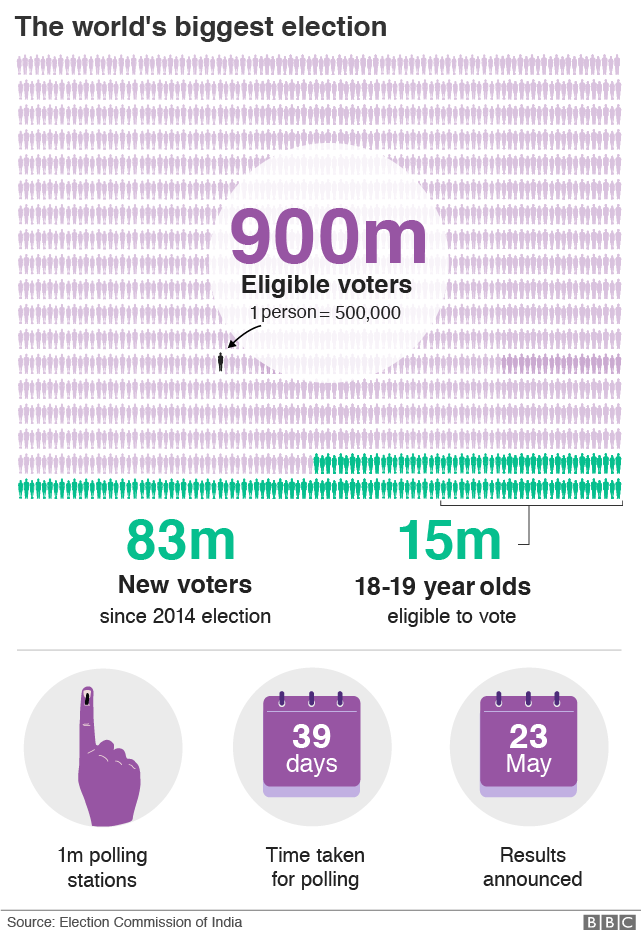
It is an election like no other. Those eligible to vote in India’s upcoming polls represent more than 10% of the world’s population and they will take part in the largest democratic exercise in history.
Voters will choose representatives for the Indian parliament, and in turn decide if Hindu nationalist Prime Minister Narendra Modi will run the country for another five years.
What is at stake?
Whoever wins these elections and forms a government will control the destiny of the world’s largest democracy.
While they are in charge, India’s economy is likely to overtake the UK’s and become the world’s fifth-largest.
Its population meanwhile – at more than 1.34bn people – is predicted to soon surpass China’s 1.39bn.
Hundreds of millions of Indians have escaped poverty since the turn of the millennium but huge challenges remain.
Unemployment is a major concern and is especially high among young people.
Millions of farmers are angry about low crop prices.
How the nuclear-armed country engages with the outside world – and manages a tricky relationship with its neighbour Pakistan – is also of immense importance to international security.
Who is being elected?
Indians are voting for members of parliament and the job of prime minister tends to go to the leader of the party or coalition with most seats. The current PM is Narendra Modi.
His main rival is opposition leader Rahul Gandhi.
Parliament has two houses: the Lok Sabha and the Rajya Sabha.
The lower house – Lok Sabha – is the one to watch.
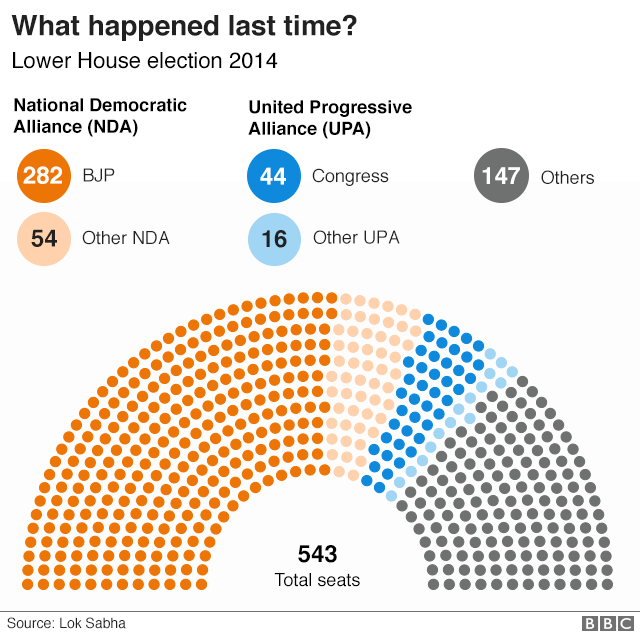
It has 543 elected seats and any party or coalition needs a minimum of 272 MPs to form a government.
At the last election in 2014, Mr Modi’s BJP won 282 seats.
Mr Gandhi’s Congress Party only took 44 seats in 2014 – down from 206 in 2009.
Why does voting take so long?
Because of the enormous number of election officials and security personnel involved, voting will take place in seven stages between 11 April and 19 May.
Different states will vote at different times.
Votes will be counted on 23 May and results are expected on the same day.
Who will win?
This election is being seen as a referendum on Mr Modi, a polarising figure adored by many but also accused of stoking divisions between India’s Hindu majority and the country’s 200 million Muslims.
Until a few months ago, Mr Modi and his BJP party were seen as the overwhelming favourites. But the loss of key states in December’s regional elections injected a sense of serious competition into the national vote.
Analysts are divided on whether Mr Modi will be able to win a simple majority again.
A recent escalation of tensions with Pakistan has given the BJP a new and popular issue to campaign on.
It will be hoping that a focus on patriotism will help the party to get past the serious challenge mounted by powerful regional parties and Congress.
GENEVA (Reuters) – U.N. human rights chief Michelle Bachelet warned India on Wednesday that its “divisive policies” could undermine economic growth, saying that narrow political agendas were marginalising vulnerable people in an already unequal society.
“We are receiving reports that indicate increasing harassment and targeting of minorities – in particular Muslims and people from historically disadvantaged and marginalised groups, such as Dalits and Adivasis,” Bachelet said in her annual report to the U.N. Human Rights Council in Geneva.
Image copyrightGETTY IMAGES (ALLISON JOYCE)Image captionCow vigilantes in Ramgarh in 2015
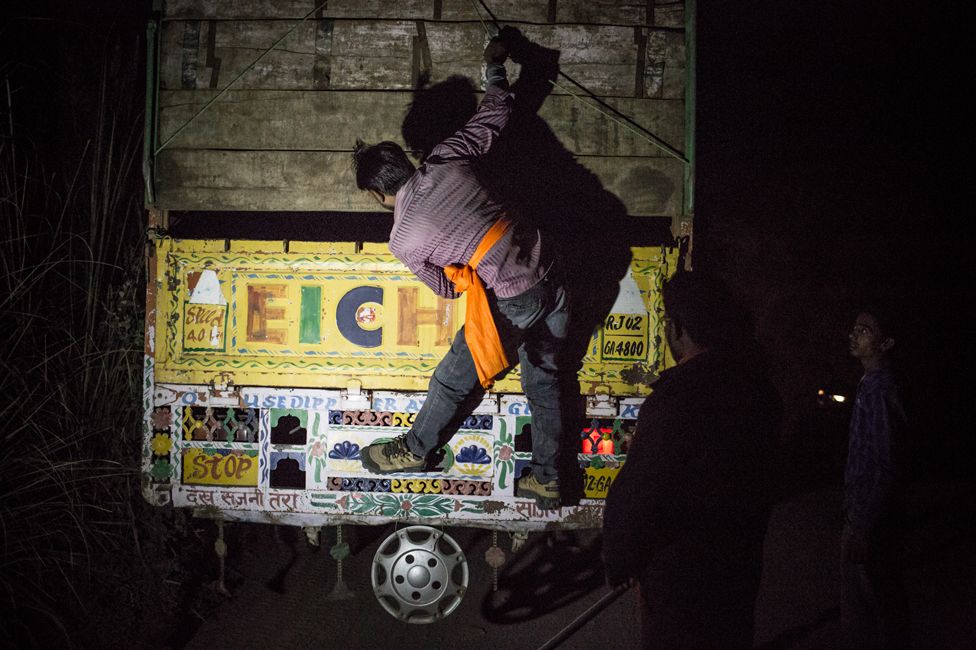
A Muslim dairy farmer was stopped late one night last July as he led two cows down a track in rural Rajasthan, south of the Indian capital, Delhi. Within hours he was dead, but who killed him, asks the BBC’s James Clayton – the “cow vigilantes” he met on the road, or the police?
It’s 4am and Dr Hassan Khan, the duty doctor at Ramgarh hospital, is notified of something unusual.
The police have brought in a dead man, a man they claim not to know.
“What were the police like when they brought him in? Were they calm?” I ask him.
“Not calm,” he says. “They were anxious.”
“Are they usually anxious?” I ask.
“Not usually,” he says, laughing nervously.
The dead man is later identified by his father as local farmer Rakbar Khan.
This was not a random murder. The story illustrates some of the social tensions bubbling away under the surface in India, and particularly in the north of the country.
And his case raises questions for the authorities – including the governing Hindu nationalist BJP party.
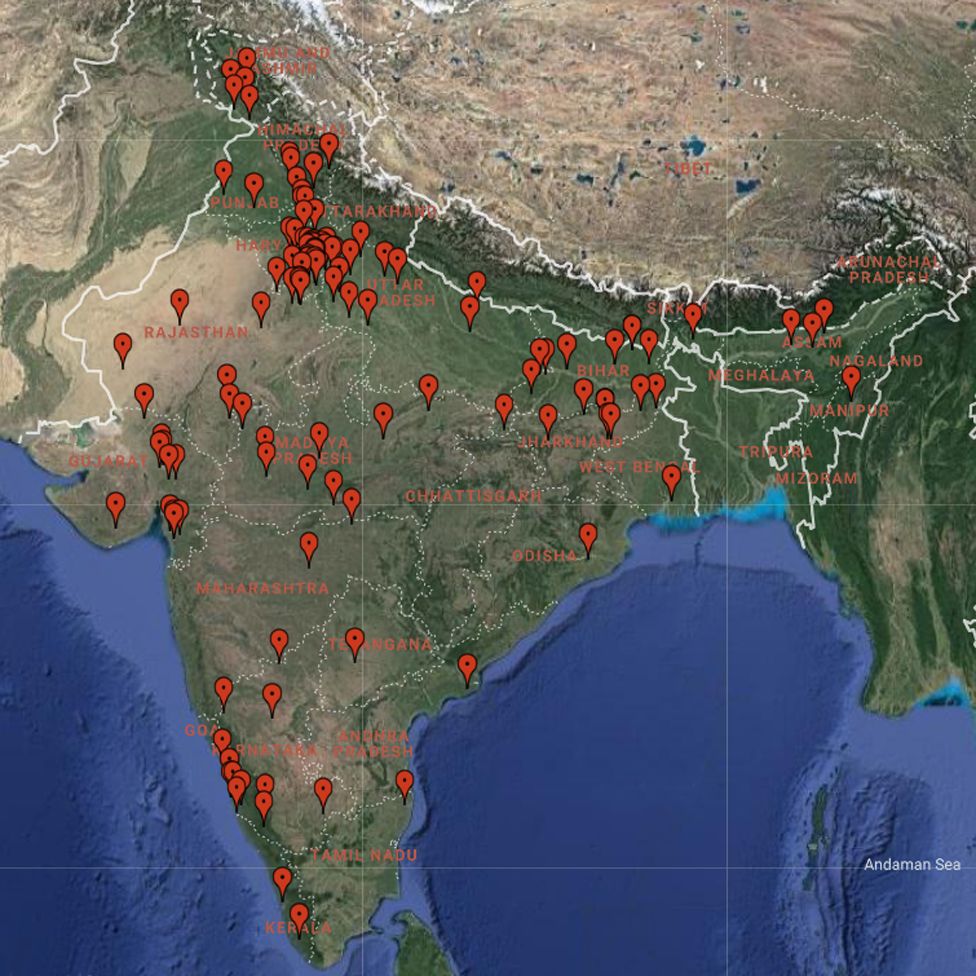
Cow-related violence – 2012-2019
Image copyrightINDIASPENDRakbar Khan was a family man. He had seven children.
He kept cows and he also happened to be a Muslim. That can be a dangerous mix in India.
“We have always reared cows, and we are dependent on their milk for our livelihood,” says Rakbar’s father, Suleiman.
“No-one used to say anything when you transported a cow.”
That has changed. Several men have been killed in recent years while transporting cows in the mainly Muslim region of Mewat, not far from Delhi, where Rakbar lived.
“People are afraid. If we go to get a cow they will kill us. They surround our vehicle. So everyone is too scared to get these animals,” says Suleiman.
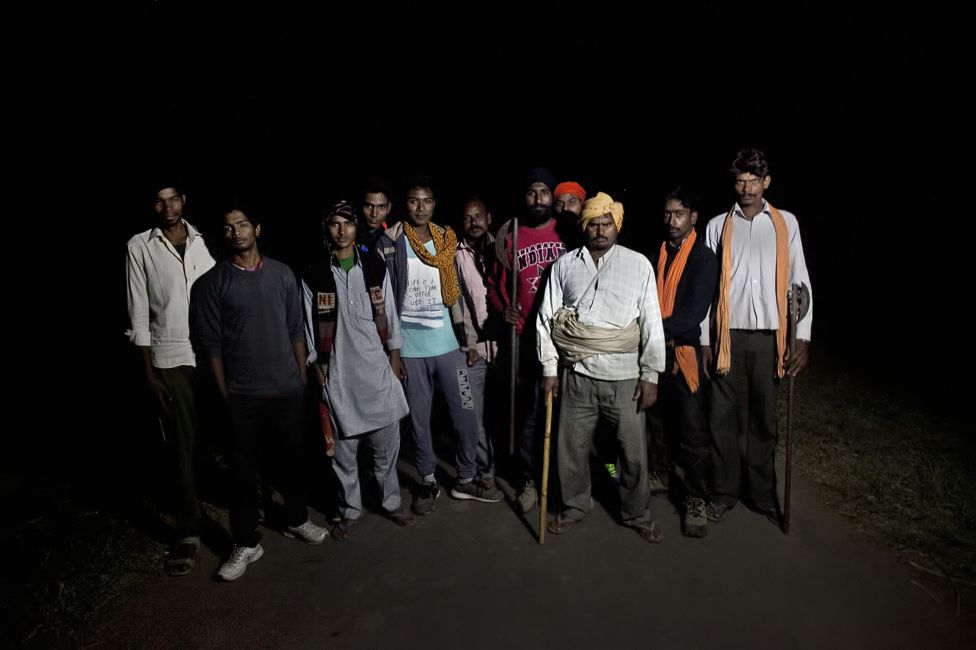
Everyone I speak to in the village where the Khans live is afraid of gau rakshaks – cow protection gangs.
Image copyrightGETTY IMAGES (ALLISON JOYCE)Image captionNawal Kishore Sharma’s cow protection group in 2015The gangs often consist of young, hardline Hindus, who believe passionately in defending India’s holy animal.
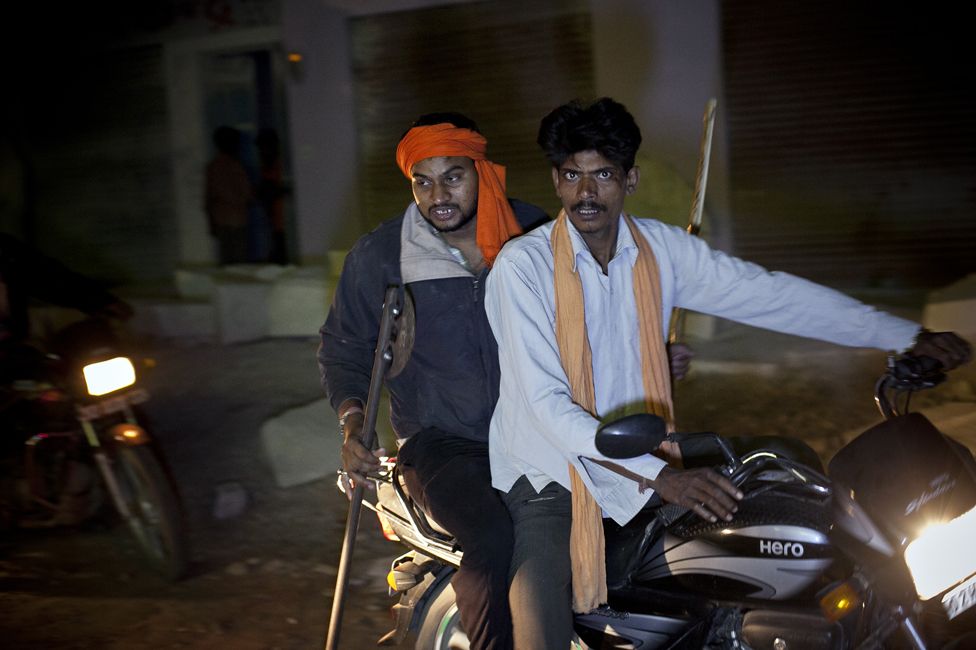
They believe that laws to protect cows, such as a ban on slaughtering the animals, are not being fully enforced – and they hunt for “cow smugglers”, who they believe are taking cows to be killed for meat.
Often armed, they have been responsible for dozens of attacks on farmers in India over the last five years, according to data analysis organisation IndiaSpend, which monitors reports of hate crimes in the media.
On 21 July 2018, Rakbar Khan met the local gau rakshak.
There are some things we know for certain about what happened that night.
Rakbar was walking down a small road with two cows. It was late and it was raining heavily.
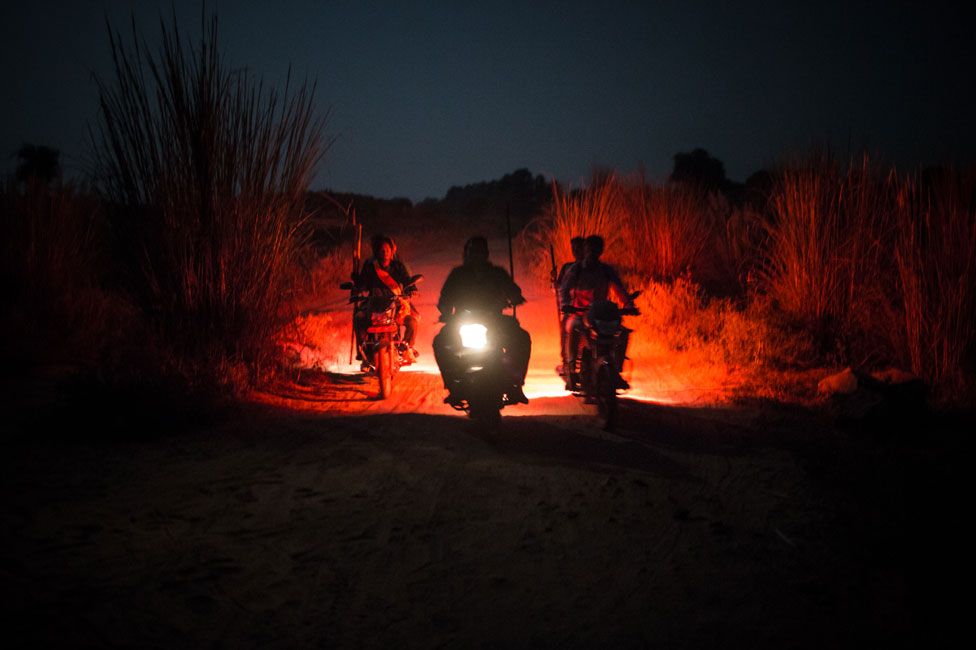
Then, out of the dark, came the lights of motorbikes. We know this, because Rakbar was with a friend, who survived.
Image copyrightGETTY IMAGES (ENRICO FABIAN)At this point the details become a little sketchier. There are three versions of the story.
The gang managed to catch Rakbar, but his friend, Aslam, slipped away. He lay on the ground, in the mud and prayed he wouldn’t be found.
“There was so much fear inside me, my heart was hurting,” he says.
“From there I heard the screams. They were beating him. There wasn’t a single part of his body that wasn’t broken. He was beaten very badly.”
The documentary India’s Cow Vigilantes can be seen on Our World on BBC World Newsand on the BBC News Channel (click for transmission times)
Aslam says that Rakbar was killed then and there.
But there is evidence that suggests otherwise.
Much of what happened next focuses around the leader of the local cow vigilante group, Nawal Kishore Sharma.
Aslam claims he heard the gang address him by name that night, but when I speak to Sharma, he denies he was there at all.
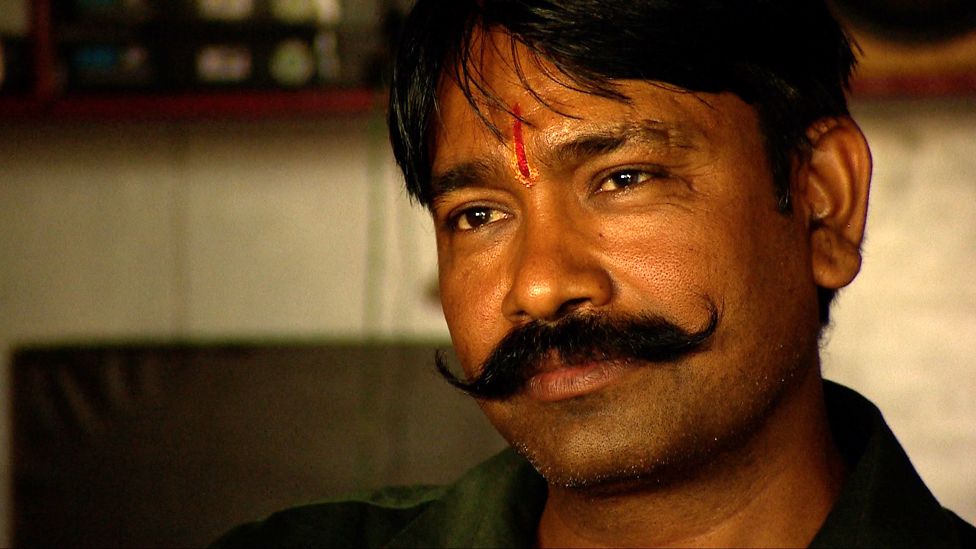
Image captionNawal Kishore Sharma
“It was about 00:30 in the morning and I was sleeping in my house… Some of my group phoned me to say they’d caught some cow smugglers,” he says.
According to Nawal Kishore Sharma, he then drove with the police to the spot. “He was alive and he was fine,” he says.
But that’s not what the police say.
In their “first incident report” they say that Rakbar was indeed alive when they found him.
“Nawal Kishore Sharma informed the police at about 00:41 that some men were smuggling two cows on foot,” the report says.
“Then the police met Nawal Kishore outside the police station and they all went to the location.
“There was a man who was injured and covered in mud.
“He told the police his name, his father’s name, his age (28) and the village he was from.
“And as he finished these sentences, he almost immediately passed out. Then he was put in the police vehicle and they left for Ramgarh.
“Then the police reached Ramgarh with Rakbar where the available doctor declared him dead.”
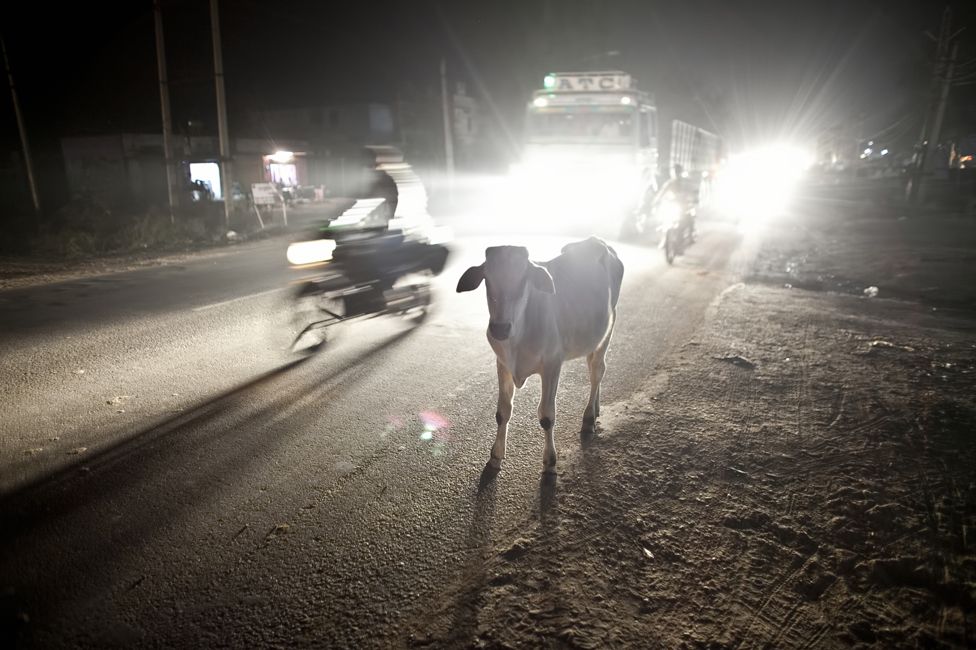
Image copyrightGETTY IMAGES (ALLISON JOYCE)Image captionRamgarh at nightBut this version of events is highly dubious.
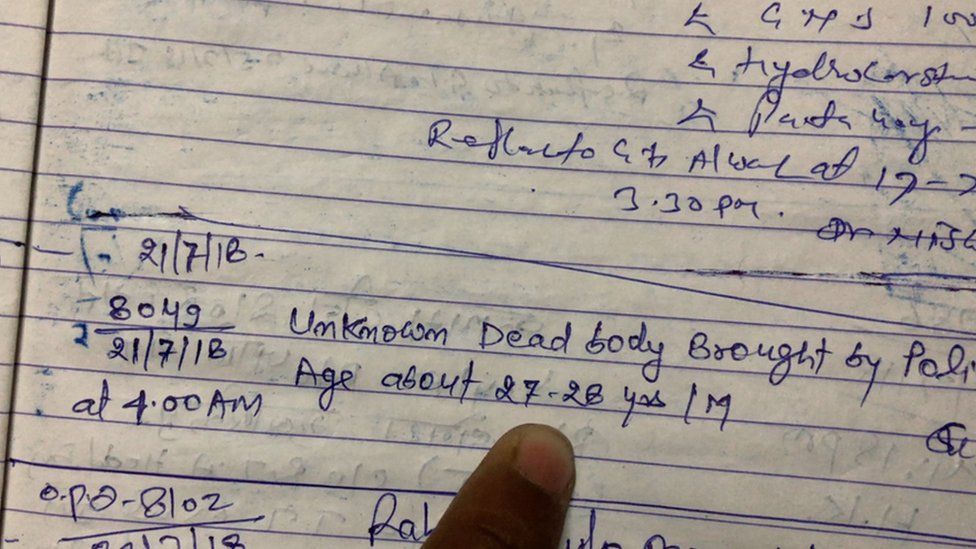
I go to the hospital in Ramgarh, where Rakbar was taken. Hospital staff are busily going through bound books of hospital records – looking for Rakbar’s admission entry.
And then, there it is. “Unknown dead body” brought in at 04:00 on 21 July 2018.
It’s not a long entry, but it contradicts the police’s story, and raises some serious questions.
For a start, Rakbar was found about 12 minutes’ drive away from the hospital. Why did it take more than three hours for them to take him there?
And if the police say Rakbar gave them his name, why did they tell the hospital they didn’t know who he was?
Nawal Kishore Sharma claims to know why. He paints a very different picture of what happened to Rakbar.
He tells me that after picking up Rakbar, they changed his clothes.
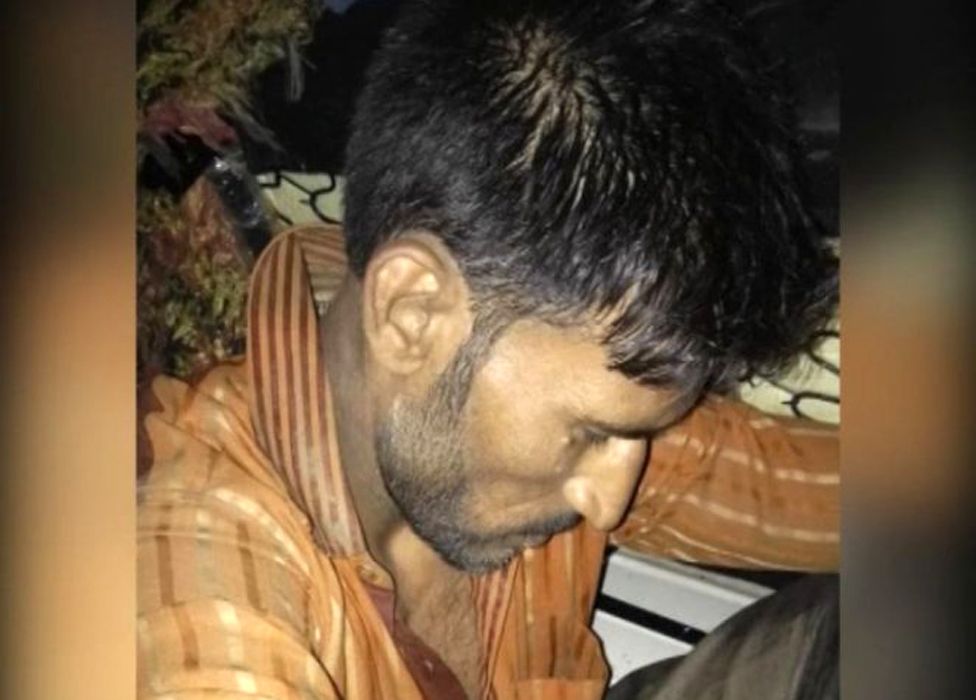
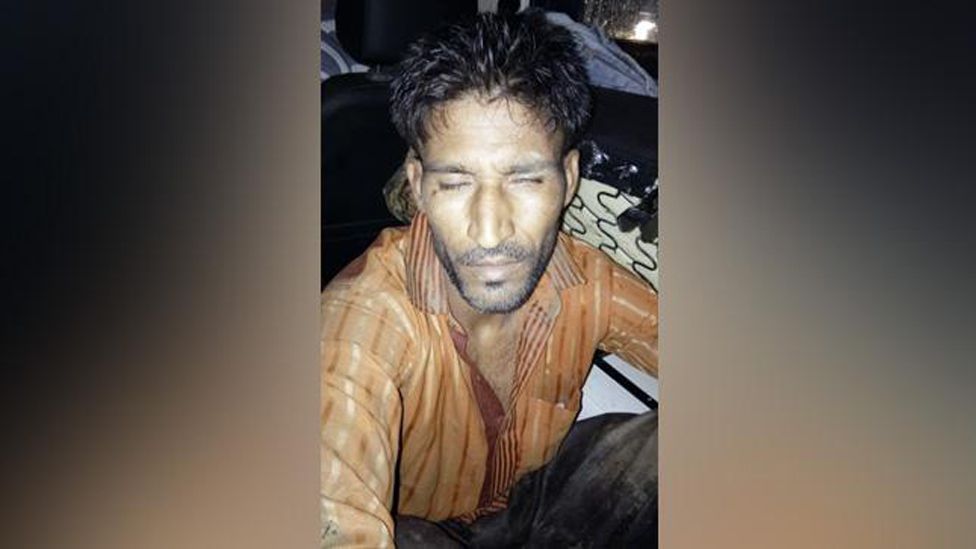
He then claims to have taken two photos of Rakbar – who at this point was with the police.
Sharma says that he went to the police station with the police. He claims that’s when the beating really began.
“The police injured him badly. They even beat him with their shoes,” he says.
“They kicked him powerfully on the left side of his body four times. Then they beat him with sticks. They beat him here (pointing at his ribs) and even on his neck.”
At about 03:00 Nawal Kishore Sharma says he went with some police officers to take the two cows to a local cow shelter. When he returned, he says, the police told him that Rakbar had died.
Rakbar’s death certificate shows that his leg and hand had been broken. He’d been badly beaten and had broken his ribs, which had punctured his lungs.
According to his death certificate he died of “shock… as a result of injuries sustained over body”.
I ask the duty doctor at the hospital whether he remembers what Rakbar’s body was like when the police brought it in.
“It was cold,” he says.
I ask him how long it would take for a body to become cold after death.
“A couple of hours,” he replies.
“I don’t want to talk about Rakbar’s case,” says Rejendra Singh, chief of police of Alwar district, which includes Ramgarh.
Since Rakbar’s murder several police officers have been suspended. I want to know why.
He looks uneasily at me.
“There were lapses on the police side,” he says.
I ask him what those lapses were.
“They had not followed the regular police procedure, which they were supposed to do,” he says. “It was one big lapse.”
Three men from Nawal Kishore Sharma’s vigilante group have been charged with Rakbar’s murder. Sharma himself remains under investigation.
The vigilante group and the police blame each other for Rakbar’s death, but neither denies working together that night.
The way Sharma describes it, the police cannot be everywhere, so the vigilantes help them out. But it’s the police that “take all the action” he says.
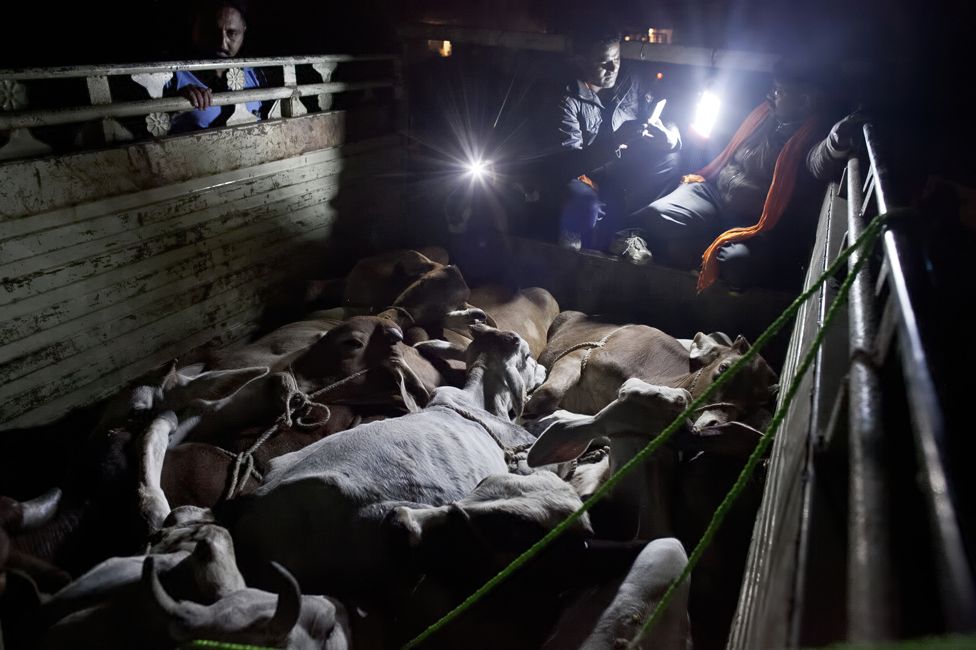
Image copyrightGETTY IMAGES (ENRICO FABIAN)Image captionNawal Kishore Sharma inspects a lorry transporting cows (October 2015)Much police activity in Rajasthan is focused on stopping cow slaughter.
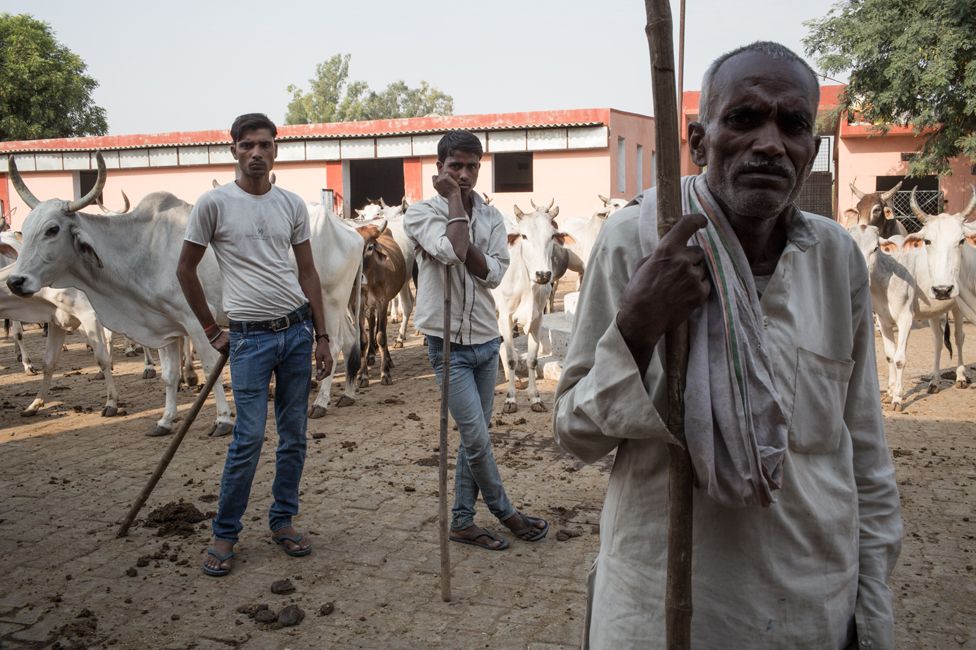
Across the state there are dozens of formal cow checkpoints, where police stop vehicles looking for smugglers who are taking cows to be killed.
I visited one of the checkpoints. Sure enough police were patiently stopping vehicles and looking for cows.
The night before officers had had a gun battle with a group of men after a truck failed to stop.
These checkpoints have become common in some parts of India. Sometimes they are run by the police, sometimes by the vigilantes, and sometimes by both.
This gets to the heart of Rakbar’s case.
Human rights groups argue that his murder – and others like his – show that in some areas the police have got too close to the gangs.
Image copyrightGETTY IMAGES (ALLISON JOYCE)Image captionThe vigilantes find what they are looking for (November 2015)“Unfortunately what we’re finding too often is that the police are complicit,” says Meenakshi Ganguly of Human Rights Watch, which published a 104-page report on cow-related violence in India this week.
In some areas, police have been reluctant to arrest the perpetrators of violence – and much faster to prosecute people accused of either consuming or trading in beef, he says.
Human Rights Watch has looked into 12 cases where it claims police have been complicit in the death of a suspected cow smuggler or have covered it up. Rakbar’s is one of them.
But this case doesn’t just illustrate police failings. Some would argue that it also illustrates how parts of the governing BJP party have inflamed the problem.
Gyandev Ahuja is a larger-than-life character. As the local member of parliament in Ramgarh at the time when Rakbar was killed he’s an important local figure.
He has also made a series of controversial statements about “cow smugglers”.
After a man was badly beaten in December 2017 Ahuja told local media: “To be straightforward, I will say that if anyone is indulging in cow smuggling, then this is how you will die.”
After Rakbar’s death he said that cow smuggling was worse than terrorism.
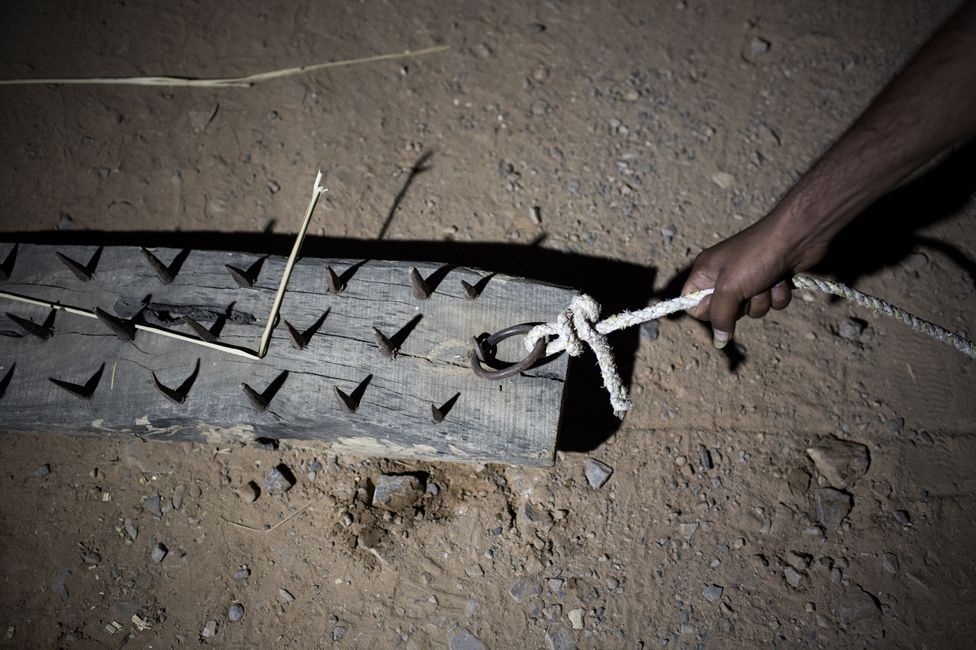
Image copyrightGETTY IMAGES (ENRICO FABIAN)Image captionNails used by the vigilantes to force lorries to stopGyandev Ahuja is just one of several BJP politicians who have made statements that are supportive of the accused in so-called “cow lynchings”.
One of Prime Minister Narendra Modi’s ministers was even photographed garlanding the accused murderers in a cow vigilante case. He has since apologised.
Meenakshi Ganguly of Human Rights Watch says it is “terrifying” that elected officials have defended attackers.
“It is really, at this point of time, something that is a great concern, because it is changing a belief into a political narrative, and a violent one,” he says.
The worry is that supportive messages from some of the governing party’s politicians have emboldened the vigilantes.
No official figures are kept on cow violence, but the data collected by IndiaSpend suggests that it started ramping up in 2015, the year after Narendra Modi was elected.
IndiaSpend says that since then there have been 250 injuries and 46 deaths related to cow violence. This is likely to be an underestimate because farmers who have been beaten may be afraid to go to the police – and when a body is found it may not be clear what spurred the attack. The vast majority of the victims are Muslims.
Image copyrightGETTY IMAGES (ENRICO FABIAN)Image captionA cow shelter in RamgarhA BJP spokesman, Nalin Kohli, emphatically rejects any connection between his party and cow violence.
“To say the BJP is responsible is perverse, inaccurate and absolutely false,” he tells me.
“Many people have an interest in building a statement that the BJP is behind it. We won’t tolerate it.”
I ask him about Gyandev Ahuja’s inflammatory statements.
“Firstly that is not the party’s point of view and we have very clearly and unequivocally always said an individual’s point of view is theirs, the point of view of the party is articulated by the party.
“Has the BJP promoted him or protected him? No.”
But a month after this interview, Ahuja was made vice-president of the party in Rajasthan.
Shortly afterwards, Prime Minister Narendra Modi visited Rajasthan – publicly slapping Ahuja on the back and waving together at crowds of BJP supporters.
In Mewat I speak to Rakbar’s wife, Asmina.
“Show me how you raise seven children without a husband. How will I be able to raise them?” she says, wiping away tears.
“My youngest daughter says that my father went to God. If you ask her, ‘How did he go to God?’ she says, ‘My father was bringing a cow and people killed him.’
“The life of an animal is so important but that of a human is not.”
The trial of the three men accused of his murder has yet to take place, but perhaps we will never know what really happened to Rakbar.
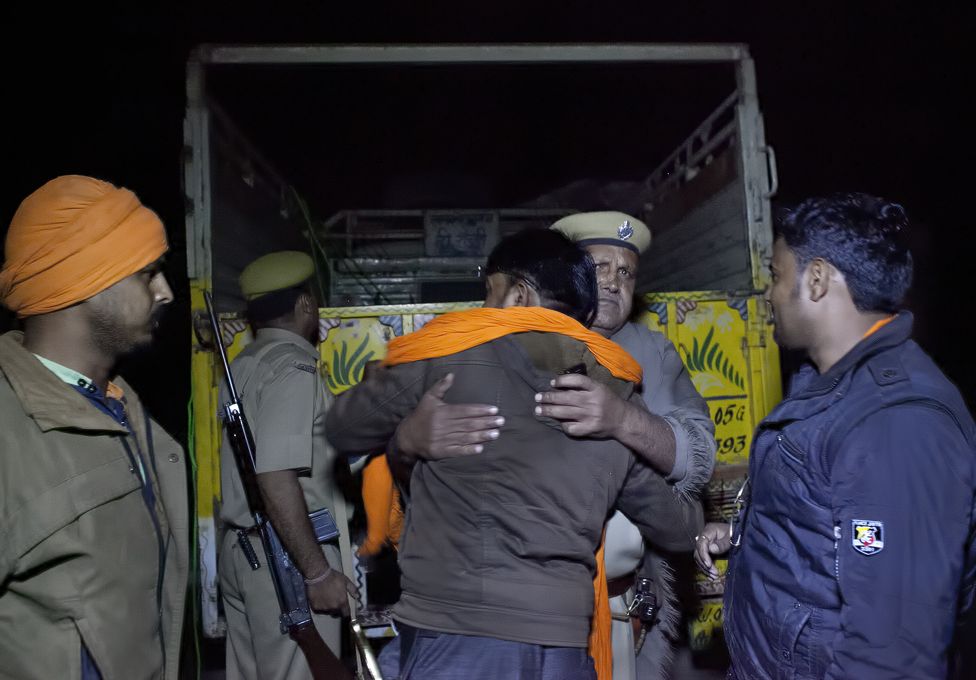
In November 2015, photographer Allison Joyce spent a night following Nawal Kishore Sharma’s vigilantes in the countryside near Ramgarh. One of her photographs shows a police officer embracing Sharma after a shootout between the vigilantes and a suspected cow smuggler.
Though the police now accuse the cow vigilantes of killing Rakbar Khan, and the vigilantes accuse the police, the photograph illustrates just how closely they worked together.
Image copyrightGETTY IMAGES (ALLISON JOYCE)In the Indian media there have been claims that the police took the two cows that Rakbar had been transporting to a cow shelter, as Rakbar lay dead or dying in a police vehicle.
There are also claims that the police stopped and drank tea instead of taking Rakbar to hospital.
Whatever they did, they did not take Rakbar to hospital immediately.
SRINAGAR (Reuters) – India has warned against rising communal tensions across the country as Kashmiris living outside their state faced property evictions, job suspensions and attacks on social media after a suicide bomber killed 44 policemen in the region.
The car bomb attack on a security convoy on Thursday, claimed by Pakistan-based Islamist militant group Jaish-e-Mohammad and carried out by a 20-year-old Kashmiri man, was the worst in decades of insurgency in the disputed area, which is claimed in full by both the nuclear-armed neighbours but ruled in part.
As the bodies of the paramilitary policemen who died in the attack were returned to families across India this weekend, passionate crowds waving the Indian flag gathered in the streets to honour them and shouted demands for revenge. Pakistan has denied any role in the killings.
Kashmiri Muslims, meanwhile, are facing a backlash in Hindu-majority India, mainly in the northern states of Haryana and Uttarakhand, forcing the federal interior ministry to issue an advisory to all states to “ensure their safety and security and maintain communal harmony”.
Aqib Ahmad, a Kashmiri student in Uttarakhand capital Dehradun, said the owner of the house he was staying in had asked him to move out fearing an attack on his property. Rates for air tickets to Kashmir have sky-rocketed as tensions escalate, he said.
Two other students in Dehradun said they also had been asked to vacate their rooms immediately.
“Where are we supposed to go?” Waseem Akram told Reuters, demanding authorities to ensure safety of all Kashmiri students.
Local media reported that some Kashmiri students were assaulted by members of Hindu right-wing groups in Uttarakhand, while a Kashmiri man had been booked by the police in the southern city of Bengaluru under a colonial-era sedition law for a post allegedly backing the militants. Reuters was not able to independently verify the reports.
Police in Jammu and Kashmir (J&K) state said they were providing temporary accommodation to people returning to Kashmir. The police urged Kashmiris to contact their hotline for “speedy assistance in case they face any difficulties/harrasment”.
“TRAITOR”
Fear has engulfed Kashmiri students in Haryana’s Ambala district after a video on social media showed a village headman asking people to evict Kashmiri students in the area.
“In case it is not done, the person in whose residence such students are living will be considered as a traitor,” the man says in the video, whose authenticity Reuters has not been able to independently verify.
Police said they were investigating the matter.
Since the video surfaced on social media on Saturday, at least half a dozen Kashmiri students have been shifted to the hostel of a university campus in Ambala.
A Facebook user named Anshul Saxena, meanwhile, has claimed credit for getting people fired or suspended for posts he calls “anti-national”.
Saxena uploaded a screengrab of a suspension letter handed out to a Kashmiri employee of a pharmaceutical company who had allegedly written in favour of the attack.
The attack on India’s paramilitary police follows the deadliest year in Kashmir for security personnel since Prime Minister Narendra Modi’s Hindu nationalist Bharatiya Janata Party came to power nearly five years ago.
Government data shows 91 officers lost their lives in Kashmir last year, about 14 percent more than 2017. Thousands of people, including militants and civilians, have died since the insurgency began in late 1980s.
Political leaders from Kashmir appealed to the government to ensure security of Kashmiris across India, while many people on Twitter said their homes were open to Kashmiris seeking shelter.
“Understand the pain and anguish,” Mehbooba Mufti, former chief minister of J&K, said in a tweet. “But we must not allow such mischievous elements to use this as an excuse to persecute/harass people from J&K. Why should they suffer for somebody else’s action?”
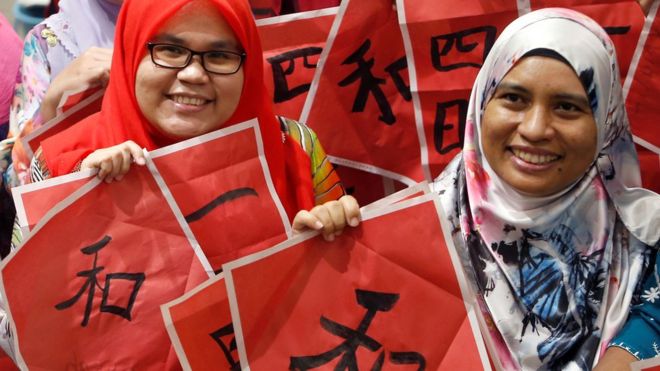
Image copyrightREUTERSImage captionMuslim teachers attend a Chinese calligraphy event in Kuala Lumpur, Malaysia to mark the Year of the Pig
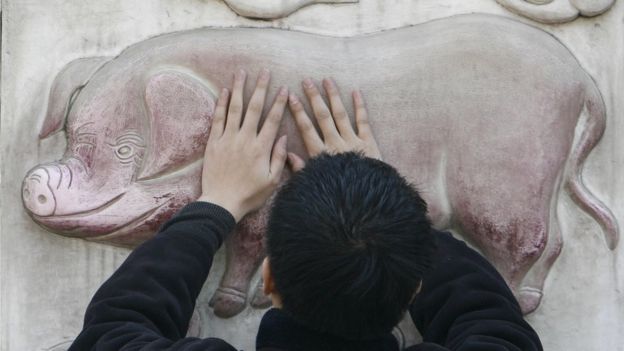
Communities around the world are gearing up to celebrate the lunar new year, which this time ushers in the Year of the Pig.
New Year celebrations usually mean the animal is depicted everywhere – in decorations, toys, gifts and advertising.
But the pig, the last animal on the Chinese zodiac calendar, is considered unclean by Muslims and a sin to consume. So does this cause problems for people celebrating lunar new year in Muslim-majority countries in South East Asia?
Like most Chinese-Malaysian families, the lunar new year is serious business for the Chow family, who live in the sleepy town of Batu Pahat in Johor, Malaysia.
This year is particularly significant because Chow Yoon Kee, his wife Stella and their daughter were all born in pig years.
“We will display lots of lucky pig ornaments at home and of course, have our relatives, friends, workers and neighbours over to visit, no matter what race or religion. Celebrations are for all,” said Mr Chow, a floor manager at a local biscuit factory.
He isn’t worried about his celebrations offending fellow residents as he believes there is no sign of new year controversy.
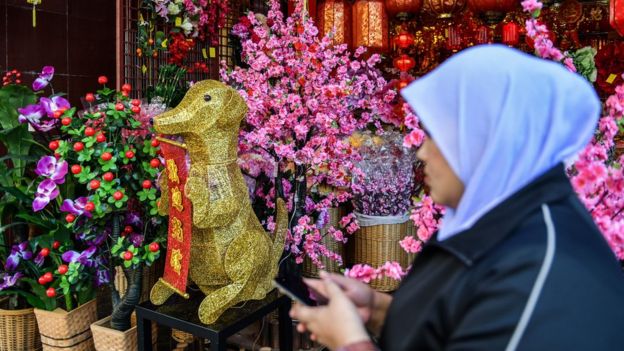
“There was a lot of fuss last year,” he recalls, when it was the Year of the Dog, also seen as impure animals by some Muslims.
Image copyrightAFPImage captionMalaysian authorities trod cautiously last year, being careful not to overdo the canine decorations
Malaysia is multicultural but the official religion is Islam, and there have been increasing reports of intolerance towards activities and actions considered insulting to Muslims.
So many shops and merchants avoided using images of dogs in fear of offending Muslim communities.
But Mr Chow feels local authorities have overlooked the feelings of the Chinese community, who actually celebrate the holiday.
“Malaysia is a country made up of many races, it isn’t just Malay Muslims. We have Chinese and Indian communities too, as well as other religions like Christianity, Hinduism, Taoism and Buddhism so we should be respecting each other’s beliefs and celebrations.”
But he adds that “the spirit of censorship” did not seem to carry on into the pig year.
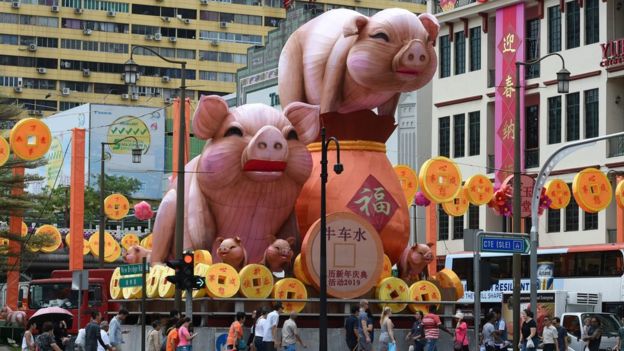
Image copyrightAFPImage captionThat’s some pig! Celebrations are under way in Chinatown, Singapore
Each animal of the Chinese zodiac is believed to have its own unique traits and qualities. Those born in the year of the pig are said to be intelligent, compassionate and loyal.
Does it matter if one’s zodiac animal isn’t welcome?
“There’s absolutely no reason to worry,” said Kuala Lumpur-based Feng Shui consultant Joey Yap. He told the BBC there didn’t seem to be any sensitivities around celebrations in Malaysia this year, compared to last.
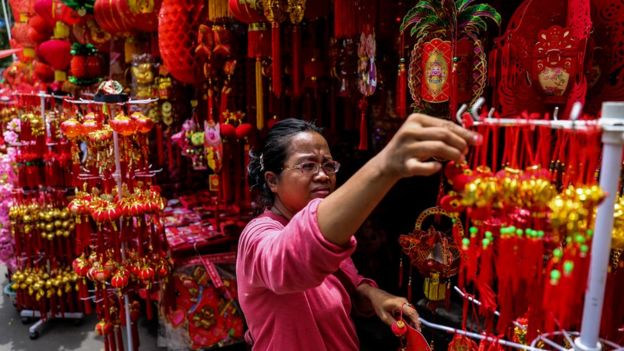
Image copyrightGETTY IMAGESImage captionRed decorations galore in Jakarta’s Chinatown
“Pigs will be fine,” he said, adding that whether you display objects or not “does not affect one’s personal luck”.
“Colours, emblems; they all aren’t important. In reality, one’s luck all boils down to one’s actions, so embrace positivity,” he said.
‘The first pigs Muslims can eat’
Even though it’s the world’s most populous Muslim nation, the lunar new year is a national holiday in Indonesia. Public celebrations are widely accepted – lanterns, colourful parades and performances are often seen in many cities.
Merry Olivia in Jakarta said her Muslim friends welcomed the image of pigs.
Image copyrightDAPUR MAMA LOEImage captionBaker Valeria Rita says her special cookies were a holiday hit with Muslim customers
“I grew up with many Indonesian Muslims so I know pigs will not make them feel uneasy,” she said, adding that the creatures looked more “festive” than other zodiac animals.
“If you compare pigs with snakes, pigs are more adorable so people would rather buy decorations embellished with them. Not many people in Jakarta like snakes.”
Baker Valeria Rita was rolling out special treats in time for the new year: pig shaped cookies with sweet pineapple jam fillings.
She said the response had been really good. “Orange or tangerine is a popular symbol for the lunar new year. This year, we decided to create pig-shaped treats and the quota for pre-orders was full within two weeks.”
Many of her customers are also Muslim.
“They buy my cookies for Chinese colleagues and friends who celebrate the holiday. Some also order for themselves because they like the pigs,” she said, sharing a joke made by her best friend, also a Muslim. “My goodies were the first pigs Muslims are allowed to eat.”
‘I don’t want to offend’
But it’s a different situation for 24-year-old Rangga Sastrajaya, from Bogor city. He bought pig toys and decorations but remains cautious in displaying them openly as he feels many Indonesians still do not accept cultural diversity.
“I could wear pig shirts or display pig-themed decorations at home but I will be quite careful in showing them off in public because I do not want to offend anyone,” he admitted.
Image copyrightAFPImage captionWill the new year spirit provoke widespread resentment among conservative Muslims?
But there are those who condemn the festivities. Forum Muslim Bogor (FMB), a conservative Islamic organisation in West Java, released a letter demanding the cancellation of festivities. They said it was “inappropriate” for Muslims because it could “undermine Islamic faith”.
Their actions follow other groups like Pemuda Pancasila (PP) and the Malayan Persatuan Forum Komunikasi Pemuda Melayu (PFKPM), who previously condemned the celebrations by Chinese communities.
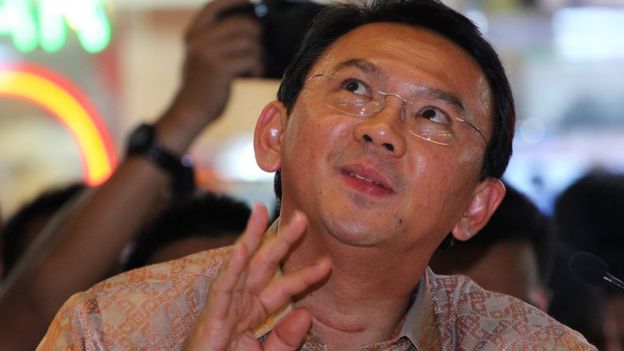
Image copyrightGETTY IMAGESImage captionIn 2017 Chinese-Christian Jakarta governor Basuki Tjahaja Purnama was jailed for blasphemy against Islam
Analyst Thung Ju-Lan from the Indonesian Institute of Science considers such sentiments the “impact of intolerant and political narratives”, the same kind which rocked Jakarta two years ago.
“It is the impact of the gubernatorial election in Jakarta, in Ahok’s case. The same sentiment has been spreading,” she told the BBC.
“The problem of intolerance continues because we have narrow understandings of what is actually happening. The more we do not understand, the more intolerant we are.”
In the case of celebrating the lunar new year, many Indonesian Muslims feel it is “more religious than cultural”.
But one politician has spoken out in defence of the Chinese community. Religious Affairs Minister Lukman Hakim Saifuddin encouraged beliefs of people from different cultures, faiths, and traditions to be respected.
“Regardless of what people understand about such celebrations, I invite all to respect tradition,” he said.






 CHINDIA ALERT: You'll be living in their world, very soon
Gandhi killer ‘patriot’ comment by BJP candidate draws outrage
India is in full election mode: voting began on 11 April, and the final ballot will be cast on 19 May with results out on 23 May. Every day, the BBC will be bringing you all the latest updates on the twists and turns of the world’s largest democracy.
Ruling party candidate calls Gandhi’s killer a patriot
What is happening?
Controversial Bharatiya Janata Party (BJP) politician Pragya Thakur has made headlines again. This time it was for calling Nathuram Godse – the man who assassinated Mahatma Gandhi – a “patriot”.
Her comment was made in response to a statement by southern actor-turned politician Kamal Haasan who had said India’s first “extremist” was a Hindu”, referring to Godse.
End of Twitter post by @ANI
His statement, made on Monday, was heavily criticised by the BJP, which accused him of indulging in “divisive politics” and filed a complaint against him with the Election Commission of India.
Why does this matter?
The BJP has responded by criticising Ms Thakur and asking her to publicly apologise.
“BJP does not agree with this statement, we condemn it. Party will ask her for clarification, she should apologise publicly for this statement,” party spokesperson GVL Narasimha Rao told reporters.
However, Ms Thakur’s comments do reflect the views of some right-wing Hindus who support the BJP and have long seen Gandhi as too moderate.
Godse, who shot Gandhi in the chest three times at point-blank range on 30 January 1948, was also an activist with nationalist right-wing groups, including those closely associated with the BJP.
Hindu hardliners in India accuse Gandhi of having betrayed Hindus by being too pro-Muslim, and even for the division of India and the bloodshed that marked Partition, which saw India and Pakistan created after independence from Britain in 1947.
Ms Thakur has seen her fair share of controversy. Her candidature caused outrage as she is an accused of involvement in a blast that killed seven people and injured 100 others. On 18 April, she said that police officer Hemant Karkare had died in the November 2008 Mumbai terror attacks because she had “cursed” him. She was then banned from campaigning for 72 hours as a result.
A team led by Mr Karkare had arrested her for questioning in connection with the Malegaon blast.
During her campaign, she also said she was “proud” of her part in the demolition of the 16th Century Babri mosque. In 1992, right-wing Hindu mobs razed the mosque to the ground, claiming it was built on the site of a temple destroyed by Muslim rulers. The site, which is in the city of Ayodhya, has been a religious flashpoint for Hindus and Muslims for decades.
Campaigning ends in West Bengal a day before deadline
What happened?
The Election Commission (EC) has told political parties to end their campaigning in West Bengal state, a day before the deadline in the wake of poll-related violence.
The campaign will end on Thursday at 10pm local time, and voting will be held on Sunday.
The decision comes after clashes broke out between the Bharatiya Janata Party (BJP) workers and protesters believed to be from the ruling Trinamool Congress (TMC) in Kolkata (formerly Calcutta) on Tuesday.
It happened during a roadshow of BJP chief Amit Shah. Several people were injured and vehicles were set on fire. A statue of renowned Bengali reformer Iswarchandra Vidyasagar was also vandalised in the clashes.
Both parties have accused each other of starting the violence.
Why does this matter?
The BJP welcomed the decision, saying it validated their argument that the state had “descended into anarchy” under the leadership of chief minister Mamata Banerjee.
Ms Banerjee said that the move was “undemocratic” and “it had insulted the people of Bengal”.
“Tomorrow, [Prime Minister Narendra] Modi has two meetings in Bengal. When he finishes, the campaigning also ends… Instead of punishing Amit Shah, the Election Commission has given a gift to the BJP,” she said.
Both parties are locked into a fierce election battle to win most out West Bengal’s 42 seats. Ms Banerjee has ambitions of becoming the prime minister in case a nationwide coalition of regional parties wins enough seats.
The state has also become crucial for the BJP as it’s trying to expand its reach in the eastern state. It won only two seats in the 2014 election.
The BJP performed well in northern states like Uttar Pradesh and Rajasthan in 2014, but this time it’s expected to suffer loses against a coalition of regional parties and the main opposition Congress.
So the party is trying to make up for the losses in West Bengal.
TMC, BJP accused each other of poll violence
What happened?
The war of words between West Bengal state chief minister Mamata Banerjee and the governing Bharatiya Janata Party (BJP) intensified ahead of voting on Sunday.
The latest verbal duel comes after violence was reported during BJP chief Amit Shah’s roadshow in Kolkata (formerly Calcutta) on Tuesday.
Clashes broke out between BJP supporters and protesters who were holding “Amit Shah go back” posters.
Some people suffered minor injuries and a few vehicles were set on fire.
The BJP said the protest was “orchestrated” and called it an “attempt to strangulate democracy”.
Why does this matter?
The eastern state has become politically crucial for the BJP as it has intensified campaigning in the past few days.
And that has sparked a feverish electoral battle between the BJP and Ms Banerjee’s Trinamool Congress (TMC).
“What does Amit Shah think of himself? Is he above everything? Is he god that no one can protest against him?” Ms Banerjee said.
In reply, Mr Shah accused the TMC of not following democratic norms during elections.
“Have faith in the people of Bengal that they’d face the TMC goons,” he said.
Prime Minister Narendra Modi is scheduled to hold more rallies in the coming days, so one can expect more verbal fireworks from the two leaders.
On Tuesday, the saga of the morphed Mamata meme continued
What happened?
India’s top court stepped in to release an activist belonging to India’s governing Bharatiya Janata Party (BJP) who was sent to prison for sharing a doctored image of West Bengal Chief Minister Mamata Banerjee.
Priyanka Sharma was sentenced to two weeks in prison on 10 May after she shared a picture of Bollywood star Priyanka Chopra and her husband Nick Jonas at the Met Gala – but with Ms Banerjee’s head superimposed on to Chopra’s body.
Earlier the court had said Ms Sharma could be released only if she apologised to Ms Banerjee, but later waived this condition.
Why does this matter?
The battle for West Bengal in this general election has been absolutely bruising.
The BJP, led by Prime Minister Narendra Modi himself, has been campaigning hard for votes in the state. This has brought them toe-to-toe with the state’s feisty chief minister. The fact that voting for West Bengal’s 42 seats has been split across all nine phases of voting has meant that the battle has been long and drawn-out.
And with just one phase to go before voting finally ends, the gloves are well and truly off. The two parties have traded insults on the campaign stage, their workers have attacked each other, and the violence on the ground has intensified. And now the battle has spread to cyberspace as well.
The country’s finance minister Arun Jaitley jumped at news of Ms Sharma’s release to call Ms Banerjee a dictator.
End of Twitter post by @arunjaitley
Analysts say that this political row is so bitter because the BJP has clearly identified West Bengal as one of the states where they may be able to make gains this election. This becomes more important for the party in the context of their fight in the politically crucial state of Uttar Pradesh, which sends the most number of MPs (80) to parliament.
They are up against a powerful coalition of regional parties there, and many expect them to lose seats as a result.
And PM Modi said Rahul Gandhi should be ashamed of 1984 riots
What happened?
Prime Minister Narendra Modi said that main opposition Congress party chief Rahul Gandhi should be “ashamed of himself” over his colleague’s remark on the 1984 anti-Sikh riots.
Mr Modi was replying to a controversial statement made by Sam Pitroda, who is a strategist of the Congress party.
In his reply to a question about the Congress’ role in the riots, Mr Pitroda had said “so what?”.
“I don’t think so, this is also another lie, and what about 1984? You speak about what you [Mr Modi] have done in five years. It [the riots] happened in 1984, so what?” he said.
Mr Gandhi said he was “ashamed” of Mr Pitroda’s statement, and asked him to apologise.
Mr Pitroda later said his statement was “twisted” and he did not mean to hurt sentiments.
But Mr Modi said the Congress chief “must apologise”.
“I was watching that naamdar [the dynast] told his guru that he should be ashamed of what he said. I want to ask naamdar, you pretended to scold your mentor for what? Because he exposed what was always in the Congress’s heart, and in the discussions of the naamdar family? Because he made public a family secret? Naamdar, it is you who should be ashamed,” Mr Modi said.
Why does this matter?
The controversy matters because it comes days ahead of voting for the 13 seats in the northern state of Punjab.
The BJP, which has formed a coalition with regional Shiromani Akali Dal, is locked in a bitter electoral battle with the ruling Congress in the state.
Sikhs are a majority in the state and the 1984 riots is still an emotional issue for many of them.
More than 3,000 Sikhs were killed in 1984 after the assassination of former prime minister Indira Gandhi by her Sikh bodyguards.
They were angry at her decision to send the army into the Golden Temple – Sikhism’s holiest shrine – to flush out militants earlier in the year.
The killing of Mrs Gandhi, who belonged to the Congress, saw mobs attack and murder members of the Sikh community across the country.
And both parties appear to be trying to come across as pro-Sikh ahead of the vote on 19 May.
On Sunday, Delhi voted but not enthusiastically
What happened?
Sunday saw India’s capital Delhi vote along with several other states in the polls – the penultimate phase of the country’s mammoth general election.
Voters turned out to vote, but in fewer numbers than they did in 2014. The election commission said that around 60% of the capital’s registered voters had actually cast ballots, which was about a five percent drop from 2014.
Delhi Chief Electoral Officer Ranbir Singh expressed disappointment, saying that the turnout did not match expectations.
Why does this matter?
The election commission is right to be disappointed – it had run a series of campaigns in the city, encouraging more people to vote.
But it was not as though polling in Delhi was an entirely smooth process. Some voters complained that their names were missing from electoral lists even though they had all the necessary documents. There were also reports that around 1,200 Electronic Voting Machines (EVMs) had malfunctioned across the city, delaying the polling process.
The fact that Delhi became a three-cornered contest after the main opposition Congress and the Aam Aadmi Party (AAP), which controls the Delhi state assembly, failed to stitch up an alliance may also have put voters off. Many analysts believe that this failure will only split voters who were against prime minister Narendra Modi’s Bharatiya Janata Party (BJP) and effectively hand them victory.
So they may have decided to just stay home, and not bother queuing up in the blistering heat – it touched 40C on Sunday.
Source: The BBC
Posted in Aam Aadmi Party (AAP), Amit Shah, Arun Jaitley, assassinated, Ayodhya, Babri mosque, Bharatiya Janata Party (BJP) politician, bjp candidate, Chief Minister, comment, Congress party chief, Delhi, Delhi Chief Electoral Officer, Election Commission, Election Commission (EC), Electronic Voting Machines (EVMs), extremist, finance minister, Gandhi killer, Hindu, Hindus, Indira Gandhi, Iswarchandra Vidyasagar, Kolkata, Kolkata / Calcutta, mahatma gandhi, Mamata Banerjee, Muslims, Nathuram Godse, outrage, patriot, PM Modi, Pragya Thakur, Priyanka Chopra, Priyanka Sharma, Punjab, rahul gandhi, Ranbir Singh, Sikh bodyguards, Trinamool Congress (TMC), Uncategorized, West Bengal | Leave a Comment »