02/11/2019
- Team from Dalian Institute of Chemical Physics says its goal is to ‘develop an all-season battery that is low cost but high safety for consumer products’
- Researchers make breakthrough by using hard carbon and lithium vanadium phosphate
Chinese researchers say they have made a breakthrough in the development of small lithium batteries that can withstand low temperatures. Photo: Xinhua
Chinese researchers say they have found a way to produce a tiny, lightweight lithium battery for use in mobile phones and electric cars that can hold up to 80 per cent of its charge in temperatures as low as minus 40 degrees Celsius.
The breakthrough came by using a combination of a new material called hard carbon along with lithium vanadium phosphate, the team from the Dalian Institute of Chemical Physics said in a paper published in this month’s edition of the scientific journal Nano Energy.
“Our goal is to develop an all-season battery that is low-cost but high-safety for consumer products,” said Song Zihan, its lead author.
It was an unprecedented approach, but “we proved it works”, he said.
The idea of a battery that can withstand extreme cold is not new. Photo: Shutterstock
The idea of a battery that can withstand extreme cold is not new, and they are already in use in space and in the Arctic and Antarctic.
But they tend to be very bulky because of the heating system and large amount of insulation they need to function properly at sub-zero temperatures.
Such measures are neither physically nor economically viable for applications like smartphones, cameras, laptops or electric cars. The trick, Song said, was replacing the soft graphite in normal lithium batteries with hard carbon.
Graphite is a good conductor and often used for the anode at the bottom of a battery, where electrons are generated. But the performance of graphite drops as the mercury slides.
How military tech sparked a robot revolution in firework factories
Song said that hard carbon was a new material that had attracted a lot of research interest in recent years, and compared with graphite, it had a much higher tolerance for the cold.
That was because of its highly irregular and “almost messy” structure, comprising layers of carbon atoms that are interconnected with each other, he said.
However, hard carbon also caused a rapid depletion of the lithium ions that served as an agent carrying the electric flow in battery, he said.
The researchers want to make battery suitable for use in consumer products. Photo: EPA-EFE
In the past, researchers have tried adding lithium powders or flakes to improve battery life, but the approach has proven costly and dangerous, mostly because pure lithium is highly reactive.
So Song and his colleagues used a composite material called lithium vanadium phosphate as the positive cathode on top of the battery.
The composite was capable of providing enough extra lithium ions for the hard carbon’s need without increasing the risk of fire or explosion, and it was cheap, he said.
“The pairing of hard carbon and lithium vanadium phosphate worked a charm,” Song said.
But the technology is still a long way from being commercially viable.
The battery Song’s team made is far too small for any real-life applications, and enlarging it would require some “innovative engineering solutions”, he said.
Another scientist involved in the project said the team was working with battery manufacturers to see if the technology could be commercialised.
Source: SCMP
Posted in Antarctica, Arctic, cameras, capable, Chinese scientists, create, Dalian Institute of Chemical Physics, electric cars, laptops, lithium batteries, low temperatures, Nano Energy, smartphones, Space, tiny battery, ultra-low temperatures, Uncategorized, withstand, working |
Leave a Comment »
06/09/2019
- Material that generates heat from sunlight could provide self-maintaining water supply on remote islands
An international research team used solar power to generate a supply of drinking water. Photo: Chinese Academy of Sciences
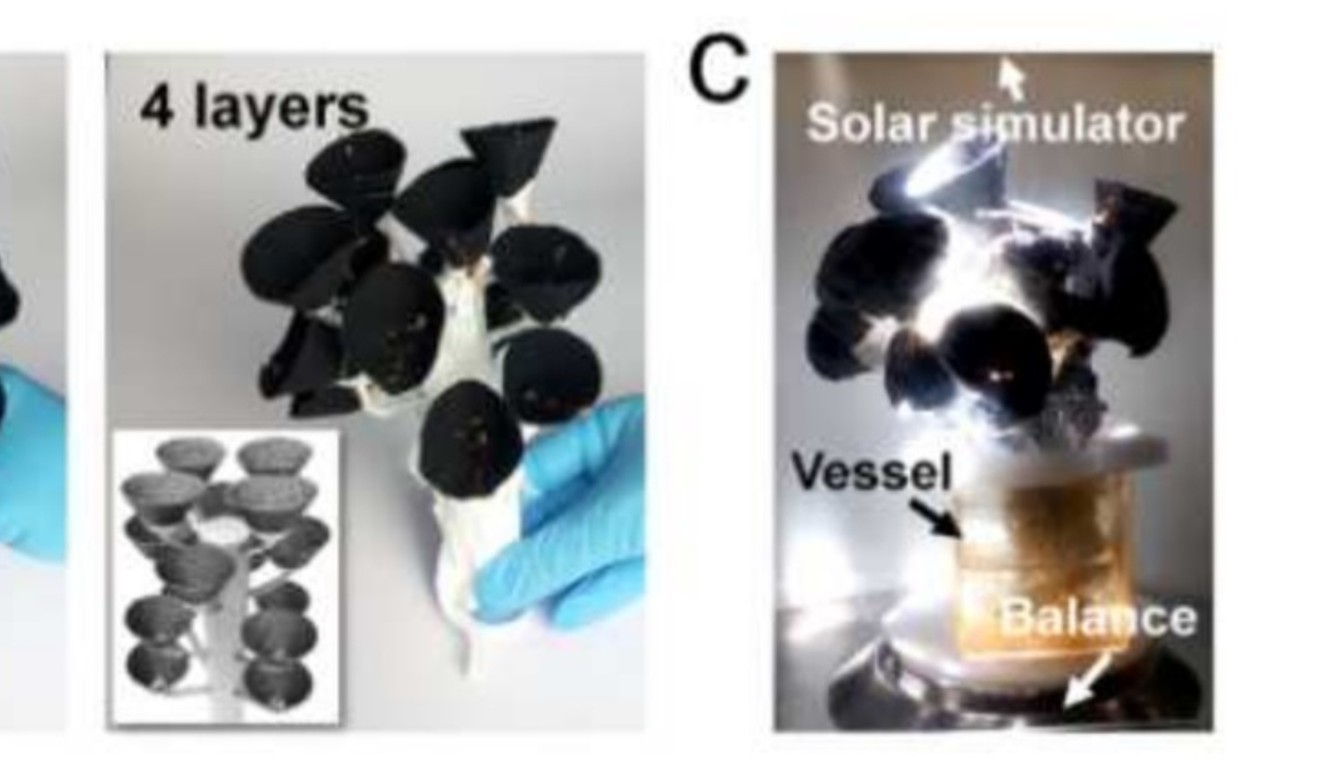
A Chinese-led international research team has created a “tree” that can generate clean drinking water.
Drawing its energy entirely from the sun just like a real tree, the “water tree” has a root made of cotton fabric that can absorb water from its surroundings, such as from sand on a beach.
After water moves up the stem, it is vaporised by “leaves” made of black-carbon paper cones that convert light energy to heat, reaching nearly 50 degrees Celsius (122 Fahrenheit). The tree sits in a glass chamber with a relatively cool surface that collects the vapour.
Using standard cotton fabric and a new nanomaterial that can be cheaply mass-produced from charcoal, a paper cone with a surface area as large as 1 square metre would cost only US$2, according to the researchers.
The cones, which function like leaves, could be mass-produced cheaply, researchers say. Photo: Chinese Academy of Sciences
A cone that size can generate up to 3.4kg (7.5lbs) of condensed water per hour, faster than any other solar-powered desalination methods previously reported.
Even on a cloudy day, the total output in seven hours of sunlight can reach 5.4kg, or three times the amount the typical adult needs to stay hydrated.
One tree can have multiple layers of branches, each with several cones to increase the vapour-producing surface area.
The study, published this month in the journal Nano Energy, was led by Professor Chen Tao at the Chinese Academy of Sciences’ Ningbo Institute of Material Technology and Engineering in Zhejiang province, and also involved researchers from Singapore and Taiwan.
World’s thirst for fresh water is causing a big toxic problem
One of the paper’s co-authors, Dr Ouyang Jianyong, associate professor at the National University of Singapore’s department of materials science and engineering, told the South China Morning Post that the technology could be applied in remote places such as on islands in the South China Sea.
“It is particularly useful for isles far away without a stable drinking water supply,” Ouyang said. “These ‘trees’ may not be able to quench the thirst of a large city, but they can meet the critical demand of a small community, especially in emergencies.
“We are already in contact with some companies [to commercialise the technology],” he added.
The material used to make the cone has several advantages, according to Ouyang. The cones can absorb a wide spectrum of sunlight, maximising the amount of energy they can collect, and their porous structure allows them to release vapour quickly.
Lawmakers endorse plan for HK$7.7 billion desalination plant
When used to desalinate a supply of seawater, the trees would be self-cleaning at night, by water washing away salt residue without being vaporised as it would during sunlight hours.
The vapour-producing fabric is as thin and lightweight as a few sheets of paper. It can be folded and sewn into almost any shape, or cleaned in a washing machine, and can operate effectively for several years in a harsh environment, the researchers say.
The condensed water meets stringent safety standards for direct drinking set by the World Health Organisation, according to the researchers.
Source: SCMP
Posted in Chinese Academy of Sciences, cleaned, department of materials science and engineering, desalinate, desalination plant, Drinking water, lawmakers, Nano Energy, National University of Singapore, night, Ningbo Institute of Material Technology and Engineering, paper, remote islands, sea, Seawater, self-cleaning, self-maintaining water supply, sewn, shape, sheets, Singapore, solar-powered ‘tree’, solar-powered desalination methods, south china morning post, South China Sea, Taiwan, turns, Uncategorized, vapour-producing fabric, washing machine, World Health Organisation, zhejiang province |
Leave a Comment »




 CHINDIA ALERT: You'll be living in their world, very soon