Chindia Alert: You’ll be Living in their World Very Soon
aims to alert you to the threats and opportunities that China and India present. China and India require serious attention; case of ‘hidden dragon and crouching tiger’.
Without this attention, governments, businesses and, indeed, individuals may find themselves at a great disadvantage sooner rather than later.
The POSTs (front webpages) are mainly 'cuttings' from reliable sources, updated continuously.
The PAGEs (see Tabs, above) attempt to make the information more meaningful by putting some structure to the information we have researched and assembled since 2006.
BEIJING, March 5 (Xinhua) — China will lower its defense budget growth rate to 7.5 percent in 2019, from last year’s 8.1 percent, according to a draft budget report submitted to the annual session of the National People’s Congress (NPC) Tuesday.
The 2019 defense budget will be 1.19 trillion yuan (about 177.61 billion U.S. dollars), figures from the report show.
The rate marks the fourth straight year for the budgeted growth rate remaining single digit, following five consecutive years of double-digit increases.
China’s budgeted defense spending growth rate stood at 8.1 percent in 2018, 7 percent in 2017, and 7.6 percent in 2016.
“The Chinese government has always paid attention to controlling the scale of defense expenditure,” said He Lei, former deputy head of the Academy of Military Sciences.
Describing China’s defense budget increase as reasonable and appropriate, Zhang Yesui, spokesperson for the legislative session, said the rise aimed to “meet the country’s demand in safeguarding national security and military reform with Chinese characteristics.”
“China’s limited defense spending, which is for safeguarding its national sovereignty, security and territorial integrity, poses no threat to any other country,” Zhang said at a press conference Monday.
The expenditure has been mainly used for advancing defense and military reforms, supporting military training and diverse tasks, modernizing weapons and equipment, and improving welfare of service personnel, according to He, who is also a deputy to the NPC.
“The defense budget increase is appropriate against the backdrop of profound changes in the country’s overall strength, its security environment, and the global strategic situation,” He said.
China’s defense budget takes up a fairly small share of its GDP and national fiscal expenditure compared with other major countries, said He, noting that its military spending per capita and per soldier was also very low.
While the national defense spending in a number of major developed countries accounts for more than 2 percent of their GDP, the ratio was only about 1.3 percent for China in 2018.
The United States has increased its national defense expenditure for the fiscal year 2019 to 716 billion dollars, about four times the budget of China, the world’s second largest economy.
China’s military spending per capita is only about one-nineteenth of that of the United States.
“When it comes to whether a country poses a threat to other countries, the key is not that country’s national strength and armed forces, but the policies it adopts,” said Chen Zhou, research fellow with the Academy of Military Sciences.
“China has always been following the path of peaceful development and firmly adheres to a defense policy that is defensive in nature,” Chen said, noting that China’s development would not pose a threat to any other country.
He Lei highlighted China’s role in providing public security goods for the international community, saying the Chinese military had actively participated in UN peacekeeping missions, maintained security of marine passages, and engaged in international rescue and security cooperation.
“The growth in China’s defense spending is the growth of forces for world peace,” he noted.
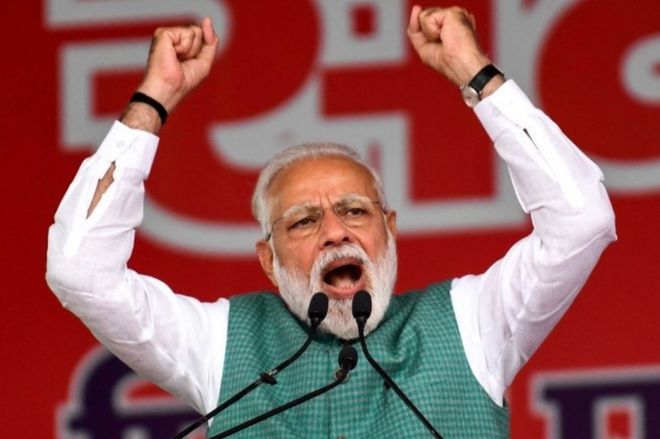
Image copyrightAFPImage captionMr Modi is accused of exploiting India-Pakistan hostilities for political gain
A gaffe is when a politician tells the truth, American political journalist Michael Kinsley said.
Last week, a prominent leader of India’s ruling Hindu nationalist Bharatiya Janata Party (BJP) appeared to have done exactly that. BS Yeddyurappa said the armed aerial hostilities between India and Pakistan would help his party win some two dozen seats in the upcoming general election.
The remark by Mr Yeddyurappa, former chief minister of Karnataka, was remarkable in its candour. Not surprisingly, it was immediately seized upon by opposition parties. They said it was a brazen admission of the fact that Prime Minister Narendra Modi’s party was mining the tensions between the nuclear-armed rivals ahead of general elections, which are barely a month away. Mr Modi’s party is looking at a second term in power.
Mr Yeddyurappa’s plain-spokenness appeared to have embarrassed even the BJP. Federal minister VK Singh issued a statement, saying the government’s decision to carry out air strikes in Pakistan last week was to “safeguard our nation and ensure safety of our citizens, not to win a few seats”. No political party can afford to concede that it was exploiting a near war for electoral gains.
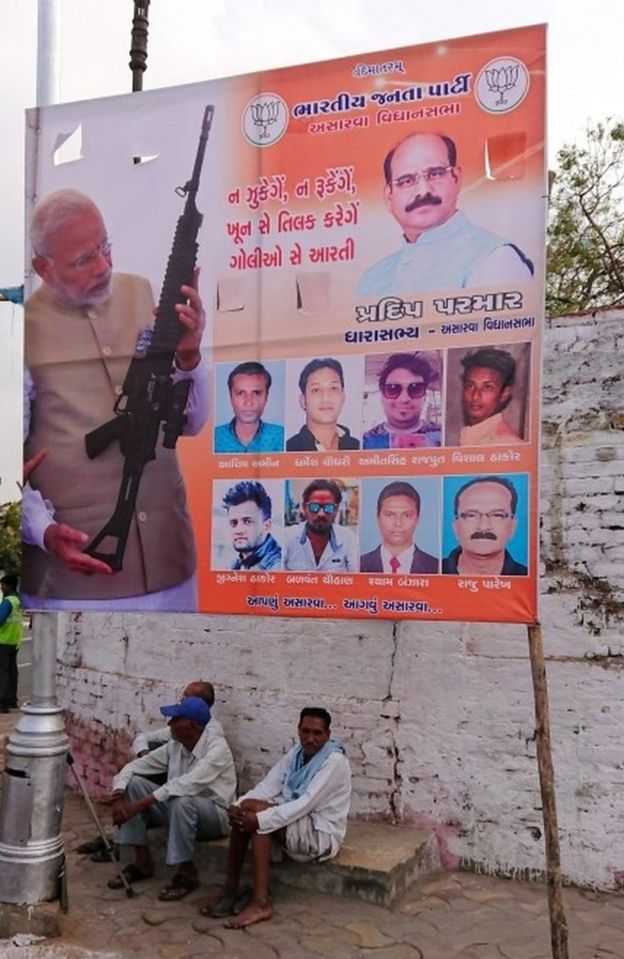
Image copyrightAFPImage captionThe BJP has put up election posters of Mr Modi posing with guns
Even as tensions between India and Pakistan ratcheted up last week, Mr Modi went on with business as usual. Hours after the Indian attack in Pakistan’s Balakot region, he told a packed election meeting that the country was in safe hands and would “no longer be helpless in the face of terror”. Next morning, Pakistan retaliated and captured an Indian pilot who ejected from a downed fighter jet. Two days later, Pakistan returned the pilot to India.
Mr Modi then told a gathering of scientists that India’s aerial strikes were merely a “pilot project” and hinted there was more to come. Elsewhere, his party chief Amit Shah said India had killed more than 250 militants in the Balakot attack even as senior defence officials said they didn’t know how many had died. Gaudy BJP posters showing Mr Modi holding guns and flanked by soldiers, fighter jets and orange explosions have been put up in parts of the country. “Really uncomfortable with pictures of soldiers on election posters and podiums. This should be banned. Surely the uniform is sullied by vote gathering in its name,” tweeted Barkha Dutt, an Indian television journalist and author.
Mr Modi has appealed to the opposition to refrain from politicising the hostilities. The opposition parties are peeved because they believe Mr Modi has not kept his word. Last week, they issued a statement saying “national security must transcend narrow political considerations”.
‘Petty political gain’
But can the recent conflict fetch more votes for Mr Modi? In other words, can national security become a campaign plank?
Many believe Mr Modi is likely to make national security the pivot of his campaign. Before last month’s suicide attack – claimed by Pakistan-based militants – killed more than 40 Indian paramilitaries in Kashmir, Mr Modi was looking a little vulnerable. His party had lost three state elections on the trot to the Congress party. Looming farm and jobs crises were threatening to hurt the BJP’s prospects.
Now, many believe, Mr Modi’s chances look brighter as he positions himself as a “muscular” protector of the country’s borders. “This is one of the worst attempts to use war to win [an] election, and to use national security as petty political gain. But I don’t know whether it will succeed or not,” says Yogendra Yadav, a politician and psephologist.
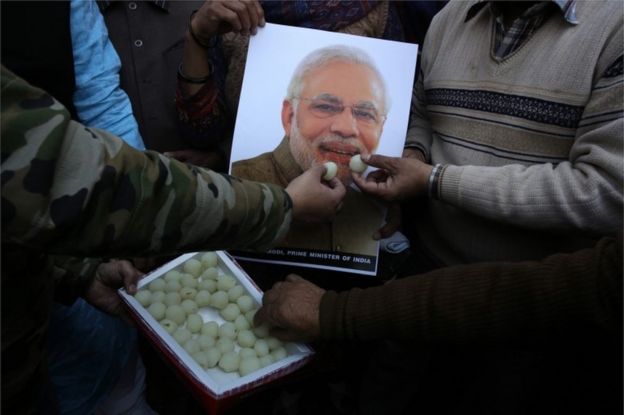
Image copyrightEPAImage captionMany Indians have celebrated India’s strike in Pakistani territory
Evidence is mixed on whether national security helps ruling parties win elections in India. Ashutosh Varshney, a professor of political science at Brown University in the US, says previous national security disruptions in India were “distant from the national elections”.
The wars in 1962 (against China) and 1971 (against Pakistan) broke out after general elections. Elections were still two years away when India and Pakistan fought a war in 1965. The 2001 attack on the Indian parliament that brought the two countries to the brink of war happened two years after a general election. The Mumbai attacks in 2008 took place five months before the elections in 2009 – and the then ruling Congress party won without making national security a campaign plank.
For one, he says, it comes just weeks ahead of a general election in a highly polarised country. The vast expansion of the urban middle class means that national security has a larger constituency. And most importantly, according to Dr Varshney, “the nature of the regime in Delhi” is an important variable. “Hindu nationalists have always been tougher on national security than the Congress. And with rare exceptions, national security does not dominate the horizons of regional parties, governed as they are by caste and regional identities.”
Bhanu Joshi, a political scientist also at Brown University, believes Mr Modi’s adoption of a muscular and robust foreign policy and his frequent international trips to meet foreign leaders may have touched a chord with a section of voters. “During my work in northern India, people would continuously invoke the improvement in India’s stature in the international arena. These perceptions get reinforced with an event like [the] Balakot strikes and form impressions which I think voters, particularly on a bipolar contest of India and Pakistan, care about,” says Mr Joshi.
Others like Milan Vaishnav, senior fellow and director of the South Asia Program at the Carnegie Endowment for International Peace, echo a similar sentiment. He told me that although foreign policy has never been a “mass” issue in India’s domestic politics, “given the proximity of the conflict to the elections, the salience of Pakistan, and the ability of the Modi government to claim credit for striking back hard, I expect it will become an important part of the campaign”.
But Dr Vaishnav believes it will not displace the economy and farm distress as an issue, especially in village communities. “Where it will help the BJP most is among swing voters, especially in urban constituencies. If there were fence-sitters unsure of how to vote in 2019, this emotive issue might compel them to stick with the incumbent.”
How the opposition counters Mr Modi’s agenda-setting on national security will be interesting to watch. Even if the hostilities end up giving a slight bump to BJP prospects in the crucial bellwether states in the north, it could help take the party over the winning line. But then even a week is a long time in politics.




 CHINDIA ALERT: You'll be living in their world, very soon