Chindia Alert: You’ll be Living in their World Very Soon
aims to alert you to the threats and opportunities that China and India present. China and India require serious attention; case of ‘hidden dragon and crouching tiger’.
Without this attention, governments, businesses and, indeed, individuals may find themselves at a great disadvantage sooner rather than later.
The POSTs (front webpages) are mainly 'cuttings' from reliable sources, updated continuously.
The PAGEs (see Tabs, above) attempt to make the information more meaningful by putting some structure to the information we have researched and assembled since 2006.
Indian defence officials have reported a coronavirus outbreak at a key naval base in the western city of Mumbai.
Twenty-one personnel have tested positive for Covid-19 at INS Angre, which is the seat of the force’s western command, the navy said in a statement on Saturday.
It added that there are no infections aboard any ships or submarines.
India has 11,906 active infections and 480 deaths, according to the latest data from the ministry of health.
The Navy said that they had tested a number of personnel who had come into contact with a soldier who had tested positive earlier this month. Many of those who had tested positive for the virus, the statement added, were asymptomatic.
All 21 personnel live in the same residential block, which has been declared a containment zone and has been placed under lockdown.
In a video message to personnel last week, Navy Chief Admiral Karambir Singh stressed the importance of keeping ships and submarines free of the virus.
“The coronavirus pandemic is unprecedented and it has never been seen before. Its impact has been extraordinary across the globe, including India,” he said.
The navy has been playing an active role in India’s response to the Covid-19 outbreak.
It has set up isolation facilities to treat patients at one of its premier hospital units and is also running quarantine camps.
The outbreak aboard the Indian naval base follows reports of outbreaks aboard vessels belonging to other nations.
More than 500 sailors on the USS Roosevelt have tested positive for the virus and one of them died earlier this week. And nearly a third of the sailors serving with France’s aircraft carrier Charles de Gaulle – 668 out of nearly 2,000 – have been infected with coronavirus.
Large-scale drills conducted across island in what defence ministry describes as test of combat-readiness
Exercise follows US Navy live-fire exercise last month and a series of incursions by Chinese warplanes in recent weeks
An F-16 fighter takes off from Hualien air base in eastern Taiwan. Photo: Military News Agency/ AFP
Taiwan has staged large-scale military drills throughout the island, including an exercise to repel an invading force, against a backdrop of rising tensions with Beijing.
The exercises, dubbed “Lien Hsiang,” involved the air force, army and the navy and were conducted on Tuesday from various military bases and strongholds in Taiwan, the island’s defence ministry said in a statement.
“The drills were designed to test the combat readiness of our forces and their responses to an all-out invasion by the enemy,” the ministry said, referring to the People’s Liberation Army, which has threatened to attack the self-ruled island.
The exercise follows a live-fire US drill in the region last week.
Taipei says Chinese military aircraft flew night exercise across Taiwan Strait
17 Mar 2020
Eight F-16 fighter jets took off from the air force base in the eastern county of Hualien at dawn on Tuesday, simulating an emergency mission to scramble and intercept enemy warplanes entering the island’s airspace, the defence ministry said.
Elsewhere on the island, F-16 and other fighter jets were spotted taking off from other air force bases in the southwestern county of Chiayi, the northern county of Hsinchu, Ching Chuan Kang in central Taiwan and the southern city of Tainan, according to Taiwanese media.
The exercises also involved operations testing cyberwarfare capabilities, while the air force ground crew simulated an emergency repair of the aircraft runway, the ministry said.
Anti-air units of both the army and the navy also joined the air force in the drills, while various types of naval warships, including Kidd-class destroyers, plus Perry and Kang Ding-class frigates, were deployed near Taiwan’s coast for separated training drills, it added.
The ministry said the training mission, carried out without live ammunition, was also designed to test the military response and make improvements based on the results.
Hundreds of Taiwanese to return from coronavirus centre after Beijing and Taipei reach deal
10 Mar 2020
Beijing considers Taiwan a wayward province that must be returned to the mainland fold, by force if necessary.
Beijing has staged a series of war games close to the island and poached seven of Taiwan’s diplomatic allies to heap pressure on President Tsai Ing-wen, from the independence-leaning Democratic Progressive Party, who was re-elected in January.
The exercises came after recent missions by PLA warplanes which briefly crossed the midpoint of the Taiwan Strait into the Taiwanese side in what analysts saw as testing the response from Taiwan and the US.
Three separate groups of warplanes approached Taiwan on their way to the western Pacific over the Bashi Channel for long-distance training exercises before returning home over the Miyako Strait to the northeast of Taiwan on February 9, 10 and 28.
Coronavirus threat shows ‘unacceptability’ of Beijing isolating Taiwan, US official says
28 Feb 2020
On March 17, another flight of PLA warplanes approached Taiwan in a rare exercise which analysts said was aimed at showing off their night navigation and all-weather capabilities.
Taiwan’s air force scrambled fighter jets to shadow, intercept and disperse the PLA warplanes through radio warnings during each approach by the mainland’s planes, according to the ministry.
Those actions also prompted the US to send two B-52 bombers on southbound flights off Taiwan’s east coast, while a transport plane flew over the Taiwan Strait, the defence ministry said.
DPP legislator Wang Ting-yu asked the Tsai government to take note of developments in the South China Sea, saying the US actions indicated that Washington must have learned “certain information suggesting that the Chinese government is planning certain military activities” or the 7th Fleet would not have made such a bold move.
Lawrence Chung covers major news in Taiwan, ranging from presidential and parliament elections to killer earthquakes and typhoons. Most of his reports focus on Taiwan’s relations with China, specifically on the impact and possible developments of cross-strait relations under the pro-independence Democratic Progressive Party and mainland-friendly Kuomintang governments. Before starting work at the South China Morning Post in 2006, he wrote for Reuters and AFP for more than 12 years.
LUCKNOW (Reuters) – U.S. and European defence firms backed Indian Prime Minister Narendra Modi’s military modernisation drive at a defence exhibition on Friday, despite a lengthy procurement process running into years and limited funds.
Airbus SE (AIR.PA) and U.S.-based Lockheed Martin Corp (LMT.N) and Boeing Co. (BA.N) are eying multi-billion dollar deals under Modi’s aim to upgrade an ageing fleet of aircraft and enhance local arms manufacturing to cut imports.
“I feel encouraged overall,” Anand Stanley, President and managing director of Airbus India and South Asia, told Reuters.
“Every year the government is doing capital allocation. They are spending,” he said.
The military is also looking to buy submarines, warships and battlefield communication systems. But these have made little headway.
Airbus is offering to set up an assembly line in India in partnership with the Tata Group to produce the C295W military transport aircraft as a replacement for Indian Air Force’s Avro fleet.
The 120 billion rupee Avro replacement programme has been in the pipeline for almost a decade.
Airbus on Thursday signed a memorandum of understanding (MoU) with India’s Adani Aerospace and Defence, part of the diversified Adani Group, for aircraft services in India and South Asia.
Boeing, which has pitched its F/A-18 Block III Super Hornet fighter for the India air force and navy and is competing with Lockheed Martin’s F-21, said it plans to push India’s armed forces’ drive for modernisation through a suite of five products – the Super Hornet, KC-46 tanker, P-8I aircraft, AH-64E Apache and CH-47(I) Chinook helicopters.
The company said it wants to build a global defence and aerospace ecosystem “that creates jobs and industrial capacity with Make in India,” said Salil Gupte, president, Boeing India in a statement during the exhibition.
Boeing and Lockheed will be competing with Sweden’s Saab AB (SAABb.ST) with its Gripen fighter and France’s Dassault Aviation SA (AVMD.PA) Rafale and Russian fighter aircraft.
Lockheed Martin, as part of its fighter jet F-21 proposal for the Indian Air Force, signed an MoU with Bharat Electronics Ltd (BAJE.NS) on Friday to explore industrial opportunities around the F-21 fleet, which is essentially building up a spare and supply ecosystem.
The three aerospace giants, with huge displays at the Defence Expo 2020 held in the northern city of Lucknow, displayed miniaturised versions of the latest aircraft and helicopters that they have pitched to India.
Another French defence firm, Dassault (DAST.PA), which recently delivered its first Rafale aircraft to the government in October under a contract to supply 36 units, said it is developing its facility in central India to make the Rafale jets in the subcontinent.
The country’s second aircraft carrier, the Shandong, officially entered service this month, but bottlenecks in training could hamper the navy’s effectiveness
Plans to build and launch more modern warships mean the need for fully trained pilots will only grow
A pilot based on the Liaoning is seen during a training exercise. China is facing a shortage of trained naval aviators. Photo: Handout
A shortage of naval pilots is holding back Beijing’s ambitions to develop a truly combat-ready fleet, military analysts have said.
China officially commissioned its second aircraft carrier the Shandong last week, which means it will need at least 70 pilots, along with more supporting flight officers.
However, plans to further expand its fleet to five or six carriers – as well as the more advanced technology that will be used on these vessels – mean the need to train more pilots will become more urgent in the future.
Chinese President Xi Jinping has initiated a sweeping modernisation drive across all branches of the People’s Liberation Army and said “the need to build up a strong navy has never been more pressing”.
The Shandong, China’s second carrier, officially entered service earlier this month. Photo: Handout
But Collin Koh, a research fellow at the S Rajaratnam School of International Studies at Singapore’s Nanyang Technological University, said there was a bottleneck in the recruitment and training of naval pilots.
“The implications of carrier-borne aviation are still relatively unfamiliar to the PLA, especially when there’s an urge to scale up training tempo and recruitment in order to fulfil the top directives of building a viable carrier programme,” he said.
China’s training programme for all military pilots is still developing – particularly when it comes to the naval aviation arm, which was only founded in May 2013.
China’s new carrier set to have smaller jet force than expected
20 Dec 2019
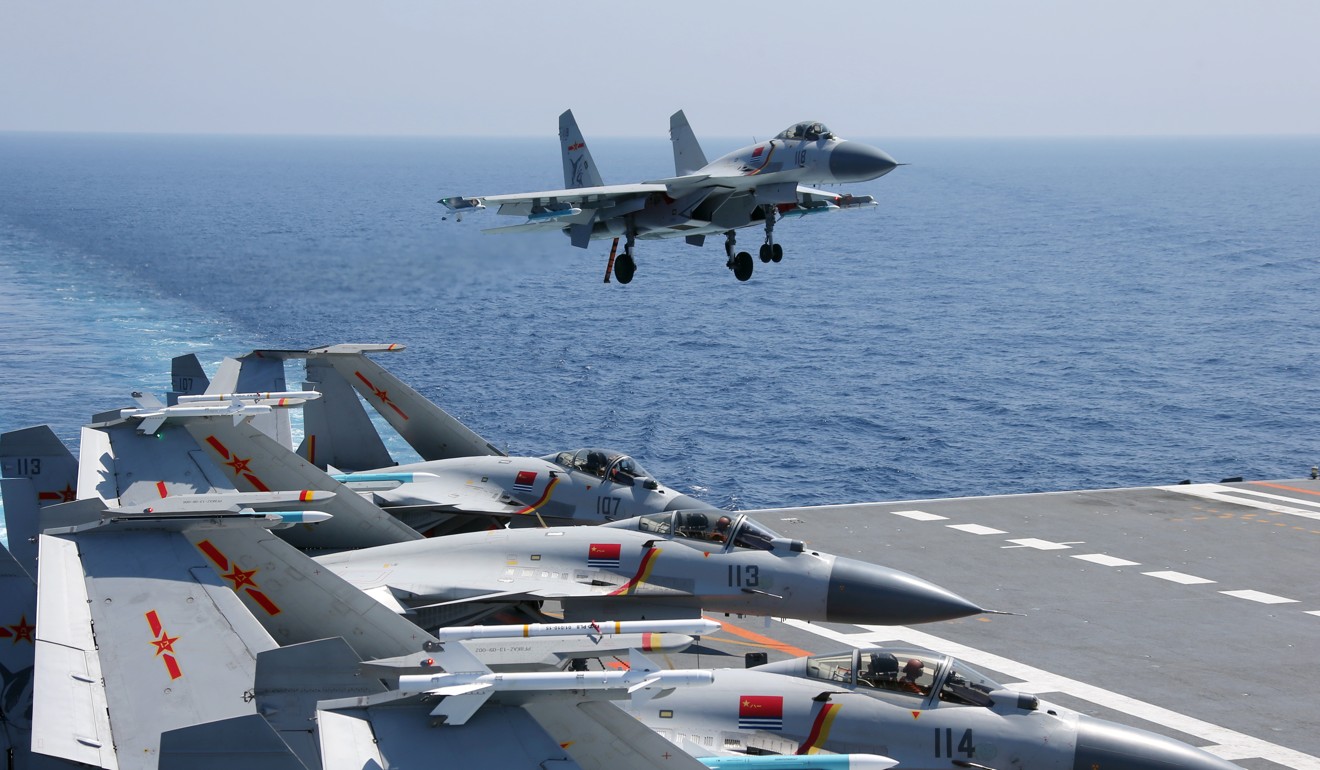
China’s first aircraft carrier, the Liaoning, was commissioned in September 2012, but the first successful fighter landing on the ship did not happen until two months later.
The first successful night landing was not reported by state media until May 2018, almost four years later.
It appears to have taken even longer to fully train helicopter pilots, with the first successful day landing taking place in November 2018, according to China’s Naval Aviation University, and the first night landing in June this year.
The training programme has also been marred by a string of fatal accidents along the way, although Koh said these had been unreported to avoid deterring prospective recruits.
Days after China marked the 70th anniversary of the foundation of the People’s Republic with a huge military parade in Beijing on October 1, three airmen were killed when a transport helicopter crashed in central Henan province.
Just eight days later there was another crash on the Tibetan Plateau, where a J-10 fighter jet on a low-altitude flying drill crashed into a mountain. The pilot was reported to have survived.
“The attrition rate of carrier-borne pilot training, including those who might have been injured or killed in the line of duty, isn’t that well publicised by the PLA,” said Koh.
Fighters on the deck of the Liaoning, China’s first carrier. Photo: Xinhua
Li Jie, another Beijing-based military expert, said although the navy is short of pilots now, the problem could be solved within two to three years.
“The insufficient number of carrier-borne warplanes and the substantial training needed for a qualified naval pilot are the two main reasons why China is so short of pilots now. But as China places more and more emphasis on the education and training of the pilots, the problem will be gradually ironed out, ” said Li.
First made-in-China carrier officially enters service
18 Dec 2019
The Naval Aviation University, which is responsible for the training of future naval pilots, has been working with three of the country’s leading universities – Peking, Tsinghua and Beihang – to identify and recruit future pilots.
The authorities have also set up Naval Aviation Experimental Classes in high schools across the country. Each class recruits 50 students, who enjoy a national subsidy and will be put in a priority list to be admitted as a naval pilot.
Military experts say PLA modernisation brought about during Xi Jinping’s presidency will be the main focus of October 1 celebration in Beijing
It’s necessary for China to ‘show some of its muscle’ amid the trade dispute with the US, observer says
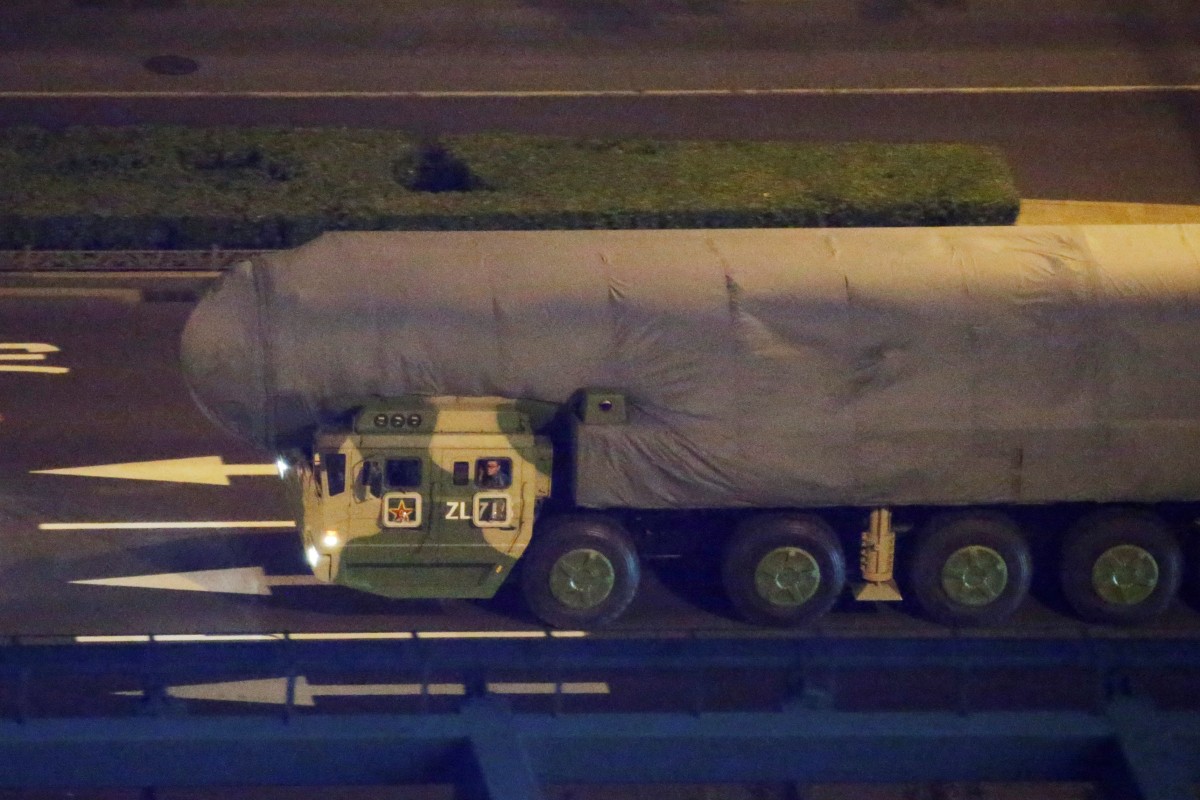
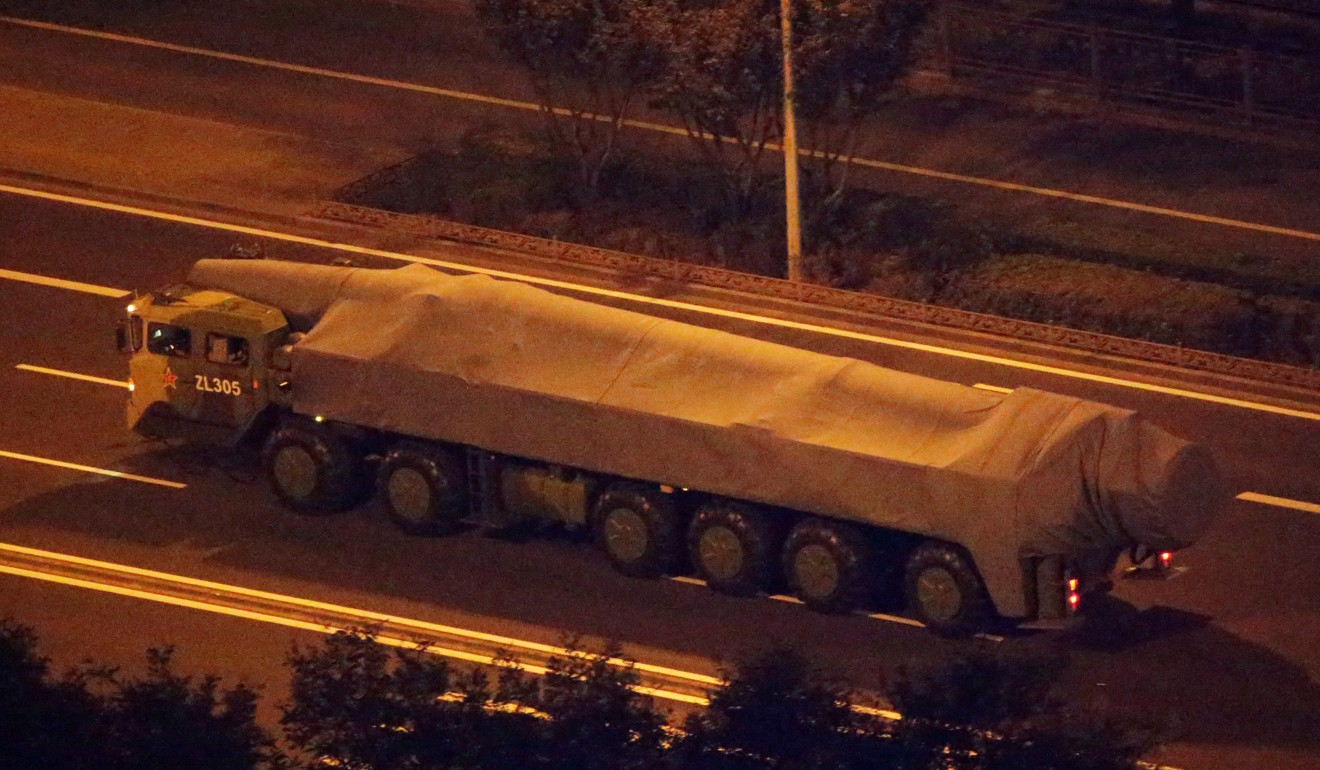
China’s land-based DF-41 intercontinental ballistic missile will be among the military hardware on show on October 1. Photo: Reuters
China plans to show off its most advanced active weapon systems at the upcoming National Day parade, which will be the biggest of the 14 such events it has held over the past seven decades.
The parade, to be held on October 1 to mark the 70th anniversary of the founding of the People’s Republic, will highlight the military modernisation – particularly in nuclear deterrence – that has taken place since President Xi Jinping came to power in late 2012, according to military experts.
The People’s Liberation Army (PLA) offered a glimpse of those weapons during rehearsals for the parade in downtown Beijing from September 14.
As part of the celebrations, Xi, who also chairs the Central Military Commission, will inspect 48 squads on the ground and more than a dozen airborne squadrons, according to a military insider involved in support services for the parade.
More than a dozen airborne squadrons will take part in the National Day parade. Photo: Kyodo
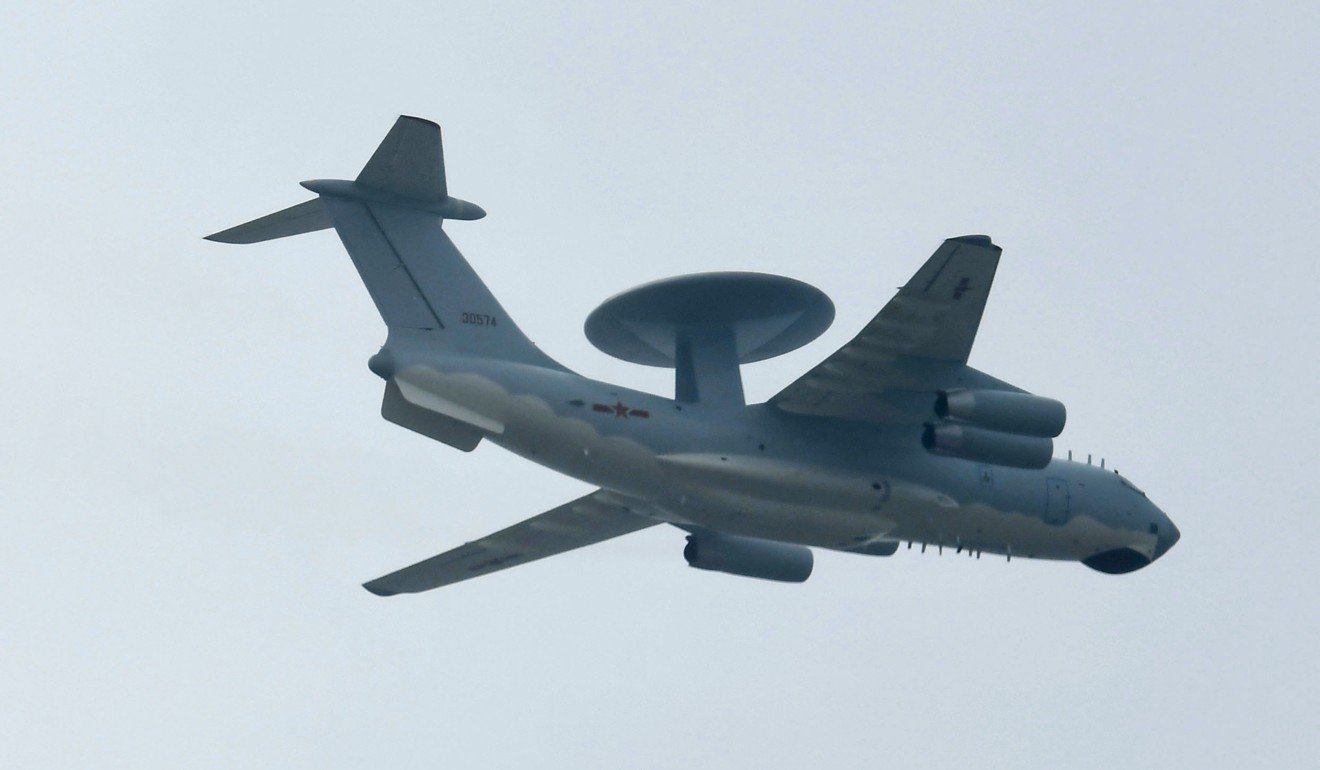
The squadrons will include the air force’s first stealth fighter, the J-20; the main active warplanes such as the J-10 and J-11B; and armed helicopters like the Z-20. However, the J-8 fighter jet would not appear this year, the source said, confirming that the first interceptor built in China has been formally retired.
“The ground march will be led by several hero forces from the five theatre commands, which is different from previous squads selected from the ground forces, air force and navy,” said the insider, who requested anonymity because of the sensitivity of the matter.
“The main goal of this year’s parade is to promote the military modernisation of the PLA under President Xi’s leadership over the past seven years, with the military overhaul being one of the key achievements.”
Thirty-three of the 48 squads would be “weapon squads”, while the 13 others would be made up of infantry troops from the five theatre commands, the source said.
National Day fireworks in Hong Kong cancelled over safety fears
As part of the PLA’s sweeping military reforms, the army’s previous seven military commands were reshaped into five theatre commands, while the four former general headquarters were dissolved and replaced by 15 small functional departments.
In September 2015, Xi announced the PLA would shed 300,000 troops, cutting its size to 2 million, a move aimed at turning the PLA into a more nimble and combat-ready fighting force on a par with international standards.
Xi also split the former Second Artillery Corps into the Rocket Force and the Strategic Support Force, with the latter backing up the military’s electronic warfare units in cyberspace and outer space.
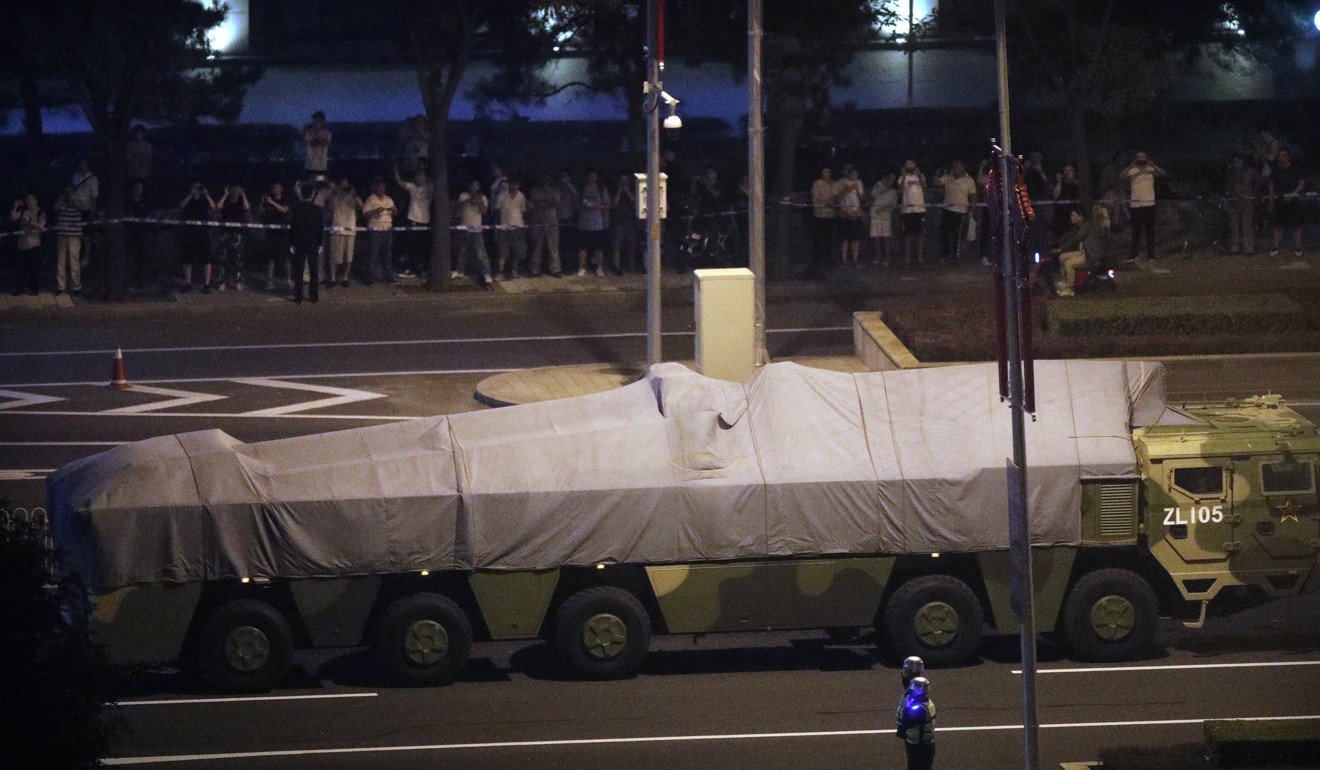
Among the 33 weapon squads, the highlights are expected to be the PLA’s strategic nuclear missiles such as the Rocket Force’s land-based DF-41 intercontinental ballistic missile (ICBM), the DF-21D anti-ship ballistic missile, the DF-17 hypersonic missile and the sea-launched JL-2, or Big Wave-2.
Adam Ni, a researcher at Macquarie University in Australia, said that showing off different types of missiles on land and sea indicated that the PLA was improving its nuclear deterrence capabilities by perfecting a three-pronged military force structure, or the so-called nuclear triad.
The DF-17 hypersonic ballistic missile will be one of the highlights of the parade. Photo: AP
The DF-41 is capable of carrying multiple warheads and many decoys, making it harder to detect than silo-based systems and better able to survive a first strike.
Ni said the DF-41 was China’s next-generation cutting-edge weapon.
“It’s actually an advanced ICBM and has a range to hit practically anywhere in the world, including the continental United States,” Ni said.
“The DF-41 is the ultimate symbol of the destructive potential of Chinese armed forces, just as nuclear weapons are similar symbols of the US and Russia.”
The JL-2 – which has a shorter range of 7,000km (4,350 miles) and can be launched by the PLA Navy’s Type 094 submarines – is unable to hit anywhere on the American continent when launched from submarines in the South China Sea and coastal areas of China.
China tests new warships in live-fire drills near Vietnam
However, China is developing the JL-3, which has a range of about 9,000km; the upgraded version of the JL-2, with a flight test conducted in June, though it is still less than the 12,000km range of the American Trident II.
“China is stepping up its military modernisation, which includes a number of aspects; the land-based aspect is introducing more mobile and survivable missile systems,” Ni said.
“The game change will happen when China is able to hit the whole US continent with its missile submarines in Chinese coastal waters.”
In military terms, survivable refers to the ability to remain mission capable after a single engagement.
The DF-17 is a land-to-land short-range strategic missile capable of delivering both nuclear and conventional payloads. The US intelligence community has estimated that it will reach initial operational capability by 2020. But if the missile is displayed in the parade, that means it is active already.
China conducted two tests of the DF-17 in November 2017, with the first launched from the Jiuquan Space Launch Centre in Inner Mongolia.
An insider said the main goal of this year’s parade is to promote the military modernisation of the PLA. Photo: Reuters
Hong Kong-based military commentator Song Zhongping said the nuclear weapons that would go on show in the parade would all be strategic missiles designed to improve China’s deterrent capabilities.
The show comes after the PLA delivered a national defence white paper in July stressing its goal to “maintain national strategic security by deterring other countries from using or threatening to use nuclear weapons against China”.
Unlike in the past, this year’s report stated that the US and China were now competing superpowers, and that the PLA’s growing forces were developing to the point that they could challenge the US.
Zhou Chenming, a Beijing-based military observer, said it was also necessary for the PLA to “show some of its muscle” amid the ongoing trade dispute between Beijing and Washington.
“To prevent misunderstanding, most of the weapons are just strategic equipment, not tactical arms, because Beijing still doesn’t want to irritate Washington,” he said.
About 280,000 people were involved in the rehearsals for the parade and related support services, according to Xinhua.
Air force and army helicopters on Wednesday had airdropped 15 mountaineers for rescue operations last evening. The IAF said eight reached the An-32 crash site on Thursday morning.
INDIAUpdated: Jun 13, 2019 14:35 IST
HT Correspondent
Hindustan Times, New Delhi
Air force and army helicopters on Wednesday had airdropped 15 mountaineers for rescue operations last evening.(ANI )
Thirteen military personnel on board the An-32 aircraft that crashed in Arunachal Pradesh on June 3 have died, the Indian Air Force said on Thursday hours after the first recce team reached the crash site. Air force and army helicopters on Wednesday had airdropped 15 mountaineers for rescue operations. Eight of them reached the crash site and transmitted the tragic news.
“IAF is sad to inform that there are no survivors from the crash of An32,” the air force said in a string of tweets to “pay tribute to the brave air-warriors who lost their life” in the crash.
The IAF also identified the air warriors who died in the crash: Wing Commander GM Charles, Squadron Leader H Vinod, Flight Lieutenants R Thapa, Ashish Tanwar, S Mohanty and Mohit K Garg, Warrant Officer KK Mishra, Sergeant Anoop Kumar, Corporal Sherin, Leading Air Craftsman SK Singh and Pankaj and two non combatant enrolled employees Putali and Rajesh Kumar.
The An-32 was on its way to an advanced landing ground at Mechuka in Arunachal Pradesh’s West Siang district – about 15 km from the Line of Actual Control, the disputed border with China – when it lost contact with ground control in about 30 minutes after taking off from Jorhat in Assam.
The aircraft was equipped with an emergency locator transmitter, an emergency beacon in the cargo section that can broadcast distress signals to reveal the location of an aircraft. But no signal came from this device.
The The 24-metre-long aircraft with a wingspan of about 29 metres was a speck in a treacherous search zone spanning hundreds of square kilometers dotted with towering ridges, thick forests and deep valleys, officials familiar with the search said. The search efforts were hampered by bad weather, with fierce rains and poor visibility narrowing the scope of operations.
For eight days, the IAF deployed every possible asset it could – right from satellites in space, specialised surveillance aircraft from the Navy, unmanned aerial vehicles, and Global 5000 surveillance jet of the country’s external spy agency to locate the Soviet-origin transport plane that mysteriously disappeared from its radar screens. It also announced a Rs 5 lakh reward for information that could help it locate the aircraft.
The first firm clue about the crash site came eight days later from a villager in Arunachal Pradesh’s remote mountains, according to state government officials in the West Siang district.
A Mi-17 helicopter, among the scores of aircraft involved in the massive search, finally sighted the wreckage at 12,000 feet near a tiny village called Lipo with a population of just around 120 people. The first image of the crash site indicated the plane had blown up into a ball of fire on impact and dimmed hopes about the possibility of the IAF personnel surviving the crash.
The crash is similar to an incident from 10 years ago in which the wreckage of an AN-32 that crashed in West Siang with the same number of people on board was found at 12,000 feet. There were no survivors in the June 2009 crash. The IAF has lost 10 aircraft this year.
In 2016, another AN-32 – flying from Chennai to the Andaman and Nicobar Islands – went missing above the Bay of Bengal with 29 people on board. Search teams were not able to locate the aircraft despite a massive operation.
With a defence budget second only to the US, China is amassing a navy that can circle the globe and developing state-of-the-art autonomous drones
The build-up is motivating surrounding countries to bolster their own armed forces, even if some big-ticket military equipment is of dubious necessity
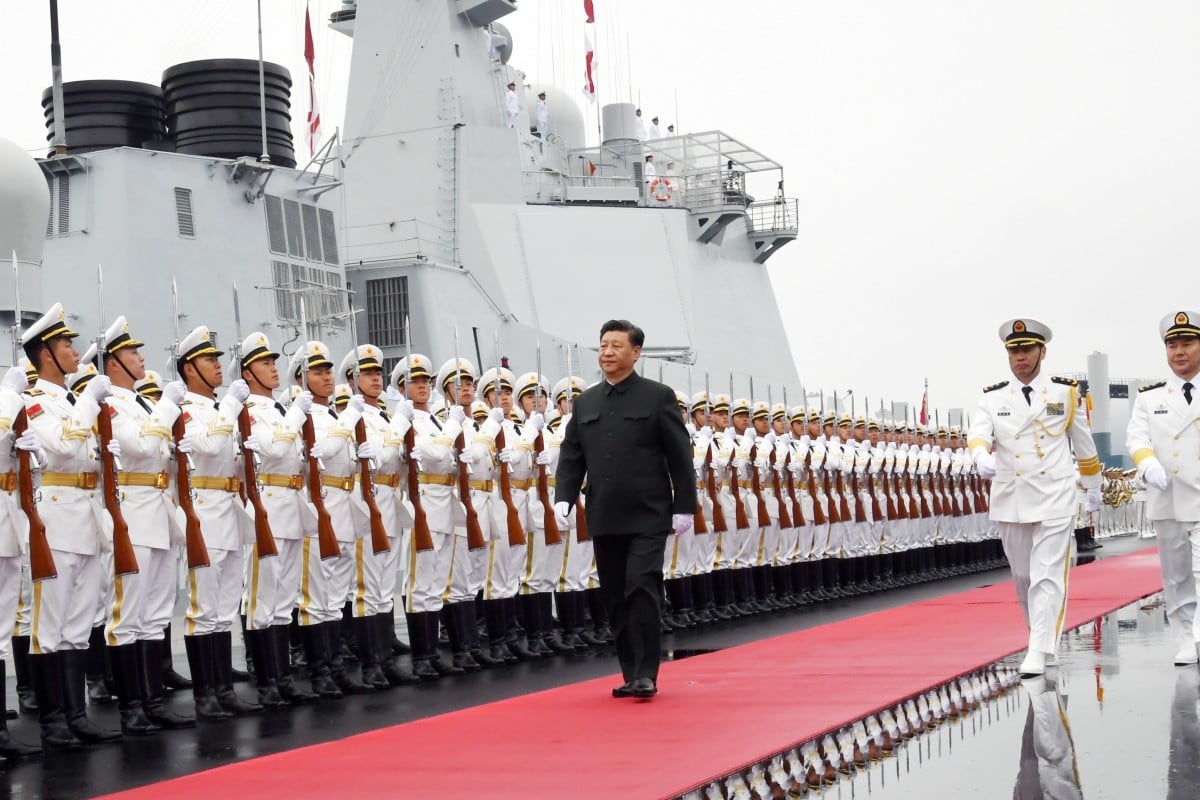
Chinese President Xi Jinping reviews an honour guards before a naval parade in Qingdao. Photo: Xinhua
The Asia-Pacific region is one of the fastest-growing markets for arms dealers, with economic growth, territorial disputes and long-sought military modernisation propelling a 52 per cent increase in defence spending over the last decade to US$392 billion in 2018, according to the Stockholm International Peace Research Institute.
The region accounts for more than one-fifth of the global defence budget and is expected to grow. That was underscored last week by news of
, China is amassing a navy that can circle the globe and developing state-of-the-art autonomous drones. The build-up is motivating surrounding countries to bolster their armed forces too – good news for purveyors of submarines, unmanned vehicles and warplanes.
Opinion: How the Shangri-La Dialogue turned into a diplomatic coup for China
Kelvin Wong, a Singapore-based analyst for Jane’s, a trade publication that has been covering the defence industry for 121 years, has developed a niche in infiltrating China’s opaque defence industry by attending obscure trade shows that are rarely advertised outside the country.
He said the US is eager to train allies in Asia and sell them arms, while also stepping up its “freedom of navigation” naval operations in contested waters in the
In his speech at the Shangri-La Dialogue, acting US Defence Secretary Patrick Shanahan touted American advancements in technology “critical to deterring and defeating the threats of the future” and said any partner could choose to win access to that technology by joining the US defence network.
Wong said the message was clear: “Buy American.”
Analysts say Chinese soldiers have less training, motivation and lower morale than their Western counterparts. Photo: Reuters
The analyst said there is a growing admission among the Chinese leadership that the
He said one executive at a Chinese defence firm told him: “The individual Chinese soldier, in terms of morale, training, education and motivation, (cannot match) Western counterparts. So the only way to level up is through the use of unmanned platforms and
To that end, China has developed one of the world’s most sophisticated drone programmes, complete with custom-built weapon systems. By comparison, Wong said,
US drones rely on weapons originally developed for helicopters.
Wong got to see one of the Chinese drones in action two years ago after cultivating a relationship with its builder, the state-owned China Aerospace Science & Technology Corporation. He viewed a demonstration of a 28-foot-long CH-4 drone launching missiles at a target with uncanny ease and precision.
“Everyone knew they had this,” Wong said. “But how effective it was, nobody knew. I could personally vouch they got it down pat.”
China unveils its answer to US Reaper drone – how does it compare?
That is what Bernard Loo Fook Weng, a military expert at Singapore’s S. Rajaratnam School of International Studies, told the author Robert Kaplan for his 2014 book, Asia’s Cauldron, about simmering tensions in the South China Sea.
He was describing the competition for big-ticket military equipment of dubious necessity.
submarines it could not figure out how to submerge.
“It’s keeping up with the Joneses,” Wong said. “There’s an element of prestige to having these systems.”
Submarines remain one of the more debatable purchases, Wong said. The vessels aren’t ideal for the South China Sea, with its narrow shipping lanes hemmed in by shallow waters and coral reefs. Yet they provide smaller countries with a powerful deterrence by enabling sneak attacks on large ships.
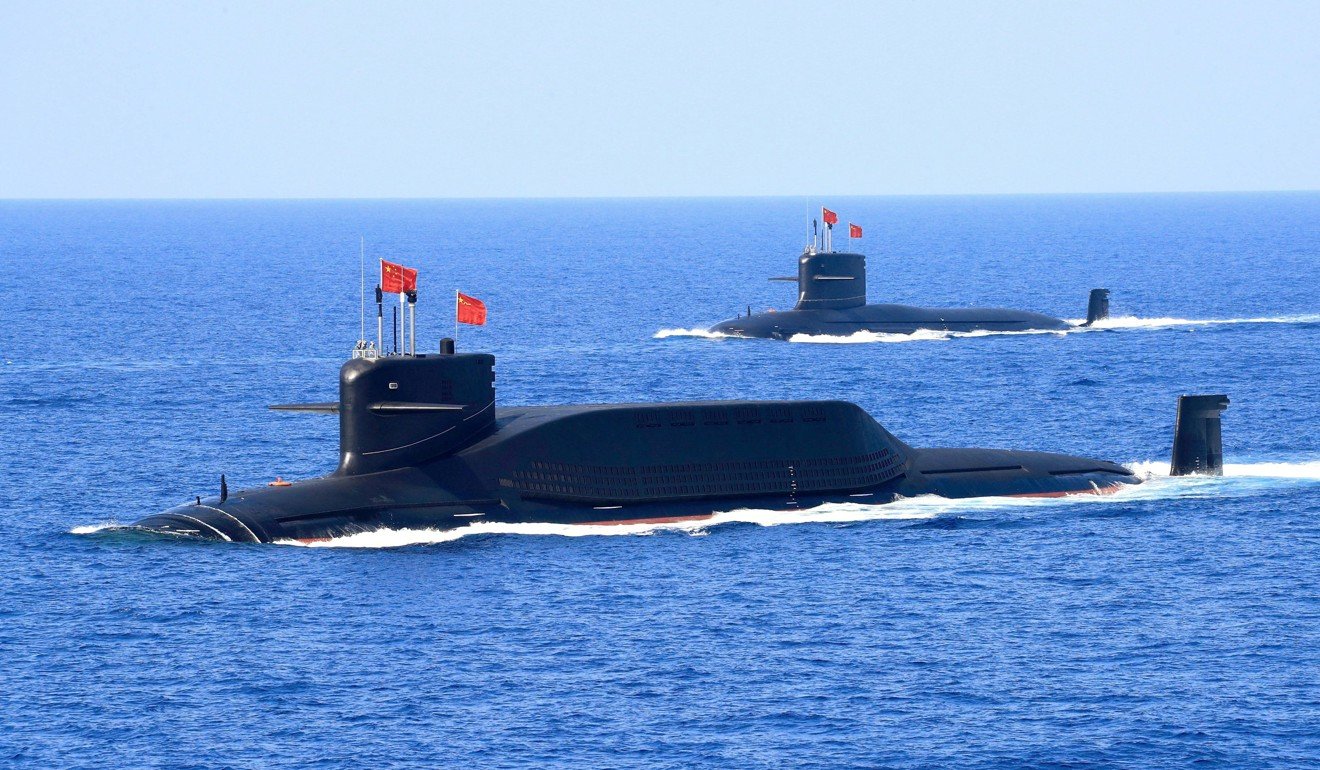
Nuclear-powered PLA Navy ballistic missile submarines in the South China Sea. Photo: Reuters
Type 218 submarines with propulsion systems that negate the need to surface more frequently. If the crew did not need to eat, the submarine could stay under water for prolonged periods. Wong said the craft were specially built for Asian crews.
“The older subs were designed for larger Europeans so the ergonomics were totally off,” he said.
Singapore, China deepen defence ties, plan larger military exercises
Tiny Singapore plays a crucial role securing the vital sea lanes linking the Strait of Malacca with the South China Sea. According to the
the country dedicates 3.3 per cent of its gross domestic product to defence, a rate higher than that of the United States.
State-of-the-art equipment defines the Singapore Armed Forces. Automation is now at the centre of the country’s military strategy, as available manpower is shrinking because of a rapidly ageing population.
Wong said Singapore is investing in autonomous systems and can operate frigates with 100 crew members – 50 fewer than they were originally designed for.
“We always have to punch above our weight,” he said.
WASHINGTON (Reuters) – A French warship passed through the strategic Taiwan Strait this month, U.S. officials told Reuters, a rare voyage by a vessel of a European country that is likely to be welcomed by Washington but increase tension with Beijing.
The passage, which was confirmed by China, is a sign that U.S. allies are increasingly asserting freedom of navigation in international waterways near China. It could open the door for other allies, such as Japan and Australia, to consider similar operations.
The French operation comes amid increasing tensions between the United States and China. Taiwan is one of a growing number of flashpoints in the U.S.-China relationship, which also include a trade war, U.S. sanctions and China’s increasingly muscular military posture in the South China Sea, where the United States also conducts freedom of navigation patrols.
Two officials, speaking on condition of anonymity, said a French military vessel carried out the transit in the narrow waterway between China and Taiwan on April 6.
One of the officials identified the warship as the French frigate Vendemiaire and said it was shadowed by the Chinese military. The official was not aware of any previous French military passage through the Taiwan Strait.
The officials said that as a result of the passage, China notified France it was no longer invited to a naval parade to mark the 70 years since the founding of China’s Navy. Warships from India, Australia and several other nations participated.
China said on Thursday it had lodged “stern representations” with France for what it called an “illegal” passage.
“China’s military sent navy ships in accordance with the law and the rules to identify the French ship and warn it to leave,” defence ministry spokesman Ren Guoqiang told a regularly scheduled media briefing, while declining to say if the sailing had led to the withdrawal of France’s invitation to the parade of ships this week.
“China’s military will stay alert to firmly safeguard China’s sovereignty and security,” he said.
Colonel Patrik Steiger, the spokesman for France’s military chief of staff, declined to comment on an operational mission.
The U.S. officials did not speculate on the purpose of the passage or whether it was designed to assert freedom of navigation.
MOUNTING TENSIONS
The French strait passage comes against the backdrop of increasingly regular passages by U.S. warships through the strategic waterway. Last month, the United States sent Navy and Coast Guard ships through the Taiwan Strait.
The passages upset China, which claims self-ruled Taiwan as part of its territory. Beijing has been ramping up pressure to assert its sovereignty over the island.
Chen Chung-chi, spokesman for Taiwan’s defence ministry, told Reuters by phone the strait is part of busy international waters and it is “a necessity” for vessels from all countries to transit through it. He said Taiwan’s defence ministry will continue to monitor movement of foreign vessels in the region.
“This is an important development both because of the transit itself but also because it reflects a more geopolitical approach by France towards China and the broader Asia-Pacific,” said Abraham Denmark, a former U.S. deputy assistant secretary of defence for East Asia.
The transit is a sign that countries like France are not only looking at China through the lens of trade but from a military standpoint as well, Denmark said.
Last month, France and China signed deals worth billions of euros during a visit to Paris by Chinese President Xi Jinping. French President Emmanuel Macron wants to forge a united European front to confront Chinese advances in trade and technology.
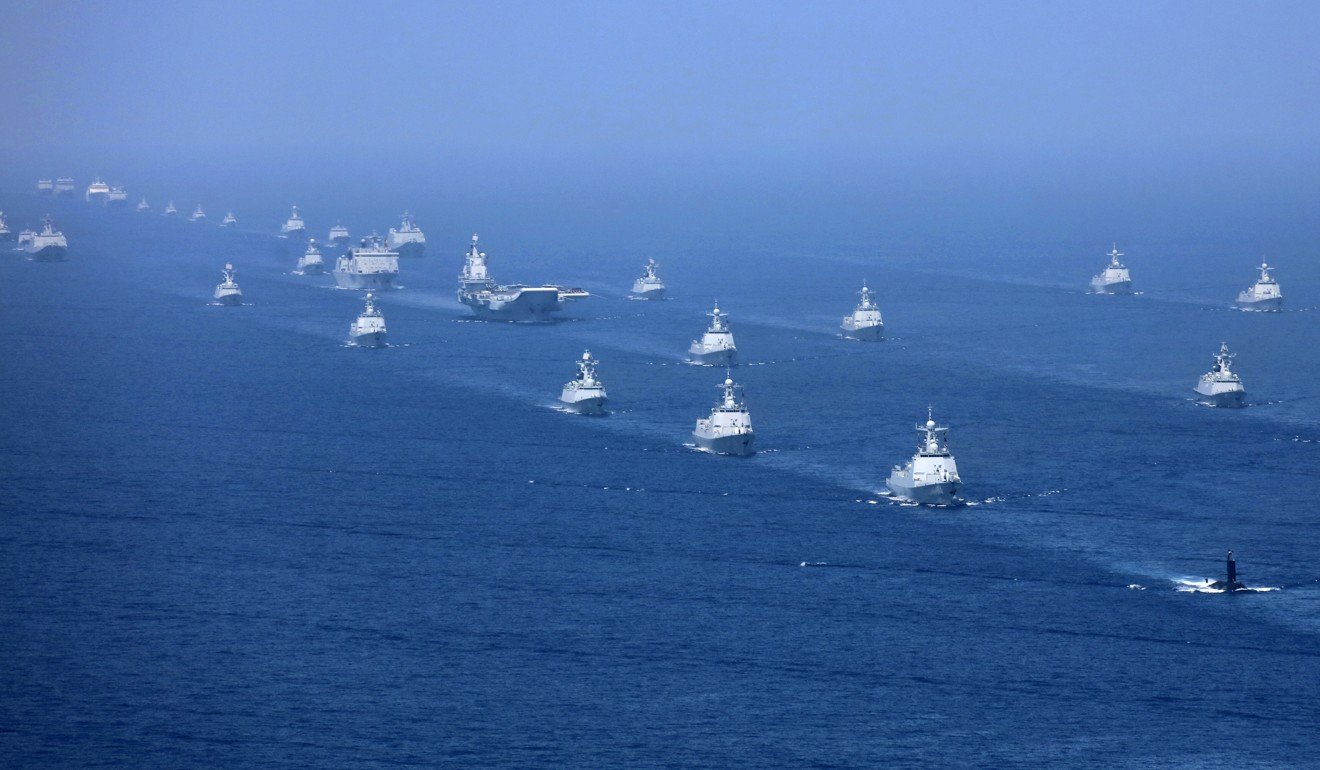
Next month’s nautical spectacle will allow country to show off its most advanced warships to an international audience
More than a dozen foreign navies are expected to join in, including the United States
Chinese navy’s 70th birthday parade showcases rising sea power
1 Mar 2019
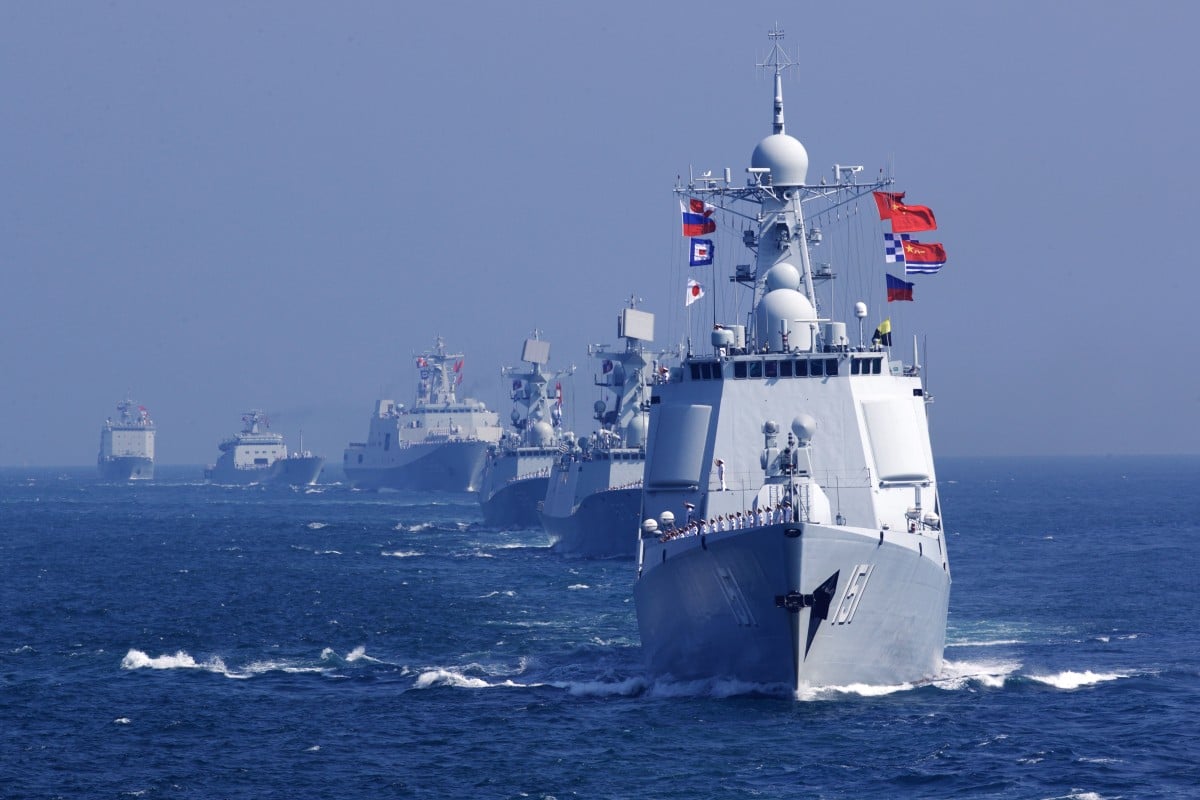
Chinese warships pictured at the end of joint exercise with the Russian navy in 2016. Photo: Xinhua
China will hold a naval parade next month to mark the 70th anniversary of the founding of the People’s Liberation Army Navy and will invite more than a dozen of foreign navies to participate.
The parade will take place on April 23 in the Yellow Sea off the coast of Qingdao in Shandong province, Ren Zhiqiang, a spokesman for the Ministry of National Defence, said on Thursday.
Ren did not provide further details of the parade but military analysts said the exercise would give the navy the opportunity to display its rapidly growing strength and show how that has increased in the past 12 months.
‘No-go zone’ in Yellow Sea for Chinese aircraft carrier sea trials
In April last year a naval review in the South China Sea featured a total of 48 vessels and 76 planes, including China’s first aircraft carrier, the Liaoning, its Type 094A and 095 nuclear submarines, 052D guided missile destroyers and J-15 fighter jets.
The experts expect that next month’s event will provide a showcase for several new and more powerful vessels including its home-grown aircraft carrier Type 001A, the Type 055 – Asia’s most powerful destroyer – and several nuclear submarines.
“The fact that China is holding the naval parade just one year after the South China Sea review shows the great importance [the leadership] attaches to the development of China’s maritime interests, the navy and its expansion,” navy expert Li Jie said.
Chinese President Xi Jinping joined the crew on the deck of the cruiser Changsha following last year’s naval review. Photo: Xinhua
Share:
China also held a major naval parade in 2009 to mark the navy’s 60th anniversary.
It was smaller in scale than the upcoming extravaganza with 25 PLA vessels and 31 fighter jets taking part.
Fourteen foreign navies sent ships to the 2009 parade, including the USS Fitzgerald from America and the guided-missile cruiser Varyag from Russia. France, Australia, South Korea, India and Pakistan also joined in the event.
More foreign countries are expected to join the party this year as the PLA has become more active internationally and China has sold more warships to foreign navies.
China’s new veterans’ law to be reviewed at National People’s Congress next week
“The parade is more like a birthday party for the PLA Navy and the participation of foreign navies is a matter of diplomatic courtesy with few military implications,” said Yue Gang, a former PLA colonel.
Yue said the US and its allies would attend despite the rising tensions between the two sides.
Since 2015 the US and Chinese navies have engaged in a series of confrontations in the South China Sea as China strengthens its military presence in the region and the US has sought to challenge Beijing’s claims to the waters by conducting what it describes as “freedom of navigation” operations.
“I don’t expect they will send any of the warships that have taken part in such operations [to the parade],” Yue said.
China has greatly expanded its naval capabilities in recent years. Photo: AP
Share:
It has been reported that the Japanese Maritime Self-Defence Force has expressed an interest in joining the parade and the Philippines – which has a rival claim to the South China Sea – is planning to send a vessel to the event for the first time.
Li said militaries such as the US and Japan would not want to miss the chance to observe the PLA Navy closely.
“In addition, greater transparency [through the parade] will also help reassure smaller regional partners such as the Philippines that China is a friendly power despite its growing military strength,” he said.
China held its first naval parade in 1957 and April’s display will be the sixth such event.
Sailors also took part in the parade through Tiananmen Square to mark the foundation of the People’s Republic on October 1 1949.
IAF strike on Jaish camp in Pakistan updates: IAF pilot who engaged Pakistan jets missing in action, said the government. India verifying Pak claims on his custody. Follow live updates here:
Pakistani aircraft violated Indian air space in the Nowshera sector of Jammu and Kashmir’s Rajouri district on Wednesday morning. The Indian Air Force scrambled jets and pushed them back. News agency ANI has reported that a Pakistan Air Force F-16 was shot down in Indian retaliatory fire in Nowshera’s Lam valley.
The Pakistani jets had entered into Indian air space over Rajouri district this morning, sources said.
The air space violation by Pakistani jets comes a day after Indian Air Force jets flew across the Line of Control to blow up Jaish-e-Mohammed’s biggest terror camp.
Watch| India lost one MiG 21, pilot who engaged Pak jets ‘missing in action’: Govt
Army’s Eastern Command chief visits Panagarh base in West Bengal amid escalating tensions
Amid heightened tensions between India and Pakistan, Army’s Eastern Command chief Lt General Manoj Naravane visited Panagarh base in West Bengal on Wednesday and reviewed operational preparedness, a defence official said.
Lt Gen Naravane, General Officer Commanding-in-Chief, Eastern Command, emphasised the need for remaining alert at all times to meet the emerging security challenges, the official said.
4:50 pm IST
“Whole country is proud of this brave son,” Arvind Kejriwal tweets for IAF pilot’s safe return
“I pray for the safety of Indian Air Force pilot Wing Commander Abhinandan,” tweeted Arvind Kejriwal. “Whole country is proud of this brave son and everyone is hoping for his safe return. We all stand united to keep our country safe and strong,” Arvind Kejriwal said in the tweet.
4:35 pm IST
Pakistan has long denied its role in terror acts in India
In his last televised statement, Imran Khan appeared to ignore the claims made by Jaish. Pakistan has long denied its role in terror acts in India, which has handed it over several dossiers containing evidence of involvement of terror groups working from its soil.
4:33 pm IST
Imran Khan’s fresh call for dialogue comes in the wake of Pulwama terror attack
Imran Khan’s fresh call for dialogue comes in the wake of India’s effort to corner Pakistan among international community in the wake of Pulwama terror attack, in which at least 40 soldiers were killed. Pakistan-based Jaish-e-Mohammed claimed responsibility for the attack.
4:26 pm IST
Imran Khan calls for talks to de-escalate rising tensions with India over Kashmir
Pakistani Prime Minister Imran Khan calls for talks to de-escalate rising tensions with India over Kashmir.
3:57 pm IST
Better sense should prevail: Imran Khan after Pak strike
“We offered that we are ready for any kind of investigation after Pulwama attack in India. We didn’t take action on Tuesday morning because we weren’t aware of the damage caused by air strike by India. We did not want to cause much collateral damage in India when there was not much damage on our side. The only motive of Pakistan’s strike today was to demonstrate that we have the capability to hit back.
All the wars have happened due to miscalculation. With all the weapons that Pakistan and India have, can we afford to miscalculate. If we take to war neither I nor Mr Narendra Modi would be in a position to control its course. This is why I suggest that better sense should prevail,” said Imran Khan.
3:25 pm IST
IAF pilot who engaged Pak jets missing in action: Govt
IAF pilot who engaged Pakistan jets missing in action, said the government. India verifying Pak claims on his custody.
Pakistan used air force to target military installations, attempt foiled successfully, the government added.
3:20 pm IST
Foreign ministry and Air Vice Marshal brief media
Foreign ministry and Air Vice Marshal briefed the media.
3:00 pm IST
Maharashtra on high alert amid border tensions
Maharashtra and its capital Mumbai have been put on high alert’ in the wake of the rising tensions on the country’s north-west border, official sources said in Mumbai on Wednesday.
Heightened security was seen in Mumbai, the commercial capital of the country. Police vigil has been enhanced in Pune, Nagpur, Aurangabad, Nashik and Kolhapur as well. The government is ensuring there is no disturbance to the ongoing HSC (Class XII) examinations in the state, reported news agency IANS.
2:45 pm IST
Pakistan closes its airspace for commercial flights
Pakistan has closed its airspace for commercial flights, the Civil Aviation Authority (CAA) announced on Wednesday amid escalating tensions with India.
The aviation authority made the announcement on Twitter after Major General Asif Ghafoor, Director General of the Pakistan Army’s media wing, Inter-Services Public Relations (ISPR), acknowledged the closure of Pakistan’s airspace due to the security situation, Dawn News reported.
2:35 pm IST
Air India avoiding route of Pakistan air space with immediate effect
Air India avoiding route of Pakistan air space with immediate effect. India use Pakistan airspace for flights to Gulf countries, Europe and USA, said an Air India official
1:25 pm IST
Pakistan says 2 IAF jets shot down, India rejects claim
There are no reports of any IAF jet suffering damage in action by India’s adversaries, defence sources said on Wednesday according to news agency PTI.
Earlier in the day, Pakistan claimed it shot down two Indian military aircraft over Pakistani air space and arrested at least one of the pilots, according to PTI.
1:20 pm IST
Army, BSF troops along IB, LoC on highest degree of alertness: Officials
The Army and BSF have been put on the highest degree of alertness along the border in Jammu after air space violations by the neighbouring country and the night-long heavy firing and shelling by Pakistani troops on forward and civilians areas across the LoC which stopped on Wednesday, reported news agency PTI.
Authorities have ordered temporary closure of educational institutions in a 5-km radius along the Line of Control (LoC) in Rajouri and Poonch districts on Wednesday amid mounting tensions between the two countries, following the Pulwama terror attack on February 14 and an Indian air strike on Jaish-e-Mohammed camp inside Pakistan on Tuesday.
1:14 pm IST
Defence minister Nirmala Sitharaman chairs DAC meeting
The Defence Acquisition Council (DAC) chaired by defence minister Nirmala Sitharaman met here today and accorded approval for acquisition of defence equipment for about Rs 2700 crores.
Approval was granted for procurement of three Cadet Training ships for the Indian Navy, which would be utilised to provide basic sea training for officer cadets including women officer undertrainees. The ships would be capable of undertaking Hospital Ship duties, providing Humanitarian Assistance and Disaster Relief, undertaking Search and Rescue (SAR) missions and Non-Combatant Evacuation Operations.
1:08 am IST
China reiterates call for India and Pakistan to exercise restraint
China’s Foreign Ministry on Wednesday said it reiterated its call for India and Pakistan to exercise restraint.
Ministry spokesman Lu Kang made the comment at a regular news briefing in Beijing.
1:00 pm IST
PM Modi rushes to review security situation: Report
Prime Minister Narendra Modi cut short his address at a function in Vigyan Bhawan on Wednesday and rushed to attend a meeting to review the security situation arising out of Pakistan’s attempt to violate Indian air space, reported news agency ANI.
Modi was replying to the questions from youngsters during the National Youth Festival 2019 when he was handed over a small piece of paper by an official of Prime Minister Office (PMO).
The Prime Minister immediately stopped and walked towards the panelist where Union minister Rajyavardhan Rathore was also present.
12:53 pm IST
Pakistan stops domestic, international flight operations from Lahore, Multan, Faisalabad, Sialkot and Islamabad
Pakistan immediately stops its domestic and international flight operations from Lahore, Multan, Faisalabad, Sialkot and Islamabad airports, reported news agency ANI.
12:30 pm IST
Sensex turns negative; cracks over 200 points
The benchmark BSE Sensex gave up all early gains and fell over 200 points in afternoon trade Wednesday on widespread selling after Pakistani fighter jets violated Indian air space in Jammu and Kashmir.
After dropping 238 points, the Sensex was trading 161.74 points, or 0.46 per cent, down at 35,811.97 after hitting a low of 35,735.33. The gauge rallied nearly 400 points in morning trade.
The 50-share Nifty also fell 62.55 points, or 0.58 per cent, to 10,772.75.
According to brokers, investor sentiment took a beating after Pakistan claimed that it shot down two Indian military aircraft over Pakistani air space and arrested one of the pilots.
The Pakistani fighter jets on Wednesday violated Indian air space in Jammu and Kashmir’s Poonch and Nowshera sectors.
12:08 pm IST
Rajnath reviews security situation
Home Minister Rajnath Singh Wednesday reviewed the security situation in the country, especially along the border with Pakistan, a day after Indian fighter jets bombed the biggest camp of terror group Jaish-e-Mohammad in that country, officials said.
During the meeting, attended by National Security Advisor Ajit Doval among others, a detailed presentation was given about the security situation in the country and steps taken to ensure peace in all sensitive places.
Singh directed the officials to ensure the Border Security Force, which guards the India-Pakistan border continues to remain on highest level of alertness so that any misadventure from across the border could be foiled, a home ministry official said.
12:01 pm IST
‘Don’t want to escalate tensions, but we are prepared’, says Pakistan
“Today, Pakistan Air Force undertook strikes across Line of Control from within Pakistani airspace. This was not a retaliation to continued Indian belligerence. Pakistan has therefore, taken strikes at non military target, avoiding human loss and collateral damage. Sole purpose being to demonstrate our right, will and capability for self defence.
We have no intention of escalation, but are fully prepared to do so if forced into that paradigm. That is why we undertook the action with clear warning and in broad daylight. For the last few years, India has been trying to establish what they call “a new normal” a thinly veiled term for doing acts of aggression at whatever pretext they wish on a given day.
If India is striking at so called terrorist backers without a shred of evidence, we also retain reciprocal rights to retaliate against elements that enjoy Indian patronage while carrying out acts of terror in Pakistan. We do not wish to go to that route and wish that India gives peace a chance and to resolve issues like a mature democratic nation,” read a statement released by Pakistan on Wednesday.
11:50 am IST
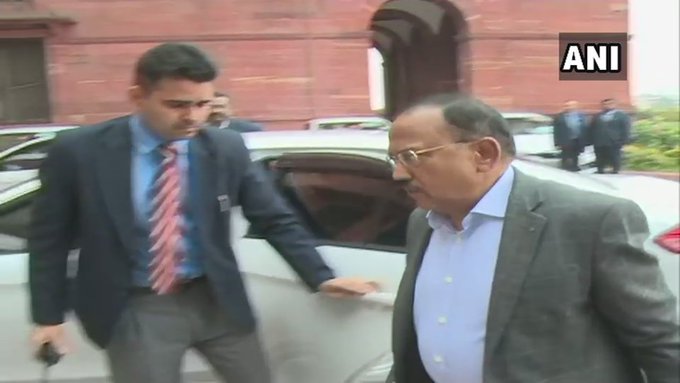
National Security Advisor Ajit Doval arrives at Home Ministry
National Security Advisor Ajit Doval arrived at the Home Ministry in Delhi.
Hope India, Pak conduct dialogue to establish facts through investigation: Wang Yi
“As a mutual friend to both India and Pakistan, we hope that they can conduct dialogue to establish facts through investigation to keep things under control and maintain peace and stability in the region. In this process China is playing a constructive role not the opposite,” said China’s foreign minister Wang Yi.
11:42 am IST
Russia, China and India reaffirmed strong opposition to terrorism: Wang Yi
“Russia, China and India reaffirmed strong opposition to terrorism. At the same time we (China) believe Pakistan has always been opposed to terrorism. China appreciates statements from Indian and Pak friends saying they’ll exercise restraint and avoid escalation of situation,” said China’s foreign minister Wang Yi.
11:37 am IST
Pakistani jets violate Indian air space in Nowshera
Pakistani jets violated Indian air space in Jammu and Kashmir’s Nowshera sector but were successfully confronted.
An official said the jets were immediately pushed back by Indian jets on air patrol.
10:55 am IST
Discussed establishment of UN led global counter-terrorism mechanism: Swaraj
“We need a global strategy, global cooperation. I’m happy to tell you today we discussed the establishment of UN led global counter-terrorism mechanism and finalising CCIT (Comprehensive Convention on International Terrorism) proposed by India to implement it,” said external affairs minister Sushma Swaraj in Wuzhen, China.
“As far as Pulwama is concerned, I had raised this issue in the bilateral meeting with Mr Wang Yi and also at RIC (Russia-India-China) forum,” she added.
10:42 am IST
All countries need to show ‘zero tolerance’ towards terrorism: Sushma Swaraj
Terrorists attacks like Pulwama are a grim reminder for the need of all countries to show ‘zero tolerance’ towards terrorism, external affairs minister Sushma Swaraj said on Wednesday, a day after India conducted pre-emptive air strikes deep inside Pakistan hitting Jaish-e-Mohammad training camps.
The operation was carried out in light of Pakistan’s refusal to acknowledge and act against terror groups operating from its soil and credible information that JeM was planning attacks in India, she said.
10:10 am IST
India’s response to Pulwama attack top agenda of Opposition meet
Left parties will participate in the meeting of the opposition parties, scheduled to be held later today. They had earlier said that they will not participate in the meeting. Pulwama attack and India’s response to it are on the agenda of discussion, reported news agency ANI.
9:55 am IST
Defence minister to meet Army, IAF, Navy chiefs shortly
Defence minister Nirmala Sitharaman, Army Chief General Bipin Rawat, Chief of the Air Staff Air Chief Marshal Birender Singh Dhanoa and Navy Chief Admiral Sunil Lanba will attend DAC (Defence Acquisition Council) meeting shortly today.
9:35 am IST
Mumbai on high alert, govt asks schools to exercise caution
In the wake of air strikes carried out by the Indian Air Force (IAF) on terror camps in Pakistan’s Balakot, the Maharashtra government has called for office bearers of the School & Co. Bus Owner’s Association to ensure the safety of school children keeping the prevailing situation in mind, reported news agency ANI.
Chief Minister Devendra Fadnavis told the state legislature that security has been tightened across the city and appealed to people not to panic.
After intelligence informed Mumbai police to be on high alert, the vigilance and CCTV surveillance has been increased in places like the airport, railway stations, and other key locations.
9:22 am IST
2 Jaish terrorists killed
At least two Jaish terrorists were killed in an encounter that broke out with security forces in Shopian district of Jammu and Kashmir, officials said.
9:20 am IST
Villagers being shifted to safer places
After cross LoC shelling and ceasefire violations , the villagers in some areas of Jammu and Kashmir’s Uri are being shifted to safer places according to officials.
9:05 am IST
Balakot camp blown up by IAF was Jaish’s preferred training spot for 18 yrs
Balakot’s Jaba Top first emerged as a preferred training ground for militants in the time of President Zia-ul-Haq. It was an ideal place for a camp for non-state actors — remote, located near a small town, yet far enough from it, on a wooded hilltop, and on Pakistani territory in the Khyber-Pakhtunkhwa. India crossed into Pakistan’s territory in 1971 (and then again, its aircraft on Tuesday), and so the Pakistanis may have thought it was a good place to host a training camp for militants whom the rest of the world called terrorists.
8:58 am IST
Underscore priority of de-escalating current tensions by avoiding military action: Mike Pompeo to Pak foreign minister
“I spoke to Pakistani foreign minister Shah Mehmood Qureshi to underscore the priority of de-escalating current tensions by avoiding military action and the urgency of Pakistan taking meaningful action against terrorist groups operating on its soil,” said US Secy of State Mike Pompeo, according to news agency ANI.
8:50 am IST
Objective was to act against terrorist infrastructure: Sushma Swaraj in China
“It wasn’t a military op, no military installation targeted. Objective was to act against terrorist infrastructure of JeM to preempt another terror attack in India. India doesn’t wish to see further escalation of situation. It’ll continue to act with responsibility and restraint,” said external affairs minister Sushma Swaraj at the 16th Foreign Ministers meeting of Russia-India-China (RIC) in Wuzhen, China.
8:45 am IST
Target selected to avoid civilian casualties: Sushma Swaraj
“In the light of continuing refusal of Pak to acknowledge and act against terror groups on its territory and based on credible info that JeM was planning other attacks in parts of India, GoI decided to take preemptive action and target was selected in order to avoid civilian casualties,” said external affairs minister Sushma Swaraj at the 16th foreign ministers meeting of Russia-India-China (RIC) in Wuzhen, China, reported news agency ANI.
8:43 am IST
Pakistan outrightly denied any knowledge of Pulwama attack: Sushma Swaraj
“Such dastardly terrorist attacks are a grim reminder for the need of all the countries to show zero tolerance to terrorism and take decisive action against it.
Following the Pulwama terrorist attack instead of taking seriously the calls by international community to act against Jaish-e-Mohammed and other terror groups based in Pakistan, it denied any knowledge of the attack and outrightly dismissed claims by Jaish-e-Mohammed,” said external affairs minister Sushma Swaraj at the 16th foreign ministers meeting of Russia-India-China (RIC) in Wuzhen, China, reported news agency ANI.
8:40 am IST
Did the US know of India’s strike on Balakot? And how much?
Asked about India’s right to self-defence, President Donald Trump told reporters last week, “India is looking at something very strong. And, I mean, India just lost almost 50 people and… with an attack, so I can understand that also.”
And his national security adviser John Bolton had on his own told reporters at a briefing that he had conveyed to his Indian counterpart Ajit Doval in a phone call “that we support India’s right to self-defence”.
8:37 am IST
Only 7 people knew of timing of air strike
On February 18, Prime Minister Narendra Modi had approved the strike. According to intelligence officials, only seven people knew of this decision – Modi, Doval, the three service chiefs, and the heads of RAW and Intelligence Bureau.
Starting February 22, the Air Force started flying night sorties from various frontline bases to confuse the Pakistanis. On February 25, intelligence inputs suggested the presence of a large number of JeM terrorists, around 300-350, at the Balakot camp. The same evening it was decided to go ahead with the strike immediately. Modi knew by late evening that an attack could happen in the next few hours.
8:31 am IST
Exercise ‘maximum restraint’: UN chief to India, Pakistan
UN chief Antonio Guterres is following the situation between India and Pakistan “very closely” and has appealed to the governments of both nations to exercise “maximum restraint” to ensure the situation does not deteriorate further, a top UN official said Tuesday.
The UN Secretary General’s remarks came after Indian Air Force (IAF) carried out a pre-dawn air strike on a terror training camp inside Pakistan.
8:27 am IST
Pak must take ‘action’ against terror groups: US after IAF strikes
Encounter underway between militants, security forces in J-K’s Shopian
An encounter broke out on Wednesday between militants and security forces in Shopian district of Jammu and Kashmir, officials said. Security forces launched a cordon and search operation in Meemendar area of Shopian following information about presence of militants there, the officials said.
They said the search operation turned into an encounter after militants opened firing towards the security forces, who retaliated.


 Image copyright GETTY IMAGES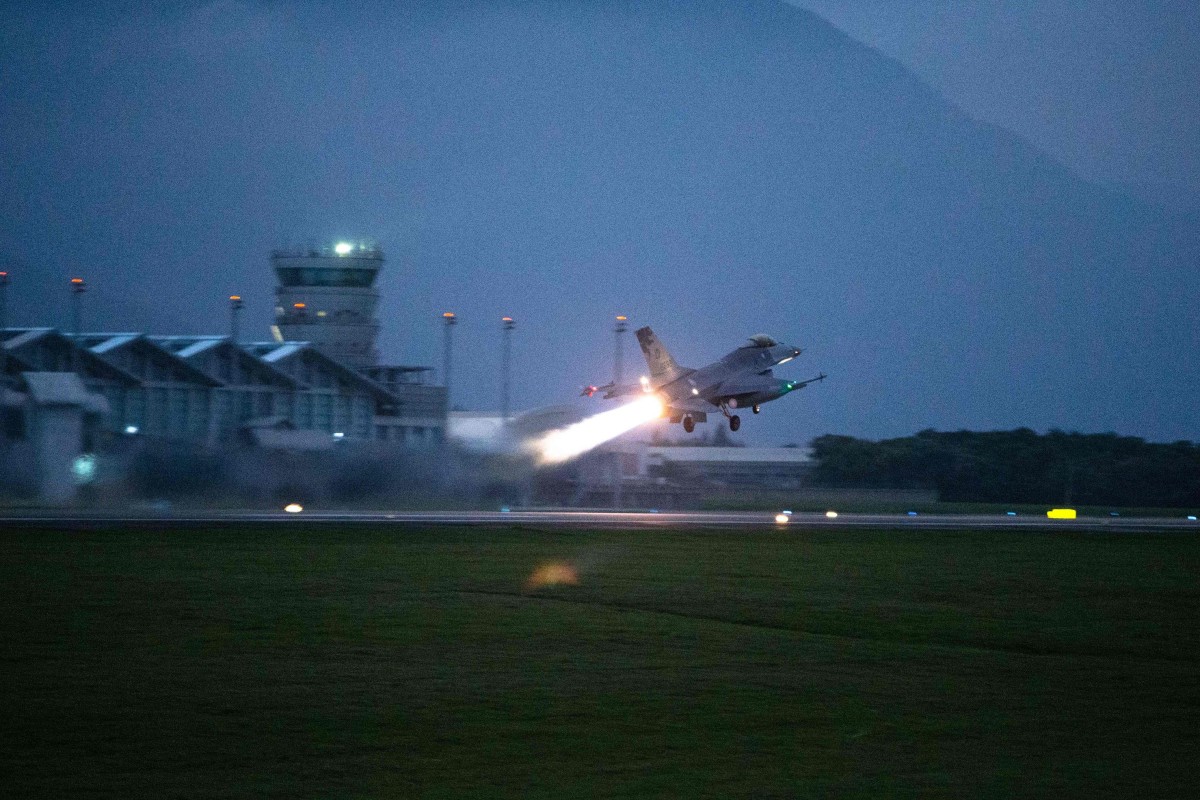









 CHINDIA ALERT: You'll be living in their world, very soon