29/01/2020
NEW DELHI (Reuters) – India’s government has stepped up the purchase of air purifiers over the last two years, taking the number of devices in ministries to protect against deteriorating air quality to nearly 300, government data seen by Reuters showed.
Six federal ministries – including the health, foreign and home affairs – bought at least 159 air purifiers during 2018-2019 at a cost of 5 million rupees ($70,353), according to previously unpublished data obtained under a Right to Information (RTI) law.
That compares with at least 140 air purifiers bought for $55,000 during 2014-2017 for the six ministries and Prime Minister Narendra Modi’s office, as previously reported by Reuters. The latest data on purchases for Modi’s office was not available. (reut.rs/2ppjyBj)
The purchases come as the federal and city governments faced criticism for failing to address the problem of worsening air pollution, especially in the winter, and drew criticism from one activist.
“It’s absolutely criminal to spend taxpayers’ money in buying air purifiers for government officials,” said environmentalist Vimlendu Jha, who is a member of a government panel tasked with solving Delhi’s pollution crisis.
In November, the level of pollution in the capital forced authorities to shut schools, restrict the use of cars and declare a public health emergency.
A senior official at the environment ministry, which bears the most responsibility for tackling pollution, said there was no particular drive to buy purifiers to protect civil servants.
“The government is not spending a fortune by buying air purifiers. And it’s not that officials don’t get to inhale toxic air by confining themselves to their offices,” said the ministry official.
The six ministries and Modi’s office did not respond to requests for comment.
Air purifiers can cost up to nearly $1,000 and are too expensive for most Indians.
Per capita income in New Delhi, a city of more than 20 million, is about $400 a month and thousands of homeless people endure the cold and the toxic air while sleeping on the streets.
Reuters requested for data using the RTI law from the six ministries as it had comparable numbers previously reported in 2018. These were the ministries of foreign affairs, tourism, agriculture, health, home affairs and the federal think-tank Niti Aayog.
(Graphic: Modi’s government purifer purchases 2018-2019 link: here).
Of the total of 159 devices bought by the ministries, the home affairs ministry topped the list with 103 of them in 2018 and 2019, the data showed.
“All the air purifiers have been installed in various offices/rooms of this ministry,” the ministry said in its RTI response, adding the amount spent was 3.1 million rupees ($43,619).
In October and November, when New Delhi saw some its worst air pollution last year, the foreign ministry bought 12 purifiers. Four of them – bought for the minister’s office – were priced at nearly $1,000 each.
The federal health ministry bought 23 air purifiers in the last two years, including 14 in 2019, its highest annual purchases since 2015, the data showed.
Source: Reuters
Posted in air pollution, air purifiers, battles, buy, capital, cars, civil servants, environment ministry, federal ministries, foreign, health, home affairs, India’s government, Indian, Law, ministries, more, New Delhi, Prime Minister Narendra Modi, public health emergency, Right to Information (RTI), shut schools, toxic air, Uncategorized |
Leave a Comment »
27/01/2020
NEW DELHI (Reuters) – India said on Monday it plans to sell its entire interest in Air India Ltd, making a renewed push to sell the flag carrier after it drew no bids in an effort to auction a majority stake almost two years ago.
A document released on Monday showed March 17 as the deadline for submission of initial expressions of interest, and that any bidder must assume liabilities, including debt of 232.87 billion rupees ($3.28 billion).
Substantial ownership and effective control of the airline must remain with an Indian entity, the government added.
The potential sale of an airline kept aloft by a $4.2 billion 10-year bailout in 2012 comes as the government divests money-losing assets to manage the fiscal deficit.
The latest offer should garner significant response partly because it involves a clean exit by the government, said CAPA aviation consultancy India head Kapil Kaul.
“As the entire debt excluding aircraft debt is taken out of the deal, it signals a very determined effort to exit Air India, to allow taxpayers’ funds be utilized for the government’s social agenda,” said Kaul.
Indian business house Hinduja Group and US-based fund Interups have expressed interest in buying the airline, the Business Standard daily said.
It quoted Laxmi Prasad, the chairman and chief business architect of Interups, as saying the fund had initiated talks with the government and would like to make a case for certain aspects of the airline’s business to be included in the deal.
The government in 2018 here tried to sell 76% of Air India and offload about $5.1 billion of its debt, with terms including the retention of all employees.
InterGlobe Aviation Ltd’s (INGL.NS) IndiGo and Jet Airways Ltd (JET.NS) – which has since collapsed – initially showed interest, but opted out after the terms were disclosed.
Steel-to-autos conglomerate Tata Group, widely viewed as a potential suitor for Air India, also decided not to bid after deeming the terms too onerous, sources told Reuters at the time.
On Monday, civil aviation minister Hardeep Singh Puri said the government was open to suggestions and altering some provisions if the changes helped to find a buyer.
“We have gone into this exercise, months of planning and preparation have gone into it and this is not the final, final. The bidders are going to get 45 days, they are going to come back to us. It is an interactive process,” Puri told reporters.
“We are open to revising, refining and tweaking our views.”
A successful bidder would win control of Air India’s 4,400 domestic and 1,800 international landing and parking slots at domestic airports, as well as 900 slots at airports overseas.
It would also get 100% of low-cost arm Air India Express and 50% of AISATS, which provides cargo and ground handling services at major Indian airports, the bid document showed.
The buyer would also have to provide 3% of the value of the airline’s equity as stock options for permanent employees.
Air India has about 9,400 permanent employees and 3,600 fixed-term contract staff – including 1,850 pilots and 4,600 cabin crew – with benefits such as discounted air tickets and pensions.
Its employees protested against the 2018 sale attempt, and it was not immediately clear if they would also resist the latest effort. The government said it would provide details on safeguarding employee interests in its final bid document.
A spokesman for the employee union did not have immediate comment.
The government’s divestment plan could also face opposition from within, with Subramanian Swamy, an MP from the ruling Bharatiya Janata Party (BJP), threatening legal action against the sale.
“This deal is wholly anti-national and I will (be) forced to go to court. We cannot sell our family silver,” Swamy said on Twitter.
Source: Reuters
Posted in Air India, Air India Express, AISATS, Bharatiya Janata Party (BJP), Business Standard daily, CAPA aviation consultancy, civil aviation minister, Hinduja Group, India, InterGlobe Aviation Ltd’s (INGL.NS), Interups, Jet Airways Ltd (JET.NS), New Delhi, renews push, sell, Steel-to-autos conglomerate, Tata Group, Twitter, Uncategorized |
Leave a Comment »
18/01/2020
KUALA LUMPUR/NEW DELHI (Reuters) – Trade ministers from India and Malaysia are likely to meet on the sidelines of the World Economic Forum’s annual meeting in Davos next week amid a palm oil spat between the two countries, a Malaysian government spokesman told Reuters on Friday.
Hindu-majority India has repeatedly objected to Malaysian Prime Minister Mahathir Mohamad speaking out against its recent policies which critics say discriminate against Muslims.
Malaysia, a Muslim-majority nation, is the second biggest producer and exporter of palm oil and India’s restrictions on the refined variety of the commodity imposed last week have been seen as a retaliation for Mahathir’s criticism of New Delhi’s actions.
India’s trade minister Piyush Goyal denied on Thursday that the government was trying to hit out at Malaysia in particular.
The row between the countries, nevertheless, pushed benchmark Malaysian palm futures to its biggest weekly decline in more than 11 years on Friday.
No agenda has been set for the proposed meeting between Goyal and his Malaysian counterpart Darell Leiking on Friday, the spokesman for Malaysia’s Ministry of International Trade and Industry said, adding that the request for a meeting had come from India.
An Indian government source said a meeting was indeed likely with Leiking. A spokeswoman for India’s trade ministry did not respond to a request for comment.
Reuters reported on Thursday that Malaysia did not want to escalate the palm spat with India by talking of any retaliation for now, after Mahathir’s media adviser called for tighter regulations on Indian expatriates and products. Malaysia instead wants to rely on diplomacy.
A separate Indian government source said it was important for New Delhi also to talk things out with Malaysia.
“We too have a lot to lose in Malaysia, there are 2 million Indian-origin people there,” the source said.
There were a total of 117,733 Indian nationals registered as foreign labour in Malaysia as at June 2019, accounting for nearly 6% of the total foreign workforce in the country. Ethnic Malaysian-Indians are the third-largest community in the Southeast Asian country.
Another reason for frosty ties between the countries is the continued presence of controversial Indian Islamic preacher Zakir Naik in Malaysia, said one of the sources.
Naik, who faces charges of money laundering and hate speech in India, has lived in Malaysia for more than three years and has permanent residency in the country. He denies the Indian accusations.
The sources declined to be identified as they were not authorised to talk to the media.
Source: Reuters
Posted in Davos, defuse, Diplomacy, India, Kuala Lumpur, Mahathir Mohamad, Malaysia, Malaysian Prime Minister, Ministry of International Trade and Industry, New Delhi, palm row, Uncategorized, World Economic Forum |
Leave a Comment »
14/12/2019
NEW DELHI (Reuters) – Violent clashes erupted in Delhi between police and hundreds of university students on Friday over the enactment of a new citizenship law that critics say undermines India’s secular foundations.
The unrest has already led Japanese Prime Minister Shinzo Abe to cancel a planned visit to India from Sunday.
The new law offers a way to Indian citizenship for six minority religious groups from neighbouring Bangladesh, Pakistan and Afghanistan including Hindus and Christians, but not Muslims.
Police fired tear gas and used baton charges to disperse scores of students demonstrating at Jamia Millia Islamia university in the heart of Delhi over the law.
Protesters attacked cars in the capital, and several people were injured and taken to hospital.
Zakir Riyaz, a PhD student in social work, said the new law made a mockery of India’s religious openness.
“It goes against the whole idea of a secular India,” he said, speaking by phone from the Holy Family Hospital in New Delhi where 15 of his fellow students were admitted after being injured in a police baton charge.
Police barricades were knocked down and streets were strewn with shoes and broken bricks. An official at the university dispensary said that more than 100 students had been brought in with injuries but all had been discharged.
Parvez Hashmi, a local politician who went to the protest site to speak to police, said about 50 students had been detained.
Students said it was meant to be a peaceful protest, with them trying to go from Jamia University to Parliament Street to show their opposition to the legislation. But police pushed them back, leading to clashes.
Critics of Prime Minister Narendra Modi’s government say it is promoting a Hindu-first agenda for India and that the citizenship law excluding Muslims showed a deep-seated bias against India’s 170 million Muslims.
Imran Chowdhury, a researcher, said “either give citizenship to refugees of all religions or none at all. The constitution is being tampered with in the name of religion.”
Modi’s ruling Bharatiya Janata Party denies any religious bias but says it is opposed to the appeasement of one community. It says the new law is meant to help minority groups facing persecution in the three nearby Muslim countries.
ABE CANCELS
The United Nations human rights office voiced concern that the new law is “fundamentally discriminatory in nature”, and called for it to be reviewed.
Two people were killed in India’s Assam state on Thursday when police opened fire on mobs torching buildings and attacking railway stations in protest at the new citizenship rules signed into law on Thursday.
Japan’s Prime Minister Shinzo Abe cancelled a trip to Assam for a summit with his Indian counterpart Narendra Modi that had been due to begin on Sunday.
Japan has stepped up infrastructure development work in Assam in recent years, which the two sides were expected to highlight during the summit. Abe had also planned to visit a memorial in the nearby state of Manipur where Japanese soldiers were killed in World War Two.
“With reference to the proposed visit of Japanese PM Abe Shinzo to India, both sides have decided to defer the visit to a mutually convenient date in the near future,” Indian foreign ministry spokesman Raveesh Kumar said in a tweet.
Japan’s Chief Cabinet Secretary Yoshihide Suga said both countries would decide on the appropriate timing for the visit although nothing has been decided yet.
A movement against immigrants from Bangladesh has raged in Assam for decades. Protesters there say granting Indian nationality to more people will further strain the state’s resources and lead to the marginalisation of indigenous communities.
Source: Reuters
Posted in admitted, Afghanistan, agenda, Assam, attacked, Bangladesh, barricades, baton charges, Bharatiya Janata Party, broken bricks, cancel, cancels, capital, cars, Christians, citizenship, citizenship law, clashes, Critics, Delhi, demonstrating, discharged, dispensary, disperse, erupt, erupted, excluding Muslims, fired, foundations, Government, heart, Hindu-first, Hindus, Holy Family Hospital, Hospital, India, India’s, injured, injuries, Jamia Millia Islamia university i, Jamia University, Japan, Japanese, Japanese Prime Minister, Japanese Prime Minister Shinzo Abe, Japanese soldiers, Law, legislation, Manipur, minority groups, minority religious groups, mockery, Muslims, new, New Delhi, Openness, opposition, Pakistan, Parliament Street, People, planned visit, PM, Police, Prime minister, Prime Minister Narendra Modi’s, Prime Minister Shinzo Abe, promoting, protesters, religious, religious bias, secular, shoes, Social work, streets, strewn, students, tear gas, Uncategorized, undermines, United Nations human rights office, university students, unrest, used, violent clashes, visit, World War Two |
Leave a Comment »
06/12/2019
HYDERABAD, India (Reuters) – Indian police shot dead four men on Friday who were suspected of raping and killing a 27-year-old veterinarian near Hyderabad city, an action applauded by her family and many citizens outraged over sexual violence against women.
However, some rights groups and politicians criticised the killings, saying they were concerned the judicial process had been sidestepped.
The men had been in police custody and were shot dead near the scene of last week’s crime after they snatched weapons from two of the 10 policemen accompanying them, said police commissioner V.C. Sajjanar.
Thousands of Indians have protested in several cities over the past week following the veterinarian’s death, the latest in a series of horrific cases of sexual assault in the country.
The woman had left home for an appointment on her motor-scooter and later called her sister to say she had a flat tyre. She said a lorry driver had offered to help and that she was waiting near a toll plaza.
Police said she was abducted, raped and asphyxiated and her body was then set alight on the outskirts of Hyderabad. Four men were arrested.
Sajjanar, the police officer, said the men – two truck drivers and two truck cleaners, aged between 20 and 26 years – had been taken to the spot to help recover the victim’s mobile phone and other personal belongings on Friday morning.
“As the party approached this area today (during the) early hours, all the four accused got together. They started attacking the police party with stones, sticks and other materials,” he told reporters near the site of the shootings.
The men, who were not handcuffed, then snatched weapons away from the police and started firing at them, but were killed after the police retaliated. He did not say how the accused were able to overpower their escorts.
“Law has done its duty, that’s all I can say,” Sajjanar said.
The National Human Rights Commission, a government-funded watchdog, said it had ordered an investigation. “Death of four persons in alleged encounter with the police personnel when they were in their custody, is a matter of concern for the Commission,” it said in a statement.
Indian police have frequently been accused of extra-judicial killings, called “encounters”, especially in gangland wars in Mumbai and insurrections in the state of Punjab and in disputed Kashmir. Police officers involved in such killings were called “encounter specialists” and were the subject of several movies.
Graphic – Police Custody Deaths in India: here
People shout slogans as they celebrate after police shot dead four men suspected of raping and killing a 27-year-old veterinarian in Telangana, in a residential area in Ahmedabad, India, December 6, 2019. REUTERS/Amit Dave
‘LONG LIVE POLICE’
The victim’s family welcomed the news the alleged perpetrators had been killed.
“I express my gratitude towards the police & govt for this. My daughter’s soul must be at peace now,” Reuters partner ANI quoted her father as saying.
A Reuters reporter saw the four men’s bodies lying in an open field, all of them face up and barefoot, with their clothes stained with blood, surrounded by policemen.
A large crowd gathered at the site and threw flower petals at police vans in support of the action. Some shouted “Long live police”, while others hoisted police officials onto their shoulders and burst firecrackers.
There was no immediate word from Prime Minister Narendra Modi’s government on the incident, but Maneka Gandhi, a lawmaker from his ruling Bharatiya Janata Party, said the police appeared to have over-reached.
“You can’t take the law in your own hands. The courts would’ve ordered them (the accused) to be hanged anyway. If you’re going to shoot them with guns before due process is followed, then what’s the point of having courts, police and law?” she said.
Tough laws were enacted after the 2012 gang rape and murder of a woman in a bus in New Delhi that led to an outpouring of anger across the country, but crimes against women have continued unabated.
Graphic – Rape cases in India: here
SLOW JUSTICE
Fast track courts have been set up but cases have moved slowly, for lack of witnesses and the inability of many families to go through the long legal process. Some victims and their families have ended up being attacked for pursuing cases against powerful men, often local politicians.
Many Indians applauded the killings.
“Great work #hyderabadpolice ..we salute u,” badminton star Saina Nehwal wrote on Twitter.
In Uttar Pradesh state, where a rape victim was set ablaze on Thursday while she was on her way to court, opposition politician Mayawati said the police there should take “inspiration” from what happened in Hyderabad.
“Culprits should be punished, and if they are not punished then whatever happened in Hyderabad should happen,” the victim’s brother said in hospital.
She was on life support, hospital authorities said, news that could further inflame passions in a country where public anger over crimes against women has grown in recent weeks.
Indian police registered more than 32,500 cases of rape in 2017, according to the most recent government data. But courts completed only about 18,300 cases related to rape that year, leaving more than 127,800 cases pending at the end of 2017.
But some people said the lack of progress in the courts did not mean the police had a free hand to dispense justice.
“We now have to trust that a police force that managed to let unarmed suspects escape their custody, and needed to shoot them dead because they could not catch them alive, is somehow competent enough to have identified and arrested the real culprits?,” Meenakshi Ganguly, South Asia Director at Human Rights Watch, told Reuters from London.
Source: reuters
Posted in applauded, Bharatiya Janata Party, Bharatiya Janata Party (BJP), Citizens, drawing applause, drawing concern, Family, four men, Government, Human Rights Watch, Human Rights Watch (HRW), Hyderabad, Indian police, kill, London, Murder, National Human Rights Commission, New Delhi, outraged, Prime Minister Narendra Modi’s, rape, Reuters, sexual, sexual violence, suspected, Telangana, Uncategorized, Uttar Pradesh, veterinarian, women |
Leave a Comment »
04/11/2019
- Hopes were high a regional summit could finally wrap up negotiations on the Regional Comprehensive Economic Partnership
- But despite claims of ‘significant progress’ in the 16-nation talks, India remains a stumbling block
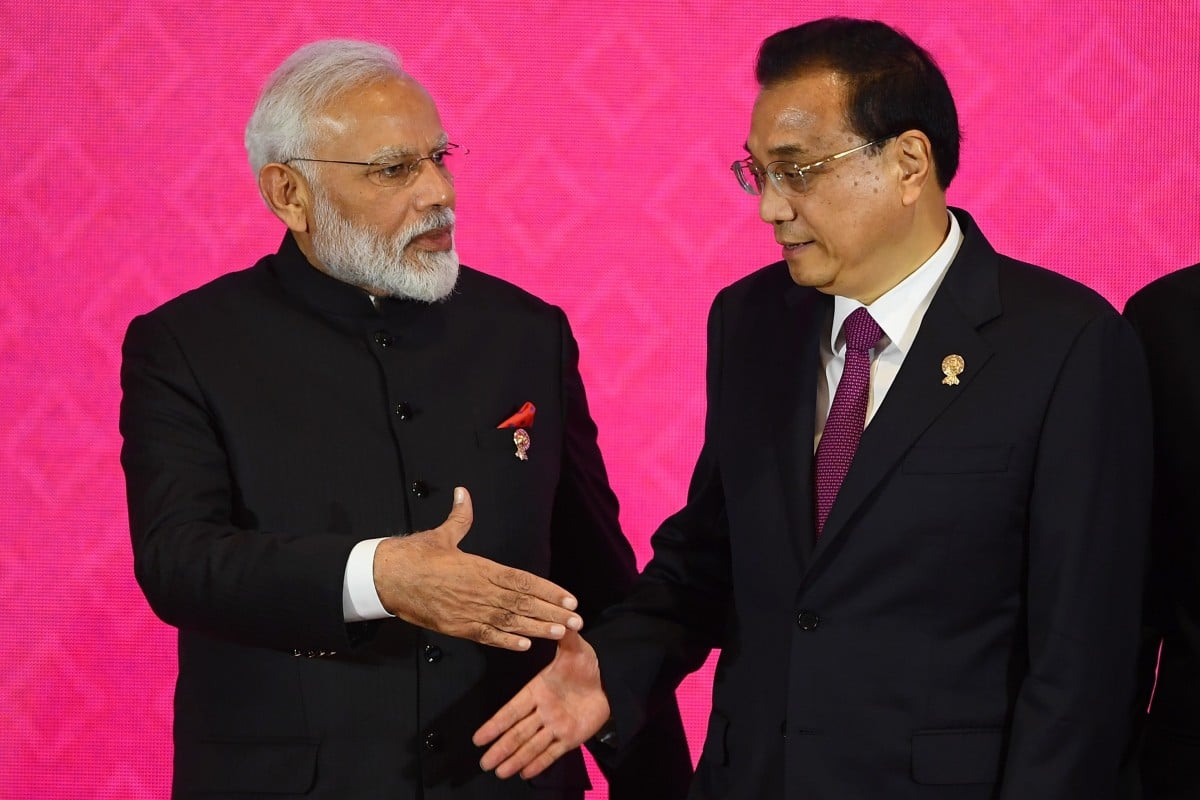
Indian Prime Minister Narendra Modi and China’s Premier Li Keqiang attend the Regional Comprehensive Economic Partnership Summit in Bangkok. Photo: AFP
Fifteen of the countries involved in negotiating a mammoth 16-nation Asian
trade pact were on Monday hoping to seal the deal after seven years of talks but faced a fresh setback as India signalled it was pulling out over terms that were against New Delhi’s interests.
A joint statement by all 16 states involved in the Regional Comprehensive Economic Partnership (RCEP) said 15 economies had “concluded text-based negotiations for all 20 chapters and essentially all their market access issues”, and would undertake legal scrubbing of the proposed pact before a formal signing in 2020.
But “India has significant outstanding issues, which remained unresolved”, the statement said.
“All RCEP participating countries will work together to resolve these outstanding issues in a mutually satisfactory way. India’s final decision will depend on satisfactory resolution of these issues.”
Multiple Indian media outlets reported that Prime Minister Narendra Modi had told a Monday evening meeting of leaders from the RCEP countries that “neither the talisman of [Mahatma Gandhi] nor my own conscience permit me to join the RCEP”.
“When I measure the RCEP agreement, with respect to the interest of Indians, I don’t get a positive answer,” he was quoted as saying.
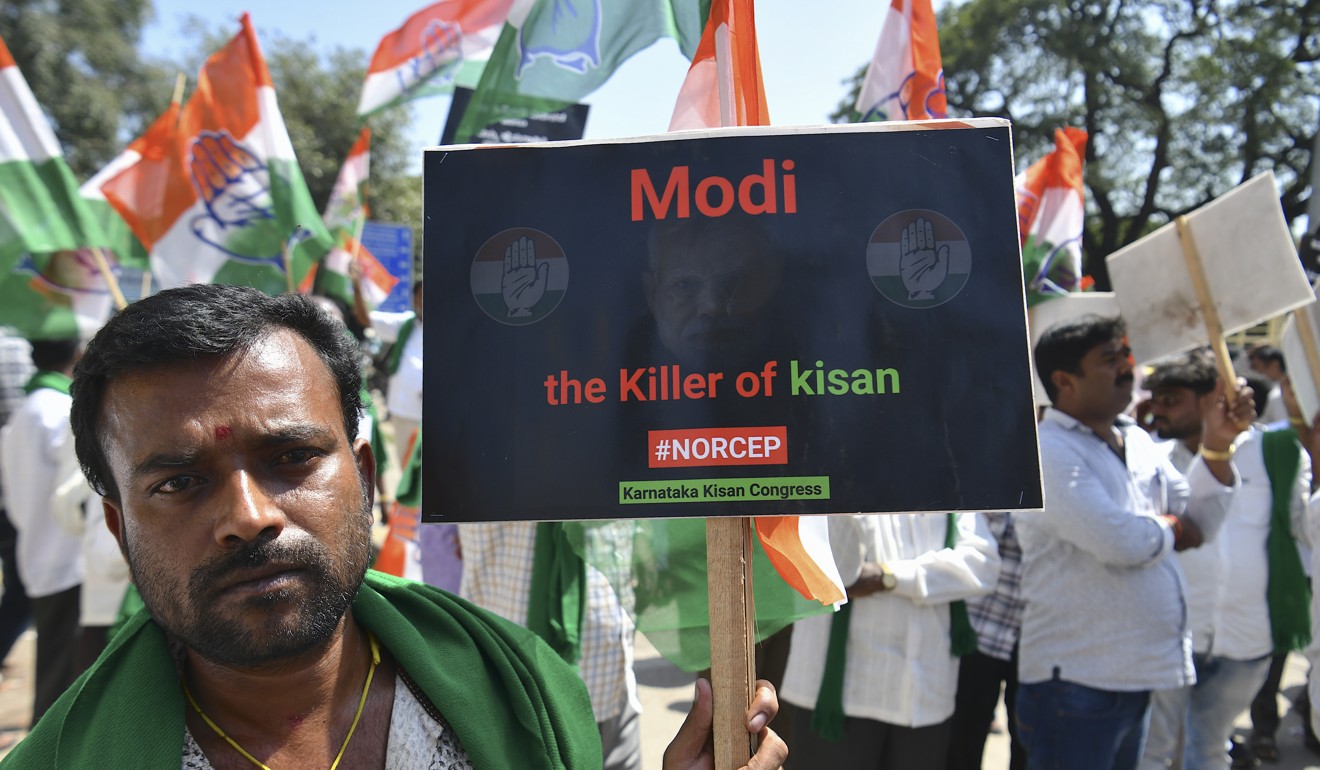
Indians protest against the Modi-led government’s backing of the Regional Comprehensive Economic Partnership. Photo: AFP
Henry Gao, a law professor at the Singapore Management University focusing on international trade law, said an RCEP without India would be “even more worthwhile” for the so-called RCEP-15.
He cited two reasons: India’s “low ambitions” for the pact, and the high level of integration among the countries of East and Southeast Asia which are part of the RCEP-15.
“A mega trade deal like RCEP will only further accelerate the integration process and greatly boost trade and economic growth in the region,” Gao said.
Explained: Regional Comprehensive Economic Partnership (RCEP)
Earlier expectations were that the joint statement would declare at least a “substantial conclusion”, “near conclusion” or “in principle conclusion” of the RCEP, which aims to create a free-trade zone spanning 39 per cent of the world economy.
The phrasing used to describe the progress of negotiations is being closely parsed because, since it requires endorsement from all RCEP countries, it accurately captures the sentiment of all the 16 negotiating teams.
Last year, Singapore, as chair of the Association of Southeast Asian Nations (Asean), pushed for a conclusion of the deal, but eventually the joint statement declared that only “substantial progress” had been made.
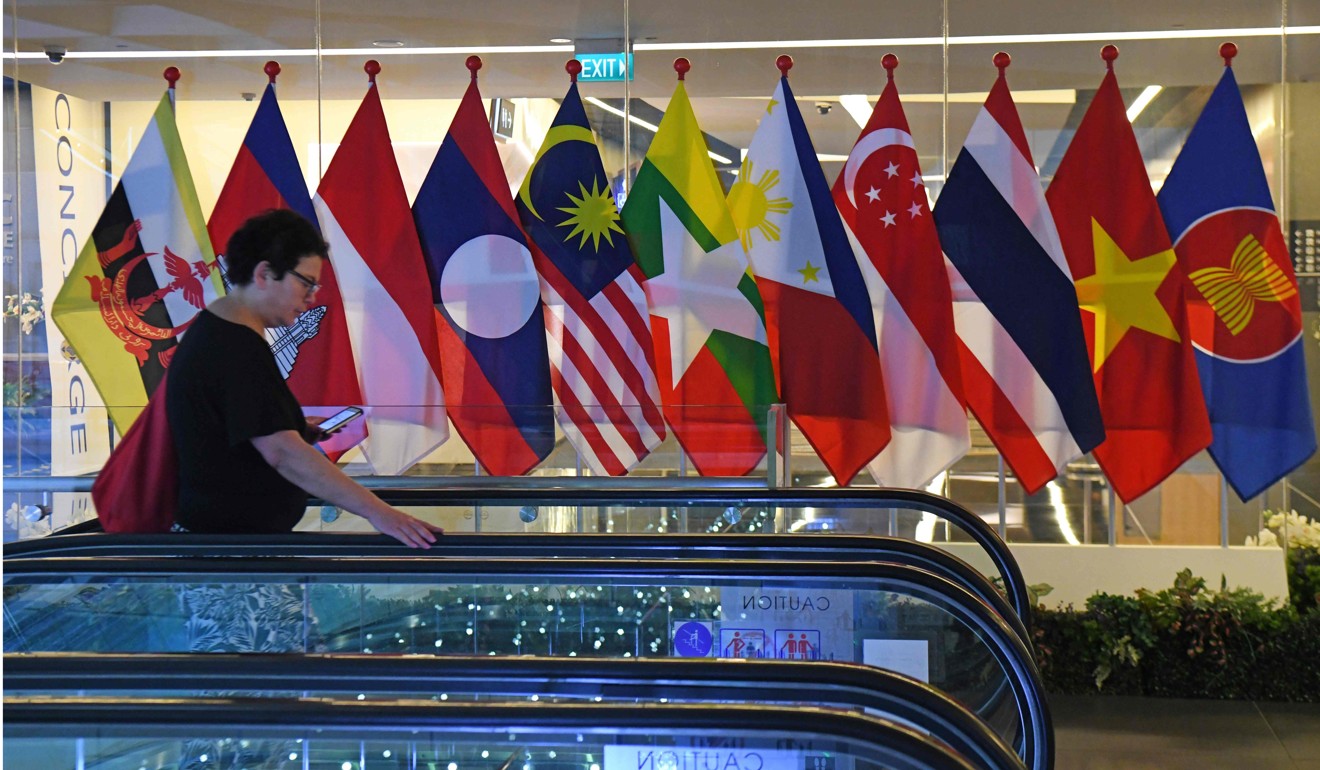
Asean countries plus six others are negotiating the trade pact. Photo: AFP
Indian media, citing government sources, said the pact’s inadequate protection against import surges, the possible circumvention of rules of origin, and a lack of “credible assurances” on market access and non-tariff barriers, proved too much for New Delhi to swallow.
facing fierce domestic criticism for being in the pact despite opposition even from
Hindu nationalist support base, last week piled on a fresh set of demands that other countries balked at, negotiators from Southeast Asian countries said over the weekend.
Furious efforts that continued up to Sunday night failed to bridge the gap between India and the 15 countries.
India’s concerns about RCEP remain the major obstacle to world’s largest trade deal
Indian critics of the RCEP say the deal will have a ruinous impact on the South Asian economy, which has trade deficits with the other 15 countries.
The biggest opposition has come from the country’s long protected industries, such as its dairy sector, which fears it could be wiped out by lower tariffs on Australian and New Zealand products that would result from the RCEP.
Indian government sources on Monday said the country had not made last-minute demands, but Southeast Asian negotiators said major demands were made as late as Thursday.
Gao, the Singapore-based law professor, said it “makes sense for India to stay out” as it would have faced “a lot of competition from Chinese manufactured products” if it were part of the deal.
“India could temporarily shield its firms from Chinese competition by staying out, but whether this will work in the long term is a different question,” he said.
Source: SCMP
Posted in Association of Southeast Asian Nations (ASEAN), Australian products, Chinese manufactured products, Chinese premier Li Keqiang, conscience, India alert, Indian Prime Minister Narendra Modi, mahatma gandhi, negotiations, New Delhi, New Zealand products, pulls out, Regional Comprehensive Economic Partnership, Regional Comprehensive Economic Partnership (RCEP), seven years, Singapore, Singapore Management University, Southeast Asian negotiators, talisman, trade deal, Uncategorized, World economy |
Leave a Comment »
03/11/2019
BANGKOK (Reuters) – Leaders from China and Southeast Asia states called for swift agreement on what could become the world’s largest trade bloc at a regional summit on Sunday, but new demands from India left officials scrambling to salvage progress.
Hopes of finalising the Asia-wide Regional Comprehensive Economic Partnership (RCEP), which is backed by China, have been thrown into doubt at the summit of the Association of Southeast Asian Nations (ASEAN) in Bangkok, Thailand.
Summit host Thailand said late on Sunday that the deal could be signed by February 2020. Thailand had previously said it aimed to conclude negotiations by the end of the year.
New impetus to reach agreement has come from the U.S.-China trade war, which has helped knock regional economic growth to its lowest in five years.
“The early conclusion of RCEP negotiations will lay the foundation for East Asia’s economic integration,” said a statement from China’s foreign ministry after Premier Li Keqiang met Southeast Asian leaders.
But Indian Prime Minister Narendra Modi did not even mention the RCEP deal in opening remarks at a meeting with Southeast Asian leaders and instead spoke only of reviewing the existing trade agreement between ASEAN and India.
Nor did Modi mention the trade bloc, whose 16 countries would account for a third of global gross domestic product and nearly half the world’s population, in Twitter posts after meeting Thai and Indonesian leaders.
An Indian foreign ministry official later told a media briefing “Let’s take all the RCEP questions tomorrow.”
Southeast Asian countries had hoped at least a provisional agreement could be announced on Monday.
But India has been worried about a potential flood of Chinese imports. A person with knowledge of New Delhi’s negotiations said new demands were made last week “which are difficult to meet.”
TRADE WAR IMPACT
Negotiators were meeting into the evening on Sunday to try to come to an agreement, Thai government spokeswoman Narumon Pinyosinwat told reporters on Sunday.
“We don’t have a conclusion yet. Once there is one, it would be announced,” she said. “Commerce ministers are still discussing outstanding issues. The signing is expected around February next year.”
Thai Prime Minister Prayuth Chan-ocha told the formal opening of the ASEAN summit on Sunday that the 16 nations in the potential trade bloc ought to come to agreement this year to stimulate economic growth, trade and investment.
He highlighted the risks of “trade frictions” and “geo strategic competition” in the region.
Some countries have raised the possibility of moving ahead without India on forming a bloc that also included Japan, South Korea, Australia and New Zealand.
But Thai commerce minister Jurin Laksanawisit told Reuters on Sunday that India had not pulled out.
Another advantage for Southeast Asian countries from having relative heavyweight India in the trade pact would be less domination by China.
Longstanding rivals China and India, which fought a border war in 1962, clashed verbally in recent days over India’s decision to formally revoke the constitutional autonomy of the disputed Muslim majority state of Kashmir.
The U.S. decision to send a lower level delegation to the summits this year has raised regional concerns that it can no longer be relied on as a counterweight to China’s increasing regional might.
Instead of President Donald Trump or Vice President Mike Pence, the United States will be represented by Commerce Secretary Wilbur Ross and White House national security adviser Robert O’Brien.
At the summit, China’s Premier Li said China was ready to work with countries in the region for long term peace and stability in the South China Sea, where neighbours reject Beijing’s sweeping maritime claims.
Source: Reuters
Posted in Asia-wide Regional Comprehensive Economic Partnership (RCEP), Association of Southeast Asian Nations (ASEAN), Bangkok, Beijing, China alert, Chinese imports, Commerce Secretary, despite, doubts, India, Indian prime minister, Indian Prime Minister Narendra Modi, Indonesian leaders, Kashmir, knock, maritime claims, Muslim-majority state, National Security Adviser, New Delhi, potential flood, Prayuth Chan-ocha, Premier Li Keqiang, President Donald Trump, push, RCEP, regional economic growth, Robert O’Brien, SE Asian states, Thai leaders, Thai Prime Minister, Thailand, Trade pact, Twitter, U.S.-China trade war, Uncategorized, Vice-President Mike Pence, White House, Wilbur Ross |
Leave a Comment »
02/11/2019
NEW DELHI (Reuters) – German Chancellor Angela Merkel and Indian Prime Minister Narendra Modi signed wide-ranging agreements in New Delhi on Friday to deepen strategic cooperation and exchanged notes on ways to boost bilateral trade.
Merkel, accompanied by several cabinet colleagues and a business delegation, is in India on a three-day visit that began on Thursday.
“We’re encouraging our private sectors to give an impetus to our growing bilateral trade and Chancellor Merkel and I will meet some of the top business and industry leaders,” Modi told a joint news conference with the German leader.
“We’re encouraging our private sectors to give an impetus to our growing bilateral trade and Chancellor Merkel and I will meet some of the top business and industry leaders,” Modi said.
Bilateral trade between the two countries rose to $24.06 billion (18.5 billion pounds) in the 2018/19 fiscal year ending in March from $22 billion the previous year, while German companies have invested nearly $12 billion in India since 2000.
Germany is India’s largest trading partner in Europe and more than 1,700 German companies are operating in India.
The agreements struck on strategic cooperation, included agriculture, cyber security and artificial intelligence. Modi said the two countries would also bolster ties to combat “terrorism and extremism”.
Germany and India also agreed to join hands in the area of education.
“As many as 20,000 Indian nationals are studying in Germany and we would like to see more,” Merkel said.
Although Merkel and Modi didn’t mention anything about restarting talks on finalising a free trade agreement between India and the European Union, sources earlier said the two leaders could take up the trade deal.
Eric Schweitzer, president of the Association of German Chambers of Commerce and Industry (DIHK), earlier said India had enormous potential but there has been uncertainty among companies after an investment protection agreement between the two countries ended in 2016.
“Small and medium-sized German companies stand in a labyrinth of regulations and shy away from larger investment. Negotiations should restart and Merkel’s visit could help,” he said.
VDA, Germany’s car industry association that counts automakers like Volkswagen (VOWG_p.DE), Daimler, BMW and Audi as members, also wanted India to restart the FTA talks.
Daimler’s Mercedes-Benz, BMW and Audi dominate India’s luxury car market.
Source: Reuters
Posted in agreements, Angela Merkel, Association of German Chambers of Commerce and Industry (DIHK), Audi, bilateral ties, BMW, Daimler, deepen, education, European Union, FTA, German Chancellor, Germany, India alert, Indian nationals, Indian prime minister, Indian Prime Minister Narendra Modi, Mercedes-Benz, New Delhi, sign, studying, Uncategorized, VDA, Volkswagen (VOWG_p.DE), wide-ranging |
Leave a Comment »
30/10/2019
- Black market imports from China, confusing regulations and pollution concerns are undermining India’s fireworks industry
- Industry sources say Diwali sales this year were down by 30 per cent
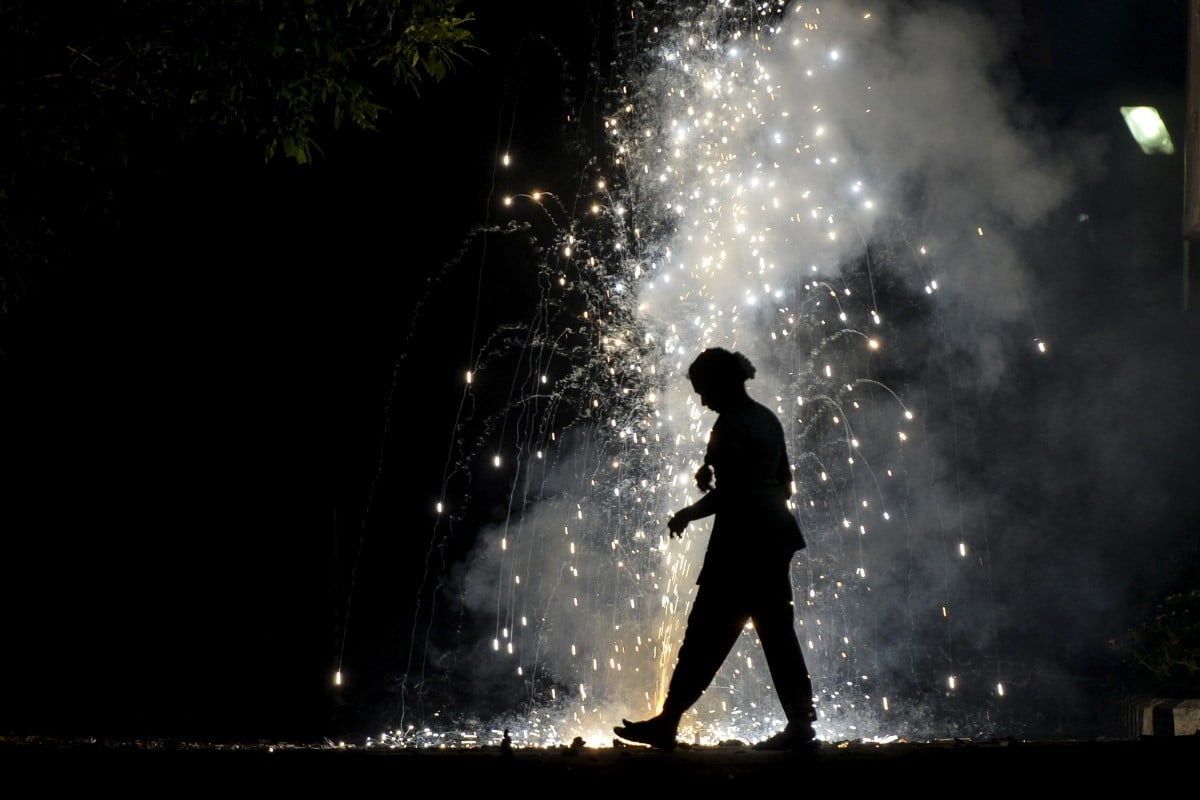
A woman is silhouetted by lit firecrackers during Diwali celebrations in Chennai. Photo: AFP
Arumugam Chinnaswamy set up his makeshift booth selling firecrackers in a Chennai neighbourhood a week ahead of Diwali, the Hindu festival of lights, with great expectations of doing a brisk trade.
Yet a week later, he has been forced to pack up more than half his stock in the hope he’ll have better luck next year.
“Four years ago, I sold firecrackers worth 800,000 rupees (US$11,288) on the eve of Diwali alone. This year, the sales have not even been a quarter of that,” said Chinnaswamy, 65, painting a grim picture that will be recognised by many in the Indian fireworks industry.
Chinnaswamy buys his firecrackers in Sivakasi, an industrial town in the southern Indian state of Tamil Nadu that produces more than 90 per cent of the country’s fireworks.
Sivakasi’s dry climate has helped to make it the firework capital of India and many production facilities in the town have been in the business for close to a century. For the most part, the industry has resisted mechanisation and still deals in handmade products. Its 1,100-plus manufacturing units provide jobs for 800,000 mostly uneducated workers and its diligent labour force have earned the town the nickname of ‘Little Japan’.
A worker lays firecrackers in an outdoor yard at a manufacturing unit involved in the production of firecrackers ahead of the Hindu festival of Diwali, in Sivakasi. Photo: AFP
But this reputation is under threat, struggling under the weight of an anti-pollution campaign, regulatory uncertainty and the arrival of cheap black-market Chinese imports. Irregular monsoons and a slowdown-induced cash crunch have not helped matters either.
Industry figures estimate the Diwali sales of India’s 80 billion-rupee firecracker industry took a 30 per cent drop this year.
With pollution in Indian cities among the worst in the world, the government has come under pressure to do something about the nation’s toxic air – a problem that becomes more acute during Diwali due to the toxic fumes emitted when celebratory fireworks are set off. This Diwali, for instance, many areas in New Delhi recorded an Air Quality Index (AQI) of 999, the highest possible reading (the recommended limit is 60).
That makes the fireworks industry seem like an easy target when it comes to meeting government air quality targets.
Trouble began brewing in October last year when the Supreme Court banned the manufacture of traditional fireworks containing barium nitrate, a chief polluter. That decision put a rocket under the industry, as barium nitrate is cheap and is used in about 75 per cent of all firecrackers in India.
Factories in Sivakasi responded with a four-month shutdown protest that decimated annual production levels by up to a third.
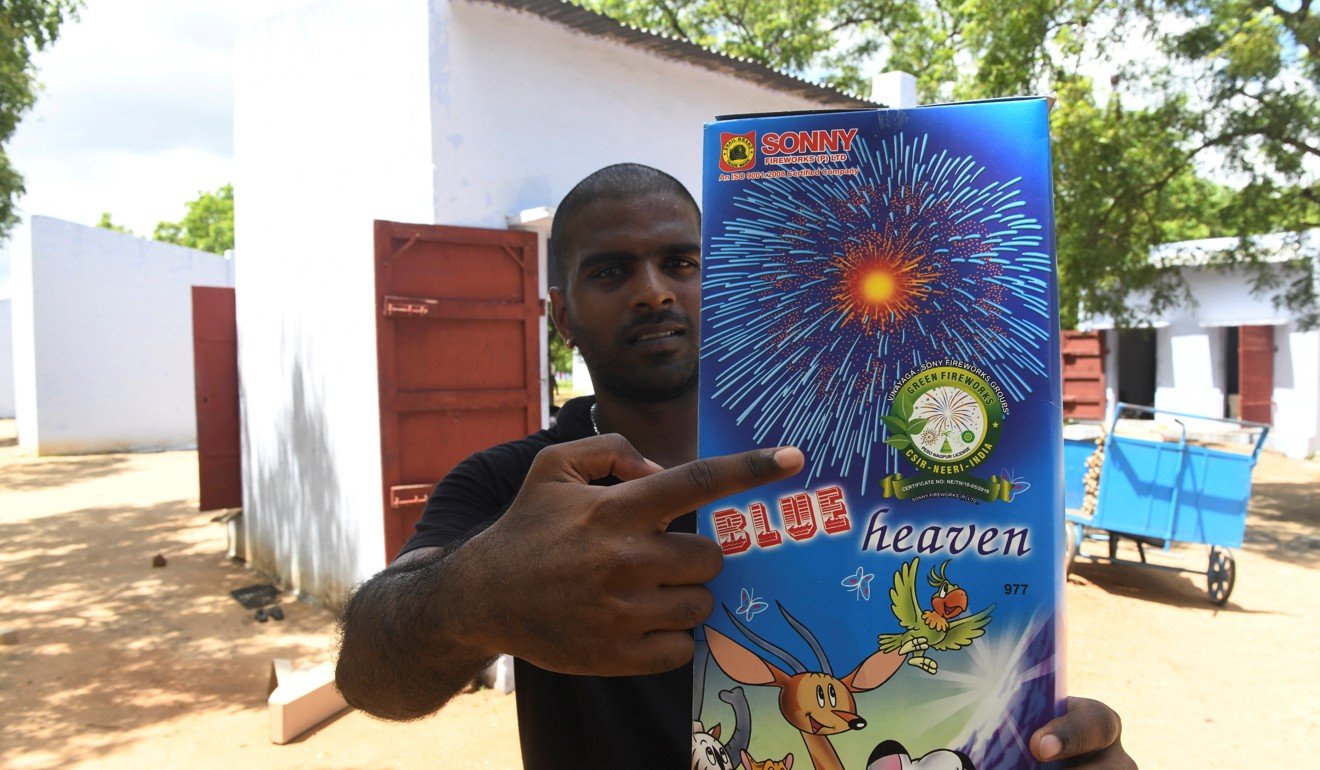
A seal denotes environment friendly ‘Green Fireworks’ at a manufacturing unit in Sivakasi. Photo: AFP
Apparently realising it had overstepped the mark – and that enforcing the Supreme Court regulations would be next to impossible – the government stepped in to rescue the industry, offering its assistance in the manufacture of environment-friendly crackers containing fewer pollutants, but it was too little, too late.
“The Supreme Court verdict was simply Delhi-centric with the vague idea of [cracking down on] urban pollution. It lacked any on-the-ground knowledge of the fireworks industry,” said Tamil Selvan, president of the Indian Fireworks Association, which represents more than 200 medium and large manufacturers.
Singapore travellers give Hong Kong a miss over Diwali long weekend
“Fireworks are low-hanging fruit for the anti-pollution drive as the industry is unorganised. Could the government or judiciary place a similar blanket ban on more pollution-causing industries like automobiles, plastics or tobacco?” asked Selvan.
CHINESE COMPETITION
The industry has also been hit by a flood of cheap Chinese firecrackers that are smuggled into the country on the black market.
In September, the country’s federal anti-smuggling agency, the Directorate of Revenue Intelligence, cautioned various government departments that huge quantities of Chinese-produced firecrackers had reached Indian soil in the lead up to Diwali.
But industry sources complain they have seen little action from the government to combat the problem.
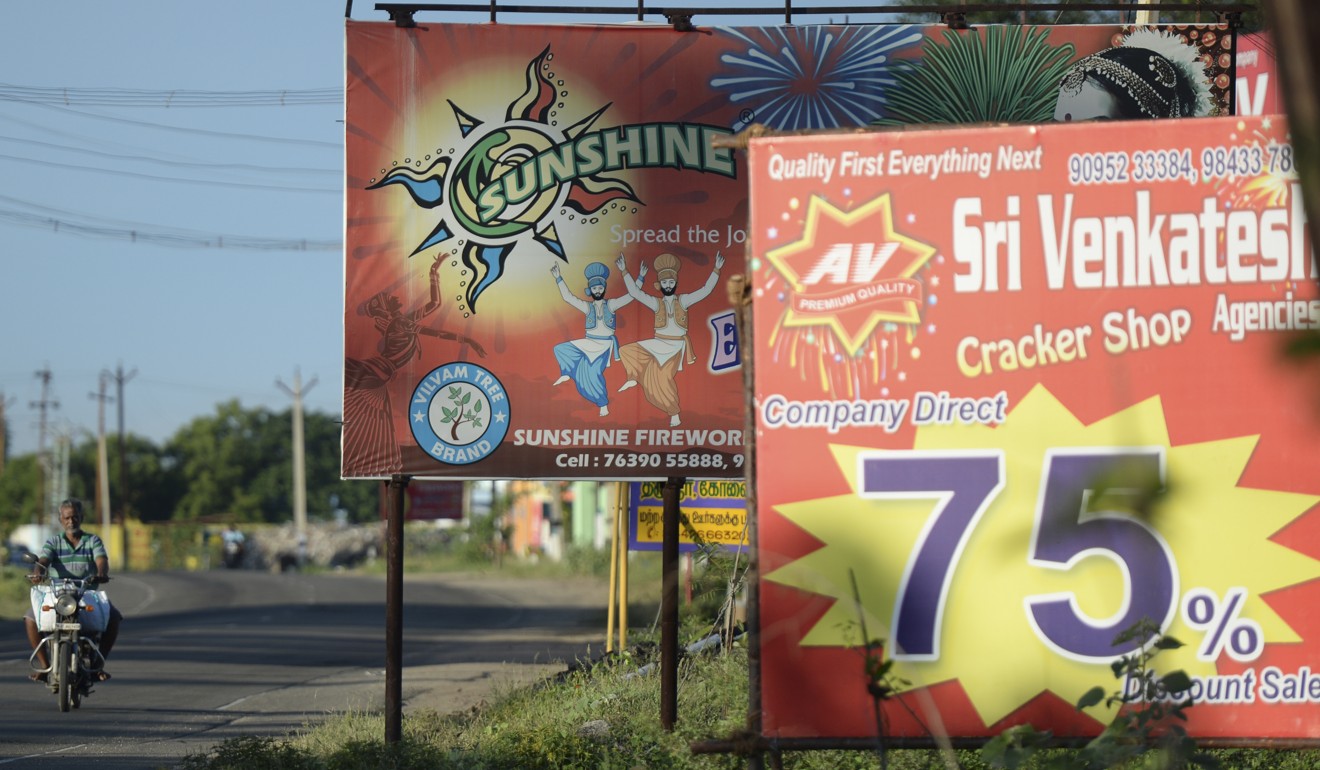
An advert for firecrackers ahead of the Hindu festival of Diwali, in Sivakasi. Photo: AFP
Legally, Indian manufacturers can neither import nor export firecrackers. The Indian firecracker industry is the second-largest in the world after China’s.
Raja Chandrashekar, chief of the Federation of Tamil Nadu Fireworks Traders, a lobbying body, said low-end Indian-manufactured firecrackers such as roll caps and dot caps – popular among children – had struggled to compete with Chinese-made pop pops and throw bombs.
“Despite our repeated complaints to government bodies, Chinese firecrackers find a way into India, particularly in the northern parts. This is severely affecting our business,” said Chandrashekar.
While more Chinese fireworks might be entering India, the effect has been to undermine the industry, resulting in fewer sales overall.
FIZZLING OUT?
The Sivakasi fireworks industry faces other problems, too. Not least among these is the use of child labour, which had been rampant until a government crackdown a few years ago, and the practice of some factories to operate without proper licences and with questionable safety standards.
But despite the darker aspects of the industry, its role goes beyond merely helping Diwali celebrations go with a bang every year.
India is crazy about gold. But can the love last as prices skyrocket?
“The livelihoods of over five million people who are indirectly involved in the business, in areas such as trade and transport, depend on the survival of the industry,” said Chandrashekar.
That survival looks increasingly in question. Dull sales of fireworks have been reported in major cities including New Delhi, Mumbai, Bangalore and Hyderabad, though exact numbers can be hard to come by due to the unregulated nature of the industry and unreliable numbers shared by manufacturers.
So great has the resultant outcry been that some cynics even wonder whether the industry is struggling as much as it claims or whether it is part of a ploy by manufacturers to gain more government concessions and avoid any further crackdown.
“These firecracker manufacturers lie through their teeth about the Diwali sales for self-serving motives such as tax avoidance. The overall business is healthy,” said Vijay Kumar, editor of the Sivakasi-based monthly magazine Pyro India News.
“Though there was a 30-40 per cent shortage in annual production, all the manufactured products have been sold this year. No large stockpile is left with any manufacturer.”
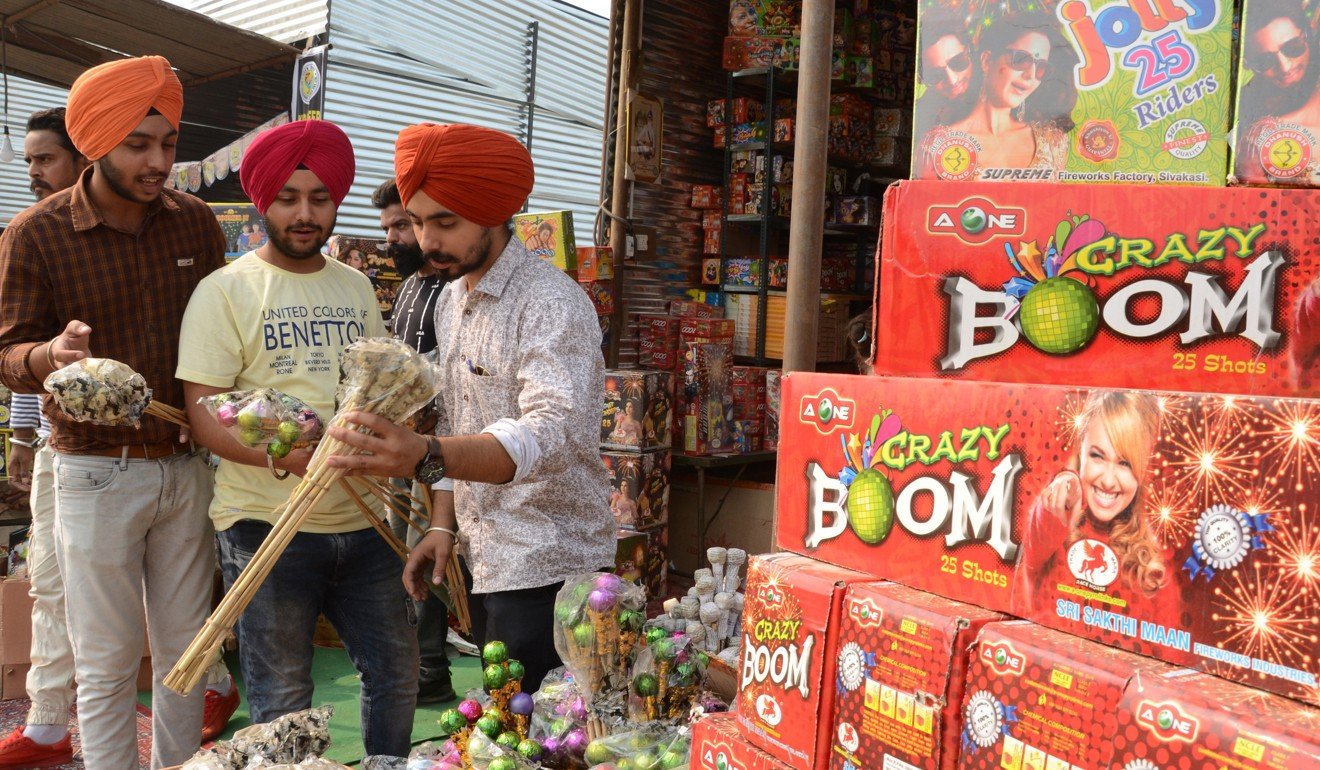
Customers buy firecrackers on the eve of the Hindu festival of Diwali in Amritsar. Photo: AFP
Still, regardless of the manufacturers’ motives, the result of the industry’s struggles has been that street sellers like Chinnaswamy have fewer fireworks to sell – and they are struggling even to sell those.
Chinnaswamy says people are confused about the government’s anti-pollution drive and about what firecrackers are now legal and this has discouraged them from buying. Despite the government’s effort to promote “green crackers” he says these are too hard to come by to be a ready solution, at least for this year.
“There was no clarity on what type of firecrackers, whether green crackers or otherwise, can be set off and at what time of the day. Many consumers even asked me whether or not the conventional firecrackers are totally banned while there was much misinformation floating about on social media,” said Chinnaswamy.
Shaking his head, all he can do is hope that next year his Diwali goes with more of a bang.
Source: SCMP
Posted in Air Quality Index (AQI), Automobiles, ‘Little Japan’, Bangalore, barium nitrate, between, Black market, Chennai, China alert, Chinese fireworks, diligent, dim Diwali, Directorate of Revenue Intelligence, Diwali, explosive truth, Federation of Tamil Nadu Fireworks Traders, festival of lights, firecrackers, Hindu, Hong Kong, Hyderabad, imports, India’s, Indian Fireworks Association, labour force, link, mumbai, New Delhi, nickname, Plastics, polluter, Pyro India News, Singapore, Sivakasi, Supreme Court, Tamil Nadu, Tobacco, toxic air, travellers, Uncategorized |
Leave a Comment »
22/10/2019
NEW DELHI (Reuters) – India and Pakistan are set to sign an agreement on Indian pilgrims visiting a Sikh shrine in Pakistan, rare cooperation between the nuclear-armed neighbours at a time of tension that has brought exchanges of fire on their disputed border.
The pact will introduce visa-free access from India to the Pakistani town of Kartarpur, home to a temple that marks the site where the founder of Sikhism, Guru Nanak, died.
India’s foreign ministry said in a statement late on Monday an understanding had been reached on most issues and India was prepared to sign the agreement on Wednesday.
Pakistani officials were not immediately available for comment but Pakistan’s Dawn newspaper cited a foreign ministry spokesman as saying agreement had been reached and the two sides would sign the pact soon.
The Sikh minority in India has long sought easier access to the temple in Kartarpur, which is just over the border in Muslim-majority Pakistan.
The collaboration comes at a time of tension between the rivals, with Pakistan particularly aggrieved over recent Indian government measures in its part of the divided Muslim-majority region of Kashmir.
Both countries claim the Himalayan region in full but rule it in part.
India in August revoked special autonomy in Indian-controlled Kashmir, which was accompanied by a crackdown on dissent by India’s security forces there, angering Pakistan.
The dispute over Kashmir has bedevilled relations since their independence in 1947 and sparked two of their three wars.
India said on Sunday two soldiers and a civilian were killed in cross-border shelling in Kashmir while Pakistan said one of its soldiers and three civilians had been killed.
In February, they came close to war following a suicide bombing in Indian Kashmir that killed 40 paramilitary soldiers. In response, India launched an air strike on the Pakistani side and Pakistan shot down an Indian aircraft.
The new crossing will be inaugurated in early November, just before the 550th birthday of Sikhism’s founder on Nov. 12, officials from both sides have said.
The shrine is about 4 km (2-1/2 miles) from the border. The crossing and corridor, including a road, bridge over the Ravi River and immigration office, will replace a drawn-out visa process and circuitous journey through Pakistan.
But there is still disagreement over a $20 fee that Pakistan wants to charge each visitor.
India “has consistently urged Pakistan that in deference to the wishes of the pilgrims, it should not levy such a fee”, India’s foreign ministry said.
Source: Reuters
Posted in 1947, air strike, Foreign Ministry, founder of Sikhism, Guru Nanak, Himalayan region, independence, India, Indian aircraft, Indian Kashmir, Kartarpur, Kashmir, Muslim-majority Pakistan, New Delhi, nuclear-armed neighbours, Pakistan, Pakistani town, pilgrim corridor pact, Ravi River, shot down, shrine, sign, Sikh minority, Sikh shrine, suicide bombing, tension, Uncategorized |
Leave a Comment »




 CHINDIA ALERT: You'll be living in their world, very soon