02/03/2019
MUZAFFARABAD, Pakistan/SRINAGAR, India (Reuters) – A flare up between arch-foes India and Pakistan appeared to be easing on Saturday after Islamabad handed back a captured Indian pilot, but tensions continued to simmer amid efforts by global powers to prevent a war between the nuclear-armed neighbours
Wing Commander Abhinandan Varthaman, who became the face and symbol of the biggest clash between India and Pakistan in many years, walked across the border just before 9 p.m. (1600 GMT) on Friday in a high-profile handover shown on live television.
Shelling across the Line of Control (LoC) that acts as a de facto border in the disputed Kashmir region, a frequent feature in recent weeks, continued on Saturday.
Pakistan’s military said on Saturday its air force and navy “continue to be alert and vigilant”, while two of its soldiers were killed after exchanging fire with Indian troops along the Line of Control. India’s military said on Saturday that Pakistan was firing mortar shells across the LoC.
Pakistan touted Abhinandan’s return as “as a goodwill gesture aimed at de-escalating rising tensions with India” after weeks of unease that threatened to spiral into war after both countries used jets for bombing missions this week.
Global powers, including China and the United States, have urged restraint to prevent another conflict between the neighbours who have fought three wars since independence from Britain in 1947.
Tensions escalated rapidly following a suicide car bombing on Feb. 14 that killed at least 40 Indian paramilitary police in Indian-controlled Kashmir.
India accused Pakistan of harbouring the Jaish-e Mohammad group behind the attack, which Islamabad denied, and Prime Minister Narendra Modi promised a strong response.
Indian warplanes carried out air strikes on Tuesday inside Pakistan on what New Delhi called militant camps. Islamabad denied any such camps existed, as did local villagers in the area, but Pakistan retaliated on Wednesday with its own aerial mission, that led to both sides claiming to have shot down jets.
The stand off came at a critical time for Modi, who faces a general election that must be held by May and who had been expected to benefit from nationalist pride unleashed by the standoff.
Pakistani leaders say the ball is now in India’s court to de-escalate the tensions, though the Pakistani army chief told top military leaders of the United States, Britain and Australia on Friday that his country would “surely respond to any aggression in self-defence”.
“COLLIDE HEAD-ON”
The Indian pilot’s ordeal since being shot down on Wednesday had made him the focal point of the crisis and he returned to his homeland to a hero’s welcome, with crowds thronging the Wagah border crossing and waving Indian flags.
Before his release, Pakistani television stations broadcast video of Abhinandan in which he thanked the Pakistani army for saving him from an angry crowd who chased him after seeing him parachute to safety.
Pakistan frees Indian pilot as crisis thaws
“The Pakistani army is a very professional service,” he said. “I have spent time with the Pakistan army. I am very impressed.”
On Friday, four Indian troops and one civilian were killed in a clash with militants in the Indian-administered Kashmir, where a further three people were killed and one wounded from Pakistani shelling.
Pakistan’s military said two civilians were killed and two wounded since Friday afternoon on Pakistan’s side of Kashmir from a barrage of Indian shelling.
In a sign of the unease, residents say they are afraid another conflagration is likely.
“The way situation is developing along the LoC makes me feel that both sides may collide head-on anytime now,” said Chaudhry Jahangir , a Pakistani resident of the Samahni sector in Kashmir.
Source: Reuters
Posted in 1947, air force and navy, Britain, Chaudhry Jahangir, China alert, global powers, independence, India alert, Islamabad, Jaish-e-Mohammad, Kashmir, Line of Control (LoC), New Delhi, nuclear-armed neighbours, Pakistan, Pakistani Army, paramilitary police, Prime Minister Narendra Modi, Samahni, suicide car bombing, Uncategorized, United States, Wagah, Wg Cdr Abhinandan Varthaman, Wing Commander Abhinandan Varthaman |
Leave a Comment »
26/02/2019
The IAF strike on Jaish camp in Balakot deep across LoC comes a day before the foreign ministers of Russia, India, and China (RIC) are expected to meet in the eastern China town of Wuzhen under the RIC mechanism.
INDIA Updated: Feb 26, 2019 15:56 IST
China has urged India and [pakistan to exercise restrain after the Indian Air Force hit a Jaish camp in Balakot acro(AP file photo)
China on Tuesday urged India to fight terrorism through “international cooperation” hours after the Indian air force carried out a targeted strike on a Jaish-e-Mohammed (JeM) camplocated across the Line of Control (LoC).
India should create “favourable” conditions internationally to fight terrorism, China added possibly in an oblique reference to New Delhi’s failure to convince Beijing to allow Jaish-e-Mohammed chief, Azhar Masood to be designated as a terrorist at the UN Security Council.
Follow live updates here
The strike comes a day before the foreign ministers of Russia, India, and China (RIC) are expected to meet in the eastern China town of Wuzhen under the RIC mechanism.
Responding to a question on the air strike, the foreign ministry spokesperson, Lu Kang said both India and Pakistan — one of China’s closest allies — should maintain restraint.
“We have taken note of relevant reports. I want to say that India and Pakistan are both important countries. A sound relationship and cooperation serve the interests of peace and stability in South Asia. Both parties (should) remain restrained and do more to improve bilateral relations,” Lu Kang said.
Read: Nation in safe hands, says PM Modi
“As for India’s claims on taking action against terrorism, fighting terrorism is a global practice. It needs to be dealt with international cooperation. And India needs to create a favourable condition internationally for the same,” Lu said.
The Chinese foreign ministry’s reaction came soon after foreign secretary, VK Gokhale confirmed that Indian forces carried out a strike on the biggest camp of the terror group Jaih e Mohammed in Balakot area early on Tuesday.
“Credible intelligence was received that JeM was attempting another suicide terror attack in various parts of the country, and the fidayeen jihadis were being trained for this purpose. In the face of imminent danger, a preemptive strike became absolutely necessary,” the foreign secretary said.
The Chinese foreign ministry reacted carefully, keeping in mind its close ties with Pakistan and the fact that India’s decision to carry out the strike was triggered by JeM-planned Pulwama attack that killed 40 CRPF personnel.
Read: After IAF strike on terror camp, Army tweets poem on power and peace
Interestingly, Chinese foreign minister, Wang Yi and his Pakistani counterpart, Shah Mehmood Qureshi spoke over phone about the Pulwama attack and its aftermath over the phone on Monday evening.
“Qureshi informed Wang of Pakistan’s stance on and measures to deal with the attack, reaffirming the country’s sincerity and resolution to communicate with India and find out the truth of the incident,” a report by China’s official news agency, Xinhua, said.
“Qureshi said Pakistan’s position on maintaining regional peace and fighting terrorism will remain unchanged and it is willing to join hands with other countries to cooperate in this area,” it added.
In the phone conversation, Wang said China supports Pakistan and India to resolve the issue through dialogue as soon as possible and avoid an escalation of the situation.
“He called on both sides to collaborate on fighting terrorism and jointly safeguard the security and stability of South Asia,” the report said.
Meanwhile, the Pulwama terrorist attack and the listing of Azhar as a global terrorist by the UN is expected to prominently figure at the 16th RIC foreign ministers’ meeting being held here on Wednesday.
Besides attending the annual trilateral meeting, external affairs minister Sushma Swaraj would also hold bilateral talks with Chinese FM Wang and Russian counterpart, Sergei Lavrov on the sidelines of the meeting.
Swaraj’s meeting with Wang assumes significance as it will be the first high-level interaction between the two countries after the Pulwama terror attack and Tuesday’s air strike.
China, a veto-wielding member of the UNSC, has consistently blocked India, the US, the UK and France’s efforts to list Azhar as a global terrorist since 2016 but endorsed a scathing statement issued by UN Security Council on February 21 on the Pulwama attack.
Source: Hindustan Times
Posted in Azhar Masood, Balakot, Beijing, China alert, Chinese foreign minister, CRPF, Foreign Ministry spokesperson, Foreign Secretary, India alert, Indian Air Force, Jaish-e-Mohammed, JeM, Lu Kang, New Delhi, Pakistan, Pulwama, RIC mechanism, Russia, Sergei Lavrov, Shah Mehmood Qureshi, terror camps, UN Security Council, Uncategorized, United Nations Security Council (UNSC), UNSC, VK Gokhale, Wang Yi, Wuzhen, Xinhua |
Leave a Comment »
25/02/2019
PM Modi said that he told him ‘let us fight against poverty and illiteracy’ and Khan gave his word saying he is a Pathan’s son, ‘but went back on it’.
SNS Web | New Delhi | February 25, 2019 10:53 am
Pakistan Prime Minister Imran Khan on Sunday asked his Indian counterpart Narendra Modi to “give peace a chance” and assured him that he “stands by” his words and will “immediately act” if New Delhi provides Islamabad with “actionable intelligence” on the Pulwama attack.
Khan’s remarks came a day after PM Modi in a rally in Rajasthan, recalled his conversation with the Pakistan PM during a congratulatory call after he became the country’s premier.
PM Modi had told him “let us fight against poverty and illiteracy” and Khan gave his word saying he is a Pathan’s son “but went back on it”.
“There is consensus in the entire world against terrorism. We are moving ahead with strength to punish the perpetrators of terrorism…The scores will be settled this time, settled for good…This is a changed India, this pain will not be tolerated…We know how to crush terrorism,” PM Modi further said.
A statement released by the Pakistan Prime Minister’s Office said, “PM Imran Khan stand by his words that if India gives us actionable intelligence, we will immediately act.”
PM Modi should “give peace a chance”, Khan said in the statement.
In his first statement issued since the February 14 attack, Pakistani Prime Minister Imran Khan had on Tuesday accused India of blaming his country “without evidence” and warned of retaliation against any military action by India.
However, he assured India that he would act against the perpetrators of the deadly Pulwama terror attack, carried out by Pakistan-based Jaish-e-Mohammad (JeM) terror group and said that the issue between the two countries can be solved through dialogue.
India had called Khan’s offer to investigate the attack if provided proof as a “lame excuse”.
The already sour relations between India and Pakistan have worsened over the past few weeks as New Delhi accused Islamabad of the Pulwama attack.
India has accused Islamabad’s spy agency ISI of being involved in the attack and has maintained that the terror group JeM is a “child of the Pakistan Army”.
Following the attack, India immediately withdrew the ‘Most Favoured Nation’ status granted to Pakistan and initiated steps to isolate the neighbouring country from the international community.
Earlier, India had also announced its decision to stop the flow of its share of water from the Beas, Ravi and Sutlej to Pakistan.
Prime Minister Narendra Modi had in many of his public speeches after the attack, said that the security forces have been given full freedom to decide the future course of action regarding the terrorist attack in Pulwama.
India’s neighbours, including Sri Lanka, Maldives, Nepal, Bangladesh, Afghanistan and Bhutan—and other countries like Saudi Arabia, UAE, Iran, Russia, Germany, Canada, UK, Australia and Canada came out in strong support of New Delhi following the terror attack.
Over 44 CRPF personnel were killed and many injured on February 14 in one of the deadliest terror strikes in Jammu-Kashmir when a Jaish-e-Mohammad (JeM) suicide bomber blew up an explosive-laden vehicle near their bus in Pulwama district.
The bus was part of a convoy of 78 vehicles carrying around 2500 CRPF personnel from Jammu to Srinagar.
Source: The Statesman
Posted in Afghanistan, Australia, Bangladesh, Beas, Bhutan, Bus, canada, convoy, CRPF, Germany, Imran Khan, India alert, international community, iran, ISI, Islamabad, Jaish-e-Mohammad (JeM), Jammu, Jammu & Kashmir, Maldives, military action, Most Favoured Nation, Nepal, New Delhi, Pakistan, Pakistan Army, Pathan, PM, PM Narendra Modi, poverty and illiteracy, Pulwama, Rajasthan, Ravi, retaliation, Russia, Saudi Arabia, Sri Lanka, Srinagar, suicide bomber, Sutlej, terrorist attack, UAE, UK, Uncategorized |
Leave a Comment »
23/02/2019

Prime Minister Narendra Modi addresses Pravasi Bhartiya representatives at Pravasi Bhartiya Kendra in New Delhi on February 23, 2019. (Photo: IANS/PIB)
Prime Minister Narendra Modi will be paying a visit to the ongoing Kumbh Mela at Prayagraj on Sunday where he will take a holy dip at the Triveni Sangam, the confluence of rivers Ganga, Yamuna, and the mythical Saraswati, considered the centre of the earth according to Hindu scriptures.
At Prayagraj, PM Modi will participate in the Swachh Kumbh Swachh Aabhaar event and interact with the “Safai Karmacharis”.
He will later address a gathering and distribute the Swachh Kumbh Swachh Aabhaar awards to safai karmacharis, swachhagrahis, police personnel, and naviks.
The Swachh Kumbh Swachh Aabhaar event is being organized by the Ministry of Drinking Water & Sanitation.
The Kumbh Mela commenced on January 15 (Makar Sankranti) and will conclude on March 4 (Mahashivratri).
Over a period of 49 days of the mega celebration, more than 22 crore devotees have visited the Kumbh Mela.
On Friday, Minister of State for External Affairs General VK Singh led a delegation of around 200 delegates of more than 185 countries to the Kumbh Mela 2019. The foreign representatives took a holy bath at Sangam and witnessed cultural programmes at Sanskriti Gram.
Singh told reporters that the idea behind the visit was to make “them see that Kumbh is not just confluence of rivers but also of different religions and faiths”.
Earlier on Saturday, PM Modi interacted with foreign delegates from 185 countries at Pravasi Bharatiya Kendra in New Delhi where he said that there is a huge potential for tourism in the country.
Source: The Statesman
Posted in General VK Singh, holy dip, India alert, Kumbh Mela, Makar Sankranti, Minister of State for External Affairs, New Delhi, PM Narendra Modi, Pravasi Bhartiya, Pravasi Bhartiya Kendra, Prayagraj, Safai Karmacharis, Sangam, Sanskriti Gram, Swachh Kumbh Swachh Aabhaar, Uncategorized |
Leave a Comment »
20/02/2019
MoUs on tourism, cooperation in the field of housing, International Solar Alliance among others were exchanged between the two countries.
SNS Web | New Delhi | February 20, 2019 2:52 pm
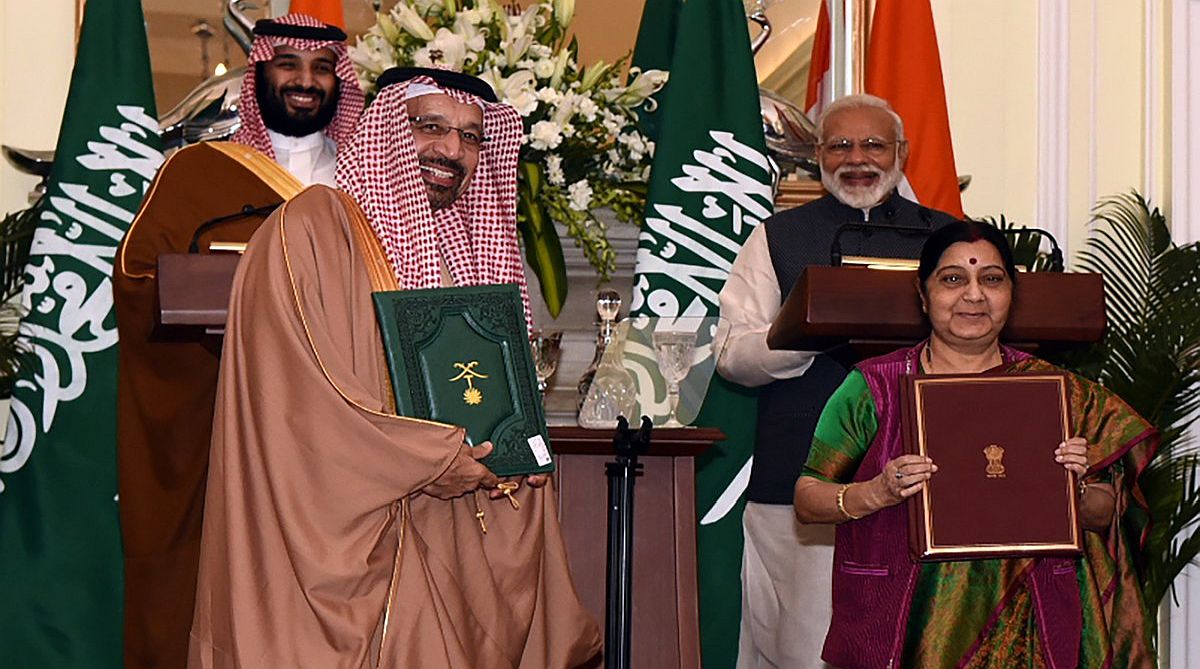
Prime Minister Narendra Modi and Saudi Arabia Crown Prince Mohammed bin Salman witnessing the Exchange of Agreements between India and Saudi Arabia at Hyderabad House, New Delhi. (Photo: Twitter | PIB India)
MoUs on tourism, cooperation in the field of housing, International Solar Alliance among others were exchanged between the two countries.
On his first state visit to the country, Prime Minister Narendra Modi welcomed the Saudi Crown Prince saying that Saudi Arabia was India’s “close friend”.
India and Saudi Arabia have a longstanding relationship, PM Modi said adding that in the 21st century, Saudi Arabia was among India’s most important strategic partners.
The Prime Minister, in a joint press conference with Crown Prince Mohammed bin Salman, also welcomed Saudi investment in Indian infrastructure.
In a major development, Saudi Arabia also joined the International Solar Alliance, informed PM Modi adding that the two leaders also discussed how to further strengthen the defence cooperation between the two nations.
“We have agreed to strengthen their cooperation in the areas of renewable energy. We welcome Saudi Arabia to the International Solar Alliance. The peaceful use of nuclear energy, especially water desalination and health, will be another dimension of our cooperation,” PM Modi said.
Speaking on the Pulwama terror attack that killed at least 44 CRPF personnel, the Prime Minister said the two leaders agreed on the need to destroy the infrastructure of terror and clamp down on countries supporting terror.
“We have also vowed to increase pressure on any country that promotes terror activities,” the Prime Minister said.
This comes after Salman’s high-profile tour of Pakistan on January 17 where he said dialogue was the only way to resolve “outstanding issues” between India and Pakistan.
Addressing the joint press conference, Saudi Arabia Crown Prince Mohammed bin Salman said his country shares India’s concerns over terror.
“Terrorism is a common concern. We will cooperate with India in every way, like intelligence sharing. India has played a positive role,” he said.
He also thanked the people of India and the Government for the warm welcome.
“The relationship between India and Saudi Arabia is over thousands of years old. It is even older than history, and this relationship has grown stronger in the last 50 years. Our objectives are similar be it in energy, agriculture or technology,” he added.
Salman also called for common planning between the two nations to tackle various issues and said that “Saudi Arabia has invested $44 billion in India”.
Earlier in the day, PM Modi and Salman held delegation-level talks on key areas of mutual interest such as trade and investment, energy, defence and security, nuclear and space, civil aviation, renewables, counter-terrorism, community welfare and regional challenges.
External Affairs Minister Sushma Swaraj also met Salman and discussed ways to add further momentum to the strategic ties between the two nations besides deepening engagement in areas of trade and investment.
Earlier on Wednesday, the Saudi Crown Prince was accorded a ceremonial reception at the Rashtrapati Bhawan by President Ram Nath Kovind.
After meeting President Ram Nath Kovind, the Saudi Arabia Crown Prince said, “Today we want to be sure that this relation is maintained and improved for the sake of both countries. With the leadership of the President and the Prime Minister, I am sure we can create good things for Saudi Arabia and India”.
Earlier on Tuesday, in a special gesture, Prime Minister Narendra Modi broke the protocol to personally receive the Saudi prince and welcomed him with a warm hug at the Palam airport.
External Affairs Ministry spokesperson Raveesh Kumar had said that the first state visit of the Saudi Crown Prince marks a “new chapter in bilateral relations between the two countries”.
Salman’s visit comes in the backdrop of the escalating tension between India and Pakistan following the Pulwama terror attack carried out by Pakistan-based Jaish-e-Mohammad (JeM) terror group in which at least 44 CRPF personnel were killed.
Saudi Arabia had on Friday said it stood with India’s fight against terrorism and extremism and denounced as “cowardly” the attack.
India’s bilateral trade with Saudi Arabia was USD 27.48 billion in 2017-18, making Saudi Arabia its fourth largest trading partner.
Saudi Arabia is also a key pillar of India’s energy security, being a source of 17 per cent or more of crude oil and 32 per cent of LPG requirements of India.
The Crown Prince is expected to travel to China from India.
Source: The Statesman
Posted in agriculture, bilateral relations, China alert, Civil aviation, community welfare, Counter-terrorism, cowardly, CRPF, Defence, energy, Exchange of Agreements, external affairs minister, External Affairs Ministry, extremism, Hyderabad House, India alert, Indian infrastructure, International Solar Alliance, LPG, Mohammed bin Salman, New Delhi, nuclear, Pakistan, PM Narendra Modi, President Ram Nath Kovind, protocol, Pulwama, Rashtrapati Bhawan, Raveesh Kumar, regional challenges, renewables, Saudi crown prince, security, Space, strategic partners, strategic ties, Sushma Swaraj, Technology, terrorism, trade and investment, Uncategorized |
Leave a Comment »
17/02/2019
ISLAMABAD (Reuters) – Saudi Arabia’s Crown Prince Mohammed bin Salman is due to arrive in Pakistan on Sunday at the start of his tour of South Asia and China, but the visit risks being overshadowed by escalating tensions between nuclear-armed rivals India and Pakistan.
The trip comes days after a suicide bomber killed 44 Indian paramilitary police in the disputed Kashmir region. New Delhi has accused Pakistan of having a hand in the bombing and vowed to punish Islamabad, which denies involvement.
Prince Mohammed had also planned to visit Indonesia and Malaysia during the Asian tour, but those trips have been postponed, according to Malaysian and Indonesian officials. No reasons for the postponements or alternative tour dates were given.
Cash-strapped and in need of friends, Pakistan is welcoming the crown prince with open arms for a visit during which he is expected to sign investment agreements worth more than $10 billion.
Saudi Arabia has in recent months helped keep Pakistan’s economy afloat by propping up its rapidly dwindling foreign exchange reserves with a $6 billion loan, giving Islamabad breathing room as it negotiates a bailout with the International Monetary Fund.
Analyst say the crown prince’s trip is being treated by Islamabad as the biggest state visit since Chinese President Xi Jinping in 2015, soon after Beijing announced plans to invest tens of billions of dollars on infrastructure in Pakistan as part of China’s global Belt and Road initiative.
The visit marks a deepening in ties between allies whose relationship has in the past centred on oil-rich Saudi Arabia backing Pakistan’s economy during difficult periods, and in return Pakistan’s powerful army lending support to Saudi Arabia and its royal family.
As the guardians of most holy sites in the birthplace of Islam, the Saudi royal family carries vast religious clout in Pakistan, a staunchly conservative and mainly-Muslim nation of 208 million people.
“What is happening in this relationship is a renewal of Pakistan’s commitment to help protect the royal family and the order as it exists in Saudi Arabia,” said Mosharraf Zaidi, Senior Fellow at Tabadlab, a Pakistani think tank focussed on global and local public policy.
“On the flip side, there is reassurance that Saudi Arabia will not only continue to serve as a strategic friend who will help shore up Pakistan’s finances when needed, but it’s also going to become a participant in the wider investment in Pakistan.”
Pakistan is shutting down its airspace and has stepped up security in Islamabad for the crown prince, who is set to become the first guest to stay at the Prime Minister’s House. Pakistan’s new populist premier, Imran Khan, has refused to use the residence in a bid to save taxpayers’ money.
Pakistani hopes for further investment opportunities from Saudi Arabia were dealt a blow on Saturday when the government announced that the Pak-Saudi Business Conference had been “postponed”.
Pakistani officials have already flagged up that Saudi Arabia will announce eight investment agreements, including a $10 billion refinery and petrochemicals complex in the coastal city of Gwadar, where China is building a port.
But the crown prince’s arrival comes amid a vow by India to isolate Pakistan internationally following the deadliest attack in Kashmir in decades.
New Delhi is demanding Islamabad act against the Jaish-e-Mohammad (JeM) militant group, which it says has the backing of the Pakistani state, over the bombing. Islamabad denies playing a role and has called for an investigation.
In Islamabad, the crown prince is expected to meet Khan and Pakistan’s army chief, Qamar Javed Bajwa.
44 killed in worst Kashmir attack in decades
He is also set to meet representatives of the Afghan Taliban militant group to discuss peace negotiations to end the 17-year civil war in Afghanistan, Pakistani government and Taliban sources say.
“We arrived in Islamabad today Sunday and others are on their way,” one senior Afghan Taliban figure told Reuters. “As per the plan we know so far, we are going to meet Mohammed bin Salman and his delegation members today at night and then on Monday.”
Source: reuters
Posted in Afghan Taliban, delegation, Gwadar, Imran Khan, India alert, Indonesia, islam, Islamabad, Malaysia, Mohammed bin Salman, Mosharraf Zaidi, New Delhi, Pakistan, Pakistan’s army chief, Pakistani think tank, President Xi Jinping, Qamar Javed Bajwa, Saudi Arabia, Saudi crown prince, Tabadlab, Uncategorized |
Leave a Comment »
15/02/2019
NEW DELHI (Reuters) – A hotel that caught fire in the Indian capital on Tuesday, killing 17 people, passed safety checks 14 months ago, but an investigation has revealed breaches of regulations, such as faulty alarms, prompting a mass reinspection of other hotels.
Poorly enforced regulations lead to thousands of deaths in fires across India every year and officials in New Delhi say an overstretched fire service is hampering safety efforts.
The Hotel Arpit Palace passed a fire safety check in December 2017, but a copy of the initial police investigation seen by Reuters showed several breaches of fire regulations, including a lack of signs to guide guests to exits and fire alarms that did not work.
Delhi’s fire service, which is responsible for safety inspections as well as fighting fires, is now reviewing certificates issued to more than 1,500 hotels in one of India’s tourist hubs, a senior fire official told Reuters.
But stretched resources mean the re-inspection process could take months.
“Fire officers have to do a lot of work,” said Vipin Kental, Delhi’s chief fire officer. “We have to be inspectors and fight fires. We do not have the manpower.”
The city has around 1,700 firefighters, he said, which is less than an eighth of the number in New York, a city with less than half of Delhi’s population.
PREVENTABLE TRAGEDY
The fire is believed to have begun on the hotel’s first floor, spreading quickly through wood-panelled corridors, police say. Among the dead were members of a wedding party from Kerala and a two Buddhist pilgrims from Myanmar.
“From the outside, the building looked intact, but inside everything was completely charred,” a police officer told Reuters.
Two of the 17 died after jumping out of windows in desperation after failing to find emergency exits, added the officer, who declined to be named as he is not authorised to talk to the media.
“Fire preparedness is a matter of shockingly low priority in most parts of the country,” said an editorial in the Indian Express, one of the country’s leading newspapers.
A 2018 study by India’s home ministry that found the country had just 2,000 of more than 8,500 fire stations it needs.
More than 17,000 people died in fires in 2015, according to data from the ministry, the last year for which figures are available, one of the largest causes of accidental death in India.
Fire safety is an issue for shanty towns and some of the country’s most expensive real estate.
A day after the Arpit Palace disaster, more than 250 makeshift homes were destroyed in a slum in Paschim Puri, a poor area of New Delhi, though no one was killed.
In 2017, 14 people were killed during a birthday party at a high-end bar in India’s financial capital Mumbai.
In several upscale neighbourhoods in Delhi, police shut hundreds of shops and restaurants last year for trading on floors meant for residential use, though many continue to operate illegally, residents say.
By the boarded-up Arpit Palace in the Karol Bagh area of New Delhi, wires from adjacent hotels still trail across the street, though staff there told Reuters they were complying with fire regulations.
Adding to the safety problems, poorly paid staff in the hotel and restaurant industries are often unable to help guests when fires break out, Kental said.
“They are not trained. They don’t know what to do in the event of a fire,” he said.
Source: Reuters
Posted in blaze, breaches, Buddhist pilgrims, capital, certificates, chief fire officer, Delhi, faulty, financial capital, fire alarm, Fire safety, fire service, fire stations, firefighters, Home Ministry, Hotel, Hotel Arpit Palace, India alert, Indian Express, Karol Bagh, Kerala, makeshift homes, mumbai, Myanmar, New Delhi, Paschim Puri, Population, regulations, reinspections, safety inspections, slum, tourist hubs, Uncategorized, Vipin Kental |
Leave a Comment »
15/02/2019
Foreign Secretary Vijay Gokhale told the high commissioner that Pakistan must take “immediate and verifiable action” against the Jaish-e-Mohammed terror group that has claimed responsibility for Thursday’s attack in Kashmir.
INDIA Updated: Feb 15, 2019 15:12 IST
Prime Minister Narendra Modi(PTI file photo)
India on Friday summoned Pakistan envoy Sohail Mahmood to lodge a strong protest over the suicide bombing in south Kashmir’s Pulwama by Pakistan-based terror group Jaish-e-Mohammad (JeM).
Foreign Secretary Vijay Gokhale told the high commissioner that Pakistan must take “immediate and verifiable action” against the Jaish-e-Mohammed terror group that has claimed responsibility for Thursday’s attack in Kashmir.
A Jaish suicide bomber on Thursday rammed a car packed with explosives into a CRPF convoy on the Jammu-Srinagar highway. The CRPF has confirmed 38 deaths in the suicide bombing, counted among the bloodiest in Kashmir. Initial reports, quoting security officials, had said 44 jawans were feared to have been killed in the attack.
The foreign secretary also told Pakistan that it must “immediately stop” groups or individuals linked to terrorism operating from its territories.
In the hours after Thursday’s attack, New Delhi had issued a strong statement that accused Pakistan of giving “full freedom” to the terror group to operate and expand its terror infrastructure to carry out attacks in India and elsewhere with impunity.
Islamabad responded with a two-line statement that said it had “always condemned heightened acts of violence” in Kashmir. Pakistan also said it will “strongly reject any insinuation by elements in the Indian government and media circles that seek to link the attack to the State of Pakistan without investigations”.
Foreign Secretary Gokhale rejected this statement by the Pakistan foreign office.
Source: Hindustan Times
Posted in action, CRPF, envoy, Foreign Secretary, High Commissioner, Highways, India alert, Jaish-e-Mohammed, Jammu-Srinagar, Kashmir, New Delhi, Pakistan, PM Narendra Modi, summoned, Uncategorized, verifiable, Vijay Gokhale |
Leave a Comment »
11/12/2018
Red-faced rhesus macaques have spread havoc, snatching food and mobile telephones, breaking into homes and terrorising people in and around the Indian capital.
They have colonised areas around parliament and the sites of key ministries, from the prime minister’s office to the finance and defence ministries, frightening both civil servants and the public.
“Very often they snatch food from people as they are walking, and sometimes they even tear files and documents by climbing in through the windows,” said Ragini Sharma, a home ministry employee.
Ahead of Tuesday’s start of parliament’s winter session, an advisory to members of parliament last month detailed ways they could keep simian attacks at bay. Don’t tease or make direct eye contact with a monkey, the advisory said, and definitely don’t get between a mother and her infant.
The rapid growth of cities has displaced macaques, geographically the most widely distributed primates in the world after humans, driving them into human habitats to hunt for food.
A monkey sits on a pavement outside India’s Parliament building in New Delhi, India, November 15, 2018. Picture taken November 15, 2018. REUTERS/Anushree Fadnavis
Many in Hindu-majority India revere and feed the animals they consider to be connected to the demigod Hanuman, who takes the form of a monkey.
“This socio-religious tradition of feeding has created a vicious cycle,” said ecology researcher Asmita Sengupta.
“They become used to being fed by humans and lose their sense of fear,” said Sengupta, of the Ashoka Trust for Research in Ecology and the Environment.
“They start actively seeking supplementary food and if we don’t feed them, they turn aggressive.”
‘APE REPELLERS’
The monkeys have hardly proved an ally for Prime Minister Narendra Modi.
Hundreds of macaques feasting on optic fibre cables strung along the banks of the river Ganges derailed his plan to roll out wifi in his constituency, the crowded 3,000-year-old holy city of Varanasi, in 2015.
Men were hired to swat the monkeys away with broomsticks and slingshots, when then U.S. President Barack Obama toured New Delhi that year, media said.
In 2007, monkeys pushed the deputy mayor of Delhi, S.S. Bajwa, off his balcony to his death. Last month, one of the animals snatched a 12-day-old boy from his mother and killed him in Agra, home to the famed monument to love, the Taj Mahal.
Monkeys have bred rapidly in Delhi and neighbouring states as they have protected status, but there is no official estimate of their numbers.
India has tried several strategies to fight the menace.
Authorities stumbled on a partially successful solution four years ago, after hiring 40 men to disguise themselves as langurs and squeal monkey-like to try and terrify the macaques away.
“We call them ‘ape repellers’ and they are contract employees,” said a government official, who asked not to be identified. The stratagem works temporarily as the monkeys flee on hearing the calls, but they return once the men depart.
Primatologist S.M. Mohnot recommends sterilisation and moving the animals to forests, as well as lifting a ban on their capture for biomedical research and resuming exports of the macaques, as components of a solution.
“The monkey menace can be checked only by a multi-pronged approach,” said Mohnot, the chairman of the Primate Research Centre, a federal institute in the western city of Jodhpur.
Posted in India alert, monkeys, New Delhi, run amok, Uncategorized |
Leave a Comment »


 CHINDIA ALERT: You'll be living in their world, very soon