Archive for ‘North Point district’

05/08/2019

Celebrities, businesses and school take patriotic stand after Chinese flag protest in Hong Kong

  • Analysts say mood is shifting in mainland China as demonstrators ‘cross a line’ with national symbols
Staff and students from Pui Kiu Middle School in North Point hold flag-raising ceremony on campus on Monday. Photo: Nora Tam

A Hong Kong protester’s decision to tear down a Chinese flag and throw it in Victoria Harbour on Saturday set off an outpouring of criticism, from Chinese internet users and celebrities to pro-Beijing businesses and schools in the city.

Then on Monday at about 7pm, a group of protesters went to the same flagstaff in Tsim Sha Tsui, tore down the flag again and threw it into the harbour, the second such incident in three days. In both cases, the protesters escaped.

In North Point, the Pui Kiu Middle School organised a flag-raising ceremony at the campus on Monday even though the school was officially on summer holidays.

Principal Ng Wun-kit said teachers and students were called back on short notice to take part.

“We saw [on the news] that some rioters in helmets threw the Chinese national flag in the harbour and we strongly condemn such behaviour. It was disrespectful,” Ng said.

“We wanted to show that we are one of the 1.4 billion Chinese people who want to protect the national flag. We hope that the students, teachers, and [Hong Kong] citizens who love the country and the Chinese Communist Party can respect the Chinese flag.”

Other Hong Kong businesses and organisations flying the Chinese flag on Monday included international hotel chain Courtyard by Marriott Hong Kong, Chinese engineering firm Shanghai Zhenhua Heavy Industries and Chinese pharmaceutical giant Beijing Tong Ren Tang.

Beijing’s Hong Kong affairs office condemns protesters who threw Chinese flag in the sea

A spokeswoman from the hotel chain said it had flown the flag for many years and Monday was no exception.

“We display the flag because we are a Chinese-funded company. We do not have plans to take it down any time soon,” she said.

On Sunday, a group of Beijing supporters sang the national anthem and raised the Chinese flag in Tsim Sha Tsui to replace the one taken down.

On microblogging site Weibo, mainland Chinese and Hong Kong celebrities were among those forwarding pictures of the flag or salutes to it, adding the hashtag “the Chinese national flag has 1.4 billion flag bearers”, a topic started by China Central Television (CCTV) on Sunday. As of Monday night, the trending topic had been read more than 2 billion times, with more than 8 million posts and support from Hong Kong actors Jackie Chan, Jordan Chan Siu-chun and Hawick Lau Hoi-Wai.

In a commentary published online on Sunday, CCTV said the topic had attracted a strong response because patriotism ran deep among the Chinese people.

“We protect the flag, the national emblem, our country, and we protect our country like we protect our own homes,” it said.

Hong Kong Chief Executive Carrie Lam blasts violence at Yuen Long and liaison office, amid further extradition bill unrest

Analysts said the mood on Chinese social media had changed as protesters in Hong Kong vandalised symbols of the central government, crossing a line for most mainland Chinese.

Wang Jiangyu, an associate law professor at the National University of Singapore, said that although many mainlanders had admired Hong Kong and sympathised with its civil movements in the past, the situation had changed.

“The Chinese flag being insulted is on the top of a list of things mainlanders dislike, and for state media, which represent the central government’s position, focusing on such issues can frame the protesters as enemies of the Chinese nation or the people,” Wang said.

“It can increase the hatred of mainlanders towards the Hong Kong protesters and gain support for the central government to take action in the future.”

Ma Ngok, a political scientist at Chinese University of Hong Kong, said mainland media were using the incident to achieve their own propaganda purposes.

“Mainland media made it seem like [the flag protest was] the theme for the whole movement … but it does not represent the main demands of the anti-extradition movement. They are turning single actions into broad propaganda, and biasing mainland sentiment about Hong Kong,” Ma said.

Source: SCMP
05/08/2019

Hong Kong protests: Police and protesters fight running battles

Police in Hong Kong have been fighting running battles with activists in a third consecutive day of protests, after a call for a general strike caused widespread disruption on Monday.

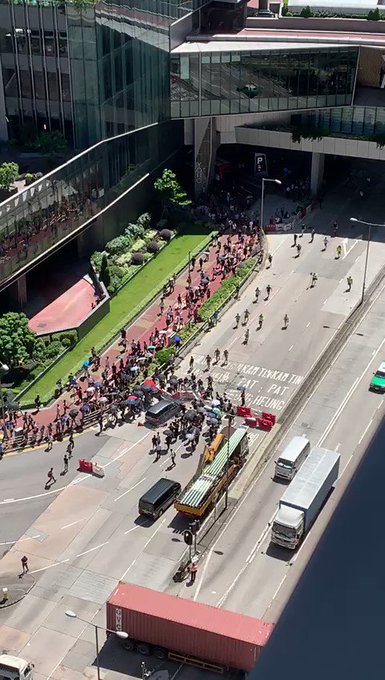
Protesters blocked roads and paralysed train services at peak times on a day of action across the city.

More than 200 flights were cancelled as the protests entered their ninth week.

Hong Kong’s leader, Carrie Lam, has pledged to restore law and order, rejecting calls for her resignation.

Initially the demonstrations, which began on 9 June, focused on a controversial extradition law, which would have allowed the transfer of suspects to mainland China. However, the protests have now become a wider challenge to Beijing’s authority.

Ms Lam warned that Hong Kong was “on the verge of a very dangerous situation”.

Media caption Protests take place in Hong Kong for the ninth weekend – for and against the authorities

In her first media address in two weeks, Ms Lam said the protesters’ actions had challenged the principle of “one country, two systems” – the extra freedoms granted to Hong Kong when it was returned from British to Chinese rule in 1997.

She also accused activists of using the extradition bill as a cover for their real goals.

“We continue to allow these violent protesters to make use of the [extradition] bill to conceal their ulterior motives,” she said. “Those ulterior motives are going to destroy Hong Kong.”

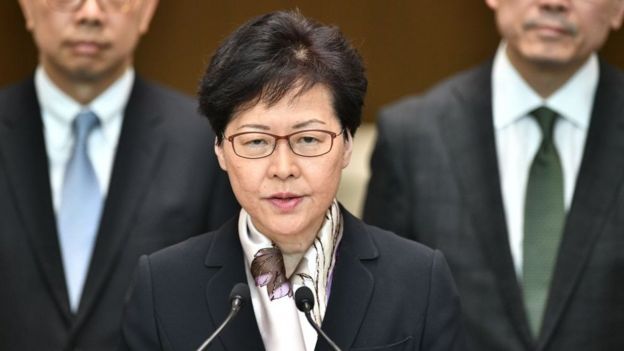
Hong Kong Chief Executive Carrie Lam (C) speaks during a press conference in Hong Kong on August 5, 2019Image copyright GETTY IMAGES

The Chinese foreign ministry said no one should underestimate China’s resolve to safeguard the stability of Hong Kong, Reuters news agency reports.

What happened on Monday?

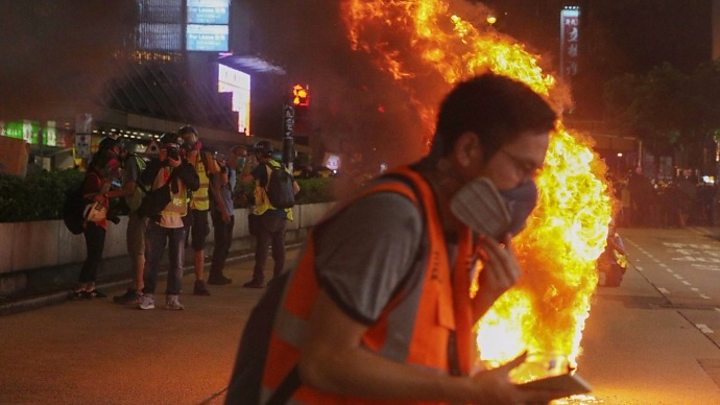
Police fired tear gas at several locations as protesters rallied into the night, setting fires and besieging police stations. In the North Point district, which has a reputation for pro-Beijing sympathies, men wielding long poles clashed with demonstrators before falling back.

More than 80 people were arrested, in addition to the 420 detained since 9 June. In that time, police said they had used more than 1,000 tear gas canisters and 160 rubber bullets.

Protest leaders had called for a general strike. While many people made it to work, in some areas protesters blocked trains from leaving stations and scuffled with commuters. Several lines of the Mass Transit Railway (MTR) were suspended for a time, and the Cross-Harbour Tunnel was also blocked.

One video circulating on Twitter reportedly showed a car in the district of Yuen Long forcefully hitting a barricade set up by protesters, injuring one person.

It is not clear how many joined the strike, but tens of thousands of protesters were out on the streets. Several shops and businesses were closed, including international fashion retailers like Topshop and Zara.

Hong Kong airport, one of the busiest in the world, said travellers should check its website and seek updates directly from the airlines.

Most of the cancelled flights were with local carriers Cathay Pacific and Hong Kong Airlines.

“The Airport Authority advises passengers… to proceed to the airport only when their seats and flight time have been confirmed,” the airport said in a statement.

What’s behind the Hong Kong protests?

The protests were initially sparked by a controversial bill that would allow China to extradite suspects from Hong Kong to the mainland.

Critics said it would undermine the territory’s judicial independence and could be used to target those who spoke out against the Chinese government.

Although the bill has now been suspended, demonstrators want it fully withdrawn.

Their demands have broadened to include an independent inquiry into alleged police brutality, Ms Lam’s resignation, and the dropping of riot charges linked to the protests.

Last week, more than 40 activists appeared in court charged with rioting. If convicted, they could be jailed for up to 10 years.

The Chinese army has so far stayed out of the dispute, but China’s top policy office in Hong Kong has previously condemned the protests, calling them “horrendous incidents” that have caused “serious damage to the rule of law”.

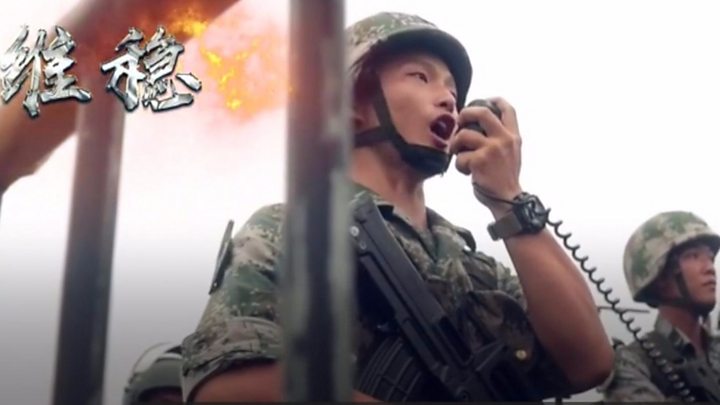
Unease rose last week when China’s army in Hong Kong posted a video on Chinese social media network Weibo showing soldiers conducting anti-riot drills.

Media caption The video shows a soldier using a loudspeaker to warn protesters
Source: The BBC
Law of Unintended Consequences

continuously updated blog about China & India

ChiaHou's Book Reviews

continuously updated blog about China & India

What's wrong with the world; and its economy

continuously updated blog about China & India