29/04/2019
-
- Fusion reactor built by Chinese scientists in eastern Anhui province has notched up a series of research firsts
- There are plans to build a separate facility that could start generating commercially viable fusion power by 2050, official says
The Experimental Advanced Superconducting Tokamak (EAST) device – or “artificial sun” – in Hefei, Anhui province. Photo: AFP/Chinese Academy of Sciences
A groundbreaking fusion reactor built by Chinese scientists is underscoring Beijing’s determination to be at the core of clean energy technology, as it eyes a fully functioning plant by 2050.
Sometimes called an “artificial sun” for the sheer heat and power it produces, the doughnut-shaped Experimental Advanced Superconducting Tokamak (EAST) that juts out on a spit of land into a lake in eastern Anhui province, has notched up a succession of research firsts.
In 2017 it became the world’s first such facility to sustain certain conditions necessary for nuclear fusion for
, and last November hit a
of 100 million degrees Celsius (212 million Fahrenheit) – six times as hot as the sun’s core.
Such mind-boggling temperatures are crucial to achieving fusion reactions, which promise an inexhaustible energy source.
EAST’s main reactor stands within a concrete structure, with pipes and cables spread outward like spokes connecting to a jumble of censors and other equipment encircling the core. A red Chinese flag stands on top of the reactor.
A vacuum vessel inside the fusion reactor, which has achieved a temperature of 100 million degrees Celsius – six times as hot as the sun’s core. Photo: AFP/Chinese Academy of Sciences
“We are hoping to expand international cooperation through this device [EAST] and make Chinese contributions to mankind’s future use of nuclear fusion,” said Song Yuntao, a top official involved in the project, on a recent tour of the facility.
China is also aiming to build a separate fusion reactor that could begin generating commercially viable fusion power by mid-century, he added.
Some 6 billion yuan (US$891.5 million) has been promised for the ambitious project.
EAST is part of the International Thermonuclear Experimental Reactor (ITER) project, which seeks to prove the feasibility of fusion power.
Funded and run by the European Union, India, Japan, China, Russia, South Korea and the United States, the multibillion-dollar project’s centrepiece will be a giant cylindrical fusion device, called a tokamak.
Now under construction in Provence in southern France, it will incorporate parts developed at the EAST and other sites, and draw on their research findings.
China is “hoping to expand international cooperation” through EAST. Photo: Reuters
Fusion is considered the Holy Grail of energy and is what powers our sun.
It merges atomic nuclei to create massive amounts of energy – the opposite of the fission process used in atomic weapons and nuclear power plants, which splits them into fragments.
Unlike fission, fusion emits no greenhouse gases and carries less risk of accidents or the theft of atomic material.
But achieving fusion is both extremely difficult and prohibitively expensive – the total cost of ITER is estimated at €20 billion (US$22.3 billion).
Wu Songtao, a top Chinese engineer with ITER, conceded that China’s technical capabilities on fusion still lag behind more developed countries, and that US and
Japanese tokamaks have achieved more valuable overall results.
But the Anhui test reactor underlines China’s fast-improving scientific advancement and its commitment to achieve yet more.
China’s capabilities “have developed rapidly in the past 20 years, especially after catching the ITER express train”, Wu said.
In an interview with state-run Xinhua news agency in 2017, ITER’s director general Bernard Bigot lauded China’s government as “highly motivated” on fusion.
“Fusion is not something that one country can accomplish alone,” Song said.
“As with ITER, people all over the world need to work together on this.”
Posted in 32 jailed, 39 million pieces, Anhui province, atomic material, “artificial sun”, Bernard Bigot, China alert, Chongqing, computer hackers, criminal gang, doughnut-shaped, European Union, Experimental Advanced Superconducting Tokamak (EAST) device, Facial recognition system, giant cylindrical fusion device, greenhouse gases, Guizhou Province, Hefei, Holy Grail of energy, ID card and mobile phone numbers, India alert, International Thermonuclear Experimental Reactor (ITER), ITER’s director general, Japan, Ministry of Public Security, names, addresses and dates of birth, nuclear fusion, painting and decorating company, People’s Daily, private data, Russia, Shanghai, Shanghai Real Estate Trading Centre, South Korea, stealing, tokamak, top Chinese engineer, Uncategorized, United States, vacuum vessel, Wang, Wu Songtao, zhejiang province, Zhongxian public security bureau |
Leave a Comment »
13/04/2019
HEFEI, China (Reuters) – China aims to complete and start generating power from an experimental nuclear fusion reactor by around 2040, a senior scientist involved in the project said, as it works to develop and commercialize a game-changing source of clean energy.
China is preparing to restart its stalled domestic nuclear reactor program after a three-year moratorium on new approvals, but at a state laboratory in the city of Hefei, in China’s Anhui province, scientists are looking beyond crude atom-splitting in order to pursue nuclear fusion, where power is generated by combining nuclei together, an endeavor likened by skeptics to “putting the sun in a box”.
While nuclear fusion could revolutionize energy production, with pilot projects targeting energy output at 10 times the input, no fusion project has up to now created a net energy increase. Critics say commercially viable fusion always remains fifty years in the future.
China has already spent around 6 billion yuan ($893 million) on a large doughnut-shaped installation known as a tokamak, which uses extremely high temperatures to boil hydrogen isotopes into a plasma, fusing them together and releasing energy. If that energy can be utilized, it will require only tiny amounts of fuel and create virtually no radioactive waste.
Song Yuntao, deputy director of the Institute of Plasma Physics at the Hefei Institute of Physical Science, said on Thursday that while technological challenges remain immense, the project has been awarded another 6 billion yuan in funding, and new construction plans are underway.
“Five years from now, we will start to build our fusion reactor, which will need another 10 years of construction. After that is built we will construct the power generator and start generating power by around 2040,” he said at the site, built on a leafy peninsula jutting into a lake.
China has been researching fusion since 1958, but at the current stage, it is still more about international cooperation than competition, Song said. The country is a member of the 35-nation ITER project, a 10-billion euro ($11.29 billion) fusion project under construction in France.
China is responsible for manufacturing 9 percent of ITER’s components, and is playing a major role in core technologies like magnetic containment, as well as the production of components that can withstand temperatures of over 100 million degrees Celsius (180 million degrees Fahrenheit).
ITER is scheduled to generate first plasma by 2025. A demonstration reactor will then be built, with the aim of creating 500 megawatts of power from just 50 megawatts of input, a tenfold return on energy.
Despite the critics who say dependable fusion energy is unrealistic, Song said he was confident breakthroughs are being made.
“Because we have a lot of technology now, a lot of challenges in plasma physics have been overcome, and I think this will speed up the entire process,” he said.
($1 = 6.7188 yuan)
($1 = 0.8859 euros)
Source: Reuters
Posted in Anhui province, Celsius, China alert, deputy director, doughnut-shaped installation, Fahrenheit, France, fusion project, Hefei, Hefei Institute of Physical Science, Institute of Plasma Physics, ITER project, leafy peninsula, nuclear fusion, power generation, Song Yuntao, tokamak, Uncategorized |
Leave a Comment »


 The Experimental Advanced Superconducting Tokamak (EAST) device – or “artificial sun” – in Hefei, Anhui province. Photo: AFP/Chinese Academy of SciencesA groundbreaking fusion reactor built by Chinese scientists is underscoring Beijing’s determination to be at the core of clean energy technology, as it eyes a fully functioning plant by 2050.Sometimes called an “artificial sun” for the sheer heat and power it produces, the doughnut-shaped Experimental Advanced Superconducting Tokamak (EAST) that juts out on a spit of land into a lake in eastern Anhui province, has notched up a succession of research firsts.In 2017 it became the world’s first such facility to sustain certain conditions necessary for nuclear fusion for
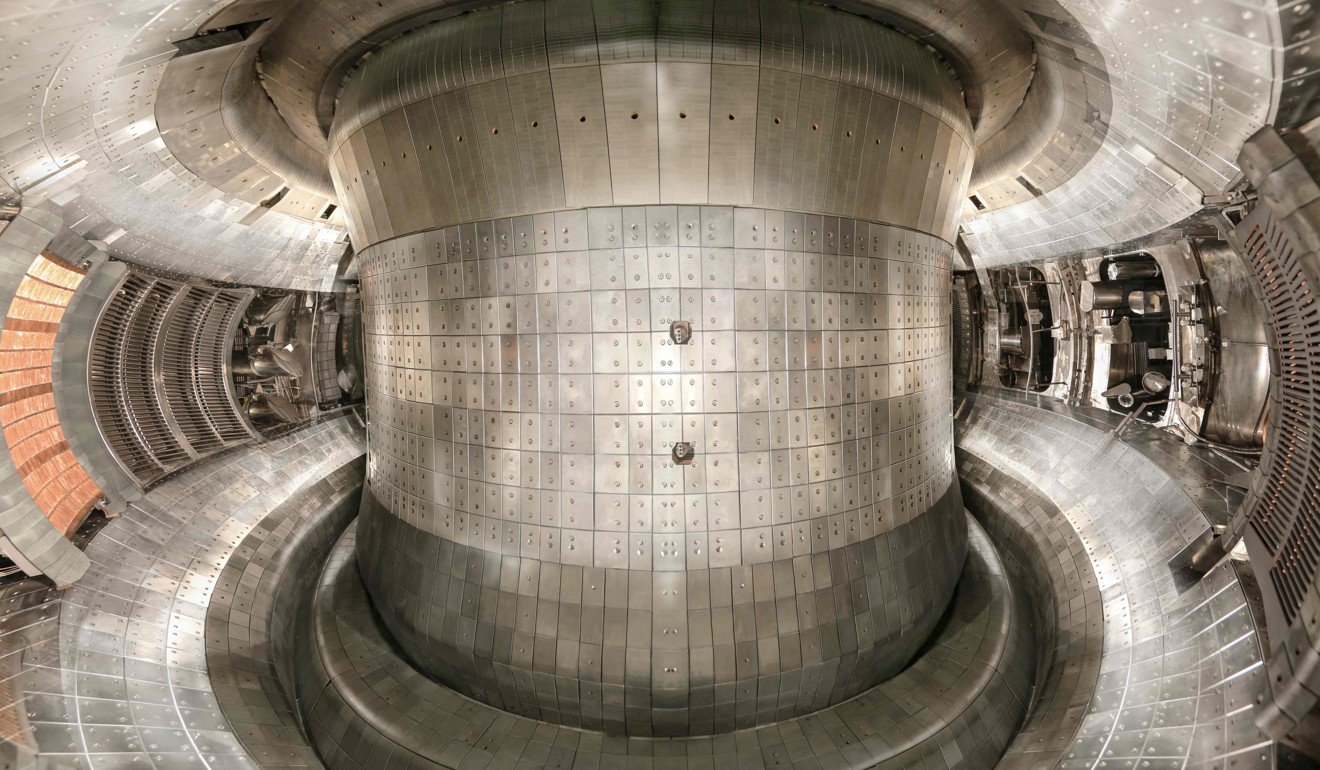 A vacuum vessel inside the fusion reactor, which has achieved a temperature of 100 million degrees Celsius – six times as hot as the sun’s core. Photo: AFP/Chinese Academy of Sciences
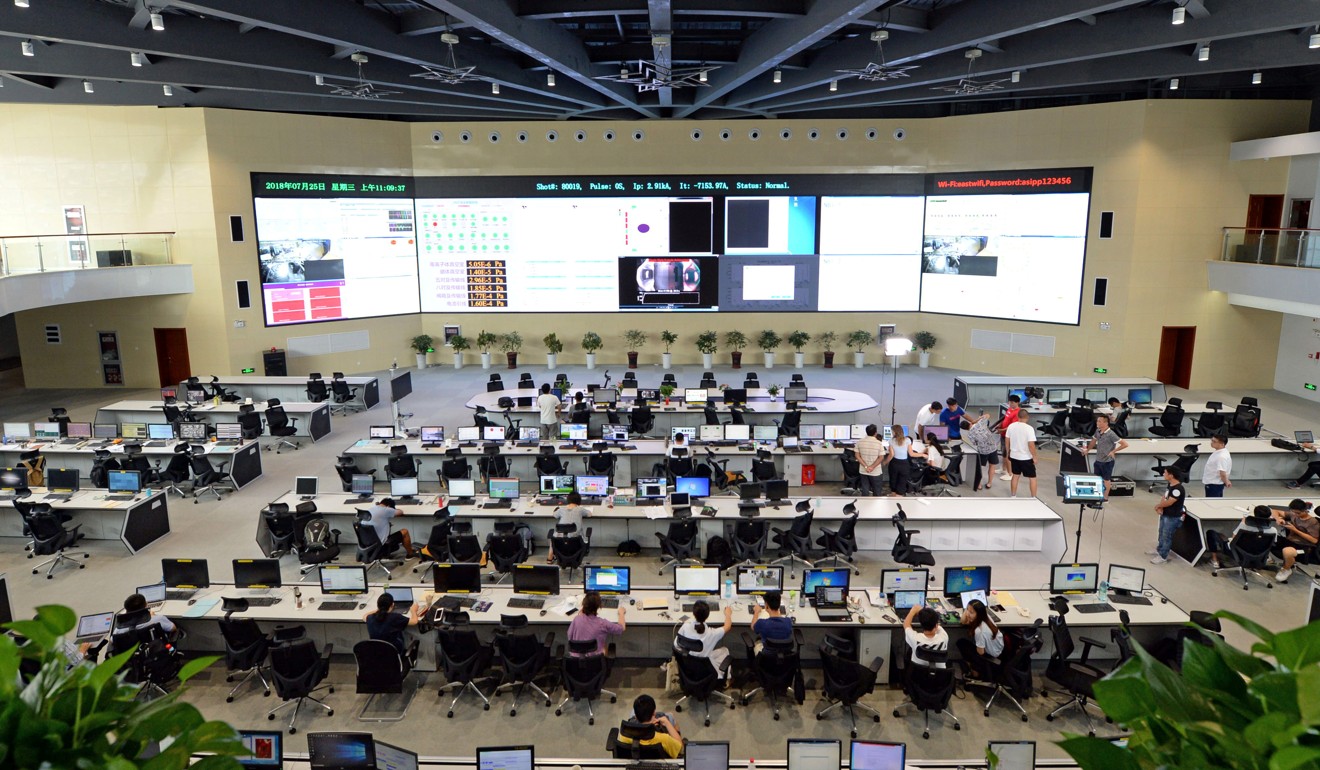 China is “hoping to expand international cooperation” through EAST. Photo: Reuters
 CHINDIA ALERT: You'll be living in their world, very soon