Chindia Alert: You’ll be Living in their World Very Soon
aims to alert you to the threats and opportunities that China and India present. China and India require serious attention; case of ‘hidden dragon and crouching tiger’.
Without this attention, governments, businesses and, indeed, individuals may find themselves at a great disadvantage sooner rather than later.
The POSTs (front webpages) are mainly 'cuttings' from reliable sources, updated continuously.
The PAGEs (see Tabs, above) attempt to make the information more meaningful by putting some structure to the information we have researched and assembled since 2006.
“Doctors and nurses are people who saved me from cancer and gave me strength in the darkest time. I need to return the favour,” says Li Yan, a food delivery rider based in Beijing.
Mr Li was diagnosed with lymph cancer in 2003, when he was just 17 years old. He recovered from the disease and has been full of gratitude ever since for the medical workers who nursed him back to health. With China in a national lockdown, food delivery firms found themselves in hot demand providing meals for residents stuck at home to prevent the spread of the coronavirus.
As a delivery rider for Meituan, one of China’s biggest food delivery firms, Mr Li saw an opportunity to repay the medical professionals he admires by providing them with food and drinks as they worked tirelessly on patients across the city. “Given my past experience, I felt I needed to do something for them in return during the virus outbreak,” he adds.
Beijing is a city of 21 million residents, and Mr Li covers its Tongzhou district, where there are a handful of hospitals with fever clinics, one of which is a designated hospital for Covid-19 treatment. “Many might have concerns delivering for the hospital, but I’ve chosen to deliver for them more often. I just think of the local residents and medical workers who need us. I can’t leave them being hungry. It’s not for money.”
Before the outbreak in China, he delivered more than 50 orders on an average day. But during the first ten days after the coronavirus outbreak in late January, the number of orders dropped to less than 20, as some restaurants were closed. The outbreak also coincided with the Chinese New Year period which is normally a low season.
“By mid-February when the situation was brought more under control, and people’s concerns and fears gradually began to ease, orders started to be restored. I can deliver over 40 orders a day now.”
Image copyright LI YAN
During this time, Meituan brought in a contactless delivery option which allowed food to be dropped off at designated points to avoid contact between customers and riders. “When I called customers to explain, some initially didn’t understand and wanted to cancel the order. But gradually people grew more understanding and began to welcome the contactless approach.”
Empty streets
China was in lockdown for more than two months, although restrictions are now beginning to be lifted. It will still take time before a sense of normalcy returns.
“I remember when the coronavirus first broke out, it was hazy for a few days in Beijing. Streets were empty and stores were closed. An ambulance or a delivery rider occasionally drove by. It felt like I was living in a different world.”
Mr Li says restaurants have started to re-open and people have begun coming back to work in the office since mid-February. Orders are still lower than normal but are improving.
“I miss the hustling Beijing which used to filled with traffic, the days when I could smell car exhaust when I stop at crossroads, the times when I had to walk all the way up to the 6th floor to deliver food, and even times when I was late for a delivery.”
Image copyright LI YAN
When the virus first broke out, face masks and alcohol disinfectant were the most ordered items along with supermarket groceries. “Grains, rice, cooking oil, vegetables, fruits, and solid, packaged food that lasts long. Orders often came in big sizes and transaction prices at around 200 yuan [£23; $28] to 300 yuan on one order.”
Being a food delivery rider, Mr Li feels he can not only give back to the medical community but to the city’s vulnerable too.
“I once received an order that came with a note saying the customer is a 82-year-old who lives alone and couldn’t get downstairs to pick up the food so the rider needs to enter the residential community and deliver food to the door. I had to spend some time communicating with security and finally was allowed in. The door was open when I arrived, and I put the bowl of wontons [a type of dumpling] on the table.”
Tips have increased from happy customers during the pandemic as a result. “Many more send me thank-you notes in the Meituan app and tell me to take care.”
Image copyright LI YAN
Keeping clean
Mr Li has a new routine now which involves lots of disinfecting and temperature checks. “I get my temperature checked dozens of times everyday now, before entering shopping malls, at restaurants, and returning home to the residential compound I live in. I also bring with me disinfectant sprays, a towel in my scooter and use disposable gloves when delivering to areas with reported confirmed cases.”
While he’s providing a vital service, is Mr Li worried about the risk of infection? “I did have worries when the virus spread and was at its worst time here but I feel like I’ve already been there, given what I went through in the fight against cancer.
“I’ve learnt to take things easy, look at the bright side of things and always seek strength in a dark time. As long as I take sufficient precautions, masks, gloves, disinfectants and everything, and follow advice from disease control experts, I think the possibility of getting the virus is pretty low.”
And with a seven-month pregnant wife at home, Mr Li is looking forward to happier times.
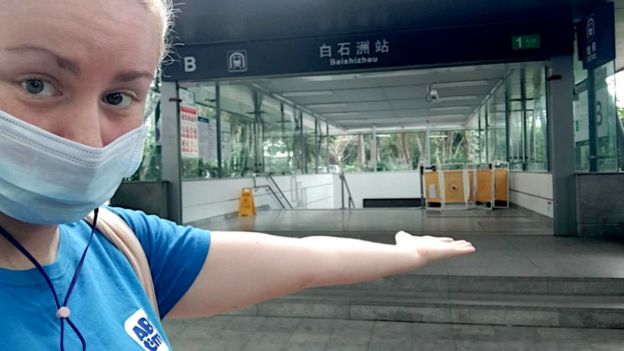
Image copyright JEN SMITHImage caption Jen Smith lives in Shenzhen, where it’s compulsory to wear a mask outside at all times
My Money is a series looking at how people spend their money – and the sometimes tough decisions they have to make. Here, Jen Smith, a children’s TV presenter from Shenzhen in southern China, takes us through a week in her life, as the country slowly emerges from the coronavirus pandemic.
Over to Jen…
Since being in lockdown I’ve been bingeing on Keeping Up With the Kardashians. It starts with one episode after dinner, blink, and suddenly it’s 3am. YouTube, Facebook, Google and Instagram are all banned here, so you’d think I’d be a binge-free socialite after a year and a half living in China. Well, those sites are banned unless you have a VPN – I pay $120 (£97) a year for mine, so Sunday was a late night, with a lie-in until 10.30 this morning.
I go for a run – mask and all, as it’s currently illegal to be outside without one. I make my coffee (bought in the UK), fruit smoothie (about 20 yuan, $2.82, £2.27) and cereal (80 yuan a packet) before cycling to work.
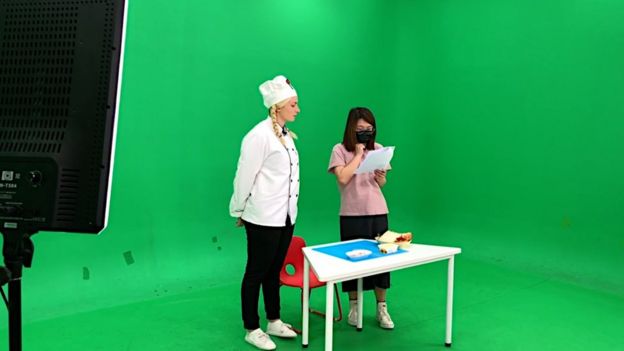
Today is a bit of a crazy day in the studio. I work as a children’s TV presenter. My company has profited from the lockdown as more children are watching the shows non-stop – meaning a rapid turnaround for us.
We shoot two shows from 2-6pm then “break” for a meeting. We discuss tomorrow’s shoot while I eat dinner – homemade aubergine curry. It is normal for the Chinese to eat breakfast, lunch and dinner at work. Normally the company gives all staff 25 yuan through a food-ordering app, and the whole company would eat together. However, because of the current social distancing, that social time is in the far distant past!
I make it home for 8pm, order some deep-fried cauliflower as a snack (45 yuan) and start the inevitable Kardashian binge.
Total spend: 65 yuan ($9.10, £7.37)
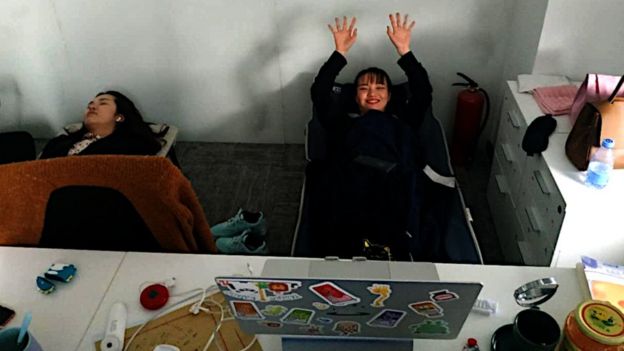
Image copyright JEN SMITHImage caption Workers often have a midday nap in the office
It’s a much earlier start (7.30am), but the same morning routine. On my cycle to work I notice that the traffic is almost back to normal – Shenzhen is inhabited by well over 12 million people, so as you can imagine rush hour is intense. This doesn’t change the fact that everywhere you go you have to scan a QR code – leaving my apartment, using the walkway by the river, and getting into the building I work in.
After a morning of shooting I eat homemade potato curry and settle down for a nap. Naptime is such a commonality in China that people store camp beds at the office. I order a coffee and banana chips (20 yuan) for a pick-me-up before the afternoon’s shooting.
It’s St Paddy’s Day so I head to the local pubs area, catch dinner at a French restaurant (222 yuan), then a few drinks (25 yuan – mainly bought by men at the bar for us) before a very tipsy cycle home.
Total spend: 242 yuan ($34, £25)
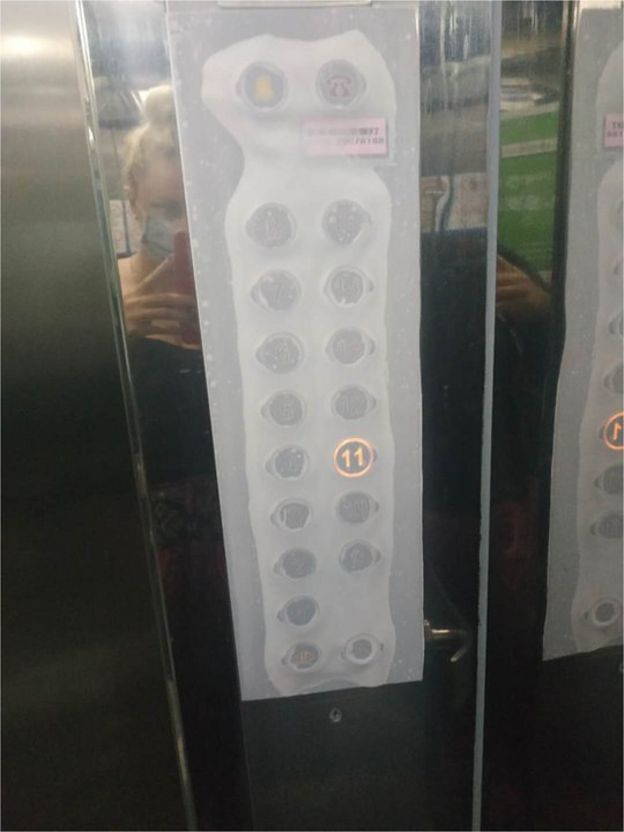
Image copyright JEN SMITHImage caption A disposable cover reduces the risk of transmitting the virus by touching lift buttons
The morning’s shoot (thankfully) was cancelled, so I nursed a hangover in bed until around 11am, at which point I had a phone meeting for a company that I do “plus-size” modelling for (for context I’m a UK size 12). I eat a bowl of cereal and order more cauliflower (45 yuan) while I watch a film.
At 2.30pm an intern picks me up, and we head to the government building to apply for a new work visa. Ironically, the image taken for my visa is Photoshopped to remove wrinkles, freckles and my frizzy hair. When I ask why this is being done for an identification document, the intern replies that the government wants it to be neat, and “the Chinese way” is to have altered photos.
I don’t argue, and have an interview before I hand in my passport. The whole process takes around two hours, so I order food to my house while on the way home (150 yuan for burger, salad and cake!) I take a taxi across town which ends up being 39.05 yuan.
The day starts at 8.30am with coffee and reading, before I get a manicure (280 yuan). My nail lady has been very worried about the state of my hands during the virus, so she spends a whopping two and a half hours treating them while I watch a film (0.99 yuan – bought by her). Because the manicure was so long I don’t have time to eat lunch before our fitness shoot, which runs from 2-5.30pm. I then have an appointment to sign into a building which I’ll shoot in tomorrow.
The building is near a supermarket called Ole (one of the only western supermarkets), and I pick up groceries for 183 yuan before heading home to cook, listen to podcasts and prep for the big day of shooting on Friday.
Total spend: 463 yuan ($64, £52.5)
Image copyright JEN SMITHImage caption Jen filming in front of a green screen – a more colourful digital background will be added later in post-production
Fridays are generally my busiest day. The way the Chinese seem to function, is a boss will say “I want this done now” and then employees rush to finish it. Generally, they will write scripts on Monday and Tuesday, discuss Wednesday, then we shoot later in the week. The poor editors, despite mandatory office hours during the week, then have to work tirelessly through the weekend to achieve a Sunday evening deadline.
I start with mashed avocado and a hard-boiled egg before work. The morning shoot runs from 9.30-11.40am, and I have an early lunch – homemade curry again, before my regular nap time. The afternoon shoot is three hours, so I have time to pop home and shower before a live stream at 6pm. I take a taxi to and from the live stream which ends up being 28 yuan.
Total spend: 28 yuan ($3.92, £3.18)
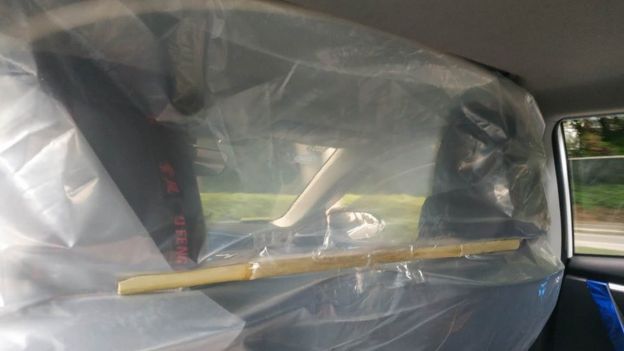
Image copyright JEN SMITHImage caption A taxi driver has improvised a screen to reduce the risk of picking up Covid-19 from a passenger
Finally the weekend! Although things are slowly getting better in China after the coronavirus outbreak, there’s still not too much to do. So I use this time to write, play my piano and generally chill inside. Around 3pm, I venture outside to the shops to pick up some snacks (159.60 yuan) before settling in to ring my family back in the UK with a homemade cocktail – a friend of mine in Canada is doing a daily live stream, “quarantinis” where he teaches you how to make cocktails!
What’s interesting is that a lot of people have started leaving their houses again, but it is still illegal to go outside without a mask on, and temperature checks are taken everywhere. I was even refused entry to a building due to being foreign. I imagine this is because recently the only new cases are being brought in by non-Chinese travelling back to China.
Total spend: 159.60 yuan ($22, £18)
Image copyright JEN SMITHImage caption Shenzhen’s Metro system is still very quiet
It’s another slow day for me as many foreigners have not yet returned to China, so most of my friends are out of the country. I start the day by reviewing potential scripts.
This takes me to 1.30pm without realising I haven’t eaten. I decide to go for a quick run and I return to eat mashed avocado and a hard-boiled egg.
I home-bleach my hair with products bought in the UK, then head back to editing again. About half way through the afternoon I take a little break to practice Chinese. I use an app which is fantastic and free! Definitely worth everyone downloading this during social distancing so you can learn new skills!
For dinner I order online again, a three-dish meal for 160 yuan.


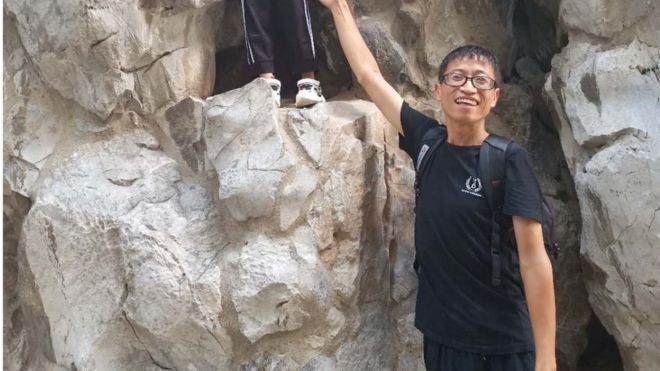 Image copyright LI YAN
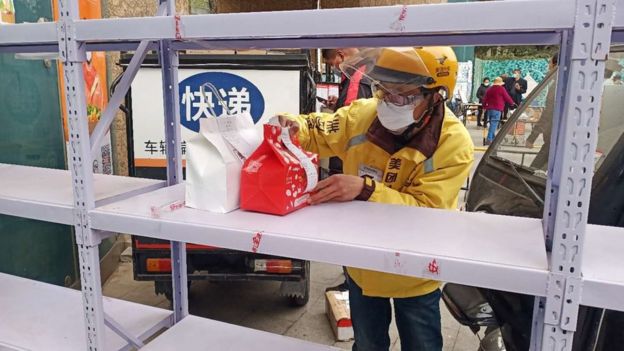 Image copyright LI YAN
 Image copyright LI YAN
 Image copyright LI YAN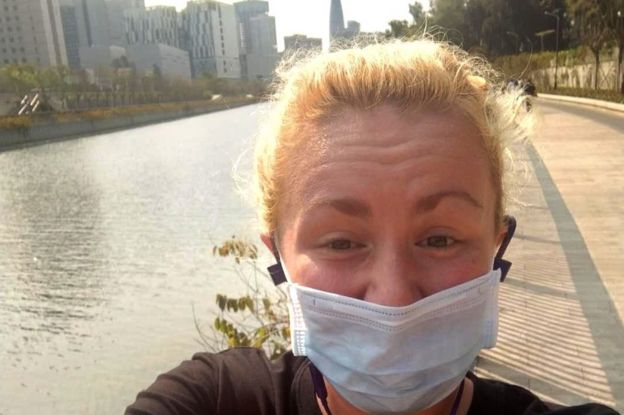










 CHINDIA ALERT: You'll be living in their world, very soon