Chindia Alert: You’ll be Living in their World Very Soon
aims to alert you to the threats and opportunities that China and India present. China and India require serious attention; case of ‘hidden dragon and crouching tiger’.
Without this attention, governments, businesses and, indeed, individuals may find themselves at a great disadvantage sooner rather than later.
The POSTs (front webpages) are mainly 'cuttings' from reliable sources, updated continuously.
The PAGEs (see Tabs, above) attempt to make the information more meaningful by putting some structure to the information we have researched and assembled since 2006.
LONDON (Reuters) – The United Kingdom’s COVID-19 death toll surpassed 47,000 on Tuesday, a dire human cost that could define the premiership of Boris Johnson.
The Office for National Statistics said 42,173 people had died in England and Wales with suspected COVID-19 as of May 15, bringing the UK total to 47,343 – which includes earlier data from Scotland, Northern Ireland, plus recent hospital deaths in England.
A death toll of nearly 50,000 underlined Britain’s status as one of the worst-hit countries in a pandemic that has killed at least 345,400 worldwide.
Johnson, already under fire for his handling of the pandemic, has had to defend his top adviser Dominic Cummings who drove 250 miles from London to access childcare when Britons were being told to stay at home to fight COVID-19.
One Johnson’s junior ministers, Douglas Ross, resigned on Tuesday in protest. Johnson has stood by Cummings, saying the aide had followed the “instincts of every father”.
The government says that while it may have made some mistakes it is grappling with the biggest public health crisis since the 1918 influenza outbreak and that it has ensured the health service was not overwhelmed.
Unlike the daily death toll published by the government, Tuesday’s figures include suspected cases and confirmed cases of COVID-19, the respiratory disease caused by the novel coronavirus.
But even these figures underestimate the true number of deaths.
In March, Britain’s chief scientific adviser said keeping deaths below 20,000 would be a “good outcome”. In April, Reuters reported the government’s worst-case scenario was 50,000 deaths.
Disease experts are watching the total number of deaths that exceed the usual for amount for the time of year, an approach that is internationally comparable.
The early signs suggest Britain is faring badly here too.
Excess deaths are now approaching 60,000 across the UK, ONS statistician Nick Stripe said, citing the latest data – a toll equivalent to the populations of historic cities like Canterbury and Hereford.
Chinese and Indian ethnic group workers have higher average earnings than their white British counterparts, the first detailed official figures show.
But the data on the ethnicity pay gap, showed all other ethnic groups have lower wages than white British workers.
The Office for National Statistics said employees in the Bangladeshi ethnic group have the largest pay gap, earning 20% less than white British employees.
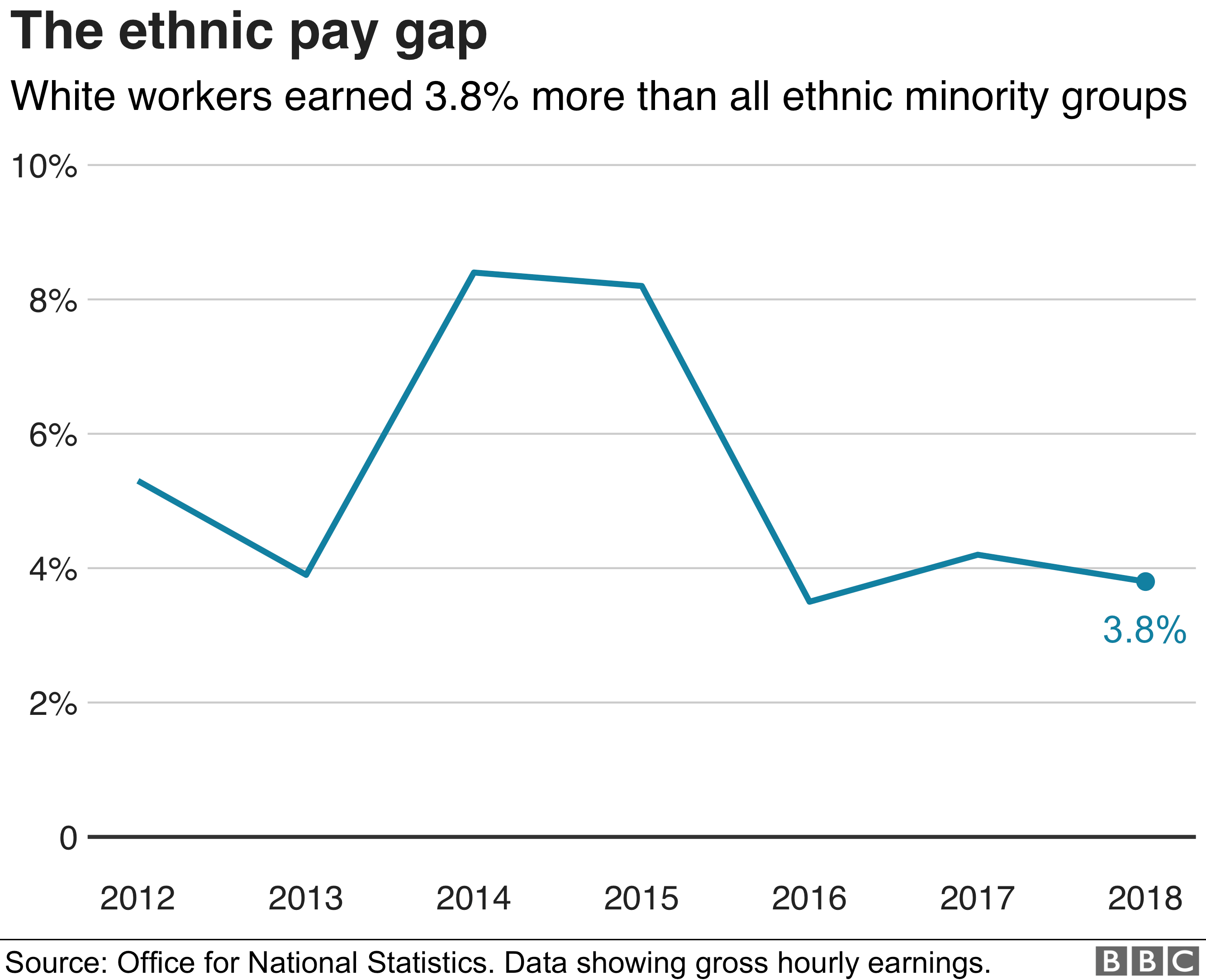
On average, ethnic minorities earn 3.8% less than white ethnic groups.
The categories are the official ones used by ONS.
In 2018, employees from the Chinese ethnic group earned 30.9% more than white British employees.
Hugh Stickland, senior ONS analyst, said: “Overall, employees from certain ethnic groups such as Indian and Chinese, have higher average earnings than their white British counterparts.
“However, all other ethnic groups have average wages lower than for white British employees, with employees from the Bangladeshi ethnic group having the largest pay gap.
“However, once characteristics such as education and occupation are taken into account, the pay gap between white British and most other ethnic groups becomes narrower, though significant differences still remain.”
Bangladeshis are the UK’s lowest earners
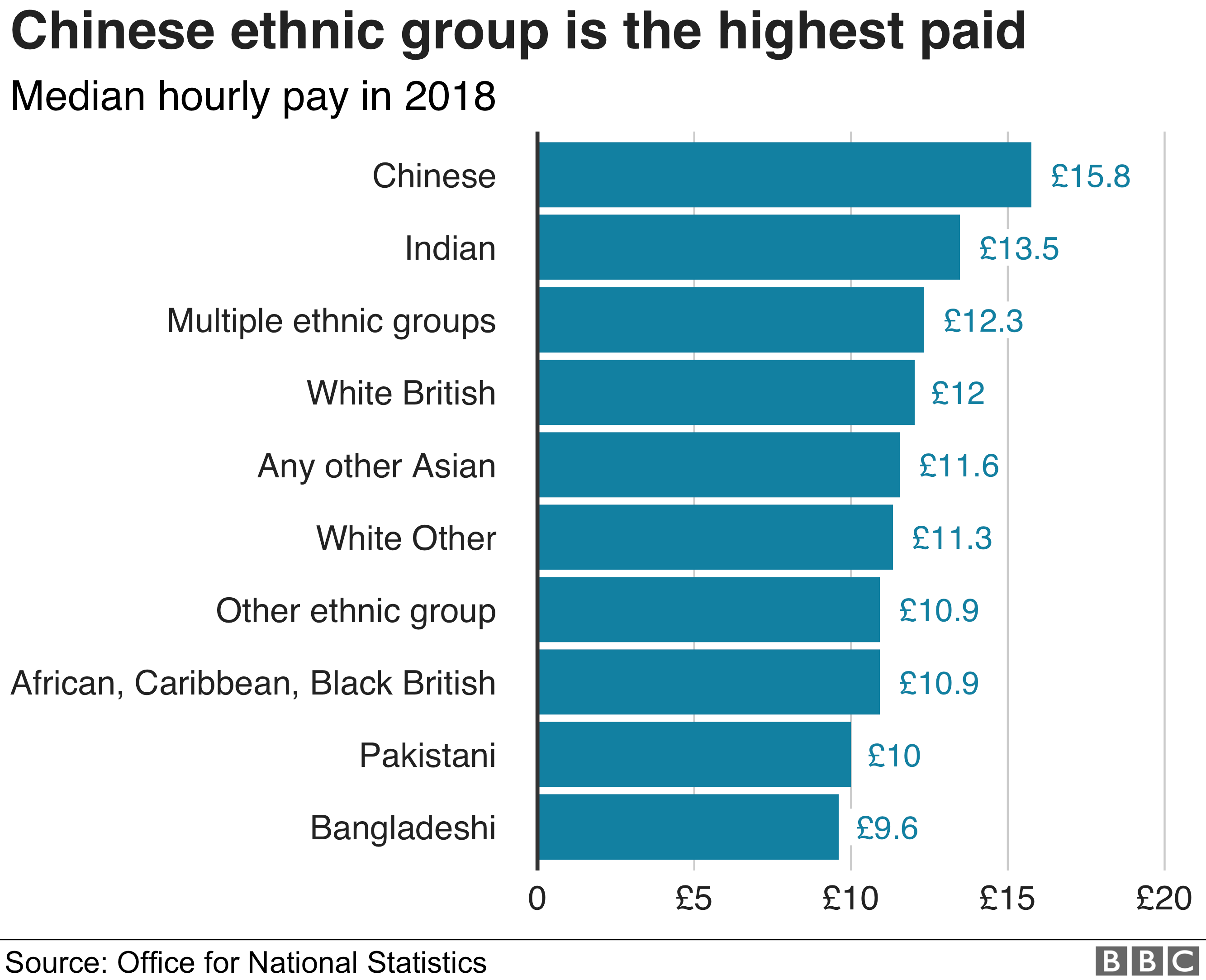
The data – based on median gross hourly earnings between 2012 and 2018 – shows that the Chinese ethnicity group is the highest paid, receiving £15.75 an hour in 2018.
That group is followed by the Indian ethnic group – which earns £13.47 an hour – and mixed/multiple ethnicity group, with a £12.33 hourly pay rate.
The median pay of the white British group was £12.03. The Bangladeshi group had the lowest median hourly pay of £9.60 with the second-lowest paid group being of Pakistani origin at £10 an hour.
“The harsh reality is that even today race still plays a real role in determining pay,” said Frances O’Grady, general secretary of the TUC.
“Ministers must take bold action to confront inequality and racism in the labour market. The obvious first step is to introduce mandatory ethnicity pay gap reporting without delay,” she said.
The government has already introduced mandatory reporting on the gender pay gap – which stands at 9.6% in favour of men – and the ONS data also shows discrepancies in male and female earnings in the ethnic groups.
The Chinese and Indian groups, which both have the highest rate of hourly pay, were among those with the biggest gender gaps.
Chinese men on average earned 19.1% more than women and Indian men earned 23.2% more than women.
But women in the Bangladeshi ethnic group earn more than their male counterparts – with a 10.5% gap.
The ONS said, though, that the sample size for the Bangladeshi group was smaller and susceptible to inaccuracy compared with other ethnic groups.
London’s gap
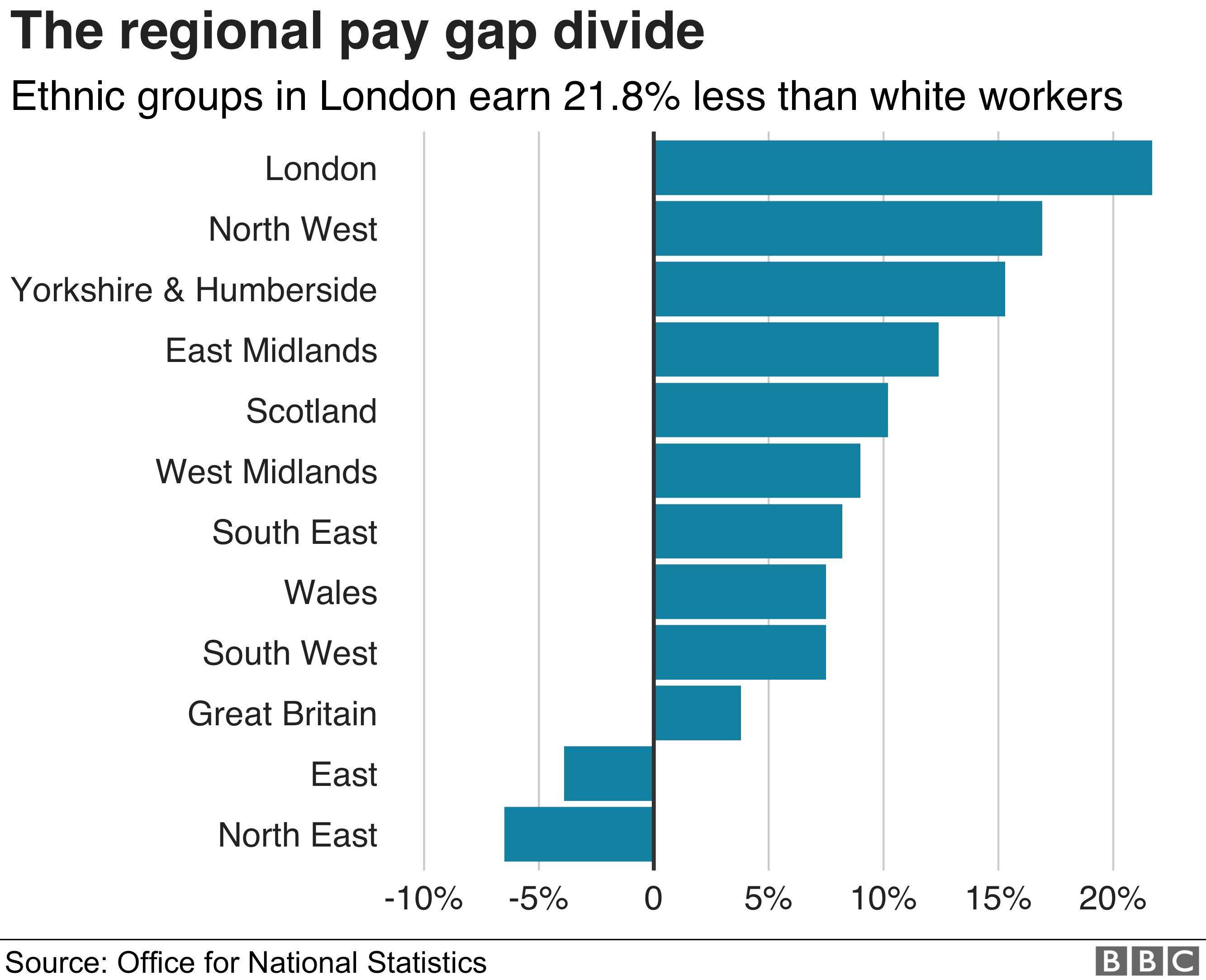
London, which has the highest proportion of its population classified as an ethnic minority group, also has the largest pay gap of 21.7%.
The ONS found this gap was reversed in other parts of Britain. In the north-east of England, for instance, employees from an ethnic minority group had average earnings that were 6.5% more than the average earnings of white employees.
Birth-place divide
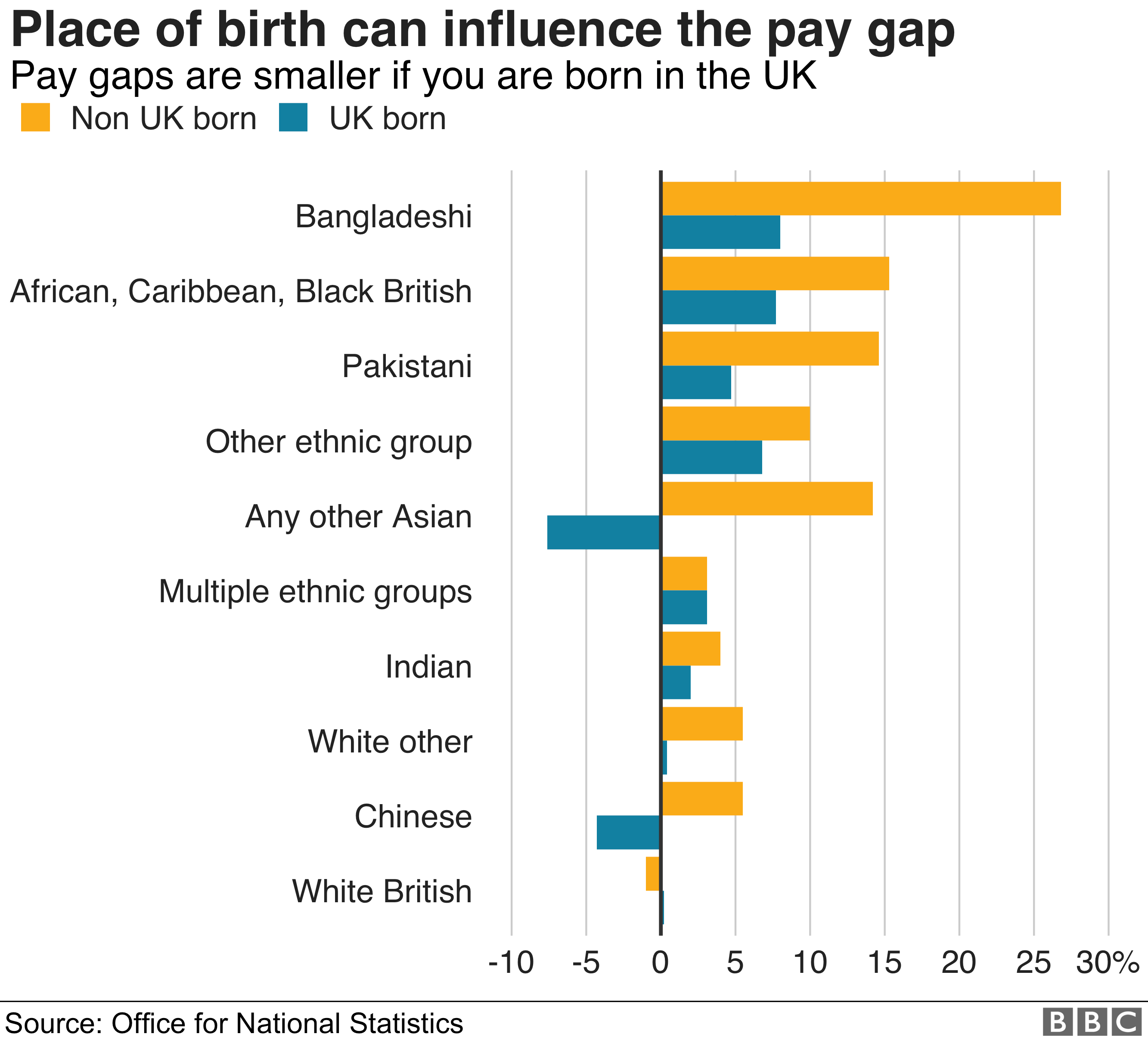
The ONS says that where someone is born can have an influence on how much they are paid.
“By comparing those who were born in the UK and those who were not, it may give us an idea of what sort of effect having a UK education and the higher likelihood of speaking English as a first language may have on those from an ethnic minority background,” the ONS said.
It found those in the Bangladeshi ethnic group – who had been born in the UK – earned 8% less than white British employees. But for Bangladeshi employees born outside the UK the gap was 26.8%.
When taking other factors into account, such as education, UK-born employees in the Indian and Chinese ethnic groups do not have pay gaps that are “statistically different” from the UK-born white British employees, the ONS found.
For example, almost a third of workers in the Indian ethnic group work in professional roles which means they tend to be higher-paid.





 CHINDIA ALERT: You'll be living in their world, very soon