Archive for ‘Olympics’

25/03/2020

Nike turns to digital sales during China shutdown

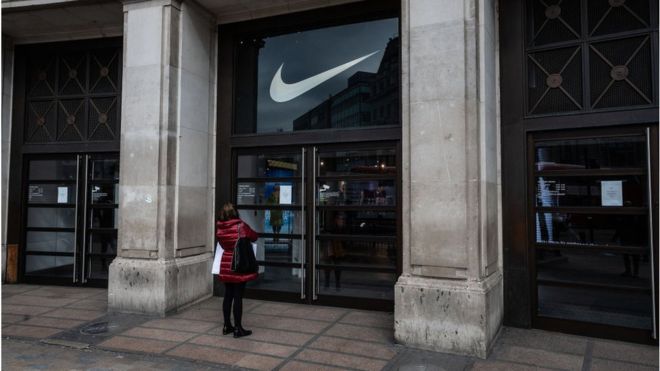
A woman reads the sign on the door of the closed Niketown store on Oxford Street, London.Image copyright GETTY IMAGES

Sportswear firm Nike has seen online sales rise by more than 30% in China as it rides out its coronavirus store shutdowns.

The US firm has shut the majority of its stores globally, but says 80% have now reopened in China.

“We expect the next several weeks to be a challenging period,” said Nike chief executive John Donahoe, talking about the US and Europe.

He hopes Nike can use the lessons learned in China to navigate its Western market shutdowns.

“Consumers are back in the stores,” Mr Donahoe said of Nike’s Chinese outlets. “They are often wearing facemasks, but they’re back in the store”.

Nike reported a 5% drop in Chinese sales to $1.5bn in its last financial quarter, which runs to the end of February. It was the first decline in China for the company in almost six years.

But it has seen strong online sales, rising by 36% during the quarter. It hopes this trend will help cushion a fall in sales from store closures.

Nike also saw an “extraordinary rise” in its personal training apps in China, designed for home workouts. User activity was up 80% as China faced a national lockdown with residents staying at home.

The sportswear firm said it would push on with some new product launches originally intended for the Olympics “when the time is right”. Nike has been promoting its sustainable footwear, made from recyclable materials.

On Tuesday the IOC announced it was postponing the Tokyo 2020 Olympic and Paralympic Games until next year because of the worldwide coronavirus pandemic.

Source: The BBC
20/03/2020

South Korea discusses coronavirus with China, Japan; plans to quarantine Europe entries

SEOUL (Reuters) – The foreign ministers of South Korea, China and Japan held a video conference on Friday to discuss cooperation on the coronavirus pandemic amid growing concern over the number of infected people arriving in their countries from overseas.

Though the epidemic erupted in China in December, and South Korea at one stage had the second-most infections, both subsequently succeeded in stifling domestic transmission of the virus. [L4N2BC3SC]

The number of cases in Japan has been far smaller, but Tokyo has the extra worry of whether to press ahead with hosting the Olympics this summer.

Japan was given expressions of support for hosting the Olympics during the video-conference call between the minister, according to South Korea’s foreign ministry.

The government remains committed to holding Games as planned in July, despite expectations that some 600,000 spectators and athletes would descend on Tokyo.

Japan has had 963 domestically transmitted cases and 33 deaths, according to public broadcaster NHK. That does not include more than 700 cases and seven deaths from a cruise ship moored near Tokyo last month.

TWO-WEEK QUARANTINE

During their call, the ministers shared information on the outbreaks in their countries.

“I think the three countries need to work together to contain the spread of the coronavirus and minimise any resulting reduction on exchanges and cooperation between the peoples, as well as its economic and social impact,” South Korean Foreign Minister Kang Kyung-wha said at the outset of the call.

South Korea’s government said on Tuesday it will conduct a coronavirus check on all travellers from Europe and impose a two-week mandatory quarantine, starting Sunday, for those who intend staying long term.

“This is the toughest step we could take without banning entries from Europe, where the virus is spreading at an unexpected speed,” Yoon Tae-ho, director-general for public health policy at the health ministry, told a briefing.

“We’re also closely monitoring developments in the United States where the rate of the transmission has been increasing over the last few days.”

The move came a day after tighter border checks took effect for all people arriving from overseas.

South Korea has established special entry procedures for visitors from hard-hit countries like China, Italy and Iran, requiring them to sign up by a smartphone application to track whether they have any symptoms such as fever.

Despite strong diplomatic and economic ties between the three North Asian neighbours, historic grievances dog their relations. And reduced flights, stronger border controls, and quarantine requirements introduced in response to the epidemic have proved irksome.

Earlier this month, Seoul suspended visas and visa waivers for Japan in a tit-for-tat move following Tokyo’s own travel restrictions on Koreans, triggering fears that their defences against the virus could spark a fresh feud.

The Korea Centers for Disease Control and Prevention (KCDC) reported 87 new coronavirus cases on Friday, bringing the total national infections to 8,652.

As of Thursday, there were 79 cases involving infected people who had recently arrived in the country, up from 44 on Sunday. Most of them were South Koreans, 27 came from Europe, 16 from China, and 12 from other Asian countries, according to the KCDC.

The daily tally for new infections has been trending downward over the past week, despite a slight uptick on Thursday as small-scale outbreaks continued to emerge across the country. South Korea’s death toll rose to 101, from 94.

South Korea’s election commission said on Friday it will disinfect all polling stations and carry out checks on voters when they show up to cast their ballots in the April 15 parliamentary election.

Source: Reuters

08/03/2020

Why Japan is so keen to go ahead with hosting the Olympic Games, despite coronavirus threat

  • Japan risks massive financial losses and a political blow for Shinzo Abe’s government if the Tokyo Olympics are cancelled or postponed
  • The Olympics were last cancelled in 1940 after Japan invaded China and the outbreak of World War II, but the Zika virus did not stop the 2016 Rio Games
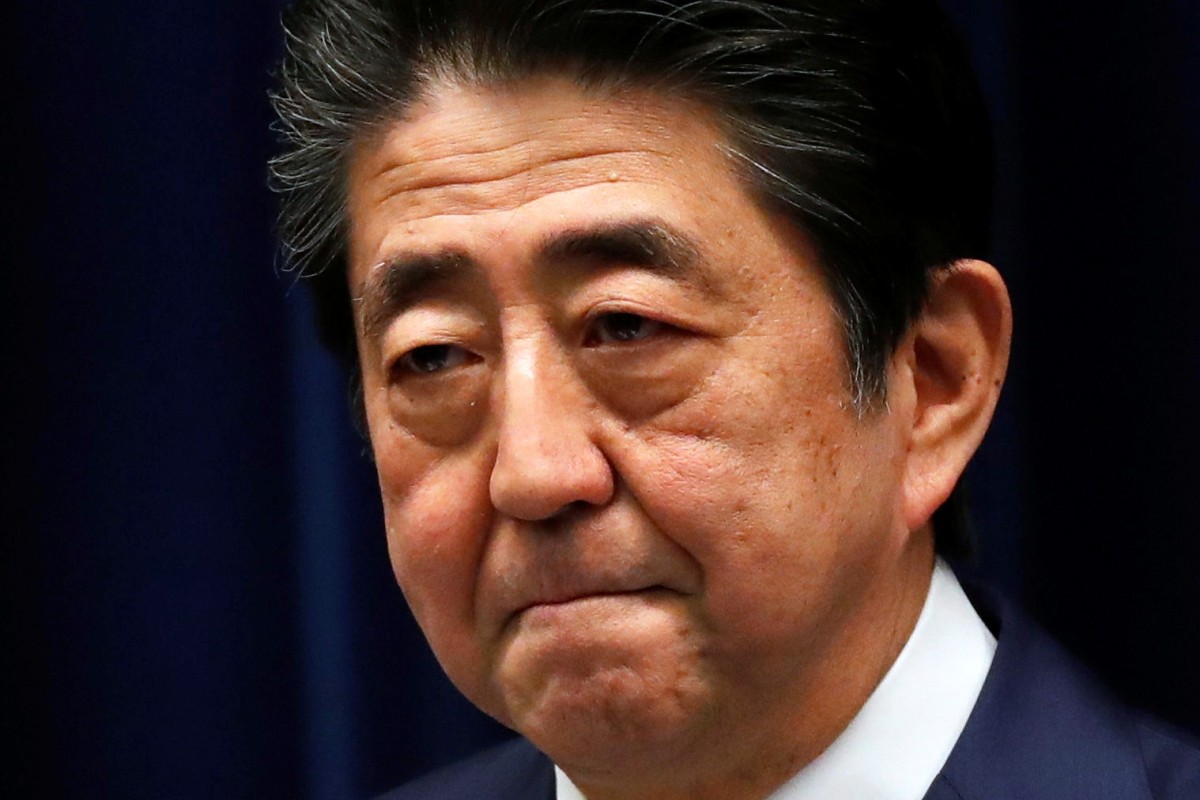
Japan's Prime Minister Shinzo Abe attends a news conference on the coronavirus. An analyst said the cancellation of the Olympic Games would not only be a financial blow, but would also dent the political pride of his government, which wanted to show the world that Japan could host a successful Olympics. Photo: Reuters
Japan’s Prime Minister Shinzo Abe attends a news conference on the coronavirus. An analyst said the cancellation of the Olympic Games would not only be a financial blow, but would also dent the political pride of his government, which wanted to show the world that Japan could host a successful Olympics. Photo: Reuters
Japan

has far more at stake than its athletes picking up medals in the upcoming

Tokyo Olympic Games and Paralympics

, which explains the government’s single-minded commitment to going ahead with the event in the face of the threat posed by the novel coronavirus.

The Japanese government on Wednesday morning reiterated that the Games would go ahead in July as scheduled, with chief cabinet secretary Yoshihide Suga declaring that preparations were continuing despite the spread of the virus worldwide.
The previous day, the International Olympic Committee (IOC) threw its weight behind Tokyo’s position. “We are preparing for a successful Olympic Games, Tokyo 2020,” said IOC head Thomas Bach.
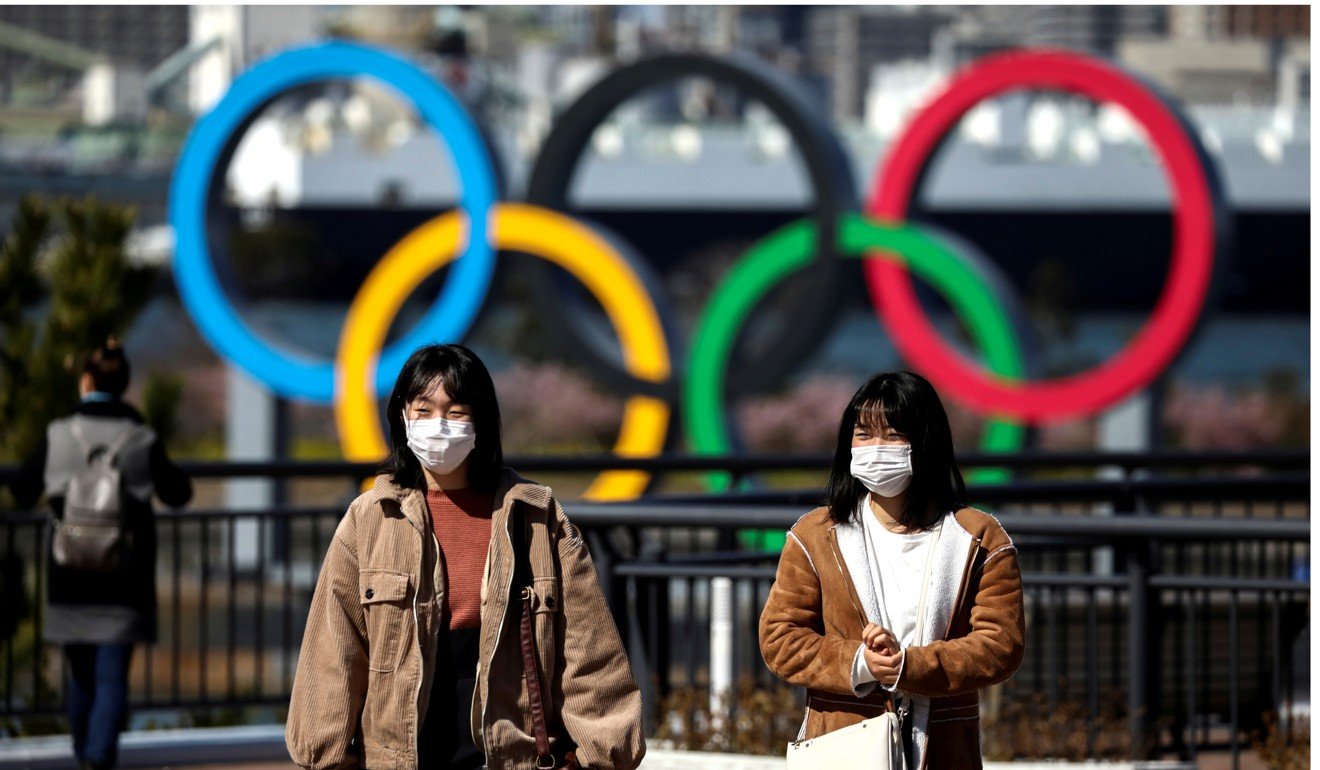
People wearing protective face masks are seen in front of the Olympic rings at the waterfront area at Odaiba Marine Park in Tokyo, Japan. Photo: Reuters
“I would like to encourage all the athletes to continue their preparations … with great confidence and full steam,” he said. “From our side, we will continue to support the athletes and the national Olympic committees.”
Both statements came on the heels of a comment by Seiko Hashimoto, Japan’s minister with responsibility for the Games, who suggested that the contract with the IOC “could be interpreted as allowing for a postponement” until later in the year. On Thursday, Hashimoto acknowledged to the Upper House budget committee that a cancellation or delay of the games would be “unacceptable for the athletes”.

Stephen Nagy, an associate professor of international relations at Tokyo’s International Christian University, said a great deal is at stake for Japan as the last time a modern Olympic Games was cancelled was in 1940 – ironically as a result of Japan’s invasion of China in July 1937, and the outbreak of World War II. Meanwhile, the Rio Games in Brazil went on as planned in 2016 despite the outbreak of the Zika virus.

While the 1940 cancellation has largely been forgotten, it would unquestionably cause serious loss of face to the Abe administration if events did conspire to halt Tokyo 2020, he said.

I think it’s much more about the national political pride of ‘Team Abe’Economist Noriko Hama

Noriko Hama, an economist at Doshisha University in Kyoto believes a number of issues are behind the government’s refusal to contemplate the Games being postponed or cancelled, but one is dominant.

“Yes, it’s about the money that has already been spent on facilities and new infrastructure and the windfall from tens of thousands of foreign tourists, but I think it’s much more about the national political pride of ‘Team Abe’,” she said.

“They wanted to show the world that they could do this, that they would be one of the very few cities to host an Olympics for a second time and that it would be a massive success,” she said. “It’s about chest-thumping.”

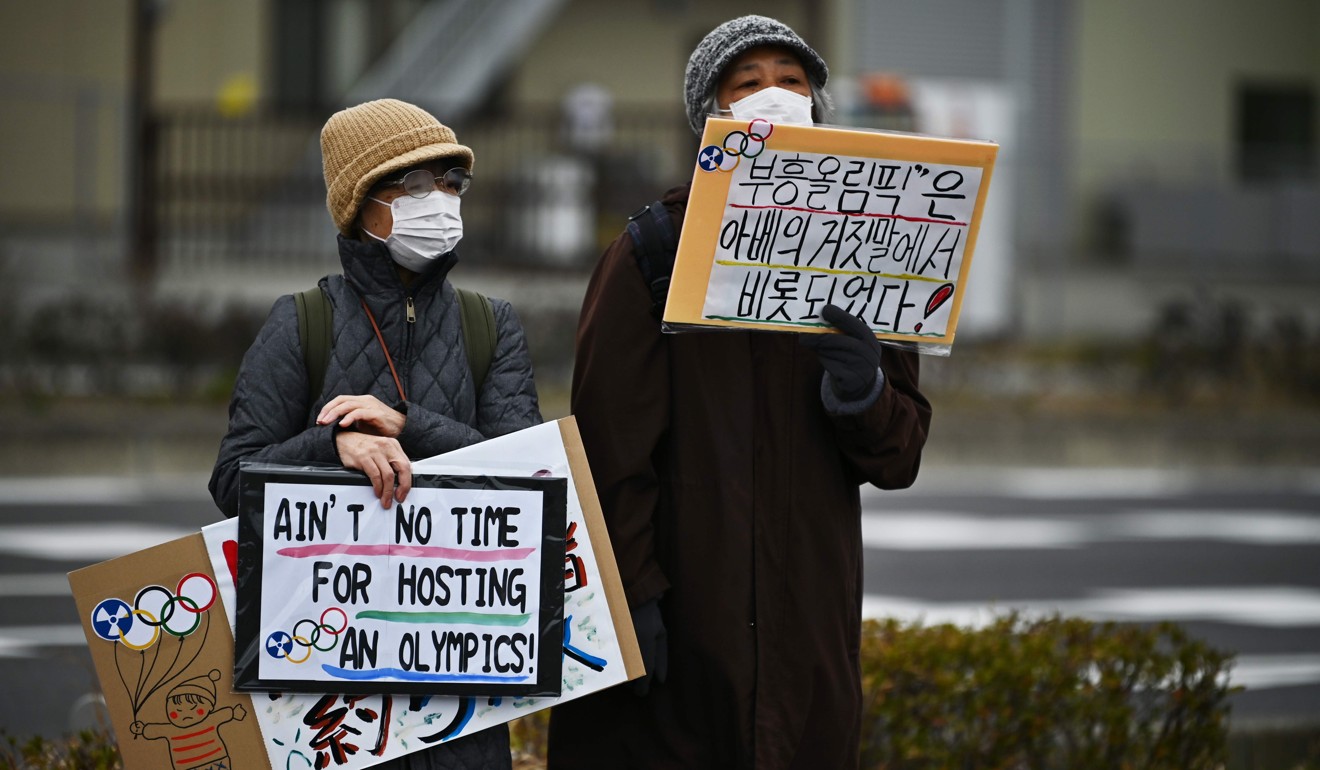
Protesters hold placards during a demonstration against the Olympics, Prime Minister Shinzo Abe and nuclear energy. Photo: AFP
Hama pointed out that many Japanese people had been sceptical about the Games, and for a variety of reasons.

Many are unhappy at the cost, which was previously estimated at 1.06 trillion yen (US$9.81 billion) but organisers confirmed in December had risen to 1.35 trillion yen (US$12.35 billion), plus another 3 billion yen required to move the marathon and walking events from Tokyo to Sapporo, in Hokkaido, to avoid the heat and humidity of the capital.

Others said the Games will cause widespread disruption to the lives of ordinary people and that Tokyo was still not fully prepared for the huge numbers of people that will inevitably flood the city. Some voiced concerns that holding the Games at the peak of a Japanese summer would cause problems for athletes, officials and spectators alike. There have been predictions that the heat is going to cause loss of life.

Only an apocalypse – or government ineptitude – can stop the Olympics

29 Feb 2020

“But there is this strange sort of blind obstinacy that is driving the whole thing forward regardless,” said Hama. “And now the coronavirus has added another layer of very serious concern and I believe the government need to think very carefully what they are going to do.”

Nagy said the Japanese government would be reluctant to postpone the Games as that would “once again tarnish the brand”.

“Seven or eight years ago, Japan was largely seen as a stagnant country that was struggling to shake off the legacy of two decades of economic underperformance, but that changed quite suddenly,” he said.

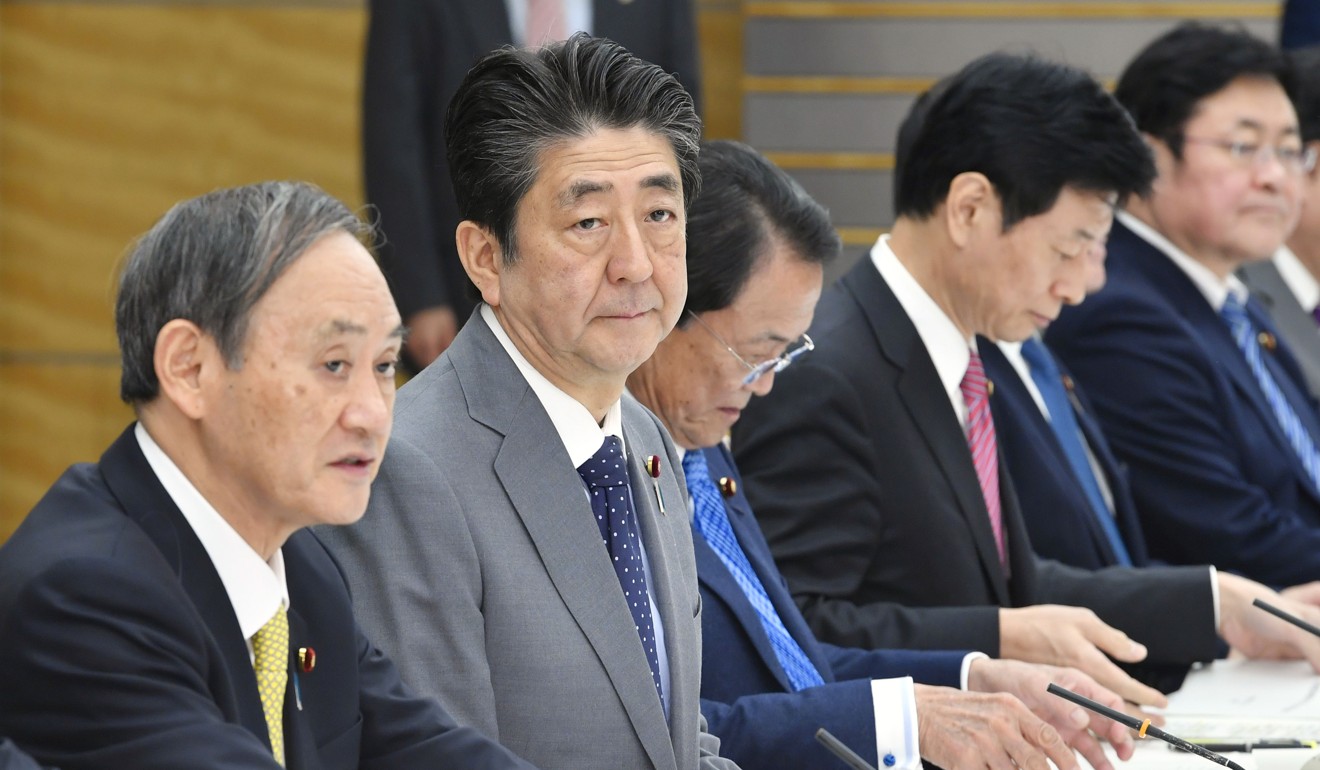
Japan’s chief cabinet secretary Yoshihide Suga and Prime Minister Shinzo Abe attend a meeting with other ministers in Tokyo. Photo: Kyodo
“Now the ‘Japan brand’ is strong and vibrant as they have successfully hosted G-7 conferences and, more importantly, last year’s Rugby World Cup.”
The rugby served to put Japan on the world stage, said Nagy, and everyone went away feeling very positive and it worked exceptionally well as a “dry run” for the Olympics.

Other considerations are the massive amount of money that was spent on preparing for the Games, as well as the political capital that Abe was obliged to use up to win the right to be the host city and then smooth the way in the run-up to the event.

Hong Kong backs IOC’s Olympic pledge despite coronavirus threat

4 Mar 2020

Dick Pound, a senior member of the IOC, said there is a window of two to three months in which organisers must make a decision, meaning there could only be clarity by the end of May. He told Associated Press that if the coronavirus situation worsens, it would probably mean a cancellation.

“You just don’t postpone something on the size and scale of the Olympics. There’s so many moving parts, so many countries and different seasons, and competitive seasons, and television seasons. You can’t just say, ‘We’ll do it in October’,” he said. It was also unlikely that the IOC would move the Games to another city at such short notice.

In the meantime, the local organising committee said it had stepped up its measures to protect runners and spectators for the torch relay, including limiting the number of visitors at venues and monitoring the health of runners.

While the Japanese government remains defiant that the Olympics will go ahead as scheduled, Nagy said both Abe and the IOC were walking a “fine line” on making a final decision.

“There are simply no good choices at this point,” he said. “Policymakers just do not know how long this virus is going to stick around, whether it is going to mutate or anything else. But there will come a point when they absolutely have to make a decision.

Coronavirus fear, paranoia reveal cracks in Japan’s polite facade

3 Mar 2020

“If they wait too long and the outbreak goes on longer than anticipated, then they risk the possibility of a poor public turnout and people getting ill,” he said. “But if they cancel too early and the virus disappears, then they will be accused of being alarmist and of wasting all the effort and money that has already gone into the Games.

“The best they can do, in the circumstances, is to use science and facts and compare this outbreak to previous cycles – and then hope the decision that they do make is the right one.”

Source:SCMP

17/10/2019

Xi Jinping to open Military World Games in China as PLA goes on charm offensive

  • Soldiers from 140 countries are expected to take part in 10-day sporting event in Wuhan, Hubei province
  • It coincides with the Xiangshan Forum, where Beijing may seek to reinforce its position on issues like the South China Sea and US arms sales to Taiwan
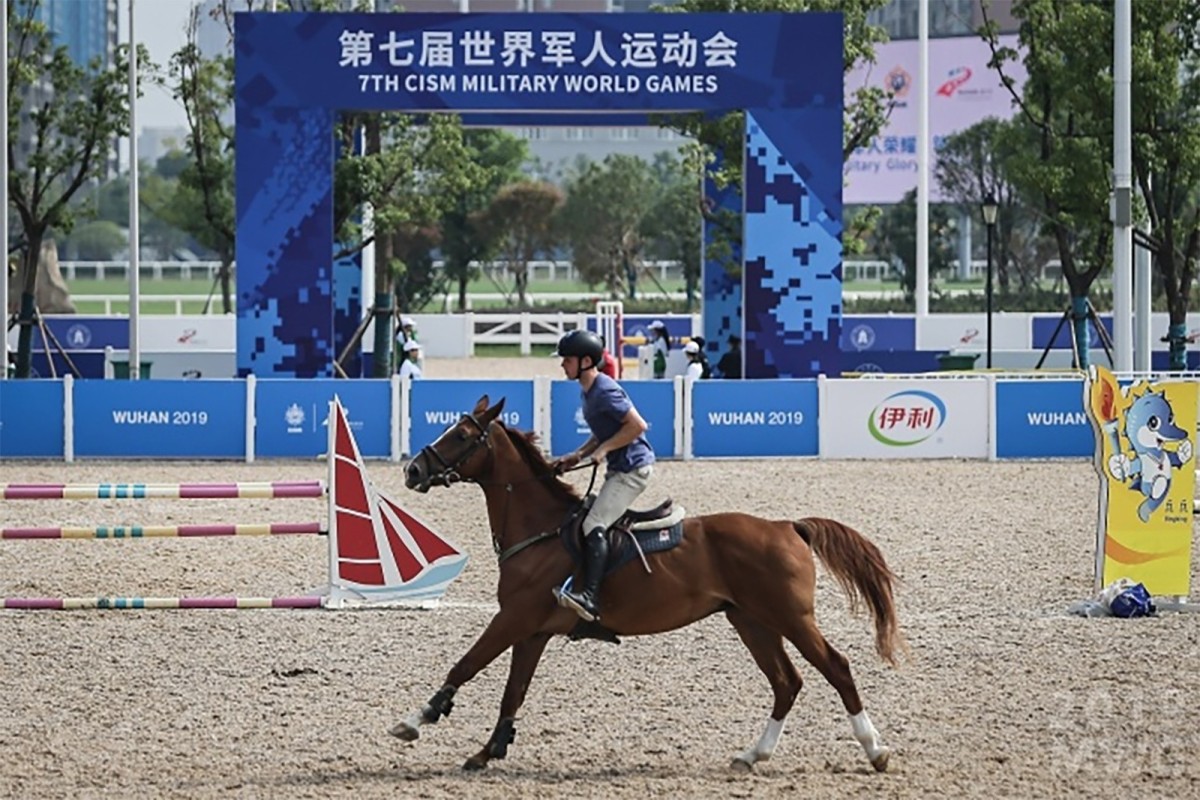
More than 100 horses have arrived in Wuhan for the equestrian and modern pentathlon events of the Military World Games, which begin on Friday. Photo: Handout
President Xi Jinping is expected to open the Military World Games in central China on Friday, setting the stage for a People’s Liberation Army charm offensive as it seeks to strengthen ties with foreign forces and exert its influence.
China is hosting the 10-day sporting event in Wuhan, Hubei province, and soldiers from 140 countries are expected to take part. It will coincide with the three-day Xiangshan Forum – China’s equivalent of the Shangri-La Dialogue in Singapore – to be held on the outskirts of Beijing from Sunday.
It comes after China staged a lavish military parade in Beijing to celebrate the 70th anniversary of the People’s Republic on October 1, showcasing some of the PLA’s most advanced weapon systems and strategic weaponry.
A Chinese military insider on Tuesday said Xi was expected to kick off the games in Wuhan – a symbolic move by the president as he seeks to boost the PLA’s international profile.
China has built a new athletes’ village in Wuhan that can accommodate 10,000 people. Photo: Handout

“[China sees] the Military World Games as a platform to promote international military diplomacy and an opportunity for the PLA to build its international image through sporting events,” the insider said.

It will be the first time China hosts the Military World Games, which is the second-biggest multi-sport event after the Olympics and is also held every four years.

To host the mega event, China has built a new athletes’ village in Wuhan that can accommodate the 10,000 military athletes who will compete. This year’s games will have the largest number of events ever, with badminton, table tennis, tennis and men’s gymnastics included for the first time.

The US Armed Forces will send about 300 athletes to Wuhan, according to state-run Xinhua. One of them is Mark Juliano, an archer and taekwondo player, who told the news agency: “You developed world-class venues and I can’t wait to experience the games.”

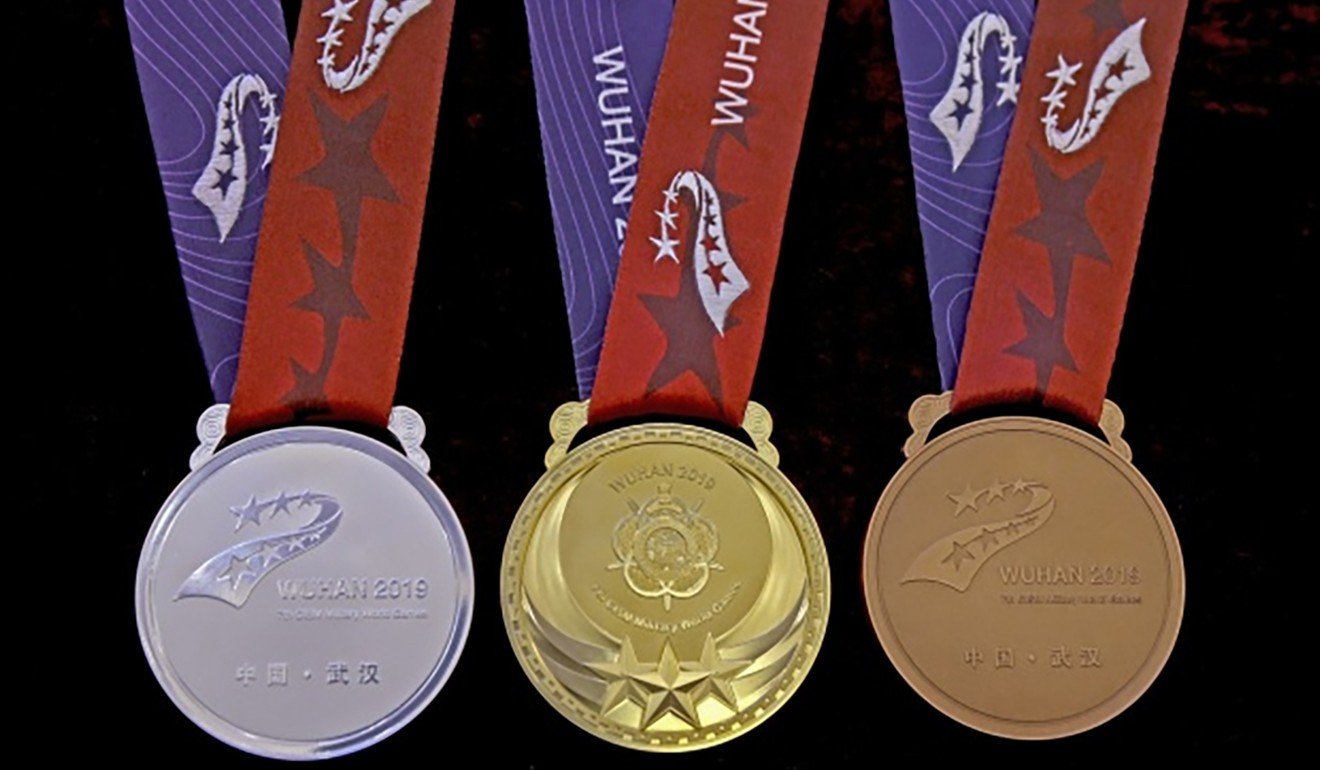
The Chinese president has high hopes for the PLA athletes at this year’s Military World Games, according to an insider. Photo: Handout

The military insider said Xi had high hopes that the PLA would win gold in some of the events.

“The Russians are known to be very good at some sports but the PLA has yet to earn a reputation in any particular sport,” the insider said. “Xi hopes that the home ground advantage will give the PLA the edge this time.”

Another Beijing-based military source said the top brass had put great emphasis on the success of three events this year – the National Day parade, Military World Games and the Xiangshan Dialogue.

The source said it would be the biggest Xiangshan Forum since China began holding the event more than a decade ago, and dozens of senior foreign defence officials and military leaders invited to the games in Wuhan would also take part in the forum.

How robots are revolutionising China’s firework factories

Set up in 2006, China uses the forum to play host to foreign military experts and leaders and discuss security and defence issues in the Asia-Pacific region. It is widely seen as an effort by Beijing to compete with the Asia Security Forum in Singapore, also known as the Shangri-La Dialogue after the hotel where it is staged.

The theme of this year’s Xiangshan Forum is “Maintaining international order and promoting peace in the Asia-Pacific”. Military observers said Beijing was likely to use it as an opportunity to reinforce its position on issues like the South China Sea and US arms sales to Taiwan.

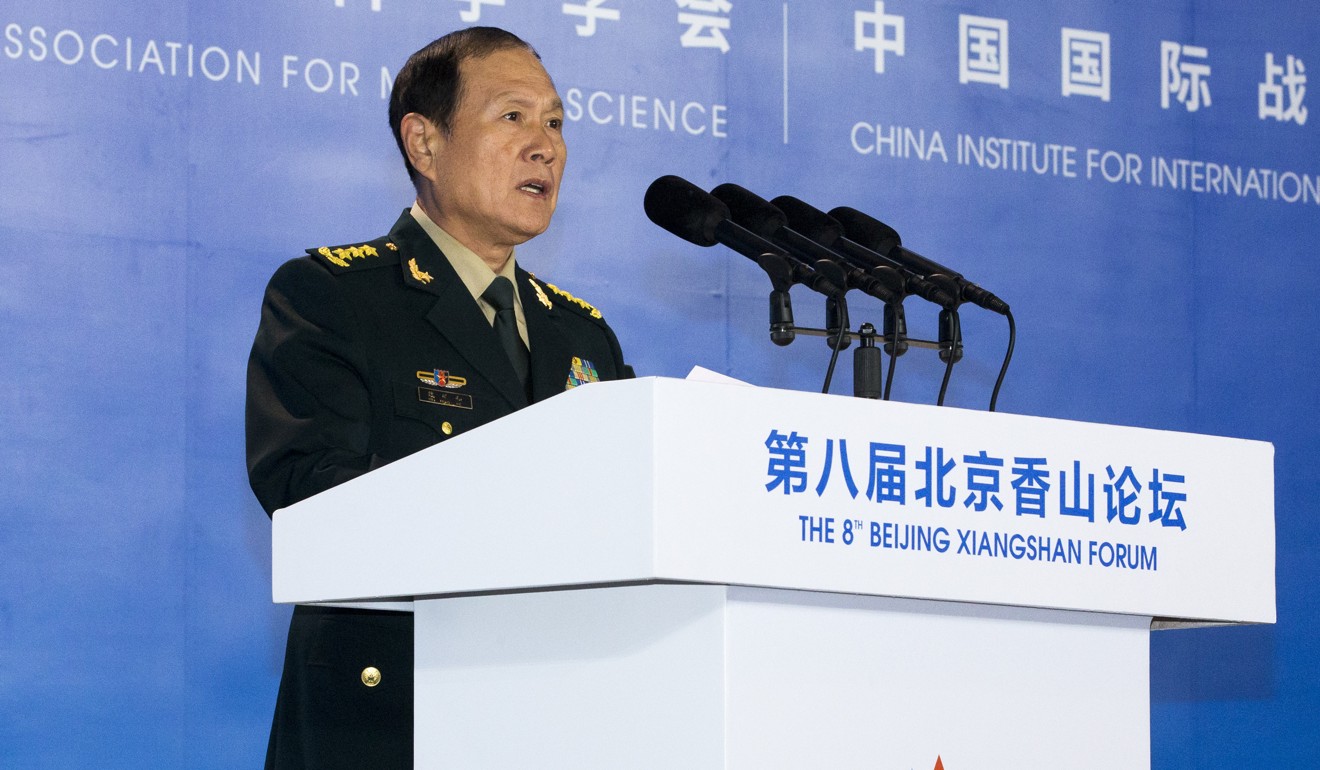
Defence Minister Wei Fenghe criticised the US for damaging ties with China at last year’s Xiangshan Forum. Photo: Xinhua
During his speech at the event last year, Chinese Defence Minister Wei Fenghe criticised the US for damaging ties with China and pushing its containment strategy against the country.

Yao Yunzhu, a retired PLA major general and a delegate at the forum, said this year’s event would give the PLA an opportunity to explain its strategy to foreign militaries, including the US.

“The relationship between the PLA and its American counterpart has been stable over the past year despite tensions between Beijing and Washington over issues such as trade,” Yao said.

“But that military relationship has been stable thanks to the efforts of the two militaries to keep their communication open, as well as improving their crisis management mechanism,” she added.

Another forum delegate, Zhu Feng, dean of the international relations school at Nanjing University, said smaller countries in the region would use the forum to raise their concerns over the impact of tensions between China and the US on the region’s long-term stability.

Source: SCMP

07/02/2019

China Focus: 2022 Olympics preparation warms up winter sports, economy

BEIJING, Feb. 6 (Xinhua) — Although winter vacation has come, 11-year-old Wang Aoyun still goes to school every day, for skating.

As school athletes, Wang and 20-plus teammates practice speed skating on a cornfield-turned ice rink at Taipingzhuang central school in Beijing’s Yanqing District.

In three years, the 2022 Winter Olympics will be held in Beijing and Zhangjiakou, Hebei Province.

While construction of stadiums and infrastructure projects has been accelerated, winter sports and the related economy at the venues have also been heating up.

With its ice rink built in 2016, Taipingzhuang school is the first that had an ice rink in Yanqing District, where competitions of alpine skiing, bobsled, skeleton, and luge will be held in 2022.

Teachers take shifts to water the ice rink every night in winter, said Ding Jianpei, principal of the school.

“Most of our students may not be engaged in winter sports in the future, but we think it’s worth it if they feel the happiness in the sports,” Ding said.

Winter sports used to be a luxury 20 years ago in Beijing. People had to travel hundreds of miles to find a ski slope. The first large ski resort in the Chinese capital, Shijinglong, was not open until the late 1990s, in Yanqing.

Local villager Guo Junhua, 35, was among the first batch of ski lovers. Last year, she quit her job as a ski coach in southwest China and opened a ski training school in Yanqing District. To date, she has trained 50 children.

The district government also encourages local people to learn winter sports.

“Influenced by the atmosphere of the Winter Olympics, more and more residents show up on ice rinks and ski fields,” said Ma Zhiyong, sports bureau deputy chief of Yanqing District, adding that more ice rinks and ski training bases are mushrooming.

This winter, Shijinglong resort received 60,000 visitors, up 10 percent year on year.

Five km away from the 2022 alpine skiing competition venue, local resident Zhang Haichao has rented and decorated 10 households, with more being constructed.

Zhang, general manager of a homestay brand company, is confident about the prospective of homestay market near his hometown.

“My friends and I love skiing, but bringing heavy snowboards to hotels is very inconvenient,” Zhang said. “Now that the Winter Olympics are coming, more visitors will come to ski, a golden opportunity for homestay business.”

He is also consulting some ski gear companies, planning to offer ski gear renting service at his homestay houses.

The district has attracted over 120 homestay brands, with the reservation rate of some brands reaching 90 percent for the Lunar New Year, said Zheng Aijuan, deputy director of Yanqing’s tourism commission.

Song Haitian, deputy director of Winter Olympics preparation office of Yanqing District, said the 2022 Winter Olympics would have a profound impact on Yanqing’s development.

“We hope the global sports event not only stimulates the sustainable development of Yanqing, especially the winter economy, but also helps upgrade the quality of both people’s health and civil society,” Song said.

Source: Xinhua

Law of Unintended Consequences

continuously updated blog about China & India

ChiaHou's Book Reviews

continuously updated blog about China & India

What's wrong with the world; and its economy

continuously updated blog about China & India