Archive for ‘Pakistan’

15/02/2019

Pulwama attack: India will ‘completely isolate’ Pakistan

India has said it will ensure the “complete isolation” of Pakistan after a suicide bomber killed 46 soldiers in Indian-administered Kashmir.

Federal Minister Arun Jaitley said India would take “all possible diplomatic steps” to cut Pakistan off from the international community.

India accuses Pakistan of failing to act against the militant group which said it carried out the attack.

This is the deadliest attack to hit the disputed region in decades.

Both India and Pakistan claim all of Muslim-majority Kashmir but only control parts of it.

An insurgency has been ongoing in Indian-administered Kashmir since the late 1980s and there has been an uptick in violence in recent years.

How will India ‘punish’ Pakistan?

India says that Jaish-e-Mohammad, the group behind the attack, has long had sanctuary in Pakistan and accuses its neighbour of failing to crack down on it.

It has called for global sanctions against the group and has said it wants its leader, Masood Azhar, to be listed as a terrorist by the UN security council.

Although India has tried to do this several times in the past, its attempts were repeatedly blocked by China, an ally of Pakistan.

Mr Jaitley set out India’s determination to hold Pakistan to account when speaking to reporters after attending a security meeting early on Friday.

He also confirmed that India would revoke Most Favoured Nation status from Pakistan, a special trading privilege granted in 1996.

Pakistan said it was gravely concerned by the bombing but rejected allegations that it was in any way responsible.

But after Prime Minister Narendra Modi said in a speech that those behind the attack would pay a “heavy price”, many analysts expect more action from Delhi.

After a 2016 attack on an Indian army base that killed 19 soldiers, Delhi said it carried out a campaign of “surgical strikes” in Pakistan-administered Kashmir, across the de facto border. But a BBC investigation found little evidence militants had been hit.

However analysts say that even if the Indian government wants to go further this time, at the moment its options appear limited due to heavy snow across the region.
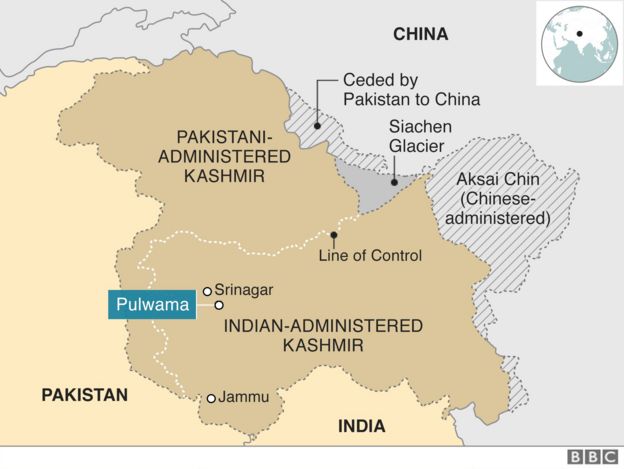
map

How did the attack unfold?

The bomber used a vehicle packed with explosives to ram into a convoy of 78 buses carrying Indian security forces on the heavily guarded Srinagar-Jammu highway about 20km (12 miles) from the capital, Srinagar.

“A car overtook the convoy and rammed into a bus,” a senior police official told BBC Urdu.

It stands as the deadliest militant attack on Indian forces in Kashmir since the insurgency began in 1989.

The bomber is reported to be Adil Dar, a high school dropout who left home in March 2018. He is believed to be between the ages of 19 and 21.

Soon after the attack Jaish-e-Mohammad released a video, which was then aired on the India Today TV channel. In it, a young man identified as Adil Dar spoke about what he described as atrocities against Kashmiri Muslims. He said he joined the banned group in 2018 and was eventually “assigned” the task of carrying out the attack in Pulwama.

He also said that by the time the video was released he would be in jannat (heaven).

Dar is one of many young Kashmiri men who have been radicalised in recent years. On Thursday, main opposition leader Rahul Gandhi said that the number of Kashmiri men joining militancy had risen from 88 in 2016 to 191 in 2018.

India has been accused of using brutal tactics to put down protests in Kashmir – with thousands of people sustaining eye injuries from pellet guns used by security forces.

What’s the reaction?

“We will give a befitting reply, our neighbour will not be allowed to de-stabilise us,” said Prime Minister Modi.

Mr Gandhi and two former Indian chief ministers of Jammu and Kashmir all condemned the attack and expressed their condolences.

The attack has also been widely condemned around the world, including by the US and the UN Secretary General.

The White House called on Pakistan to “end immediately the support and safe haven provided to all terrorist groups operating on its soil”.

Pakistan said it strongly rejected any attempts “to link the attack to Pakistan without investigations”.

What’s the background?

There have been at least 10 suicide attacks since 1989 but this is only the second suicide attack to use a car.

Prior to Thursday’s bombing, the deadliest attack on Indian security forces in Kashmir this century came in 2002, when militants killed at least 31 people at an army base in Kaluchak near Jammu, most of them civilians and relatives of soldiers.

At least 19 Indian soldiers were killed when militants stormed a base in Uri in 2016. Delhi blamed that attack on the Pakistani state, which denied any involvement.
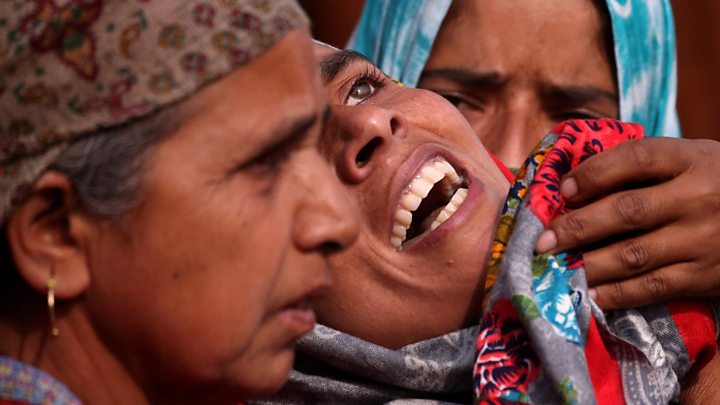
The latest attack also follows a spike in violence in Kashmir that came about after Indian forces killed a popular militant, 22-year-old Burhan Wani, in 2016.

More than 500 people were killed in 2018 – including civilians, security forces and militants – the highest such toll in a decade.

India and Pakistan have fought three wars and a limited conflict since independence from Britain in 1947 – all but one were over Kashmir.

Who are Jaish-e-Mohammad?

Started by cleric Masood Azhar in 2000, the group has been blamed for attacks on Indian soil in the past, including one in 2001 on the parliament in Delhi which took India and Pakistan to the brink of war.

Most recently, the group was blamed for attacking an Indian air force base in 2016 near the border in Punjab state. Seven Indian security personnel and six militants were killed.

It has been designated a “terrorist” organisation by India, the UK, US and UN and has been banned in Pakistan since 2002.

However Masood Azhar remains at large and is reportedly based in the Bahawalpur area in Pakistan’s Punjab province.

India has demanded his extradition from Pakistan but Islamabad has refused, citing a lack of proof.

Source: The BBC

15/02/2019

Kashmir attack: Pak envoy summoned, ‘verifiable’ action against JeM sought

Foreign Secretary Vijay Gokhale told the high commissioner that Pakistan must take “immediate and verifiable action” against the Jaish-e-Mohammed terror group that has claimed responsibility for Thursday’s attack in Kashmir.

INDIA Updated: Feb 15, 2019 15:12 IST

HT Correspondent
HT Correspondent
Hindustan Times, New Delhi
PM Modi Jhansi,Modi Pulwama attack,Pulwama attack
Prime Minister Narendra Modi(PTI file photo)

India on Friday summoned Pakistan envoy Sohail Mahmood to lodge a strong protest over the suicide bombing in south Kashmir’s Pulwama by Pakistan-based terror group Jaish-e-Mohammad (JeM).

Foreign Secretary Vijay Gokhale told the high commissioner that Pakistan must take “immediate and verifiable action” against the Jaish-e-Mohammed terror group that has claimed responsibility for Thursday’s attack in Kashmir.

A Jaish suicide bomber on Thursday rammed a car packed with explosives into a CRPF convoy on the Jammu-Srinagar highway. The CRPF has confirmed 38 deaths in the suicide bombing, counted among the bloodiest in Kashmir. Initial reports, quoting security officials, had said 44 jawans were feared to have been killed in the attack.

The foreign secretary also told Pakistan that it must “immediately stop” groups or individuals linked to terrorism operating from its territories.

In the hours after Thursday’s attack, New Delhi had issued a strong statement that accused Pakistan of giving “full freedom” to the terror group to operate and expand its terror infrastructure to carry out attacks in India and elsewhere with impunity.

Islamabad responded with a two-line statement that said it had “always condemned heightened acts of violence” in Kashmir. Pakistan also said it will “strongly reject any insinuation by elements in the Indian government and media circles that seek to link the attack to the State of Pakistan without investigations”.

Foreign Secretary Gokhale rejected this statement by the Pakistan foreign office.

Source: Hindustan Times

14/02/2019

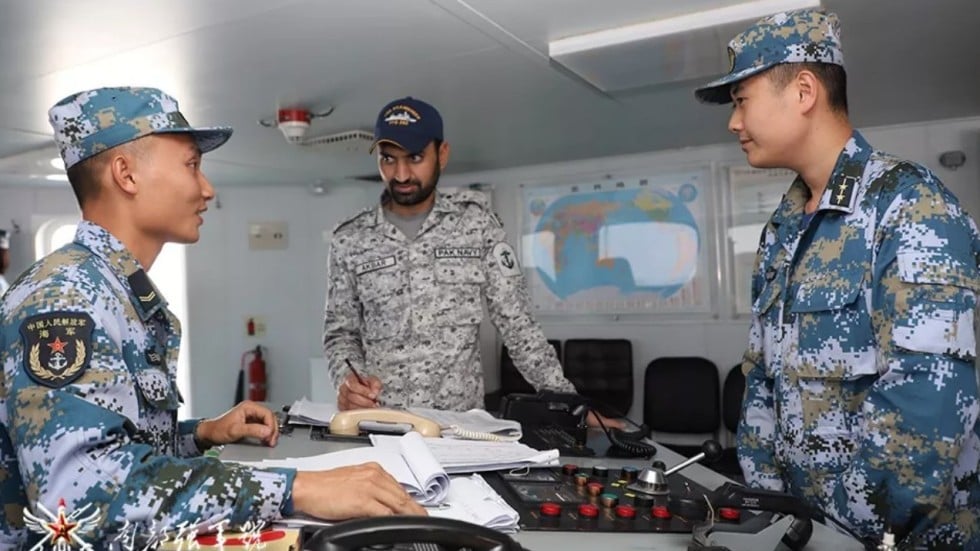
Pakistan and China build friendship ties at Aman – 19 multinational naval exercise but no room for India on the guest list

  • Chinese naval commander says war games strengthened mutual understanding and trust
  • Drills included protection of strategic projects such as China-Pakistan economic corridor
PUBLISHED : Thursday, 14 February, 2019, 8:02pm
UPDATED : Thursday, 14 February, 2019, 8:02pm

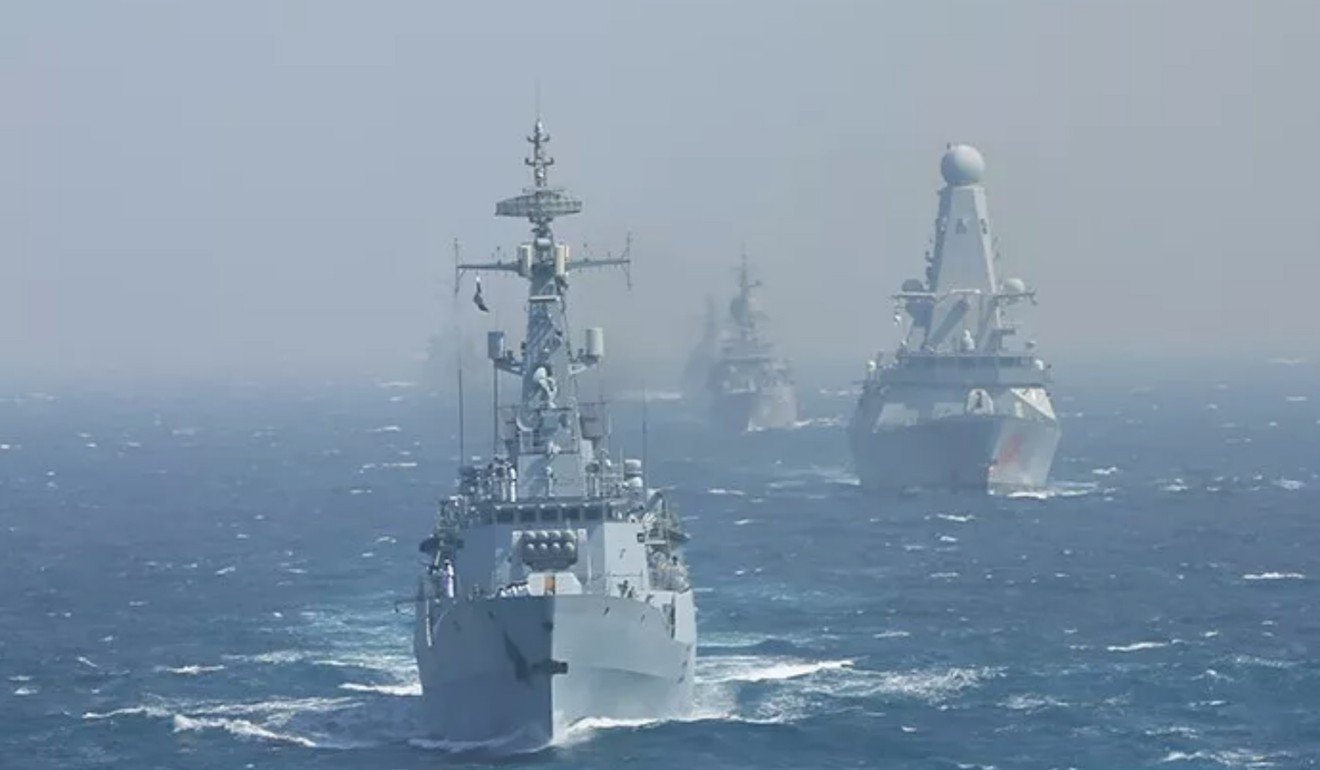
Pakistan’s multinational naval drill involving 46 nations has wrapped up in the Indian Ocean and, once again, India was not invited.

The Pakistan Navy has hosted the Aman – which means “peace” – exercises every two years since 2007 to promote regional cooperation and stability. India has never been invited, in a sign of the long history of strained ties between the neighbours.

China, Japan and the United States were among the countries taking part in Aman-19, from February 8 to 12, which included maritime conferences, seminars and cross-ship visits, as well as 23 sea operations with main-gun firing, formation movement and replenishment-at-sea.

Shao Shuguang, commander of the People’s Liberation Army Navy’s 998 Fleet, was quoted on a Chinese military social media account as saying the exercise had strengthened mutual understanding and trust between the participating navies.

China sent one of its biggest warships, the Kunlun Shan amphibious landing vessel, to the exercise, signalling its close relationship with Pakistan and the key role both nations hold in the Indian Ocean, according to analysts.

“The Pakistan-China relationship is very strong, and this is one more illustration of the strength of the Pakistan-China relationship,” said Madhav Das Nalapat, honorary director of the department of geopolitics and international relations at Manipal University in India.

“China is also now becoming an important maritime power, especially in the Indo-Pacific. By aligning with China, Pakistan hopes to get the synergy of that.

“India by itself cannot have any primacy in the Indian Ocean. But along with the United States, the two countries together can have primacy in the Indian Ocean. India is positioning itself to be allied with the US, but has not yet reached there.”

Tridivesh Singh Maini, assistant professor with the Jindal School of International Affairs in India, said the exercises should be a cause for alarm for India. “They will keep an eye on what’s going on, but they don’t need to be too concerned,” he said.

The military exercise also centred on maritime security to protect strategic economic projects such as the China-Pakistan Economic Corridor, as well as sea lanes from the Persian Gulf.

The US$62 billion China-Pakistan Economic Corridor (CPEC) is designed to connect China’s far west region of Xinjiang with Gwadar Port in Pakistan via a network of motorways, railways, oil pipelines and trading hubs.

The project is expected to be finished by 2030, and will provide China with an important trading route to the Middle East and Africa.

“India has very strenuously objected to the name CPEC being given to the part that goes through Pakistan-occupied Kashmir, but so far nothing has been done,” Nalapat said.

Kashmir has long been a hotbed for competing territorial claims between India and Pakistan. The two countries have fought three wars against each other since their independence from Britain in 1947, and two of those conflicts have centred on the Kashmir territorial dispute.

Source: SCMP

17/01/2019

‘One step ahead of Pak, giving them befitting reply’: Northern Army chief

Lt General Ranbir Singh said 2018 was a great year for the security forces as more than 250 terrorists had been killed, 54 were caught alive and another 4 had surrendered to them.

INDIA Updated: Jan 17, 2019 16:58 IST

Ravi Krishnan Khajuria
Hindustan Times, Jammu
lt general ranbir singh,pakistan ceasefire violation,kalai bridge
Northern Army Commander Lt Gen Ranbir Singh said that the Indian Army has been giving a befitting response to the Pakistani ceasefire violations.(HT Photo)

The Northern Army commander Lt Gen Ranbir Singh on Thursday said the Indian Army was one step ahead of Pakistan and was giving a befitting reply to every single ceasefire violation by the neighbouring country.

Talking to media after inaugurating a bridge at Kalai in Poonch district, General Singh said, “We are one step ahead of Pakistan and are giving befitting reply to them.”

“2018 has been a great year for the security forces, more than 250 terrorists were killed, 54 were caught alive, and 4 surrendered to the forces,” he said.

When asked about the increased ceasefire violation by Pakistani forces since January 1 this year and the elimination of five Pakistani soldiers by Indian forces in retaliation in the last few days, Gen Singh said the answer lies in the query itself.

On Thursday, Pakistani army again resorted to heavy firing in Jhangar, Laam, Pukherni and Peer Bhadreshwar areas of Rajouri district, prompting the Indian Army to retaliate in equal measure.

On Tuesday, Pakistan killed BSF’s assistant commandant in sniper firing on the international border in Hiranagar sector of Kathua district on Tuesday.

Notably, PM Narendra Modi is scheduled to visit the border district of Samba on February 3 to kick-start the BJP’s election campaign in the state.

Despite repeated calls for restraint and adherence to the 2003 ceasefire agreement to maintain peace and tranquility, Pakistani troops have been indulging in ceasefire violations including BAT attacks, sniper attacks and planting IEDs inside Indian territory to kill Indian personnel.

Meanwhile, General Ranbir Singh dedicated the Kalai Bridge to the country on Thursday. The bridge spans over the Suran River and connects Kalai area to Chandak area in Poonch district.

During the inauguration function, the Army Commander addressed the gathering of Army, GREF and local residents and said the Kalai bridge is an important milestone towards enhancing the road communication and for socio-economic development of the area.

The bridge is an important strategic asset as it will enhance the movement of military equipment and troops in a faster timeframe. The Indian Army and BRO has been working towards infrastructure development in the remote and far-flung areas of the state and have been improving road connectivity.

The bridge will reduce traffic congestion in the city and reduce the inconvenience caused to the people specially while moving towards Budha Amarnath Shrine in Mandi as it reduces the travelling time considerably.

Also watch:

First Published: Jan 17, 2019 15:17 IST

Source: Hindustan Times

31/12/2018

Army foils New Year’s eve attack by Pakistan’s Border Action Team along LoC, kills 2 intruders

Naugam sector in Kashmir’s Kupwara district is manned by soldiers of the 19th Infantry Division of the Indian Army. There have been frequent ceasefire violations going in the Naugam, Tanghdar and Keran sectors in the past several months.

INDIA Updated: Dec 31, 2018 12:21 IST

HT Correspondent
HT Correspondent
Hindustan Times, Srinagar
Indian Army,Pakistan infiltration bid,BAT
The Indian Army has claimed to have thwarted a “treacherous attempt” by Pakistan’s Border Action Team (BAT) to launch a strike on its post along the Line of Control in Jammu and Kashmir’s Naugam sector and killed two intruders in the area.(HT Photo/Reprsentative image)

The Indian Army has claimed to have thwarted a “treacherous attempt” by Pakistan’s Border Action Team (BAT) to launch a strike on its post along the Line of Control in Jammu and Kashmir’s Naugam sector and killed two intruders in the area.

A spokesperson of the army said the recovery of arms and ammunition early on Sunday indicated that they intended to carry out a “gruesome attack” in the region.

“The alertness and resilience of the own troops, who engaged and neutralised the intruders, thus eliminated a likely treacherous attack on the army forward posts along the Line of Control on the eve of New Year,” he said.

The officials said the intruders were wearing combat uniform like regular Pakistani soldiers and carrying stores with markings of the neighbouring country. He said they took advantage of the thick forests close to the LoC.

“Some intruders were also seen in BSF (Border Security Force) and old pattern IA dresses as part of a deception. They had intruded well equipped with IEDs, incendiary materials, explosives, and a plethora of arms and ammunition,” the spokesperson said.

“They were assisted by heavy covering fire of high calibre weapons such as mortars and rocket launchers from the Pakistani posts. The movement was nonetheless detected by the vigilant Indian Army troops deployed along the LoC,” he said.

He said the firefight initiated by Pakistan was retaliated strongly by the Indian Army.

“The exchange of fire continued the whole night. Our troops conducted prolonged search operations in thick jungles and difficult terrain conditions to ascertain the situation, which confirmed the elimination of two likely Pakistani soldiers and resulted in the recovery of a large cache of warlike stores.”

The army said the search operations are still underway in the sector to sanitise the area.

“Few other intruders managed to escape across the LoC, taking advantage of the Pakistani firing and adverse weather and visibility conditions,” it said.

“The Indian Army’s resolve to keep a strict vigil along the LoC and defeat all such nefarious designs of Pakistan will continue to remain firm and consistent.”

The spokesperson said the Indian Army will ask Pakistan to take back the bodies of the likely Pakistani soldiers.

Naugam sector in Kashmir’s Kupwara district is manned by soldiers of the 19th Infantry Division of the Indian Army. There have been frequent ceasefire violations going in the Naugam, Tanghdar and Keran sectors in the past several months.

19/12/2018

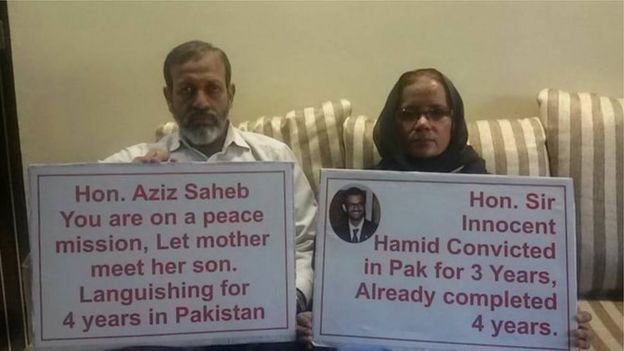
Hamid Ansari: ‘Love-struck’ Indian home after Pakistan jail ordeal

Hamid Ansari reunited with his family
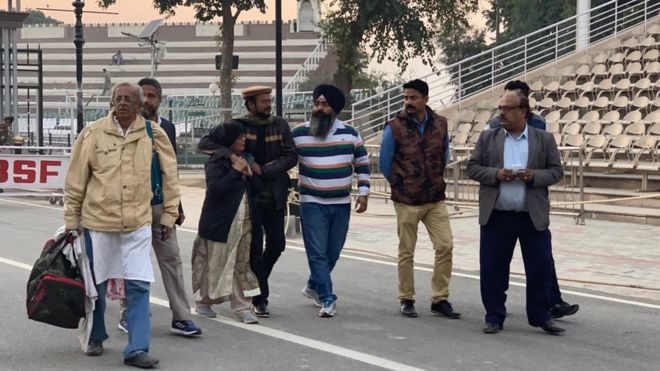
Image captionHamid Ansari reunited with his family at the border on Tuesday

An Indian man held for six years in Pakistan after illegally entering the country has returned to his family.

Hamid Ansari was convicted on charges of spying after he was found with a fake Pakistani identity card.

But his supporters said he had entered the country to pursue “blind and stupid” love with a woman he met online.

It is not clear, however, if he ever met the woman he crossed the border for.

Ansari was greeted at India’s Wagah border by his family, government officials and journalists.

His return ends a years-long ordeal for his family who fought to first track him down, and then secure his release.

Though officially convicted in 2015, Ansari had been in Pakistani custody since 2012.

His jail term officially ended on Sunday, but his release was delayed because legal formalities had not been completed.

India and Pakistan have fought three wars since independence and the partition of India in 1947 and regularly jail each others citizens.

Who is Hamid Ansari?

Hamid Ansari is the youngest son of Fauzia Ansari, the vice-principal of a Mumbai college, and banker Nihal Ansari.

In November 2012, the 33-year-old had just started a new job as a lecturer at an educational institute when he told his parents that he was going to Afghanistan for an interview with an airline company.

But a few days after he landed in the Afghan capital Kabul, Ansari went missing.

हामिद अंसारी के माता पिताImage copyrightFAUZIA ANSARI

His family says that he stopped communicating with them, and his phone number was switched off.

Activist Jatin Desai, who has been at the forefront of efforts to get Ansari released, told BBC Hindi that that the family had then checked his laptop, where they discovered that he had been communicating with several people from Pakistan via email and social media.

They had also realised that he was in the Khyber Pakhtunkhwa province of the country.

So why did he go?

“Blind and stupid love,” according to Mr Desai.

In comments to India’s Mumbai Mirror newspaper, Mr Desai said that he first met Ansari when he had approached him about six months before his disappearance, asking for help with getting a Pakistani visa. He claimed he wanted to marry a woman in Khyber Pakhtunkhwa who he had met online.

“I had a big laugh when he told me that he wanted to marry a woman in a place notorious for honour killings. I told him to stop being stupid and concentrate on his career,” the newspaper quoted him as saying.

But the determined Ansari reportedly reached out to people in Pakistan, who apparently told him he could enter the country through Afghanistan more easily.

He entered through Torkham in Afghanistan after obtaining a fake Pakistani identity card under the name Hamza.

Then, according to documents released later, he was arrested from a hotel in Kohat city, where the girl he had come to find reportedly lived.

How did his release come about?

After his family was unable to trace his whereabouts in Pakistan, they reached out to government officials and activists for help.

Among them was Mr Desai, who has been working for many years to secure the release of both Indian and Pakistani prisoners jailed in each others countries.

A Pakistani journalist – who was later detained for a long period – managed to get in touch with Hamid’s mother in Mumbai and filed a missing person’s petition in court on her behalf.

She played an important role in encouraging a government commission on enforced disappearances to investigate his case.

As a result, security agencies, in early 2016, eventually admitted that Ansari was in their custody and had been jailed.

Hamid Ansari
Image captionAnsari pictured before he went to Pakistan

The Indian Express newspaper quoted official sources as saying that the Pakistan government did not allow any Indian officials to meet Ansari for the entire six years,

His release now is being seen as a “humanitarian gesture” by the new Pakistan government, led by Imran Khan.


The reaction from Pakistan

Ilyas Khan, BBC News, Islamabad

The morning headlines on Pakistani television channels were unanimous: “Indian spy released after completing prison term,” they said. But the reality may not be as stark.

Hamid Ansari was missing for well over three years before it was disclosed that he’d actually been picked up by an intelligence agency and sentenced to three years by a military court for espionage.

Since the military court records remain secret, it is not clear what the actual evidence was. But investigations conducted by the human rights cell of the Supreme Court and hearings held at Peshawar High Court found Mr Ansari’s account of events to be reliable in the light of evidence put before it.

At one point, Mr Ansari’s lawyer even pleaded that he should be charged for illegal entry only and that espionage charges be dropped. But the Peshawar court refused this in the end on grounds that it had no jurisdiction to overturn the ruling of a military court.

Pakistan’s foreign ministry spokesman on Monday still described Ansari as an “Indian spy” but the narrative in India is very different.

However given Mr Ansari trespassed into Pakistan at a time when militancy was at its peak, and the fact that he is an Indian national, the military court actually took a rather lenient view of his case, observers here say.

15/12/2018

China, Afghanistan, Pakistan reach broad consensus on cooperation, Afghan peace process, anti-terrorism

KABUL, Dec. 15 (Xinhua) — China, Afghanistan and Pakistan reached broad consensus on trilateral cooperation during the foreign ministers’ dialogue between the three sides, Chinese State Councilor and Foreign Minister Wang Yi said here Saturday.

Wang made the remarks when speaking to the press after attending the 2nd China-Afghanistan-Pakistan Foreign Ministers’ Dialogue in Kabul.

Firstly, the three sides agreed to make use of the foreign ministers’ dialogue and relevant mechanisms to strengthen coordination and communication in planning and promoting trilateral cooperation in various fields, Wang said.

Secondly, amid important opportunities in Afghanistan’s reconciliation process, the three sides are willing to strengthen coordination and push for the Taliban’s early return to the negotiation table and reintegration into mainstream politics, Wang said.

Afghanistan is willing to continue push forward the peace plan and push for the resume of peace talks, while China and Pakistan firmly support the Inclusive Afghan-led and Afghan-owned reconciliation process, he said.

Thirdly, Afghanistan and Pakistan agreed to further improve bilateral ties, implement the Afghanistan-Pakistan Action Plan for Peace and Solidarity, boost positive interactions in political, military, economic and security fields, handle disputes through friendly consultation, and properly manage temporarily intractable differences to avoid undermining the improvement of the bilateral ties, said Wang.

Fourthly, the three sides committed to a tightened trilateral cooperation, promising to explore possibilities for projects regarding people’s livelihood and transportation infrastructures, on the basis of personnel exchanges and training, Wang said.

Fifthly, the three sides agreed to promote the construction of the China-proposed Belt and Road Initiatives in a bid to boost regional connectivity and economic development, said the Chinese top diplomat.

China and Pakistan supported Afghanistan to make itself a regional pivot by giving a full play of its geographical advantages and to benefit from regional cooperative projects including the China-Pakistan Economic Corridor, he noted.

Sixthly, the three sides also vowed to implement the newly signed Memorandum of Understanding (MoU) on Counter-Terrorism, enhance dialogues on counter-terrorism policies and push forward pragmatic counter-terrorism cooperation, while taking a strong and firm stand against terrorist organizations including the East Turkestan Islamic Movement, said Wang.

China would offer support and help to Afghanistan and Pakistan regarding counter-terrorism causes and cooperation, he added.

12/12/2018

Why India is furious about a set of stamps

The foreign ministers of India and Pakistan were supposed to meet this week on the sidelines of the UN General Assembly in New York.

The meeting was agreed more than a week ago, raising hopes of movement towards a more cordial relationship between the two nuclear-armed foes, and possibly even fresh peace talks.

After all, the neighbours hadn’t met at such a senior level since 2014.

But within 24 hours, the briefly open door was slammed shut when India called off the meeting. Pakistan’s “evil agenda” had been exposed and “the true face” of new Prime Minister Imran Khan had been “revealed to the world”, a spokesman said.

Why? Well, part of the reason was a set of stamps.

What do the stamps show?

The stamps carry 20 different images of what Pakistan calls “atrocities in Indian-occupied Kashmir”.

They include images of victims of alleged chemical weapons, pellet guns, “fake police encounters” and “braid chopping”, scenes of general abuse and pictures of Kashmiri protests.

One stamp carries a picture of Burhan Wani, a popular Kashmiri militant leader killed in 2016, and describes him as a “freedom icon”.

Wani, who was linked to the Hizbul Mujahideen militant group, was killed in a gunfight with Indian forces in 2016.

His death sparked widespread protests in the region that still continue.

Another stamp shows a Kashmiri protester, Farooq Ahmed Dar, tied to the front bumper of a military jeep purportedly as a “human shield” against stone-throwing and gun-firing protesters.

A line in Urdu text running down the left side of the stamps reads: “Kashmir will become Pakistan.”

This contrasts with a 1960 commemorative stamp which showed a Pakistani map, with Kashmir shown in a different colour and a more neutral text line saying: “Jammu & Kashmir; Final Status Not Yet Determined.”

India and Pakistan have fought two wars over the Himalayan Muslim-majority territory, which both claim in full but control in part. India accuses Pakistan of harbouring and supporting cross-border militants who are active in Indian-administered Kashmir – an allegation Pakistan denies.

What has been the response?

India cited the issue of stamps as one of two reasons why it called off the meeting at the UN.

The other was the killing of an Indian border guard and three Kashmiri policemen by suspected militants.

In a statement, a spokesman for India’s Ministry of External Affairs said: “The latest brutal killings of our security personnel by Pakistan-based entities and the recent release of a series of 20 postage stamps by Pakistan glorifying a terrorist and terrorism confirm that Pakistan will not mend its ways.”

Pakistan’s Foreign Office responded on the same day, saying: “By falsely raising the canard of terrorism, India can neither hide its unspeakable crimes against the Kashmiri people nor can it delegitimise their indigenous struggle for their inalienable right to self determination.”

The meeting was proposed by Pakistan’s newly elected Prime Minister Imran Khan and was agreed to by India.

The “normalisation” process between the two countries, started in 2010, broke down in 2014 due to increased militant attacks in Indian-administered Kashmir.

Who commissioned the stamps?

A top official of Pakistan Post, who spoke on the condition of anonymity, told the BBC that anyone could propose a commemorative postal stamp.

“Once it is cleared by Pakistan Post, it needs to be approved by the communications ministry, and also by the foreign ministry if it has a bearing on Pakistan’s foreign relations. The final approval is given by the prime minister’s office.”

But he was reluctant to identify the source of this particular idea.

Interestingly, though, as Pakistan Post officials admit, the idea was floated and implemented during the caretaker government, which took charge of day-to-day affairs of the state ahead of the election which Mr Khan’s PTI party won.

The stamps were issued on 24 July, a day ahead of the general elections, and some 25 days before the new prime minister was sworn in. Observers speculate that the idea must have come from state institutions with a hawkish stand on relations with India.

The two elected governments since 2008 have both pushed for normalisation of ties with India. Both have come under pressure either directly from the militaryor from political groups suspected of having support from the military intelligence network.

The last government of Prime Minister Nawaz Sharif fell out with the military over its alleged support for militant networks operating in India and Afghanistan, as was revealed by a report in the Dawn newspaper. Sharif was ousted in what was seen by many as an unfair trial, described by some as part of a “creeping coup against democracy”.

The military has also been blamed for “managing” the July elections. It denies all these accusations but critics say its huge business and financial interests hinge on painting India as a mortal enemy.

They say the stamps were issued at a time when the military dominated the political scene.

How have the stamps been selling?

Philatelists in Pakistan say the Kashmir commemoration postage stamps have sold well overseas, with one sheet of 20 stamps selling for nearly $6.

In Islamabad, a Pakistan Post official said they had sold more than 300 sheets in recent days at the official rate of about $1.30 apiece.

Only 20,000 sheets have been issued, most of which have already sold out, after the spat over the stamps hit the headlines.

02/12/2018

Kartarpur corridor: A road to peace between India and Pakistan?

  • 29 November 2018
Gurcharan Singh
Image captionGurcharan Singh welcomes the opportunity to unite Indians and Pakistanis

Seventy-five-year-old Gurcharan Singh was just a child during Partition in 1947, when his family left their home in the city of Sialkot, in modern day Pakistan, to head to India.

Now on a visit to the Sikh temple in the Pakistani village of Kartarpur, he was delighted that the two countries had agreed to construct a corridor allowing visa-free access to pilgrims from India.

“Since Pakistan was created our community has wanted this,” he told the BBC. “Two families,­ Indians and Pakistanis,­ are meeting again.”

The Gurdwara Darbar Sahib Kartarpur is one of the holiest places in Sikhism. It’s believed to have been built on the site where Guru Nanak, the founder of the religion, died in the 16th Century.

Image captionThe Gurdwara Darbar Sahib Kartarpur, close to the Pakistan-Indian border, is one of the holiest sites in Sikhism

The temple is located around 4km (2.5 miles) from the border with India, but tensions between the neighbouring countries have meant Sikh pilgrims have often found it difficult to visit. Some have had to be content with viewing it through binoculars from India.

The “Kartarpur corridor” will however lead from the Indian border straight to the gurdwara, with the sides fenced off.

The move has been welcomed enthusiastically by the Sikh community, and also represents a rare instance of co-operation between the two countries, which have fought three wars against each other since independence.

Image captionThe ceremony was attended by Sikh children

Relations between India and Pakistan remain strained, but at a ceremony formally starting construction work on the pathway on the Pakistani side of the border, the country’s Prime Minister Imran Khan said: “We will only progress when we free ourselves from the chains of the past”.

A number of Indian politicians were amongst those attending.

Pakistani Foreign Minister Shah Mahmood Qureshi told the BBC the Kartarpur project would help improve the countries’ relationship.

“The more people meet, the more they realise how much in common we have, and what we are missing by not resolving our outstanding issues.” he said.

Formal talks between India and Pakistan have stalled since an attack in 2016, which Indian authorities blamed on Pakistani-backed militants. Pakistan denied the claim.

Prime Minister Khan directly addressed the commonly held view that Pakistan’s powerful military and intelligence services don’t want peace with India, whilst civilian governments generally do.

“My political party, the rest of our political parties, our army, all our institutions are all on one page. We want to move forward,” he said.

Image captionPakistani PM Imran Khan spoke of his hope that the two neighbours can one day be friends

However India’s Foreign Minister, Sushma Swaraj, said the initiative did not mean “bilateral dialogue will start”, adding: “Terror and talks cannot go together. The moment Pakistan stops terrorist activities in India, bilateral dialogue can start.”

Pakistan denies supporting militants targeting Indian forces in Kashmir and in return accuses India of supporting separatist movements within Pakistan.

Following his election victory this summer, Mr Khan announced that for every “one step” India takes on improving relations, Pakistan would take “two”. However, a planned meeting between the countries’ foreign ministers on the sidelines of the United Nations General Assembly in September was cancelled by Indian officials, amidst anger over stamps issued by Pakistan commemorating what they termed Indian atrocities in Kashmir.

Analyst Michael Kugelman, from the Wilson Centre, told the BBC the Kartarpur border crossing was a “significant” development but it would be wrong to suggest that the next step was a peace process.

“It’s a confidence building measure but at the end of the day India and Pakistan are still at loggerheads”.

Image captionSikhs will be celebrating a landmark birthday of their founder next year

Many observers have also predicted that substantial progress on dialogue between the neighbours would have to wait at least until after elections are held in India, next April or May.

Mr Kugelman said: “It’s politically risky for the Indian government, particularly for a Hindu nationalist government like the current one, to extend an olive branch to Pakistan during the height of campaign season.”

The Kartarpur corridor is due to become operational next year, in time for celebrations of the 550th anniversary of the birth of Guru Nanak.

Law of Unintended Consequences

continuously updated blog about China & India

ChiaHou's Book Reviews

continuously updated blog about China & India

What's wrong with the world; and its economy

continuously updated blog about China & India