Archive for ‘People’s Liberation Army’

11/02/2020

Equifax: US charges four Chinese military officers over huge hack

The US has charged four Chinese military officers over the huge cyber-attack on credit rating giant Equifax.

More than 147 million Americans were affected in 2017 when hackers stole sensitive personal data including names and addresses.

Some UK and Canadian customers were also affected.

China has denied the allegations and insisted it does not engage in cyber-theft.

Announcing the indictments on Monday, Attorney General William Barr called the hack “one of the largest data breaches in history”.

According to court documents, the four – Wu Zhiyong, Wang Qian, Xu Ke and Liu Lei – are allegedly members of the People’s Liberation Army’s 54th Research Institute, a component of the Chinese military.

They spent weeks in the company’s system, breaking into security networks and stealing personal data, the documents said.

The nine-count indictment also accuses the group of stealing trade secrets including data compilation and database designs.

Chinese foreign ministry spokesman Geng Shuang denied the allegations on Tuesday and said China’s government, military and their personnel “never engage in cyber theft of trade secrets”.

He said China was itself a victim of cyber-crime, surveillance and monitoring by the US, Reuters reported.

The whereabouts of the four suspects is unknown and it is highly unlikely that they will stand trial in the US.

FBI Deputy Director David Bowdich said: “We can’t take them into custody, try them in a court of law, and lock them up – not today, anyway.”

What happened in 2017?

Equifax said hackers accessed the information between mid-May and the end of July 2017 when the company discovered the breach.

The accused allegedly routed traffic through 34 servers in nearly 20 countries to try to hide their true location.
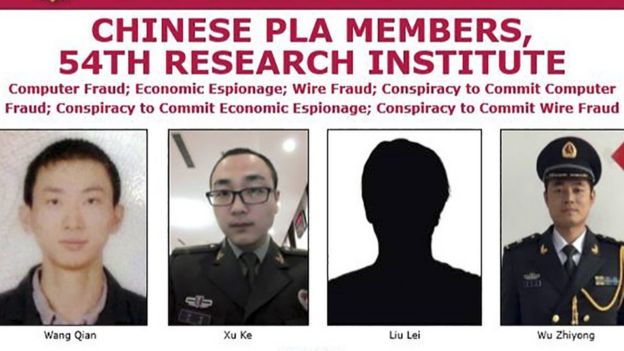
A picture of the wanted poster for the four Chinese menImage copyright FBI
Image caption The FBI released this wanted picture of the suspects

The credit rating firm holds data on more than 820 million consumers as well as information on 91 million businesses.

Mr Bowdich said there was no evidence so far of the data being used to hijack a person’s bank account or credit card.

Equifax CEO Mark Begor said in a statement that the company was grateful for the investigation.

“It is reassuring that our federal law enforcement agencies treat cybercrime – especially state-sponsored crime – with the seriousness it deserves.”

Critics have accused the company of failing to take proper steps to guard information and for waiting too long to inform the public about the hack.

Richard Smith, CEO of Equifax at the time of the hacking, resigned a month after the breach. He apologised for the firm’s failings, ahead of testifying in Congress.

Equifax was forced to pay a $700m (£541m) settlement to the Federal Trade Commission.

The US regulator alleged the Atlanta-based firm failed to take reasonable steps to secure its network. At least $300m of the settlement went towards paying for identity theft services and other related expenses run up by the victims.

In a statement Mr Barr said: “This was a deliberate and sweeping intrusion into the private information of the American people.

“Today we hold PLA hackers accountable for their criminal actions, and we remind the Chinese government that we have the capability to remove the internet’s cloak of anonymity and find the hackers that nation repeatedly deploys against us.”


Analysis box by Gordon Corera, security correspondent

This is not the first time the US has charged members of the Chinese military with hacking US companies.

The first indictment came back in 2014 and helped lead to a deal the following year to try to restrain such activity.

But clearly the US feels that it needs to return to the weapon of public indictments to increase pressure again.

The US has become increasingly concerned not just at the alleged theft of economic secrets but also the intelligence risks.

Equifax was one of a series of large data breaches linked to China – others include health care providers and, most significantly, the theft of data from the Office of Personnel Management which carried sensitive records for almost all US federal employees.

One of the concerns for US security officials is how Chinese spies may be able to put together these vast databases about US citizens.

Officials say the information could be used to create “targeting packages”, establishing which individuals have access to sensitive information and potential vulnerabilities which would allow them to be approached. They add, though, that so far they have not seen the Equifax information being used for that purpose.

Source: The BBC

28/11/2019

Xi stresses cultivating new type of military personnel

CHINA-BEIJING-XI JINPING-MILITARY ACADEMIES AND SCHOOLS-TRAINING SESSION (CN)

Chinese President Xi Jinping, also general secretary of the Communist Party of China (CPC) Central Committee and chairman of the Central Military Commission, addresses the opening of a training session for heads of military academies and schools at the National Defense University of the People’s Liberation Army in Beijing, capital of China, Nov. 27, 2019. (Xinhua/Li Gang)

BEIJING, Nov. 27 (Xinhua) — Chinese President Xi Jinping on Wednesday called for efforts to cultivate a new type of military personnel who are competent, professional and possess both integrity and ability.

Xi, also general secretary of the Communist Party of China (CPC) Central Committee and chairman of the Central Military Commission, made the requirement at the opening of a training session for heads of military academies and schools held in Beijing.

On behalf of the CPC Central Committee and the Central Military Commission, Xi extended greetings to the heads of military academies and schools as well as those working in the military education field.

In the morning, Xi met with all members of the training session and took photos with them at the National Defense University of the People’s Liberation Army, where the opening was held.

The military education policy in the new era, Xi said, upholds the Party’s absolute leadership over the military, serves the goal of building a strong country with a strong military, and aims to train a new type of military personnel who are competent, professional and possess both integrity and ability.

To deepen reform and innovation of military academies and schools, Xi emphasized efforts to strengthen the top-level design and long-term plans, develop better academic disciplines, build a high-caliber teaching staff and improve support systems and institutions.

Xi required the heads of military academies and schools to have high political integrity, possess a good knowledge of education, warfare research and management while subjecting themselves to strict self-discipline.

Xi stressed more efforts to care for and support military academies and schools and prioritize their development.

The opening ceremony was presided over by Xu Qiliang and attended by other senior military officers including Zhang Youxia, Wei Fenghe, Li Zuocheng, Miao Hua and Zhang Shengmin.

Source: Xinhua

11/11/2019

Police shooting exposes deep divide online between mainland China and Hong Kong

  • Mainland social media users come out in strong support for the officer, compounding extensive coverage of vandalism of businesses with ties across the border
Hong Kong’s police force has gained support from online commenters on the mainland. Photo: Nora Tam
As Monday morning’s police shooting of a protester triggered a wave of shock and outrage in Hong Kong, across the border in mainland China, the response online was just as swift – but in support of the force.
“Support Hong Kong police opening fire! Clean up Hong Kong’s cockroaches!” one popular financial blogger on Weibo, China’s Twitter-like platform, said as he shared footage of the incident.
In the video, an officer grapples with a protester and points his gun towards another approaching protester. The second protester reaches out towards the gun, the officer dodges, steps back and shoots him in the torso.

“It feels great [to watch]! Kill them all, these trash and tumours of society,” a Weibo user replied to the video, with a thumbs-up emoji.

“Hongkong’s loser youth, [police] should totally open fire!! It would be best to shoot them in the head,” another post read.
These comments, and many others like them flooding social media in mainland China, highlight the deep divisions in views on each side of the border as Hong Kong’s political crisis drags into its sixth month.

Despite some initial sympathy, mainland public sentiment towards Hong Kong has hardened since July, amid state propaganda painting the protesters as a separatist movement plotted by “Western black hands”.

In recent weeks, the rancour from the mainland has only appeared to deepen, with photos and videos of protesters vandalising businesses with ties to the mainland spreading online.

Last month, a mainland Chinese banker was assaulted in a confrontation with protesters during his lunch break in Central, drawing the wrath of many mainlanders and renewed online calls for military intervention.

Extensive media coverage of the vandalism and attack, as well as a series of inflammatory commentaries, have further fanned the anger.

On Monday, the social media account of state-run Beijing Daily ran the story of the shooting under the headline: “This morning, a gunshot in Hong Kong, to the applause of citizens!”

“At such a critical moment, the police officer acted so bravely and restrained,” the report said.

“After the police fired the shot and subdued the rioters, some citizens at the scene directly applauded the police. The reaction of the public directly shows that the officer fired not only in a legal and reasonable way, but also in line with the will of the people.”

In the video, a man in a dark blue jumper claps his hands at a nearby traffic light, as police officers pin the protesters to the ground.

The Beijing Daily report did not refer to angry bystanders condemning the officers as “murderers”.

Hong Kong police officer who shot protester receives death threats against children after personal details released online, force says

Hu Xijin, editor-in-chief of nationalist tabloid Global Times, and a regular – and hugely popular – commentator on Hong Kong’s unrest, also weighed in.

“As a media worker, I resolutely support this Hong Kong police officer gunning down the attacking rioters,” he wrote to his 2 million fans on Weibo in a post that included video of the shooting.

Hu accused Hong Kong and Western media of “focusing their coverage on the police shooting and diluting the illegal, criminal and evil deeds of the rioters”.

“Such guiding of public opinion is disgusting,” he wrote.

Hu ended his post with a message to Hong Kong police: “Don’t you be afraid of anything, resolutely defend Hong Kong’s law and order, be strong and be tough. You’re not alone on the front lines. Behind you there are not only the [patriotic] Hong Kong public and the nation, but also the country’s paramilitary police and the People’s Liberation Army Hong Kong garrison, who can enter Hong Kong and offer support in accordance with the Basic Law when needed.”

The post was liked more than 26,000 times in six hours.

Scores of Chinese students flee Hong Kong over fears they will be attacked as anti-mainland sentiment sweeps through protesters in city

Meanwhile, Taiwanese President Tsai Ing-wen called on the Hong Kong government to give a detailed response to the Hong Kong people’s calls for democracy and freedom, which she described as “the only path to return to stability and order”.

“Governments should not fire upon unarmed people, this will only exacerbate the problem,” she wrote on her official Facebook account. “Beijing and the Hong Kong government should respond to the Hong Kong people, not with bullets but with the promise of democracy and freedom.”

Taipei’s Mainland Affairs Council, which oversees the island’s policies on Beijing, called on all sides to give up their arms and aggressive actions to make way for peaceful conversation.

Source: SCMP

28/08/2019

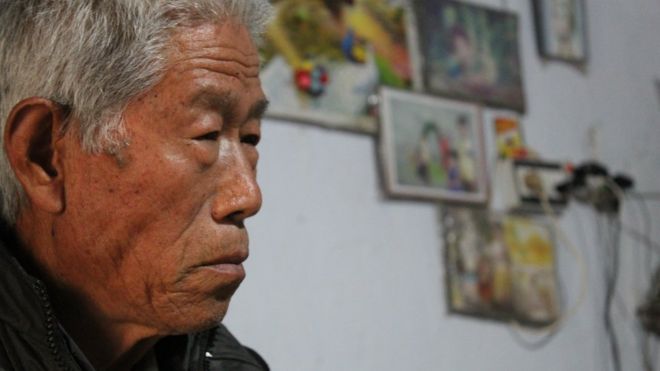
Chinese man prevented from visiting Indian family

Wang Qi
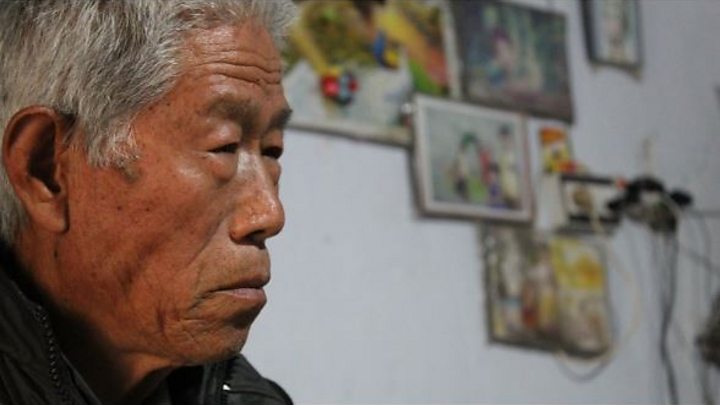
Image caption Wang Qi has been waiting for months to see his family in India

In 1963, a former Chinese army surveyor crossed into India and was captured weeks after a war between the two countries. Wang Qi was then left in a central Indian town for more than five decades before he was allowed to travel back home to China in 2017.

The BBC reported his story at the time and videos of the emotional family reunion in China were watched by millions.

But now, more than 30 months later, his story has taken an unexpected turn – Mr Wang is stuck in China and unable to return to India.

He has been waiting for more than four months for officials to renew his Indian visa so that he can travel back to India where his children and grandchildren live.

“Why are they doing this? I’ve been fighting for such a long time. How much longer can I fight?” Mr Wang told me over the phone from his home city of Xianyang.

The BBC has emailed the Indian embassy in Beijing and is yet to receive a response.

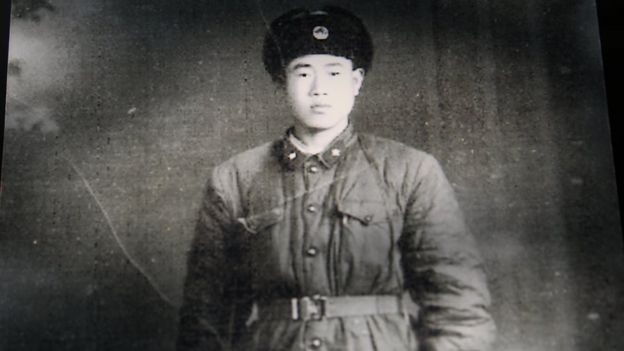
Born to a farmer family in Shaanxi with four brothers and two sisters, he studied surveying and joined China’s People’s Liberation Army in 1960.

Mr Wang says he was “tasked with building roads for the Chinese army” and was captured when he “strayed erroneously” into Indian territory in January 1963.

Wang Qi in Chinese army uniform
Image caption He joined China’s People’s Liberation Army in 1960

“I had gone out of my camp for a stroll but lost my way. I was tired and hungry. I saw a Red Cross vehicle and asked them to help me. They handed me over to the Indian army,” he said.

After he was captured, he spent the next seven years in multiple prisons before he was released by a court order in 1969.

Police took him to Tirodi, a far-flung village in the central state of Madhya Pradesh, where he ended up living for most of his life.

Instead he worked at a flour mill, eventually marrying a local woman and raising a family with her. Neighbours said they lived in “utter poverty”.

It was never clear whether Mr Wang was actually a prisoner of war. But he was denied official Indian documents or citizenship, and he was also denied permission to return to China. Officials told the BBC in 2017 that there were “deficiencies” and a “lack of interest” in the case over the years.

A Chinese passport holder, Mr Wang was reunited with his family in China in 2017. After the BBC reported his story, he received a one-year multiple entry Indian visa.

Media caption Wang Qi did not see his family in China for decades

He kept coming back to India to meet his wife, children and grandchildren who continued to live here.

When Mr Wang first arrived in China, he received a rapturous welcome. Crowds met him with banners reading, “Welcome home, soldier, it’s been a rough journey”.

But according to Mr Wang’s son, Vishnu, his father’s request to local officials to clear his salary for the period of his stay in India, remains unanswered.

Vishnu also adds that it’s unclear if his father still has any claim to ancestral property in China after being away for so many years.

“He was ecstatic to have met his family after decades. He didn’t want anything else.”

In 2017, Mr Wang rushed back to India to take care of his wife, who was hospitalised due to “liver complications”.

“Getting funds for the expensive treatment was very difficult. We tried everywhere, begged for money but didn’t receive any response,” Vishnu says.

She died within a fortnight.

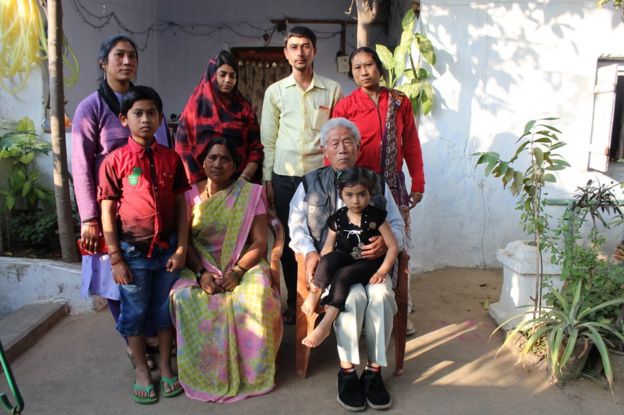
Mr Wang with his family
Image caption Mr Wang married an Indian woman and raised a family with her

“My father’s visa was renewed in 2018. He applied again in April 2019 but he is still waiting,” Vishnu adds.

Xianyang and Beijing, where the Indian embassy is located, are more than 1,000 kilometres (621 miles) apart – and travelling between the two cities isn’t easy for Mr Wang, who is nearly 80 years old, Vishnu says.

“My father is fed up. He doesn’t understand why this is taking so long.”

Source: The BBC

24/02/2019

China’s military build-up just starting – a lot more to come, expert warns

  • Military watchers can expect ‘something new’ at this year’s National Day parade in October, Professor Jin Canrong tells forum in Hong Kong
  • As tensions rise over Taiwan, Beijing is building a naval and missile force as powerful as any in the world, he says

Beijing’s military build-up just starting – a lot more to come, expert warns

24 Feb 2019

Submarine arms race seen heating up in Indo-Pacific amid China ‘threat’

16 Feb 2019

The US could send more nuclear attack submarines, such as the Virginia-class, to the region. Photo: AFP
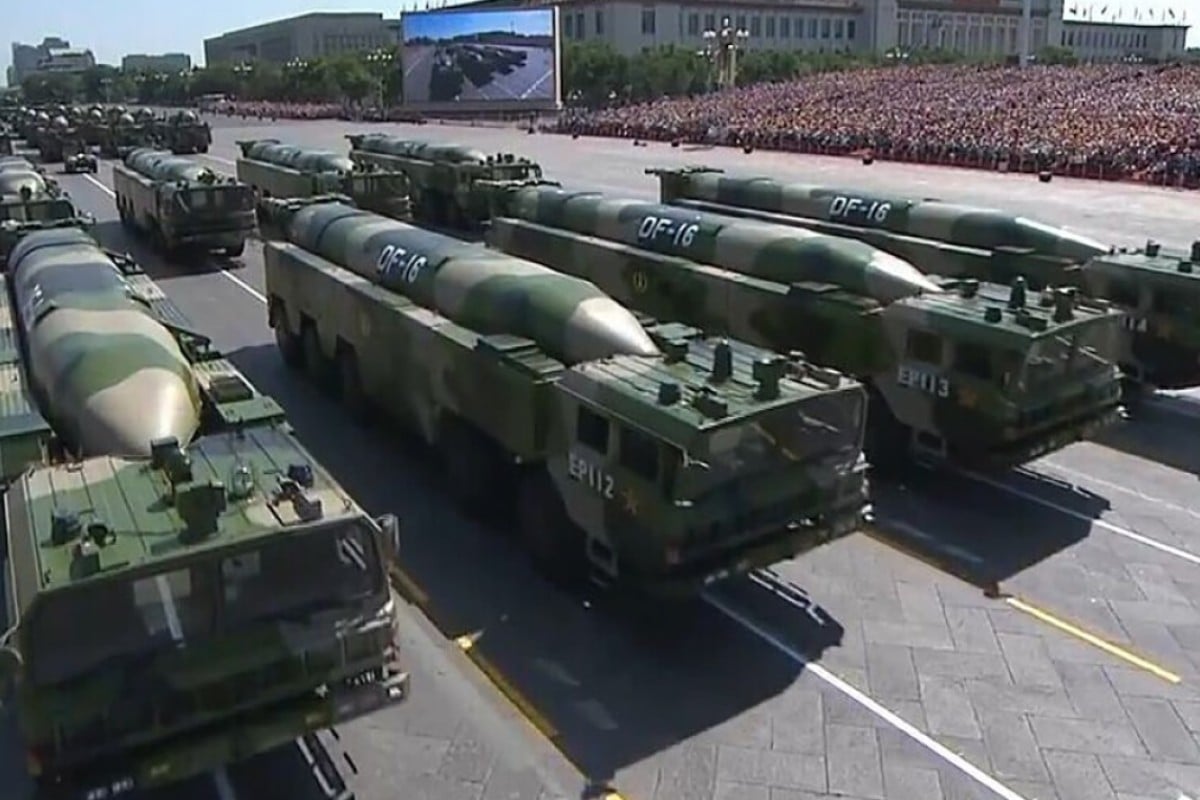
Military vehicles carrying DF-16 ballistic missiles take part in China’s National Day parade. Taiwan says Beijing has such missiles trained on the self-ruled island. Photo: Handout

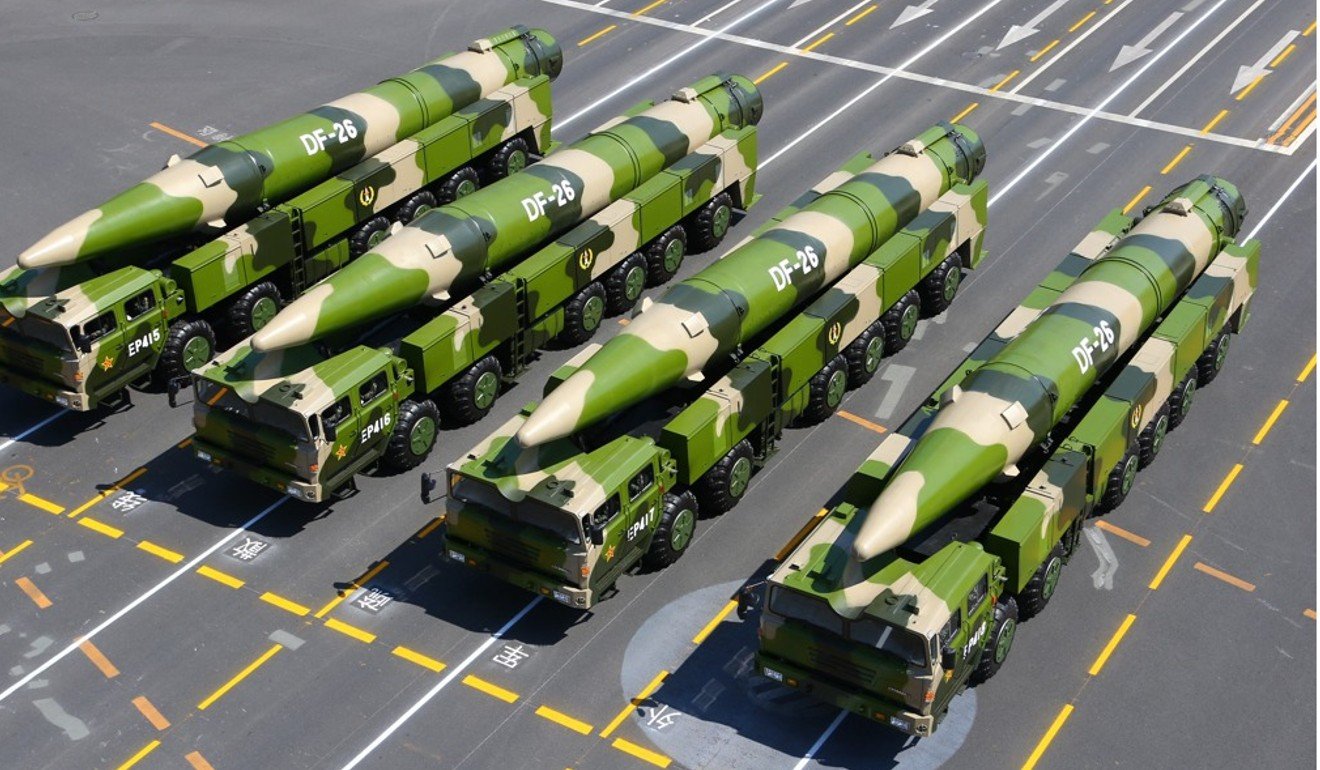
Beijing will show the world “something new” when it rolls out its arsenal of short- to medium-range ballistic missiles at its National Day military parade in October, according to a Chinese expert on international relations.

Speaking at a seminar at the University of Hong Kong on Saturday, Professor Jin Canrong, associate dean of the school of international studies at Renmin University in Beijing, said China had made great strides in expanding its military capability, but there was a lot more to come.

US commander pushes for more funding to counter China’s influence in Indo-Pacific

While he did not elaborate on what the “something new” might be, he said the country was gearing up for a possible conflict over Taiwan, the self-ruled island that Beijing regards as a wayward province awaiting reunification.

Over the next five or 10 years, Taiwan could provide the “biggest uncertainty” for Beijing, he said, especially if the United States decided to “ignite” the situation.

Known for being outspoken on sensitive issues, Jin said that while Beijing wanted a peaceful reunification, it was wary of “pro-independence factions [on the island] and right-wing American [politicians] creating trouble”.

In a speech on January 2 to mark the 40th anniversary of Beijing’s call to end military confrontation across the Taiwan Strait, Chinese President Xi Jinping said that “the political division across the strait … cannot be passed on from generation to generation”, apparently signalling his determination to bring it to an end.

Xi said China would not abandon the use of force in reunifying Taiwan, but stressed the military would target only external elements and those seeking independence for the island.

In 2017, Taipei said that it had detected the deployment of DF-16 ballistic missiles on the mainland that were aimed at Taiwan.

Jin said China was rapidly expanding its missile capabilities. The People’s Liberation Army had already stockpiled about 3,000 short- and medium-range missiles, he said, even though it had been using just 15 per cent of its production capacity.

“Just imagine if we were running at 100 per cent,” he said.

Beijing will show the world “something new” when it rolls out its ballistic missiles at its National Day military parade in October, an expert says. Photo: Xinhua

Under its plan for military modernisation China had achieved “great advancements in space, electronics and cyberwarfare”, the academic said, but its achievements to date were only the beginning.

As well as the expansion of its missile force, Beijing was investing heavily in its navy, he said.

Is China about to abandon its ‘no first use’ nuclear weapons policy?

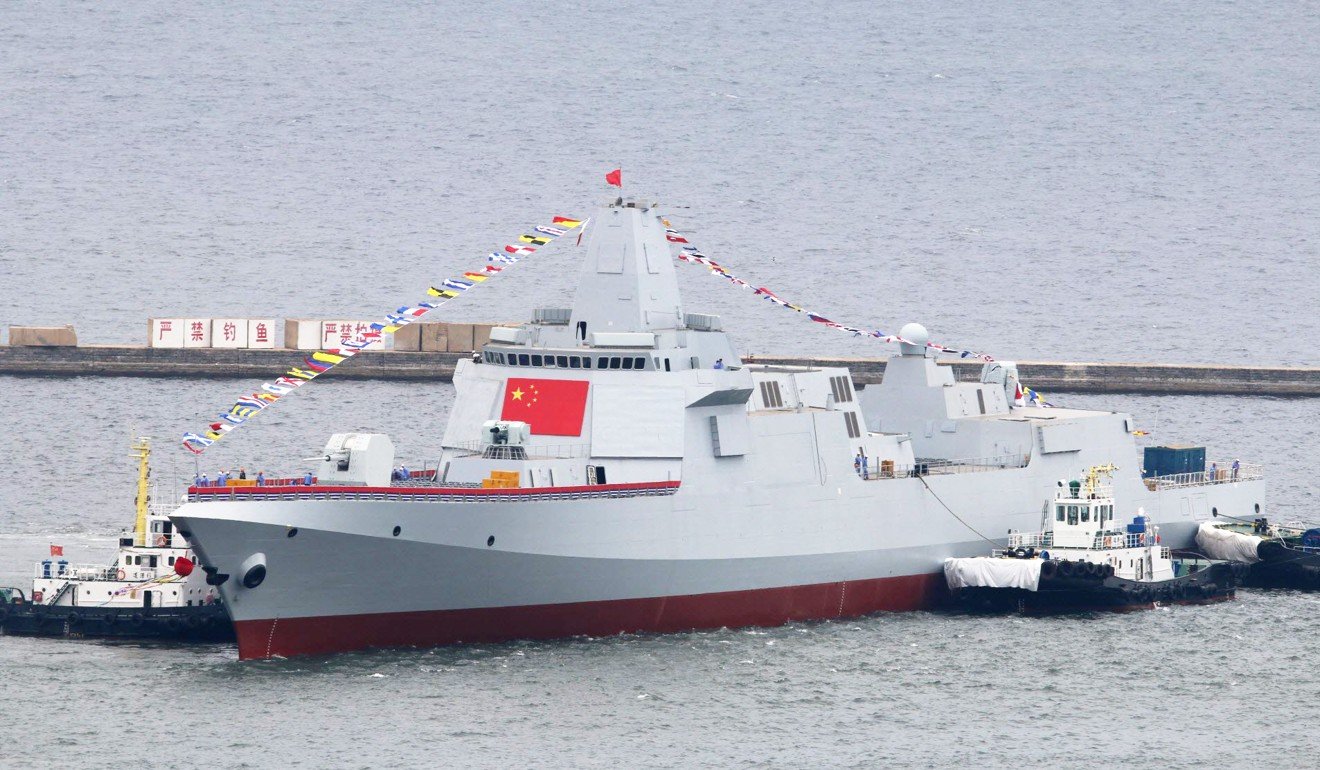
With the deployment of the new Type 055 guided-missile destroyer – which some Chinese military experts have said is as good as anything in the US Navy – the balance of power was shifting, he said.

“For the first time in 500 years, the East has combat equipment that is at least as good as the West’s.”

With the deployment of the new Type 055 guided-missile destroyer, the balance of power between China and the US is shifting, according to Jin Canrong. Photo: Handout

And as the navy continued to modernise and expand, the US might be forced to rethink its position in the region, he said.

“When we have dozens of destroyers and four or five [aircraft] carriers the US will not be able to meddle in Taiwan.”

China’s first aircraft carrier may become test bed for electromagnetic warplane launcher

Jin said that China would also soon have all the scientific, academic and research personnel it needed to achieve its military ambitions.

“China had nearly 30 million university students in 2018, which is twice as many as the US. More than half of them are studying science or engineering,” he said.

“Every year we produce about 4 million science and engineering graduates, while America produces just 440,000.”

Professor Jin Canrong speaks at a forum in Hong Kong. Photo: Handout

Beijing also had the money to support its plans, Jin said. Based on his own calculations, he said China allocated about 1.4 per cent of its gross domestic product to military spending, which was lower than “Germany’s 1.5 per cent”, and less than half the “3 per cent in Britain and France”.

“The tax paid by Chinese smokers is more than enough to cover [the country’s] military expenses,” Jin said.

According to figures from Nato, Britain spent 2.1 of its GDP on defence in 2017, France 1.8 per cent and Germany 1.2 per cent. Both the World Bank and the United Nations put China’s military spending in 2017 at 1.9 per cent of its GDP.

Source: SCMP

14/02/2019

Pakistan and China build friendship ties at Aman – 19 multinational naval exercise but no room for India on the guest list

  • Chinese naval commander says war games strengthened mutual understanding and trust
  • Drills included protection of strategic projects such as China-Pakistan economic corridor
PUBLISHED : Thursday, 14 February, 2019, 8:02pm
UPDATED : Thursday, 14 February, 2019, 8:02pm

Pakistan’s multinational naval drill involving 46 nations has wrapped up in the Indian Ocean and, once again, India was not invited.

The Pakistan Navy has hosted the Aman – which means “peace” – exercises every two years since 2007 to promote regional cooperation and stability. India has never been invited, in a sign of the long history of strained ties between the neighbours.

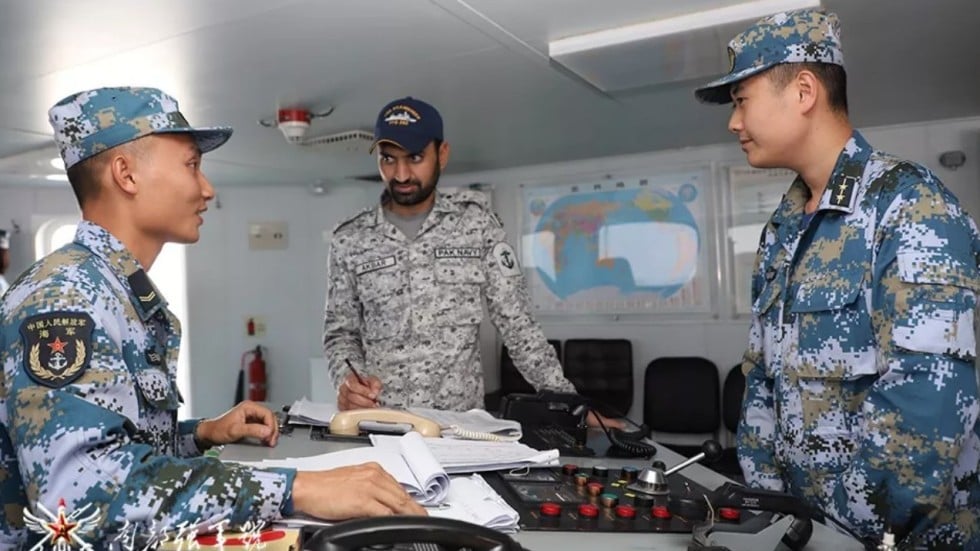
China, Japan and the United States were among the countries taking part in Aman-19, from February 8 to 12, which included maritime conferences, seminars and cross-ship visits, as well as 23 sea operations with main-gun firing, formation movement and replenishment-at-sea.

Shao Shuguang, commander of the People’s Liberation Army Navy’s 998 Fleet, was quoted on a Chinese military social media account as saying the exercise had strengthened mutual understanding and trust between the participating navies.

China sent one of its biggest warships, the Kunlun Shan amphibious landing vessel, to the exercise, signalling its close relationship with Pakistan and the key role both nations hold in the Indian Ocean, according to analysts.

“The Pakistan-China relationship is very strong, and this is one more illustration of the strength of the Pakistan-China relationship,” said Madhav Das Nalapat, honorary director of the department of geopolitics and international relations at Manipal University in India.

“China is also now becoming an important maritime power, especially in the Indo-Pacific. By aligning with China, Pakistan hopes to get the synergy of that.

“India by itself cannot have any primacy in the Indian Ocean. But along with the United States, the two countries together can have primacy in the Indian Ocean. India is positioning itself to be allied with the US, but has not yet reached there.”

Tridivesh Singh Maini, assistant professor with the Jindal School of International Affairs in India, said the exercises should be a cause for alarm for India. “They will keep an eye on what’s going on, but they don’t need to be too concerned,” he said.

The military exercise also centred on maritime security to protect strategic economic projects such as the China-Pakistan Economic Corridor, as well as sea lanes from the Persian Gulf.

The US$62 billion China-Pakistan Economic Corridor (CPEC) is designed to connect China’s far west region of Xinjiang with Gwadar Port in Pakistan via a network of motorways, railways, oil pipelines and trading hubs.

The project is expected to be finished by 2030, and will provide China with an important trading route to the Middle East and Africa.

“India has very strenuously objected to the name CPEC being given to the part that goes through Pakistan-occupied Kashmir, but so far nothing has been done,” Nalapat said.

Kashmir has long been a hotbed for competing territorial claims between India and Pakistan. The two countries have fought three wars against each other since their independence from Britain in 1947, and two of those conflicts have centred on the Kashmir territorial dispute.

Source: SCMP

Law of Unintended Consequences

continuously updated blog about China & India

ChiaHou's Book Reviews

continuously updated blog about China & India

What's wrong with the world; and its economy

continuously updated blog about China & India