Archive for ‘People’s Republic of China’

19/09/2019

China to tap pork reserves as swine fever hits industry


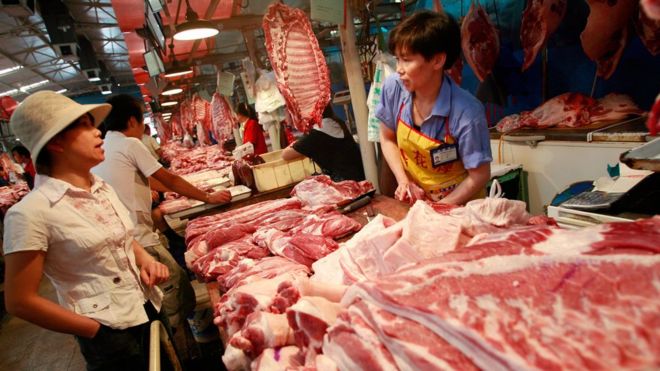
A customer shops for pork at at butcher in ChinaImage copyright GETTY IMAGES

China is set to release pork supplies from its central reserves as it moves to tackle soaring prices and shortages caused by an outbreak of swine fever.

A state-backed body will auction 10,000 tonnes of frozen pork from its strategic reserves on Thursday.

China, the world’s biggest producer and consumer of pork, has struggled to control the spread of the disease.

Beijing has slaughtered more than 1 million pigs in a bid to contain the incurable pig virus.

The highly contagious disease is not dangerous to humans, but has hit China’s crucial pig-farming industry and driven up costs for consumers.

Pork prices jumped 46.7% in August on a year earlier, official figures showed.

In a bid to stabilise prices, a state-backed group that manages the pork reserves will auction imported frozen pork from countries including Denmark, France, the US and UK.

Only 300 tonnes will be sold to each bidder at the auction.

Pork is used widely in Chinese festivals, and the auction comes as the country prepares to celebrate a week-long national holiday for the 70th anniversary of the People’s Republic of China.

Julian Evans-Pritchard, senior China economist at Capital Economics, said the auction would provide slight relief to the industry but would not do much to contain prices.

“In itself, I don’t think it will be able to prevent pork prices from rising further unless they manage to get the disease under control,” he said.

Beijing created its strategic pork reserve in 2007 but the size of the stockpile is not known.

Capital Economics estimates that at most, the stockpile would hold four days’ worth of pork supplies to feed China.

How has swine fever hit China’s pork industry?

Pork is one of China’s main food staples and accounts for more than 60% of the country’s meat consumption. The industry produced close to 54 million tonnes of pork last year.

About 1.2 million pigs have been culled in China in an effort to halt the spread of swine fever since August 2018, according to data from the Food and Agriculture Organization, a UN agency.

In April, Rabobank estimated Chinese pork production would fall by up to 35% this year due to swine fever.

The supply shortage has sent pork prices soaring and has eaten into household incomes.

That poses a fresh challenge for the Chinese economy, which is already facing a slowdown and a trade war between Beijing and Washington.

Source: The BBC

12/09/2019

China welcomes more Japanese investments: Premier Li

BEIJING, Sept. 11 (Xinhua) — Premier Li Keqiang on Wednesday expressed his expectation for the Japanese economic community to seize the opportunities of China’s opening up, increase investment in China and expand bilateral cooperation areas to promote more achievements in trade and the economy.

Li made the remarks in a meeting with a delegation from Japan’s business community, led by president of the Japan-China Association on Economy and Trade Shoji Muneoka, chair of the Japan Chamber of Commerce and Industry Akio Mimura, and Nobuyuki Koga, chairman of the Board of Councilors of the Japan Business Federation.

China-Japan relations have returned to the right track since last year thanks to the joint efforts of the two sides, and the trade and economic cooperation between the two countries has been steadily advanced and the prospects for bilateral cooperation are broad, said Li.

When China-Japan relations encountered difficulties, the Japanese economic community made important efforts and contributions to maintain their healthy and steady development as well as accelerate pragmatic cooperation between the two countries, the Chinese premier said.

According to Li, China and Japan are two of the world’s major economies, and should give full play to their complementary advantages and work together to deepen cooperation, which will not only benefit the two countries, but also conducive to regional and global economy, as well as the prosperity and stability of the world.

Noting that economic globalization is irreversible, and economic and trade exchanges should not be blocked by national borders, Li pointed out that promoting the healthy development of globalization is the way of progress.

“China has always firmly upheld the multilateral trading system with the World Trade Organization at its core and promotes the liberalization and facilitation of trade and investment,” Li said, stressing China will unswervingly promote all-round opening up, and strive to optimize the business environment.

China welcomes the Japanese economic community to seize the opportunity brought forth by China’s opening up and increase investments in China, expand cooperation areas, and promote more cooperation achievements in trade and economic areas between the two countries, he said.

While expressing congratulations on the 70th anniversary of the founding of the People’s Republic of China, the Japanese economic delegation said that Japan and China have witnessed progress in bilateral ties since last year, and close high-level exchanges have facilitated the two countries’ economic and trade cooperation.

The Japanese economic community firmly supports free trade and hopes China and the United States will resolutely resolve their trade disputes through negotiation, they said.

Speaking highly of China’s efforts in promoting trade and investment liberalization, expanding market access and improving the business environment, they said that the Japanese economic community is willing to boost cooperation with the Chinese side in science and technology innovation, climate change, health care and third-party markets.

They also expressed their expectation of concluding the negotiations for the Regional Comprehensive Economic Partnership (RCEP), a proposed free trade agreement between the 10 ASEAN (the Association of Southeast Asian Nations) members and Australia, China, India, Japan, South Korea and New Zealand, by the end of the year.

Source: Xinhua

31/08/2019

Xi attends opening ceremony of FIBA Basketball World Cup 2019

CHINA-BEIJING-XI JINPING-FIBA BASKETBALL WORLD CUP-OPENING CEREMONY (CN)

Chinese President Xi Jinping attends the opening ceremony of the FIBA Basketball World Cup 2019 at the National Aquatics Center, also known as the Water Cube, in Beijing, capital of China, Aug. 30, 2019. (Xinhua/Huang Jingwen)

BEIJING, Aug. 30 (Xinhua) — Chinese President Xi Jinping attended the opening ceremony of the FIBA Basketball World Cup 2019 Friday at the National Aquatics Center (Water Cube) in Beijing.

When Xi stepped into the Olympic Hall of the Water Cube with FIBA President Horacio Muratore, FIBA Secretary General Andreas Zagklis and visiting Philippine President Rodrigo Duterte, the audience gave a warm welcome with a standing applause.

After the national flag of the People’s Republic of China was raised and the national anthem being performed and sung, Muratore delivered a speech.

He said the 2019 edition will be the largest and most-watched Basketball World Cup in history, and will feature the greatest ever number of host cities.

He highly commended the preparation China has made for the competition and said he believed that this Basketball World Cup would be a tremendous success.

At Muratore’s invitation, Xi declared the opening of the FIBA Basketball World Cup 2019.

Artistic performances unveiled after the rising of the flags of the FIBA and the FIBA Basketball World Cup 2019.

Yao Ming, chairman of the China Basketball Association, escorted the trophy of the Basketball World Cup into the center.

The FIBA Basketball World Cup is the top national-level basketball competition held by FIBA every four years. This year’s competition will be held from Aug. 31 to Sept. 15.

Source: Xinhua

19/04/2019

Xi Focus: Xi delivers resolve, confidence at “critical stage” of poverty alleviation

CHINA-CHONGQING-XI JINPING-INSPECTION-SYMPOSIUM (CN)

Chinese President Xi Jinping, also general secretary of the Communist Party of China Central Committee and chairman of the Central Military Commission, talks with villagers, primary-level officials, cadres in charge of poverty alleviation work and village doctors in Huaxi Village of Shizhu Tujia Autonomous County, southwest China’s Chongqing, April 15, 2019. From April 15 to 17, Xi made an inspection tour to Chongqing. He also presided over and delivered a speech at a symposium to address the problems concerning the basic living needs of rural poor populations and their access to compulsory education, basic medical services, and safe housing. (Xinhua/Ju Peng)

CHONGQING, April 18 (Xinhua) — Eliminating absolute poverty in China has been an aspiration of the Communist Party of China (CPC) throughout its 98-year history and a goal for the 70-year-old People’s Republic of China and the 40 years of reform and opening-up.

It is a major concern for Xi Jinping, general secretary of the CPC Central Committee. During an inspection tour to southwest China’s Chongqing Municipality from Monday to Wednesday, he pledged to address this issue like “a hammer driving a nail.”

Since the 18th CPC National Congress held in late 2012, China has made incredible progress in fighting poverty. The number of rural residents living below the current poverty line has been reduced from 98.99 million in 2012 to 16.6 million in 2018.

“The battle against poverty has entered a decisive and critical stage. We must press ahead with our full strength and strongest resolve and never stop until securing a complete victory,” he said.

CONFIDENCE

When Xi walked into the home of Ma Peiqing, a resident of Huaxi Village, located deep in the mountains of Chongqing, it was around 6 p.m. Monday.

After flying from Beijing in the morning to Chongqing, he spent another three hours, first by train and then by road, to reach Huaxi Village, home to 85 households and 302 villagers who were registered as living below the current poverty line. Today, only eight households and 19 villagers remain on the list.

Huaxi Village is a typical case of China’s impoverished regions. The basic needs for food and clothing have been met, but more efforts are needed for compulsory education, basic medical care and safe housing.

“I was diagnosed with nasopharynx cancer in 2017,” said Zhang Jianfeng, an impoverished villager. “About 80,000 yuan (11,900 U.S. dollars) of my medical expenses were reimbursed by medical insurance. It was indeed a timely help.”

“After visiting the village, I feel reassured,” said Xi. “We may have about 6 million impoverished people and 60 impoverished counties left at the beginning of 2020. If we make sure this year’s work is well-implemented and push ahead next year, we will eliminate poverty.”

“We are confident about accomplishing the mission,” he added.

NO LAXITY

“Less than two years are left before fulfilling the objective of poverty alleviation. This year is particularly crucial,” Xi said at a symposium held Tuesday afternoon in Chongqing. “The most important thing at this stage is to prevent laxity and backsliding.”

Xi stressed that people need to be aware of the difficulties and problems and clearly define priorities.

What needs to be solved and can be solved must be tackled urgently, he said, adding that as for the long-term problems, plans should be made and solutions developed step by step.

Of the country’s 832 poverty-stricken counties, 153 have been removed from the state list while another 284 are under assessment.

“To get rid of poverty, we must consider both quantity and quality. We must strictly enforce the standards and procedures for evaluating whether people are poor or not, so as to ensure that genuinely poor people really get rid of poverty.”

SOLIDARITY

Tan Xuefeng, Party chief of the Zhongyi Township, shared with Xi his seven-year experience in the forefront of the fight against poverty.

“Last year, my colleagues and I only took three full weekends off, spending the rest on household surveys and implementing the policies,” said Tan.

Throughout the years, more than three million officials from governments above the county level, state-owned enterprises and public institutions have stayed in impoverished villages to offer assistance.

Reaffirming the Party’s commitment to poverty reduction, Xi said that no one should be left behind as the country marches toward building a moderately prosperous society in all respects, and the assistance must be offered to everyone in need because “that makes a Communist party.”

Source: Xinhua

Law of Unintended Consequences

continuously updated blog about China & India

ChiaHou's Book Reviews

continuously updated blog about China & India

What's wrong with the world; and its economy

continuously updated blog about China & India