Chindia Alert: You’ll be Living in their World Very Soon
aims to alert you to the threats and opportunities that China and India present. China and India require serious attention; case of ‘hidden dragon and crouching tiger’.
Without this attention, governments, businesses and, indeed, individuals may find themselves at a great disadvantage sooner rather than later.
The POSTs (front webpages) are mainly 'cuttings' from reliable sources, updated continuously.
The PAGEs (see Tabs, above) attempt to make the information more meaningful by putting some structure to the information we have researched and assembled since 2006.
Chinese Premier Li Keqiang meets with Philippine President Rodrigo Duterte at the Great Hall of the People in Beijing, capital of China, Aug. 30, 2019. (Xinhua/Ding Lin)
BEIJING, Aug. 30 (Xinhua) — Chinese Premier Li Keqiang said Friday that the common interests between China and the Philippines far outweigh the differences in his meeting with visiting Philippine President Rodrigo Duterte.
Li said that China is willing to cooperate with the Philippines on the basis of mutual respect, equality and mutual benefit, and seek better synergy between the Belt and Road Initiative and the Philippines’ “Build, Build, Build” program, so as to promote sustained, stable and healthy development of bilateral relations and cooperation.
Li said that the current situation in the South China Sea is generally stable and the countries in the region are living in peace.
China always acts with the greatest sincerity and is willing to work together with the Philippines and ASEAN countries to achieve the Code of Conduct (COC) in the South China Sea in the period when the Philippines serves as a coordinating country for China-ASEAN relations, said Li.
Li also expected joint efforts to promote offshore oil and gas development, and safeguard peace and stability in the South China Sea and the region.
Duterte said the Philippine side is willing to further expand exchanges and cooperation with China in such fields as the economy, trade and people-to-people exchanges, so as to promote bilateral ties and secure the two peoples concrete benefits.
Duterte said the Philippines will never confront China.
On the South China Sea issue, Duterte said Western countries are not COC negotiators and should not hinder the efforts of regional countries in this regard.
He said as the Philippines now is fulfilling its responsibilities as a coordinating country for China-ASEAN relations, the Philippine side will work with China and ASEAN countries to actively promote the adoption of the COC during his term of office.
Duterte also expressed the willingness to push forward common development with China on offshore oil and gas.
China suggests good progress made in Regional Comprehensive Economic Partnership talks after marathon 10-day negotiations in Zhengzhou
Indian Commerce Minister Piyush Goyal has opted to skip the upcoming high-level meetings, adding fuel to rumours that the country could be removed
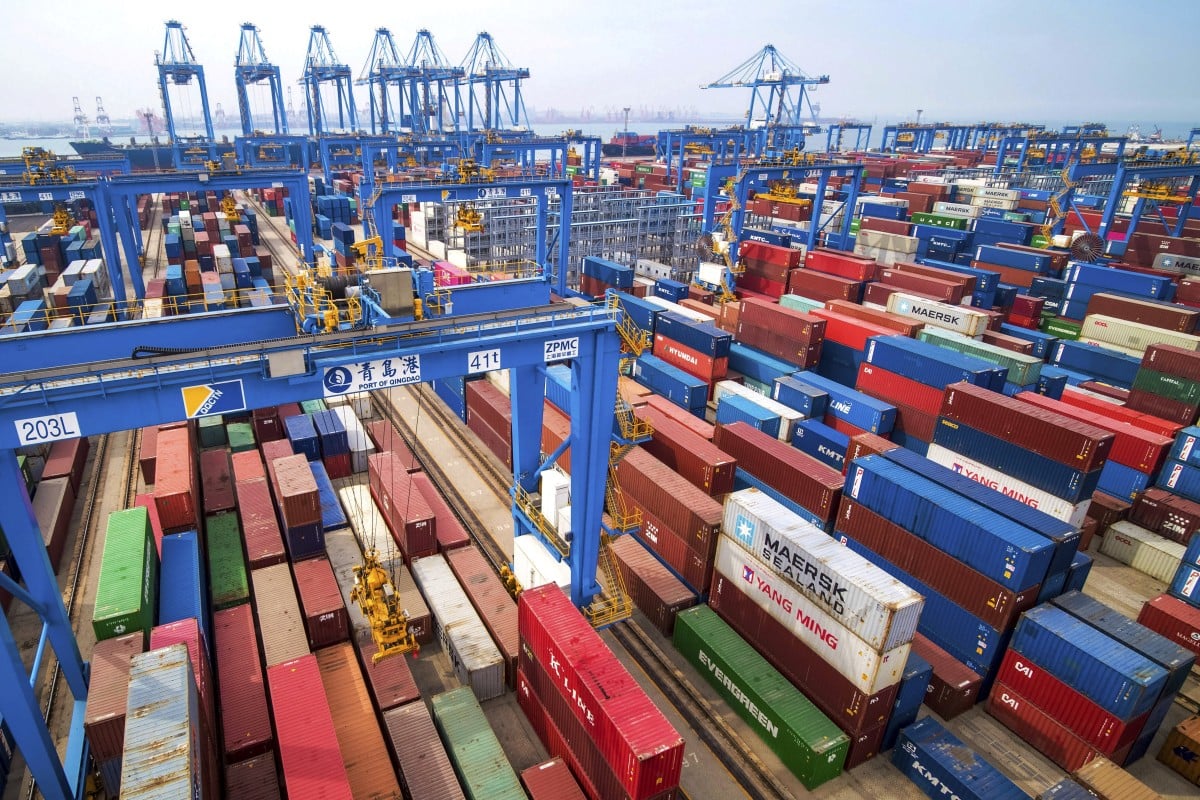
The Association of Southeast Asian Nations (Asean) has overtaken the US to become China’s second-largest trading partner in the first half of 2019. Photo: AP
China has claimed “positive progress” towards finalising the world’s largest free-trade agreement by the end of 2019 after hosting 10 days of talks, but insiders have suggested there was “never a chance” of concluding the deal in Zhengzhou.
The 27th round of the Regional Comprehensive Economic Partnership (RCEP) negotiations closed on Wednesday in the central Chinese city.
working level conference brought over 700 negotiators from all 16 member countries to Henan province, with China keen to push through a deal which has proven extremely difficult to close.
If finalised, the agreement, which involves the 10 Asean nations, as well as China, Japan, South Korea, Australia, New Zealand, and India, would cover around one-third of the global gross domestic product, about 40 per cent of world trade and almost half the world’s population.
“This round of talks has made positive progress in various fields,” said assistant minister of commerce Li Chenggang, adding that all parties had reaffirmed the goal of concluding the deal this year. “China will work together with the RCEP countries to proactively push forward the negotiation, strive to resolve the remaining issues as soon as possible, and to end the negotiations as soon as possible.”
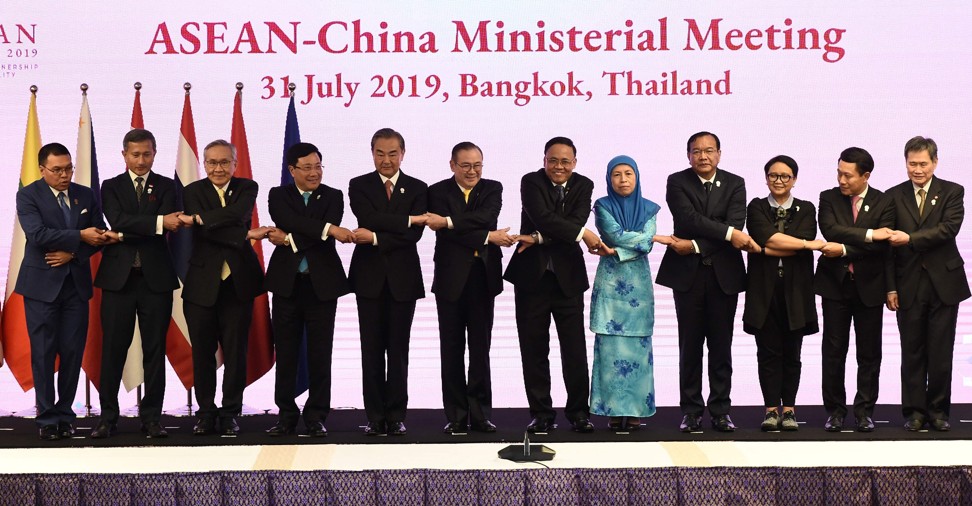
China’s Foreign Minister Wang Yi (fifth left) poses with foreign ministers from the Association of Southeast Asian Nations (Asean) countries during the ASEAN-China Ministerial Meeting in Bangkok. Photo: AFP
China is keen to complete a deal which would offer it a buffer against the United States in Asia, and which would allow it to champion its free trade position, while the US pursues protectionist trade policy.
The RCEP talks took place as Chinese and American trade negotiators resumed face-to-face discussions in Shanghai, which also ended on Wednesday, although there was little sign of similar progress.
As the rivalry between Beijing and Washington has intensified and bilateral trade waned, the Association of Southeast Asian Nations (Asean) overtook the US to become China’s second-largest trading partner in the first half of 2019. From January to June, the trade volume between China and the 10-member bloc reached US$291.85 billion, up by 4.2 per cent from a year ago, according to government data.
The Asean bloc is made up of Indonesia, Thailand, Malaysia, Singapore, Philippines, Vietnam, Myanmar, Cambodia, Brunei and Laos.
China will work together with the RCEP countries to proactively push forward the negotiation, strive to resolve the remaining issues as soon as possible, and to end the negotiations as soon as possible. Li Chenggang
RCEP talks will now move to a higher level ministerial meeting in Beijing on Friday and Saturday, but trade experts have warned that if material progress is not made, it is likely that the RCEP talks will continue into 2020, prolonging a saga which has already dragged on longer than many expected. It is the first time China has hosted the ministerial level talks.
But complicating matters is the fact that India’s Commerce Minister, Piyush Goyal, will not attend the ministerial level talks, with an Indian government official saying that he has to participate in an extended parliamentary session.
India is widely viewed as the biggest roadblock to concluding RCEP, the first negotiations for which were held in May 2013 in Brunei. Delhi has allegedly opposed opening its domestic markets to tariff-free goods and services, particularly from China, and has also had issues with the rules of origin chapter of RCEP.
China is understood to be “egging on” other members to move forward without India, but this could be politically explosive, particularly for smaller Asean nations, a source familiar with talks said.
Deborah Elms, executive director of the Asian Trade Centre, a Singapore-based lobby group, said that after the last round of negotiations in Melbourne between June 22 to July 3 – which she attended – there was “frustration” at India’s reluctance to move forward.
She suggested that in India’s absence, ministers in China could decide to move forward through a “pathfinder” agreement, which would remove India, but also potentially Australia and New Zealand.
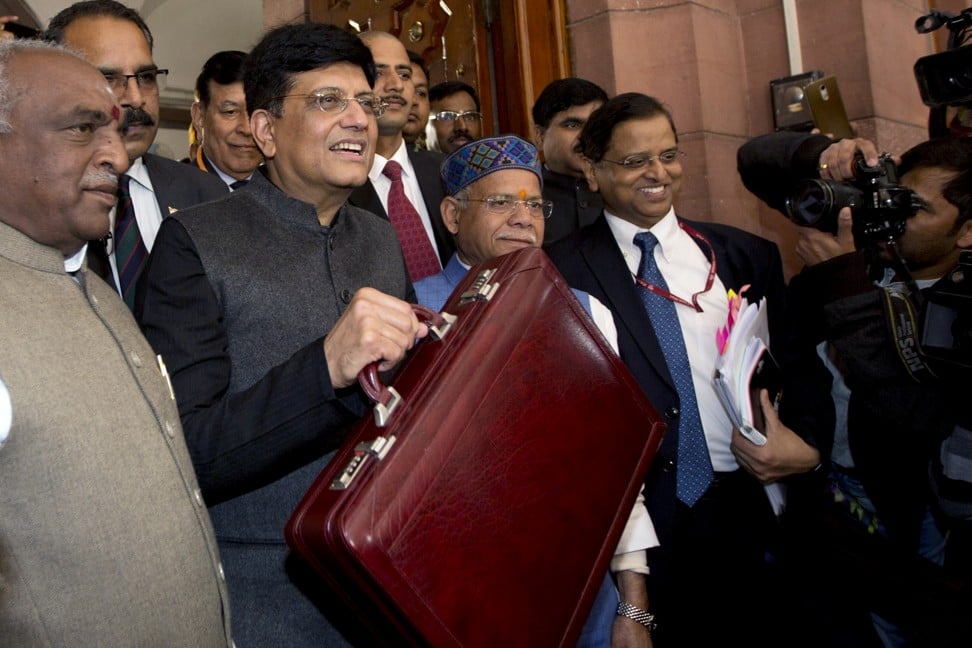
India’s Commerce Minister, Piyush Goyal, will not attend the ministerial level talks this week in Beijing. Photo: Bloomberg
This “Asean-plus three” deal would be designed to encourage India to come on board, Elms said, but would surely not go down well in Australia and New Zealand, which have been two of the agreement’s biggest supporters.
New Zealand has had objections to the investor protections sections of RCEP, and both countries have historically been pushing for a more comprehensive deal than many members are comfortable with, since both already have free trade agreements with many of the other member nations.
However, their exclusion would be due to “an unfortunate geographical problem, which is if you’re going to kick out India, there has always been an Asean-plus three concept to start with”. Therefore it is easier to exclude Australia and New Zealand, rather than India alone, which would politically difficult.
A source close to the negotiating teams described the prospect of being cut out of the deal at this late stage as a “frustrating rumour”, adding that “as far as I know [it] has no real basis other than a scare tactic against India”.
There was “never a chance of concluding [the deal during] this round, but good progress is being made is what I understand. The key issues remain India and China”, said the source, who wished to remain anonymous.
Replacing bilateral cooperation with regional collaborations is a means of resolving the disputesTong Jiadong
However, Tong Jiadong, a professor of international trade at the Nankai University of Tianjin, said Washington’s refusal to recognise India as a developing country at the World Trade Organisation could nudge the world’s second most populous nation closer to signing RCEP.
“That might push India to the RCEP, accelerating the pace of RCEP,” Tong said, adding that ongoing trade tensions between Japan and South Korea could also be soothed by RCEP’s passage.
“Replacing bilateral cooperation with regional collaborations is a means of resolving the disputes between the two countries,” Tong said.
Although the plan was first proposed by the Southeast Asian countries, China has been playing an increasingly active role, first as a response to the now defunct US-backed Trans-Pacific Partnership (TPP), and more recently as a means of containing the impact of the trade war.
China’s vice-commerce Minister, Wang Shouwen, told delegates last week that RCEP was “the most important free trade deal in East Asia”. He called on all participants to “take full advantage of the good momentum and accelerating progress at the moment” to conclude a deal by the end of the year.
Hanoi says it has sent several messages to Beijing that a Chinese survey ship vacate the waters located in its exclusive economic zone
‘Vietnam resolutely and persistently protects our sovereign rights … by peaceful means on the basis of international laws,’ a foreign ministry spokesperson said
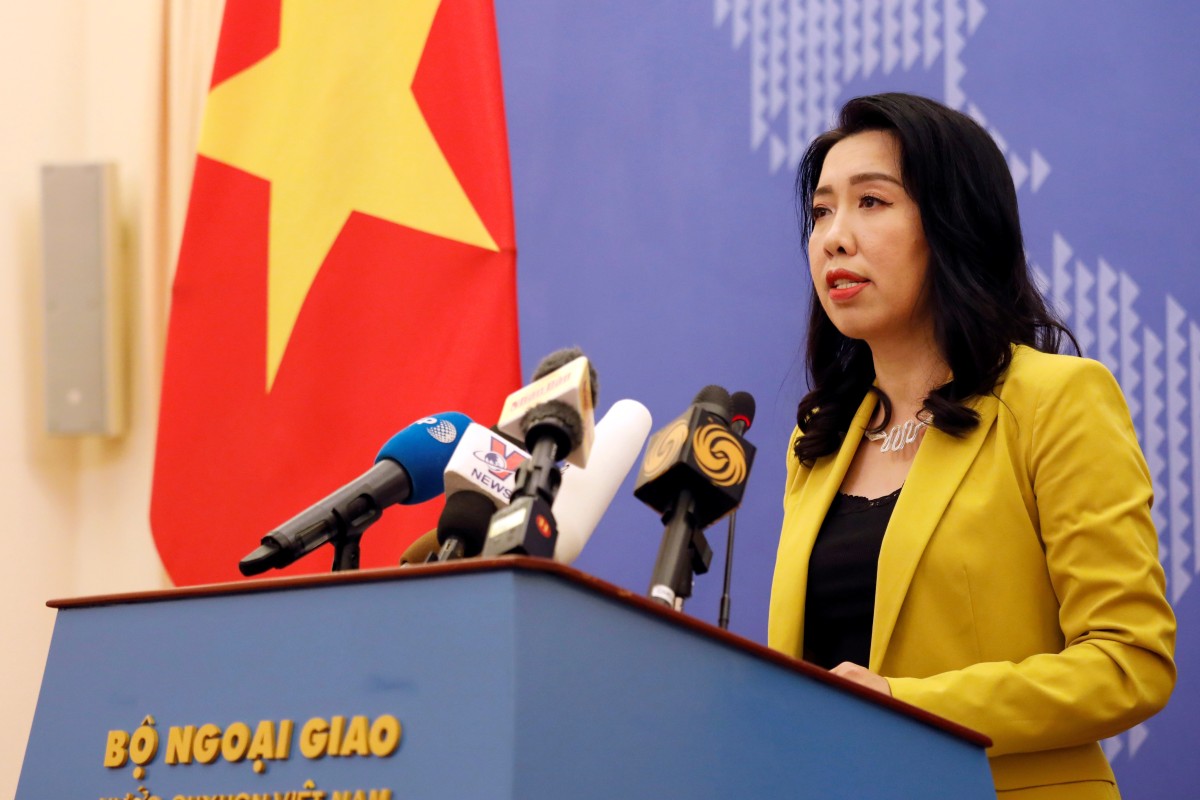
Vietnamese foreign ministry spokeswoman Le Thi Thu Hang. Photo: Reuters
Vietnam on Thursday called for the “immediate withdrawal” of a Chinese ship in the
, as the stand-off over the disputed waters intensified.
Beijing last week issued a new call for Hanoi to respect its claims to the resource-rich region – which has historically been contested by Vietnam, as well as Taiwan, the Philippines, Malaysia and Brunei.
Hanoi responded by saying it had sent several messages to Beijing insisting that a Chinese survey ship vacate its waters, and doubled down on Thursday with new demands for the vessel’s removal.
“Vietnam has had several appropriate diplomatic exchanges … requesting immediate withdrawal from Vietnam’s exclusive economic zone,” a foreign ministry spokesperson told reporters, while refusing to disclose the ship’s precise location.
“Vietnam resolutely and persistently protects our sovereign rights … by peaceful means on the basis of international laws,” Le Thi Thu Hang added.
The ship, owned by the government-run China Geological Survey, begun research around the contested Spratly Islands on July 3, according to the US-based Center for Strategic and International Studies (CSIS).
Before it was spotted, a Chinese coastguard vessel also patrolled near Vietnamese supply ships in a “threatening manner”, CSIS said.
China has not confirmed the presence of its ships in the area.
China’s neighbours boost coastguards as tensions rise in South China Sea
Beijing invokes its so-called nine-dash line to justify its claim to historic rights to the waterway, and has previously built up artificial islands as well as installed airstrips and military equipment in the region.
The line runs as far as 2,000km (1,240 miles) from the Chinese mainland to within a few hundred kilometres of the Philippines, Malaysia and Vietnam.
In 2014 Beijing moved an oil rig into waters claimed by Hanoi, sparking deadly anti-China protests across Vietnam.
The latest stand-off in the sea prompted a swift rebuke from the United States over the weekend, calling for an end to China’s “bullying behaviour”.
US accuses China of acting like a bully in the South China Sea
“China’s repeated provocative actions aimed at the offshore oil and gas development of other claimant states threaten regional energy security,” the US State Department said Saturday.
Observers will be watching to see if General Wei Fenghe holds talks with his American counterpart
Forum comes as Beijing and Washington are at odds over issues ranging from security to trade
General Wei Fenghe will be the first Chinese defence minister to attend the Shangri-La Dialogue in eight years. Photo: Reuters
China is sending its defence minister to a leading Asian security forum next week, the first time in eight years that a high-ranking Chinese general will represent the country at the conference.
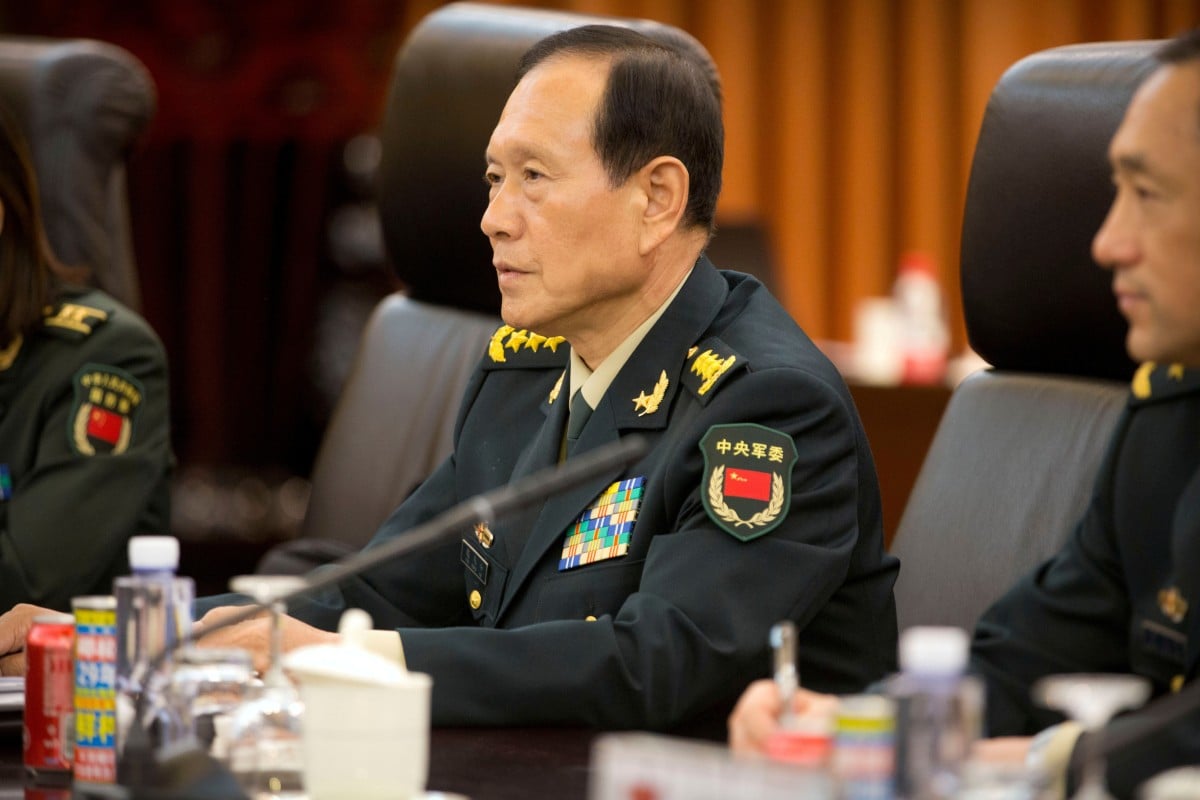
General Wei Fenghe, a State Councillor and China’s defence minister, will speak at the three-day Shangri-La Dialogue in Singapore, a gathering that comes as Beijing and Washington are at odds over issues ranging from security to trade.
“In a highly anticipated speech, General Wei Fenghe will speak on China’s role in the Indo-Pacific at a pivotal time for the region,” the International Institute for Strategic Studies, an organiser of the conference, said on Monday night.
Chinese military sources said that Wei would lead a “relatively big” delegation to the gathering, which starts on May 31 and is co-organised by the Singaporean government.
South China Sea stand-offs ‘a contest of wills’
The last time Beijing sent a high-ranking officer to the event was in 2011 when General Liang Guanglie, then the defence minister, attended.
Acting US secretary of defence Patrick Shanahan will also attend the conference and deliver a speech.
The spoils of trade war: Asia’s winners and losers in US-China clash
Beijing-based military specialist Zhou Chenming said observers would be watching to see whether the two senior defence officials held talks.
“The whole world will keep a close eye on any possible encounters between the Chinese and the Americans … At least now China has shown its sincerity in sending Wei to attend the conference, who is of equal standing as Shanahan, if the latter is willing to hold talks with him in good faith,” Zhou said.
But he said a meeting between Wei and Shanahan would be difficult because of the current distance between Beijing and Washington on major issues.
How Trump’s tweets bested China in the trade war publicity battle
“It’s not realistic to expect they will make a breakthrough because both sides will just sound their own bugles. The … mistrust between China and the US is actually growing every day,” Zhou said.
Just on Sunday, the USS Preble, an Arleigh Burke-class guided missile destroyer, sailed within 12 nautical miles of the Scarborough Shoal, an area in the South China Sea claimed by both China and the Philippines.
by strongly urging “the US to stop such provocative actions” and saying it would “take all necessary measures” to protect its “national sovereignty”.
Military analysts said the size of the Chinese delegation at the conference would underscore the importance of the People’s Liberation Army (PLA) attached to the event this year.
One military insider said the delegation would also include Lieutenant General He Lei, former vice-president of the Academy of Military Science, who headed China’s delegation in 2017 and 2018; and Senior Colonel Zhou Bo, director of the defence ministry’s Centre for Security Cooperation. In addition, the PLA would send a number of Chinese academics to speak at various sessions of the forum.
China tries to go one on one with Malaysia to settle South China Sea disputes
Singaporean Prime Minister Lee Hsien Loong will deliver a keynote speech on the opening day of the annual dialogue.
Japan and South Korea are also sending their defence ministers, according to a report by The Korean Times on Tuesday. The report also said South Korean Defence Minister Jeong Kyeong-doo was keen to hold one-on-one meetings with his Chinese and Japanese counterparts on the sidelines of the conference.
Streaming platform Huahua earned US$2.3 million in profit in five months, according to media report
Final two suspects arrested in Philippines, police say
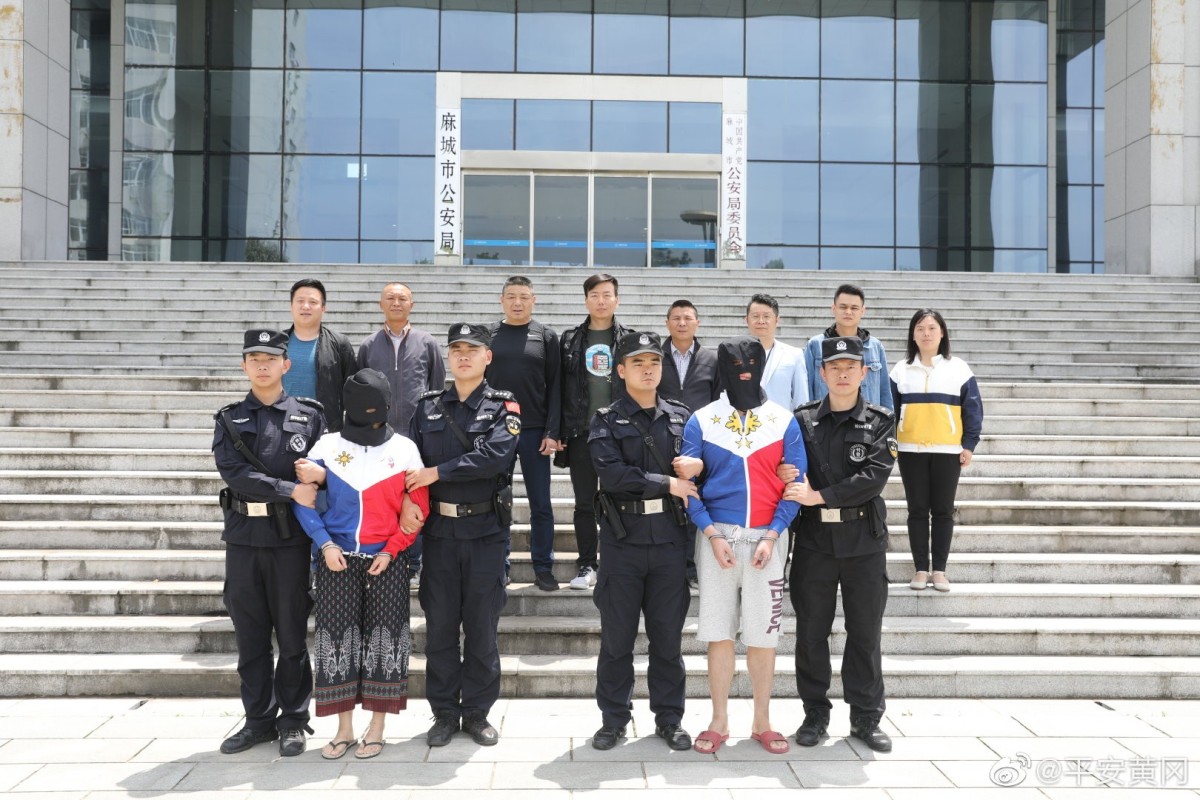
Chinese police with the last two principal suspects in the Philippines on April 26. Photo: Weibo
Chinese police have arrested 20 people from a cross-border group accused of operating illegal live streaming platforms to broadcast pornographic content, according to mainland online news outlet The Paper.
After an investigation lasting over a year, police in Macheng in central China’s Hubei province said they arrested the last two main suspects, a man surnamed Hong and a woman surnamed Li, in the Philippines on April 26.
platform, which was initially called Huahua, had more than 900,000 registered users, earning the group 16 million yuan (US$2.3 million) in profit in five months from November 2017, according to the report.
The Chinese government announced in February 2018 it was
against pornographic and illegal publications to foster a healthy online environment.The next month, Macheng police received a tip-off that people were distributing QR codes to download Huahua in chat groups on the popular Chinese messaging app QQ.
On the Huahua platform, live streamers gave erotic performances, with the most popular streamers drawing more than 2,000 viewers at a time and users able to make requests by paying up to almost 2,000 yuan (US$290).
The group had a structure and rules designed to avoid the police’s attention, the report said. Members did not know each other’s identities and each had only one point of contact.
Some recruited streamers, others promoted the app on social platforms to attract traffic, and members in Mongolia laundered money with foreign bank accounts, while the app’s appearance and servers were changed several times, the report said.
After 18 people were arrested by April 2018 across the country, including in Shanghai and Guangdong, the No 1 suspect, the Mongolia-based Hong, fled to South Korea then to the Philippines, where he met Li and they built a similar app, according to the report.
The report said Hong had owned a company in Shanghai focusing on developing video games before turning to pornographic live streaming to make money quickly when the gaming business struggled.
Chinese Premier Li Keqiang (R) meets with Philippine President Rodrigo Duterte, who is here to attend the Second Belt and Road Forum for International Cooperation, in Beijing, capital of China, April 25, 2019. (Xinhua/Li Tao)
BEIJING, April 25 (Xinhua) — Chinese Premier Li Keqiang on Thursday met with Philippine President Rodrigo Duterte, who is here to attend the Second Belt and Road Forum for International Cooperation.
China and the Philippines are neighbors facing each other across the sea, and their development and stability is closely related, Li said, adding that bilateral relations had achieved positive turnaround and consolidation, and had been progressing on the right track, after the joint efforts of the two sides over the past three years.
China is willing to see new achievements in the economic and social development of the Philippines, and align the Belt and Road Initiative (BRI) with the “Build, Build, Build” program of the Philippines, he said.
Peace and stability in the South China Sea is in line with the common interests of China, the Philippines and other countries in the region, Li added.
China supports the Philippines in fulfilling its responsibilities as the country coordinator for China-ASEAN relations, and expects negotiations on the Code of Conduct (COC) in the South China Sea to be completed soon, Li said.
Li also expressed confidence that countries around the South China Sea will be able to jointly safeguard peace and stability in the region with wisdom, adding that it is necessary to properly manage existing issues through dialogue and consultation, so as to realize common development.
Noting the contribution of the BRI to global prosperity and connectivity, Duterte said the Philippines is ready to deepen the cooperation with China under the BRI framework.
The Philippines will further improve its business environment, and welcomes more investments from Chinese companies, said the president.
Duterte said the Philippines will firmly make the South China Sea a sea of peace, friendship and cooperation, and is looking forward to working with other parties to conclude the negotiations on the COC as soon as possible.
Philippines’ foreign ministry weighs in on controversy over presence of Chinese fleet near contested Thitu Island
Manila has ‘consistently manifested its … objections or concerns over illegal, tension-raising or coercive activities’, statement says
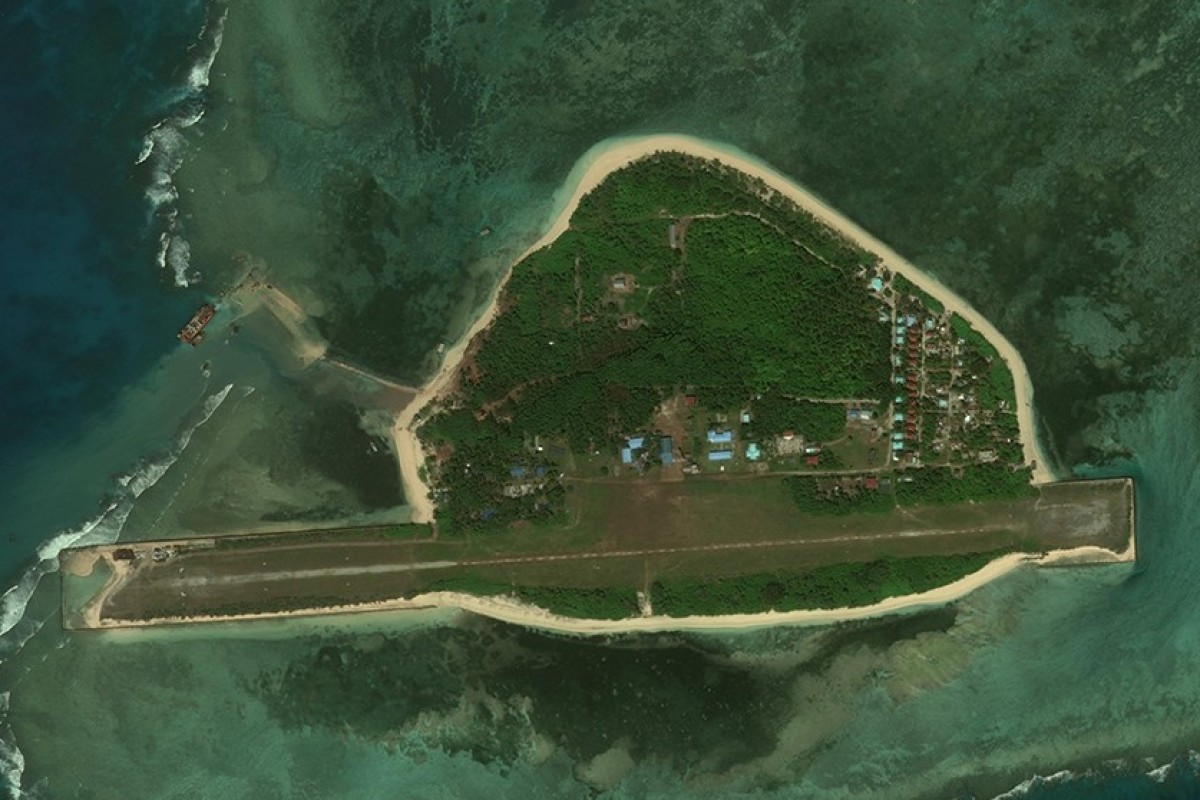
The Philippines is angry about the presence of a Chinese fleet close to Thitu Island in the South China Sea. Photo: AMTI
The Philippines’ foreign ministry on Thursday accused Beijing of violating its sovereignty and jurisdiction by allowing hundreds of vessels to sail close to an island claimed by Manila in the South China Sea.
described China’s growing presence in the disputed waters as “very concerning”, saying on a trip to Washington that it was encroaching on the Philippines’ exclusive economic zone.
, which Manila calls Pag-asa, in the disputed Spratly Islands.
The Department of Foreign Affairs in Manila said the Philippines “has consistently manifested its position on Pag-asa … and its objections or concerns over illegal, tension-raising or coercive activities, through diplomatic actions … and in meetings with the Chinese side”.
The statement said Thitu is part of the Kalayaan island group – the local name for the Spratlys – and an integral part of the Philippines, over which it has sovereignty and jurisdiction.
“The presence of Chinese vessels near and around Pag-asa and other maritime features in the KIG is illegal,” it said.
US, Philippines in talks on rocket system to deter Beijing
“Such actions when not repudiated by the Chinese government are deemed to have been adopted by it,” it said. “The presence of Chinese vessels within the KIG, whether military, fishing or other such will thus continue to be the subject of appropriate action by the Philippines”.
The foreign ministry said earlier it had filed a diplomatic protest about the presence of more than 200 Chinese vessels near Thitu between January and March.
Satellite images captured in February by the Asia Maritime Transparency Initiative under the Washington-based Centre for Strategic and International Studies show almost 100 Chinese ships apparently hampering Philippine construction work on Thitu.
The fleet, dispatched from the nearby Subi Reef, includes naval and coastguard vessels, as well as dozens of fishing boats.
Manila was planning to upgrade its military facilities on Thitu, including the construction of an airstrip, but the project was suspended because of the Chinese interference.
The defence chiefs of the US and the Philippines reaffirmed their security alliance on Monday in Washington. As well as agreeing to boost cooperation, the US promised to increase its support for Manila’s military modernisation – a move seen as a response to Beijing’s increasingly assertive posturing in the South China Sea.
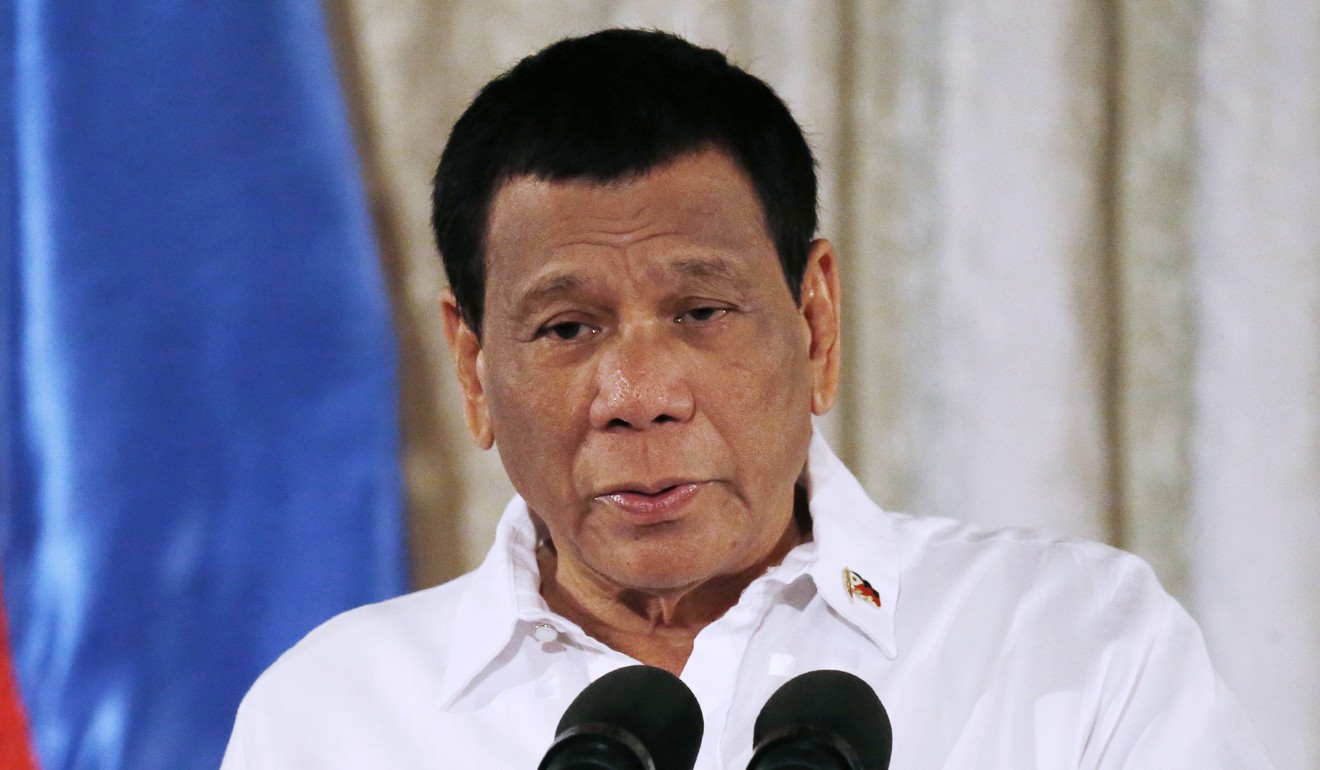
Philippine President Rodrigo Duterte says he will not confront China over the South China Sea dispute as doing so would end in war. Photo: AP
said on Wednesday that Beijing wanted to be friends with Manila and that he would not confront China over their competing claims in the South China Sea because it would end in war.
The foreign affairs department in Manila also sought to sound a positive note in its statement, saying the maritime dispute was not the “sum total” of Philippines-China relations, and should not exclude mutually beneficial cooperation in other fields.
US more likely than Philippines to end up in ‘shooting war’
A day after the two nations wrapped up their latest meeting on the South China Sea, Chinese foreign ministry spokesman Geng Shuang said on Thursday the two sides had reaffirmed their differences but would continue to seek a resolution.
“China looks forward to working with the Philippines to make active efforts to safeguard the overall interests of China-Philippines cooperation and peace and stability in the South China Sea,” he said.
Hong Kong-based military expert Song Zhongping said the presence of the Chinese vessels near Thitu was a clear statement of Beijing’s intent.
“Beijing believes Thitu Island is Chinese territory, so any work there should be done by China, not the Philippines,” he said.
It also wanted to stop Manila “opening the door to dangerous people” he said, referring to the Southeast Asian nation’s announcement about allowing the US access to five more of its military bases.
Delegation from Manila lands in Beijing to seek loans and unlock funds for controversial China-backed Kaliwa dam
Critics say the Duterte government has engineered the water shortage to gain backing for the dam, which indigenous tribes oppose
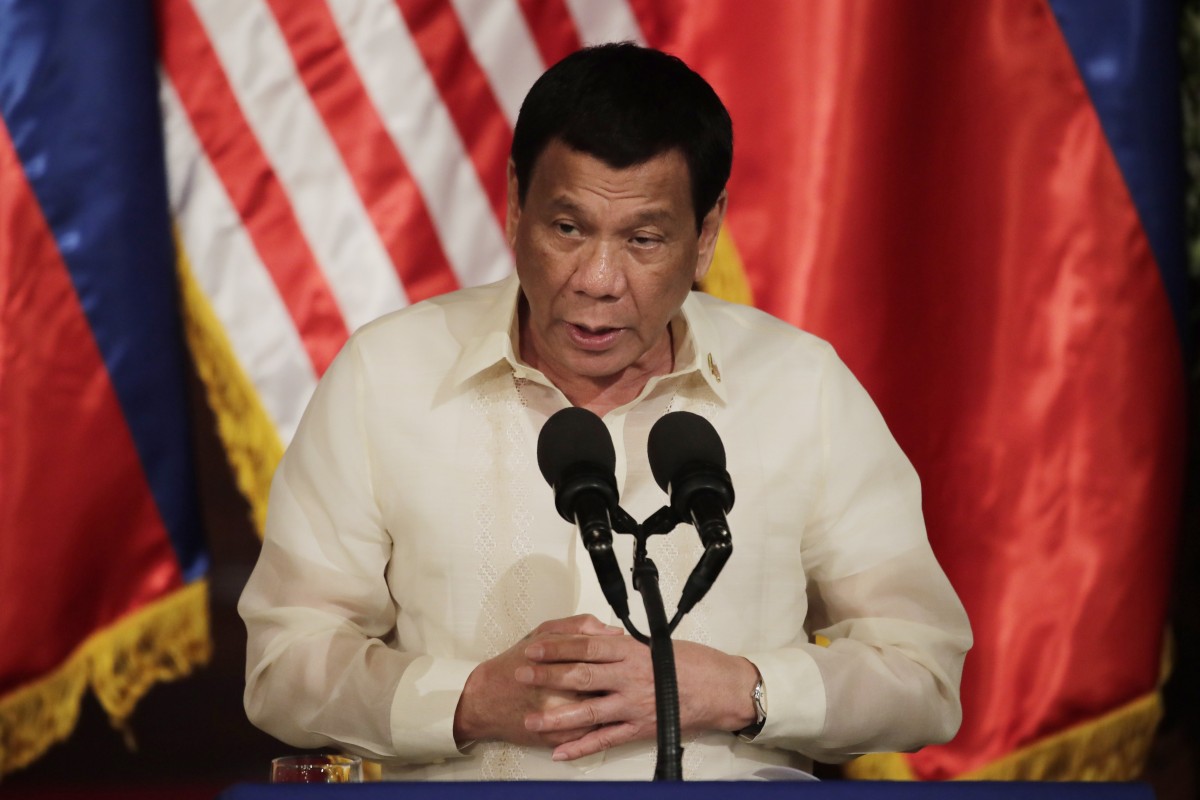
Philippine President Rodrigo Duterte. Photo: EPA
The Philippines has gone cap in hand to China as it struggles with a severe water shortage that has seen taps in its capital city run dry.
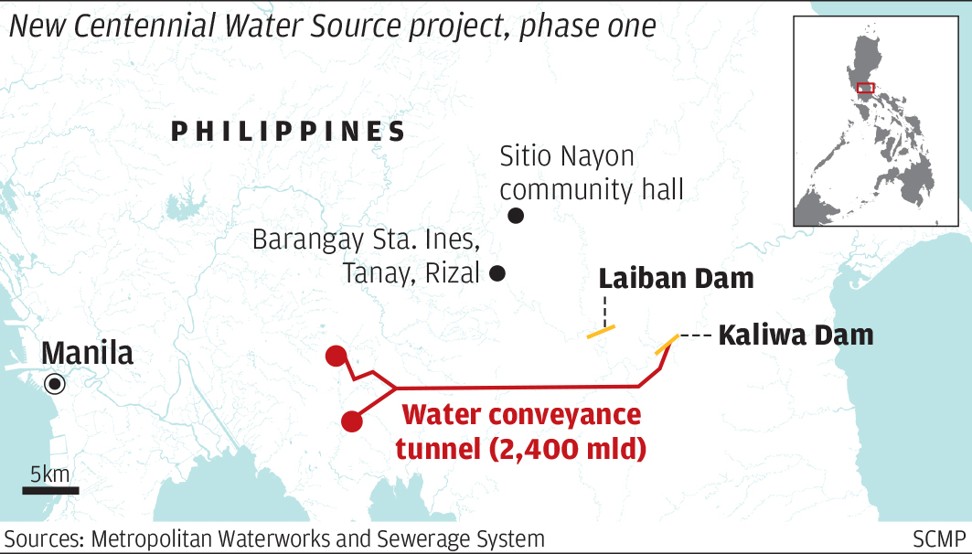
A delegation from Manila landed in China on Tuesday hoping to attract further infrastructure investment and speed up the delivery of loans Beijing has pledged for an irrigation project and a controversial dam that government ministers say will ease the water shortage. Any new loans they negotiate would be on top of the US$10 billion China has already pledged to President Rodrigo Duterte’s “build, build, build” project to transform the Philippines’ economy.
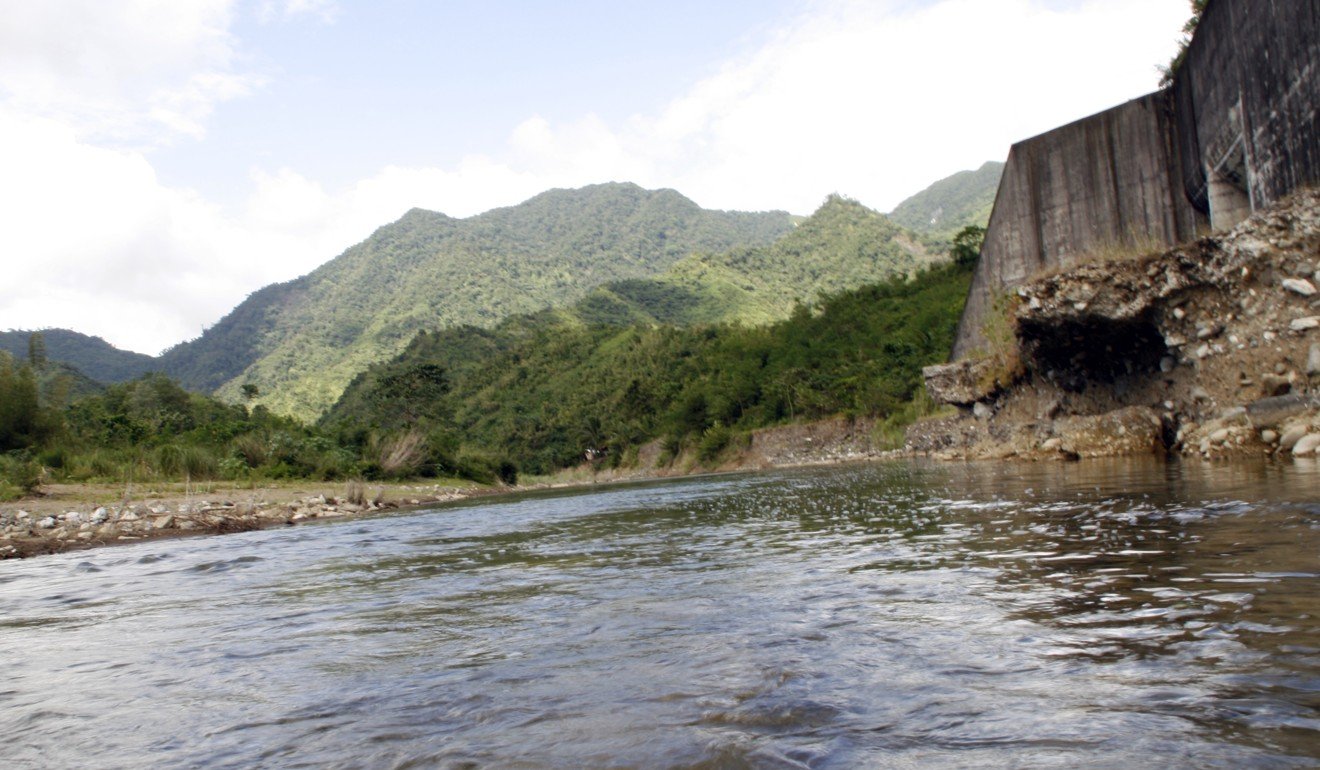
The site of the controversial Chinese-funded Kaliwa Dam Project. Photo: MWSS
Share:
The delegation, led by Duterte’s Executive Secretary Salvador Medialdea, will meet Chinese Vice-President Wang Qishan and officials at the Ministry of Commerce, China’s Export-Import Bank and China International Development Cooperation Agency, which reviews foreign aid projects. They will also brief potential investors from the private sector.
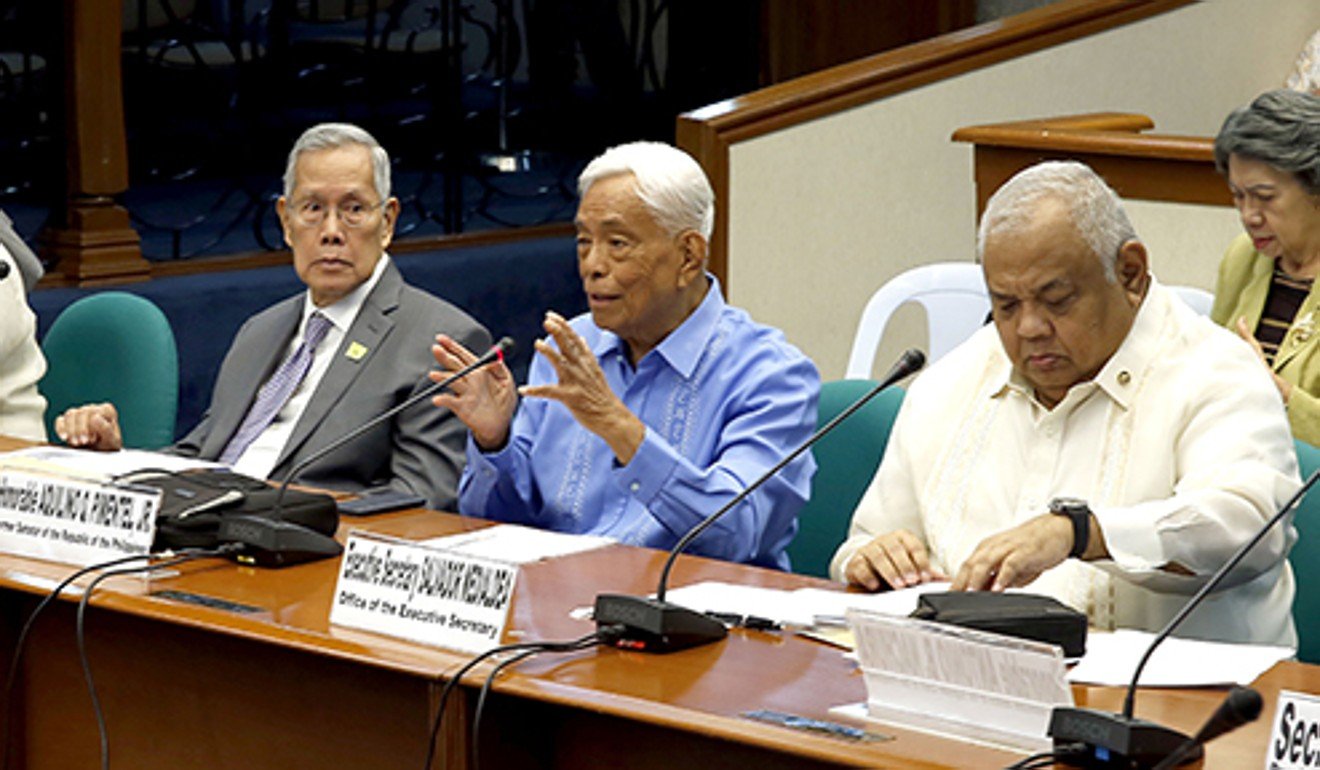
Duterte’s Executive Secretary Salvador Medialdea, right. Photo: PRIB
The trip comes amid the most severe water shortage to have hit the Philippine capital in the past decade, with dozens of districts having gone days without water. However, it is likely to prove controversial in some quarters, as critics believe the water shortage has been engineered by the Duterte government as a ploy to win support for the long-stalled Chinese-funded Kaliwa Dam Project. The project, which has been shelved for decades, is controversial partly because Duterte asked China to fund it rather than put it to public tender. It is also opposed by indigenous communities, who stand to be displaced, and by NGOs and the Catholic Church, who question its safety.
The task of Medialdea’s delegation will include trying to speed up the delivery of a promised US$211 million loan from the Export-Import Bank to fund the Kaliwa dam.
Finance Secretary Carlos Dominguez said last week the dam was “absolutely” the solution to Manila’s water shortage and defended the conditions of the loan.
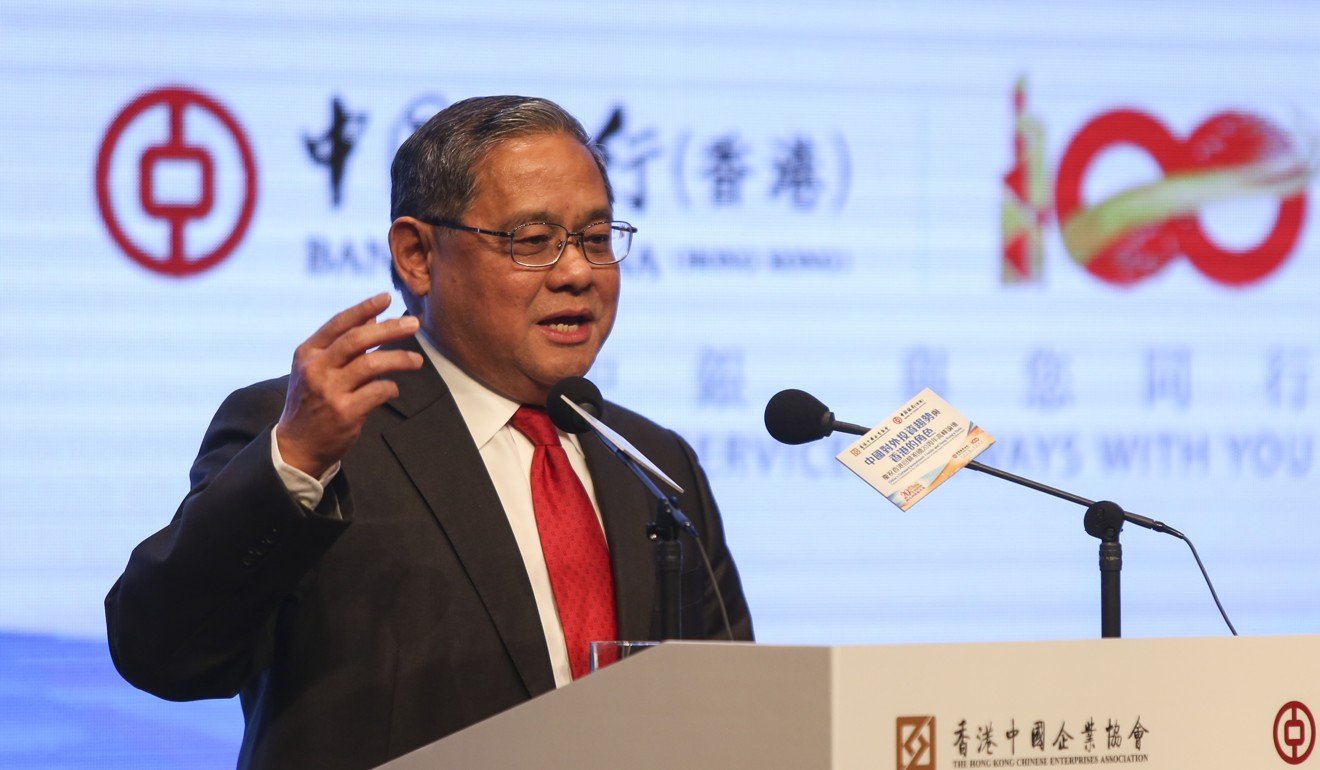
Philippine Finance Secretary Carlos Dominguez. Photo: Xiaomei Chen
Share:
He said the bank was giving Manila a preferential rate of 2 per cent per annum for 20 years, with a seven-year grace period; a commitment fee of 0.3 per cent of the loan amount and a management fee of 0.3 per cent of the loan amount.
The delegation will also seek to speed up the delivery of a US$62 million loan pledged by the Export-Import Bank to build the Chico River Pump Irrigation Project in the north of the country.
Dominguez urged the Chinese contractors in both projects to build quickly.
Still, in the Philippines, “quickly” can be a relative term.
China holds the cards as online betting booms in the Philippines
Even as the delegation landed in Beijing, a senate probe into the water crisis was hearing from the Metropolitan Waterworks and Sewerage System (MWSS) administrator Reynaldo Velasco that it would take five years to build the dam, which was still in the consultation stages.
Velasco said that since the dam would be located in the ancestral domain of indigenous communities, “we have to go through a process to be able to get their approval including the agreement [on what displaced families should be paid and their relocation].”
Velasco said if the tribes did not consent, “we will not start the dam”.
Opposition by the tribes has stalled the project for decades.
Graphic: SCMP
According to Ramcy Astoveza, chief of the Agta tribe, the tribes will never change their mind because “the dam project is a matter of life and death for us. Once we allow the dam inside our natural habitat, what would follow is the death of our tribe”.
Environmental NGOs including the Save Sierra Madre Network Alliance, Alyansa Laban sa Kaliwa Dam, Task Force Sierra Madre and Tribal Centre for Development have warned that, aside from submerging seven villages, the dam project was “within a zone of two active tectonics – the Philippine Fault Zone and the Valley Fault System”.
The winners and losers in Duterte’s China play
Meanwhile, the Catholic Bishops Conference of the Philippines has warned the dam would endanger 100,000 residents downstream of Kaliwa River, particularly during earthquakes and extreme flooding events brought about by climate change.
As Patrick Ty, chief of the MWSS Regulatory Office, said: “With all the problems Kaliwa Dam is facing, it might get delayed.”
Despite such concerns, the government remains optimistic both projects will go ahead. Velasco said the MWSS hoped to start building the Kaliwa dam by August this year. He denied that Manila’s water shortage was artificial and a ploy to get Metro Manila residents to support the China-funded project.
Image copyrightMANDALUYONG POLICE/FACEBOOKImage captionPhotos of Ms Zhang at a train station in Manila later went viral
A Chinese student who threw her cup of soybean pudding at a police officer in the Philippines has been charged with assault and disobedience.
Zhang Jiale was at a train station in Manila when she was stopped and told she had to finish her dessert before she could enter the station.
She responded by throwing the treat at the officer, and was later detained.
Ms Zhang could face deportation and eventual blacklisting from the Philippines.
‘I was in a bad mood’
The incident took place on 9 February at the Metro Rail Transit (MRT) in the Philippines’ capital of Manila.
The 23-year-old is currently a fashion design student in the Philippines.
According to local media outlets, she was stopped by police officer William Cristobal from going onto the MRT station in Manila as she was holding a cup of “taho” – a local dessert of soybean pudding.
Image copyrightJAY DIRECTOImage captionTaho is a popular sweet dessert in the Philippines
Bottled drinks, water and liquid substances are banned from MRT stations in Manila.
Mr Cristobal told her she would have to finish her dessert or throw it away before she would be allowed to enter the platform.
Image copyrightMANDALUYONG POLICE/FACEBOOKImage captionMr Cristobal had a cup of taho thrown at him
Ms Zhang was later charged by the Mandaluyong City prosecutor’s office for direct assault, disobedience to an agent of a person in authority and unjust vexation.
The Mandaluyong City Police told the BBC that they were unable to comment on what punishment Ms Zhang would face if found guilty.
She posted bail but was later detained again by the Bureau of Immigration on a separate charge of violating immigration laws. She now remains in detention in Manila.
Image copyrightMANDALUYONG POLICE/FACEBOOKImage captionMs Zhang was later brought in by Mandaluyong police
“The incident showed her disrespect towards persons of authority which in turn shows her disrespect to the country.”
Ms Sandoval said Zhang may face deportation and eventually be blacklisted from the country altogether, adding that the court case would run “independent” from her immigration case.
“If found deportable, we will wait for the resolution of her court case before implementing the deportation.”
MANILA, Jan. 29 (Xinhua) — Chinese Ambassador to the Philippines Zhao Jianhua said Tuesday that China will give its “firm support” to the Filipinos and the Philippine government in the fight against violent extremism after twin blasts hit a cathedral in the southern Philippines.
In a speech at the Chinese New Year reception, Zhao said the Chinese government expressed its deepest condolences and sympathies to the families of those who were killed and injured in Sunday’s blasts in Jolo city of Sulu province.
“Chinese government once again will give its firm support to the Philippine people and Philippine government for fighting against all barbaric violence including terrorism,” he said.
Bombings hit a cathedral in Sulu province of the southern Philippines last Sunday, killing 21 people and wounding more than 100 others.








 CHINDIA ALERT: You'll be living in their world, very soon