Chindia Alert: You’ll be Living in their World Very Soon
aims to alert you to the threats and opportunities that China and India present. China and India require serious attention; case of ‘hidden dragon and crouching tiger’.
Without this attention, governments, businesses and, indeed, individuals may find themselves at a great disadvantage sooner rather than later.
The POSTs (front webpages) are mainly 'cuttings' from reliable sources, updated continuously.
The PAGEs (see Tabs, above) attempt to make the information more meaningful by putting some structure to the information we have researched and assembled since 2006.
Image copyrightREUTERSImage captionPM Narendra Modi flagged off the Vande Bharat Express on Friday
India’s fastest train has broken down on its first trip, a day after it was inaugurated by Prime Minister Modi.
The Indian-built semi high-speed Vande Bharat Express was returning to the capital Delhi from the city of Varanasi after its first outing when brakes in a carriage reportedly jammed.
Indian media quoted a railways spokesperson as saying the train may have struck cattle on the line.
The train reached a speed of 180km/hr (110mph) during trials.
The new train service is expected to start its commercial run from Sunday. It is expected to reduce the travel time between Delhi and Varanasi by six hours.
SRINAGAR (Reuters) – India has warned against rising communal tensions across the country as Kashmiris living outside their state faced property evictions, job suspensions and attacks on social media after a suicide bomber killed 44 policemen in the region.
The car bomb attack on a security convoy on Thursday, claimed by Pakistan-based Islamist militant group Jaish-e-Mohammad and carried out by a 20-year-old Kashmiri man, was the worst in decades of insurgency in the disputed area, which is claimed in full by both the nuclear-armed neighbours but ruled in part.
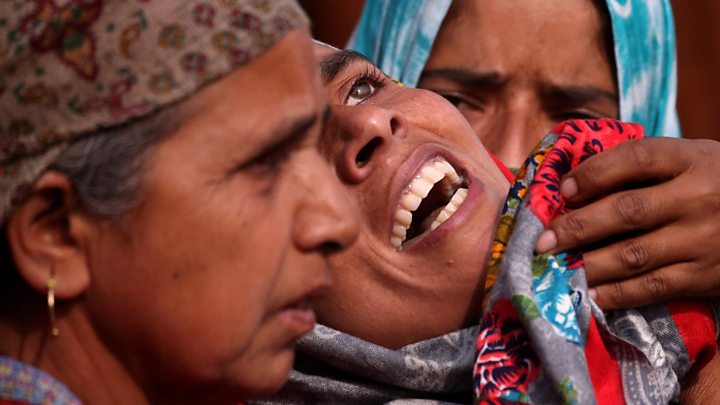
As the bodies of the paramilitary policemen who died in the attack were returned to families across India this weekend, passionate crowds waving the Indian flag gathered in the streets to honour them and shouted demands for revenge. Pakistan has denied any role in the killings.
Kashmiri Muslims, meanwhile, are facing a backlash in Hindu-majority India, mainly in the northern states of Haryana and Uttarakhand, forcing the federal interior ministry to issue an advisory to all states to “ensure their safety and security and maintain communal harmony”.
Aqib Ahmad, a Kashmiri student in Uttarakhand capital Dehradun, said the owner of the house he was staying in had asked him to move out fearing an attack on his property. Rates for air tickets to Kashmir have sky-rocketed as tensions escalate, he said.
Two other students in Dehradun said they also had been asked to vacate their rooms immediately.
“Where are we supposed to go?” Waseem Akram told Reuters, demanding authorities to ensure safety of all Kashmiri students.
Local media reported that some Kashmiri students were assaulted by members of Hindu right-wing groups in Uttarakhand, while a Kashmiri man had been booked by the police in the southern city of Bengaluru under a colonial-era sedition law for a post allegedly backing the militants. Reuters was not able to independently verify the reports.
Police in Jammu and Kashmir (J&K) state said they were providing temporary accommodation to people returning to Kashmir. The police urged Kashmiris to contact their hotline for “speedy assistance in case they face any difficulties/harrasment”.
“TRAITOR”
Fear has engulfed Kashmiri students in Haryana’s Ambala district after a video on social media showed a village headman asking people to evict Kashmiri students in the area.
“In case it is not done, the person in whose residence such students are living will be considered as a traitor,” the man says in the video, whose authenticity Reuters has not been able to independently verify.
Police said they were investigating the matter.
Since the video surfaced on social media on Saturday, at least half a dozen Kashmiri students have been shifted to the hostel of a university campus in Ambala.
A Facebook user named Anshul Saxena, meanwhile, has claimed credit for getting people fired or suspended for posts he calls “anti-national”.
Saxena uploaded a screengrab of a suspension letter handed out to a Kashmiri employee of a pharmaceutical company who had allegedly written in favour of the attack.
The attack on India’s paramilitary police follows the deadliest year in Kashmir for security personnel since Prime Minister Narendra Modi’s Hindu nationalist Bharatiya Janata Party came to power nearly five years ago.
Government data shows 91 officers lost their lives in Kashmir last year, about 14 percent more than 2017. Thousands of people, including militants and civilians, have died since the insurgency began in late 1980s.
Political leaders from Kashmir appealed to the government to ensure security of Kashmiris across India, while many people on Twitter said their homes were open to Kashmiris seeking shelter.
“Understand the pain and anguish,” Mehbooba Mufti, former chief minister of J&K, said in a tweet. “But we must not allow such mischievous elements to use this as an excuse to persecute/harass people from J&K. Why should they suffer for somebody else’s action?”
NEW DELHI (Reuters) – The United States supports India’s right to self-defence against cross-border attacks, India’s foreign ministry said on Saturday after a deadly car bombing in disputed Kashmir raised tensions with rival neighbour Pakistan.
Prime Minister Narendra Modi has promised a strong response after a Pakistan-based militant group claimed responsibility for the suicide attack on a military convoy on Thursday that killed 44 paramilitary policemen.
India’s government said it had evidence the group, Jaish-e-Mohammad (JeM), had the backing of Pakistan and demanded Islamabad take action. Pakistan has condemned the attack and rejected India’s allegations.U.S. National Security Adviser John Bolton spoke to his Indian counterpart Ajit Doval on Friday night, promising to help bring those behind the attack to justice, the foreign ministry said in a readout of the phone call.
“The two NSAs vowed to work together to ensure that Pakistan cease to be a safe haven for JeM and terrorist groups that target India, the U.S. and others in the region,” the foreign ministry said.
“They resolved to hold Pakistan to account for its obligations under U.N. resolutions,” it added.
India has for years accused Muslim Pakistan of backing separatist militants in divided Kashmir, which the neighbours both claim in full but rule in part.
Pakistan denies that, saying it only offers political support to the Himalayan region’s suppressed Muslim people.
Modi, who is facing an election in the next few months, has called a meeting of political parties on Saturday to build support for action against Pakistan.
Indians have poured onto social media to vent their fury over the suicide bombing in Kashmir, with many of them calling for swift retribution against Pakistan as TV news shows hosted jingoistic debates.
When he swept to power at the head of a Hindu nationalist-led alliance in 2014, Modi vowed to pursue a tough line with Pakistan. The two countries have gone to war three times since independence from Britain in 1947, twice over Kashmir.
The attack comes at a difficult time for Pakistan, which is struggling to attract foreign investment and avert a payments crisis, with its swiftly diminishing foreign currency reserves at less than $8 billion, equivalent to two months of import payments.
India has said it will ensure the “complete isolation” of Pakistan after a suicide bomber killed 46 soldiers in Indian-administered Kashmir.
Federal Minister Arun Jaitley said India would take “all possible diplomatic steps” to cut Pakistan off from the international community.
India accuses Pakistan of failing to act against the militant group which said it carried out the attack.
This is the deadliest attack to hit the disputed region in decades.
Both India and Pakistan claim all of Muslim-majority Kashmir but only control parts of it.
An insurgency has been ongoing in Indian-administered Kashmir since the late 1980s and there has been an uptick in violence in recent years.
How will India ‘punish’ Pakistan?
India says that Jaish-e-Mohammad, the group behind the attack, has long had sanctuary in Pakistan and accuses its neighbour of failing to crack down on it.
It has called for global sanctions against the group and has said it wants its leader, Masood Azhar, to be listed as a terrorist by the UN security council.
Although India has tried to do this several times in the past, its attempts were repeatedly blocked by China, an ally of Pakistan.
Mr Jaitley set out India’s determination to hold Pakistan to account when speaking to reporters after attending a security meeting early on Friday.
He also confirmed that India would revoke Most Favoured Nation status from Pakistan, a special trading privilege granted in 1996.
Pakistan said it was gravely concerned by the bombing but rejected allegations that it was in any way responsible.
But after Prime Minister Narendra Modi said in a speech that those behind the attack would pay a “heavy price”, many analysts expect more action from Delhi.
After a 2016 attack on an Indian army base that killed 19 soldiers, Delhi said it carried out a campaign of “surgical strikes” in Pakistan-administered Kashmir, across the de facto border. But a BBC investigation found little evidence militants had been hit.
However analysts say that even if the Indian government wants to go further this time, at the moment its options appear limited due to heavy snow across the region.
How did the attack unfold?
The bomber used a vehicle packed with explosives to ram into a convoy of 78 buses carrying Indian security forces on the heavily guarded Srinagar-Jammu highway about 20km (12 miles) from the capital, Srinagar.
“A car overtook the convoy and rammed into a bus,” a senior police official told BBC Urdu.
It stands as the deadliest militant attack on Indian forces in Kashmir since the insurgency began in 1989.
The bomber is reported to be Adil Dar, a high school dropout who left home in March 2018. He is believed to be between the ages of 19 and 21.
Soon after the attack Jaish-e-Mohammad released a video, which was then aired on the India Today TV channel. In it, a young man identified as Adil Dar spoke about what he described as atrocities against Kashmiri Muslims. He said he joined the banned group in 2018 and was eventually “assigned” the task of carrying out the attack in Pulwama.
He also said that by the time the video was released he would be in jannat (heaven).
Dar is one of many young Kashmiri men who have been radicalised in recent years. On Thursday, main opposition leader Rahul Gandhi said that the number of Kashmiri men joining militancy had risen from 88 in 2016 to 191 in 2018.
India has been accused of using brutal tactics to put down protests in Kashmir – with thousands of people sustaining eye injuries from pellet guns used by security forces.
What’s the reaction?
“We will give a befitting reply, our neighbour will not be allowed to de-stabilise us,” said Prime Minister Modi.
Mr Gandhi and two former Indian chief ministers of Jammu and Kashmir all condemned the attack and expressed their condolences.
The attack has also been widely condemned around the world, including by the US and the UN Secretary General.
The White House called on Pakistan to “end immediately the support and safe haven provided to all terrorist groups operating on its soil”.
Pakistan said it strongly rejected any attempts “to link the attack to Pakistan without investigations”.
What’s the background?
There have been at least 10 suicide attacks since 1989 but this is only the second suicide attack to use a car.
Prior to Thursday’s bombing, the deadliest attack on Indian security forces in Kashmir this century came in 2002, when militants killed at least 31 people at an army base in Kaluchak near Jammu, most of them civilians and relatives of soldiers.
The latest attack also follows a spike in violence in Kashmir that came about after Indian forces killed a popular militant, 22-year-old Burhan Wani, in 2016.
More than 500 people were killed in 2018 – including civilians, security forces and militants – the highest such toll in a decade.
India and Pakistan have fought three wars and a limited conflict since independence from Britain in 1947 – all but one were over Kashmir.
Who are Jaish-e-Mohammad?
Started by cleric Masood Azhar in 2000, the group has been blamed for attacks on Indian soil in the past, including one in 2001 on the parliament in Delhi which took India and Pakistan to the brink of war.
Most recently, the group was blamed for attacking an Indian air force base in 2016 near the border in Punjab state. Seven Indian security personnel and six militants were killed.
It has been designated a “terrorist” organisation by India, the UK, US and UN and has been banned in Pakistan since 2002.
However Masood Azhar remains at large and is reportedly based in the Bahawalpur area in Pakistan’s Punjab province.
India has demanded his extradition from Pakistan but Islamabad has refused, citing a lack of proof.
Foreign Secretary Vijay Gokhale told the high commissioner that Pakistan must take “immediate and verifiable action” against the Jaish-e-Mohammed terror group that has claimed responsibility for Thursday’s attack in Kashmir.
India on Friday summoned Pakistan envoy Sohail Mahmood to lodge a strong protest over the suicide bombing in south Kashmir’s Pulwama by Pakistan-based terror group Jaish-e-Mohammad (JeM).
Foreign Secretary Vijay Gokhale told the high commissioner that Pakistan must take “immediate and verifiable action” against the Jaish-e-Mohammed terror group that has claimed responsibility for Thursday’s attack in Kashmir.
A Jaish suicide bomber on Thursday rammed a car packed with explosives into a CRPF convoy on the Jammu-Srinagar highway. The CRPF has confirmed 38 deaths in the suicide bombing, counted among the bloodiest in Kashmir. Initial reports, quoting security officials, had said 44 jawans were feared to have been killed in the attack.
The foreign secretary also told Pakistan that it must “immediately stop” groups or individuals linked to terrorism operating from its territories.
In the hours after Thursday’s attack, New Delhi had issued a strong statement that accused Pakistan of giving “full freedom” to the terror group to operate and expand its terror infrastructure to carry out attacks in India and elsewhere with impunity.
Islamabad responded with a two-line statement that said it had “always condemned heightened acts of violence” in Kashmir. Pakistan also said it will “strongly reject any insinuation by elements in the Indian government and media circles that seek to link the attack to the State of Pakistan without investigations”.
Foreign Secretary Gokhale rejected this statement by the Pakistan foreign office.
The Congress has been repeatedly alleging a scam in the multi-crore Rafale fighter jet deal with France.
SNS Web | New Delhi | February 12, 2019 1:33 pm
Congress president Rahul Gandhi on Tuesday accused Prime Minister Narendra Modi of compromising on national security and called him a “middleman for Anil Ambani”.
Addressing a press conference on Tuesday in New Delhi, Gandhi, whose party has been repeatedly alleging a scam in the multi-crore Rafale fighter jet deal with France, cited a media report which said that Ambani met the French Defence Minister just days before the inking of the fighter jet deal.
“An email has come into light that states ‘A. Ambani visited the Minister’s office… Mentioned MoU in preparation and intention to sign during PM visit’. How is Anil Ambani meeting the French Defence Minister prior to PM’s visit?” Gandhi said while showing the email to media persons.
“Modi is under oath to protect secrets. He has given these secrets to Anil Ambani, who knew about the biggest defence deal in the world 10 days before. This in itself is criminal. This in itself will put the Prime Minister in jail,” Gandhi said.
Alleging that the PM has compromised with national security, Gandhi said, “Defence Minister says he doesn’t know about the new deal, whereas Anil Ambani is sitting in the French Defence Minister’s office saying PM will sign an MoU with him involved.”
“This is the breach of the Official Secrets Act. PM was working as the middleman for Anil Ambani,” he added.
“First, it (the deal) was a matter of corruption, now it is a matter of official secrets act. Investigation should begin immediately,” Gandhi demanded, reiterating that the new development is serious.
Rejecting the Comptroller and Auditor General (CAG) report on the Rafale deal, Gandhi even went on raising a finger at the Supreme Court’s judgement based on that report.
“Supreme Court judgement is open to question. It does not have jurisdiction and has quoted the CAG report which does not exist,” he said.
A three-Judge bench headed by Chief Justice Ranjan Gogoi had dismissed all the petitions calling for a probe in the procurement of 36 Rafale fighter jets from France.
According to a report published by The Indian Express on Tuesday, Anil Ambani visited then French Defence Minister Jean-Yves Le Drian’s office in Paris and had a meeting with his top advisers in March 2015. NDTV reported that Anil Ambani’s Reliance Defence stated that the visit had nothing to do with Rafale but to discuss a Naval Utility Helicopter deal for which the government of India had issued a Request for Information in 2015.
Gandhi had on Monday slammed the PM for “facilitating loot” in the deal by removing the anti-corruption clause, as was reported by a daily.
“Every defence deal has an anti-corruption clause. The Hindu has reported that the PM removed the anti-corruption clause. It is clear that the PM facilitated loot,” Gandhi told reporters outside the Andhra Bhawan in New Delhi where he came to support Andhra Pradesh Chief Minister N Chandrababu Naidu’s protest against the Centre.
“NoMo anti corruption clause. The Chowkidar himself opened the door to allow Anil Ambani to steal 30,000 crore from the IAF,” Gandhi tweeted from his official handle using his “chowkidaar chor hai” jibe at the PM.
Congress members have been raising the matter since the start of the Winter Session of Parliament on 11 December, demanding a Joint Parliamentary Committee (JPC) probe into the Rafale deal.
LUCKNOW, India (Reuters) – Priyanka Gandhi Vadra, the latest entrant into politics from India’s Nehru-Gandhi dynasty, made her debut on Monday with a roadshow drawing thousands to see her in the most populous state, months before a general election due to be held by May.
Congress President Rahul Gandhi pulled a surprise last month by appointing his younger sister a party general secretary. She will also be its face in Uttar Pradesh, the state that sends the highest number of lawmakers to the lower house of parliament and is currently dominated by Prime Minister Narendra Modi’s ruling Bharatiya Janata Party (BJP).
But a string of BJP defeats in state elections late last year and rising discontent over a weak farm economy and lacklustre jobs growth have weakened Modi’s position, which an increasingly aggressive Congress is looking to capitalize on.
The 47-year-old Priyanka – she is usually referred to by just her first name – bears a striking resemblance to her grandmother, former Prime Minister Indira Gandhi, and is known for her gifts as a speaker able to connect with voters.
Congress hopes that the eyeballs she’s able to generate will turn into votes.
“It’s like Indira Gandhi has come back,” said Fuzail Ahmed Khan, 45, a Congress supporter. “The state’s farmers want Rahul Gandhi to be prime minister, Priyanka to be chief minister.”
Indira Gandhi, India’s only woman prime minister and known as the “Iron Lady”, was criticised for suspending civil liberties for nearly two years starting in 1975. The Hindu nationalist BJP calls Priyanka’s appointment an extension of Congress’s “dynastic politics”.
Posters of Priyanka lined the streets of the state capital, Lucknow, and hundreds of Congress supporters, accompanied by drummers, chanted her name as she emerged from the airport with her brother.
The siblings continuously waved at supporters from atop a bus and then later from an SUV during the drive from the airport to their state office.
At a stopover, Rahul Gandhi grabbed a microphone and said the appointments of Priyanka and lawmaker Jyotiraditya Scindia as state party leaders were aimed at beyond the general election and bringing Congress into power in Uttar Pradesh.
“If there is a heart of the country, it is Uttar Pradesh,” he said to loud cheers, Priyanka standing by his side. “They’re definitely focused on the parliamentary election but the aim also is to form a government in the state. We’ll bring a government of youth, poor and peasants.”
But it won’t be easy for the brother-sister combination in Uttar Pradesh, a poor state of 220 million people where two regional caste-based parties now compete for power with the BJP and Congress is only a marginal player.
The BJP won 73 of the 80 seats in the state in the last general election. BJP President Amit Shah said last week the party would win 74 seats there this year.
Although Priyanka has helped manage elections for her brother and her mother, former Congress chief Sonia Gandhi, she has never held an official party post until now.
“I hope that we can together start a new kind of politics,” she said in an audio message shared by Congress, but she did not make a speech in Lucknow amid fears, political analysts say, she could overshadow her brother.
Since the announcement of Priyanka’s entry into politics, India’s financial crime-fighting agency Enforcement Directorate has questioned her husband, Robert Vadra, in a case relating to alleged ownership of 1.9 million pounds of undisclosed assets abroad. His lawyer and Congress have dismissed the charges as politically motivated.
Priyanka, who drew more 78,000 followers soon after joining Twitter on Monday and even before sending a single tweet, will spend three days in Lucknow meeting workers from more than 40 constituencies.
From 21 seats in the 2009 general election in Uttar Pradesh, Congress’ tally fell to just two in 2014.
Narendra Modi rally Live updates:Prime Minister Narendra Modi addressed rallies and unveiled development projects in Andhra Pradesh and Tamil Nadu on Sunday. The prime minister is also scheduled to address a public meeting in Karnataka.
By HT Correspondent | Feb 10, 2019 16:36 IST
Prime Minister Narendra Modi addressed rallies and unveiled development projects in Andhra Pradesh and Tamil Nadu on Sunday. The prime minister is also scheduled to address a public meeting in Karnataka.
Prime Minister Narendra Modi’s rally in Guntur in Andhra Pradesh on Sunday is part of the Bharatiya Janata Party’s (BJP) southern campaign where it faces a tall order to increase its footprints in four out of five states.
Modi will head to Tamil Nadu from Guntur, his second visit to the state since January 27, when he laid the foundation stone for the All India Institute of Medical Sciences (AIIMS) at Madurai amid black flag protest
Modi will also visit Karnataka, the only southern state the BJP has ever ruled, in the last leg of his one-day tour. He will unveil several projects at Gabbur in Hubli. The results of the by-elections in Karnataka last November in which it won only one seat out of five was a warning sign for the party which wants to win 20 of the 28 Lok Sabha seats.
BEIJING, Feb. 9 (Xinhua) — The Chinese Foreign Ministry on Saturday expressed strong opposition to Indian Prime Minister Narendra Modi’s visit to a region on the east section of the China-India border.
Spokeswoman Hua Chunying’s remarks came in response to a query about news reports saying that Prime Minister Modi visited the so-called “Arunachal Pradesh” earlier in the day.
“China’s position on the China-India border issue is consistent and clear-cut,” said Hua, stressing that the Chinese government has never recognized the so-called “Arunachal Pradesh.”
While urging the Indian side to bear in mind the common interests of the two countries, Hua called on the neighboring country to respect interests and concerns of the Chinese side, cherish the momentum of improvement in bilateral ties and refrain from “any action that may lead to an escalation of disputes or complicate the border issue.”
Prime Minister Narendra Modi addressed a public meeting in Chhattisgarh’s Raigarh district. The Prime Minister is also scheduled to address a rally in West Bengal’s Maynaguri on Friday,
This will be the prime minister’s first rally in Chhattisgarh after the BJP suffered a massive loss in the state assembly elections in December last year.
“All the preparations have been completed for the PM’s rally in Kodatarai village in Raigarh,” a spokesperson of the party said.
The rally is aimed at energising party workers and supporters ahead of the Lok Sabha elections, he said.
In Bengal, the prime minister laid the foundation stone for the four laning of the Falakata-Salsalabari section of National Highway-31 D in Jalpaiguri. This 41.7 km-long section of National Highway falls in the Jalpaiguri district in West Bengal, and will be constructed at a cost of about Rs 1938 crore, a statement from the Prime Minister’s Office said.


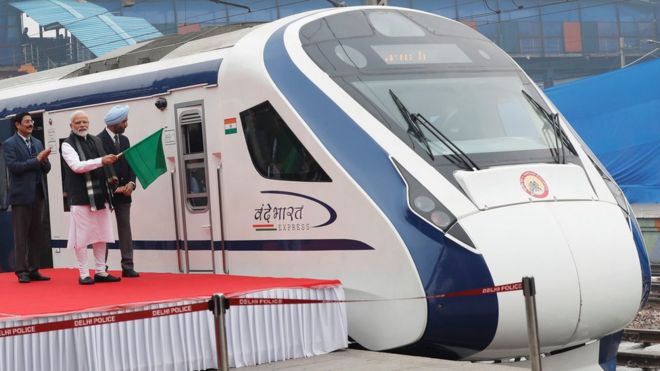 Image copyrightREUTERS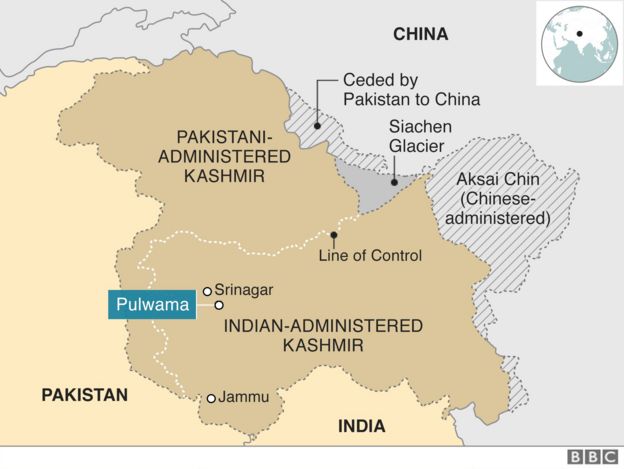


 CHINDIA ALERT: You'll be living in their world, very soon