Archive for ‘Espionage’

30/05/2020

US-China tensions set to worsen as moderates lose out to hardliners, observers say

  • Chinese groups calling for more ‘fighting spirit’ are getting the upper hand on those who favour calm and cooperation, government adviser says
  • From Hong Kong to Covid-19, trade to the South China Sea, Beijing and Washington are clashing on a growing number of fronts and in an increasingly aggressive way
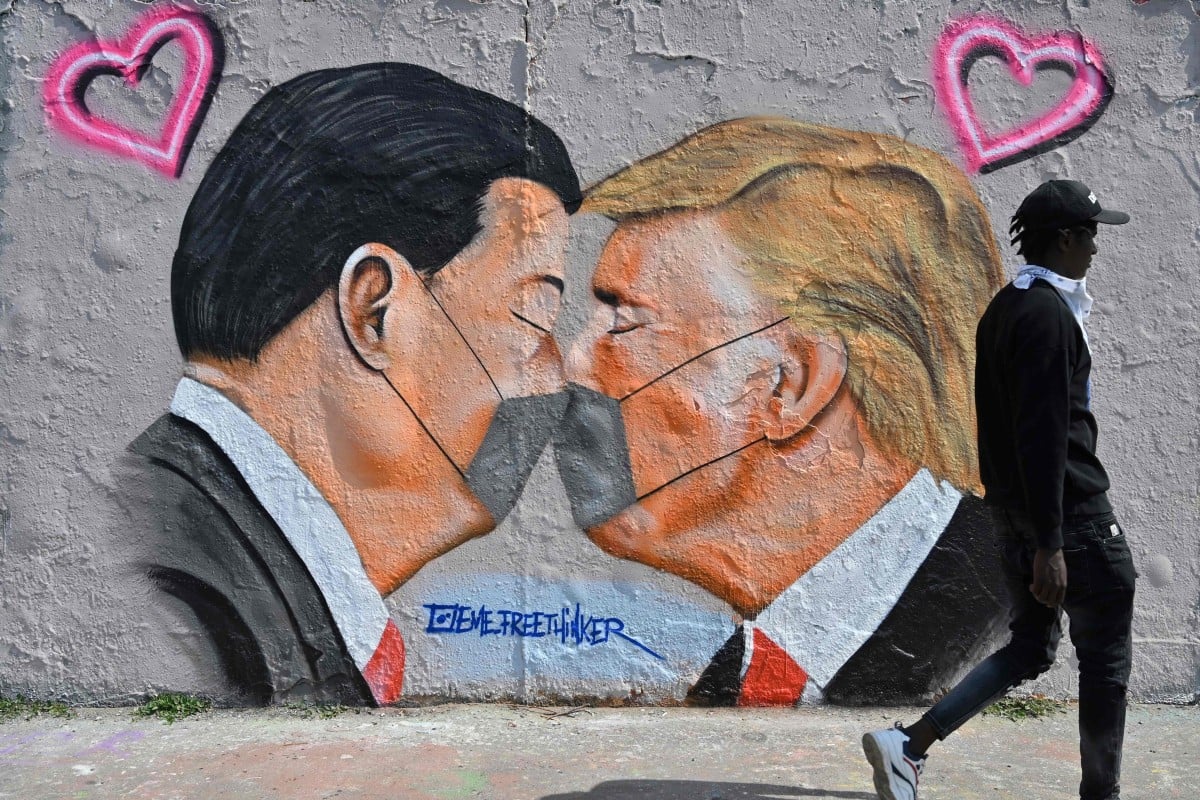
Efforts to promote dialogue and cooperation between the US and China are failing, observers say. Photo: AFP
Moderates who favour dialogue and cooperation as a way to resolve China’s disputes with the United States are losing ground to hardline groups bent on taking the fight to Washington, according to political insiders and observers.
“There are two camps in China,” said a former state official who now serves as a government adviser and asked not to be named.
“One is stressing the combat spirit, the other is trying to relieve tensions. And the former has the upper hand.”
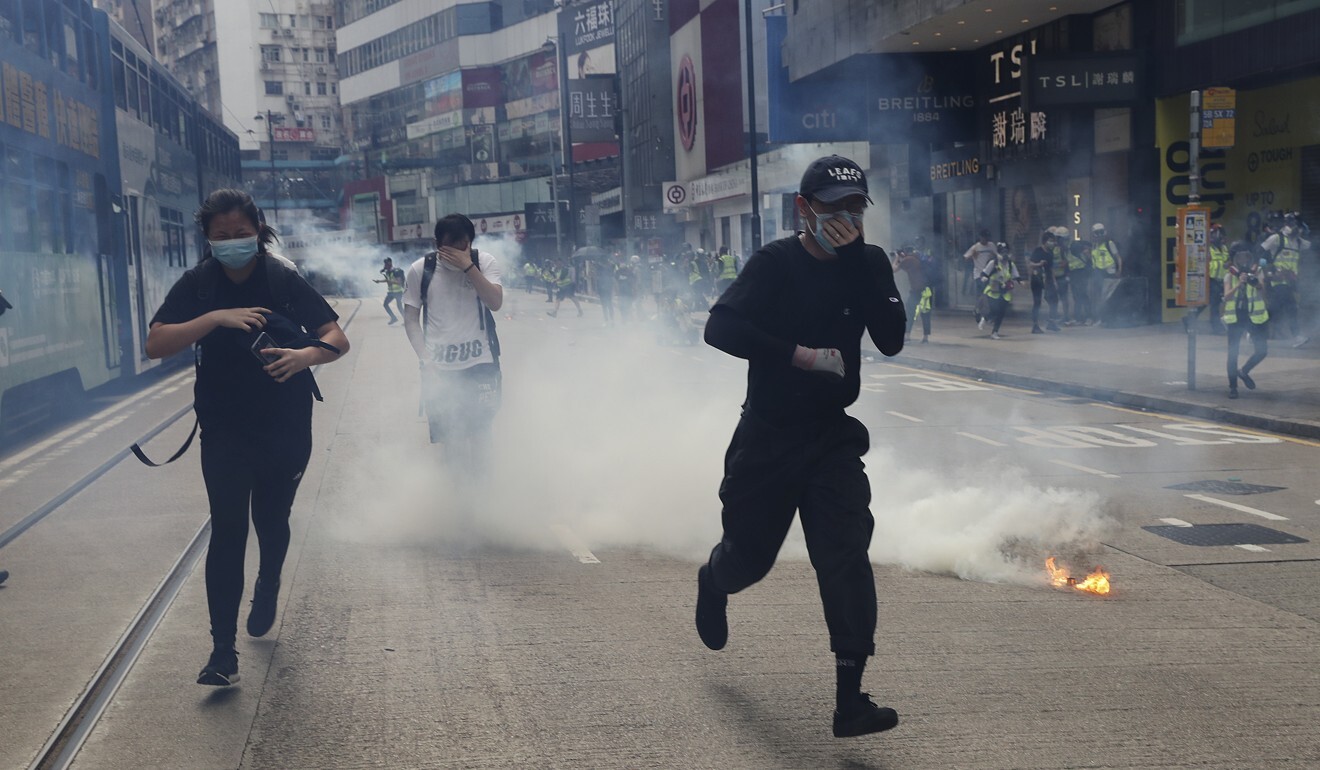
Relations between China and the US are under intense pressure. After Beijing moved to introduce a national security law for Hong Kong, US President Donald Trump said on Friday that Washington would begin eliminating the special policy exemptions it grants the city, as it no longer considers it autonomous from mainland China.
Beijing’s decision to enact a national security law for Hong Kong was met with anger from the US and other Western countries. Photo: Sam Tsang
The two nations have also clashed over trade, Xinjiang, Taiwan and the South China Sea, with the US passing several acts denouncing Beijing and sanctioning Chinese officials.
China has also experienced turbulence in its relations with other countries, including Australia and members of the European Union, mostly related to the Covid-19 pandemic
 and Beijing’s efforts to position itself as a leader in the fight against the disease with its policy of “mask diplomacy”.

After Canberra appealed for an independent investigation to be carried out to determine the origins of the coronavirus, Beijing responded by imposing tariffs on imports of Australian barley, showing it is prepared to do more than just trade insults and accusations with its adversaries.

Pang Zhongying, a professor of international relations at Ocean University of China in Qingdao, said there was a worrying trend in China’s relations with other nations.

“We need political and diplomatic means to resolve the challenges we are facing, but … diplomatic methods have become undiplomatic,” he said.

“There are some who believe that problems can be solved through tough gestures, but this will never work. Without diplomacy, problems become confrontations.”

Chinese Foreign Minister Wang Yi

said during his annual press conference on the sidelines of the National People’s Congress last weekend that China and the United States must work together to prevent a new Cold War.

His words were echoed by Chinese Premier Li Keqiang, who said during a press conference after the closure of the legislative session on Thursday that the many challenges facing the China-US relations could only be resolved through cooperation.

However, the government adviser said there was often quite a chasm between what China’s leaders said and what happened in reality.

“Even though we say we do not want a Cold War, what is happening at the working level seems to be different.” he said. “The implementation of policies is not properly coordinated and often chaotic.”

Tensions between China and the US have been in a poor state since the start of a trade war almost two years ago. After multiple rounds of negotiations, the sides in January signed a phase one deal, but the positivity that created was short-lived.

In February, Beijing expelled three reporters from The Wall Street Journal over an article it deemed racist, while Washington has ramped up its military activity in the South China Sea and Taiwan Strait, and threatened to revoke the visas of Chinese students studying science and technology in the US over concerns they might be engaged in espionage.

Beijing has also used its state media and army of “Wolf Warrior” diplomats to promote its narrative, though many Chinese scholars and foreign policy advisers have said the latter’s nationalistic fervour has done more harm than good and appealed to Beijing to adopt a more conciliatory tone.
However, Hu Xijin, editor-in-chief of Chinese tabloid Global Times, said China had no option but to stare down the US, which regarded the world’s most populous nation as its main rival.
“Being contained by the US is too high a price for China to pay,” he said. “I think the best thing people can do is forget the old days of China-US ties”.

Jin Canrong, a professor of international relations at Renmin University in Beijing, wrote in a recent newspaper article that Beijing’s actions – notably enacting a national security law for Hong Kong – showed it was uncompromising and ready to stand its ground against the US.

Wu Xinbo, dean of international studies at Fudan University in Shanghai, agreed, saying relations between the two countries were likely to worsen in the run-up to the US presidential election in November and that Beijing should be prepared for a fight.

But Adam Ni, director of China Policy Centre, a think tank in Canberra, said the issue was not that the moderate camp had been sidelined, but rather Beijing’s perception of the US had changed.

“Beijing has woken up to the idea that America’s tough policy on China will continue and it is expecting an escalation of the tensions,” he said.

“The centre of gravity in terms of Beijing’s perception of the US has shifted, in the same way the US perception of China has shifted towards a more negative image”.

Beijing was simply responding in kind to the hardline, assertive manner of the US, he said.

Source: SCMP

16/05/2019

Trump administration hits China’s Huawei with one-two punch

WASHINGTON/NEW YORK (Reuters) – The Trump administration on Wednesday took aim at China’s Huawei Technologies Co Ltd, banning the firm from buying vital U.S. technology without special approval and effectively barring its equipment from U.S. telecom networks on national security grounds.

Taken together, the two moves threaten Huawei’s ability to continue to sell many products because of its reliance on American suppliers, and represents a significant escalation in the U.S. government’s worldwide campaign against the company.

The steps also come at a delicate time in relations between China and the United States as the world’s two largest economies ratchet up tariffs in a battle over what U.S. officials call China’s unfair trade practices.

Washington believes the handsets and network equipment for telecommunications companies made by Huawei could be used by the Chinese state to spy on Americans.

Huawei, which has repeatedly denied the allegations, said in a statement that “restricting Huawei from doing business in the U.S. will not make the U.S. more secure or stronger; instead, this will only serve to limit the U.S. to inferior yet more expensive alternatives, leaving the U.S. lagging behind in 5G deployment.”

“In addition, unreasonable restrictions will infringe upon Huawei’s rights and raise other serious legal issues.”

The ban on U.S. suppliers, which appears similar to one on Huawei rival ZTE Corp. last year, could hit the shares of Huawei’s biggest U.S. suppliers, including chipmakers Qualcomm Inc and Broadcom Inc (AVGO.O).

In the first action taken on Wednesday, President Donald Trump signed a long-awaited executive order declaring a national emergency and barring U.S. companies from using telecommunications equipment made by firms posing a national security risk.

The order invoked the International Emergency Economic Powers Act, which gives the president the authority to regulate commerce in response to a national emergency that threatens the United States. It directs the Commerce Department, working with other government agencies, to draw up an enforcement plan by October.

Members of Congress said Trump’s order was squarely aimed at Chinese companies like Huawei, which generated $93 billion in revenue last year and is seen as a national champion in China.

“China’s main export is espionage, and the distinction between the Chinese Communist Party and Chinese ‘private-sector’ businesses like Huawei is imaginary,” Republican Senator Ben Sasse said.

ENTITY LIST

Soon after the White House announced the order had been signed, the Commerce Department said it had added Huawei and 70 affiliates to its so-called Entity List – a move that bans the telecom giant from buying parts and components from U.S. companies without U.S. government approval.

U.S. officials told Reuters the decision would make it difficult, if not impossible, for Huawei, the largest telecommunications equipment producer in the world, to sell some products because of its reliance on U.S. suppliers. It will take effect in the coming days.

Commerce Secretary Wilbur Ross said in a statement Trump backed the decision that will “prevent American technology from being used by foreign owned entities in ways that potentially undermine U.S. national security or foreign policy interests.”

With Huawei on the Entity List, U.S. suppliers will need to apply for licenses to provide the Chinese company with anything subject to U.S. export control regulations. Obtaining such licenses will be difficult because they will have to show the transfer of items will not harm U.S. national security, said John Larkin, a former export control officer in Beijing for the Commerce Department.

The United States in January unsealed a 13-count indictment against Huawei accusing the company and its chief financial officer of conspiring to defraud global financial institutions by misrepresenting Huawei’s relationship with a suspected front company that operated in Iran.

The indictment was unsealed a month after CFO Meng Wanzhou was arrested in Canada on a U.S. warrant for her role in the alleged fraud. Meng, who maintains her innocence, is fighting extradition.

5G NETWORKS

Reuters reported on Tuesday that Trump was expected to sign his long-awaited executive order this week. The order does not specifically name any country or company, but U.S. officials have previously labeled Huawei a “threat”.

The United States has been actively pushing other countries not to use the Chinese company’s equipment in next-generation 5G networks that it calls “untrustworthy.” In August, Trump signed a bill that barred the U.S. government from using equipment from Huawei and another Chinese provider, ZTE Corp.

ZTE was added to the Commerce Department’s Entity List in March 2016 over allegations it organised an elaborate scheme to hide its re-export of U.S. items to sanctioned countries in violation of U.S. law.

The restrictions prevented suppliers from providing ZTE with U.S. equipment, potentially freezing the company’s supply chain, but the restrictions were suspended in a series of temporary reprieves, allowing the company to maintain ties to U.S. suppliers until it agreed to a plea deal a year later.

The status of Huawei and ZTE has taken on new urgency as U.S. wireless carriers rollout 5G networks.

While the big wireless companies have already cut ties with Huawei, small rural carriers continue to rely on both Huawei and ZTE switches and other equipment because they tend to be cheaper. Trump’s order applies to future purchases and does not address existing hardware, officials said Wednesday.

Source: Reuters

18/02/2019

Britain does not support total Huawei network ban – sources

(Reuters) – British security officials do not support a full ban of Huawei from national telecoms networks despite U.S. allegations the Chinese firm and its products could be used by Beijing for spying, people with knowledge of the matter said.

Huawei, the world’s biggest producer of telecoms equipment, faces intense scrutiny in the West over its relationship with the Chinese government and allegations of enabling state espionage, with the United States calling for its allies not to use its technology.

Although no evidence has been produced publicly and Huawei has denied the claims, the allegations have led several Western countries to restrict its access to their markets.

“We don’t favour a complete ban. It’s not that simple,” one of the sources told Reuters on Monday after a Financial Times report on Sunday said that Britain had decided it could mitigate the risks of using Huawei equipment in 5G networks.

The FT cited two sources familiar with what it said was a conclusion by the government’s National Cyber Security Council (NCSC), which last year said technical and supply-chain issues with Huawei’s equipment had exposed national telecom networks to new security risks. Huawei had no immediate comment.

Any decision to allow Huawei to participate in building next-generation 5G networks would be closely watched by other nations, because of Britain’s membership of the Five Eyes intelligence-sharing group with the United States.

Britain is an important market for Huawei and last month Vodafone, the world’s second-largest mobile operator, said it was “pausing” the deployment of its equipment in core networks until Western governments give the Chinese firm full security clearance.

Other operators in Europe, including Britain’s BT and France’s Orange have already removed Huawei’s equipment or taken steps to limit its future use.

Two sources said the NCSC did not think it was necessary to completely bar Huawei from British networks, believing it could continue to manage any risks by testing the products at a special laboratory overseen by intelligence officials.

Both sources, who spoke on condition of anonymity because of the sensitivity of the matter, said the position was consistent with public statements made by the NCSC and British officials.


“As was made clear in July’s HCSEC oversight board, the NCSC has concerns around Huawei’s engineering and security capabilities. We have set out the improvements we expect the company to make, an NCSC spokeswoman said on Monday.

CONFIDENCE MEASURES

People with knowledge of the matter said the next NCSC report on Huawei’s position in Britain will criticise its slow response to issues raised in last year’s report and detail tense relations with British officials.

The report, which is expected to be released in coming weeks, does not itself set government policy.

The results of a government review of British telecoms infrastructure is expected later in the year and will include recommendations on managing security risks, including in future 5G networks.

Fellow Five Eyes member Australia has banned Huawei from supplying 5G equipment, while New Zealand said on Monday it would make its own independent assessment of the risk of using Huawei equipment in 5G networks.

Huawei has set up security labs in Britain and Germany aimed at building confidence that its equipment does not contain “back doors” for Chinese intelligence services.

It has also offered to build a cyber-security centre in Poland, where authorities have arrested a Chinese Huawei employee along with an ex-Polish security official.

Source: Reuters

29/07/2013

China’s brain drain may be world’s worst

China Daily: “Sun Zhipei has only been in Helsinki for four months, but he has already decided it is where he wants to settle.

The 35-year-old nanotech scientist previously spent almost 10 years living in Spain and Britain, and said he would not entertain the idea of returning to his native China.

“I can have more control about what I want to study here and carry out projects I’m interested in,” said the associate professor at Aalto University, who gained his PhD at the Chinese Academy of SciencesInstitute of Physics.

Sun’s attitude perhaps goes some way toward explaining a People’s Daily report in June that said China is experiencing “the world’s worst brain drain”.

Eighty-seven percent of the mainland’s top specialists in science and engineering who went abroad for work or study have no plans to return, the paper quoted an unnamed official with the Party’s coordination group on specialists as saying.

The group consists of 20 Party and government agencies, including the Organization Department of the Communist Party of China’s Central Committee, which oversees human resources.

China Daily interview requests with the organization department went unanswered.

Although independent experts and statistics do not confirm the severity of the brain drain, there is little doubt it exists.

Wang Huiyao, director-general of the Center for China and Globalization, a Beijing-based think tank, said since the reform and opening-up policy of the late 1970s, 2.6 million Chinese students have studied overseas, of which about half went to the United States.”

via China’s brain drain may be world’s worst |Society |chinadaily.com.cn.

06/11/2012

* Neil Heywood: Briton killed in China ‘had spy links’

No smoke without a fire?

BBC: “A British businessman killed in China had been providing information to the British secret service, the Wall Street Journal newspaper claims.

File photo: British businessman Neil Heywood

Neil Heywood had been communicating with an MI6 officer about top politician Bo Xilai for at least a year before he died, the paper said.

The UK Foreign Office said it would not comment “on intelligence matters”.

In April, Foreign Secretary William Hague said Mr Heywood was not a government employee “in any capacity”.

The case is at the heart of China’s biggest political scandal in decades.

The November 2011 death of Mr Heywood brought down Mr Bo, the former Communist Party chief of Chongqing and a high-flier who was once tipped for top office.

Mr Bo’s wife, Gu Kailai, was jailed in August for the murder of Mr Heywood at a Chongqing hotel. His former police chief, Wang Lijun, has also been jailed in connection with the scandal.

Mr Bo himself was expelled from parliament in September, stripping him of immunity from prosecution. He is accused of abuse of power, bribe-taking and violating party discipline, Chinese state media say, and is expected to go on trial in the future.

via BBC News – Neil Heywood: Briton killed in China ‘had spy links’.

See also: https://chindia-alert.org/2012/08/12/bo-xilai-scandal-gu-admits-neil-heywood-murder/

19/10/2012

* Huawei – leaked report shows no evidence of spying

Was the recent US congressional report just trying to “even out a level playing field” for US telecoms companies or was it based on genuine security concerns?

BBC: “A US government security review has found no evidence telecoms equipment firm Huawei Technology spies for China.

Huawei stand at mobile communications show

The 18-month review, details of which were leaked to the Reuters news agency, suggests security vulnerabilities posed a greater threat than any links between the firm and the Chinese government.

Last week a US congressional report warned against allowing Chinese companies Huawei and ZTE Corp to supply critical telecom infrastructure.

The firms have always denied espionage.

The classified inquiry was a thorough review of how Huawei worked, involving nearly 1,000 telecom equipment buyers.

One of the government employees involved with the inquiry told Reuters: “We knew certain parts of government really wanted evidence of active spying. We would have found it if it were there.”

Huawei spokesman Bill Plummer said: “Huawei is not familiar with the review, but we are not surprised to hear that the White House has concluded there is no evidence of any Huawei involvement with any espionage or other non-commercial activities.

“Huawei is a $32bn [£19bn] independent multinational that would not jeopardise its success or the integrity of its customers’ networks for any government or third party – ever,” he added.

ZTE’s senior vice president of Europe and North America, Zhu Jiny, told the BBC: “The security issues should not be focused on the Chinese companies. These are problems of the world situation. It’s not only Chinese companies – it’s a global issue.””

via BBC News – Huawei – leaked report shows no evidence of spying.

15/06/2012

* Arrested spy compromised China’s U.S. espionage network

Reuters: “A Chinese state-security official arrested this year on allegations of spying for Washington is suspected to have compromised some of China’s U.S. agents in a major setback that angered President Hu Jintao, sources said.

Hu personally intervened this year, ordering an investigation into the case after the Ministry of State Security arrested one of its own officials for passing information to the Americans, two sources with direct knowledge of the matter said.

The official, an aide to a vice minister, was taken into custody sometime between January and March after the ministry became alarmed last year over repeated incidents of Chinese agents being compromised in the United States, they said.

Seal of the C.I.A. - Central Intelligence Agen...

Seal of the C.I.A. of the United States Gov’t (Photo credit: Wikipedia)

The ministry’s own investigations found the aide had been working for the Central Intelligence Agency (CIA) for years, divulging information about China’s overseas spy network in the nation’s worst espionage scandal for two decades, they added.

The sources’ comments represent the first confirmation that overseas Chinese espionage was deemed to have been damaged by the security breach, which has been kept quiet by both Beijing and Washington. Reuters first reported it on June 1.”

via Exclusive: Arrested spy compromised China’s U.S. espionage network: sources | Reuters.

Law of Unintended Consequences

continuously updated blog about China & India

ChiaHou's Book Reviews

continuously updated blog about China & India

What's wrong with the world; and its economy

continuously updated blog about China & India