Archive for ‘free speech’

22/05/2020

NPC: China begins move to impose controversial Hong Kong security law

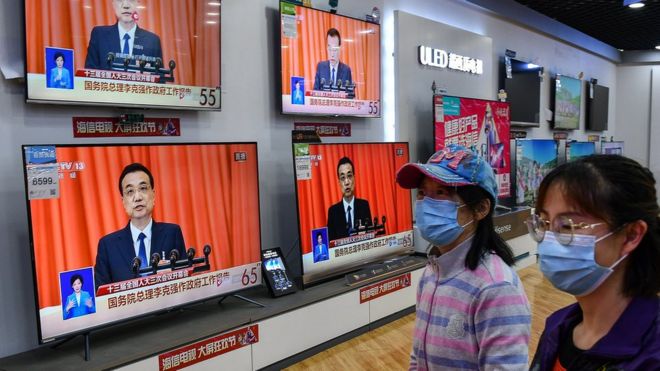
Shoppers walking past a broadcast of Chinese Premier Li Keqiang delivering his speech at the opening of the NPCImage copyright AFP / GETTY
Image caption Shoppers walking past a broadcast of Chinese Premier Li Keqiang delivering his speech at the opening of the NPC on Thursday

China’s ruling Communist Party has set in motion a controversial national security law for Hong Kong, a move seen as a major blow to the city’s freedoms.

The law to ban “treason, secession, sedition and subversion” could bypass Hong Kong’s lawmakers.

Critics say China is breaking its promise to allow Hong Kong freedoms not seen elsewhere in China.

It is likely to fuel public anger and may even trigger fresh protests and demands for democratic reform.

The plan was submitted at the annual National People’s Congress (NPC), which largely rubber-stamps decisions already taken by the Communist leadership, but is still the most important political event of the year.

Hong Kong, a semi-autonomous region and an economic powerhouse, was always meant to have introduced such laws after the handover from British control to Chinese rule in 1997.

After last year’s wave of sustained and violent protest, Beijing is now attempting to push them through, arguing “law-based and forceful measures” must be taken to “prevent, stop and punish” such protests in the future.

On Friday, Hong Kong’s government said it would co-operate with Beijing to enact the law, adding it would not affect the city’s freedoms.

What is in Beijing’s proposed law?

The “draft decision” – as it is known before approval by the NPC – was explained by Wang Chen, vice chairman of the Standing Committee of the NPC.

It consists of an introduction and seven articles. Article 4 may prove the most controversial.

That article says Hong Kong “must improve” national security, before adding: “When needed, relevant national security organs of the Central People’s Government will set up agencies in Hong Kong to fulfil relevant duties to safeguard national security in accordance with the law.”

China could essentially place this law into Annex III of the Basic Law, which covers national laws that must be implemented in Hong Kong – either by legislation, or decree.

Addressing the congress, Premier Li Keqiang spoke of the economic impact of the coronavirus and on Hong Kong and Macau said: “We’ll establish sound legal systems and enforcement mechanisms for safeguarding national security in the two Special Administrative Regions.”

What do opponents say the dangers are?

Hong Kong is what is known as a “special administrative region” of China.

It has observed a “one country, two systems” policy since Britain returned sovereignty in 1997, which has allowed it certain freedoms the rest of China does not have.

Pro-democracy activists fear that China pushing through the law could mean “the end of Hong Kong” – that is, the effective end of its autonomy and these freedoms.

Last year’s mass protests in Hong Kong were sparked by a bill that would have allowed extraditions to mainland China.
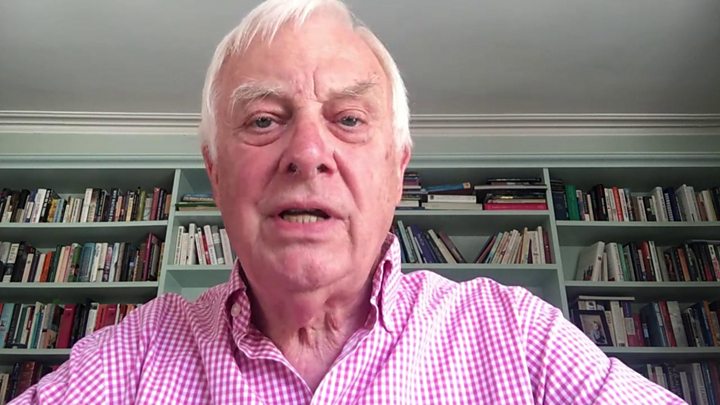
Media caption Former Hong Kong governor Chris Patten: “UK should tell China this is outrageous”

The bill was paused, then withdrawn – but the protests continued until the virus outbreak at the end of the year.

The US has also weighed in, with President Trump saying the US would react strongly if it went through – without giving details.

It is currently considering whether to extend Hong Kong’s preferential trading and investment privileges.

Why is China doing this?

Mr Wang said the security risks had become “increasingly notable” – a reference to last year’s protests.

“Considering Hong Kong’s situation at present, efforts must be made at the state-level to establish and improve the legal system and enforcement mechanisms,” he is quoted as saying in state media.
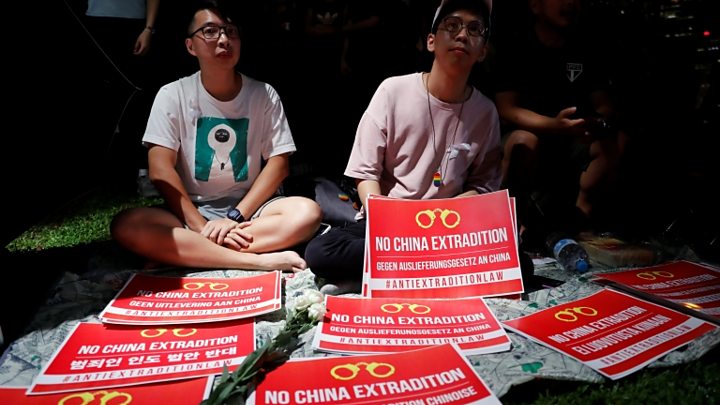
Media caption The BBC’s Helier Cheung on Hong Kong’s 2019 protests

Beijing may also fear September’s elections to Hong Kong’s legislature.

If last year’s success for pro-democracy parties in district elections is repeated, government bills could potentially be blocked.

What is Hong Kong’s legal situation?

Hong Kong was under British control for more than 150 years up to 1997.

The British and Chinese governments signed a treaty – the Sino-British Joint Declaration – that agreed Hong Kong would have “a high degree of autonomy, except in foreign and defence affairs”, for 50 years.

This was enshrined in the Basic Law, which runs out in 2047.

As a result, Hong Kong’s own legal system, borders, and rights – including freedom of assembly and free speech – are protected.

But Beijing has the ability to veto any changes to the political system and has, for example, ruled out direct election of the chief executive.
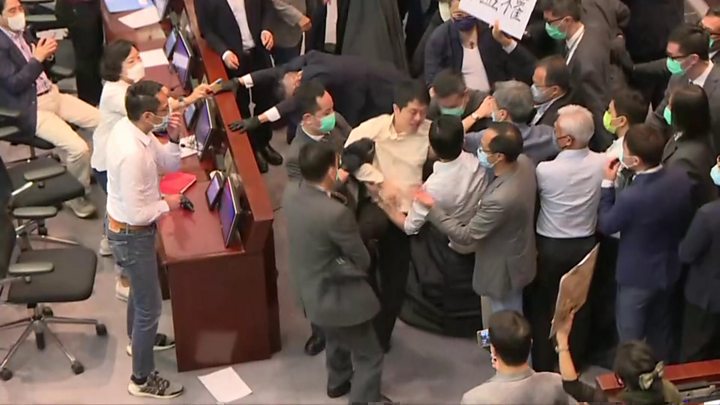
Media caption Uproar on Monday in Hong Kong’s legislature

Source: The BBC

29/08/2019

Tolstoy’s War and Peace lands India activist in trouble

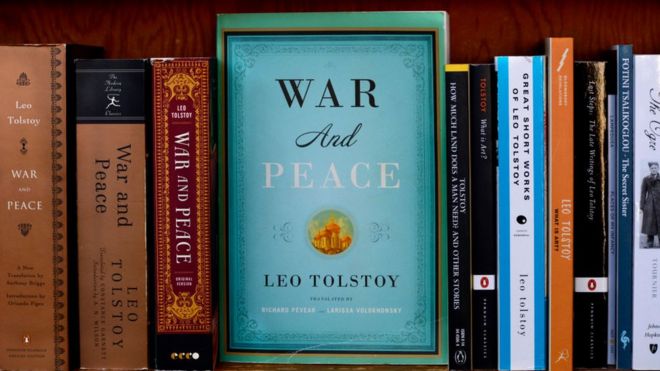
Books by Leo Tolstoy, incuding 'War and Peace', are among titles featured at City Lights Bookstore in San Francisco, California.Image copyright GETTY IMAGES

Leo Tolstoy’s War and Peace is in the news in India after a judge asked an activist to explain why he had a book “about war in another country”.

Vernon Gonsalves had appeared in the high court in Mumbai city on Wednesday for a hearing on his bail plea.

The judge’s question sparked a flurry of tweets, with users both outraged and bemused by it.

Five activists, including Mr Gonsalves, were arrested in August 2018 in connection with caste-based violence.

Police raided and searched their homes at the time and submitted a list of books, documents and other belongings to the court. The public prosecutor told the court that police had found “incriminating evidence” in Mr Gonsalves’ home, including “books and CDs with objectionable titles”.

“Why were you having these books and CDs at your home? You will have to explain this to the court,” the judge told Mr Gonsalves.

He also pointed out a CD titled Rajya Daman Virodhi or “in protest against state oppression” saying, “The title itself suggests it has something against the state.”

Police said that all five activists incited Dalits (formerly untouchables) at a large public rally on 31 December 2017, leading to violent clashes that left one person dead. They accused them of “radicalising youth” and taking part in “unlawful activities” which led to violence and showed “intolerance to the present political system”.

The arrests had been criticised by many at the time who saw them as an attack on free speech, and even a “witch hunt” against those who challenged the governing Bharatiya Janata Party (BJP).

So the judge’s question quickly made news and War and Peace was soon trending on Twitter.

The tweets ranged from jokes to shock over the state of India’s judiciary.

Presentational white space

Others wondered how they would fare in a courtroom given what’s on their bookshelf, and some have issued a call out asking people to share books from their own “subversive” collection.

Source: The BBC

17/02/2016

Free Speech in China Gets an Unlikely State-Media Backer – China Real Time Report – WSJ

China’s ruling Communist Party is cracking down on internal criticism, and the editor of one of the country’s most nationalist tabloids isn’t going to take it anymore.

In a post on his Weibo microblog over the weekend, Hu Xijin, editor in chief of the Global Times, called on Chinese authorities to show greater tolerance for dissenting opinions.

“China should open up more channels for criticism and suggestions and encourage constructive criticism,” Mr. Hu wrote on Sunday. “There also should be a certain amount of tolerance for unconstructive criticism.”

While allowing greater freedom of speech can lead to some problems, it brings greater benefits, he wrote, adding that recent Chinese history since the beginning of Communist rule in 1949 shows that freedom of speech “is inseparably linked to the vitality of society.”

“As for the problems it causes, the state has ample capacity to respond,” Mr. Hu wrote, without elaborating.

The message had received more than 2,000 comments and 1,500 “likes” as of Wednesday afternoon, on par with some of Mr. Hu’s other recent posts.

The posting comes as the Communist Party is doubling down on its efforts to stifle dissent among cadres. The sacking last November of Zhao Xinyu, an editor at a state-run newspaper, drew attention to a new tool in the party’s repertoire: the punishment of members for “groundlessly commenting” on official policies.

Introduced in a set of party rules last October, the prohibition against speaking out on national policies – known in Chinese as 妄议中央, wangyi zhongyang – is likely to have a chilling effect on political discussion within China, experts say.

It wasn’t clear whether Mr. Hu’s posting was in reaction to the new regulation – although some of the comments on his post indicated that the issue is on Chinese Internet users’ minds. “Aren’t you afraid of [being fired for] groundlessly commenting on official policies?” one user wrote.

Source: Free Speech in China Gets an Unlikely State-Media Backer – China Real Time Report – WSJ

Law of Unintended Consequences

continuously updated blog about China & India

ChiaHou's Book Reviews

continuously updated blog about China & India

What's wrong with the world; and its economy

continuously updated blog about China & India