Chindia Alert: You’ll be Living in their World Very Soon
aims to alert you to the threats and opportunities that China and India present. China and India require serious attention; case of ‘hidden dragon and crouching tiger’.
Without this attention, governments, businesses and, indeed, individuals may find themselves at a great disadvantage sooner rather than later.
The POSTs (front webpages) are mainly 'cuttings' from reliable sources, updated continuously.
The PAGEs (see Tabs, above) attempt to make the information more meaningful by putting some structure to the information we have researched and assembled since 2006.
Teams from Shanghai, Guangdong – including experts who helped tackle Sars – arrive in Wuhan to lend their support
Tencent, JD.com, Lenovo among raft of private firms offering financial aid to those battling deadly outbreak
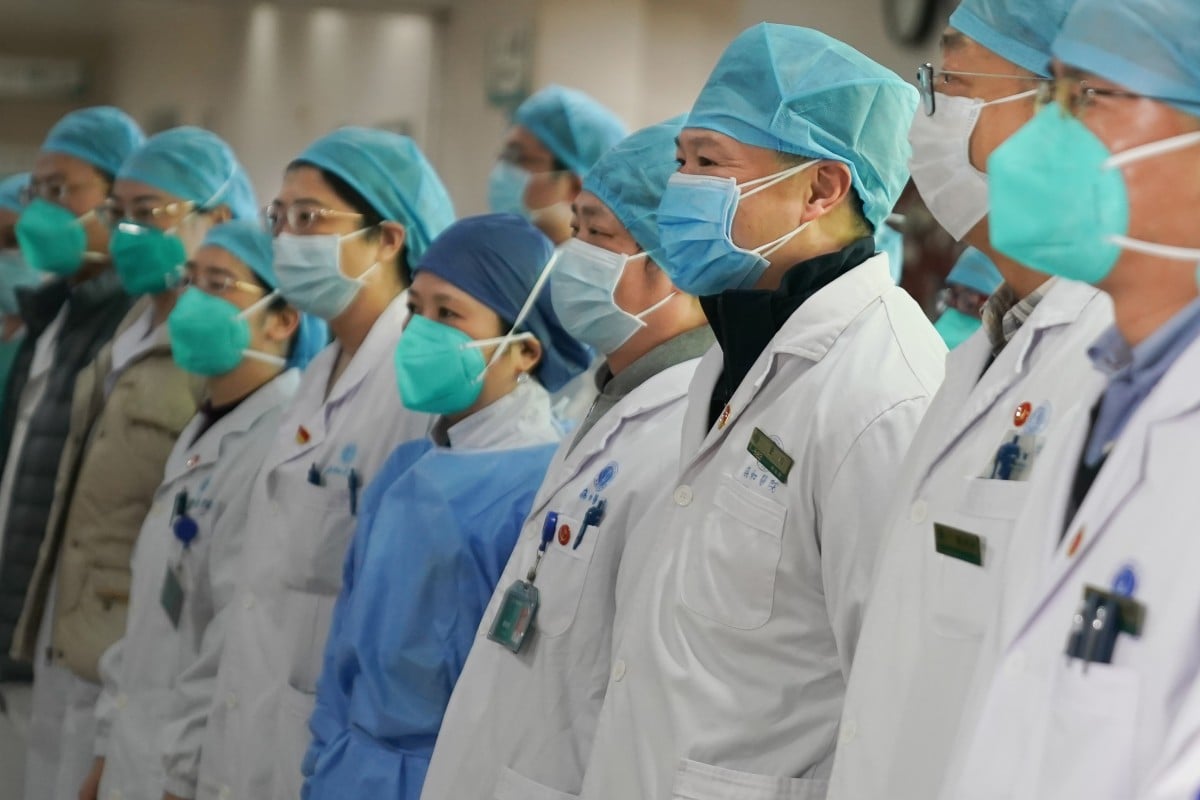
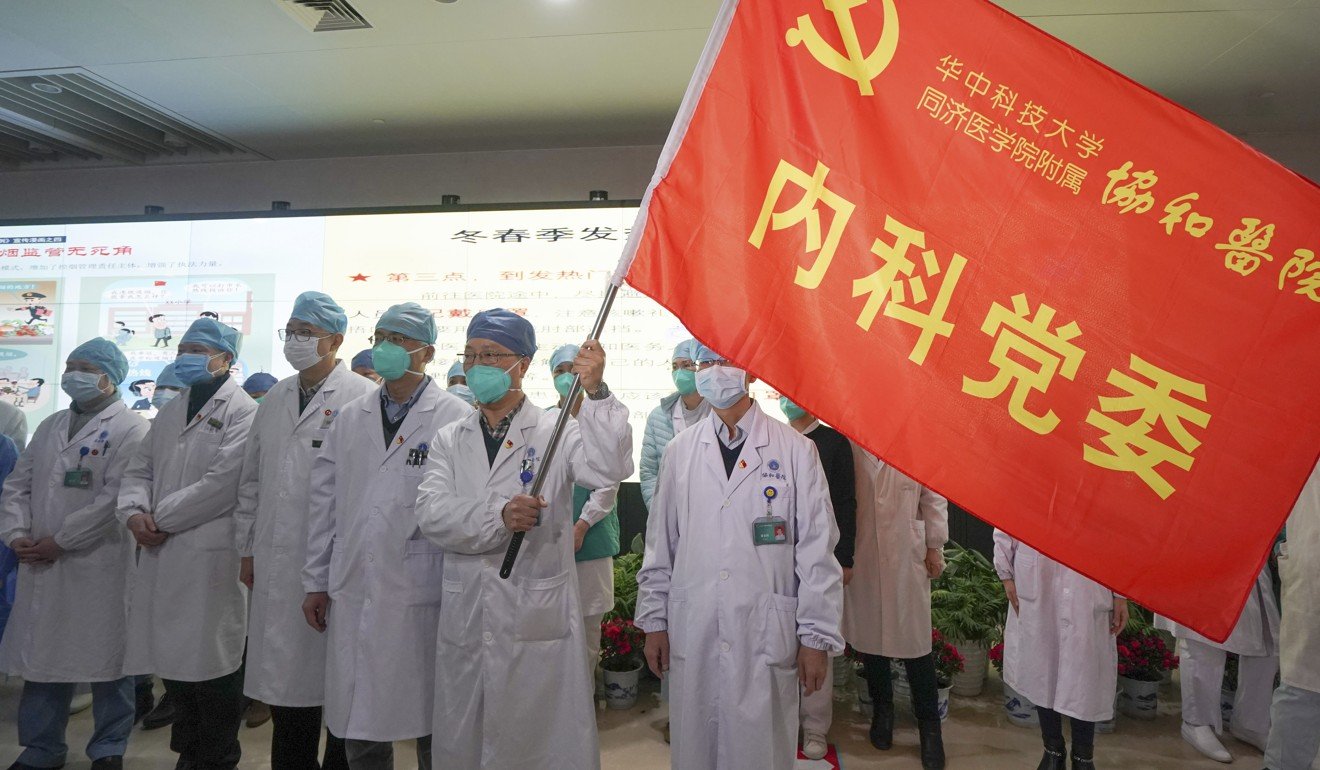
Doctors and nurses from across China are being dispatched to help tackle the coronavirus epidemic in Hubei province. Photo: Xinhua
Chinese authorities and private enterprises are stepping up their support for embattled medical teams in Hubei province as they continue to fight the coronavirus epidemic, while neighbouring governments ramp up their efforts to prevent its further spread.
Hospitals across Wuhan – the city at the centre of the outbreak – have been overwhelmed by the flood of patients and doctors are becoming increasingly frustrated at the lack of support, both in terms of supplies and personnel, they have received.
But national bodies say they are responding to the crisis.
On Saturday, China’s National Health Commission (NHC) said that six medical teams comprising 1,230 staff had been set up and dispatched to help fight the deadly virus in Hubei.
Three medical units from Shanghai, Guangdong and the armed forces had already arrived in the province, it said, though did not make clear if they were in addition to or part of the six teams.
Chen Dechang, a doctor from Ruijin Hospital in Shanghai who is among those sent to Hubei, said it was important there were more medical staff on the scene.
“We can help save more patients in the intensive care unit if we are on the front line,” he said.
Authorities in Shanghai have also sent 81 ECMO (extracorporeal membrane oxygenation) life-support machines to Jinyintan Hospital, which is one of the designated facilities treating patients in Wuhan.
The ECMO technique – which involves removing blood from a person’s body, removing the carbon dioxide and oxygenating red blood cells before pumping them back into the patient – has already been used on one critically ill patient at Wuhan University’s Zhongnan Hospital, according to Shanghai-based news outlet Thepaper.cn.
Though the report did not say how effective the treatment had been.
Medical teams in Wuhan have been under huge pressure since the outbreak began. Photo: Xinhua
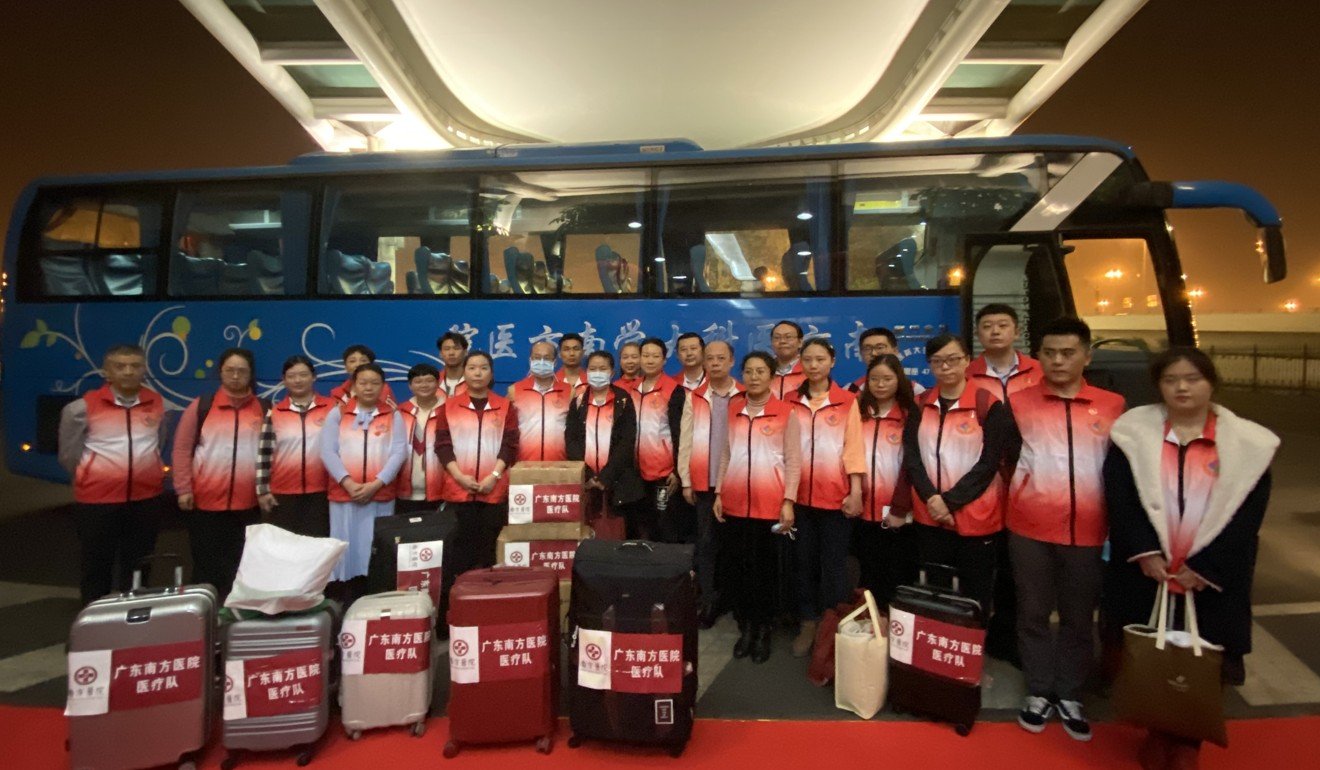
The team from Guangdong comprised 42 doctors and 93 nurses, the NHC said. The deployment came after a group of current and former medical staff from Southern Medical University in Guangzhou – who had helped tackle the Sars (severe acute respiratory syndrome) outbreak in 2002-03 – signed a petition saying they were willing to help in Wuhan.
“We are a team of experienced practitioners who fought Sars,” they said in the petition, a copy of which was posted on the social media accounts of Communist Party mouthpiece People’s Daily.
“We cannot back away from our responsibility to help 17 years later as people are facing the outbreak of a new coronavirus. We are willing to be deployed to the front line to make our contributions.”
A team of 135 doctors from Chongqing arrived in Wuhan on Friday evening, the NHC said, without elaborating.
A medical team from Guangdong province prepares to travel to Wuhan. Photo: Xinhua
As well as the wave of medical support, several private companies said they had provided financial support to help fight the epidemic.
According to Chinese media reports, Shanghai Ocean Forest Assets has donated 10 million yuan (US$1.4 million) to the cause, while Shanghai-based asset management firm, Jinglin Assets is coordinating efforts to buy urgently needed medical supplies from South Korea and Japan.
Shenzhen’s Fantasia Holdings said it would donate 6 million yuan and send medical supplies, including surgical masks, to Wuhan, while tech giant Tencent said it would donate 300 million yuan from its charity. E-commerce platform JD.com said it had donated 1 million surgical masks and 60,000 other medical items.
Chinese smartphone manufacturer Xiaomi said on Friday it had sent a first batch of medical equipment – masks and thermometers worth more than 300,000 yuan – to Wuhan, while tech firm Lenovo said on Saturday it would donate all of the IT equipment required by the new specialist treatment centre being built in the city.
Authorities set a target to have the 1,000-bed facility up and running within six days of starting construction.
Aside from the support from the private sector, state lender China Development Bank on Friday issued a 2 billion yuan emergency loan to Wuhan, while a day earlier, China’s finance ministry said it had allocated 1 billion yuan to authorities in Hubei to help tackle the epidemic.
Across the country, authorities have introduced a number of measures to help prevent the further spread of the coronavirus, including the closure of all cinemas in Shanghai.
Wuhan residents stockpile food, medical supplies
25 Jan 2020
Also on Saturday it was reported that Liang Wudong, a doctor at Xinhua Hospital in Wuhan, had become the first medical professional to die after treating people infected with the virus.
Liang, 62, was suspected of having contracted the virus last week and had been transferred to Jinyintan Hospital for treatment. He died at 7am on Saturday, Thepaper.cn reported.
According to official figures, 41 people have been killed by the coronavirus and there have been more than 1,280 confirmed cases. The vast majority are in the Chinese mainland, but there have also been confirmed cases in Hong Kong, Macau, Taiwan and eight other countries, including the United States and Europe.
Tens of millions of people in cities across Hubei are effectively on lockdown after the introduction of travel bans to help control the spread of the virus.
As public health concerns rise over a new virus, the impact is being felt by China’s travel and tourism sector.
More than 400m Chinese were expected to travel over the Lunar New Year which starts today, normally one of the busiest periods for airlines, hotels and tourist attractions.
Instead, flights and hotels are being cancelled as people face travel restrictions or choose to stay home.
The virus has already taken 25 lives, with more than 800 cases globally.
Many airlines have agreed to refund fares or let passengers rebook free of charge if affected, while major hotel chains are now following suit as more travel restrictions are announced.
After the Civil Aviation Administration of China announced that airlines should give refunds for cancelled flights, the country’s three major airlines, China Southern Airlines, China Eastern Airlines and China Air all saw their share prices take a dive. China Eastern Airlines has seen its value fall about 13% this week.
Hong Kong’s national carrier Cathay Pacific was among the first airlines to allow passengers scheduled to fly to or from Wuhan to reschedule for free while, at the same time, allowing cabin crew to wear surgical masks on flights.
Wuhan is where the first cases in the outbreak were reported. The flu-like virus has since spread to several our parts of China and internationally with cases being confirmed in Singapore, Thailand and the US among others countries.
China’s biggest online travel agency, Trip.com, is also waiving cancellation fees on all hotels, car rentals and tickets for tourist attractions to Wuhan and is ”actively monitoring the situation to ensure the safety of all travellers”.
Hotels and casinos hit
Hotel groups are also paying out refunds to tourists who want to cancel trips to Wuhan and other parts of China.
Both InterContinental Hotels Group (IHG) and Hyatt will allow guests to change or cancel stays at the majority of their Chinese hotels over the Lunar New Year holiday. IHG has 443 hotels in China, Hong Kong, Macau and Taiwan under different brands, with four in Wuhan.
Casino operators have also seen shares fall, particularly those with businesses in Macau. The city is home to casinos owned by Las Vegas Sands and Wynn Resorts.
The release of seven movies over the Lunar New Year has also been postponed.
Blow to economy
Tourism has become an increasingly important part of the Chinese economy and is estimated to contribute about 11% of China’s economic growth and employ about 28 million people.
In 2018, 62.9 million tourists visited China, ranking it the fourth most popular tourist destination behind France, Spain and the US, according to the UN’s World Tourism Rankings.
Outside of China, luxury goods brands are also likely to take a battering as Chinese tourists stay at home rather than travel overseas for shopping sprees. LVMH, which owns the Burberry, Louis Vuitton and Hermes brands, saw its value slide this week.
BEIJING (Reuters) – The death toll from China’s coronavirus outbreak jumped on Saturday to 41 as the Lunar New Year got off to a gloomy start, with Hong Kong declaring a virus emergency, scrapping celebrations, and restricting links to mainland China.
Australia on Saturday confirmed its first four cases, Malaysia confirmed three and France reported Europe’s first cases on Friday, as health authorities around the world scrambled to prevent a pandemic.
Hong Kong leader Carrie Lam on Saturday declared a virus emergency in the Asian financial hub, with five confirmed cases, immediately halting official visits to mainland China and scrapping official Lunar New Year celebrations.
Inbound and outbound flights and high speed rail trips between Hong Kong and Wuhan, the epicentre of the outbreak, would be halted, and schools, now on Lunar New Year holidays, would remain shut until Feb. 17. The territory was also treating 122 people suspected of having the disease.
RELATED COVERAGE
U.S. to evacuate its citizens from Wuhan, China – WSJ
China’s President Xi holds politburo meeting on curbing virus outbreak – state TV
The death toll in China rose to 41 on Saturday from 26 a day earlier and more than 1,300 people have been infected globally with a virus traced to a seafood market in the central city of Wuhan that was illegally selling wildlife.
Hu Yinghai, deputy director-general of the Civil Affairs Department in Hubei province, where Wuhan is located, made an appeal on Saturday for masks and protective suits. Hospitals in the city have made similar pleas.
“We are steadily pushing forward the disease control and prevention … But right now we are facing an extremely severe public health crisis,” he told a news briefing.
Vehicles carrying emergency supplies and medical staff for Wuhan would be exempted from tolls and given traffic priority, China’s transportation ministry said on Saturday.
Wuhan said it would ban non-essential vehicles from its downtown starting Sunday to control the spread of the virus, further paralysing a city of 11 million that has been on virtual lockdown since Thursday, with nearly all flights cancelled and checkpoints blocking the main roads leading out of town.
Authorities have since imposed transport restrictions on nearly all of Hubei province, which has a population of 59 million.
In Australia, three men, aged 53, 43 and 35 in New South Wales were in stable condition after they were confirmed to have the virus after returning from Wuhan earlier this month.
A Chinese national in his 50s, who had been in Wuhan, was also in stable condition in a Melbourne hospital after arriving from China on Jan. 19, Victoria Health officials said.
State-run China Global Television Network reported in a tweet on Saturday that a doctor who had been treating patients in Wuhan, 62-year-old Liang Wudong, had died from the virus.
Police officers stand guard in front of the closed gate of Lama Temple where a notice saying that the temple is closed for the safety concern following the outbreak of a new coronavirus is seen, in Beijing, China January 25, 2020. REUTERS/Carlos Garcia Rawlins
It was not immediately clear if his death was already counted in the official toll of 41, of which 39 were in the central province of Hubei, where Wuhan is located.
U.S. coffee chain Starbucks said on Saturday that it was closing all its outlets in Hubei province for the week-long Lunar New Year holiday, following a similar move by McDonald’s in five Hubei cities.
PROTECTIVE SUITS
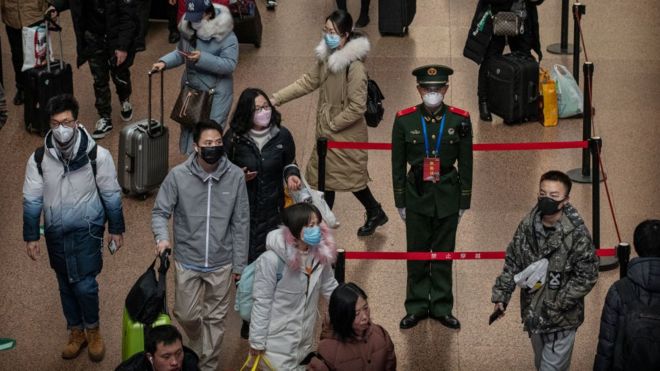
In Beijing on Saturday, workers in white protective suits checked temperatures of passengers entering the subway at the central railway station, while some train services in eastern China’s Yangtze River Delta region were suspended, the local railway operator said.
The number of confirmed cases in China stands at 1,287. The virus has also been detected in Thailand, Vietnam, Singapore, Japan, South Korea, Taiwan, Nepal, and the United States.
The U.S. Centers for Disease Control and Prevention said on Friday it had 63 patients under investigation, with two confirmed cases. While China has called for transparency in managing the crisis, after cover-up of the 2002/2003 Severe Acute Respiratory Syndrome spread, officials in Wuhan have come in for criticism over their handling of the current outbreak.
In rare public dissent, a senior journalist at a Hubei provincial newspaper run by the ruling Communist Party on Friday called for a “immediate” change of leadership in Wuhan on the Twitter-like Weibo. The post was later removed.
REINFORCEMENTS TO WUHAN
The World Health Organization (WHO) declared the new coronavirus an “emergency in China” this week but stopped short of declaring it of international concern.
Human-to-human transmission has been observed in the virus.
China’s National Health Commission said it had formed six medical teams totalling 1,230 medical staff to help Wuhan.
Hubei province, where authorities are rushing to build a 1,000 bed hospital in six days to treat patients, announced on Saturday that there were 658 patients affected by the virus in treatment, 57 of whom were critically ill.
The newly-identified coronavirus has created alarm because there are still many unknowns surrounding it, such as how dangerous it is and how easily it spreads between people. It can cause pneumonia, which has been deadly in some cases.
Symptoms include fever, difficulty breathing and coughing. Most of the fatalities have been in elderly patients, many with pre-existing conditions, the WHO said.
NEW YEAR DISRUPTIONS
Airports around the world have stepped up screening of passengers from China, though some health officials and experts have questioned the effectiveness of such screenings.
There are fears the transmission could accelerate as hundreds of millions of Chinese travel during the week-long Lunar New Year holiday, which began on Saturday, although many have cancelled their plans, with airlines and railways in China providing free refunds.
The virus outbreak and efforts to contain it have put a dampener on what is ordinarily a festive time of year.
Sanya, a popular resort destination on the southern Chinese island of Hainan, announced that it was shutting all tourist sites, while the island’s capital city, Haikou, said visitors from Wuhan would be placed under 14-day quarantine in a hotel.
Shanghai Disneyland was closed from Saturday. The theme park has a 100,000 daily capacity and sold out during last year’s Lunar New Year holiday.
Beijing’s Lama Temple, where people traditionally make offerings for the new year, has also closed, as have some other temples.
Media caption The billionaire financier and philanthropist has become a divisive figure in global politics in recent years
Billionaire philanthropist George Soros has launched a stinging attack on the “authoritarian rulers” of both the US and China.
He said President Donald Trump was a “conman and the ultimate narcissist” who had breached the limits of the US constitution.
And he said China’s President Xi Jinping was using technology to exert total control over Chinese life.
“The world would be a better place if they weren’t in power,” Mr Soros said.
Using his annual speech at the World Economic Forum, in Davos, the financier warned of a growing threat from populism and climate change, while pledging $1bn towards a new global university network to tackle intolerance.
But the businessman – who is a major donor to the US Democratic party – said Beijing and Washington posed the biggest threat to “open societies”.
“Both [leaders] try to extend the powers of their office to its limit and beyond.
“Trump is willing to sacrifice the national interests for his personal interests and he will do practically anything to win re-election.
“By contrast, Xi Jinping is eager to exploit Trump’s weaknesses and use artificial intelligence to achieve total control over his people.”
The White House was approached for comment.
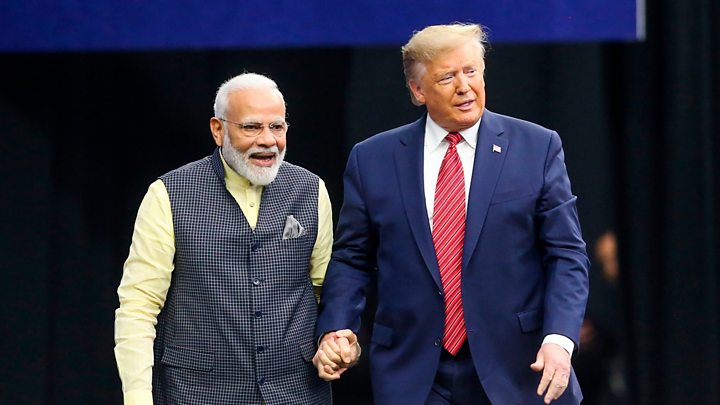
Media caption Modi to Trump: “My honour to introduce you to my family”
Mr Soros also targeted Indian Prime Minister Narendra Modi, saying the Indian state was “imposing punitive measures on Kashmir, a semi-autonomous Muslim region, and threatening to deprive millions of Muslims of their citizenship”.
He was referring to two controversial decisions made by Mr Modi’s Hindu nationalist government.
The first was to strip the disputed Kashmir region of its semi-autonomous status and place it under virtual lockdown.
The second is the introduction and passage of a controversial citizenship law that critics say is discriminatory towards Muslims.
It seeks to fast-track Indian citizenship to non-Muslim minorities from three nearby Muslim-majority countries.
Media caption The Conspiracy Files: Why did Hungary’s PM turn on George Soros?
The US and China recently struck a deal to de-escalate a major trade war which has seen both sides impose tariffs on billions of dollars worth of exports.
But Mr Soros said President Xi’s had stifled China’s economy, while Mr Trump had “overheated” his.
“US stock markets are high but can’t be kept at boiling point for too long.”
Mr Soros, a Jew who survived Nazi occupation by forging identity documents, became infamous for his involvement in the devaluation of the British pound, known as Black Wednesday.
But it is his philanthropic and political activities that have made him a divisive figure in the US, Europe and beyond.
He has spent billions of his own money funding human rights projects and liberal democratic ventures around the world, and has become a frequent target for criticism by right-wing groups due to his support for liberal causes.
Much of the criticism aimed at him has been criticised as having anti-Semitic undertones.
The financier, who is a regular at the elite World Economic Forum, said his new university network would help promote “critical thinking” in an age of intolerance.
The move will be seen as a riposte to Hungarian President Victor Orban, who has repeatedly tried to shut down the Central European University, a private institution set up by Mr Soros in the country in 1971.
Mr Orban’s populist nationalist government claims Mr Soros has a secret plot to flood Hungary with migrants and destroy the nation, an accusation Mr Soros denies.
Mr Soros said the network would be “the most important and enduring project of my life and I should like to see it implemented while I am still around”.
BEIJING, China (Reuters) – China ramped up measures to contain a virus that has killed 26 people and infected more than 800, suspending public transport in 10 cities, shutting temples over the Lunar New Year and even closing the Forbidden City and part of the Great Wall.
The week-long holiday to welcome the Year of the Rat began on Friday, raising fears the infection rate could accelerate as hundreds of millions of people travel to their homes and abroad in what is usually a festive time of year.
The World Health Organisation (WHO) has declared the new coronavirus an emergency for China but stopped short of declaring the epidemic of international concern.
While most of the cases and all of the deaths have been in China, the virus has been detected in Thailand, Vietnam, Singapore, Japan, South Korea, Taiwan and the United States. It was likely Britain also had cases, a health official said.
RELATED COVERAGE
‘What choice do I have?’ Lock-down strands millions in China’s Wuhan
WHO expects coronavirus cases to rise in China
The newly identified coronavirus has created alarm because it is too early to know just how dangerous it is and how easily it spreads between people.
Symptoms include fever, difficulty breathing and coughing.
Most of the fatalities have been elderly, many with pre-existing conditions, the WHO said.
Cases are likely to continue to rise in China but it is too soon to evaluate the severity of the virus, a WHO spokesman said on Friday.
As of Thursday, there were 830 confirmed cases and 26 people had died there, China’s National Health Commission said.
In Wuhan, where the outbreak began last month, pharmacies were running out of supplies and hospitals were flooded with nervous resident seeking medical checks.
“There’s so much news, so much data, every 10 minutes there’s an update, it’s frightening, especially for people like us in a severely hit area,” Lily Jin, 30, a resident of the city, told Reuters by phone.
While restrictions have already been put in place in cities across the country to curb the outbreak, China will take stricter and more targeted measures, state television reported citing a state council, or cabinet, meeting on Friday, but gave no further details.
“The spread of the virus has not been cut off … Local authorities should take more responsibility and have a stronger sense of urgency,” state broadcaster CCTV said.
Most cases have been in Wuhan, where the virus is believed to have originated in a market that traded illegally in wildlife. Preliminary research suggested it crossed to humans from snakes.
The city of 11 million people, and neighboring Huanggang, a city of about 7 million, were in virtual lockdown.
Nearly all flights at Wuhan’s airport had been canceled, and airports worldwide have stepped up the screening of passengers from China.
Checkpoints blocked the main roads leading out of town, and police checked incoming vehicles for wild animals.
Wuhan was rushing to build a 1,000-bed hospital for the infected by Monday, the official Changjiang Daily reported.
About 10 people got off a high-speed train that pulled into Wuhan on Friday afternoon but nobody got on before it resumed its journey. Although it stopped there, Wuhan had been removed from the train’s schedule.
“What choice do I have? It’s Chinese New Year. We have to see our family,” said a man getting off the train who gave his family name Hu.
CHINA EMERGENCY
The WHO said on Thursday it was a “bit too early” to designate the outbreak a public health emergency of international concern, which would require countries to step up their response.
Some experts believe the virus is not as dangerous as the one that caused the 2002-03 outbreak of Severe Acute Respiratory Syndrome, which also began in China and killed nearly 800 people, or the one that caused Middle East Respiratory Syndrome, which has killed more than 700 people since 2012.
There is no known vaccine or particular treatment.
“There is some work being done and there are some trials now for MERS (vaccines). And we may look at some point whether those treatments and vaccines would have some effect on this novel coronavirus,” WHO spokesman Tarik Jasarevic said on Friday.
Gilead Sciences Inc said it was assessing whether its experimental Ebola treatment could be used. Meanwhile, three research teams were starting work on vaccines, the Coalition for Epidemic Preparedness Innovations said.
In the meantime, Chinese authorities have imposed restrictions on movement and gatherings to try to stem the spread. It has advised people to avoid crowds and 10 cities in the central province of Hubei, where Wuhan is located, have suspended some transport, the Hubei Daily reported.
Some sections of the Great Wall near Beijing will be closed from Saturday, state media said.
Some temples have also closed, including Beijing’s Lama Temple where people make offerings for the new year, have also been closed as has the Forbidden City, the capital’s most famous tourist attraction.
Shanghai Disneyland will close from Saturday. The theme park has a 100,000 daily capacity and sold out during last year’s Lunar New Year holiday.
The virus is expected to dent China’s growth after months of economic worries over trade tensions with the United States, unnerving foreign companies doing business there.
Shares in luxury goods firms have suffered from the anticipated drop in demand from China, and on Friday French spirits group Remy Cointreau said it was “clearly concerned” about the potential impact.
Chinese President Xi Jinping, also general secretary of the Communist Party of China (CPC) Central Committee and chairman of the Central Military Commission, addresses a Chinese Lunar New Year reception at the Great Hall of the People in Beijing, capital of China, Jan. 23, 2020. The CPC Central Committee and the State Council held the reception on Thursday in Beijing. (Xinhua/Yao Dawei)
BEIJING, Jan. 23 (Xinhua) — Chinese President Xi Jinping on Thursday stressed racing against time and keeping abreast with history to reach the Chinese Dream of national rejuvenation.
“Time and history wait for no one as they are both on the side of hard workers,” said Xi, also general secretary of the Communist Party of China (CPC) Central Committee and chairman of the Central Military Commission.
Xi made the remarks while addressing a Chinese Lunar New Year reception held at the Great Hall of the People in Beijing.
Under the strong leadership of the CPC, all members of the Party, armed forces and people of all ethnic groups must fear no wind or wave, rise up to challenges and keep marching toward the glorious goal of national rejuvenation and the great prospect of building a community with a shared future for humanity, Xi said.
At the reception, held by the CPC Central Committee and the State Council, Xi extended Lunar New Year’s greetings to Chinese people of all ethnic groups, compatriots in Hong Kong, Macao and Taiwan and overseas Chinese.
Party and state leaders Li Keqiang, Li Zhanshu, Wang Yang, Wang Huning, Zhao Leji, Han Zheng and Wang Qishan were among the more than 2,000 people attending the reception. Li Keqiang chaired the event.
Xi noted in his speech that new and significant progress has been made in the past year toward building a moderately prosperous society in all respects.
He mentioned major events during the year, including the fourth plenary session of the 19th CPC Central Committee, celebrations marking the 20th anniversary of Macao’s return to the motherland and resolute efforts to safeguard the prosperity and stability of Hong Kong and Macao, as well as celebrations marking the 70th founding anniversary of the People’s Republic of China.
A campaign themed “staying true to our founding mission” was also carried out to demand the more than 90 million Party members remember to always stay with the people.
“In the new year, we must secure a decisive victory in building a moderately prosperous society in all respects and fighting poverty,” Xi said, adding that achieving this first centenary goal is a milestone in the process of realizing the Chinese Dream of national rejuvenation.
The results, Xi said, must be recognized by the people and stand the test of time.
Xi said the Chinese nation, with a civilization stretching back over 5,000 years, has made indelible contributions to the civilization and progress of mankind. But the nation was held back for too long by various internal and external troubles in modern times.
That is why, Xi said, the Chinese people have always had an extraordinary sense of urgency and appreciation of the underlying trend of the times.
From now to the middle of this century, the Chinese people will strive to build China into a great modern socialist country. It will be a great era in which a new splendid chapter of the Chinese civilization will be written, he said.
Every Chinese person must feel proud of living in such a great era, Xi said.
“We must maintain strategic direction and resolve, stay united, work hard and forge ahead against all odds,” Xi said.
on Thursday, just a week after President Tsai Ing-wen angered Beijing by saying the island was an independent country.
According to Taiwan’s defence ministry, the formation, which included a KJ-500 early warning and control aircraft and an H-6 bomber, passed through the Bashi Channel near Taiwan’s Orchid Island en route to the western Pacific Ocean.
It did not say how many aircraft were involved but said they had taken off from different airbases in southern China.
“They returned to their airbases from their morning flight path after a long-haul exercise,” the ministry said in a statement.
The ministry urged the public not to be alarmed by the aircraft’s presence, saying it constantly monitored the activities of the People’s Liberation Army (PLA), both in the air and at sea.
Taiwan’s armed forces would also remain on high alert over the Lunar New Year
holiday, which starts on Friday, it said.
“There is no holiday for national security,” it said.
The PLA exercise came just a week after Tsai said on January 15 that Beijing needed to face the reality of Taiwan’s independence.
“We don’t have a need to declare ourselves an independent state,” she said in an interview with the BBC. “We are an independent country already and we call ourselves the Republic of China, Taiwan.”
Tsai urges mainland China to review strained ties
21 Jan 2020
Tsai’s comments came just days after she secured a second term as president with a record 8.2 million votes.
In her victory speech, she promised to continue to stand up to Beijing’s intimidation, while also strengthening Taiwan’s defences, partly by developing more home-grown military equipment, including submarines.
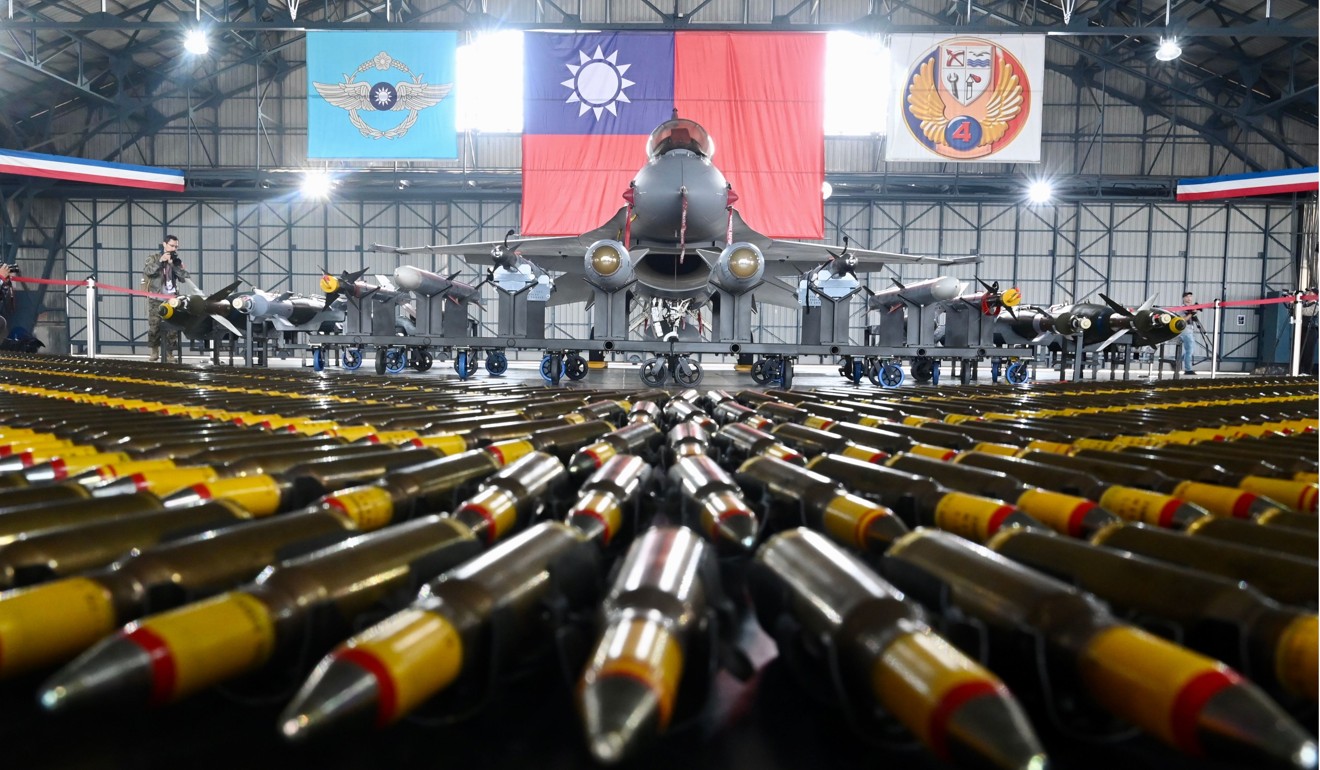
US-made F-16V fighters took part in a show of Taiwan’s military might last week. Photo: AFP
In response to Tsai’s “independent country” comments, Ma Xiaoguang, a spokesman for the mainland’s Taiwan Affairs Office, said: “We firmly attack and counter various forms of Taiwan independence and separatist activities to maintain overall peace and stability in the Taiwan Strait.”
Beijing regards Taiwan as part of its territory awaiting reunification, by force if necessary. Official ties between the two sides have been suspended since Tsai took office in 2016 and refused to accept the one-China principle – the political understanding that there is only one China with ambiguity over whether it is governed by Taipei or Beijing.
Over the past four years Beijing has ramped up the pressure on the island, by poaching its diplomatic allies and staging military drills.
Taiwanese Minister of National Defence Yen Te-fa said earlier that the mainland staged about 2,000 bomber patrols a year near the Taiwan Strait.
For their part, Taiwan’s army and air force last week gave two demonstrations of their readiness to defend the island against attack.
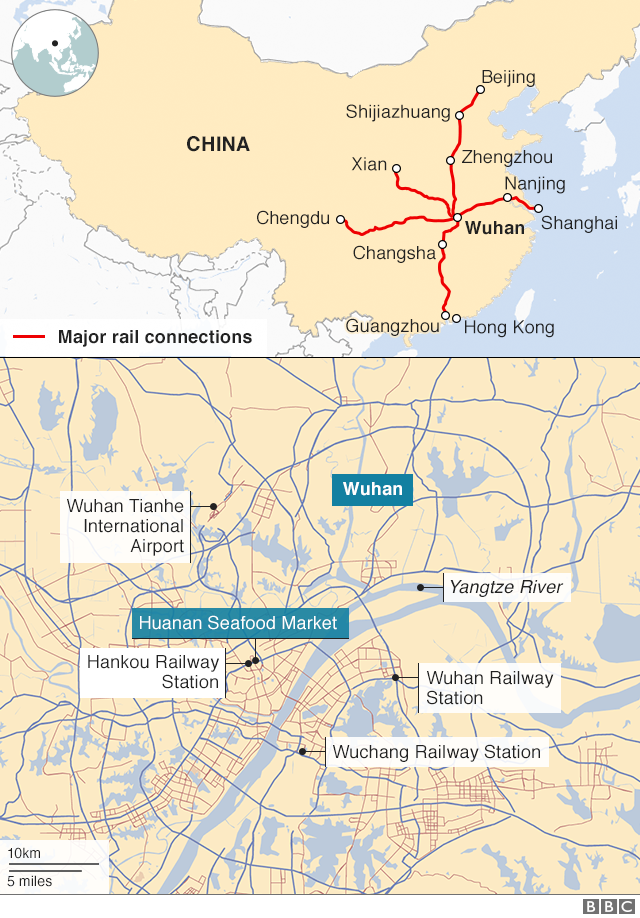
Wuhan, a Chinese city of eleven million people, has temporarily shut down its public transport as it tries to halt the outbreak of a new strain of virus.
Those living in the city have been advised not to leave, in a week when millions of Chinese are travelling for the upcoming Lunar New Year holiday.
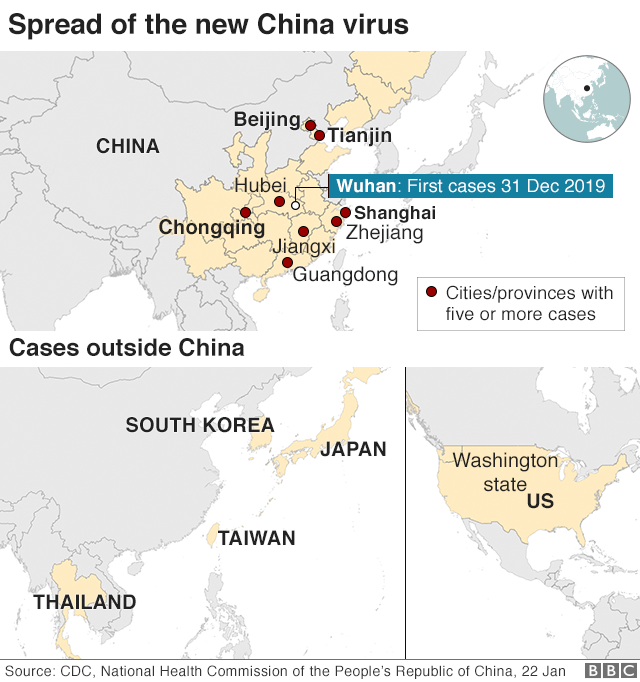
The respiratory illness has spread to other parts of China, with some cases in other countries including the US.
There are more than 500 confirmed cases and 17 people have died.
Known for now as 2019-nCoV, the virus is understood to be a new strain of coronavirus not previously identified in humans. The Sars (severe acute respiratory syndrome) virus that killed nearly 800 people globally in the early 2000s was also a coronavirus, as is the common cold.
All the fatalities so far have been in Hubei, the province around Wuhan.
Meanwhile, after a day of discussions in Geneva, the World Health Organization’s (WHO) emergency committee has announced it will not yet declare a “global emergency” over the new virus.
Director general Dr Tedros Ghebreyesus said more information was needed about the spread of the infection. The committee of health experts will meet again on Thursday.
A global emergency is the highest level of alarm the WHO can sound and has previously been used in response to swine flu, Zika virus and Ebola.
What measures have been announced?
From Thursday, all flights and passenger train services out of Wuhan have been stopped.
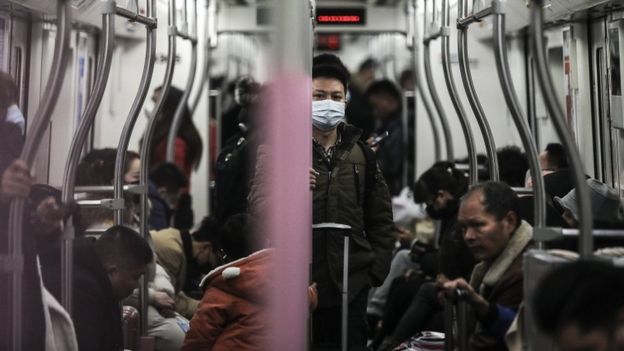
Bus, subway and ferry services all shut down from 10:00 local time (02:00 GMT).
A special command centre in Wuhan set up to contain the virus said the move was meant to “resolutely contain the momentum of the epidemic spreading”.
Those living in Wuhan had already been told to avoid crowds and minimise public gatherings.
State news agency Xinhua said tourist attractions and hotels in the city had been told to suspend large-scale activities while libraries, museums and theatres were cancelling exhibitions and performances.
A Lunar New Year prayer-giving ceremony at the city’s Guiyuan Temple, which attracted 700,000 people last year, has also been cancelled.
The hashtag “Wuhan is sealed off” was trending on Chinese social media website Weibo.
One user said worries about food and disinfectant made it feel like “the end of the world”, while another said they were on the “verge of tears” when Chinese officials announced the shut-down.
The WHO’s Dr Ghebreyesus described the latest measures as “very strong” and said they would “not only control the outbreak, they will minimise spread internationally”.
Chinese officials said the country was now at the “most critical stage” of prevention and control.
“Basically, do not go to Wuhan. And those in Wuhan please do not leave the city,” said National Health Commission vice-minister Li Bin in one of the first public briefings since the beginning of the outbreak.
Like shutting down London before Christmas
By James Gallagher, BBC health and science correspondent
Wuhan is starting to look like a city in quarantine.
Officials had already warned residents not to leave the city and visitors not to come.
Now the reported public transport ban – which includes flights – slams many of the routes in and out of the city shut.
Image copyright GETTY IMAGESImage caption Subways in Wuhan will be temporarily shut
It is a significant attempt to stop the spread of this new virus, which we now know can spread from person to person.
Limiting transport will cut the chance of the virus reaching other cities in China and other countries around the world.
This all comes just as millions of people are travelling across China for the week-long holiday that is Lunar New Year.
If you’re struggling for context – imagine shutting down London in the week before Christmas.
The big question left is the roads – and whether any of Wuhan’s 11 million inhabitants will be able to simply drive away.
The patient in Macau is said to be a businesswoman who arrived from Wuhan over the weekend.
The first US case was confirmed on Tuesday. President Donald Trump said the situation was “totally under control” and that he trusted the information being provided by Chinese authorities.
There have been three cases in Thailand, one in Korea, one in Japan and one in Taiwan.
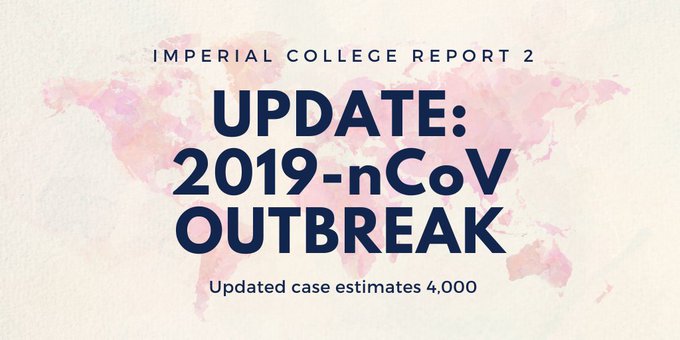
Although only about 500 cases have been confirmed, calculations by scientists at the MRC Centre for Global Infectious Disease Analysis at Imperial College London suggest there are 4,000 people sick with the virus in Wuhan.
Our estimate at 4,000 cases is more than double the past estimate due to increase of number of cases outside China. This should not be interpreted as implying the outbreak has doubled in size.
The virus originated in a seafood market in Wuhan that “conducted illegal transactions of wild animals”, authorities said. The market has since been shut down.
Chinese President Xi Jinping, also general secretary of the Communist Party of China Central Committee and chairman of the Central Military Commission, beats a wooden drum of the Wa ethnic group three times to bless the coming year in Sanjia Village in the city of Tengchong, southwest China’s Yunnan Province, Jan. 19, 2020. Xi has extended Chinese New Year greetings to all Chinese people during a three-day inspection tour to Yunnan Province which concluded Tuesday. (Xinhua/Ju Peng)
KUNMING, Jan. 21 (Xinhua) — Chinese President Xi Jinping has extended Chinese New Year greetings to all Chinese people.
He wished Chinese people of all ethnic groups a better life and the country greater prosperity in the new year.
Xi, also general secretary of the Communist Party of China (CPC) Central Committee and chairman of the Central Military Commission, made the remarks during a three-day inspection tour of southwest China’s Yunnan Province which concluded Tuesday.
During a visit to Sanjia Village in the city of Tengchong on Sunday afternoon, Xi learned about poverty alleviation efforts and called for efforts to speed up the development of ethnic minorities and areas with large ethnic minority populations.
After joining local villagers in making rice cakes, a traditional local festival food, Xi noted that shaking off poverty is the new starting point, calling for vigorously promoting rural vitalization after China completes the building of a moderately prosperous society in all respects.
According to local custom, Xi beat a wooden drum of the Wa ethnic group three times to bless the coming year.
Later that day, Xi went to the old town of Heshun, a gateway on the ancient Southern Silk Road, where he visited a village-level library built over 90 years ago.
Visiting the memorial hall of Ai Siqi, a renowned philosopher, Xi said the country needs a large number of talented individuals who can explain the adaptation of Marxism to the Chinese context well and who can use easy-to-understand language to spread the Party’s new theories to more ordinary households.
Visiting an ecological wetland of Dianchi Lake in Kunming on Monday, Xi stressed resisting the old way of developing the economy at the cost of the environment.
Dianchi Lake, once among the most polluted lakes in China, has seen its ecology greatly improved after years of conservation efforts.
Inspecting market supply for Chinese New Year at the Kunming International Convention and Exhibition Center, Xi demanded a sufficient supply of safe and reliable goods during the festival.
There, Xi extended Chinese New Year greetings to local residents, the Chinese people of all ethnic groups, compatriots in Hong Kong, Macao and Taiwan, and overseas Chinese nationals.
Xi then went to the former site of the National Southwest Associated University in Kunming. He stressed the close link between education and the fate and future of the country and noted that the goal of China’s education system is to nurture a new generation of capable young people who are well-prepared to join the socialist cause.
After hearing the work reports of the CPC Yunnan Provincial Committee and the provincial government on Tuesday morning, Xi encouraged Yunnan to break new ground in promoting ethnic unity and progress, pushing forward ecological conservation, and pursuing greater cooperation with South Asia and Southeast Asia.
Xi urged efforts to promote high-quality development, accelerate building a modernized economy, consolidate the achievements in poverty alleviation, boost the healthy and sustainable development of tourism, while continuing to fight air, water and soil pollution.
He also required further opening-up to neighboring countries, speeding up the building of connectivity networks and strengthening cultural and people-to-people exchanges.
Xi demanded efforts to strengthen governance capacity in border areas and areas with large ethnic minority populations, implement the plans to boost the development of ethnic minority areas and ethnic groups with small populations, step up the fight against cross-border crime, gangs and their “protective umbrellas,” and maintain the stability of border areas.
On the anti-poverty fight, Xi ordered focusing on areas with extreme poverty, preventing people from falling back into poverty due to illness, injury or the lack of follow-up policies, and further aligning developmental poverty relief with protective poverty relief.
On Party building, Xi said the “staying true to the Party’s founding mission” campaign should be regarded as a lifelong task for strengthening Party building among all Party members and a source of inspiration in the new era.
Chinese State Councilor and Foreign Minister Wang Yi addresses the 2020 new year reception of Chinese Foreign Ministry at the Diaoyutai State Guesthouse in Beijing, capital of China, Jan. 20, 2020. (Xinhua/Li Xiang)
BEIJING, Jan. 21 (Xinhua) — Chinese State Councilor and Foreign Minister Wang Yi on Monday reiterated China’s resolve on reunification.
The historical and legal fact that Taiwan is an inalienable part of China will not change no matter how the situation in Taiwan may evolve, Wang said when addressing the 2020 New Year reception hosted by the Chinese Foreign Ministry.
Nothing will shake the resolve and confidence of the Chinese government and people in advancing the reunification, he said.
The one-China principle has been a consensus shared by the international community and a universally recognized norm governing international relations, Wang said.
The annually reception was attended by nearly 400 diplomatic envoys and representatives of relevant Chinese departments.









 CHINDIA ALERT: You'll be living in their world, very soon