Chindia Alert: You’ll be Living in their World Very Soon
aims to alert you to the threats and opportunities that China and India present. China and India require serious attention; case of ‘hidden dragon and crouching tiger’.
Without this attention, governments, businesses and, indeed, individuals may find themselves at a great disadvantage sooner rather than later.
The POSTs (front webpages) are mainly 'cuttings' from reliable sources, updated continuously.
The PAGEs (see Tabs, above) attempt to make the information more meaningful by putting some structure to the information we have researched and assembled since 2006.
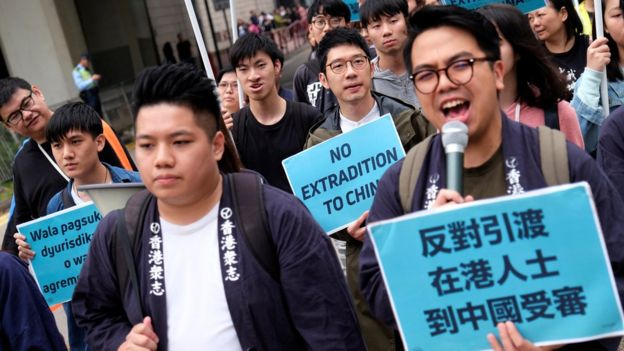
HONG KONG (Reuters) – Thousands of people marched on Hong Kong’s parliament on Sunday to demand the scrapping of proposed extradition rules that would allow people to be sent to mainland China for trial – a move which some fear puts the city’s core freedoms at risk.
Opponents of the proposal fear further erosion of rights and legal protections in the free-wheeling financial hub – freedoms which were guaranteed under the city’s handover from British colonial rule to Chinese sovereignty in 1997.
Early estimates suggested several thousand people had joined the march along Hong Kong Island from Causeway Bay to the council in the Admiralty business district.
Veteran Hong Kong activist and former legislator Leung Kwok-hung said the government’s move risked removing Hong Kongers’ “freedom from fear”.
“Hong Kong people and visitors passing by Hong Kong will lose their right not to be extradited into mainland China,” he said. “They would need to face an unjust legal system on the mainland.”
Some younger marchers said they were worried about travelling to China after the move, which comes just as the government encourages young people to deepen ties with the mainland and promotes Hong Kong’s links with southern China.
The peaceful marchers chanted demands for Hong Kong’s Executive Carrie Lam to step down, saying she had “betrayed” Hong Kong. Some sported yellow umbrellas – the symbol of the Occupy civil disobedience movement that paralysed parts of Hong Kong for 11 weeks in 2014.
The proposed changes have sparked an unusually broad chorus of concern from international business elites to lawyers and rights’ groups and even some pro-establishment figures.
Chris Patten, the last British governor of Hong Kong who handed the city back to Chinese rule in 1997, on Saturday described the move “as an assault on Hong Kong’s values, stability and security”, government-funded broadcaster RTHK reported.
Chief Executive Lam and other government officials are standing fast by their proposals, saying they are vital to plug long-standing loopholes.
Under the changes, the Hong Kong leader would have the right to order the extradition of wanted offenders to China, Macau and Taiwan as well as other countries not covered by Hong Kong’s existing extradition treaties.
As a safeguard such orders, to be issued case-by-case, could be challenged and appealed through the city’s vaunted legal system.
Government officials have said no-one at risk of the death penalty or torture or facing a political charge could be sent from Hong Kong. Under pressure from local business groups, they earlier exempted nine commercial crimes from the new provisions.
The proposals could be passed into law later in the year, with the city’s pro-democratic camp no longer holding enough seats to block the move.
The government has justified the swift introduction of the changes by saying they are needed so a young Hong Kong man suspected of murdering his girlfriend in Taiwan can be extradited to face charges there.
The government’s assurances are not enough for Lam Wing-kee, a former Hong Kong political bookseller who said in 2016 he was abducted by mainland agents in the city.
Lam left Hong Kong for Taiwan last week, saying he feared being sent back to the mainland under the new laws and his experienced showed he could have no trust in China’s legal system.
A group of 33 followers of Falun Gong, a religious sect banned in China, flew from Taiwan to Hong Kong on Saturday to join the march but were refused entry to Hong Kong, RTHK reported.
Sunday’s march comes amid renewed calls for deeper electoral reforms stalled five years ago after Occupy protests.
Four leaders of the movement were last week sentenced to jail terms ranging from eight to 16 months, part of a group of nine activists found guilty after a near month-long trial.
In European countries outside the EU, investment also dropped in 2018.
What and where is China investing?
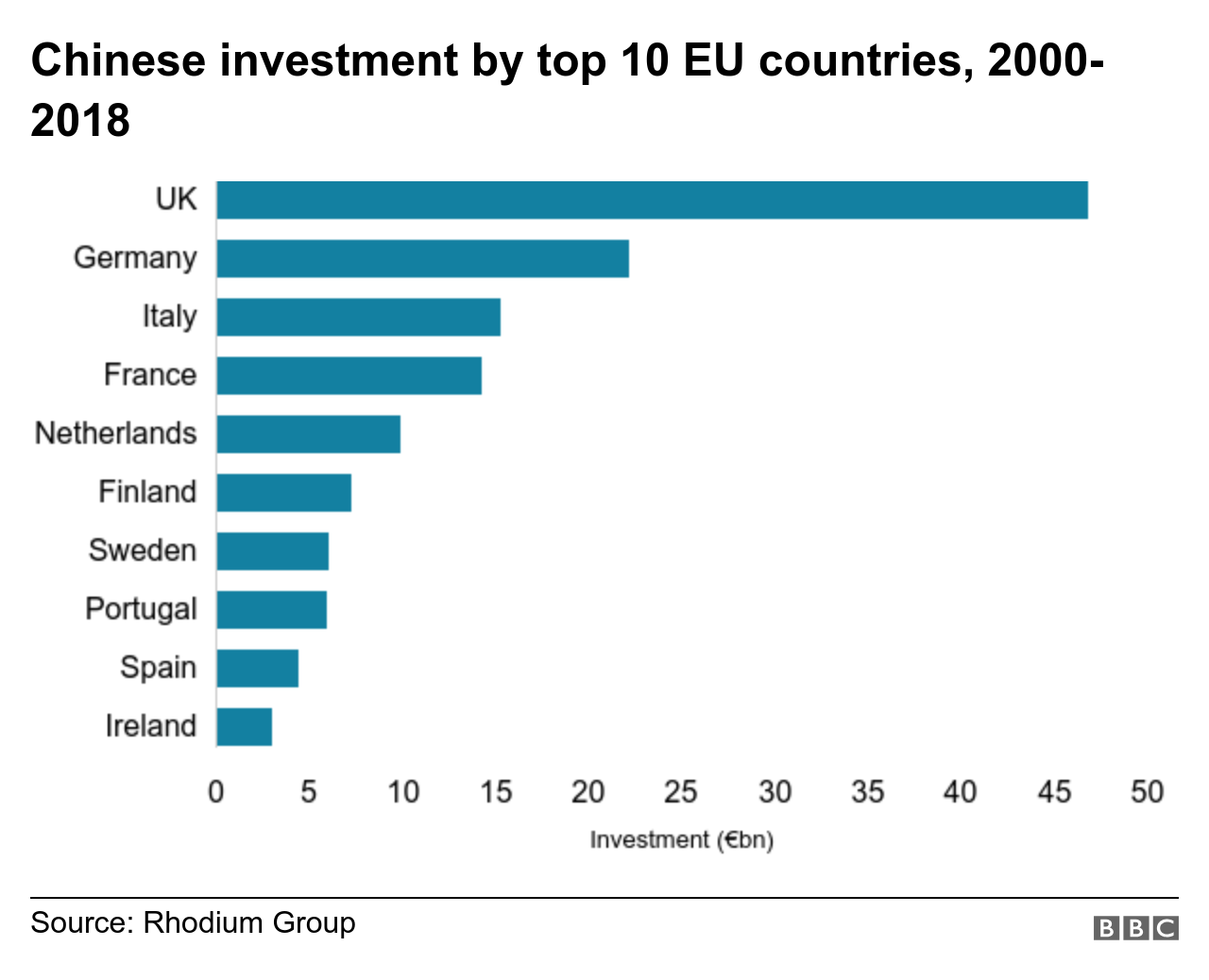
A large proportion of Chinese direct investment, both state and private, is concentrated in the major economies, such as the UK, France and Germany combined, according to the Rhodium Group and Mercator Institute.
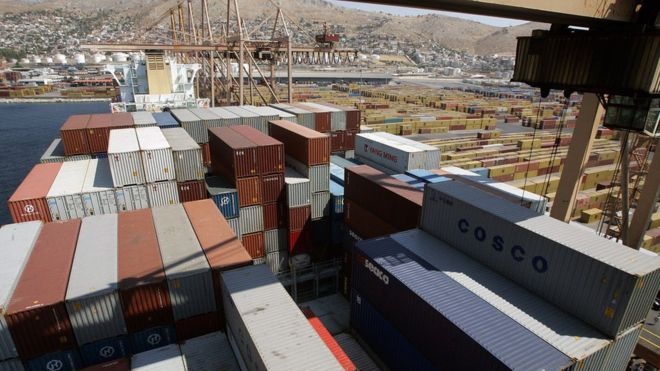
Analysis by Bloomberg last year said that China now owned, or had a stake in, four airports, six maritime ports and 13 professional soccer teams in Europe.
It estimated there had been 45% more investment activity in 30 European countries from China than from the US, since 2008.
And it said this was underestimating the true extent of Chinese activity.
For example, China is financing the expansion of the port of Piraeus in Greece and is building roads and railways in Serbia, Montenegro, Bosnia-Herzegovina and North Macedonia.
This could prove attractive to poorer Balkan and southern European countries, especially as demands for transparency and good governance can make EU funding appear less attractive.
Globally, China’s outward direct investment has slowed over the last year or two, after more than a decade of expansion.
“This is mainly the result of stricter controls on capital outflows from China, but also of a changing political environment globally concerning Chinese investment,” says Agatha Kratz of the Rhodium Group.
China’s global investment slows
The Trump administration is taking a tougher line towards China’s economic activities.
Governments elsewhere are more cautious – particularly when it comes to investment in sensitive areas of the economy, such as telecommunications and defence.
But there’s little doubt China is now a significant player in Europe, whether through direct investments or via the new Silk Road project.
BEIJING, April 19 (Xinhua) — In the countdown to China’s deadline to eradicate absolute poverty by 2020, the socialist system is playing a crucial role.
“Socialism means development. Development must serve the common prosperity for everyone,” President Xi Jinping called for greater efforts to win the battle against poverty on time during a recent inspection tour to southwest China’s Chongqing Municipality.
China’s socialist system has made it possible to pool resources for its aims and stick to its targets from start to finish, especially when it comes to tasks concerning people’s livelihoods.
Thanks to consistent hard work, more than 700 million Chinese people have been lifted out of poverty in the past four decades, with poverty rate in rural areas lowered from 97.5 percent in 1978 to 1.7 percent in 2018.
The Communist Party of China (CPC) in 2017 pledged to eliminate poverty in all poor counties and regions by 2020, waging a final war on poverty to realize its goal.
Under the leadership of the CPC, poverty alleviation has become a strategic task for the country. Governments at every level have taken steps to ensure the task is completed on time.
Party members have been dispatched to impoverished villages across the country to assist poverty reduction work, including government officials, ex-servicemen and college graduates, all working to fully implement the central government policy.
China has made it crucial to adopt customized measures based on local conditions to ensure resources are used in the right place at the right time.
With only two years until the deadline, the country is at a critical juncture in finishing off the final, and most difficult tasks, in its poverty reduction campaign. The socialist system will continue to show its strength in the final battle.
TAIPEI (Reuters) – Terry Gou, chairman of Apple supplier Foxconn, said on Wednesday he will contest Taiwan’s 2020 presidential election, shaking up the political landscape at a time of heightened tension between the self-ruled island and Beijing.
Gou, Taiwan’s richest person with a net worth of $7.6 billion according to Forbes, said he would join the already competitive race, and take part in the opposition, China-friendly Kuomintang (KMT) primaries.
His decision capped a flurry of news this week that began when Gou told Reuters on Monday he planned to step down from the world’s largest contract manufacturer to pave the way for younger talent to move up the company’s ranks.
He later announced he was considering a presidential bid and hinted he was close to a decision, and then told more than 100 people packed into a temple he would follow the instruction of a sea goddess who had told him to run for president.
RELATED COVERAGE
Foxconn’s Gou announces bid to run in Taiwan’s 2020 presidential race
The sea goddess Mazu is a popular deity in Taiwan and is believed to hold sway over one’s safety and fortune.
“Peace, stability, economy, future, are my core values,” Gou said later at the KMT’s headquarters in Taipei.
He urged the party to rediscover its spirit, the honor of its members and the lost support of the youth, and to establish a fair and transparent system for the primary race.
The KMT’s primary was already highly competitive, with contenders including a former KMT chairman, Eric Chu, and a former head of the island’s parliament, Wang Jin-pyng.
The KMT has not agreed how the race should be run or how candidates will be decided.
Gou’s bid, which requires KMT approval, comes at a delicate time for cross-strait relations and delivers a blow to the ruling pro-independence Democratic Progressive Party, which is struggling in opinion polls.
China-Taiwan relations have deteriorated since the island’s president, Tsai Ing-wen, of the independence-leaning DPP, swept to power in 2016.
China suspects Tsai is pushing for the island’s formal independence. That is a red line for China, which has never renounced the use of force to bring Taiwan under its control.
Tsai says she wants to maintain the status quo with China but will defend Taiwan’s security and democracy.
‘VERY PRO-CHINA’
A senior adviser to Tsai told Reuters he thought Gou’s bid could create problems, given his extensive business ties with China.
“This is problematic to Taiwan’s national security,” the adviser, Yao Chia-wen, said.
“He’s very pro-China and he represents the class of the wealthy people. Will that gain support from Taiwanese?” Yao said, adding he believed Gou would face a tough battle in the KMT primary.
Tension between Taipei and Beijing escalated again on Monday, as Chinese bombers and warships conducted drills around the island, prompting Taiwan to scramble jets and ships to monitor the Chinese forces.
A senior U.S. official denounced Beijing’s military maneuvers as “coercion” and a threat to stability in the region.
Gou has questioned Taiwan’s ties with the United States and said this week the island should stop buying U.S. weapons. He said peace was the best the defense.
William Stanton, professor at National Taiwan University and former head of the de facto U.S. embassy in Taipei, said he would have concerns if Gou were to become president.
“I’d be concerned about how he would behave. He did not have a positive attitude toward the U.S.,” Stanton said.
The KMT, which once ruled China before fleeing to Taiwan at the end of a civil war with the Communists in 1949, said in February it could sign a peace treaty with Beijing if it won the presidential election.
Zhang Baohui, a regional security analyst at Hong Kong’s Lingnan University, said Gou’s run could mark the start of the most unusual election in Taiwan history.
This is something entirely fresh for Taiwan politics – here is a candidate who sees everything through the pragmatic angle of a businessman rather than raw politics or ideology,” Zhang told Reuters.
“He has no baggage and that will be a fascinating scenario.”
Gou’s news comes as Tsai is grappling with a series of unpopular domestic reform initiatives, from a pension scheme to labor law, which have come under intense voter scrutiny.
The KMT said this week Gou had been a party member for more than 50 years and had given it an interest-free loan of T$45 million ($1.5 million) in 2016 under the name of his mother, which had signaled his loyalty to the party.
Foxconn said on Tuesday Gou would remain chairman, though he planned to withdraw from daily operations.
It was not immediately clear when he planned to pull back or if his presidential bid would require him to step down from Foxconn. There were no regulations related to a company executive running for the presidency, the island’s stock exchange said.
Foxconn’s shares closed up 2.1 percent at T$91.80 ahead of Gou’s formal declaration, the highest in six months. His Hong Kong-listed FIH Mobile closed up 28 percent, tracking the strength in parent Foxconn.
Doctors say drink contained anti-bacteria compound used by catering industry
Woman took ‘one sip and found it tasted bad’
Fast food chain McDonald’s apologised to a customer who was served milk tea contaminated with disinfectant at one of its stores in eastern China. Photo: Weibo
Fast food chain McDonald’s apologised to a customer who was served milk tea contaminated with disinfectant in one of its stores in eastern China, damaging her digestive tract.
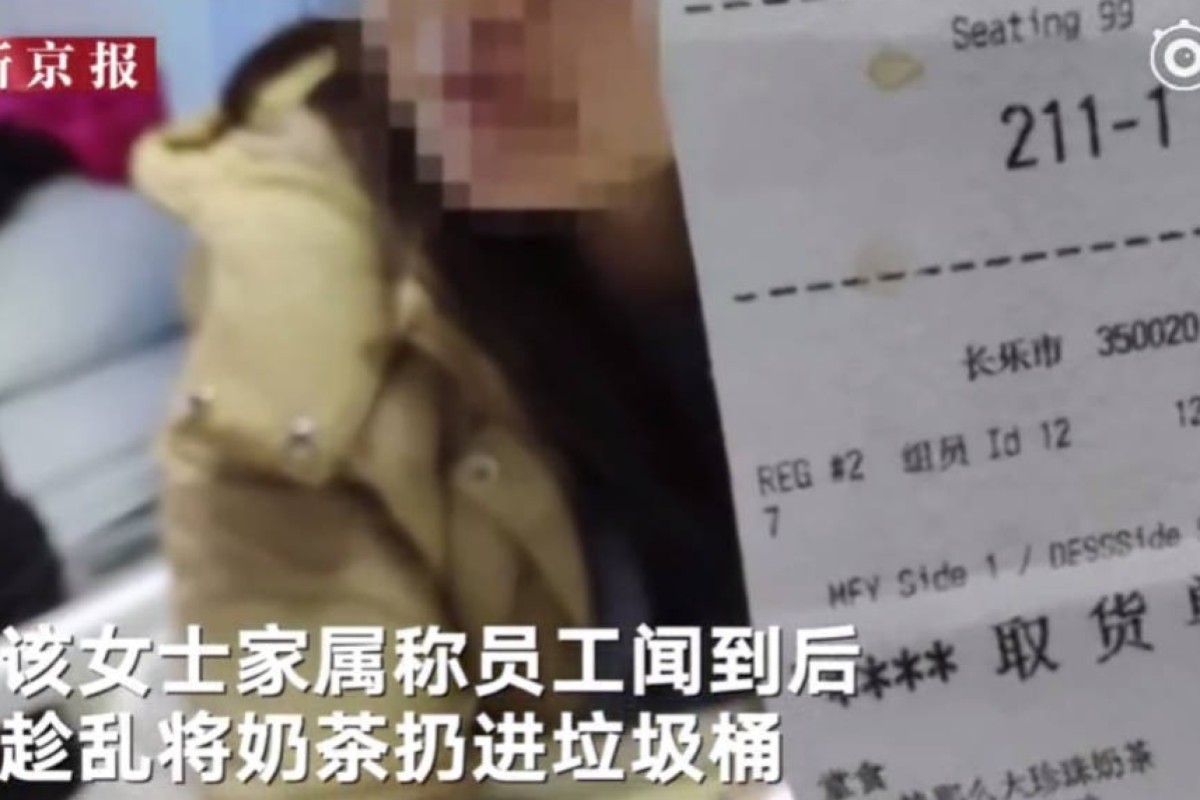
The restaurant said on Monday that it had reached a settlement with the customer, a woman surnamed Huang, after she suffered vomiting, a sore throat, a stomach ache and was taken to hospital on Friday for treatment.
Huang – who was still in hospital – suffered the symptoms shortly after taking a sip of the drink in a restaurant at Changle Airport in Fuzhou, the capital of Fujian province, the Strait Metropolis Daily reported.
“She just had one sip and found it tasted bad. But she already swallowed some of it,” Huang’s husband, surnamed Tang, told the newspaper.
McDonald’s apologises after advertisement showing Taiwan as a country draws criticism
When the lid was removed from the cup there was a strong smell of disinfectant, Tang said.
“I asked staff workers about the drink, but they just took it and smelled it, without giving any explanation. They threw the drink into the rubbish when we were not looking, but we took it back,” Tang said.
Doctors said the woman’s symptoms were caused by sodium dichloroisocyanurate, a chlorine compound widely used to kill bacteria in water by the catering industry and by the leisure sector in swimming pools.
On its Weibo feed, McDonald’s described the incident as unintentional and said staff would be given more training.
“McDonald’s has paid great attention to the incident and is deeply sorry for the error made by a staff member of our restaurant,” it said.
McDonald’s said that it would improve staff training after the customer was given tea tainted with disinfectant. Photo: Weibo
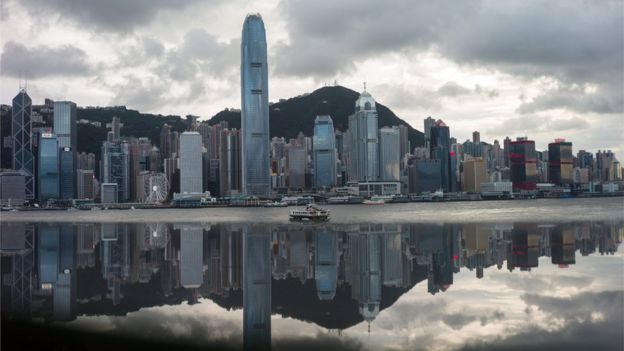
Image copyrightREUTERSImage captionHong Kong is part of China but has its own judicial system
The Hong Kong government has proposed changes to extradition laws that could allow transferring suspects to mainland China for trial. The move has further fuelled fears of erosion of the city’s judicial independence amid Beijing’s increasing influence.
The Hong Kong government will also consider extradition requests from Taiwan and Macau after the new changes.
Officials say the change is needed so that a murder suspect can be extradited to Taiwan for trial, and that mainland China and Macau must be included in the change to close a “systematic loophole”.
Hong Kong’s leader Carrie Lam has pushed for the amendments to be passed before July.
What are the changes?
The changes will allow for extradition requests from authorities in mainland China, Taiwan and Macau for suspects accused of criminal wrongdoings, such as murder and rape.
The requests will then be decided on a case-by-case basis.
Image copyrightREUTERSImage captionOver 100,000 protesters took to Hong Kong streets to rally against the government’s proposal.
Several commercial offences such as tax evasion have been removed from the list of extraditable offences amid concerns from the business community.
Hong Kong officials have said Hong Kong courts will have the final say whether to grant such extradition requests, and suspects accused of political and religious crimes will not be extradited.
Why is this controversial?
There has been a lot of public opposition, and critics say people would be subject to arbitrary detention, unfair trial and torture under China’s judicial system.
“These amendments would heighten the risk for human rights activists and others critical of China being extradited to the mainland for trial on fabricated charges,” Sophie Richardson of Human Rights Watch said in a statement.
Lam Wing Kee, a Hong Kong bookseller said he was abducted and detained in China in 2015 for selling books critical of Chinese leaders and charged with “operating a bookstore illegally”.
During a recent protest against the government proposal, Mr Lam said he would consider leaving the territory before the proposal was passed.
“If I don’t go, I will be extradited,” he said. “I don’t trust the government to guarantee my safety, or the safety of any Hong Kong resident.”
Though some pro-Beijing politicians eager to defend China, dispute the criticism of its judicial system.
Image copyrightEPAImage captionHong Kong and China – one country, two systems
The changes have also attracted opposition from the Hong Kong business community over concerns they may not receive adequate protection under Chinese law.
The proposal has already sparked a legal challenge from Hong Kong tycoon Joseph Lau, who was convicted in absentia in a corruption case in Macau in 2014.
Macau’s government has not been able to have Mr Lau extradited because of a lack of extradition agreement between Hong Kong and Macau, but that will become possible if Hong Kong’s legislature decides to amend the extradition laws.
His lawyers argue in a 44-page submission to Hong Kong’s courts that the Macau trial was marred by “serious procedural irregularities that rendered the trial incompatible with internationally mandated standards of fairness”.
Every citizen can request a judicial review like Mr Lau has done, but it’s the High Court that decides whether this will be granted. Most observers say there is little chance Mr Lau’s request will be successful.
Why the change now?
The latest proposal has come after a 19-year-old Hong Kong man allegedly murdered his 20-year-old pregnant girlfriend, while holidaying in Taiwan together in February last year. The man fled Taiwan and returned to Hong Kong last year.
Taiwanese officials have sought help from Hong Kong authorities to extradite the man, but Hong Kong officials say they cannot comply because of a lack of extradition agreement with Taiwan.
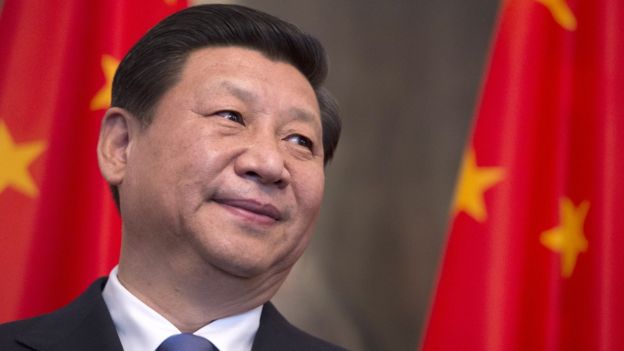
Image copyrightGETTY IMAGESImage captionUnder Xi Jinping, Beijing is seeking increasing control over Hong Kong
“Are we happy to see a suspect that has committed a serious offence staying in Hong Kong and we’re unable to deliver justice over the case?” Mrs Lam said on 1 April while responding to media questions.
She added that mainland China and Macau were included in the proposed change to address a “loophole” in current laws.
Isn’t Hong Kong part of China anyway?
A former British colony, Hong Kong is semi-autonomous under the principle of “one country, two systems” after it returned to Chinese rule in 1997.
The city has its own laws and its residents enjoy civil liberties unavailable to their mainland counterparts.
Hong Kong has entered into extradition agreements with 20 countries, including the UK and the US, but no such agreements have been reached with mainland China despite ongoing negotiations in the past two decades.
Critics have attributed such failures to poor legal protection for defendants under Chinese law.
LHASA, March 18 (Xinhua) — The State Grid’s Tibet branch announced that 25,000 more people in the plateau region will be covered by the main power grid by the end of this year.
In 2019, Tibet plans to build 140 electric substations of 35 kilovolts and above and 7,000 km of power transmission lines as the region continues to expand and upgrade its electricity infrastructure.
By the end of 2018, 2.76 million people in 63 counties, or over 80 percent of Tibet’s population, were covered by the main power grid, thanks to an investment of 8.89 billion yuan (about 1.3 billion U.S. dollars) in the year.
If the plan goes well, the figure will rise to 66 counties by the end of 2019.
A 16.2-billion-yuan power interconnection project was put into operation in Tibet last November, linking the region with the national grid network for the first time.
BEIJING, March 15 (Xinhua) — The People’s Liberation Army (PLA) and armed police force have been urged to study the spirit of the second session of the 13th National People’s Congress (NPC) and the spirit of the remarks made by President Xi Jinping during the session.
This is an important political task for the whole military, said a circular released Friday by the General Office of the Central Military Commission.
Xi, also general secretary of the Communist Party of China Central Committee and chairman of the Central Military Commission, stressed fulfilling the set targets and tasks of national defense and military development as scheduled, in the remarks he made while attending a plenary meeting of the PLA and armed police force delegation.
The circular called on the PLA and armed police force to have a clear understanding of new circumstances, new tasks and new demands in strengthening national defense and the armed forces, and intensify the sense of mission to achieve new progress in making the military strong.
The circular stressed studying the spirit of Xi’s remarks, and urged the PLA and armed police force to clearly understand the importance and urgency of implementing the 13th Five-Year Plan for military development, and go all out to carry out the plan so as to ensure that the set targets and tasks are fulfilled as scheduled.
The PLA and armed police force should have a deep understanding of the severe situation facing China’s security and development, improve military preparedness, actively support local economic and social development as well as ecological conservation and resolutely safeguard national sovereignty, security and development interests, the circular stressed.
In the run-up to the Indian election, which gets under way on 11 April, BBC Reality Check is examining claims and pledges made by the main political parties.
One of the most dramatic actions taken by the ruling BJP was the withdrawal in 2016 of all high-value banknotes from circulation, almost overnight.
This effectively removed 85% of all cash notes from the economy.
It also said it would help move India towards an economy less dependent on cash.
However, Reality Check has found that there’s little evidence the ban has helped root out illegally held assets.
And compared with other emerging economies, the level of cash in circulation in India has remained high.
What actually happened?
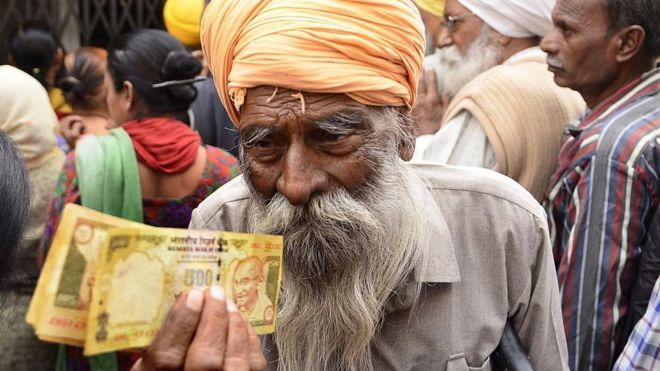
In November 2016, the two highest notes in circulation – 500 and 1,000 Indian rupees (£11) – were scrapped.
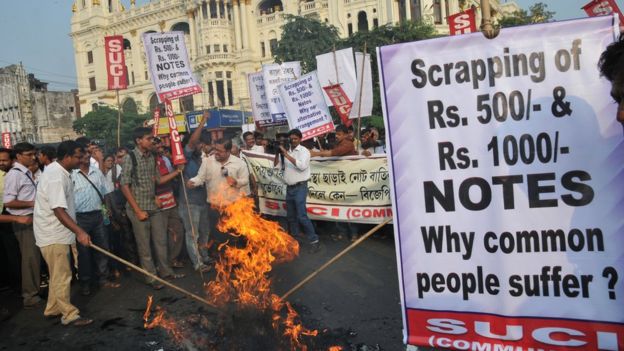
The surprise move – referred to in India as “demonetisation” – caused widespread confusion and led to street protests.
Image copyrightGETTY IMAGES
For a limited period only, the withdrawn notes could be exchanged for legal currency at banks – but there was a limit of 4,000 rupees per person.
What impact did it have?
Critics said the policy severely disrupted the economy, badly affecting the poor and rural communities that relied on cash.
The government said it was targeting illegal wealth held outside the formal economy, which fuelled corruption and other illegal activity and had not been declared for tax purposes.
It was assumed that those with large amounts of such cash would now find it difficult to exchange for legal tender.
But by August 2018, a report published by India’s central bank said that more than 99% of the old banknotes in circulation prior to the ban had been accounted for.
It was suggested that there had not been much unaccounted for wealth held in cash in the first place – or if there had been, the owners had found ways to convert it to legal tender.
Image copyrightGETTY IMAGES
Did the policy achieve the objective of exposing counterfeit currency?
Not really, according to India’s central bank.
The number of fake 500 and 1,000 rupee notes found after the ban was only marginally higher than the amount from the previous year.
In the two years before the currency withdrawal, tax collection growth rates had been in single digits.
Then in 2016-17, the amount of direct taxes collected increased by 14.5% over the previous year.
The following year, collections rose by 18%.
But the rate of growth in collecting direct taxes had seen a similar increase between 2008-09 and 2010-11, when the Congress party was in power.
And it’s likely that other policies – such as an income tax amnesty in 2016 and a new goods and services tax the following year – may have contributed as much to the growing tax take as demonetisation.
What about a cashless society?
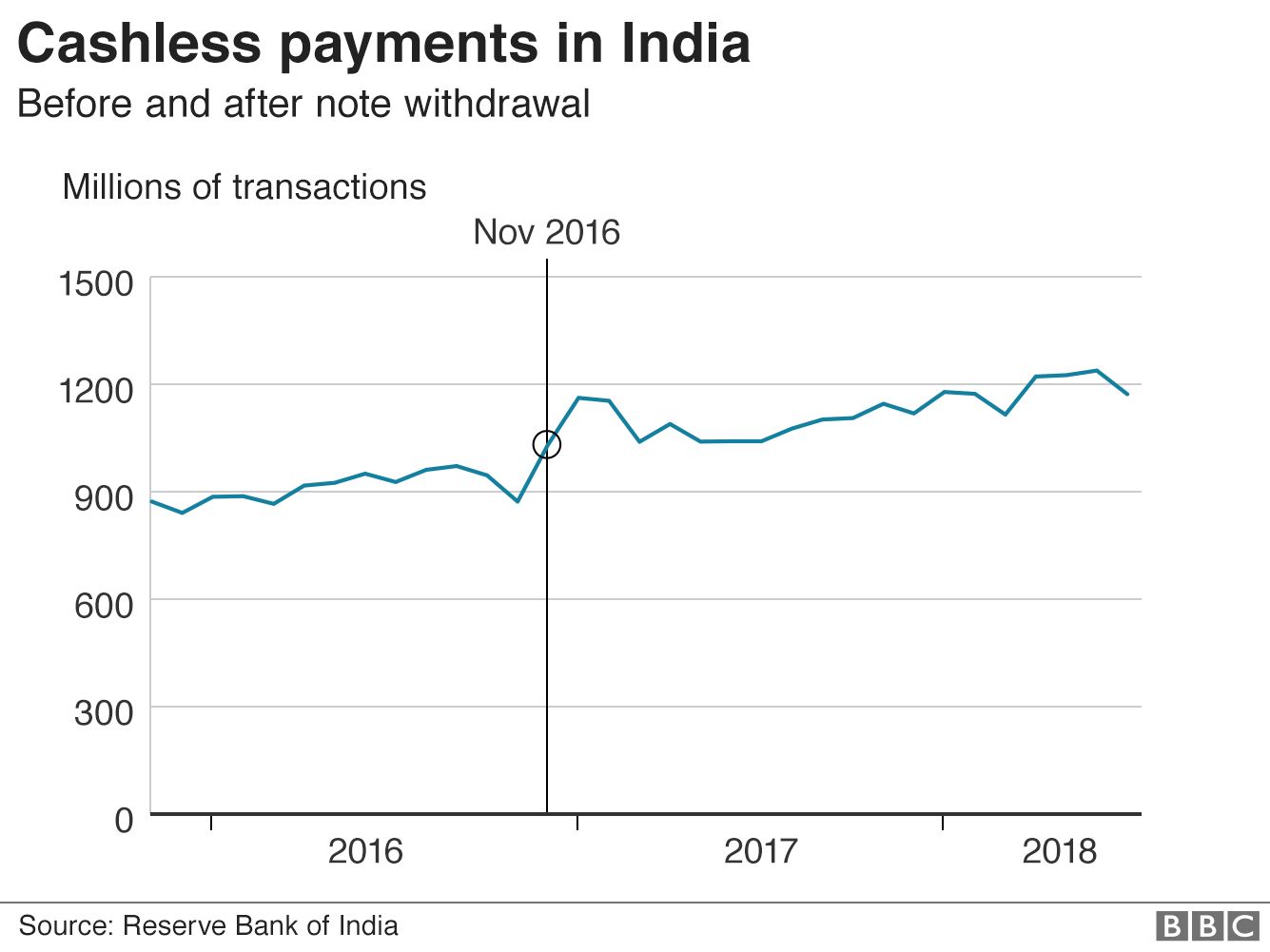
Against a long-term trend of a gradual rise in cashless payments, there is a significant jump at the end of 2016, when the notes were withdrawn.
But this reverted soon afterwards to the steady rising trend.
The overall increase over time may have less to do with government policy and more to do with changing technology and easier cashless payments.
As to whether the overall amount of cash in the economy has fallen, we can look at India’s currency to gross domestic product (GDP) ratio over time.
This is a measure of the amount of currency in circulation in proportion to the total value of goods and services produced.
This took a sharp dive immediately following the withdrawal of the 500 and 1,000 rupee notes – but by the following year, currency in circulation had reverted to pre-2016 levels.
NEW DELHI (Reuters) – India’s main opposition Congress party will reserve a third of federal government jobs for women if it comes into power, its chief Rahul Gandhi said on Wednesday, in a sign women’s rights are rising up the political agenda for next month’s election.
Over the last week, two powerful parties from eastern India said they would field women in a third of parliamentary races, putting pressure on Prime Minister Narendra Modi’s ruling Bharatiya Janata Party (BJP) and other big parties to follow suit.
India ranks at 149 out of 193 countries – worse than neighbouring Afghanistan, Bhutan, Bangladesh and Pakistan – for the percentage of women in national parliaments, according to the Inter-Parliamentary Union, an independent organisation promoting democracy.
“…Frankly, I don’t see enough women in leadership positions. I don’t see them leading enough companies, I don’t see them leading enough states, I don’t see enough of them in the Lok Sabha and the Vidhan Sabhas,” Gandhi said in the southern city of Chennai, referring to India’s lower house of parliament and state legislatures.
Federal government jobs in India are already subject to numerous quotas, including one passed in January that reserves 10 percent of openings for people outside high income brackets.
Gandhi also said that Congress would pass the Women’s Reservation Bill this year if it came to power. The bill, which reserves 33 percent of the seats in national and state assemblies for women, has been on hold for two decades despite being championed by Congress and the BJP at different points.
The BJP, which says it has empowered women through nationwide schemes including clean fuel and sanitation, questioned how the Congress jobs plan would be implemented.
“For how many generations have people talked about reservation in party positions, reservation for elections, reservation in jobs? But it doesn’t seem to happen,” BJP spokesperson Shaina N.C. said.
There are currently 66 women out of a total 543 elected members in India’s lower house of parliament. At 12 percent, this is the highest ever proportion of women in the Lok Sabha.
Women make up nearly half of all voters in the country of 1.3 billion people, according to the Election Commission of India. Based on recent state polls, women will likely head to voting stations in droves for the elections due by May, surpassing male turnout, analysts predict.
On Tuesday, Mamata Banerjee, chief minister of West Bengal state, said her All India Trinamool Congress party would field 17 women candidates across 42 seats.
Earlier, on Sunday, the Biju Janata Dal, which rules Odisha state in eastern India, said it would reserve seven of 21 seats it is contesting for women candidates.
“33% reservation in parliament will give them bigger role in highest policy making body,” Naveen Patnaik, leader of the BJD and Odisha’s chief minister, said in a tweet.
“Women of our nation rightfully deserve this from all of us.”






 CHINDIA ALERT: You'll be living in their world, very soon