Archive for ‘Politics’

18/10/2015

Sonia says Modi govt imposing its ideology on people – The Hindu

Congress president Sonia Gandhi on Saturday blamed the Modi government for the growing intolerance to intellectuals and communal tensions in the country. The government, she said, was anti-poor and corporate-friendly.

Congress president Sonia Gandhi at an election rally in Buxar, Bihar on Saturday. Photo: Ranjeet Kumar

“Ever since Narendra Modi came to power, the intellectuals are being harassed and an effort has been made to stoke communal tensions through rumours. The BJP is trying to enforce its own ideology on people. It is shameful,” she said at election meetings at Buxar and Chappra. Her comments refers to the recent lynching of a man at Dadri in Uttar Pradesh and writers returning their Sahitya Academy awards.

“Modiji, Hindu aur Musalmaan apas main ladte nahi, balki unko ladaya jata hai… kyunki communal jhagde band ho gaye toh kuch logo ki dukaandari band ho jayegi, aur yeh BJP se behtar kaun janta hai? [Mr. Modi, Hindus and Muslims don’t clash with each other but they are being pushed to do it … If communal clashes are being stopped, many people’s business will be closed, and who knows this better than the BJP?],” she said.

Ms. Gandhi said the Modi government worked only for big businesses and had no concern for the poor.

She said the Congress would not allow the Goods and Services Tax (GST) Bill to go through the Rajya Sabha as it was against the welfare of the people. “The UPA government wanted the GST law for the development of industry, but we are opposing it now for the welfare of the people,” she said.

“Mr. Modi speaks much but delivers little. Has he delivered on the tall claims made by him during the last Lok Sabha polls,” she asked. When the crowd yelled “no”, she said: “It is high time he understood the pain of the people.”

The government was silent when pulse prices were rising, farmers were committing suicide and unemployment among the youth was rising, she said.

Taking on Mr. Modi for alleging that the Congress had done little in the past 60 years of its regime, Ms. Gandhi said: “When we got freedom, we had nothing; but the Congress government did revolutionary works in education, health and employment in the past 60 years. We maintained the unity and integrity of the country and strengthened democracy.”

Source: Sonia says Modi govt imposing its ideology on people – The Hindu

18/10/2015

China’s Xi lauds Britain for ‘visionary’ openness, prods others to emulate | Reuters

Chinese President Xi Jinping heaped praise on Britain for what he called a “visionary and strategic choice” to strengthen commercial ties with China, as he prepared for a state visit to the United Kingdom that’s expected to be richer in pomp and considerably warmer in tone than his recent trip to the United States.

The trip comes at a time of global anxiety about China’s slowing growth. Xi himself acknowledged “concerns about the Chinese economy”, but sought to allay them in a written interview with Reuters.

China itself is worried about the slowing of the broader global economy, Xi said, even while he expressed confidence that China would weather the current downturn as it reshapes its economy to be more resilient in the future.

That confidence will be on display when Xi arrives in London on Monday evening to kick off a four-day visit that is expected to cement ties between Britain and China, including through a host of business deals.

“The UK has stated that it will be the Western country that is most open to China. This is a visionary and strategic choice that fully meets Britain’s own long-term interest,” Xi said in a written response to questions from Reuters.

“China looks forward to engaging with the UK in a wider range, at a higher level and in greater depth.”

WARMER WELCOME

Xi’s visit comes amid debate in Britain and many other Western countries over what is the best way to engage with a Communist-ruled China that has grown more influential economically and diplomatically, but which maintains stances in areas from human rights to the South China Sea that are often at odds with those widely held in the West.

Such tensions were on display when Xi visited the United States last month, with friction over issues from cyber theft to China’s maritime disputes with its neighbors at the center of discussions.

Xi’s visit to Britain, during which he and his wife Peng Liyuan will stay at Buckingham Palace as guests of Queen Elizabeth II, is expected to be much warmer, with Xi saying it could be the start of a “golden time” in bilateral relations.

Britain was the first Western nation to join the China-led Asian Infrastructure Investment Bank (AIIB) earlier this year, leading to a stampede of other countries signing up and marking an embarrassment for Washington, which had been pressing its allies not to join.

At the time, Britain said joining the AIIB at the founding stage would “create an unrivalled opportunity for the UK and Asia to invest and grow together”.

British finance minister George Osborne set the tone with a preparatory visit to China last month, when he courted Chinese investment into Britain and won praise from Chinese state media for having the “etiquette” not to press human rights issues.

Still, Xi’s visit, the first state visit by a Chinese president since 2005, will not be without potentially awkward moments. Newly installed opposition leader Jeremy Corbyn intends to bring up the issue of human rights when he meets Xi, his official spokesman has said.

Source: Exclusive – China’s Xi lauds Britain for ‘visionary’ openness, prods others to emulate | Reuters

29/09/2015

China’s Xi says to commit 8,000 troops for U.N. peacekeeping force | Reuters

China will contribute 8,000 troops for a United Nations peacekeeping standby force, China’s President Xi Jinping told the United Nations General Assembly on Monday, a move that could make it one of the largest players in U.N. peacekeeping efforts.

unpeacekeepers.jpg

Xi’s pledge comes as China is trying to show it is a responsible international player amid concern over its growing military might and territorial disputes in the Asia-Pacific region. During a state visit to Washington on Friday, Xi agreed with U.S. President Barack Obama that both countries would increase their “robust” peacekeeping commitments. They are among leaders from more than 50 countries who pledged some 40,000 troops and police, as well as equipment or training for U.N. peacekeeping missions during a U.N. summit chaired on Monday by Obama.

“China will join the new U.N. peacekeeping capability readiness system, and has thus decided to lead in setting up a permanent peacekeeping police squad and build a peacekeeping standby force of 8,000 troops,” Xi said. He also said China would provide $100 million in military assistance to the African Union in the next five years to support the establishment of an African standby force and to boost its capacity for crisis response.

At the later summit, Xi said part of a new 10-year, $1 billion China-U.N. peace and development fund set up by China would be used for peacekeeping operations. China would give “favorable consideration” to future U.N. requests for more Chinese engineering, transport and medical staff, but operations’ “exit strategies need to be timely formulated and executed”, Xi said.

Obama, who held tense summit talks with Xi last week in Washington, shook his hand vigorously as he left the podium on Monday.

OPERATIONAL EXPERIENCE

The U.S. military told dozens of U.N. ambassadors and military advisers in New York in July that the U.N. needed rapid response forces, equipment and training. Washington pays more than 28 percent of the $8.2 billion U.N. peacekeeping budget, but Beijing says it contributes more personnel to peacekeeping missions than each of the other four permanent members of the U.N. Security Council: the United States, Russia, France and the United Kingdom.

The top five troop- and police-contributing countries are Bangladesh, Ethiopia, India, Pakistan and Rwanda, according to August data from the U.N. website. China now provides around 3,000 of the more than 106,500 U.N. troops, police and advisers deployed by all countries, making it the ninth biggest contributor of peacekeeping personnel. Its largest contingent is in South Sudan, where it has played a growing diplomatic role and is a major investor in the oil industry.

Experts have noted that China’s expanding peacekeeping role in recent years parallels its desire to expand its military’s capabilities farther abroad and could provide logistical and operational experience. “They clearly want to create a more international armed force so they can operate in more challenging environments,” said Douglas Paal, director of the Asia program at the Carnegie Endowment for International Peace.

During his earlier address to the General Assembly, Xi tried to allay concerns that his country’s growing influence was a threat. “We are committed to peaceful development. No matter how the international landscape may evolve and how strong China may become, China will never pursue hegemony, expansion, or sphere of influence,” he said.

Source: China’s Xi says to commit 8,000 troops for U.N. peacekeeping force | Reuters

Tags: ,
29/09/2015

Google’s Sundar Pichai Welcomes India’s Modi to Silicon Valley – India Real Time – WSJ

Before Indian Prime Minister Narendra Modi touches down in Silicon Valley at the weekend, one of his country’s most-successful sons has welcomed him to the U.S. tech hub.

Sundar Pichai, the Indian-born Google CEO, says in a video message that “there is tremendous excitement” about Mr. Modi’s arrival in the valley “among all Googlers” a shorthand for people who work at the search engine giant.

Mr. Modi will meet with Mr. Pichai and other Indian-born CEOs, including Satya Nadella of Microsoft Corp., during his valley visit and tour Google’s headquarters where he will look at inventions in healthcare and smartgrid technology. His visit comes after Chinese President Xi Jinping held a roundtable in Seattle with U.S. and Chinese CEOs including Tim Cook of Apple Inc. and Jeff Bezos of Amazon.com on Wednesday.

“The bond between India and Silicon Valley is strong. India has long been an exporter of talent to tech companies,” Mr. Pichai says in the two minute clip.

Raised in the southern city of Chennai and attending the legendary Indian Institute of Technology, Mr. Pichai became CEO of Google in August having started out at the company in 2004 as a semiconductor engineer after gaining a graduate degree from Stanford University and an M.B.A. from the University of Pennsylvania’s Wharton School. More In Google Who Is Google’s Sundar Pichai? Why Indian Managers Are Succeeding in Tech’s C-Suite Sundar Pichai to Lead Google, Now a Subsidiary of Alphabet, After Restructuring Tech Giants Help Track Nepal Earthquake Survivors as Communications Are Hit Google Executive Dan Fredinburg Killed in Everest Avalanche After Nepal Earthquake

“The products built by Indian graduates from IIT and other institutions have helped to revolutionize the world,” the Google chief adds.

But it is India that is now undergoing its own revolution, he continues. Mr. Pichai touches on Mr. Modi’s plans to digitize India and get 600 million people in remote areas connected to the Internet.

“We at Google as well as many others around the world are passionate about playing our part, there is no more important role for tech companies today than helping to connect the next billion Internet users,” he adds.

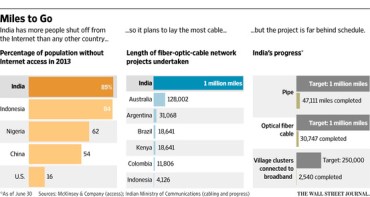
The prime minister’s Digital India plan is stuttering however. Up to June only 1% of the villages in the program had been connected to broadband via fiber optic cables.

The slow pace of the rollout of the Internet in India is among the main subjects raised for Mr. Modi in his upcoming Q&A at Facebook Inc. on Sunday.

Meghna Agarwal has asked how Facebook can help India in reaching remote areas “so that each one of the Indians has a voice of their own thus promoting equality and bridging the gap between the rich and the poor?”

Sumit Dhawan asked what Mr. Modi is doing to bring high speed broadband Internet to India.

In Mr. Pichai’s video, the CEO predicts that in the next few years, 50 million women and 20 million small businesses will get online for the first time. He promises Google will help India with products that work on low bandwidth and even offline as well as with investments in core infrastructure to help the Indians among them.

Source: Google’s Sundar Pichai Welcomes India’s Modi to Silicon Valley – India Real Time – WSJ

23/09/2015

5 Things Modi Unpacks on Every Foreign Trip – WSJ

1 Be First (Sort Of)

People like to read about folks who come first, and Mr. Modi’s visits often claim this honor. Sometimes, such as his trip to Mongolia, because his visit is the first by an Indian prime minister. But in other cases, the firsts come with footnotes. For instance, Mr. Modi was the first Indian prime minister to visit Canada in 40 years on a “bilateral visit” in April, according to India’s foreign ministry.  Indian prime ministers have visited Canada in the past four decades, but on multi-lateral or other types of visit.  Another twist: Mr. Modi’s time in Australia in November followed a visit of Australia’s then-Prime Minister Tony Abbott to India a few months earlier. The exchange was thus described as the “first time Australian and Indian Prime Ministers have made reciprocal visits in the same year,” according to India’s Press Information Bureau. For his upcoming visit, expect Mr. Modi’s team to point out that he is the first Indian prime minister to visit Silicon Valley, because Mrs. Gandhi only went to Los Angeles.

2 Take Over a Stadium

In countries with a large Indian-origin population, Mr. Modi likes to make a big impression. Usually in a stadium packed with thousands of people and supported by a song-and-dance show. Mr. Modi has taken over such arenas in New York, Sydney and Toronto. In the upcoming visit, the big event will be at the SAP Center in San Jose, which is also nicknamed the “Shark Tank” because it hosts ice hockey team the San Jose Sharks. The SAP Center will host Madonna in October. The event’s organizers say they have received requests for around 45,000 passes, while SAP Center can seat only around 20,000 people.

3 Promise a Visa Freebie

One crowd-pleaser that Mr. Modi uses on trips abroad is to announce India will make it easier for foreigners to visit. In February 2014, before Mr. Modi came to power, India’s government pledged to give visas-on-arrival to people from 180 countries, up from 11 countries previously. The expanded list so far covers people traveling to India from the U.K., U.S. and China among others. Mr. Modi re-announced this step as evidence of India’s efforts to make it easier for people to visit. In New York, it got a lot of applause.  But, when some tourists tried to get a “visa-on-arrival”, they were asked to apply for it 72 hours in advance. This created confusion. In April, the Indian government changed the name to “e-tourist visas”, saying that tourists could apply for it online.

4 Snap a Selfie

During his overseas trips, Mr. Modi’s selfies with other leaders including Li Keqiang, the Chinese premier, have received a lot of attention online. Most recently, Mr. Modi took a selfie with ministers of the United Arab Emirates . From the upcoming trip, look out for selfies with Mark Zuckerberg, chief executive of Facebook Inc. who is meeting Mr. Modi, and other high-profile Silicon Valley execs.

5 Unveil or Visit a Gandhi Tribute

The icing on the cake of a good trip abroad for Mr. Modi is the unveiling of a bust or statue of Indian independence leader Mahatma Gandhi. Mr. Modi unveiled the bust of Gandhi in Hannover, Germany, and in Turkmenistan’s capital Ashgabat . He inaugurated a statue of Gandhi in Brisbane, Australia, and another in Bishkek, Kyrgyzstan. In China, Mr. Modi inaugurated the Center for Gandhian & Indian Studies at Shanghai’s Fudan University.  On his most-recent trip to the U.S. in September 2014, Mr. Modi visited a statue of Gandhi in Washington. Mr. Modi’s  U.S. hosts haven’t included a Gandhi unveiling for the upcoming trip however. The focus of the prime minister’s visit to Silicon Valley will be on technology, startups and innovation, said Khanderao Kand, convener of the Indo American Community of West Coast.

Source: 5 Things Modi Unpacks on Every Foreign Trip – WSJ

23/09/2015

Command and lack of control | The Economist

IF THE People’s Liberation Army (PLA) were a company, it would be about to lose its position as the world’s largest corporate employer. When troop cuts recently announced by Xi Jinping, China’s president, are completed in 2017, the ranks of China’s armed forces will have shrunk by 300,000 to 2m, putting it just behind Walmart, a retailer (see chart). It would still be by far the world’s largest military outfit.

When the downsizing was announced, at a big military parade on September 3rd, the cuts seemed no more significant than a round of corporate redundancies. Mr Xi’s own explanation—that they would help the PLA to “carry out the noble mission of upholding world peace”—also seemed to come straight from the gobbledygook of corporate obfuscation.

But recent commentary in China’s state media suggests that the reductions may presage something more: a long-overdue reform of the command structure of the PLA and a shift in the balance of the main military services. If so, one of the most important subsidiaries of the Chinese state is in for a shake-up.

The army has long been the senior service. Almost three quarters of active-duty personnel are soldiers. The navy and air-force chiefs did not have seats on the main institution for exercising civilian control over the armed forces, the Central Military Commission, until 2004. It was only in 2012 that an officer outside the ranks of the army became its most senior military figure. The army’s dominance is a problem at a time when China is expanding its influence in the South China Sea and naval strategy is looming larger.

Moreover, there has long been a split within the PLA between combat forces (which kill the enemy) and other operations (logistics, transport and so on) which are regarded as secondary. But in modern, high-tech warfare, non front-line services such as those responsible for cyberwarfare and electronic surveillance often matter more than tanks and infantry.

Embodying these outdated traditions is a top-heavy, ill-co-ordinated structure with four headquarters and seven regional commands. Many Chinese analysts argue that, as now constituted, the PLA would not be able to conduct modern information-intensive military operations which integrate all the services properly.

China has long talked about military reform. In late 2013 Mr Xi told fellow leaders that the command system for joint operations was “not strong enough”. It was duly announced that China would “optimise the size and structure” of the armed forces. China Daily, an English-language newspaper, said that a “joint operational command system” would be introduced “in due course”.

It now appears that these changes are under way. Mr Xi was recently quoted in PLA Daily, a newspaper, saying that “we have a rare window … to deepen [military] reform”. It is possible that Mr Xi’s anti-corruption purge, which has taken aim at two men (one now dead) who were once the country’s most powerful military figures, as well as 50 other generals, may have weakened opposition enough for change to begin.

The South China Morning Post, a newspaper in Hong Kong, recently published what it described as a radical plan devised by military reformers. This would scrap three of the four headquarters, reduce the number of regional military commands to four and give a more prominent role to the navy. It remains to be seen whether Mr Xi will go that far. But there is no doubt that, in order to fulfil what he calls China’s “dream of a strong armed forces”, he wants a leaner, more efficient PLA. To China’s neighbours, that would make it even more frightening.

Source: Command and lack of control | The Economist

12/09/2015

China’s top graft-buster breaks taboo by discussing Communist Party’s ‘legitimacy’ | South China Morning Post

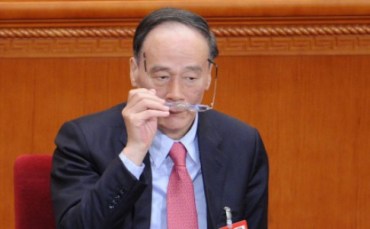
Open discussion by top graft-buster Wang Qishan about the legitimacy of the ruling Communist Party – a topic long deemed unquestionable – has raised the eyebrows of some commentators. Graft-buster Wang Qishan has raised some eyebrows with his comments on the Communist Party's 'legitimacy'. Photo: AFP

“The legitimacy of the Communist Party of China derives from history, and depends on whether it is supported by the will of the people; it is the people’s choice,” Wang said when meeting some 60 overseas attendants of the Party and World Dialogue 2015 in Beijing on Wednesday. ADVERTISING Analysts said the aberration was a step forward but some disagreed with Wang’s interpretation of “legitimacy”.

Zhang Lifan, a Beijing-based commentator, said Wang’s remarks reflected a shift of attitude in the party as a result of intensified social conflicts and increasing pressure from an underperforming economy.

“In the past, the issue was not allowed to be discussed, because the [party] thinks [its rule] is justified unquestionably. As the old saying goes, ‘political power grows out of the barrel of a gun’. They fought their way into the ruling position, instead of being elected into it,” Zhang said. [The Communist Party’s] legitimacy was maintained by relying on economic growth, but now economic growth is facing problemsZHANG LIFAN, COMMENTATOR

“Its legitimacy was maintained by relying on economic growth, but now economic growth is facing problems. In the past people thought [the party] could continue governing and did not have strong opposition to it because they still had money in their pocket. Now the size of their pockets have shrunk,” he said.

Zhang Ming , a political scientist with Renmin University, applauded Wang’s courage, but disagreed with his use of “legitimacy”. “You can’t talk about legitimacy merely from a historical perspective. How to let the people express their approval or disapproval [of the government]? The ballots are the most obvious way,” he said.

Steve Tsang, a senior fellow at the China Policy Institute of the University of Nottingham, said the “legitimacy” Wang mentioned did not mean democratic accountability.

“The will of the people, in China’s political reality, is collected and reorganised into something in line with what the party wants,” he said.

“Then [it] uses the powerful propaganda machinery to ensure the people embrace the newly reformulated views as their own.”

Source: China’s top graft-buster breaks taboo by discussing Communist Party’s ‘legitimacy’ | South China Morning Post

03/09/2015

China military parade commemorates WW2 victory over Japan – BBC News

China has held a lavish parade in Beijing to mark the defeat of Japan in World War Two, showcasing its military might on an unprecedented scale. President Xi Jinping in his opening speech paid tribute to “the Chinese people who unwaveringly fought hard and defeated aggression” from Japan. He also said the People’s Liberation Army would be reduced by 300,000 personnel, but gave no timeframe.

Soldiers of China's People's Liberation Army (PLA) march at the beginning of the military parade marking the 70th anniversary of the end of World War Two, in Beijing, China, 3 September 2015

China’s growing military power is being keenly watched amid regional tensions. China has several territorial disputes with neighbours in the South China Sea, as well as with Japan in the East China Sea. Ahead of the parade, the US said five Chinese ships had been spotted in the Bering Sea off Alaska for the first time. China’s People’s Liberation Army (PLA) is the world’s largest military, with 2.3 million members. China also has the second biggest defence budget after the US.

Source: China military parade commemorates WW2 victory over Japan – BBC News

31/08/2015

Fewer crimes to be subject to death penalty|Society|chinadaily.com.cn

China’s top legislature has adopted an amendment to the Criminal Law removing the death penalty for nine crimes and limiting the ability of those convicted of corruption from continually seeking reduced sentences. The revisions, passed by the Standing Committee of the National People’s Congress on Saturday, will take effect on Nov 1.

Crimes that will no longer subject to the death penalty include: ・ smuggling weapons, ammunition, nuclear materials or counterfeit currency; ・ counterfeiting money and fraudently raising funds; ・ arranging for or forcing another person to engage in prostitution; ・ obstructing military personnel from performing their duties; ・ fabricating rumors to mislead others during wartime. When the law takes effect, the number of crimes subject to capital punishment will be reduced to 46.

Since the late 1990s, there has been a consistent move to reduce the use of the death penalty and gradually reduce the number of capital crimes, said Lang Sheng, deputy head of the Law Committee of the NPC Standing Committee. Lang said the decision to abolish the death penalty in the nine crimes was made after thorough research. “After deliberation on the sentencing of the nine crimes, we found the death penalty was rarely applied,” he said. In other cases, few crimes of that type were prosecuted. The revision reflects the changing views of society and the legal community, Lang said.

The legislature also sought to restrict the ability of people convicted of corruption to repeatedly seek reduced sentences. Currently, those who are convicted of serious corruption offenses might receive a death sentence with a two-year reprieve. During the suspended death sentence period, felons typically apply for sentence reductions, often leading to sentences of life imprisonment. The law allows them, thereafter, to appeal for further reductions-commutation of their sentences, parole or non-prison sentences. The amendment changes that, allowing the courts to decline further sentence reductions. “Courts will be allowed to pass a sentence of life imprisonment without the possibility of commutation or parole in corruption cases,” the Law Committee said in a report to the NPC.

The amendment to the Criminal Law also changed rape laws so that sex with girls under 14, whether consensual or not, is rape. The change comes amid public outrage over recent offenders who were charged with lesser crimes in such cases.

Source: Fewer crimes to be subject to death penalty|Society|chinadaily.com.cn

24/08/2015

What the Indian and Pakistani Media Said About Canceled NSA Talks – India Real Time – WSJ

With talks set for Monday between India and Pakistan called off, the blame game is in full swing. Newspapers in both countries spilled a lot of ink on the vitriolic back-and-forth between New Delhi and Islamabad and tried to predict what would happen next.

India’s Amar Ujala, a Hindi-language daily newspaper, said Pakistan’s stubbornness had derailed the planned meeting between the two countries’ national security advisors.

The paper pointed to a joint statement by Indian Prime Minister Narendra Modi and his Pakistani counterpart, Nawaz Sharif, when they agreed to the talks in July, saying the two sides would discuss terrorism. “If Pakistan had an objection, it should not have signed the joint statement,” the paper wrote.

“Pakistan took India’s sovereignty too casually,” said another editorial in Navbharat Times, one of the most-widely read Hindi dailies, referring to a Pakistani demand that its security advisor be allowed to meet separatists from the disputed region of Kashmir ahead of the talks. “Now it can’t expect India to show respect.”

Some in India’s English-language press took a milder tone.

The Times of India, India’s most widely circulated English-language daily described the cancelation of talks as a “temporary setback.” In an editorial, it described the days before the talks were finally called off as a “prolonged game of chicken to see who blinks first.”


“There’s a more than even chance Pakistan will seek to escalate tensions on the so-far quiet northern stretches of the Line of Control,” said the Indian Express in an editorial published Monday referring to the border which divides India-and Pakistan-held Kashmir. The paper advised both countries of the need for “maturity and self-reflection” which it said was “little in evidence this past week.”

On the other side of the border, some in the Pakistani media held India accountable for the failure of the talks.

In an editorial, Dawn, one of Pakistan’s biggest newspapers, said the Indian government’s anger against “a fairly innocuous and standard meeting” between Pakistan and Kashmiri separatists was a sign of Indian Prime Minister Narendra Modi’s “true intentions.”

“He does not really want dialogue with Pakistan, but does not want to be seen rejecting talks outright in front of the international community,” Dawn said.

In Pakistan’s the Nation, an editorial said Pakistan’s decision to pull out of the talks mean it was “finally taking a stand” against India. “Enough is enough,” it said.

India was “not ready to settle” and Pakistan was now quitting its “good cop routine,” something the paper said Monday was the “right move.”

“India will make sure to repackage the situation as Pakistan refusing to talk, rather than India reneging on its promises. As the bigger country, as the more globally popular country, India will get away with that,” the paper concluded.

The Nawa-i-Waqt, a prominent national Urdu-language daily, said in an editorial Sunday that “from day one, it has been India’s policy to indicate its willingness to talk to Pakistan on all issues including Kashmir to deceive the world, but whenever the time nears for talks at any level, it makes some excuse to sabotage them.”

via What the Indian and Pakistani Media Said About Canceled NSA Talks – India Real Time – WSJ.

Law of Unintended Consequences

continuously updated blog about China & India

ChiaHou's Book Reviews

continuously updated blog about China & India

What's wrong with the world; and its economy

continuously updated blog about China & India