Archive for ‘Politics’

17/03/2020

Coronavirus: Hong Kong to quarantine all arrivals from abroad

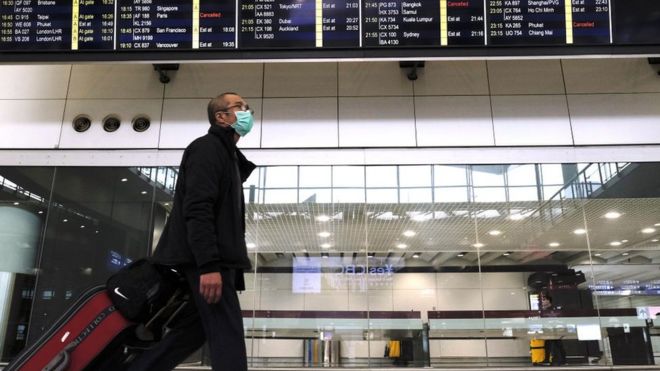
Aman wearing a mask pulls suitcase as he walks past a flight information display boardImage copyright GETTY IMAGES
Image caption Chief Executive Carrie Lam said the majority of Hong Kong’s cases had been imported

Hong Kong will quarantine all people arriving from abroad for 14 days, its leader Carrie Lam has said.

The restrictions, which will kick in on Thursday, will not apply to those from Macau or Taiwan. Entrants from mainland China already had to self-isolate.

Ms Lam said the majority of Hong Kong’s cases had been imported, adding that “strict measures” were needed.

Hong Kong has seen 57 new infections over the past two weeks, 50 of which were imported, said Ms Lam.

“If we exclude these imported, we only have seven local cases in the past week,” she said.

“If we do not impose strict measures, our previous efforts could be wasted.”

Ms Lam also advised residents to avoid all non-essential travel.

There are at least 155 confirmed cases in the territory, which detected its first cases in January.

The territory – a special administrative region of China – has so far been able to avoid the contagion seen elsewhere, thanks partly to a quick government response.

In January, cross-border travel with mainland China was slashed. Soon afterwards, health workers went on strike to demand a total border shutdown.

Presentational grey line

Some of the restrictions in the Asia-Pacific region, as of 17 March:

  • Australia – All travellers will have to self-isolate for 14 days. Foreign nationals who have been to China, Iran, Korea and Italy not allowed in
  • New Zealand – Everyone entering the country will have to self-isolate for 14 days. This excludes those from small Pacific islands with no confirmed virus cases
  • South Korea – Travellers from China’s Hubei province not allowed in. International arrivals from certain countries will need to submit papers on their health condition
  • Singapore – All visitors with travel history to France, Germany, Italy, Spain, South Korea and China banned from entering or transiting. Residents with recent history to these countries will have to self-isolate for 14 days. All those entering from Japan, Switzerland, the UK and Asean countries will have to self-isolate for 14 days
  • Malaysia – All foreign visitors have been banned, all Malaysians will not be allowed to travel overseas until 31 March. All returning Malaysians will have to self quarantine for 14 days
  • Japan – Ban on entry to travellers who have been to parts of China, South Korea, Iran or Italy in 14 days before arrival
Presentational grey line

The number of confirmed coronavirus cases and deaths outside China has now surpassed the number inside.

More than 100,000 people have been infected outside China, while just over 80,000 cases have been reported inside.

There have been more than 182,000 confirmed cases of coronavirus globally and over 7,000 deaths, according to a tally from Johns Hopkins University.

Media caption Steps the NHS says you should take to protect yourself from Covid-19

Source: The BBC

16/03/2020

Alibaba’s Ma donates coronavirus test kits to US

Co-founder of Alibaba Group Jack Ma .Image copyrightGETTY IMAGES

Alibaba co-founder Jack Ma has sent the first shipment of surgical masks and coronavirus test kits to the US.

The Chinese billionaire tweeted two pictures of the pallets of goods being loaded on to a plane in Shanghai.

Earlier this month he said he would give 500,000 testing kits and one million masks to America.

Mr Ma is also sending consignments of medical supplies to Europe as he called for international cooperation efforts to combat the pandemic.

In his first tweet, Asia’s richest person posted photos of a China Eastern Airlines jet being loaded with boxes of coronavirus test kits and face masks as they were shipped to the US.

It comes after the Jack Ma Foundation and the Alibaba Foundation last week announced that they had prepared 500,000 testing kits and 1 million masks to be sent to America.

They also said that they had already donated supplies to other countries including Japan, South Korea, Italy, Iran and Spain, with two million protective masks pledged for distribution across Europe.

The first consignment of 500,000 masks and other medical supplies such as test kits, which was destined for Italy, arrived in Belgium on Friday.

He joins other high-profile technology executives in pledging support for coronavirus research and disease prevention.

Microsoft co-founder Bill Gates, who is the world’s second-richest person, has announced that the Bill and Melinda Gates Foundation would give $100m to help efforts to stop the spread of the virus.

On Friday Mr Gates announced that he was stepping down from Microsoft’s board to spend more time on philanthropic activities. He said he wanted to focus on global health and development, education and tackling climate change.

Chinese tech giants, including Tencent, ride-hailing company Didi Chuxing, and TikTok owner ByteDance, have all pledged money and resources to fight the coronavirus outbreak.

Source: The BBC

13/03/2020

China Focus: China report says human rights situation deteriorating in U.S.

BEIJING, March 13 (Xinhua) — China on Friday issued a report on human rights violations in the United States.

Titled “The Record of Human Rights Violations in the United States in 2019,” the report said the facts detailed in the document show that “in recent years, especially since 2019, the human rights situation in the United States has been poor and deteriorating.”

The State Council Information Office released the report based on published data, media reports and research findings. It began by citing a quote from U.S. Secretary of State Mike Pompeo in a speech on April 15, 2019: “We lied, we cheated, we stole … It reminds you of the glory of the American experiment.”

“The remarks of U.S. politicians have completely exposed their hypocrisy of adopting double standards on human rights issues and using them to maintain hegemony,” read the report.

The United States released annual reports to “distort and belittle” human rights situation in countries and regions that did not conform to U.S. strategic interests, but turned a blind eye to the “persistent, systematic and large-scale” human rights violations in its own country, the report said.

Consisting of foreword and seven chapters, it detailed facts on human rights violations in the United States relevant to civil and political rights, social and economic rights, discrimination suffered by ethnic minorities, discrimination and violence against women, living conditions of vulnerable groups, and abuses suffered by migrants, as well as U.S. violations of human rights in other countries.

The lack of restraint in the right to hold guns has led to rampant gun violence, posing a serious threat to citizens’ life and property safety in the United States, the report said.

“The United States is a country with the worst gun violence in the world,” read the report. In total, 39,052 people died from gun-related violence in the United States in 2019, and a person is killed with a gun in the United States every 15 minutes, figures showed.

Wealth polarization in the United States hit a 50-year high in 2018, the report said. In 2018, the wealthiest 10 percent held 70 percent of total household wealth. The bottom 50 percent saw essentially zero net gains in wealth over the past 30 years, it noted.

Regarding discrimination suffered by ethnic minorities in the United States, the report said the political structure and ideology of white supremacy in the United States have caused ethnic minorities to suffer all-round discrimination in various fields such as politics, economy, culture and social life.

Since 2016, white supremacy in the United States has shown a resurgence trend, leading to racial opposition and hatred, it noted.

Women in the United States face severe discrimination and violence, according to the report. Women in the United States were 21 times more likely to die by firearm homicide than women in peer nations, it noted, adding that sexual assault cases against women kept increasing.

About the living conditions of vulnerable groups, the report said tens of millions of U.S. children, elderly people, and disabled people live without enough food or clothing, and face threats of violence, bullying, abusing and drugs.

“The U.S. government not only has insufficient political will to improve the conditions for vulnerable groups but also keeps cutting relevant funding projects,” read the report.

While levels of extreme poverty worldwide had dropped dramatically, the poverty ratio of U.S. children was about the same rate as 30 years ago, it said.

The report noted the increasingly strict and inhumane measures taken by the U.S. government against immigrants in recent years, in particular, the “zero-tolerance” policy, which caused the separations of many immigrant families.

Many unaccompanied immigrant children were held in overcrowded facilities, without access to adequate healthcare or food, and with poor sanitation conditions, the report said.

It noted grave abuses at detention facilities for immigrants, including injecting them with sedatives, keeping them in handcuffs, and depriving them of clothing and mattresses.

The United States also wantonly trampled on human rights in other countries and was responsible for many humanitarian disasters around the world, according to the report.

The economic embargo against Cuba and the unilateral sanctions against Venezuela imposed by the United States had been a massive and flagrant violation of the human rights of people in these countries, the report said.

The United States withdrew from several multilateral mechanisms, including the UN Human Rights Council and the UN Global Compact on Migration, shirking off its international obligations and making troubles to the international governance system, it noted.

Source: Xinhua

11/03/2020

Thailand restricts visitor visas to limit virus spread

BANGKOK (Reuters) – Thailand will temporarily suspend issuing visas on arrival to visitors from 19 countries and territories, including China, to contain the spread of the coronavirus, its interior minister said on Wednesday.

The suspensions were the latest measures imposed in the tourism-reliant Southeast Asian country, which has reported 59 cases of the virus and one death so far. Globally, over 113,000 people have been infected in over 100 countries.

“People from any country who want to come will need to apply for a visa with our embassies,” Minister of Interior Anupong Paochinda told reporters.

“Thai embassies everywhere will ensure that no sick people will travel to Thailand.”

Visa on Arrival (VoA) will be suspended for nationals of all 19 countries and territories previously eligible, including Bulgaria, Bhutan, China, Cyprus, Ethiopia, Fiji, Georgia, India, Kazakhstan, Malta, Mexico, Nauru, Papua New Guinea, Romania, Russia, Saudi Arabia, Taiwan, Uzbekistan, and Vanuatu, according to a list provided to reporters by the Ministry of Foreign Affairs.

However, Russian passport holders will not be affected by the suspension of the visa on arrival from Russia, as they can still travel to Thailand and stay for 30 days under a visa waiver agreement, an official at the ministry told Reuters.

Visa exemptions will be cancelled for South Korea, Italy and Hong Kong, Anupong said.

“These measures will solve the problem of foreigners arriving from risky zones,” he said.

Anupong said he would start the process immediately but it was not immediately clear when they will be effective.

Chatree Atchananant, director-general of the foreign ministry’s Consular Affairs Department, said visa applicants will need to present medical certificates and insurance as part of the screening at Thai embassies.

Last week, Thailand designated South Korea, China, Macao, Hong Kong, Italy and Iran as “dangerous communicable disease areas.”

Thai authorities urged people arriving from the six places to self-quarantine for 14 days.

Source: Reuters

11/03/2020

China urges relevant parties to immediately lift unilateral sanctions against Iran: diplomat

GENEVA, March 10 (Xinhua) — China urges relevant parties to immediately lift unilateral sanctions against Iran to prevent further harm to the human rights of the Iranian people, a senior Chinese diplomat has said.

Liu Hua, Special Representative for Human Rights of the Chinese Foreign Ministry, told the on-going 43rd session of the UN Human Rights Council on Monday that imposing external mechanisms without the consent of the countries concerned is not conducive to dialogue and cooperation, and does not play a role in promoting and protecting human rights.

Liu said that the international community should treat the human rights situation of Iran in an objective and fair manner, understand the challenges Iran faces as a developing country in promoting and protecting human rights, and listen more to the Iranian government and the demands of its people.

The unilateral sanctions imposed by relevant countries on Iran have had a significant negative impact on the human rights of the Iranian people, and have also restricted the United Nations and other organizations from providing humanitarian assistance to Iran, she said.

The Chinese diplomat highlighted that it is crucial time at this moment for the Iranian government and its people to fight the COVID-19 epidemic.

“China is providing support to the Iranian side within its capacity, including providing testing kits and other anti-epidemic materials, and sending a team of volunteer experts to help Iran fight the epidemic. China also calls on all parties to strengthen cooperation with Iran on epidemic prevention,” Liu said.

She also highlighted that China has always advocated that all countries should address human rights issues through constructive dialogue and cooperation, oppose politicization, selectivity, double standards, and confrontational practices, and does not support the practice of “naming and shaming” and publicly pressuring.

Source: Xinhua

10/03/2020

China issues contingency plan against locust threat

BEIJING, March 9 (Xinhua) — China on Monday unveiled its contingency plan to monitor and control the spread of locusts from home and abroad, in a bid to secure grain production and ecological safety.

Regional governance and scientific prevention and control should be given priority, said the plan jointly issued by the Ministry of Agriculture and Rural Affairs, the General Administration of Customs and the National Forestry and Grassland Administration.

The plan clarified the goal of locust control, which is to ensure that desert locusts from abroad will not cause harm and domestic locust outbreaks will not turn into a plague, with no more than 5 percent of crops affected.

Local authorities are urged to prevent the invasion of desert locusts from abroad. The plan requires that monitoring stations be set up in Tibet, Yunnan and Xinjiang on the potential migration routes of the destructive pests.

To control locusts in domestic agricultural areas, chemical control methods will be adopted for areas with a high density of the pests, while medium- or low-density areas will use biological and ecological control methods, the plan noted.

The plan also requires an investigation into the hidden dangers of grasshoppers in major grasslands in Inner Mongolia, Xinjiang and Sichuan, and the strengthening of prevention and control at key points on the border between China and Kazakhstan, and that between China and Mongolia.

The rare desert locust outbreak in East Africa and Southwest Asia has posed a severe threat to local grain and agricultural production, which led to the desert locust plague warning issued by the Food and Agriculture Organization of the United Nations.

Although experts believe it is highly unlikely that desert locusts will invade China, it is still necessary to take precautions, said the plan.

Source: Xinhua

07/03/2020

China welcomes Russia-Turkey agreement on ceasefire in Idlib: envoy

UNITED NATIONS, March 6 (Xinhua) — China’s UN envoy on Friday said China welcomes the Russia-Turkey agreement on a ceasefire for Syria’s northwestern province of Idlib.

In a press encounter after a close-door Security Council meeting on Syria, China’s Permanent Representative to the UN Zhang Jun said “for China, we welcome the agreement signed by the Russian Federation and the Republic of Turkey, and we welcome the diplomatic efforts along this direction.”

He said the signing of the agreement is conducive to finding “what we have always longed … a comprehensive solution to the issue in Syria.”

It’s a step forward in promoting a Syrian-led and Syrian-owned political process, facilitated by the UN, he said, expressing the hope that the agreement will be fully implemented.

Zhang stressed that in the process of implementation, Syria’s sovereignty, territorial integrity and political independence should be fully respected.

He said China hopes the international community will continue to commit to the fight against terrorism in the process. “We do hope that we will see more encouraging progress.”

The Chinese envoy voiced support for the humanitarian effort made by the UN, pledging that China will do whatever it can to provide humanitarian aid. “We also hope that the comprehensive humanitarian situation in Syria will be taken care of by the international community.”

He also urged parties concerned to avoid any attack on the civilians in Idlib and in Syria as a whole.

Russia and Turkey agreed Thursday on a ceasefire in the de-escalation zone in Idlib, a development that could ease escalating conflicts and facilitate a peace process in the war-torn country.

The ceasefire became effective from 00:01 a.m. on Friday local time. Russia and Turkey also agreed to create a safety corridor 6 km to the north and 6 km to the south from the strategic M4 highway, which connects Aleppo in northern Syria with Latakia in the northwest.

Also in the press encounter, Russia’s Permanent Representative to the UN Vassily Nebenzia said the ceasefire does not “exempt” operations targeting terrorists in the area, and that he hopes the sporadic fighting after the ceasefire took effect will be put out.

Britain and Germany’s UN ambassadors also expressed hope that the fresh ceasefire will last.

In 2018, the two countries agreed on a deal in the southern Russian city of Sochi, which created a “de-escalation” zone in Idlib and allowed for the deployment of 12 Turkish observation posts. However, the “de-escalation” zone has been repeatedly violated.

More than 30 Turkish soldiers were killed last month around the area during an operation of the Syrian government, which Russia backs. The operation was attempting to regain control of the final rebel stronghold in the country after nearly nine years of war.

In response, Turkey targeted Syrian positions with aircraft, drones and artillery, raising fears of a direct military confrontation between Russia and Turkey.

Since March 2011, Syria has been in the throes of a conflict that has forced more than half of all Syrians to leave their homes.

According to The UN Office for the Coordination of Humanitarian Affairs, an estimated 5 million Syrians have fled the country, 6 million others are internally displaced, over 13 million people need assistance and an untold number of men, women and children are suffering greatly.

Source: Xinhua

06/03/2020

No double standards should be applied in countering terrorism: Chinese diplomat

GENEVA, March 5 (Xinhua) — A senior Chinese diplomat said here Thursday that there is no “good” terrorism or “bad” terrorism, there is only terrorism in the world, and no double standards should be applied in countering terrorism.

Speaking during the interactive dialogue with the UN Special Rapporteur on the promotion and protection of human rights while countering terrorism at the 43rd session of the Human Rights Council, Liu Hua, Special Representative for Human Rights of the Chinese Foreign Ministry, pointed out that terrorism is the common enemy of the mankind.

At present, Liu said, the international counter-terrorism situation is complex and severe. The international community is facing a new wave of terrorist activities, which pose serious threats to international and regional security and stability.

“The international community should carry out international cooperation and jointly combat terrorism in accordance with the purposes and principles of the Charter of the United Nations and other generally accepted basic principles of international relations,” she said.

The Chinese diplomat stressed that the key to countering terrorism is to provide the right solution to both the symptoms and root causes.

“On the one hand, we must base ourselves on the current situation, adopt a zero-tolerance attitude towards terrorism, and uproot all evils. On the other hand, we must take a long-term perspective, promote equal dialogue between different civilizations, religions, and nationalities, promote economic and social development, properly handle regional conflicts, and strive to eradicate the breeding ground for terrorism and extremism,” Liu noted.

At the same time, all parties should actively explore the balance between counter-terrorism and protection of human rights, and effectively prevent violations of the legitimate rights and interests of citizens and organizations, she added.

China is willing to strengthen counter-terrorism exchanges and cooperation with relevant parties in accordance with the principles of mutual respect and equal cooperation to jointly combat terrorist forces and maintain international peace and security, she said.

Source: Xinhua

06/03/2020

China’s Hubei reports no new coronavirus cases outside city of Wuhan

BEIJING (Reuters) – China’s central province of Hubei, excluding the provincial capital Wuhan, has reported zero new cases of coronavirus over 24 hours for the first time in the outbreak, as authorities seek to stem imported infections in other areas.

Wuhan, the centre of the epidemic, reported 126 new confirmed cases on Thursday but there were no new infections elsewhere in the province, the National Health Commission said on Friday.

Elsewhere in China, schools in provinces reporting no new cases for a number of days started to set reopening dates.

Qinghai, a northwesterly that had reported no new infections for 29 days as of March 5, said it would stagger the start date of different schools between March 11 and March 20, according to a notice posted on an official website.

The southwesterly province of Guizhou has said its schools will start reopening from March 16.

Outside of Hubei, there were 17 new confirmed cases, bringing the total new infections in mainland China to 143 on Thursday, up from 139 cases a day earlier.

Of the 17 new cases, 16 were imported from outside of China – 11 in Gansu province, four in Beijing and one in Shanghai.

A total of 311 passengers arriving at Gansu’s provincial capital Lanzhou from Iran were quarantined, state television reported late on Thursday.

Beijing’s four new cases had come from Italy. On Friday, one of the city’s government officials described its epidemic control campaign as being at its most challenging period, adding that roughly 827,000 people who had returned to the capital from outside – most of them from extended Lunar New Year holidays – were currently undergoing home observation.

Last month, Gansu became the first province to lower its emergency response measures from level I to level III, reflecting the lack of new infections.

Tibet became the latest region to lower its emergency response level on Friday, announcing on an official website that some areas had eased to level II and others to level III.

OPTIMISM FOR WUHAN

Health authorities in Shanghai said that the city had recorded three new cases in the first 12 hours of Friday. All were Chinese nationals who had studied in Iran, state media reported. [B9N28E04N]

All three had been transferred by Shanghai customs to quarantine on March 3, a spokeswoman for the city’s health commission told a news briefing.

Despite the fresh cases in Wuhan, senior Chinese government officials expressed optimism about its situation as the city shut its second makeshift hospital on Friday afternoon, state radio reported.

“As the situation in Wuhan and Hubei improves, relevant authorities, with approvals, will make timely adjustments according to China’s Infectious Diseases Law and public health emergency regulations,” Ding Xiangyang, vice secretary general at the State Council, told a news briefing.

“When I went out in the morning, the cherry blossoms were blooming in front of my door, telling us that winter has passed and spring has come. I think the day everyone has been looking forward to is not far away,” he said.

As new cases dwindle in China, attention has turned to potential infections arriving from overseas.

Authorities in Beijing, Shanghai and Guangdong have all vowed to quarantine travellers from countries hit the hardest by the coronavirus, which Beijing identified as South Korea, Japan, Iran and Italy.

The overall accumulated number of confirmed cases in mainland China stood at 80,552 as of Thursday.

The death toll from the outbreak in mainland China was 3,042 as of the end of Thursday, up by 30 from the previous day.

Hubei reported 29 new deaths, while in Wuhan, 23 people died.

Source: Reuters

04/03/2020

Xinhua Headlines: Guitars, roads and red tours: former revolutionary base casts off poverty

Zunyi, a former revolutionary base of the Communist Party of China in southwest China’s Guizhou Province, has cast off poverty.

Thanks to burgeoning industries, improving infrastructure and distinctive cultural tours, more than eight million people in Zunyi are living better lives.

By Xinhua writers Zhong Qun, Wang Li, Li Jingya and Liu Zhiqiang

GUIYANG, March 3 (Xinhua) — Riding on the fast development of industries, improving infrastructure and distinctive cultural tours, a former revolutionary site of the Communist Party of China (CPC) has formally cast off poverty in China’s southwestern mountains.

On Tuesday, the government of Guizhou Province announced that Zheng’an County in the province has shaken off poverty. The county is under the jurisdiction of the city of Zunyi, where the CPC conducted its early revolutionary activities. The announcement means that more than 8 million people in the entire city of Zunyi have officially bid farewell to poverty.

A view of Huamao Village of Fengxiang Township in Zunyi City, southwest China’s Guizhou Province, Feb. 28, 2020. (Xinhua/Tao Liang)

Over the years, Zunyi has taken a variety of measures in answer to China’s campaign to eradicate absolute poverty in 2020.

Major industries such as guitar-making and tea plantations powered Zunyi’s economic growth, while roads, water projects and the revolution-themed tourism also put the city, once mired in grinding poverty, on a fast track toward modernization.

GUITARS STRIKE A CHORD IN REVOLUTIONARY HEARTLAND

When Zheng Chuanjiu decided to build a guitar-making factory in Zunyi’s Zheng’an County in 2013, he was a little nervous.

“There were no raw materials, and transportation was bad,” said Zheng, 42. “But the county had advantages in land and labor and there was government support.”

Zheng, a native of the county, had found success in the guitar industry in Guangzhou, capital of south China’s Guangdong Province. He and his brother established the Guangzhou Shenqu Musical Instruments, a Guangzhou-based guitar-making company, after years of hard work in the southern metropolis.

“The county government of my hometown wanted to develop the guitar-making industry after they found many local migrant workers were working in the industry in Guangzhou,” Zheng said. “They established an industrial park and we were the first to join.”

An employee works at the workshop of Guangzhou Shenqu Musical Instruments, a Guangzhou-based guitar-making company, in Zheng’an County of Zunyi City, southwest China’s Guizhou Province, March 28, 2017. (Xinhua/Tao Liang)

The government put forward a variety of preferential policies in rents, financing and taxes, to support guitar-making companies like Zheng’s and allow the sector to prosper.

Today, Zheng’s company in the county has grown into one with an annual production value of more than 30 million U.S. dollars. One of the country’s top five guitar makers, it employs more than 500 local farmers and more than 100 poverty-stricken residents.

Zheng’s company is part of a bigger picture. The company’s success has led many to jump on the bandwagon. After years of growth, the county is now home to 64 companies specializing in guitar-related fields, churning out about 7 million guitars a year to more than 30 countries and regions across the world and employing more than 15,000 locals.

The guitar industry forms part of the government’s efforts to develop local industries. Thanks to geological advantages, the county also saw the emergence of tea gardens and traditional Chinese medicine plantations. All these sectors drove local economic growth.

A group of children trying tea-picking at Hetaoba Village in Meitan County of Zunyi City, southwest China’s Guizhou Province, April 1, 2018. (Xinhua/Yang Wenbin)

BETTER INFRASTRUCTURE, BETTER LIVES

Given the mountainous landscape in Guizhou, authorities in Zunyi knew the importance of improving infrastructure projects if they wanted to bring the local economy to the next level. So they started building new roads to facilitate transportation.

Last year, Guizhou built 8,116 km of roadways. The Guizhou provincial government spent 29.34 billion yuan (4.2 billion U.S. dollars) building the roadways, including 7,386 km in rural areas, according to the provincial highway bureau. The province also upgraded many old roadways.

The construction site of Tuanjie Grand Bridge of Renhuai-Zunyi Highway, which has resumed construction amid strict prevention measures against the novel coronavirus, in southwest China’s Guizhou Province, Feb. 27, 2020. (Xinhua/Tao Liang)

In the county of Zheng’an, for example, several major highways not only enhanced logistics to bring specialties out of town but also allowed outside investment to flow to the county tucked in the lush green mountains.

“Thanks to improved transportation conditions, our guitars can easily reach many areas in the country and around the world,” said Zheng Chuanjiu.

In Huanglian Village, rural family inns have mushroomed, as more visitors come as more roads were built. Many tourists come to enjoy the countryside scenes during the holidays.

In addition, water projects also began, bringing safe drinking water to local households.

“We used to depend on the weather for water,” said Zunyi resident Zeng Fanyun. “Now we have clean water from the taps.”

For areas deemed inhabitable, authorities moved people out.

Statistics show that Guizhou relocated 1.88 million people from inhospitable areas in 2019.

RED TOURS, GOLDEN OPPORTUNITIES

As many cities in China scramble to modernize and adopt the latest technology to power growth, Zunyi seems to have found a new way to develop itself by looking to the past.

In January 1935, an enlarged meeting of the Political Bureau of the CPC Central Committee took place in Zunyi during the Long March.

The meeting focused on rectifying the left-leaning errors in military and organizational affairs and established the correct leadership of the new Central Committee, as represented by Mao Zedong.

The Zunyi Meeting is regarded as a crucial turning point of the Long March, leading to the ultimate success of the Chinese revolution.

Since then, Zunyi has become a sacred place for generations of CPC members, and the footprints of the Red Army are forever imprinted on the city’s culture and spirit.

Today, local authorities are promoting “red tours” in the locality, aiming to bolster the tourism sector as part of economic growth.

Tourists are seen at the Memorial of Zunyi Meeting in Zunyi, southwest China’s Guizhou Province, Oct. 16, 2018. (Xinhua/Tao Liang)

Yang Zhirong started a family homestay in the county of Tongzi in Zunyi. The homestay is called “The Red Army Road Inn,” because it is close to the command center of a famous battle during the 1930s.

“During the summer holidays, there are barely enough rooms to accommodate all the tourists,” Yang said. “Because the Red Army used to walk near here, the visitors feel they could sense history by staying here.”

Last year, Zunyi received more than 46 million visitors for red tours, generating a revenue of about 35.5 billion yuan, up 24.1 percent year on year, according to official figures.

The red tours also prompted sales of local cultural products, such as handmade soap, wallets and fragrances, all featuring Red Army themes. Forums, hiking and even marathons feature red themes as well in Zunyi.

“Zunyi serves as a good example of the CPC’s ability and responsibility to help people live prosperous lives,” said Zheng Dongsheng, a professor with the Party School of the Guizhou Provincial Committee of the CPC. “Zunyi’s success to cast off poverty highlights the Long March spirit in the modern era.”

Source: Xinhua

Law of Unintended Consequences

continuously updated blog about China & India

ChiaHou's Book Reviews

continuously updated blog about China & India

What's wrong with the world; and its economy

continuously updated blog about China & India