Archive for ‘Taiwan’

05/01/2019

Taiwan President Tsai Ing-wen open to cross-strait talks, but has some demands for Beijing first

  • Leader explains her rejection of Xi Jinping’s proposal to start talks on unification based on ‘one country, two systems’
PUBLISHED : Saturday, 05 January, 2019, 5:00pm
UPDATED : Saturday, 05 January, 2019, 6:13pm

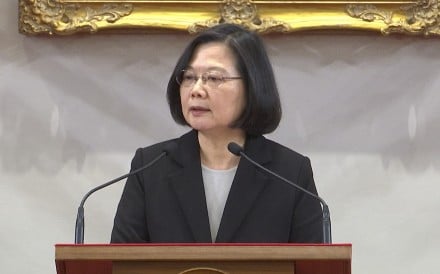
Taiwan’s President Tsai Ing-wen said on Saturday she was open to talks with the mainland if Beijing was willing to promote democracy and renounce the use of force against the self-ruled island.

Tsai’s comments came two days after she rejected Chinese President Xi Jinping’s proposal for the two sides to start talks on unification based on the “one country, two systems” model which applied in Hong Kong.

“As the democratically elected president, I have to defend our democracy, freedom, and way of life,” she told foreign journalists in Taipei to explain her rejection of Xi’s proposal, made in a speech on Wednesday to mark 40 years since the end of military confrontation across the Taiwan Strait.

Tsai said Xi’s statement highlighted two fundamental dangers posed by Beijing to freedom and democracy in Taiwan.

“First, by emphasising ‘one China’ and ‘one country, two systems,’ particularly in the context of the so-called 1992 consensus, China has made clear their political intentions towards Taiwan and their steps for unification.

“This is a major disregard for the fact that the Republic of China, Taiwan does exist, and is in full operation like all other democratic countries,” she said.

“Second, China’s plan to engage in political consultation with the political parties instead of the democratically elected government of Taiwan, is a continuation of its deliberate campaign to undermine and subvert our democratic process and create division in our society.”

The 1992 consensus refers to an understanding that there is only one China, though each side may have its own interpretation of what constitutes “China”.
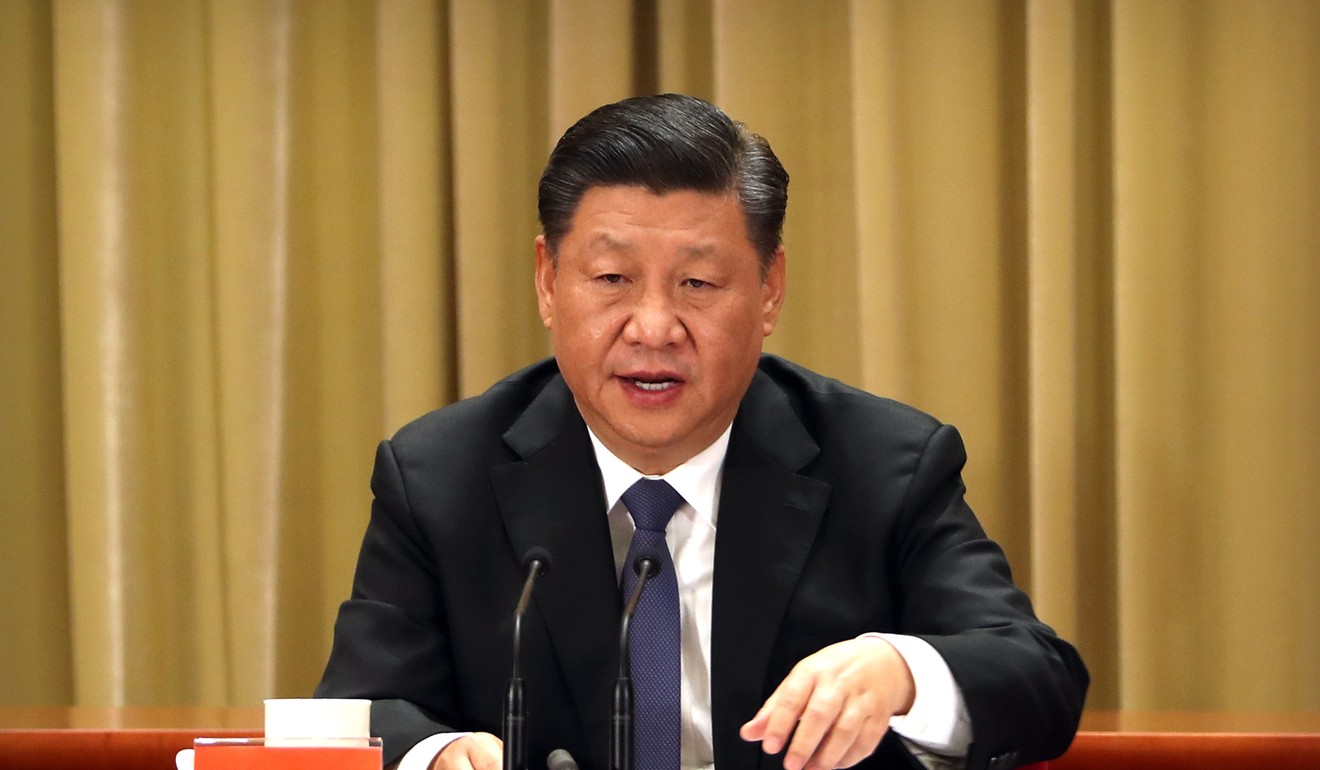
In his speech, Xi rephrased the consensus as an understanding that “the two sides of the Taiwan Strait belong to one China, jointly seeking to achieve cross-strait unification”.

Beijing suspended official talks and exchanges with Taiwan when Tsai was elected president in 2016 and refused to accept the consensus.

Since then Beijing, which considers Taiwan a wayward province awaiting unification by force if necessary, has staged a series of war games to intimidate the island and poached five of Taiwan’s diplomatic allies to try to pressure Tsai into accepting the consensus.

“As a democracy, cross-strait interaction must follow the rules and oversight of the people of Taiwan, and therefore any discussions must be between governments that are representative of the people on both sides,” Tsai said on Saturday.

She identified a lack of mutual trust as the key problem keeping the two sides from consulting on a possible way of dealing with each other.

“The lack of democracy and protection of human rights, as well as the military threats from China are the major reasons [that people here do not trust Beijing],” Tsai said.

This was why majority opinion in Taiwan opposed cross-strait unification, as people there did not want to live in a system without democracy and human rights, she said.

Asked if the Tsai administration would want talks with Beijing, Tsai said her government did not oppose talks, but Beijing must “move towards democracy, protect human rights and renounce the use of force against us”.

“Only when the two sides step up efforts to accumulate adequate trust will the room for [negotiation] be widened and options [for talks] increased,” she said.

Tsai said Taiwan had long adhered to the principle of refraining from provoking Beijing and had done all it could to maintain stability in the region.

On the contrary, she said, Beijing had tried to suppress Taiwan and refused to cooperate with the island, even on health issues like the outbreak of African swine fever which threatened the well-being of the public in Taiwan.

Tsai added that she had also sought international support to defend the self-ruled island’s democracy and way of life, as well as Taiwan’s refusal to accept the one country, two systems approach offered by Xi for unification talks, given Beijing’s snubbing of democracy and human rights.

She asked Beijing to take note of the democratic mindset of Taiwanee.

03/01/2019

Xinhua Headlines: Xi says “China must be, will be reunified” as key anniversary marked

CHINA-BEIJING-XI JINPING-MESSAGE TO COMPATRIOTS IN TAIWAN-COMMEMORATION (CN)

Chinese President Xi Jinping, also general secretary of the Communist Party of China (CPC) Central Committee and chairman of the Central Military Commission, delivers a speech at a gathering to commemorate the 40th anniversary of issuing Message to Compatriots in Taiwan, at the Great Hall of the People in Beijing, capital of China, Jan. 2, 2019. (Xinhua/Li Tao)

BEIJING, Jan. 2 (Xinhua) — President Xi Jinping on Wednesday said China must be and will be reunified, as he addressed a gathering in Beijing to commemorate the 40th anniversary of the Chinese mainland’s Message to Compatriots in Taiwan.

“It is a historical conclusion drawn over the 70 years of the development of cross-Strait relations, and a must for the great rejuvenation of the Chinese nation in the new era,” said Xi, also general secretary of the Communist Party of China (CPC) Central Committee and chairman of the Central Military Commission.

Speaking at the Great Hall of the People, Xi called for joint efforts across the Taiwan Strait to advance peaceful national reunification.

The long-standing political differences can not be dragged on generation after generation, Xi said.

The Taiwan question originated from national weakness and disorder and has lasted for 70 years.

Xi said since 1949 the CPC, the Chinese government and the Chinese people have always unwaveringly taken resolving the Taiwan question to realize China’s complete reunification as a historic task.

He expressed confidence that the Taiwan question will definitely end with national rejuvenation.

BEST APPROACH

On Jan. 1, 1979, the National People’s Congress Standing Committee issued the Message to Compatriots in Taiwan. It was considered a declaration of the mainland’s policy for peaceful reunification.

Halt to military confrontations was proposed. Visits, cross-Strait transportation, postal services and economic and cultural exchanges were promoted. A page on cross-Strait relations has been turned.

On Wednesday, Xi raised a five-point proposal for peaceful reunification.

He said the principles of “peaceful reunification” and “one country, two systems” are the best approach to realizing national reunification.

He proposed that the mainland and Taiwan conduct democratic consultation on cross-Strait relations and the future of the nation, and establish institutional arrangement for peaceful development of cross-Strait relations.

He said on the basis of ensuring China’s sovereignty, security and interests of development, the social system and way of life in Taiwan will be fully respected, and the private property, religious beliefs and legitimate rights and interests of Taiwan compatriots will be fully protected after peaceful reunification is realized.

The president pledged “utmost sincerity and greatest efforts” for the prospect of peaceful reunification and said Taiwan will be guaranteed lasting peace after reunification.

“We are all of the same family,” Xi said.

While stressing that the “Chinese don’t fight Chinese,” Xi said, “We make no promise to renounce the use of force and reserve the option of taking all necessary means.”

This targets only the interference of external forces and the very small number of “Taiwan independence” separatists and their activities, he added.

IRRESISTIBLE TREND

“‘Taiwan independence’ goes against the trend of history and will lead to a dead end,” Xi said.

The president said achieving the country’s greatness, national rejuvenation and cross-Strait reunification is the trend of history, which can never be blocked by anyone or any force.

The peaceful and stable development of cross-Strait situations and the progress of cross-Strait relations are the tide of the time that can never be stopped by anyone or any force, he said.

Liu Jieyi, head of the State Council Taiwan Affairs Office, noted the strengthened political, economic, cultural, personnel exchanges over the decades.

Between 1988 and 2018, 134 million cross-Strait visits were logged; two-way trade reached 2.6 trillion U.S. dollars; and the mainland has been Taiwan’s largest market and top investment destination outside the island, Liu said.

In his speech, Xi said the future of Taiwan lies in national reunification.

“We sincerely hope all the compatriots in Taiwan treasure peace as much as they treasure their own eyes, and pursue national reunification as much as they pursue happiness.”

NO INTERFERENCE FROM OUTSIDE

Xi said the Taiwan question is China’s internal affair and allows no external interference.

The Chinese people’s affairs should be decided by the Chinese people, Xi said, stressing that the Taiwan question concerns China’s core interests and the national bond of the Chinese people.

China’s reunification does not harm any country’s legitimate interests, including their economic interests in Taiwan, Xi said, adding that it will only bring more development opportunities to other countries.

Over the 70 years, more and more countries and peoples have understood and supported China’s cause of reunification, the president noted.

Wednesday’s gathering was attended by Li Zhanshu, a member of the Standing Committee of the Political Bureau of the CPC Central Committee and chairman of the National People’s Congress Standing Committee.

Wang Yang, a member of the Standing Committee of the Political Bureau of the CPC Central Committee and chairman of the National Committee of the Chinese People’s Political Consultative Conference, presided over the event.

Wang said Xi’s speech demonstrated the historical trend of cross-Strait relations and called for joint efforts to forge ahead for the peaceful national reunification.

Chen Ching-lung, a 54-year-old hotel operator in Xiamen, Fujian Province, followed Xi’s speech, which was broadcast live by China Media Group and on Xinhua News Agency’s website (xinhuanet.com).

A veteran who was once stationed in Kinmen, Chen joined the influx of Taiwan compatriots who found bristle business chances on the mainland.

“The direction of peaceful development is totally correct,” he said. “What the two sides should do is to mitigate differences and enhance their communications.”

Hsueh Ching-te, another Taiwan compatriot who runs a business in Fujian, said he looks forward to complete reunification so that “all Chinese people will live in peace, prosperity and with dignity.”

02/01/2019

Xi highlights breakthroughs in cross-Strait relations over 70 years

BEIJING, Jan. 2 (Xinhua) — President Xi Jinping highlighted the breakthrough progress made in the cross-Strait relations since 1949, at a gathering on Wednesday to commemorate the 40th anniversary of Chinese mainland’s Message to Compatriots in Taiwan.

Over the 70 years, estrangement between the mainland and Taiwan was ended in line with the common will of compatriots across the Strait, and Taiwan compatriots have made great contributions to the reform and opening-up in the mainland, said Xi, who is also general secretary of the Communist Party of China (CPC) Central Committee and chairman of the Central Military Commission.

During the seven decades, the mainland and Taiwan reached the 1992 Consensus based on the one-China principle, and the political exchanges across the Strait have reached new heights, Xi said.

Over the 70 years, the basic principles of “peaceful reunification” and “one country, two systems” were established, and the basic policy of upholding “one country, two systems” and advancing the national reunification was laid out, according to Xi.

He continued that more and more countries and peoples have understood and supported the cause of the reunification of China over the 70 years.

Furthermore, over the 70 years, a series of major victories in the battles against “Taiwan independence” and separatists have been achieved, Xi said.

20/10/2013

Six Wars China Is Sure to Fight In the Next 50 Years – StratRisks

We can only hope that the article below is a worst-case scenario that will not actually happen.

From: http://stratrisks.com/geostrat/15914

On July 8, 2013, the pro-PRC Chinese-language newspaper, Wenweipo, published an article titled “中國未來50年裡必打的六場戰爭 (Six Wars China Is Sure to Fight In the Next 50 Years)”.

The anticipated six wars are all irredentist in purpose — the reclaiming of what Chinese believe to be national territories lost since Imperial China was defeated by the Brits in the Opium War of 1840-42. That defeat, in the view of Chinese nationalists, began China’s “Hundred Years of Humiliation.” (See Maria Hsia Chang,Return of the Dragon: China’s Wounded Nationalism. Westview, 2001.

Below is the English translation of the article, from a Hong Kong blog, Midnight Express 2046. (The year 2046 is an allusion to what this blog believes will be the last year of Beijing’s “One County, Two Systems” formula for ruling Hong Kong, and “the last year of brilliance of Hong Kong.”)

Midnight Express 2046 (ME2046) believes this article “is quite a good portrait of modern Chinese imperialism.” What ME2046 omits are:

  • the original Chinese-language article identifies the source of the article as 中新網 (ChinaNews.com).
  • The Chinese-language title of the article includes the word bi (), which means “must” or “necessarily” or “surely.” That is why  the word “sure” in the English-language title of the article.

PLAN

THE SIX WARS [SURE] TO BE FOUGHT BY CHINA IN THE COMING 50 YEARS

China is not yet a unified great power. This is a humiliation to the Chinese people, a shame to the children of the Yellow Emperor. For the sake of national unification and dignity, China has to fight six wars in the coming fifty years. Some are regional wars; the others may be total wars. No matter what is the nature, each one of them is inevitable for Chinese unification.

THE 1ST WAR: UNIFICATION OF TAIWAN (YEAR 2020 TO 2025)

Though we are enjoying peace on the two sides of the Taiwan Strait, we should not daydream a resolution of peaceful unification from Taiwan administration (no matter it is Chinese Nationalist Party or Democratic Progressive Party). Peaceful unification does not fit their interests while running for elections. Their stance is therefore to keep to status quo (which is favourable to the both parties, each of them can get more bargaining chips) For Taiwan, “independence” is just a mouth talk than a formal declaration, while “unification” is just an issue for negotiation than for real action. The current situation of Taiwan is the source of anxiety to China, since everyone can take the chance to bargain more from China.

China must work out a strategy to unify Taiwan within the next ten years, that is, by 2020.

THE 2ND WAR: “RECONQUEST” OF SPRATLY ISLANDS (YEAR 2025 TO 2030)

After unification of Taiwan, China will take a rest for two years. During the period of recovery, China will send the ultimatum to countries surrounding the Islands with the deadline of 2028. The countries having disputes on the sovereignty of Islands can negotiate with China on preserving their shares of investments in these Islands by giving up their territorial claims. If not, once China declares war on them, their investments and economic benefits will be taken over by China.

At this moment, the South East Asian countries are already shivering with Chinese military unification of Taiwan.

THE 3RD WAR: “RECONQUEST” OF SOUTHERN TIBET (YEAR 2035 TO 2040)

China and India share a long border, but the only sparking point of conflicts between the two countries is only the part of Southern Tibet. China has long been the imaginary enemy of India. The military objective of India is to surpass China. India aims to achieve this by self-development and importing advanced military technologies and weapons from the U.S, Russia and Europe, chasing closely to China in its economic and military development.

In India, the official and media attitude is more friendly towards the U.S, Russia and Europe, and is repellent or even hostile against China. This leads to unresolvable conflicts with China. On the other hand, India values itself highly with the aids from the U.S, Russia and Europe, thinking it can beat China in wars. This is also the reason of long lasting land disputes.

In my opinion, the best strategy for China is to incite the disintegration of India. By dividing into several countries, India will have no power to cope with China.

THE 4TH WAR: “RECONQUEST” OF DIAOYU ISLAND [SENKAKU] AND RYUKYU ISLANDS (YEAR 2040 TO 2045)

In the mid-21st century, China emerges as the real world power, accompanied with the decline of Japan and Russia, stagnant U.S. and India and the rise of Central Europe. That will be the best time for China to take back Diaoyu Island and Ryukyu Islands. The map below is the contrast between ancient and recent Diaoyu Island and Ryukyu Islands (map omitted).

From the historical records of Chinese, Ryukyu and other countries (including Japan), Ryukyu has long been the vassal states of China since ancient times, which means the islands are the lands of China.

THE 5TH WAR: UNIFICATION OF OUTER MONGOLIA (YEAR 2045 TO 2050)

Though there are advocates for reunification of Outer Mongolia at the moment, is this idea realistic? Those unrealistic guys in China are just fooling themselves and making a mistake in strategic thinking. This is just no good to the great work of unification of Outer Mongolia.

China should also pick the groups advocating the unification, aiding them to take over key posts in their government, and to proclaim Outer Mongolia as the core interests of China upon the settlement of Southern Tibet issue by 2040.

THE 6TH WAR: TAKING BACK OF LANDS LOST TO RUSSIA (YEAR 2055 TO 2060)

The current Sino-Russian relationship seems to be a good one, which is actually a result of no better choice facing the U.S. In reality, the two countries are meticulously monitoring the each other. Russia fears the rise of China threaten its power; while China never forgets the lands lost to Russia. When the chance comes, China will take back the lands lost.

When the Chinese army deprives the Russians’ ability to counter strike, they will come to realize that they can no longer match China in the battlefield.

09/05/2013

* China and Taiwan cross-strait representative offices: One offensive, the other defensive

Another illustration of the Chinese pragmatism. Why let ‘politics and dogma’ stand in the way of good mutual trade relationship?

See also: https://chindia-alert.org/social-cultural-diff/chinese-mindset/

20/01/2013

* Beijing to lend Taiwan historical artefacts from Forbidden City

SCMP: “Beijing has agreed to lend art exhibits for a major joint exhibition in Taipei, the head of Taiwan’s top museum said on Sunday, as the two former rivals push ahead with detente.

museum.jpg

Feng Ming-chu, director of Taipei’s National Palace Museum, will fly to Beijing on Monday, the first such trip since 2009 when the chiefs of the museum and of Beijing’s Palace Museum made landmark exchange visits.

Feng will meet her mainland counterpart Shan Jixiang to discuss the loan of more than 30 artefacts from the museum, also known as the Forbidden City, for the exhibition in Taipei in October.

“The Palace Museum in Beijing has agreed to our proposal for loaning artefacts,” she said.

The exhibition, which will also include some items from the Taipei museum, features the artistic tastes of Qianlong (1735-1796), an emperor in China’s last dynasty Qing.

“Hopefully the co-operation between the two museums will be further enhanced through the visit, following the 2009 ice-breaking exchange of visits by the curators of the two sides,” Feng said.

The 2009 visits resulted in the loan of 37 works from the Beijing museum to the Taiwanese museum later that year.

It was the first joint exhibition by the two museums, highlighting warming relations between Beijing and Taipei which have been ruled separately since the end of a civil war in 1949.”

via Beijing to lend Taiwan historical artefacts from Forbidden City | South China Morning Post.

30/12/2012

* Taiwan’s Fubon says to buy China bank stake for $1 billion

Another reason why China and Taiwan will try their utmost not to go to war.

Reuters: “Fubon Financial (2881.TW), one of the most aggressive Taiwanese financial firms expanding into the Chinese market, said on Thursday it will buy an 80 percent stake in China’s Firstsino Bank for 6.45 billion yuan ($1.03 billion).

Map of the Taiwan Strait

Map of the Taiwan Strait (Photo credit: Wikipedia)

The acquisition would be another sign that banking links across the Taiwan Straits are strengthening. Taiwan’s financial companies are keen to tap the huge mainland market as trade ties between the former political foes boom, helping them move beyond a saturated domestic market.

“It will help us build a complete platform in Greater China, paving the way to enter the fast-growing areas in China,” Fubon said in a statement, adding that the purchase is subject to regulatory approvals from both sides.”

via Taiwan’s Fubon says to buy China bank stake for $1 billion | Reuters.

29/12/2012

Hope the author is correct!

Law of Unintended Consequences

continuously updated blog about China & India

ChiaHou's Book Reviews

continuously updated blog about China & India

What's wrong with the world; and its economy

continuously updated blog about China & India