Archive for ‘Prime Minister Narendra Modi’

15/05/2019

Priyanka Gandhi: Can Congress party’s ‘mythical weapon’ deliver?

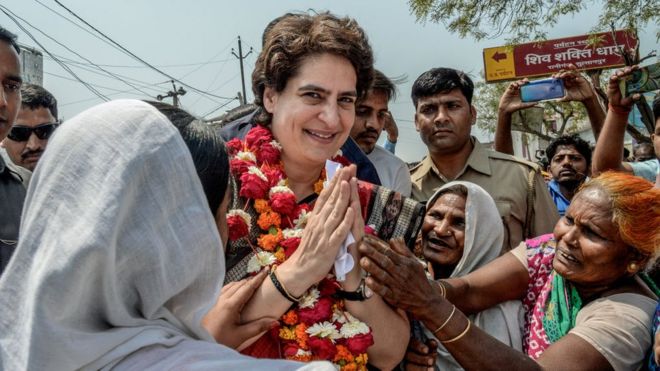
Congress Party's Priyanka Gandhi campaigns on the road for for India National Congress on March 29, 2019 in Utter Pradesh, India.Image copyrightGETTY IMAGES

On Wednesday, Priyanka Gandhi is taking on Prime Minister Narendra Modi on his home turf – by holding a road show in his constituency Varanasi. Ever since she formally joined politics in February, she has been on a whirlwind tour, campaigning mostly in Uttar Pradesh where Varanasi is located. But will her efforts make any difference to the fortunes of the Congress party in the general elections?

When Ms Gandhi, the charismatic sister of Congress party president Rahul Gandhi, walked up onto the stage at a rally in the town of Pratapgarh last week, she was greeted by shouts of “Priyanka Gandhi zindabad! [Long Live Priyanka Gandhi!]”. A massive garland of red roses was held up by local Congress leaders to frame her and a golden crown was placed on her head.

Ms Gandhi launched a direct attack on Mr Modi, accusing him of not fulfilling the promises he had made before the 2014 elections.

His government, she said, had failed to create jobs, his decision to scrap high denomination banknotes had broken the backs of poor people and small businesses, and she chided the prime minister for denying farmers their rights.

When the Congress is voted to power, she said, the job scheme for the poor would be extended, wages paid on time and high school education made free.
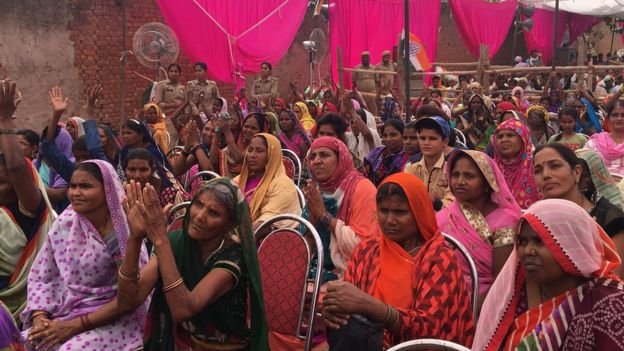
Supporters of Priyanka Gandhi
Image caption Ms Gandhi connects easily with people, especially women

The rally was held in a small ground in the town centre and it was a small crowd, but the audience was responsive, clapping and cheering as she spoke in flawless Hindi. She ended her speech by appealing to them to vote for the Congress candidate, to vote in the change.

Mithilesh Kumar Yadav, a 21-year-old student in the audience, told me that as a young man, that’s what he wanted.

“Priyanka Gandhi wants to bring change here. As a young man I want change. Mr Modi’s policies have affected people adversely,” he said, adding that “the prime minister doesn’t talk about issues that are important. He’s trying to divert attention from his unkept promises.”

Congress spokesman Akhilesh Pratap Singh told me that Ms Gandhi had been brought in to strengthen her brother’s hands, help energise the party rank and file and counter Mr Modi’s Bharatiya Janata Party (BJP).

Presentational grey line

India votes 2019

Presentational grey line

Since taking the plunge into active politics, Ms Gandhi has hit the ground running. In the past three months, I too have travelled extensively in this bellwether state that elects 80 MPs, talking to Congress party supporters to understand why they clamour for the Gandhis, especially her.

At her rallies and road shows, I have met people who are enthused by her presence, her decision for a more active political role, but I didn’t meet a single person who said they were going to vote for the Congress because of her.

Ms Gandhi has spent hours campaigning in cars, trucks and even a boat, participated in dozens of road shows and addressed scores of rallies, grinning and waving at supporters, often reaching out to shake hands.

In February, when she made her first public appearance as a full-time politician in the state capital, Lucknow, along with her brother, thousands of supporters thronged the streets to greet them. Party workers and supporters were charged up and many told me that the Congress was now on course to win the elections and form the next government.

Similar scenes were repeated later in Amethi, Mr Gandhi’s constituency, and in towns and cities across northern India.
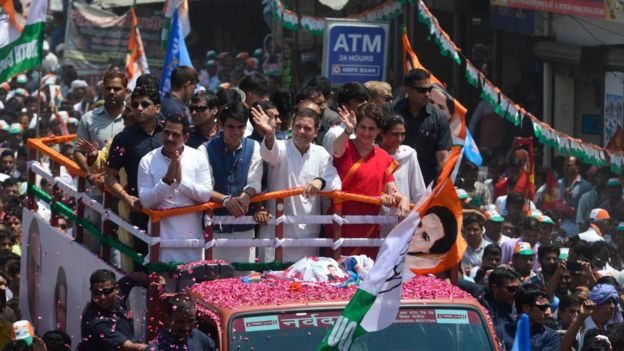
Congress Party Senior Leaders, Rahul Gandhi and Priyanka Gandhi clicked during a road show, in Amethi.Image copyright GETTY IMAGES
Image caption The Gandhi siblings received a tumultuous welcome during their road show in Amethi

A natural politician, Ms Gandhi is extremely articulate in Hindi and English and connects easily with people, especially women. With her short hair and crisp cotton saris, she bears a striking resemblance to her grandmother, India’s tough and only female prime minister Indira Gandhi.

And even though she’s not running for parliament, there is obsessive media interest in everything she does – during her visit to a village of snake charmers in her mother’s constituency Rae Bareli, she’s photographed holding up snakes, and in central India, a sari-clad Priyanka Gandhi is seen scaling a fence to mingle with the crowd at a rally while her security men race to catch up with her.

Her visits to temples and shrines to woo the religious are streamed live on TV channels, her road shows get prime time, and her comments about PM Modi often make headlines. And increasingly, it’s her who’s taking on Mr Modi, countering his criticism of her family and his charge that the siblings are there not because of merit but their name.

Ms Gandhi is not exactly a newcomer to politics. For almost two decades now, she has managed campaigns for her brother and mother Sonia Gandhi, but been reluctant to take on a wider role.

Presentational grey line

Read more from Geeta Pandey

Presentational grey line

The 47-year-old mother-of-two has always been regarded as the more charismatic of the Gandhi siblings. And in recent years, as the Congress has suffered major electoral setbacks, the chorus for her to take on a larger role has been getting louder. In 2015, some party workers demonstrated outside the Congress headquarters in Delhi, holding placards that read, “Priyanka lao, Congress bachao [Bring Priyanka, Save Congress]”.

So when it was announced in January that she had been appointed as general secretary for the eastern part of Uttar Pradesh, supporters celebrated by setting off fireworks and dancing outside the party office. She was described as the “Brahmastra” – a mythical celestial weapon of last resort deployed by Hindu deities to annihilate the enemy.
In a recent interview with a Hindi-language newspaper, Ms Gandhi explained the reasons why she finally said yes.

“Democracy, constitution and our institutions are under attack and it would have been cowardly not to take the plunge now. In 2017, Rahul asked me to take on Uttar Pradesh but I didn’t. It was a mistake but people learn from their experiences, so this time when he asked, I agreed.”

The Gandhi siblings are the fourth generation of the Nehru-Gandhi dynasty, often described as India’s political royalty. Their great-grandfather, Jawaharlal Nehru, was the first prime minister of independent India, their grandmother and father also served as prime ministers, while their mother, Italian-born Sonia, was the Congress chief until poor health forced her to hand over the reins to her son.
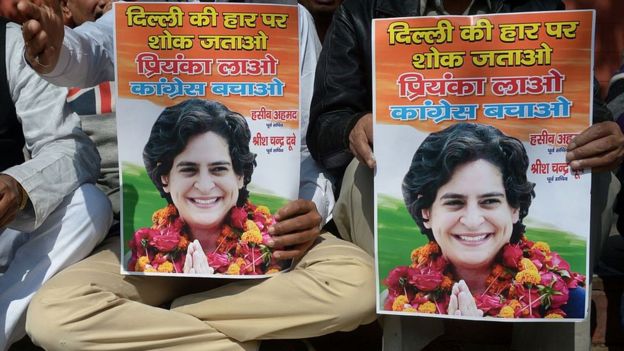
Indian Congress party workers hold pictures of Priyanka Gandhi as they shout slogans outside the All Indian Congress Committee office in New Delhi on February 10, 2015, demanding Priyanka replace Congress party vice-president Rahul Gandhi to 'save the party'. Indian Prime Minister Narendra Modi conceded defeat on February 10 in the Delhi state elections as early results showed anti-corruption campaigner Arvind Kejriwal's party set for a landslide victory.Image copyright GETTY IMAGES
Image caption In 2015, some party workers demonstrated outside Congress HQ in Delhi, holding placards that read “Bring Priyanka, Save Congress”

Mr Modi often mocks the siblings, saying they lead the Congress because of entitlement and not achievement.

Congress supporters, however, don’t seem unduly worried about the dynasty link – they talk about the fact that their grandmother and father were assassinated and the “sacrifices” the family has made for the country.

Spokesman Akhilesh Pratap Singh says Rahul – and now Priyanka – have re-energised the party. “BJP leaders, including PM Modi, are rattled, otherwise why would they call her names or say she won’t make any impact on the elections?”

Mr Singh says the most important thing is that “our workers are enthused and the public confidence in the party has grown”.

But will all this adulation really convert into votes and seats for the party?

“Definitely,” Mr Singh says. “When the votes are counted, you’ll see our voting percentage has gone up.”
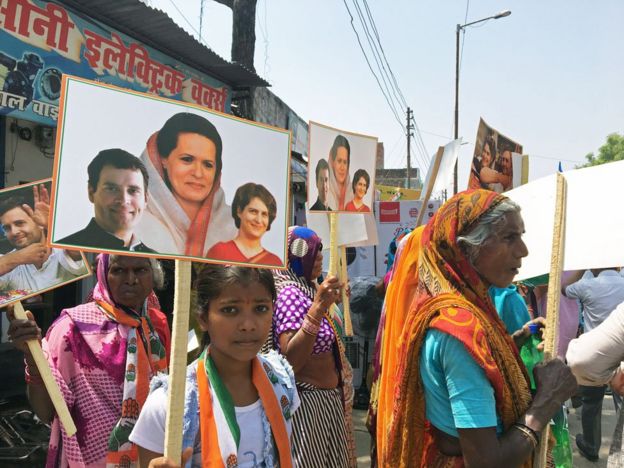
Congress road show in Amethi
Image caption Congress says Ms Gandhi has been brought in to help energise the party rank and file in Uttar Pradesh

Political analyst Neerja Chowdhury says Ms Gandhi has lots of charisma but she is a great example of its limits.

She “left it a bit too late” and should have come out a year ago and worked to galvanise the people, she says.

“The party organisation is decimated in the state and has to be built from scratch. She doesn’t have a magic wand.”

Ms Chowdhury says expecting Ms Gandhi to turn around the party in such a short time is asking her to do the impossible and it’s unfair on her because it will open her to being dismissed as a failure.

But in the absence of a strong party machinery or leadership in Uttar Pradesh, Ms Gandhi’s efforts can take Congress only so far and no further.

Ms Chowdhury says she would need to build the party base in the state brick-by-brick – that would require much more than charisma, and plenty of hard work.

But one thing, she says, she’s sure about is that “Ms Gandhi is here to stay”.

Source: The BBC

12/05/2019

Indians vote in penultimate phase of seven-round general election

NEW DELHI (Reuters) – Voters in north India lined up early on Sunday to cast their ballots in the second-to-last round of a seven-phase general election, with Prime Minister Narendra Modi facing a diverse group of opposition parties seeking to deny him a second term.

More than 100 million people across seven states are eligible to vote in the sixth phase of the 39-day-long poll, which Modi began on April 11 as front-runner after an escalation of tension with neighbouring Pakistan.

But opposition parties have recently taken heart at what they see as signs Modi’s Hindu nationalist Bharatiya Janata Party (BJP) may be losing ground and have begun negotiations over a post-election alliance even before polling ends on May 19. Votes will be counted on May 23.

The president of the main opposition Congress party, Rahul Gandhi, said the main issues in the election were unemployment, distress in the countryside, the demonetisation of bank notes and a new sales tax.

“It was a good fight,” Gandhi said after he cast his vote.

“Narendra Modi used hatred, we used love. And I think love is going to win.”

A lack of new jobs – despite annual economic growth of about 7% – and the plight of farmers struggling with falling crop prices have been major worries for voters.

A new good and services tax (GST), as well as Modi’s shock ban on all high-value currency notes in 2016, hurt small and medium businesses.

Some voters in the capital, New Delhi, said they were backing Modi because they were won over by his tough stand on security.

Indian warplanes attacked what the government said was a terrorist training camp in Pakistan in February, soon after a suicide car bomb attack in the disputed Kashmir region killed 40 police officers.

BIG CHANCE FOR SMALL PARTIES?

The aggressive response stirred nationalist passions that pollsters said could favour Modi in the election.

“I have voted for Modi’s sound foreign policy and national security,” said a 36-year-old first-time voter who declined to be identified.

“The demonetisation has affected jobs growth but over time, the positive effects of GST and demonetisation would take care of jobs,” he said.

But concern about unemployment and crop prices have put the BJP on the back foot, and the opposition has in recent days felt more upbeat about its chances.

Political analysts say state-based and caste-driven parties could be decisive in determining the make-up of the next government.

“Regional parties will play a bigger role compared to the previous 5 years or even 15 years,” said K.C. Suri, a political science professor at the University of Hyderabad. “They will regain their importance in national politics.”

Recent weeks have also been marked by personal attacks between leaders, including comments from Modi about the family of Congress President Rahul Gandhi, the scion of the Nehru-Gandhi political dynasty.

At a recent rally Modi called Gandhi’s late father, former Prime Minister Rajiv Gandhi, “corrupt no. 1”. The BJP says Modi was reacting to Rahul Gandhi calling him a thief.

“The political vitriolic has become intense, and negatively intense,” said Ashok Acharya, a political science professor at the University of Delhi.

“It seems as if this particular election is all about a few political personalities. It is not about issues, any kind of an agenda.”

Source: Reuters

07/05/2019

‘Arrogant like Duryodhan’: Priyanka Gandhi jabs PM after ‘corrupt Rajiv’ attack

Over the last few days, Prime Minister Narendra Modi and his party’s top leadership have scaled up attacks on the Gandhi family, particularly on former prime minister Rajiv Gandhi.

LOK SABHA ELECTIONS Updated: May 07, 2019 17:40 IST

HT Correspondent
HT Correspondent
Hindustan Times, New Delhi
Priyanka Gandhi,Congress,PM Modi
Congress general secretary Priyanka Gandhi Vadra(PTI file photo)
Launching a scathing attack on the ruling BJP, Congress leader Priyanka Gandhi Vadra said on Tuesday that the saffron party’s “arrogance is like that of Duryodhan”, just days after Prime Minister Modi referred to Congress general secretary’s father and former prime minister Rajiv Gandhi “bhrashtachari no 1”.
Without naming anyone, Priyanka Gandhi Vadra said:” This country has never forgiven arrogance. Even Duryodhan had such arrogance, when Lord Krishna tried to make him see sense, he wanted to take him hostage.”
Speaking at a rally in Ambala for party candidate Kumari Selja, Priyanka Gandhi quoted poet Ramdhari Singh Dinkar to reinforce her remarks. “Jab naash manuj par chaata hai, pehle vivek mar jata hai (When doom looms, first thing a human loses is the ability to discern right from wrong).”
Priyanka Gandhi slams BJP, says party’s ‘arrogance like that of Duryodhan’
Priyanka Gandhi launched an attack on BJP while addressing a rally in Ambala.
The party incharge of eastern Uttar Pradesh added: “They never fulfil the promises they make at election time, instead they either seek votes in the name of martyrs or insult the martyr members of my family.”
Over the last few days, Prime Minister Narendra Modi and his party’s top leadership have scaled up attacks on the Gandhi family, particularly on former prime minister Rajiv Gandhi.
At a rally in Uttar Pradesh over the weekend, PM Modi had attacked Congress president Rahul Gandhi who has been hammering the BJP-led national coalition alleging corruption in the Rafale deal.
“Your father was termed Mr Clean by his courtiers, but his life ended as corrupt no 1,” PM Modi said, provoking a sharp response from the Congress and other opposition parties.
As she spoke at an election rally in Bengal on Tuesday, chief minister Mamata Banerjee said PM Modi’s attack was in bad taste. “Rajiv Gandhi died for the country. You may not like him but you should give respect to a departed leader,” Mamata Banerjee said.
The BJP response came soon after. Amit Shah, the party chief and its master strategist, wondered why PM Modi’s comment was made an issue when the latter spoke only the “truth”. “Is it not true that there was a Bofors scandal,” Shah told a public rally in Bengal insisting that the prime minister had only reminded the Congress about one fact. “It is not an insult to remind someone about the truth,” the BJP chief said.
Source: Hindustan Times
05/05/2019

India’s rural pain goes beyond farmers, and it may be a problem for Modi

ZADSHI VILLAGE, India (Reuters) – Three years ago, brick mason Pundlik Bhandekar was always busy as farmers in his tiny hamlet in Maharashtra commissioned new houses and nearby towns were undergoing rapid urbanisation. Now, as the rural economy sinks and the pace of construction slows, Bhandekar is struggling to get work.

“I used to get a new construction project before I could even finish one. People would come to my house to check when I would be free to work for them,” said Bhandekar, as he sat with friends under the shade of a tree on a hot afternoon.

From daily wage workers such as masons, to barbers and grocery shop owners – just about everyone in Zadshi village, some 720 km (450 miles) from India’s financial hub Mumbai, says a drop in farm incomes has dented their livelihoods.

Their woes are symptomatic of a wider problem across India, where more than half of the country’s 1.3 billion people are dependent on agriculture for their livelihoods, as the slowdown in the rural economy is felt in the dampening sales of consumer goods, especially the biggest such as car and motorbike sales.

The slowdown has also dented Prime Minister Narendra Modi’s popularity in the hinterland that propelled him to power in 2014, and political strategists say it may mean he struggles to form a majority after voting in a staggered general election that began on April 11 concludes on May 19.

Zadshi has been almost entirely dependent on annual cotton and soybean crops that, according to farmers, have given lacklustre returns in the past few years due to a dip in prices, droughts and pest attacks.

And as incomes have dropped, farmers have cut back on big-ticket spending such as building new houses, digging wells or laying water pipelines, squeezing employment opportunities for people such as Bhandkekar.

“No one is interested in hiring us. We are ready to work even at 250 rupees ($3.60) per day,” said Bhandekar, who charged 300 rupees a day when work was steady, but now gets work only once or twice in a fortnight.

LOWER WAGES, LESS SPENDING

Economic data reflects the plight of farmers and daily wage workers.

Retail food inflation in the fiscal year ended on March 31 fell to 0.74 percent, even as core inflation stood at 5.2 percent, according to Bank of America Merrill Lynch Research, eroding the spending power of farmers.

Inflation adjusted wage growth for workers involved in crop sowing was just 0.6 percent 2018/19 compared with 6.5 percent in 2013/14.

The value of farm produce at constant prices grew 15 percent in the past five years, compared with 23 percent in the previous five, while the manufacturing sector grew 40 percent, against 32.6 percent in the previous five years, government data shows.

“Lower rural wages will result in lesser spending, which in turn will reduce demand for goods and services that are part of the rural basket,” Rupa Rege Nitsure, group chief economist at L&T Finance Holdings in Mumbai, told Reuters.

The government needs to spend more in rural areas to generate employment and boost incomes, Nitsure said.

Modi’s Hindu nationalist government did introduce various support schemes in the past six months, such as a 6,000 rupees yearly handout to small farmers.

The main opposition Congress party has gone much further with its pledges though, saying it would introduce a basic minimum income, where the country’s poorest families would get 72,000 rupees annually, benefiting some 250 million people.

RISING UNEMPLOYMENT

In Zadshi, as the mercury touched a searing 40 degrees Celsius(104F), a group of villagers gathered under the trees lining a dusty road and began chatting about everything from crop prices to politics.

“What else we can do? Had work been available in urban areas, we could have moved there but even in the cities construction has slowed down,” said Amol Sontakke, an unskilled labourer who works in farms and on construction sites.

Job opportunities have slowed even in urban areas and India’s unemployment rate touched 7.2 percent in February, the highest since September 2016, according to data compiled by the Centre for Monitoring Indian Economy (CMIE). Official data is unavailable for recent periods.

The mood in Zadshi was glum. While four dozen villagers interviewed by Reuters were hopeful that if there was a good monsoon this year it could improve farm incomes, they’ve been cutting back on spending in the meantime.

“People are thinking twice before buying new clothes during festivals,” said Avinash Gaurkar, a farmer currently doubling up as a part-time driver. “Buying big-ticket items such as motorcycles or refrigerators is out of the question.”

Two years ago Gaurkar began building a house, but had to give up midway as his five-acre farm could not generate the money needed, he said, pointing towards a half-finished structure without doors.

In 2018, just four villagers bought new motorbikes compared with as many as 10 a year about four years ago, said cotton farmer Raju Kohale, whose son is sitting at home unemployed after graduating as an engineer.

“Poor monsoon or lower prices, something or the other has been hurting us in the past few years,” Kohale said.

MODI AGAIN?

In the 2014 general election, most in Zadshi voted for Modi, but the farmers’ distress has swayed many towards the opposition Congress party. That was clear from Reuters’ interviews with 48 villagers, who cast their ballots last month.

Farmers are at the bottom of the Modi administration’s priority list, said labourer Sagar Bahalavi.

“They are building big roads to connect metros and calling it development. How is that useful for us?” he said.

Some, though, want to give Modi a second chance.
“Modi’s intentions are good, it’s the bureaucratic system that is not supporting him,” said Gulab Chalakh, who owns a 20-acre farm and is among the richest in the village. “We should give him another chance.”
Source: Reuters
29/04/2019

Police break up clashes in West Bengal, Mumbai votes in fourth phase of massive poll

MUMBAI/NEW DELHI (Reuters) – Police broke up clashes between rival groups of voters in West Bengal on Monday as some of India’s richest families and Bollywood stars also cast their ballots in Mumbai during the fourth phase of a massive, staggered general election.

In West Bengal, a populous eastern state crucial for Prime Minister Narendra Modi’s re-election bid, supporters of his Hindu nationalist Bharatiya Janata Party (BJP) clashed with others from the regional Trinamool Congress, police said.

TV footage showed armed security forces chasing away people wielding sticks, although it was initially difficult to determine the scale of the clashes.

There were no immediate reports of any poll-related injuries in West Bengal, where at least one person was killed and three injured during the third phase of voting last week.

The BJP is in a direct, and sometimes bloody, fight in West Bengal with Trinamool, whose chief Mamata Banerjee is one of Modi’s biggest critics and a potential prime ministerial candidate.

More than 127 million people are eligible to vote in this round of the seven-phase election held across 71 seats in nine states. Modi’s coalition won more than 75 percent of the seats in the previous election in 2014.

Many of the constituencies are in Uttar Pradesh in the north and western India’s Maharashtra, where the financial capital Mumbai is located. Uttar Pradesh elects the most lawmakers, with Maharashtra next. Both states are ruled by the BJP and its allies.
However, political analysts say the BJP may struggle to repeat its strong showing this time due mainly to a jobs shortage and weak farm prices, issues upon which the main opposition Congress party has seized.

‘SOME PROGRESS’

First-time voter Ankita Bhavke, a college student in Mumbai, said she voted for economic development.

“I want the country to be at par with the best in the world,” she said. “There’s been some progress in the last five years.”

India’s financial markets were closed on Monday for the election.

Mumbai is home to the massive Hindi film industry, as well as Asia’s wealthiest man, Mukesh Ambani, and India’s richest banker, Uday Kotak.
Ambani, who heads Reliance Industries, and Kotak, managing director of Kotak Mahindra Bank, created a stir this month by publicly endorsing an opposition Congress party candidate from their upscale South Mumbai constituency.
Mumbai, which has six seats, is India’s wealthiest city but ageing and insufficient infrastructure is a major concern. Six people were killed last month when part of a pedestrian bridge collapsed, recalling memories of a 2017 rush-hour stampede that killed at least 22 people on a narrow pedestrian bridge.
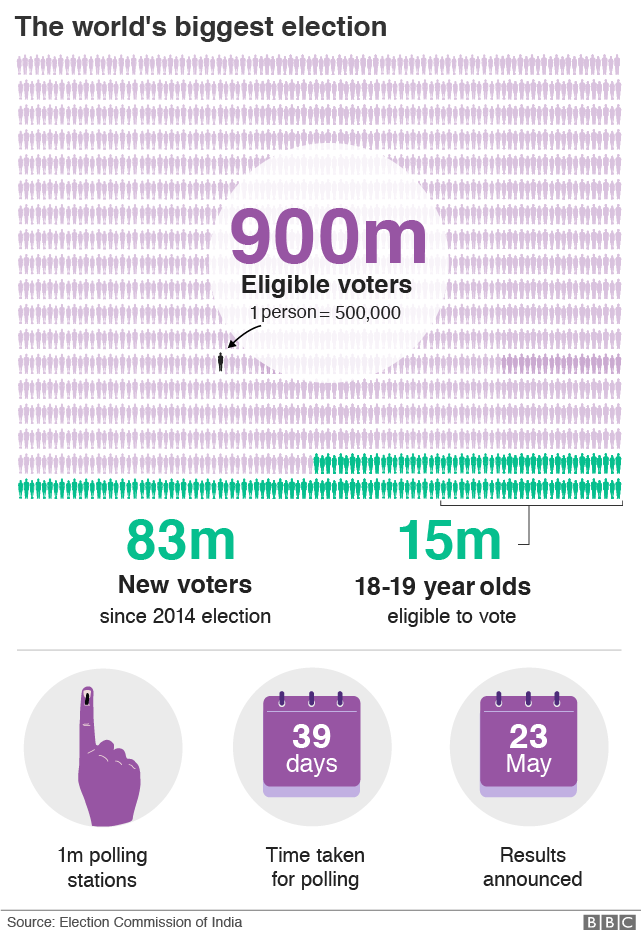
The election, the world’s biggest democratic exercise with about 900 million voters, started on April 11 with Modi in the lead amid heightened tension with long-time enemy Pakistan.
The last phase of voting is on May 19, with results released four days later.
There are a total of 545 seats in the Lok Sabha.
Modi sent warplanes into Pakistan in late February in response to a suicide attack by an Islamist militant group based there that killed 40 Indian police in the disputed Kashmir region.
Modi has sought votes on his tough response towards militancy and in recent days has evoked the deadly Easter Sunday bombings in nearby Sri Lanka.
Maidul Islam, a professor of political science at Kolkata’s Centre for Studies in Social Sciences, said long queues outside polling stations would indicate whether Modi’s national security pitch was working.
“Whenever there is a BJP kind of a wave, you see a higher voter turnout,” he said.
Source: Reuters
28/04/2019

A really simple guide to India’s general election

Indian electionsImage copyright GETTY IMAGES

It is an election like no other. Those eligible to vote in India’s upcoming polls represent more than 10% of the world’s population and they will take part in the largest democratic exercise in history.

Voters will choose representatives for the Indian parliament, and in turn decide if Hindu nationalist Prime Minister Narendra Modi will run the country for another five years.

What is at stake?

Whoever wins these elections and forms a government will control the destiny of the world’s largest democracy.

While they are in charge,  is likely to overtake the UK’s and become the world’s fifth-largest.

Its population meanwhile – at more than 1.34bn people – is predicted to soon surpass China’s 1.39bn.

Hundreds of millions of Indians have escaped  since the turn of the millennium but huge challenges remain.

 is a major concern and is especially high among young people.

Millions of  about low crop prices.

How the nuclear-armed country engages with the outside world – and manages a tricky  – is also of immense importance to international security.

Graphic: The immense scale of India's elections

Who is being elected?

Indians are voting for members of parliament and the job of prime minister tends to go to the leader of the party or coalition with most seats. The current PM is .

His main rival is opposition leader .

Parliament has two houses: the Lok Sabha and the .

The lower house –  – is the one to watch.

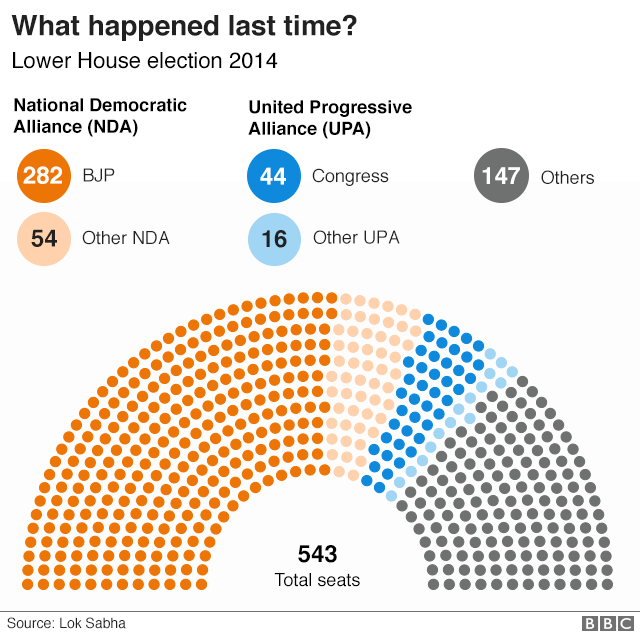
It has 543 elected seats and any party or coalition needs a minimum of 272 MPs to form a government.

At the last election in 2014, Mr Modi’s  won 282 seats.

Mr Gandhi’s  only took 44 seats in 2014 – down from 206 in 2009.

Graphic: The battle for the Lower House of the Indian Parliament

Why does voting take so long?

Because of the enormous number of election officials and security personnel involved, voting will take place in seven stages between 11 April and 19 May.

Different states will vote at different times.

Votes will be counted on 23 May and results are expected on the same day.

Who will win?

This election is being seen as a referendum on Mr Modi, a polarising figure adored by many but also accused of stoking divisions between  and the country’s 200 million Muslims.

Until a few months ago, Mr Modi and his BJP party were seen as the overwhelming favourites. But the  in December’s regional elections injected a sense of serious competition into the national vote.

Analysts are divided on whether Mr Modi will be able to win a simple majority again.

A recent escalation of tensions with Pakistan has given the BJP a new and popular issue to campaign on.

It will be hoping that a focus on patriotism will help the party to get past the serious challenge mounted by powerful regional parties and Congress.

Source: The BBC

18/04/2019

India election 2019: Can West Bengal’s female candidates win?

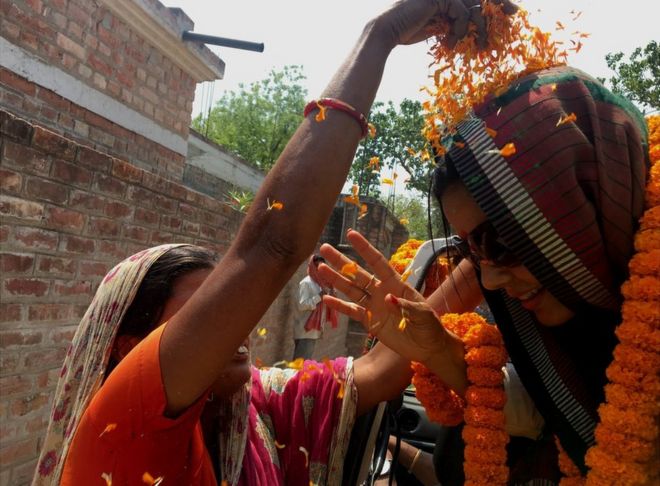
A supporter throws marigold petals at Mahua Moitra
Presentational white space

Women make up nearly half of India’s 900 million voters, but they are still poorly represented in the country’s law-making bodies. One political party is trying to correct the balance by nominating 41% female candidates. The BBC’s Geeta Pandey travelled to the state of West Bengal to see how they are faring.

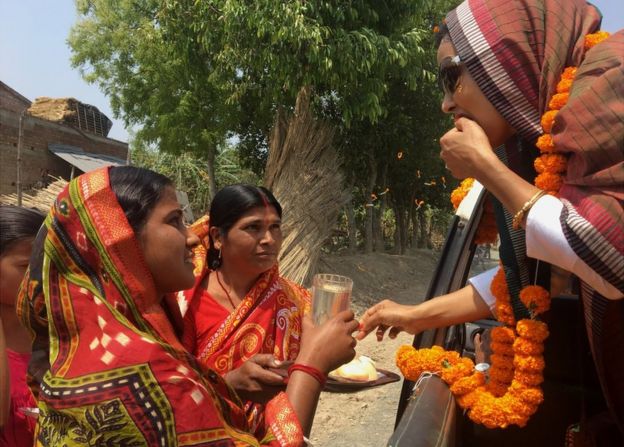
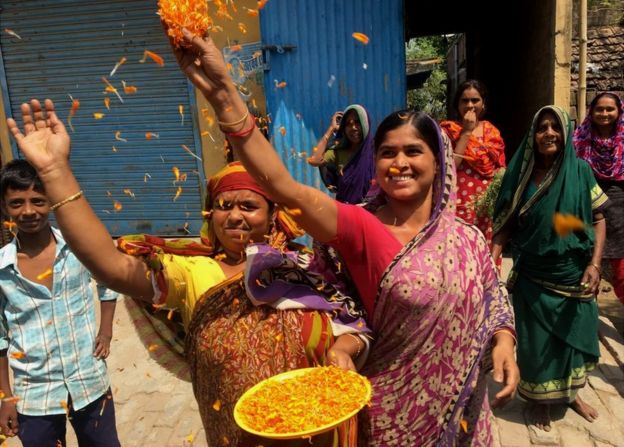
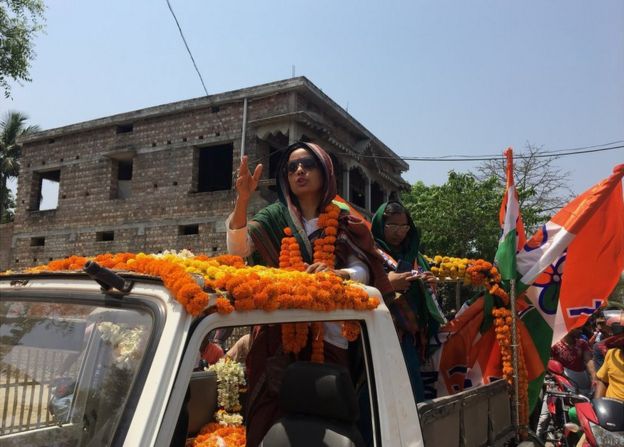
On a bright sunny morning, as an open jeep decorated with bright yellow and orange flowers hurtles along the dirt track from one village to the next, women in colourful saris and men rush to greet Mahua Moitra.

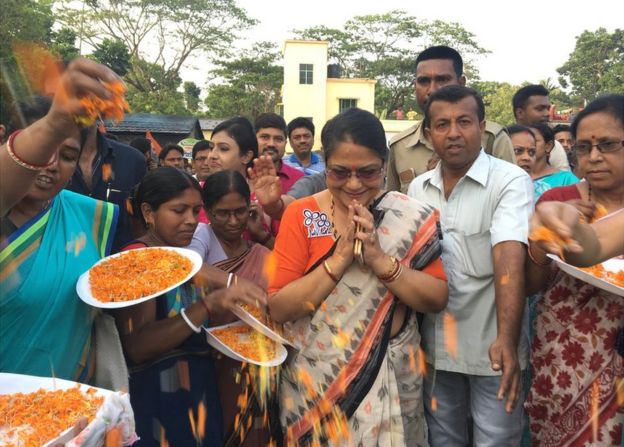
They shower bright orange marigold petals on her, place garlands around her neck and many reach out to shake and kiss her hands. She waves at them, greeting them with her palms joined: “Give me your blessings.”

Young men and women whip out their smartphones to take photos and selfies. On the way, she’s offered coconut water and sweets.

Ms Moitra, who is contesting the general election as a candidate of the state’s governing Trinamool Congress Party (TMC), is campaigning in her constituency Krishnanagar.

Women offer sweets to Mahua Moitra
Image caption On the campaign trail, women offer coconut water and sweets
Presentational white space
Women throw marigold petals at Mahua Moitra
Image caption Supporters throw marigold petals at Mahua Moitra
Presentational white space

In one village, party workers tell her about an old man who’s too ill to come to meet her, so she walks to his home to greet him.

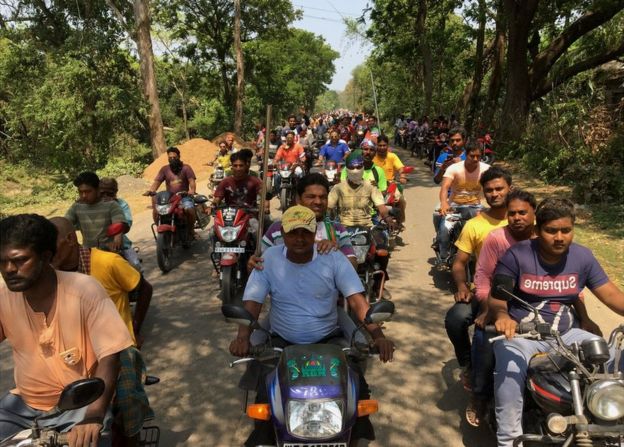
Her jeep is followed by dozens of bikes and their riders, all young men, chanting slogans like “Long live Trinamool Congress, Long live Mamata Banerjee.”

The loud, colourful procession is led by a small truck, fitted with loudspeakers, from which announcements asking people to vote for Ms Moitra are played on a loop.

With the election season well under way in India and political leaders criss-crossing the length and breadth of the country, addressing rallies, I’m travelling across the country to see if the high-decibel campaigns are addressing the real issues that actually affect millions of people. One of them is getting more women into parliament.

In India, only 11% of members of parliament are women, and in state assemblies it’s 9%. In a list of 193 countries this year, India was ranked 149th for female representation in parliament – below Pakistan, Bangladesh and Afghanistan.

A bill to reserve 33% of seats for women in parliament and regional assemblies has been pending since 1996, so the decision by the TMC – led by West Bengal Chief Minister Mamata Banerjee – to give 41% of her party nominations to women has created a huge buzz.

Mahua Moitra during her road show
Image caption Ms Moitra quit her banker’s job in London to return to India and enter politics
Presentational white space

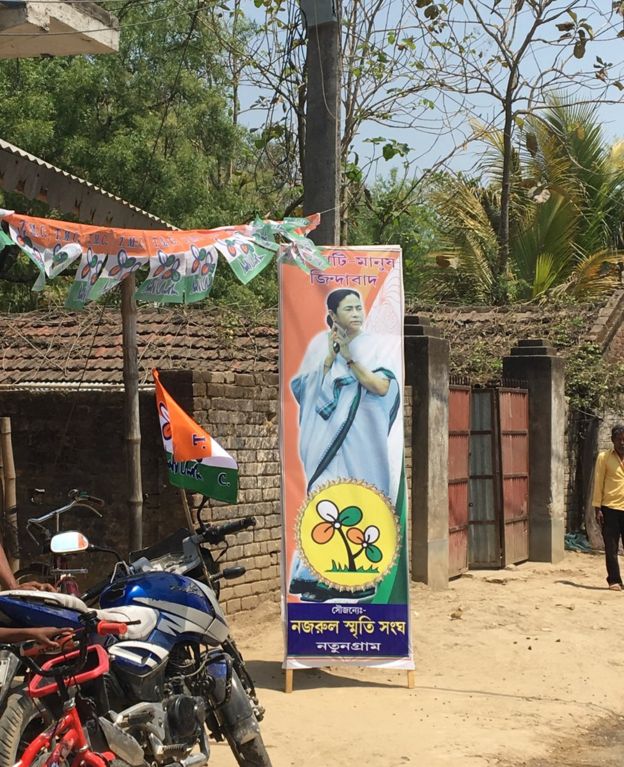
Ms Banerjee, who set up the TMC in 1998 after falling out with the Congress party, is a feisty politician who was named one of Time magazine’s 100 most influential people in the world in 2012.

Her female candidates, says my BBC Bengali colleague Subhajyoti Ghosh, are an “interesting mix” of career politicians and first-timers. They include actors, doctors, a tribal activist and the 25-year-old widow of a recently-murdered politician.

Ms Moitra, the TMC’s national spokesperson and a member of the state assembly since 2016, is among 17 women who have made it to the party’s list of 42 general election nominees.

Presentational grey line

Read more from Geeta Pandey

Presentational grey line

A former investment banker with JP Morgan, she gave up a well-paying job in London in 2009 to return to the heat and dust of Indian politics.

Her decision left her family aghast. Her parents, she told me, thought she was “insane”. Some party workers too had their doubts – “she’s a memsahib”, they said at the time, “she won’t survive”.

A poster of Mamata Banerjee in West Bengal
Image caption Mamata Banerjee was named one of Time magazine’s 100 most influential people in the world in 2012
Presentational white spaceBut she has survived – and thrived. In 2016, she won the Karimpur assembly seat that no non-Left party had won since 1972 and has now set her eyes on the national parliament.

She’s agreed to let me follow her on the campaign trail, so for two days I’ve been a “fly on the wall” – standing behind her in her jeep, travelling in her car, watching her strategise with party workers, aides and confidants.

The previous evening, I had watched her be the chief guest at a college cricket match and address a gathering at the local market in Plassey.

A four-hour drive from Kolkata, Plassey is the site of the famous 1757 battle between the British East India Company and the local ruler supported by the French.

Ms Moitra takes her spot to speak and clearly takes aim at Prime Minister Narendra Modi and his Bharatiya Janata Party (BJP) as she talks about a deadly suicide attack in Kashmir and India’s subsequent air raid in Pakistan.

The bike riders
Image caption Her jeep is followed by dozens of supporters on bikes
Presentational white space
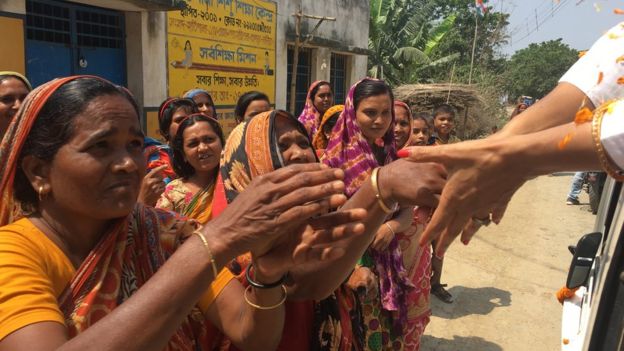
Women shaking hands
Image caption Many women reach out to shake hands with Ms Moitra

“What’s the point of saying you killed all those terrorists in Pakistan? It’s not important who you killed in Pakistan or how many. What’s important is you failed to protect our soldiers.”

She talks about how the government has failed to create jobs and accuses the BJP of trying to divide Hindus and Muslims.

“You have taken away our livelihoods and you’re trying to teach us about [the Hindu god] Ram and [Muslim saint] Rahim? I don’t have to write my religion on my forehead,” she declares to loud claps from her supporters.

Elections in the past were to change the government, she says, but this election is to save the constitution of India. “It is no ordinary vote.”

Her main rival is the BJP’s Kalyan Chaubey, a former footballer who played in goal for India. So drawing a football analogy, she declares: “I’m an A-league centre-forward player, stop my goal if you can. I am here to win.”

Kakoli Ghosh Dastidar, a founder member of the TMC and two-term MP, says to nominate so many women is part of a “continuous process” followed by Mamata Banerjee because “you can’t develop a society without uplifting the status of its women”.

In the last general election in 2014, she points out that the party nominated 33% women and 12 of their 34 MPs in the outgoing lower house were women.

Ms Banerjee, she says, believes that gender sensitive laws will come only if more women are in power.

At a campaign rally that Dr Ghosh Dastidar addresses in Kumhra Kashipur village in her constituency Barasat, women are seated in the front rows.

Their opinion though is divided over whether having more women in parliament will actually benefit other women.

Dr Kakoli Ghosh Dastidar being welcomed in her constituency
Image caption Dr Kakoli Ghosh Dastidar is among the founder members of the TMC and a two-term MP
Presentational white space

Supriya Biswas says it’s easier if their MP is a woman because then it’s easier to approach her. “For, who can understand a woman better than a woman?”

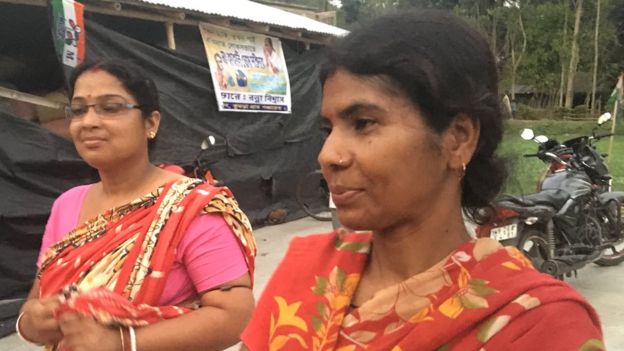
Archana Mallick and Meena Mouli, who live just across from the rally ground, point to the broken roads near their homes and complain about poor medical facilities in their village. They say that the candidate’s gender is “inconsequential” and what’s important is “who works for our benefit”.

Studies, however, show that female representatives bring economic growth to their constituencies because they are more concerned than men about issues such as water supply, electricity, road connectivity and health facilities.

Saswati Ghosh, professor of economics at Kolkata’s City College, says that politics in India is “still very patriarchal” and it’s “absolutely necessary” to elect more women MPs.

“It is important to have more women in lawmaking bodies because I think after a certain number, you’ll reach the threshold level and that will lead to change. I don’t know if 33% is the magic number that will change the quality of discourse, maybe 25% can do the trick?”

Archana Mallick and Meena Mouli say a candidate's gender is "inconsequential"
Image caption Archana Mallick and Meena Mouli say a candidate’s gender is “inconsequential”

Critics, however, question whether celebrities are the right candidates to bring about that change.

Prof Ghosh says actors and celebrities make for “winnable candidates” and that’s why all parties choose them even though sometimes they may not be the right candidates to reach that threshold.

But, she says that Ms Banerjee is a strong leader who’s regarded by many women as “a role model who inspires more women to come into politics”.

And that’s something that many Indians think the country sorely needs.

In their manifestos, the main opposition Congress party has promised to pass the women’s reservation bill, if elected to power. So has the ruling Bharatiya Janata Party, although it had made similar promises in its last manifesto and did nothing about it.

By allotting 41% seats to women, Ms Banerjee has shown that one doesn’t need to set artificial quotas to elect more women.

Source: The BBC

17/04/2019

India’s Supreme Court considers call to open mosques to women

NEW DELHI (Reuters) – India’s Supreme Court agreed on Tuesday to consider a petition from a Muslim couple to allow women into mosques, seeking to overturn a centuries-old practice that largely bars women from the places of worship.

Women are not allowed inside most mosques in India although a few have separate entrances for women to go into segregated areas.

The petitioners, Yasmeen Peerzade and her husband Zuber Peerzade, said that women were allowed to enter mosques during the time of the Prophet Mohammad.

“Like men, women also have the constitutional rights to offer worship according to their belief,” they said in their petition.

“There should not be any gender discrimination and allow Muslim women to pray in all mosques,” they said.

The Muslim couple referred to the temple ruling, which angered conservative Hindus, as a precedent to support their call for women to be allowed to pray at mosques.

A representative of a prominent organisation of Islamic scholars, the Jamiat Ulema-e-Hind, was not immediately available for comment.

The petition comes at a sensitive time for relations been minority Muslims and the majority Hindu community.

Some members of Prime Minister Narendra Modi’s Hindu nationalist ruling party have been accused of stirring communal animosity as the party seeks a second term in a staggered general election now underway.

Supreme Court judge S.A. Bobde said the court will examine the couple’s request at length.

The court in 2017 ruled as unconstitutional a law which allows Muslim men to divorce their wives simply by uttering the word “talaq”, which means divorce in Arabic, three times.

This year, the government issued an executive order making instant divorce an offence punishable with up to three years in jail.

Source: Reuters

15/04/2019

‘Not our views’: Supreme Court asks Rahul Gandhi to explain Rafale remark

BJP’s Meenakshi Lekhi had complaints to the Supreme Court that the words attributed by Rahul Gandhi to the Supreme Court in the Rafale case had been “made to appear something else”.

INDIA Updated: Apr 15, 2019 14:06 IST

HT Correspondent
HT Correspondent
New Delhi
Rahul Gandhi,Rafale,Rafale deal
Supreme Court will next hear the case on April 23(AFP file photo)
Congress president Rahul Gandhi has been told by the Supreme Court to explain his remarks during the Lok Sabha campaign where he attributed comments to the top court which had ruled on the admissibility of three sets of documents in the Rafale review petition.
The bench said Gandhi had incorrectly attributed “views, observations and findings” in the Rafale case to the top court. Gandhi has been given till next Monday to come up with his explanation. The court, however, has not issued a formal notice to him yet.
“We also make it clear that this court had no occasion to record any such views or make observations in as much as what was decided by this court was the legal admissibility of certain document to which objections were raised,” the bench headed by Chief Justice of India Rajan Gogoi said.
BJP lawmaker Meenakshi Lekhi had last week filed a contempt petition against the Congress president for his attacks on Prime Minister Narendra Modi that she said, “replaced his personal statement as Supreme Court’s order “ and tried to create prejudice.
Watch: ‘Chowkidar chor’ vs ‘SC’s contempt’: Rahul, Nirmala face off on Rafale order
‘Chowkidar chor’ vs ‘SC’s contempt’: Rahul, Nirmala face off on Rafale order
Defence Minister Nirmala Sitharaman slammed Congress president Rahul Gandhi over his remarks on Supreme Court’s decision related to Rafale documents

Gandhi, who was in Amethi to file his nomination papers, had reacted to this setback to the government, saying: “Now the Supreme Court has made it clear that ‘chowkidarji’ (watchman) has committed a theft… I want to directly challenge that the Supreme Court has stated that you have indulged in corruption.”

The BJP and its top leaders had taken umbrage at the Congress president’s remarks, accusing him of wildly exaggerating and misquoting the court’s observations and the context. Defence Minister Nirmala Sitharaman had said Rahul Gandhi’s statement was contempt of contempt of court and was the Congress’s attempt to “perpetrate their own lies”.

Her party later filed a formal complaint against Gandhi with the Election Commission, charging him of lying. The Congress party wants to “perpetrate their own lies”. She further added that Gandhi’s comments are not based on the facts.

In her petition before the Supreme Court, Meenakshi Lekhi had complained that “the words used and attributed by him (Gandhi) to the Supreme Court in the Rafale case has been made to appear something else. He is replacing his personal statement as Supreme Court’s order and trying to create prejudice.”

The government’s April 2015 decision to buy 36 Rafale warplanes has been at the heart of the Congress-led opposition campaign against Prime Minister Narendra Modi and the ruling BJP-led national coalition. The $8.7 billion government-to-government deal replaced the previous United Progressive Alliance (UPA) regime’s decision to buy 126 Rafale aircraft, 108 of which were to be made in India by state-owned Hindustan Aeronautics Ltd (HAL).

The deal has become controversial with the Opposition, led by the Congress, claiming that the price at which India is buying Rafale aircraft now is Rs 1,670 crore for each, three times the Rs 526 crore, the initial bid by the company when the UPA was trying to buy the aircraft. It has also claimed the previous deal included a technology transfer agreement with HAL. The NDA has not disclosed details of the price.

Source: Hindustan Times

13/04/2019

Jet Airways halts all international flights

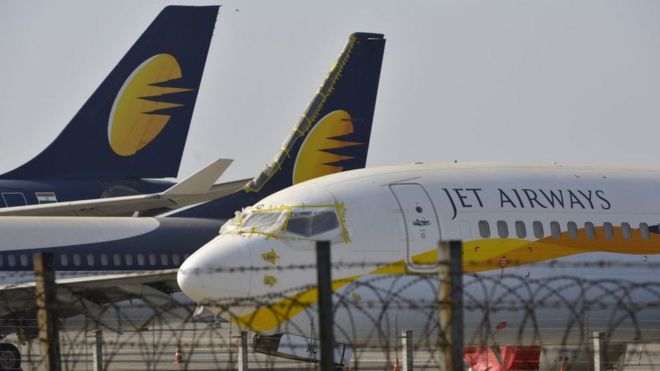
Jet Airways planed parked at Chattrapati Shivaji International Airport in Mumbai on 25 March 2019Image copyrightGETTY IMAGES

Passengers are stranded in India and around the world after Jet Airways suspended all international flights.

Flights from London, Paris and Amsterdam are among those grounded amid fears about the survival of India’s largest private airline.

The airline cancelled all international flights until Monday when, according to reports, it will meet its lenders again to try to secure funding.

Jet Airways is saddled with more than $1bn (£765m) of debt.

It is seeking a financial lifeline to avoid collapse and, on Thursday, grounded 10 planes over unpaid fees to leasing firms .

These were the latest flights to be grounded and it was not clear how many of its fleet of more than 100 planes was still in operation. Local reports suggested that it was barely a dozen.

The airline flies on 600 domestic and 380 international routes – but carriers in India must maintain a fleet of least 20 aircraft to continue to operate international services.

From London, the airline initially confirmed it had cancelled its flights between London, Paris and Amsterdam and India for 12 April, but later said that all international flights would be cancelled between 12 and 15 April.

It said it “regrets the inconvenience caused” to its passengers and was “working to minimise guest inconvenience”.

“In parallel, the airline’s management and its key stakeholders including its consortium of lenders, continue to work closely towards resolving the current situation,” it said.

There was no statement about the status of domestic flights.

Presentational grey line

Wedding party delay

Sandeep Kooner and her three children had been expecting to be on a flight from London to India on Friday evening to attend her niece’s wedding in Punjab.

But the 40 year-old who lives in Walsall will now miss the first few days of the week-long celebrations after her Jet Airways flight was cancelled.

“I had just sat down in the nail salon when I got a text message to say my flight had been cancelled,” she told the BBC.

She has now arranged to fly with Air India, but that will be days later and to Delhi – an eight hour drive to her destination – rather than a local one.

“I’m not 100% sure my problem is 100% sorted,” she says.


‘Necessary steps’

Television channels in India reported that the prime minister’s office had called for an urgent meeting to discuss the airline.

They also reported remarks by government officials saying Jet Airways only had funds to operate six to seven aircraft over the weekend.

India’s Aviation Minister, Suresh Prabhu, had tweeted that his ministry would “review issues related to Jet Airways” and “take necessary steps to minimise passenger inconvenience and ensure their safety”.

The UK’s Civil Aviation Authority said it was aware flights had been suspended.

Jet Airways owes money to employees and suppliers and in recent weeks it has grounded aircraft and cancelled thousands of flights as its financial strains worsened.

The pilots union in India is planning a protest on Saturday and has written to the airline demanding that employees are paid. Staff of the airline were pictured by Priyanka Iyer of Business Television India marching to the company’s headquarters in Mumbai.

Presentational grey line

Rare intervention

By Sameer Hashmi, India business correspondent

In March, when the crisis at Jet Airways led to thousands of flights being cancelled, the government immediately stepped in and asked public sector banks to rescue the private carrier.

It was a rare move. With India holding a national election, Prime Minister Narendra Modi’s government did not want the airline to be grounded as that would have affected 23,000 jobs.

The lenders which took control of the airline have only released a fraction of the amount they had promised so the airline has not been able to pay aircraft leasing companies. This means its fleet has shrunk further from the 100-plus it had at the start of the year.

The lenders have started accepting bids from potential investors, but that process will take a couple of months to complete. And many analysts fear that Jet Airways will not survive even a week if immediate cash is not provided to keep the operations running.

Presentational grey line

Investment sought

The airline was founded by Naresh Goyal more than 25 years ago and he and his family currently own 52% of the airline, although that majority stake is expected to be lost as lenders’ restructure the debt.

A consortium of investors led by the State Bank of India (SBI) took control of the airline in March.

The group is searching for a new investor to acquire a stake of up to 75% in Jet Airways. The deadline for bids had been extended to Friday, according to reports.

Ellis Taylor, deputy Asia editor of Flight Global, told the BBC the airline was in a “precarious position”.

“The interim lifeline that the carrier talked about two weeks ago looks like it won’t materialise any time soon, and that really leaves its future looking bleak,” he said.

There were reports in local media that India’s aviation ministry might review the regulations setting the fleet cap, which could allow the airline to resume international services.

Source: The BBC

Law of Unintended Consequences

continuously updated blog about China & India

ChiaHou's Book Reviews

continuously updated blog about China & India

What's wrong with the world; and its economy

continuously updated blog about China & India