29/05/2019
- The Asian security forum in Singapore had been seen as an ideal venue for a breakthrough in the growing diplomatic spat – but Tokyo has got cold feet
- That will ease the pressure on Beijing in the South China Sea, analysts say
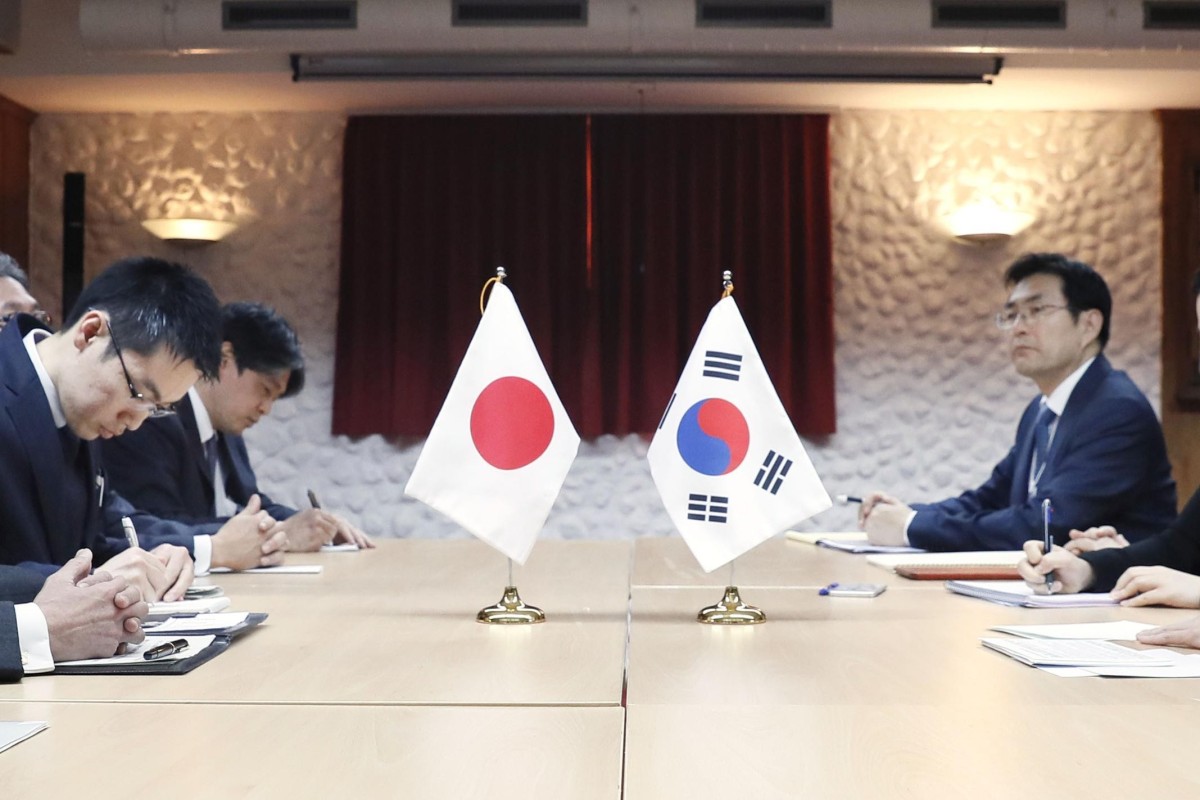
Hopes are fading for a breakthrough in Japan-South Korea relations at the Shangri-La Dialogue in Singapore. Photo: Kyodo
Hopes that
and
could use the Shangri-La Dialogue in
to address their growing diplomatic spat are receding.
The three-day Asian security forum, which begins on Friday, had been seen as an ideal neutral venue for the two countries’ defence ministers to hold formal talks on issues including Tokyo’s claim that in January a
onto a Japanese reconnaissance aircraft.
The issue is one of the biggest deviling the bilateral relationship, alongside Japan’s perception that Seoul has backtracked on a promise to draw a line under Japan’s use of
– euphemistically known as “comfort women” – in military-run brothels during World War Two.
However, Tokyo appears to have concluded that formal talks on the sidelines of the Shangri-La Dialogue would be premature. The Yomiuri newspaper has reported that a formal meeting will no longer take place and that Takeshi Iwaya and Jeong Kyeong-doo, his South Korean opposite number, will now be restricted to a brief, stand-up exchange of their positions.
Despite the report, South Korean officials were guarded when asked whether the meeting had been shelved. “A detailed plan [on the bilateral talks] has yet to be fixed. Consultations are still underway between authorities of the two countries,” said the South Korean defence ministry spokesperson Choi Hyun-soo on Tuesday.
Analysts suggested Japan had run out of patience with South Korea and that the biggest winner in the stand off between two US allies would be China.
Japanese Defence Minister Takeshi Iwaya. Photo: Kyodo
“My sense is that Japan sees South Korea as not engaging in negotiations on a number of issues and not adhering in good faith to agreements that it has already signed,” said Stephen Nagy, a senior associate professor of international relations at Tokyo’s International Christian University.
Tokyo has been incensed that the administration of
has gone back on a 2015 agreement that was meant to draw a final line under the “comfort women” issue. Its anger deepened when Seoul said it would not intervene in a South Korean Supreme Court ruling, which ordered Japanese companies to pay up to 120 million won (US$100,000) to each of a dozen
of the Korean peninsula from 1910-1945.
Like its stance on “comfort women”, Japan believed a line had been drawn under the issue, this time in a 1965 pact that normalised relations between the two countries. Seoul argues that the 1965 treaty, which it signed after receiving US$800 million in grants and soft loans from Tokyo as compensation, does not cover individual victims of colonial-era atrocities.
As rift between Japan, South Korea deepens, how hard can Seoul afford to push?
“Japan is not ready to get into any more agreements because it fears that Seoul will not follow through or that they will become politicised in the future,” Nagy said.
“Tokyo wants binding, long-lasting agreements rather than having to renegotiate something each time a new Korean government comes in,” he said.
“The biggest winner in this stand-off between the US’ two most important allies in the region is, of course, China,” he added. “They must be delighted to see this playing out because it means the US is not able to exert nearly as much pressure in areas such as the
A long-standing strategic aim in US foreign policy circles has been to form a trilateral alliance with South Korea and Japan to present a united front against common security concerns, including China’s growing influence. However, the seeming inability of the two countries to get along has long thwarted this ambition.
“If Japan, South Korea and the US could find a way to cooperate, imagine the influence they could exert over the South China Sea or over
,” Nagy said. “If Japan and Korea could find a way to put their differences aside and with their security capacity, it would be a powerful deterrent to Beijing and Pyongyang.”
South Korean protesters demonstrate against Japan’s use of sex slaves – euphemistically termed ‘comfort women’ in World War II. Photo: AFP
Toshimitsu Shigemura, a professor of international relations at Tokyo’s Waseda University, agreed that the schism between Seoul and Tokyo would be of serious concern to Washington, but he believed that US pressure had already been brought to bear on the two neighbours.
“By avoiding talks in Singapore, Japan is doing its best to avoid public problems between the two sides and I believe that talks are already taking place between the two governments on these issues,” he said.
US wants Japan and South Korea to tag team China. But history is in the way
“The US will have told Tokyo and Seoul that it does not want to see more disagreements and that it is very important that they cooperate and calm things down a bit,” he said.
“I am sure that Washington knows exactly what happened when the Korean warship locked onto the Japanese aircraft in January, but they’re not publicly taking sides and instead they’re telling both governments to put the dispute behind them and to move on,” he added.
Other analysts were more pessimistic.
“The dynamics in domestic politics in both countries are currently overwhelming any diplomatic motives to improve bilateral ties,” said Bong Young-sik, a researcher at the Asan Institute for Policy Studies in Seoul.
Japanese Prime Minister Shinzo Abe. Photo: AFP
“For President Moon Jae-in, Japan-bashing is a useful political card to appeal to his supporters while for
, giving the impression that South Korea is going too far in pressing Japan is also beneficial for his own political gains.”
Professor Ha Jong-moon at Hansin University said there were “no solutions in sight” to resolve the differences over forced labour and wartime sex slavery, but said there would be a chance to “smooth ruffled feathers” at the G20 summit in Osaka, which takes place at the end of June.
The last time the defence ministers of the two countries met was in October last year, when they held talks on the sidelines of the Asean Defence Ministers’ Meeting in Singapore.
Source: SCMP
Posted in Asian security forum, associate professor of international relations, ‘win for China’, “comfort women”, Beijing, China alert, cold feet, fire control radar, hopes fade, Japan-South Korea talks, Japan’s colonial rul, Japan’s colonial rule, Japanese, Jeong Kyeong-doo, Korean sex slaves, military-run brothels, President Moon Jae-in, professor of international relations, Pyongyang, reconnaissance aircraft, Seoul, Shangri-La Dialogue, Singapore, South China Sea, South Korea, South Korean Supreme Court, South Korean warship, Stephen Nagy, Takeshi Iwaya, Tokyo, Tokyo’s International Christian University., Tokyo’s Waseda University, Toshimitsu Shigemura, Uncategorized, US allies, World War Two, Yomiuri |
Leave a Comment »
27/04/2019
- Foreign Minister Wang Yi tells French counterpart Jean-Yves Le Drian the two sides should ensure ties ‘continue to develop in a healthy way’
- Meeting comes after Paris angers Beijing by sending a warship through the sensitive Taiwan Strait
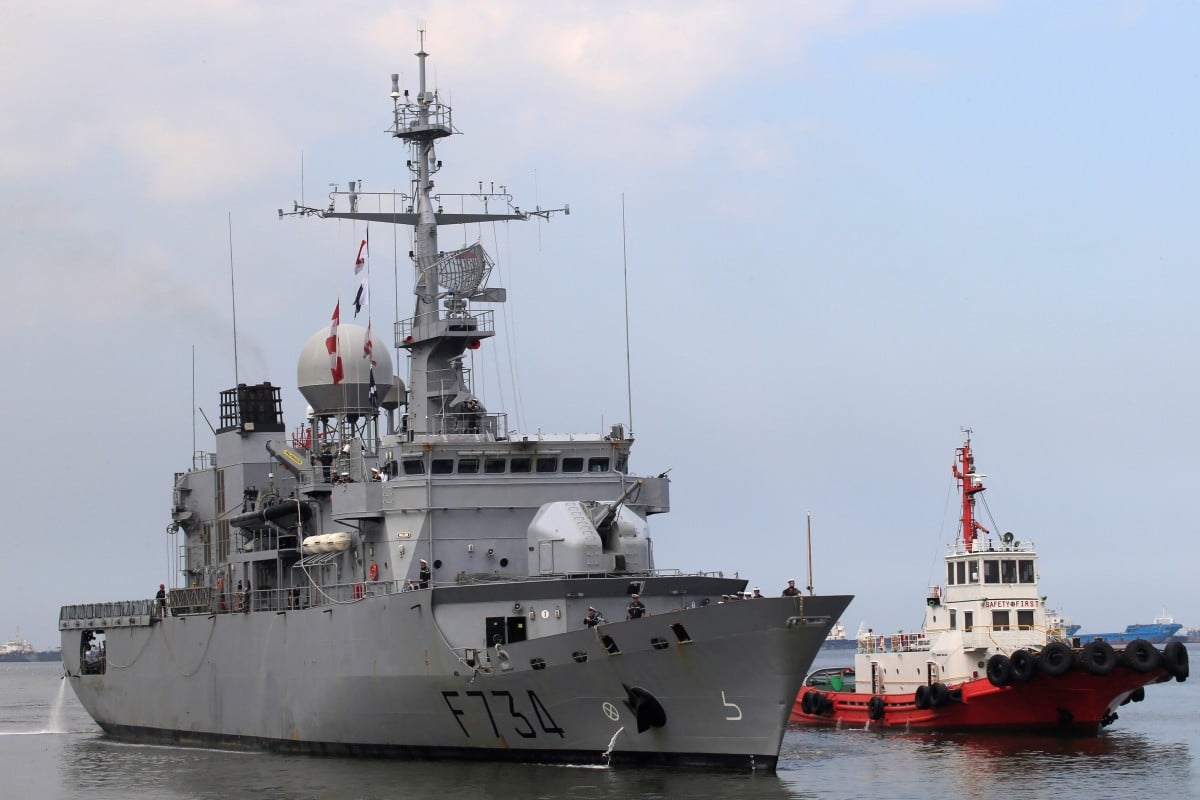
Paris upset Beijing earlier this month by sending its frigate Vendémiaire through the Taiwan Strait. Photo: Reuters
France and China should value their strong relationship and not take actions that disrupt it, China’s foreign minister told his French counterpart on Thursday, just days after
at Paris for sending a warship through the Taiwan Strait earlier this month.
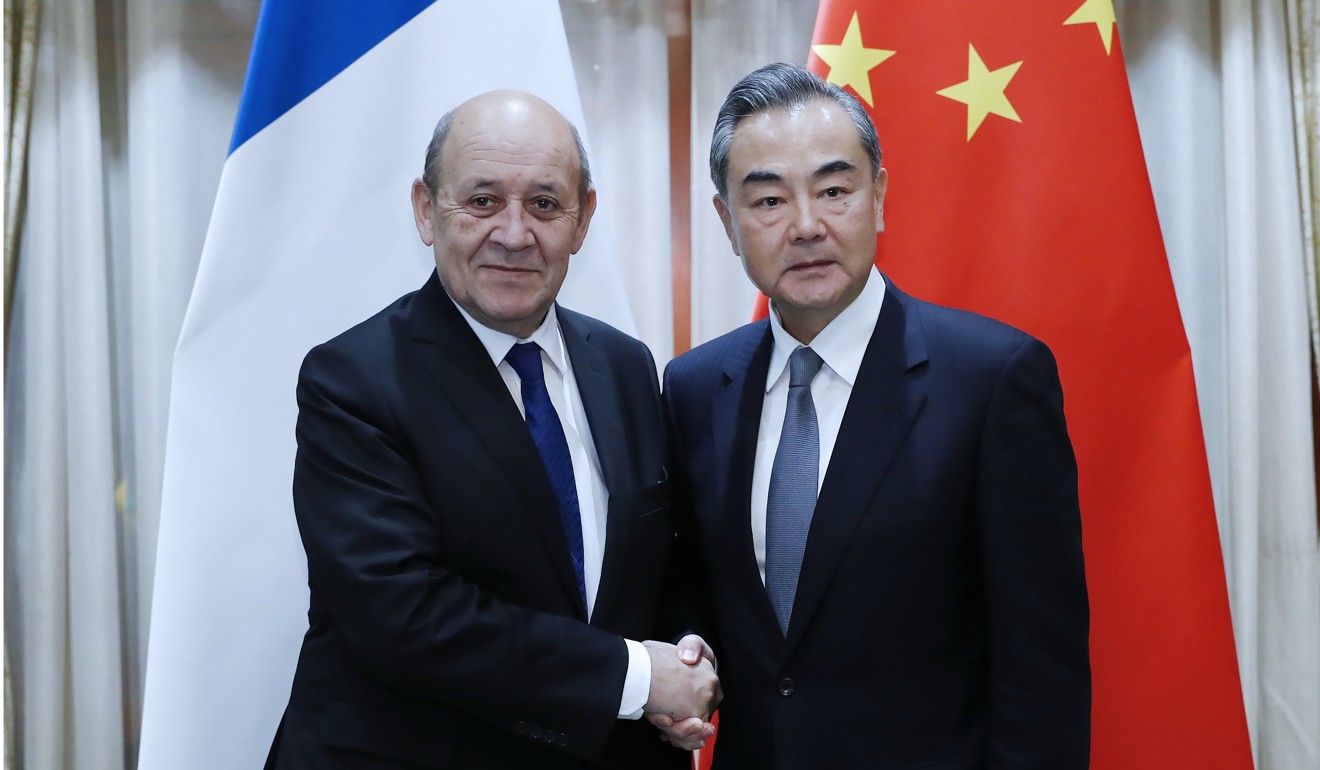
Speaking at a meeting on the sidelines of the Belt and Road Forum in Beijing, Wang Yi told Jean-Yves Le Drian that the two nations “should cherish their hard-won and good relations”.
“[We should] avoid unnecessary disruptions and ensure that bilateral relations continue to develop in a healthy and progressive way,” he was quoted as saying in a statement issued on Friday by the Chinese foreign ministry.
Le Drian responded by saying France was willing to cooperate with China to “maintain the growth momentum of bilateral relations”, according to the statement.
French Foreign Minister Jean-Yves Le Drian told his Chinese counterpart Wang Yi that Paris was willing to cooperate with Beijing. Photo: Xinhua
The
passed through the Taiwan Strait on April 6. It had been expected to take part in a naval parade on Tuesday to celebrate the 70th anniversary of China’s navy, but Beijing withdrew the invitation in response to the action.
The defence ministry in Paris said this week it had been “in close contact with the Chinese authorities” about the incident.
EU’s connectivity plan ‘more sustainable’ than belt and road
A spokesman for the European Union said the trading bloc was committed to a rules-based maritime order based on international law, including freedom of navigation, and that it was in regular contact with the member states.
Chinese academics said that after the transit by the French warship it was likely that more Western countries would make their presence known in the region and that Beijing should remain vigilant.
“France wants to show that as a great power it has a broader concern in Asia-Pacific beyond trade and other ‘soft’ fields,” said Shi Yinhong, an international relations professor at Renmin University of China in Beijing.
“And it will exert its right to free navigation in any international waters regardless of China’s position or sensitivities.”
The Taiwan Strait is about 160km (100 miles) wide and divides mainland China from Taiwan, which Beijing regards as a breakaway province awaiting reunification, by force if necessary. The US, meanwhile, is bound by law to help the self-ruled defend itself and frequently sends warships through the strait in a show of support.
Shi said that US President Donald Trump’s Indo-Pacific strategy, which regards China as a “strategic competitor”, might draw “opportunistic associates” – like France and Britain – into the region.
“Some other states could be encouraged by the French action to do the same,” he said. “But [they] may also be deterred by China’s probable military and diplomatic responses, which would be determined on a case-by-case basis.”
Putin gets behind Xi’s belt and road plan in face of US hostility
Zhu Feng, a professor of international relations at Nanjing University, said France’s conduct was intended to show the “shared concern of Western allies” regarding the security aspect of cross-strait relations.
“China must be vigilant to the new tendency [for nations] to internationalise the Taiwan Strait issue,” he said, though added that the transit of the French warship was “more of a symbolic gesture than actual action”.
Philippe Le Corre, a senior fellow at the Carnegie Endowment for International Peace in Washington and former special assistant for international affairs to the French defence minister, said the Taiwan Strait did not belong to any one nation and, therefore, ships were within their rights to sail through it without prior authorisation.
“From Paris’s point of view, like the rest of the EU, the principles of freedom of navigation are critical to the world economy and trade, therefore there is no reason why European navies or even commercial ships should not be allowed to cross the Taiwan Strait,” he said.
“This is EU policy, not just France or the UK. It has nothing to do with the US, it is international law.”
Source: SCMP
Posted in avoid causing unnecessary upset, Beijing, belt and road plan, China alert, European Union, foreign minister, France, Jean-Yves Le Drian, Nanjing University, Paris, Philippe Le Corre, professor of international relations, Putin, senior fellow at the Carnegie Endowment for International Peace, Taiwan Strait, Uncategorized, US hostility, Wang Yi, warship, Washington, Zhu Feng |
Leave a Comment »





 CHINDIA ALERT: You'll be living in their world, very soon