Archive for ‘quarantine’

15/03/2020

Temporary hospitals play key role in curbing virus spread in Wuhan: expert

WUHAN, March 14 (Xinhua) — Temporary treating centers converted from public facilities have played a key role in curbing the spread of the novel coronavirus in Wuhan, the central Chinese city at the epicenter of the epidemic outbreak, a medical expert said.

The experience in setting up temporary hospitals in Wuhan should be drawn on in the future and could help other countries fight the pandemic of COVID-19, Wang Chen, a respiratory disease specialist and vice president of the Chinese Academy of Engineering, told Xinhua in a recent interview.

The hospitals were converted from public venues such as exhibition centers and gymnasiums in early February in an effort to treat patients with mild symptoms and isolate the source of infections amid strained medical resources.

Over more than a month, the 16 temporary hospitals have received more than 12,000 patients until the last two of them were shut down Tuesday as the city sees more patients recover and a sharp drop in the number of new infection cases, according to Wang.

The temporary hospitals were set up in Wuhan at the grimmest moment of its fight against the virus, when medical institutions were overwhelmed by an influx of patients and over 10,000 infected patients were unable to receive proper medical treatment, Wang said.

Under the principle of “leaving no patients unattended” established by Chinese central authorities, these hospitals have performed three major functions — isolation, treatment and monitoring, Wang said.

“These hospitals can keep patients under quarantine to block household and social contacts, offer proper treatments to patients with mild symptoms and monitor their conditions in case of exacerbation,” he added.

“One of the characteristics of COVID-19 is that most patients have mild symptoms, but they need proper treatments to avoid possible exacerbation. And the key is to keep them isolated to stem the spread of the virus,” said Wang, explaining why temporary hospitals are important to curbing the epidemic in Wuhan.

Source: Xinhua

12/03/2020

Coronavirus pandemic “could be over by June” if countries act, says Chinese adviser

BEIJING (Reuters) – The global coronavirus pandemic could be over by June if countries mobilize to fight it, a senior Chinese medical adviser said on Thursday, as China declared the peak had passed there and new cases in Hubei fell to single digits for the first time.

Around two-thirds of global cases of the coronavirus have been recorded in China’s central Hubei province, where the virus first emerged in December. But in recent weeks the vast majority of new cases have been outside China.

Chinese authorities credit strict measures they have taken, including placing Hubei under near total lockdown, with preventing big outbreaks in other cities, and say other countries should learn from their efforts.

“Broadly speaking, the peak of the epidemic has passed for China,” said Mi Feng, a spokesman for the National Health Commission. “The increase of new cases is falling.”

Zhong Nanshan, the government’s senior medical adviser, told reporters that as long as countries take the outbreak seriously and are prepared to take firm measures, it could be over worldwide in a matter of months.

“My advice is calling for all countries to follow WHO instructions and intervene on a national scale,” he said. “If all countries could get mobilized, it could be over by June.”

Speaking to U.N. Secretary-General Antonio Guterres, President Xi Jinping similarly expressed confidence, state television reported.

“After hard work, China has shown a trend of continuous improvement in epidemic prevention and control,” the report cited Xi as saying.

“I am confident that the Chinese people will be able to overcome this epidemic and achieve their intended economic and social development goals.”

Zhong, an 83-year-old epidemiologist renowned for helping combat the SARS outbreak in 2003, said viruses in the same family typically became less active in warm months.

“My estimate of June is based on scenarios that all countries take positive measures.”

Later on Thursday, Zhong held a teleconference with a group of U.S. medical experts, including from Harvard University, state television reported.

Zhong and his team shared their experiences of quickly testing and containing the virus, difficulties in treatment, and cooperation in clinical research, the report added.

The United States is now facing its own virus crisis as the number of infected people rises.

BUSINESSES REOPEN

With the marked slowdown of the spread of the virus in China, more businesses have reopened, with authorities cautiously easing strict containment measures.

Hubei province announced a further loosening of travel restrictions and will also allow some industries to resume production.

Hubei’s economy, driven by manufacturing and trade, including a sizable auto sector in the provincial capital, Wuhan, had been virtually shut down since Jan. 23.

While the virus is spreading quickly globally, its progress in China has slowed markedly in the past seven days. In all, 15 new cases were recorded in mainland China on Wednesday, down from 24 the day before. Seven of the new cases were outside Hubei, including six imported from abroad.

While only 85 of the cases in China have come from abroad, the rising number of such incidences has prompted authorities to shift their focus on containing the risk of imported cases.

The total number of cases recorded in mainland China was 80,793. As of Tuesday, 62,793 people had recovered and been discharged from hospital, or nearly 80% of the infections.

In Wuhan, the epicenter of the outbreak, 34,094 patients had been discharged from hospitals, but over half were still under observation at so-called “recovery stops” – quarantine venues repurposed from hotels and student dormitories.

Hubei’s health authority said the post-discharge quarantine was a precautionary measure, after a few discharged patients tested positive again.

As of the end of Wednesday, the death toll in mainland China had reached 3,169, up by 11 from the previous day. Hubei accounted for 10 of the new deaths, including seven in Wuhan.

China is focusing on restarting factories and businesses hit by the containment policies. Factory activity plunged to its worst level on record in February, and while more businesses have reopened in recent weeks as containment measures have been eased, analysts do not expect activity to return to normal until April.

Airlines have been hit particularly hard. China’s airlines reported total losses of 20.96 billion yuan ($3 billion) in February. The total number of airline passengers fell 84.5% year-on-year last month, China’s aviation regulator said.

Source: Reuters

10/03/2020

China’s President Xi visits Wuhan as number of new coronavirus cases tumbles

BEIJING (Reuters) – Chinese President Xi Jinping visited Wuhan, the epicentre of the coronavirus outbreak, on Tuesday, the first time he has done so since the epidemic began and a sign that Beijing believes its efforts to control the virus are working.

His arrival in the city, where the virus is believed to have first taken hold late last year, comes after its spread in mainland China has sharply slowed in the past week and as attention has turned to preventing imported infections from overseas hot spots such as Iran, Italy and South Korea.

News of the visit gave a lift to Chinese stocks, with the blue-chip index .CSI300 climbing back into positive territory after falling as much as 1% in morning trade.

“It is obvious that Xi could not have visited Wuhan earlier because the risk of him contracting the virus there was initially too high,” Zhang Ming, a professor at Renmin University in Beijing, told Reuters.

“He is there now to reap the harvest. His being there means the CCP (Communist Party of China) may declare victory against the virus soon,” Zhang said.

China came in for criticism at home and globally over its early response to the outbreak, suppressing information and downplaying its risks, but its draconian efforts at control, including the lock-down of Wuhan and Hubei province where it is originated, have been effective at curbing the spread.

Hubei province, of which Wuhan is the capital, said on Tuesday it would implement a “health code” system to allow people in areas at a medium or low risk of contracting the coronavirus to start travelling.

During his trip to Wuhan, Xi will “visit and express regards to medical workers, military officers and soldiers, community workers, police officers, officials and volunteers who have been fighting the epidemic on the front line, as well as patients and residents during the inspection,” state news agency Xinhua said.

Separately, Taiwan’s government said on Tuesday a second round of evacuations of its citizens who had been stranded in Wuhan had begun, after weeks of arguments between the Chinese-claimed island and Beijing over the arrangements.

NEW CASES FALL

Mainland China had 19 new coronavirus infections on Monday, the National Health Commission said on Tuesday, down from 40 a day earlier. It also marked the third straight day of no new locally transmitted coronavirus cases outside of Hubei.

Of the new cases, 17 were in Wuhan, while one was in Beijing and one other in Guangdong due to people arriving from abroad, according to the health authority.

That brings the total number of confirmed cases in mainland China so far to 80,754.

However, Chinese authorities have ramped up warnings about the risks from foreigners and Chinese nationals travelling to China from viral hot spots abroad such as Iran and Italy.

The one case in Beijing on Monday was due to a traveller from Britain, and the one in Guangdong was an imported case from Spain. As of Monday, there have been 69 imported cases.

More than 114,300 people have been infected by the coronavirus globally and over 4,000 have died, according to a Reuters tally of government announcements.

Outside China, Italy, South Korea and Iran have reported the most cases and deaths.

Since the outbreak, 59,897 patients have been discharged from hospitals in China. Recently discharged patients need to go into quarantine for 14 days.

In Wuhan, 12 of the 14 temporary hospitals dedicated to treating coronavirus patients have closed, with the remaining two due to shut on Tuesday.

On Saturday, a small hotel used to quarantine people under observation in southern Fujian province collapsed, killing 20, while 10 had yet to be rescued.

Of the 71 people inside the hotel in Quanzhou city at the time of the collapse, 58 were in under quarantine, the Quanzhou city government said.

As of the end of Monday, the overall death toll from the coronavirus outbreak in China reached 3,136, up by 17 from the previous day.

Hubei reported 17 new deaths, all of which were in Wuhan.

Xi, who was mostly absent from Chinese state media coverage of the crisis in its early days, has become for more visible in recent weeks.

The Global Times, a nationalist tabloid published by the official People’s Daily, on Tuesday detailed the various instructions and actions Xi had given and taken between Jan. 7 and March 2 to combat the epidemic.

“Xi personally commands the people’s war against the epidemic. He has been paying constant attention to the epidemic prevention and control work and made oral or written instructions every day,” the newspaper said.

Source: Reuters

08/03/2020

Coronavirus: Six dead in China quarantine hotel collapse

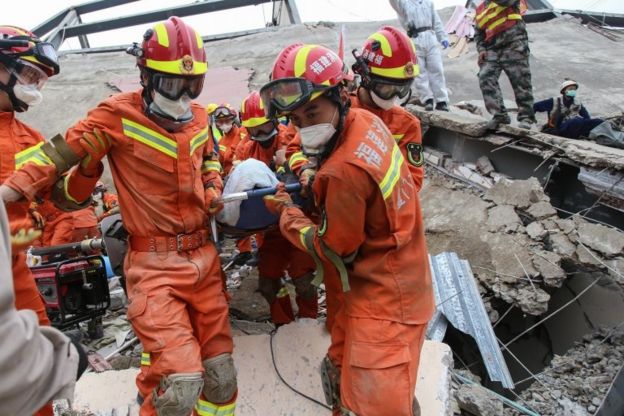
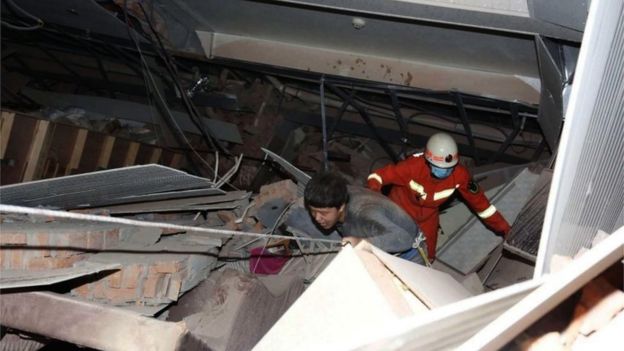
At least six people are dead and 28 remain missing after a hotel being used as a coronavirus quarantine facility in the Chinese city of Quanzhou collapsed on Saturday.

Rescue workers are still searching the rubble of the five-storey Xinjia Hotel in the southern province of Fujian.

Seventy-one people were in the building when it collapsed and dozens have been rescued, authorities say.

It is not clear what caused the collapse on Saturday evening.

Rescue workers continued to search for survivors on SundayImage copyright GETTY IMAGES
Image caption Rescue workers continued to search for survivors on Sunday

State media say the hotel was being used as a quarantine facility monitoring people who had had close contact with coronavirus patients. It’s reported 58 of the 71 people in the building were under quarantine.

The building’s first floor had been undergoing renovation since before the Lunar New Year, the official Xinhua news agency said, adding that police had summoned the building’s owner.

The hotel reportedly opened in 2018 and had 80 guest rooms.

The city of Quanzhou has recorded 47 cases of the virus, which first emerged in the city of Wuhan, about 1,000km away.

A rescuer follows an injured man walking out of the rubbles of a collapsed five-story hotel building in Quanzhou city in southeast China's Fujian province, 7 March 2020Image copyright EPA
Image caption The hotel reportedly had 80 guest rooms

One woman told the Beijing News website that relatives including her sister had been under quarantine there.

“I can’t contact them, they’re not answering their phones,” she said.

“I’m under quarantine too [at another hotel] and I’m very worried, I don’t know what to do. They were healthy, they took their temperatures every day, and the tests showed that everything was normal.”

As of Friday, Fujian province had 296 confirmed cases of coronavirus. Meanwhile 10,819 people have been placed under observation because they have been in close contact with someone infected.

The number of new reported cases in China dropped on Saturday to 44, down from 99 the previous day.

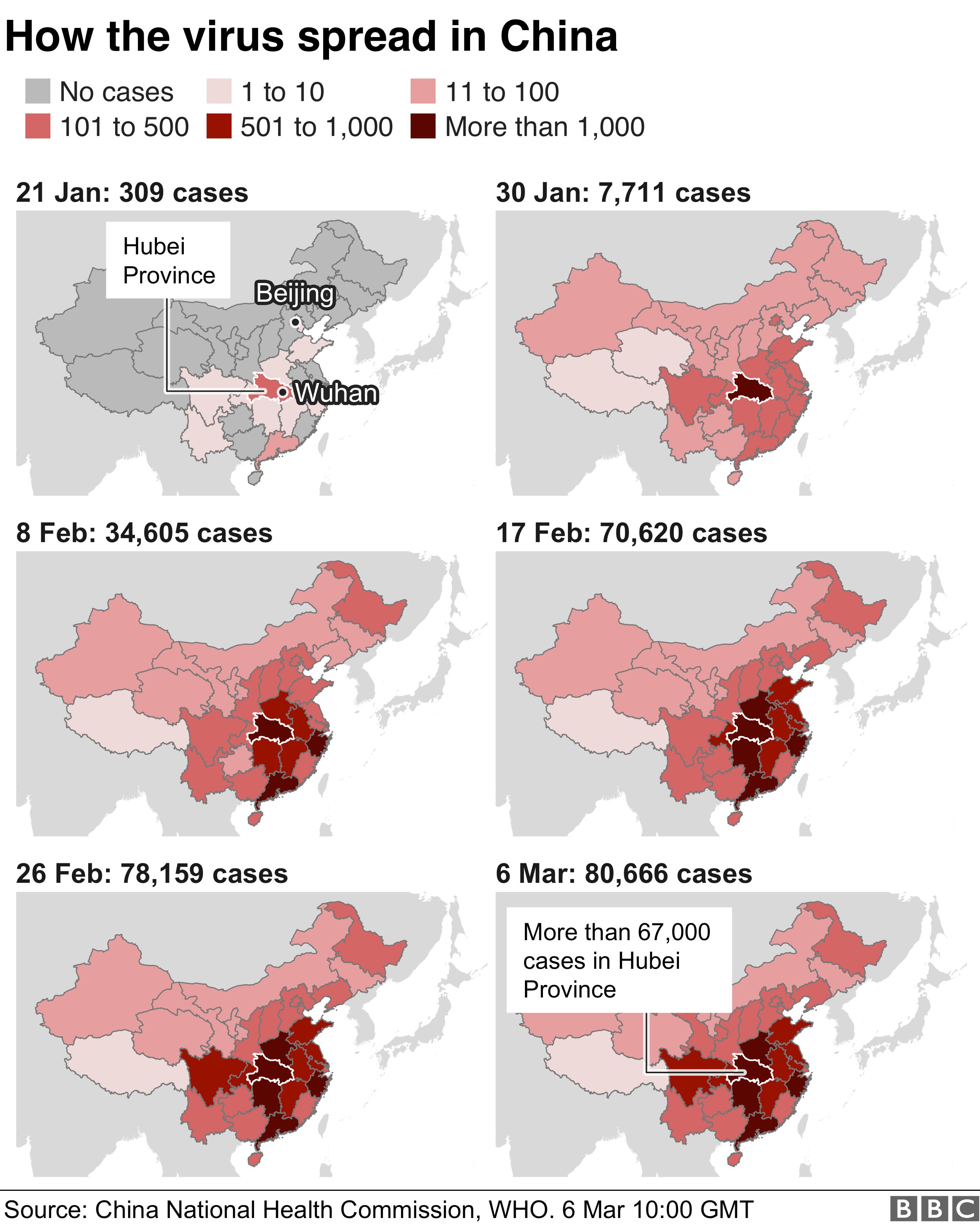
The World Health Organization says more than 101,000 people worldwide have now contracted the virus. More than 80,000 of them are in China.

About 3,500 people have died – the majority in the Chinese province of Hubei where the outbreak originated.Presentational white space

Banner image reading 'more about coronavirus'
Banner
Chart showing how the virus has spread in China 6 MarchPresentational white space

Source: The BBC

06/03/2020

China’s Hubei reports no new coronavirus cases outside city of Wuhan

BEIJING (Reuters) – China’s central province of Hubei, excluding the provincial capital Wuhan, has reported zero new cases of coronavirus over 24 hours for the first time in the outbreak, as authorities seek to stem imported infections in other areas.

Wuhan, the centre of the epidemic, reported 126 new confirmed cases on Thursday but there were no new infections elsewhere in the province, the National Health Commission said on Friday.

Elsewhere in China, schools in provinces reporting no new cases for a number of days started to set reopening dates.

Qinghai, a northwesterly that had reported no new infections for 29 days as of March 5, said it would stagger the start date of different schools between March 11 and March 20, according to a notice posted on an official website.

The southwesterly province of Guizhou has said its schools will start reopening from March 16.

Outside of Hubei, there were 17 new confirmed cases, bringing the total new infections in mainland China to 143 on Thursday, up from 139 cases a day earlier.

Of the 17 new cases, 16 were imported from outside of China – 11 in Gansu province, four in Beijing and one in Shanghai.

A total of 311 passengers arriving at Gansu’s provincial capital Lanzhou from Iran were quarantined, state television reported late on Thursday.

Beijing’s four new cases had come from Italy. On Friday, one of the city’s government officials described its epidemic control campaign as being at its most challenging period, adding that roughly 827,000 people who had returned to the capital from outside – most of them from extended Lunar New Year holidays – were currently undergoing home observation.

Last month, Gansu became the first province to lower its emergency response measures from level I to level III, reflecting the lack of new infections.

Tibet became the latest region to lower its emergency response level on Friday, announcing on an official website that some areas had eased to level II and others to level III.

OPTIMISM FOR WUHAN

Health authorities in Shanghai said that the city had recorded three new cases in the first 12 hours of Friday. All were Chinese nationals who had studied in Iran, state media reported. [B9N28E04N]

All three had been transferred by Shanghai customs to quarantine on March 3, a spokeswoman for the city’s health commission told a news briefing.

Despite the fresh cases in Wuhan, senior Chinese government officials expressed optimism about its situation as the city shut its second makeshift hospital on Friday afternoon, state radio reported.

“As the situation in Wuhan and Hubei improves, relevant authorities, with approvals, will make timely adjustments according to China’s Infectious Diseases Law and public health emergency regulations,” Ding Xiangyang, vice secretary general at the State Council, told a news briefing.

“When I went out in the morning, the cherry blossoms were blooming in front of my door, telling us that winter has passed and spring has come. I think the day everyone has been looking forward to is not far away,” he said.

As new cases dwindle in China, attention has turned to potential infections arriving from overseas.

Authorities in Beijing, Shanghai and Guangdong have all vowed to quarantine travellers from countries hit the hardest by the coronavirus, which Beijing identified as South Korea, Japan, Iran and Italy.

The overall accumulated number of confirmed cases in mainland China stood at 80,552 as of Thursday.

The death toll from the outbreak in mainland China was 3,042 as of the end of Thursday, up by 30 from the previous day.

Hubei reported 29 new deaths, while in Wuhan, 23 people died.

Source: Reuters

02/03/2020

Coronavirus: South Korea church leader apologises for virus spread

Leader of the Shincheonji Church of Jesus holds press conference in South KoreaImage copyright EPA
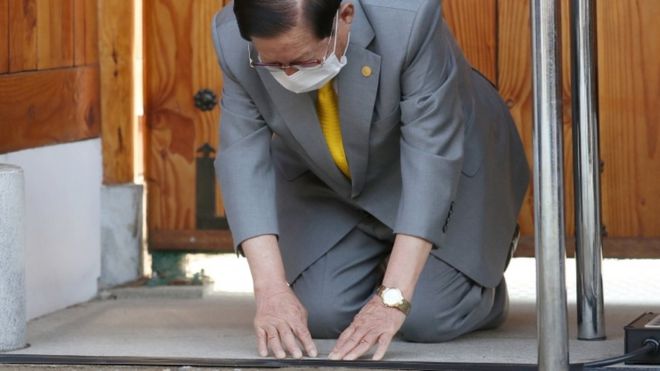
Image caption Lee Man-hee is the founder of the Shincheonji Church

The head of the religious sect that has been at the centre of the coronavirus outbreak in South Korea has apologised to the nation for the disease’s spread.

Lee Man-hee, the leader of the Shincheonji Church of Jesus, got on his knees and bowed at a news conference.

About 60% of the country’s more than 4,000 confirmed cases are sect members.

On Monday, South Korea – the biggest hotspot outside China – reported 476 new cases, bringing the total number to 4,212. It has recorded 26 deaths.

Prosecutors have been asked to investigate Mr Lee on possible charges of gross negligence.

“Although it was not intentional, many people have been infected,” said the 88-year-old leader. “We put our utmost efforts, but were unable to prevent it all.”

Media caption Empty shelves as coronavirus ‘panic-buying’ hits Australia

Of the confirmed cases, 3,081 are from the southern city of Daegu and 73% of these cases have been linked to the Shincheonji Church near there.

In the capital Seoul, the mayor urged the city’s 10 million residents to work from home and to avoid crowded places.

Why is the Shincheonji Church of Jesus in the spotlight?

Members of the fringe Christian group are believed to have infected one another and then travelled around the country, apparently undetected.

The group has been accused of keeping its members’ names secret, making it harder to track the outbreak.

But church spokesman Kim Shin-chang told the BBC they had provided a list of members, students, and buildings to authorities.

“We were worried about releasing this information because of the safety of our members,” Mr Kim said.

Media caption ‘We’re often persecuted’: Spokesman for virus-hit S Korean church defends secrecy

Mr Lee claims he is the second coming of Jesus Christ and identifies as “the promised pastor” mentioned in the Bible who will take 144,000 people to heaven with him.

The Shincheonji Church is labelled as a cult within South Korea and also in the Christian community, which results in the group often being discriminated against, persecuted or criticised, Mr Kim told the BBC.

What’s the global situation?

The number of people killed worldwide by the coronavirus has exceeded 3,000, as China reported 42 more deaths. More than 90% of the total deaths are in Hubei, the Chinese province where the virus emerged late last year.

But there have also been deaths in 10 other countries, including more than 50 in Iran and more than 30 in Italy.

Worldwide, there have been almost 90,000 confirmed cases, with the numbers outside China now growing faster than inside China.

In other developments:

  • In the UK, where there are 36 confirmed cases, Prime Minister Boris Johnson has called a meeting of the emergency Cobra committee on Monday
  • Indonesia – one of the world’s most populous countries – has announced its first confirmed cases of coronavirus, a 64-year-old woman and her 31-year-old daughter, currently being treated at a Jakarta hospital
  • Iceland and Andorra also reported their first confirmed cases on Monday
  • Share prices in Asia and in Europe rose after central banks pledged to intervene to help protect markets from the impact of the coronavirus. Concerns about the outbreak last week wiped more than $5tn (£3.9tn) from global stocks
  • US sportswear giant Nike has closed its European headquarters in Hilversum city in the Netherlands after an employee tested positive for the virus

In the European hotspot of Italy, the number of infections doubled in 48 hours, the head of the country’s civil protection body said on Sunday.

There have been at least 34 deaths and 1,694 confirmed cases. Amazon said two of its employees in Italy have the virus and are under quarantine.

Countries including Qatar, Ecuador, Luxembourg and Ireland all confirmed their first cases over the weekend. On Monday, Ecuador reported five new cases of the disease, bringing the total number of infected patients in the country to six.

The US state of New York has also confirmed its first case. The patient is a woman in her 30s who contracted the virus during a recent trip to Iran. Two people have died in the US, both in the state of Washington.

Presentational grey line

What do I need to know about the coronavirus?

Presentational grey line

What’s the situation in China?

China on Monday reported 42 more deaths, all in Hubei. There were also 202 confirmed new cases – only six of which were outside Hubei.

A total of 2,912 people have died inside China, with more than 80,000 confirmed cases of the virus.

A spokesman from China’s National Health Commission said the next stop would be to “focus on the risks brought by the resumption of work”.

China’s economy has taken a hit – with factory activity falling at a record rate.

On Monday, a man was sentenced to death by a Chinese court for fatally stabbing two officials at a virus checkpoint, news agency AFP reported.

Ma Jianguo, 23, refused to co-operate with officials – though it is not clear what he was told to do – and stabbed two checkpoint officials.

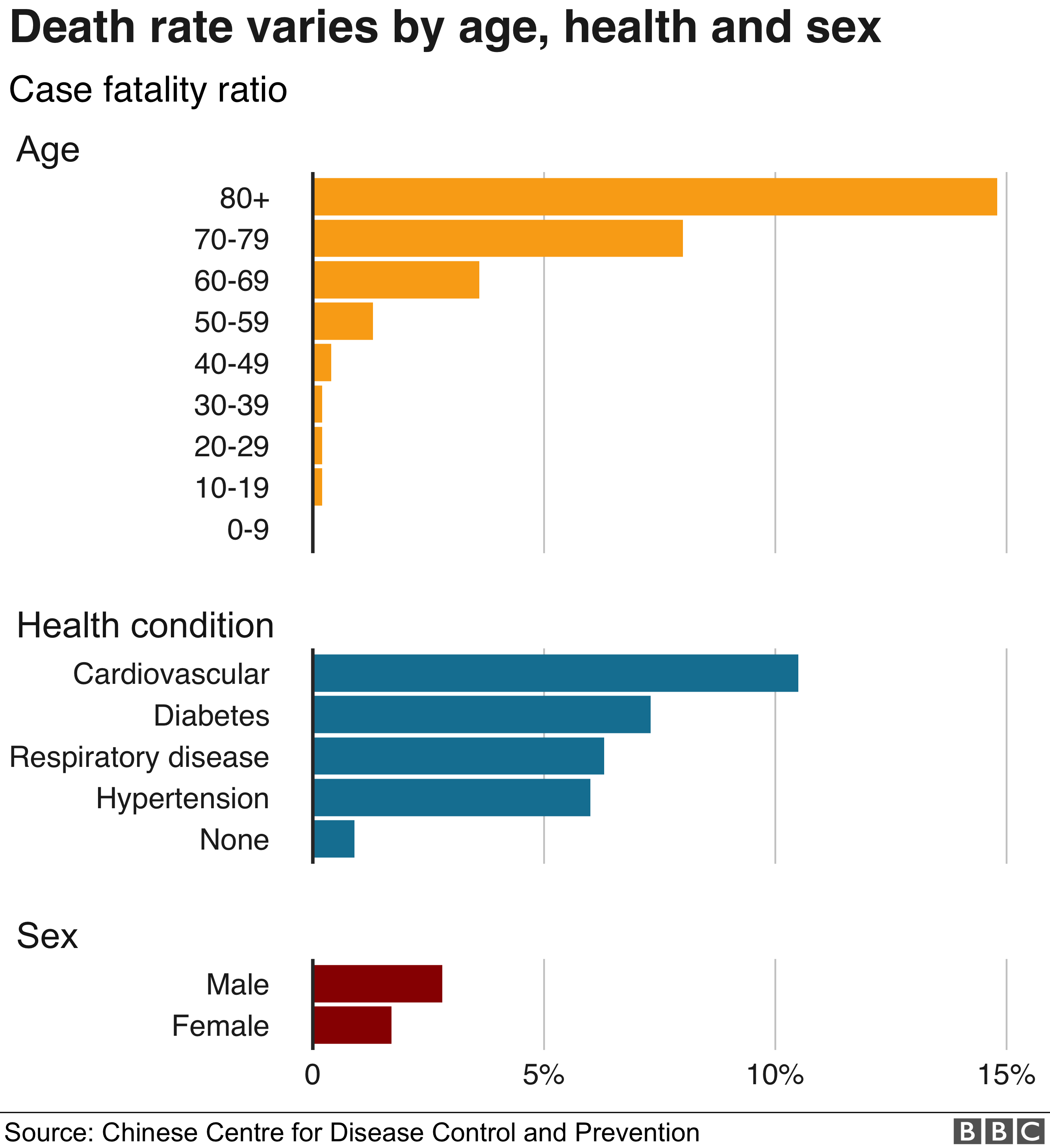
Death rates for different groupsPresentational white spaceWhat has the WHO said?

On Sunday, the World Health Organization (WHO) said the virus appears to particularly affect those over 60, and people already ill.

It urged countries to stock up on ventilators, saying “oxygen therapy is a major treatment intervention for patients with severe Covid-19”.

In the first large analysis of more than 44,000 cases from China, the death rate was 10 times higher in the very elderly compared to the middle-aged.

But most patients have only mild symptoms and the death rate appears to be between 2% and 5%, the WHO said.

By comparison, the seasonal flu has an average mortality rate of about 0.1%, but is highly infectious – with up to 400,000 people dying from it each year.

Other strains of coronavirus, such as Severe Acute Respiratory Syndrome (Sars) and Middle East Respiratory Syndrome (Mers), have much higher death rates than Covid-19.

Source: The BBC

29/02/2020

Could the coronavirus help to improve China’s ties with South Korea, Japan?

  • Cooperation on ‘soft’ issues like public health can provide an ‘opportunity for improvement’ in the nations’ broader relationship, international affairs expert says
  • Foreign ministers agree to do all they can to ensure Chinese President Xi Jinping’s planned visits to east Asian neighbours go ahead later this year
South Korea on Thursday reported 505 new coronavirus cases, its largest increase yet. Photo: AP
The rapid spread of the coronavirus outside China, especially in South Korea and

Japan, 

has created a fresh challenge to Beijing’s delicate relationship with its northeast Asian neighbours, but experts say the unprecedented public health crisis could draw them closer, at least for now.

China’s Foreign Minister Wang Yi held separate conversations with his South Korean and Japanese counterparts on Wednesday as Beijing scrambles to deal with the growing risk of imported infections from the two countries.
In a sign of the “strong momentum at the leadership level on both sides”, Wang and Japanese Minister for Foreign Affairs Toshimitsu Motegi agreed to ensure Chinese President Xi Jinping’s state visit to Japan later this year goes ahead as planned, despite mounting fears the virus outbreak will become a pandemic.
China’s foreign ministry said on Thursday that Yang Jiechi, Wang’s predecessor and Xi’s top aide on foreign affairs, would visit Japan on Friday. His trip is expected to pave the way for Xi’s high stakes visit in the spring, observers said.

But Benoit Hardy-Chartrand, an international affairs expert at Temple University in Tokyo, said that if the outbreak did not subside in the next few weeks, Japanese Prime Minister Shinzo Abe’s government would come under intense pressure to delay the visit.

“Despite reassuring official pronouncements, no one would be surprised if the visit was postponed to a later date,” he said. “With an already declining approval rate, the Abe administration would be hard-pressed to go ahead with the summit.”

During her phone call with Wang, South Korean Foreign Minister Kang Kyung-wha urged China to refrain from carrying out what she described as “excessive” restrictions and forcible quarantine measures against visitors from her country, the Yonhap news agency reported.

White House announces coronavirus ‘coordinator’ to lead response under Pence

28 Feb 2020
South Korea

on Thursday reported 505 new coronavirus cases – its largest increase yet and the first time any country has confirmed more daily cases than China. The outbreak has now spread to more than 30 countries and killed more than 2,800 people.

US-CHINA TRADE WAR
In the cities of Qingdao and Weihai in east China’s Shandong province – both of which are home to large South Korean and Japanese communities – local authorities have begun to quarantine arrivals from the two countries, while similar measures targeting South Koreans in particular have been introduced in Shenyang and Nanjing.

This is the first time China, where the coronavirus originated and which earlier criticised other nations for overreacting to the outbreak, has introduced country-specific measures in the name of disease control.

The move sparked fierce criticism in South Korea, with more than 750,000 people signing an online petition calling for a ban on Chinese visitors.

The foreign ministry in Seoul said that about 40 nations and regions had imposed some sort of restrictions on South Korean visitors.

Both South Korea and Japan – which were among the first to offer support and aid to China when the epidemic took hold – have imposed only partial restrictions on Chinese travellers, mostly those from Hubei, the province at the centre of the contagion.

Wang again thanked South Korea for its support and defended China’s control measures, saying they were necessary to reduce the cross-border movement of people and restrict the spread of the disease, China’s foreign ministry said.

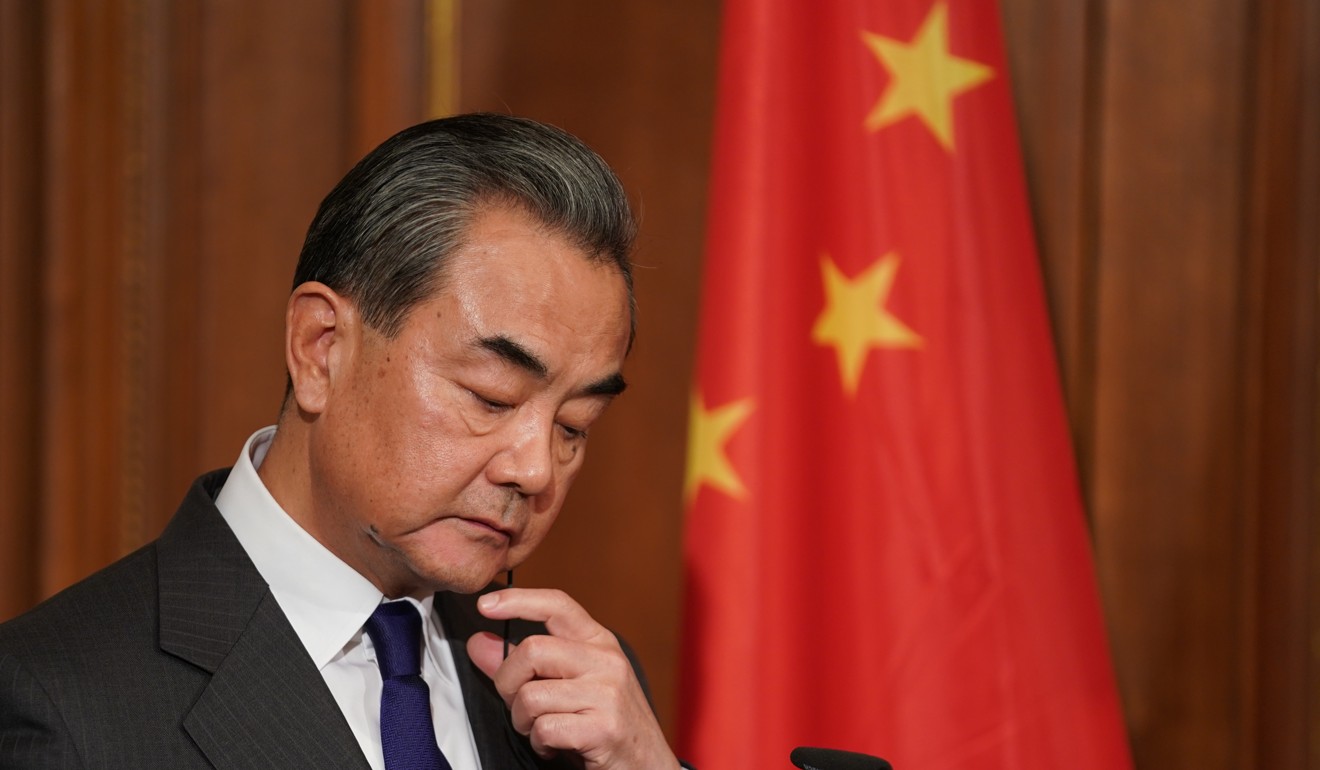
China’s Foreign Minister Wang Yi. Photo: EPA-EFE
Yonhap said both Wang and Kang also agreed that Xi’s proposed trip to South Korea in the first half of the year would proceed as planned.
Chinese experts said the coronavirus had deepened distrust and antagonism towards China in both countries, with many South Koreans and Japanese blaming China for the spread of the disease.
Li Wen, an expert from the China Institute of International Studies, said the coronavirus crisis had seen the rise of the “China threat” in South Korea, with its government under enormous pressure to get tough on its giant neighbour.

According to Yonhap, Kang urged South Korean diplomats in China earlier this month to help minimise any negative impact the epidemic might have had on relations between the two countries.

Hardy-Chartrand said relations between China and South Korea remained tense because of Seoul’s deployment of the American-made THAAD missile defence system, which in turn led to Beijing introducing unofficial sanctions that caused resentment among South Koreans.

Hongkongers stuck in Japan with airlines reluctant to fly them home

28 Feb 2020

But the latest spat over the control measures was unlikely to be a major obstacle to regional relations, he said.

“Overall, cooperation on so-called soft issues like public health, as we are witnessing at the moment, can provide an opportunity for further improvement in the broader relationship, at least in the short term,” he said.

China-Japan relations might also benefit from closer cooperation on disease control given uncertainty in the region over the US-China trade war, the North Korean denuclearisation impasse, the United States’ commitment to its allies, and the coronavirus outbreak, he said.

“I am less sanguine about the mid- to long-term prospects for Sino-Japanese relations, given that the sources of the tensions that we saw from 2010 to 2017, namely the East China Sea territorial dispute and other historical issues, remain wholly unresolved,” he said.

According to a Pew study in December, 85 per cent of Japanese have an unfavourable view of China, the highest among 34 countries surveyed, while 63 per cent of South Koreans see China negatively.

Source: SCMP

28/02/2020

Coronavirus: secretive South Korean church linked to outbreak held meetings in Wuhan until December

  • Around 200 Shincheonji Church of Jesus members continued to meet in the Chinese city amid rumours of virus, but ‘no one took [claims] seriously’ at first
  • Around half the Covid-19 cases in South Korea have been linked to members of the religious group
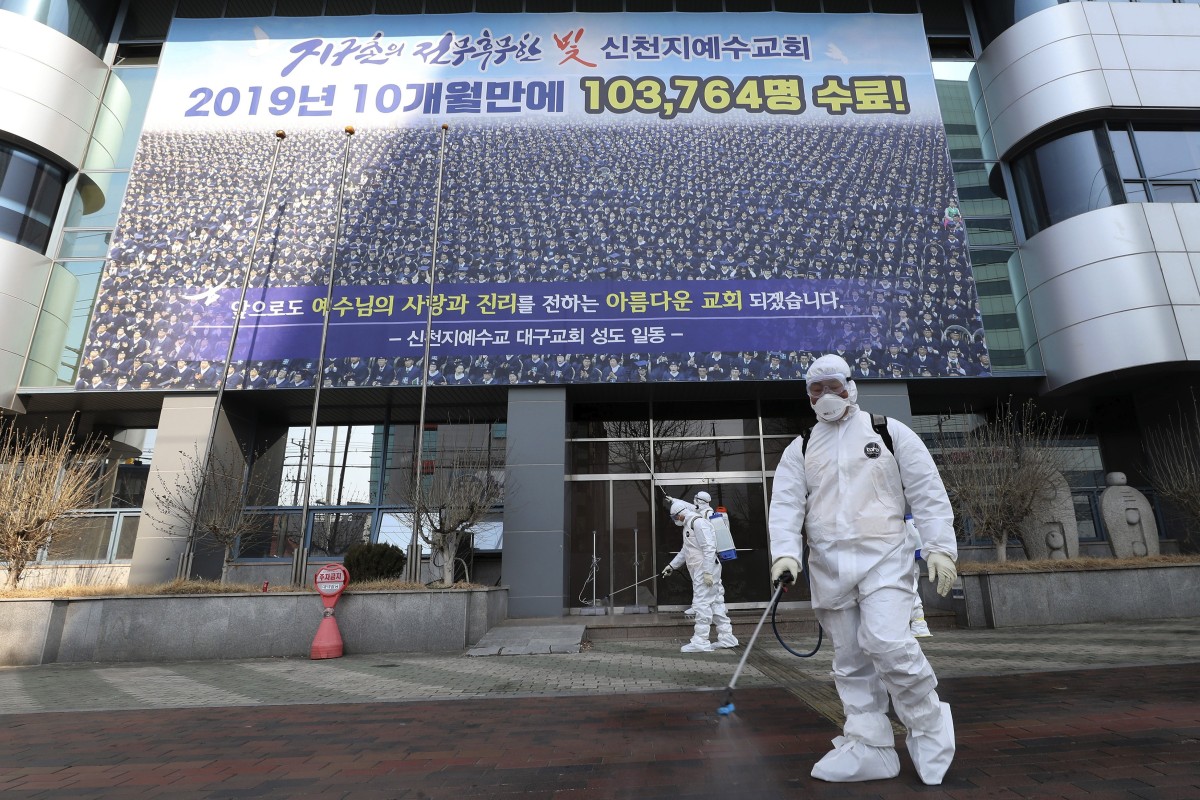
The Shincheonji church in Daegu has been linked to a cluster of infections. Photo: Yonhap via AP

Members of the Christian sect linked to a cluster of coronavirus cases in South Korea held meetings in Wuhan until December, only stopping when they realised that their community had been hit by Covid-19, the previously unknown disease caused by the virus.

The South China Morning Post has learned that the Shincheonji Church of Jesus in Wuhan, the Chinese city at the centre of the epidemic, has around 200 members, most of whom are currently under quarantine outside the city.

“Rumours about a virus began to circulate in November but no one took them seriously,” said one member, a 28-year-old kindergarten teacher.

“I was in Wuhan in December when our church suspended all gatherings as soon as we learned about [the coronavirus],” said the woman, who declined to be named because of the sensitivity of the matter.

She said the group was continuing to share sermons and teachings online, but most members had returned home at the start of the Lunar New Year holiday in late January.

The 250,000-member Shincheonji Church of Jesus is regarded by mainstream Christian groups as a secretive and unorthodox sect. Its founder, Lee Man-hee, has claimed that he is the second coming of Jesus Christ.

Around half the Covid-19 infections in South Korea have been linked to a branch of the church in Daegu.

Coronavirus spreads through Europe from Italy to Austria, Croatia, Tenerife

26 Feb 2020

According to the Korea Centres for Disease Control and Prevention, there were 977 confirmed cases as of Tuesday – the second highest number outside China – and 11 deaths.

Of the 84 new cases reported on Tuesday, over half were recorded in Daegu city.

Coronavirus: Churches on high alert as South Korea confirms huge rise in infections
A member of the church from Daegu reportedly visited China in January, and health officials in South Korea are investigating whether a cluster of infections in Cheongdo city is linked to a three-day funeral ceremony held at a local hospital.

Chinese sources said that the Shincheonji church has about 20,000 members in China – most of whom live in major cities such as Beijing, Shanghai, Dalian, Changchun and Shenyang.

One Christian pastor in Hubei province, who declined to be named, said that Shincheonji church members were hard-working and some continued to proselytise even during the outbreak.

Chinese cities quarantine travellers from South Korea amid spike in coronavirus cases

25 Feb 2020

The Wuhan kindergarten teacher said she was confident that the recent mass outbreaks in South Korea were not linked to Shincheonji church members from the city.

“I don’t think the virus came from us because none of our brothers and sisters in Wuhan have been infected. I don’t know about members in other places but at least we are clean. None of us have reported sick,” she said.

“There are so many Chinese travelling to South Korea, it’s quite unfair to pin [the disease] on us.”

Coronavirus: China reports 508 new Covid-19 cases, with only nine outside outbreak epicentre
She sidestepped questions on whether church members had travelled from Wuhan to South Korea after the outbreak.
The teacher said that in 2018 the Wuhan group’s “holy temple” in Hankou district had been raided by police “who branded us a cult”, but members continued to worship in small groups.
“We are aware of all the negative reporting out there after the outbreak in South Korea, but we do not want to defend ourselves in public because that will create trouble with the government,” she said. “We just want to get through the crisis first.”
Airfares from South Korea to China shoot up amid Covid-19 fears
25 Feb 2020

Bill Zhang, a 33-year-old Shanghai resident and a former missionary with Shincheonji, said the group’s secretive nature made it hard for the authorities to effectively crackdown on its activities.

He said the Shanghai branch held its main meetings on Wednesdays and Saturdays, attracting 300 to 400 people at a time.

“The Shincheonji church in Shanghai has been raided many times and police spoke to church leaders regularly.

“But the church members simply continued their meetings in smaller groups of eight-to-10 people and regrouped when the surveillance was relaxed.”

Zhang continued: “Shincheonji holds that it is the only real church that upholds the biblical truth and all other churches – mainstream or cults – are evil.”

Source: SCMP

24/02/2020

Coronavirus: North Korea quarantines foreigners

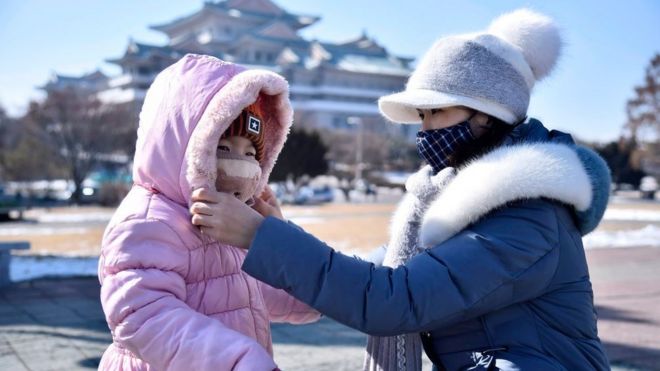
A woman helps her daughter seen wearing a face mask in PyongyangImage copyright GETTY IMAGES
Image caption North Korea is taking precautions to keep the virus out

North Korea has quarantined 380 foreigners in an attempt to stop the coronavirus from breaking out.

The foreigners are mostly diplomats stationed in the capital Pyongyang, state media reported.

About 200 foreigners had already been confined to their compounds for the past 30 days – but as that came to an end, the quarantine has been extended.

North Korea has not reported any cases of Covid-19, but several other countries did so on Monday.

Afghanistan and Dubai said they had detected their first cases, and Kuwait said three people returning from Iran had been infected.

In South Korea, seven people have died with 763 people infected. Around 7,700 troops have been quarantined after 11 military members were infected.

The virus, which emerged in China, has spread to at least 29 countries. Italy has the highest number of coronavirus cases in Europe, with 152.

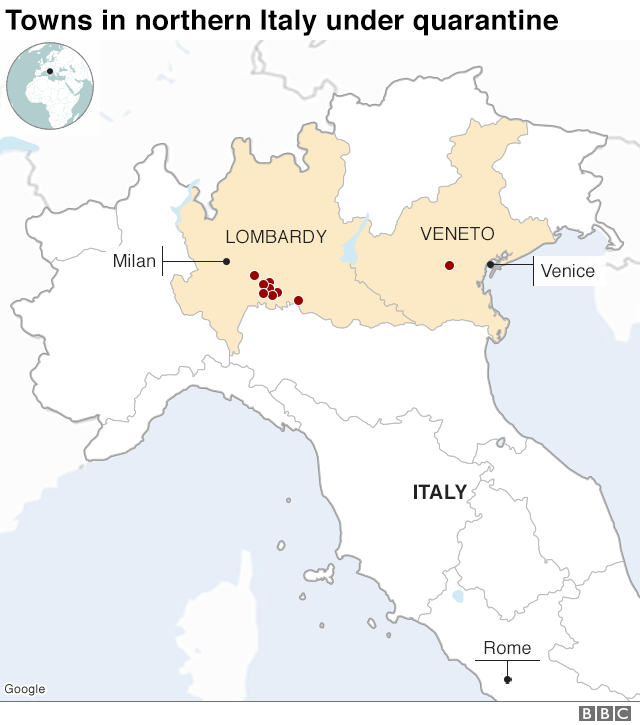
Around 50,000 people in two northern “hotspot” regions – Veneto and Lombardy – have been put under quarantine for two weeks.

Iran has also confirmed 43 cases of the virus and eight deaths.

In the Chinese city of Wuhan, where the virus emerged, the authorities earlier announced that some non-residents would be allowed to leave if they showed no symptoms of the virus.

However, local officials now say that order was made without authorisation and has been revoked.

The city has been in lockdown since January 23, with authorities cutting off transport links in and out of the city.

More than 2,500 people have died from the virus in mainland China, with some 77,150 cases confirmed cases reported.

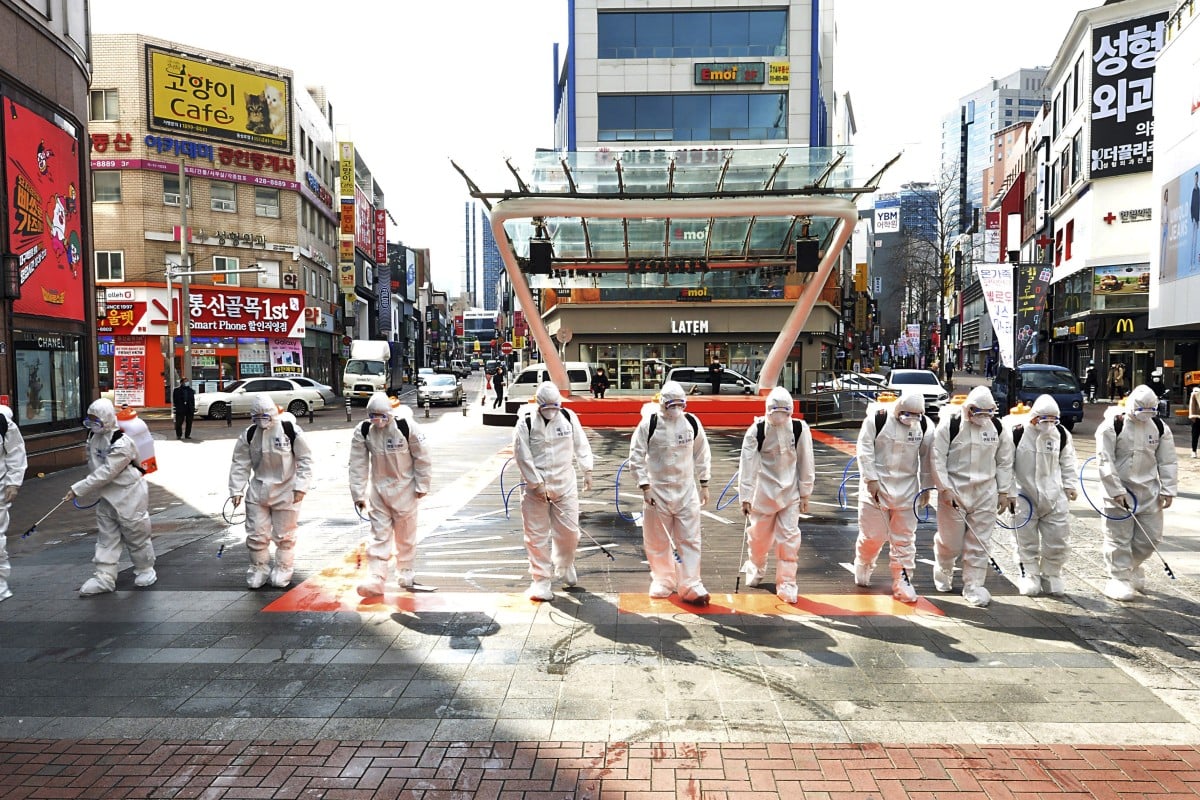
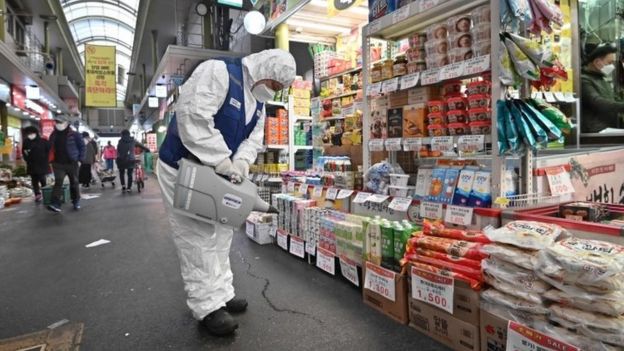
A worker sprays disinfectant to help prevent the spread of the novel coronavirus at a market in SeoulImage copyright AFP
Image caption A worker sprays disinfectant to help prevent the spread of the novel coronavirus at a market in Seoul

What is the situation in North Korea?

North Korea has not confirmed any cases but the country shares a long and often porous border with China. There are concerns that North Korea, which is subject to international sanctions, lacks the health infrastructure to test and treat those infected and that any outbreak could quickly spread unchecked.

At the moment, all foreigners coming into the country must be quarantined for 30 days.

There are relatively few foreigners in North Korea, and only around 200 Westerners, according to one expert.

North Korean authorities have also cancelled the annual Pyongyang marathon, which typically sees people from all over the world participating.

Around 3,000 people in North Pyongan province – a north-western region bordering China – are also now under monitoring for reportedly showing suspected symptoms, said state media.

What about South Korea?

Media caption People in Daegu have voiced concern over the spread of the virus

South Korea has the largest number of confirmed cases outside China, after a huge spike in the past week.

Before last Wednesday, the country had recorded just 31 cases. That number has now jumped to 763.

Eight new cases of the virus have been reported in the army, and one in the navy, air force and marine corps – bringing the number to 11.

But the biggest virus clusters have been linked to a hospital and a religious group near the south-eastern city of Daegu.

A handful of South Korea airlines, including Korean Air Lines – the country’s biggest airline – has suspended flights going to Daegu, which has a population of around 2.5m.

Korean Air says the suspension will last until March 27

What’s happening in Italy?

Italian officials have introduced sweeping measures to control what is now the worst outbreak of the coronavirus in Europe – at least three people have died and more than 150 cases confirmed.

In the regions of Lombardy and Veneto, a lock-down is in place in several small towns. For the next two weeks, 50,000 residents will not be able to leave without special permission.

Even outside the zone, many businesses and schools have suspended activities, and sporting events have been cancelled – including several top-flight football matches.

Officials have yet to find the first carrier of the virus in the country.

Map of Italy
Presentational white space
Grey line

World edges closer to coronavirus pandemic

Analysis by Fergus Walsh, medical correspondent

The combined situation in South Korea, Iran and Italy points to the early stages of pandemic. This means a global outbreak, with the coronavirus spreading in the community in multiple parts of the world.

In each of these countries we are seeing spread of the virus with no connection to China. The lockdown efforts in Italy mirror those that have happened in China.

The situation in Iran is especially worrying, because the health authorities have reportedly said the virus has spread to multiple cities, and it appears the first case in Lebanon is linked to a traveller from Iran.

If we have a pandemic, it will still be important to limit the speed of spread of the virus.

If countries could hold it somewhat at bay until the end of winter, there is a hope that warmer temperatures will reduce the time the virus can survive in the air, as we see with seasonal flu. But this may not be certain.

Grey line

What’s the latest from Iran?

Iran said on Sunday it had 43 confirmed cases of the virus, most of them in the holy city of Qom. Eight of those infected have died, the highest number of deaths outside China.

Iraq, Pakistan, Armenia and Turkey have closed their borders with Iran, and Afghanistan has suspended air and road travel to and from Iran.

What about China, where the outbreak started?

China’s President Xi Jinping has described the outbreak as the “largest public health emergency” in the country’s recent history.

Speaking on Sunday, he acknowledged “shortcomings” in China’s response and said lessons must be learned.

China reported 409 new infections on Monday, the bulk of which were from Wuhan.

But outside China, cases with no clear link to that country or other confirmed cases continue to rise, prompting concern from the World Health Organization (WHO).

Source: The BBC

23/02/2020

Korea raises alert to highest level as coronavirus cases jump

SEOUL/SHANGHAI (Reuters) – South Korea raised its disease alert to the highest level on Sunday after a surge in coronavirus infections and two more deaths, while China state media warned the outbreak there had yet to reach a turning point despite some signs of easing.

South Korea’s president said he was putting the country on “red alert” due to the rapid rise in new cases, which are largely being traced back to church services. Health officials reported 169 new infections, bringing the total to 602, having doubled from Friday to Saturday.

The escalation in the alert level allows the government to send extra resources to Daegu city and Cheongdo county, which were designated “special care zones” on Friday.

South Korea’s Yonhap News Agency said it also enables the government to forcibly prevent public activities and order the temporary closure of schools, though the government gave no immediate details on what steps could be taken.

In China, the health commission confirmed 648 new infections – higher than a day earlier – but only 18 were outside of Hubei province, the lowest number outside of the epicenter since authorities started publishing data a month ago and locked down large parts of the country.

But the number of cases continued to climb elsewhere.

Japanese Prime Minister Shinzo Abe instructed government agencies on Sunday to urgently prepare medical provisions and draft a comprehensive plan to curb the spread of the virus, after it reported 27 more cases a day earlier.

The U.S. State Department raised its travel advisory level one notch for South Korea and Japan to Level 2 on a scale of 1 to 4.

Concern about the reach and rapid spread of coronavirus also grew in Europe and the Middle East.

Cases in Italy, Europe’s worst hit country, more than quadrupled to 79 on Saturday, with two deaths.

Iran reported a total of 43 infections, with eight deaths – all since Tuesday – forcing some of its neighbors to announce travel and immigration curbs.

The World Health Organization on Saturday stressed that the number of cases outside of China was still relatively few, but it was worried by the detection of infections without a clear link to China.

The disease has spread to some 26 countries and territories outside China, killing more than a dozen people, according to a Reuters tally. It has been fatal in 2% of reported cases, with the elderly and ill the most vulnerable, according to the WHO.

The potential economic impact of coronavirus was prominent at a meeting of G20 finance ministers in Riyadh, at which the International Monetary Fund chief said China’s 2020 growth would likely be lower at 5.6%, down 0.4 percentage points from its January outlook, with 0.1 percentage points shaved from global growth.

Graphic: Online site for coronavirus news here

Graphic: Tracking the novel coronavirus here

CHURCH CONTAGION

The last time South Korea raised the alert to the highest was 11 years ago during the Influenza A or H1N1 outbreak.

Many of South Korea’s new cases were linked to the Shincheonji Church of Jesus congregation in Daegu after a 61-year-old woman known as “Patient 31” tested positive for the virus last week. The woman had no recent record of overseas travel.

Catholic churches in Daegu and Gwangju have suspended mass and other gatherings, while churches elsewhere saw declines in attendance on Sunday, especially among the elderly.

“If the situation gets worse, I think we’ll need to take more measures. Currently, we’re limiting personal gatherings within the church except for Mass,” said Song Gi-young, 53, wearing a face mask at church.

Heo Young-moo, 88, expressed frustration.

“Devotees shouldn’t go to any risky places … Hasn’t it become so widespread because those people didn’t get checked?”,” he said.

Outside of the church was a sign that said: “All Shincheonji followers are strictly prohibited from entering”.

The foreign ministry said South Koreans aboard a plane to Israel had been denied entry there on Saturday due to concerns about the virus spread.

China said the number of new deaths on Saturday from COVID-19, as the disease caused by the virus is known, was 97, all but one of which were in Hubei.

Eighty-two of those were in the provincial capital Wuhan, where Xinhua news agency said nucleic tests were being carried out on the backlog of cases to try to contain the spread.

In total, China has reported 76,936 cases, and 2,442 deaths. The WHO says the virus is severe or critical in only a fifth of infected patients, and mild in the rest.

Graphic: Reuters graphics on the new coronavirus here

NOT OVER YET

Beijing, Zhejiang, Sichuan had no new infections on Feb. 22 for the first time since the outbreak was detected. There were signs of street life in Shanghai, with some cafes serving take-out food and families wearing masks walking their dogs.

State run television on Sunday urged people to avoid complacency, drawing attention to people gathering in public areas and tourist spots without wearing masks.

Analysts have been closely watching out for any signs of a secondary wave of infections as transport restrictions are eased and many migrant workers return to factories and offices. Business activity in the world’s second-biggest economy is only gradually returning to normal after widespread disruptions.

Japan’s health minister apologized on Saturday after a woman who was allowed to leave the coronavirus-struck Diamond Princess cruise ship tested positive despite having underwent quarantine.

At least 623 cases have been reported on the vessel, the biggest outbreak outside China, involving more than a dozen nationalities.

In Italy, schools and universities were closed and some soccer matches postponed in Lombardy and Veneto, the country’s industrial heartland.

Saudi Arabia, Kuwait, Iraq have travel and immigration curbs on Iran, while Oman on Sunday urged its citizens to steer clear of countries with high infection rates and said arrivals from those nations would be quarantined.

Source: Reuters

Law of Unintended Consequences

continuously updated blog about China & India

ChiaHou's Book Reviews

continuously updated blog about China & India

What's wrong with the world; and its economy

continuously updated blog about China & India