CHINDIA ALERT: You'll be living in their world, very soon

continuously updated blog about China & India

  • Home
    • HOME: Why Chindia?
    • Chindia sources
  • Historical Perspectives
    • 4,000 years of records
    • Before the Raj
    • China’s first-half 20C Timeline
    • India’s first-half 20C Timeline
    • 70 years from Liberation
    • 70 years from Independence
  • Social & Cultural Factors
    • India’s British influence
    • China is homogeneous
    • India is diverse
    • Very different mindsets
    • Chinese mindset
    • Indian mindset
    • Chinese body, mind and spirit
    • Indian body, mind and spirit
    • Uncanny similarities
    • Major events or changes in China – Social & Cultural 2013:
    • Major events or changes in India – Social & Cultural 2013
  • Economic Factors
    • Major Chinese Economic events or changes: 2013 – 2019
    • Major Indian economic events or changes: 2013 – 2017
    • Chinese overseas acquisitions / investments
    • China needs to rebalance her economy
    • China’s infrastructure
    • ‘Greening’ of China
    • China’s manufacturing
    • India changes gear in 1991
    • India’s services
    • Consumerism blossoms
    • Information Technology
  • Political Factors
    • Major Chinese Political events or changes: 2013 – 2017
    • Major Indian Political events or changes: 2013 – 2017
    • Intrinsic uncertainty and instability – China
    • Intrinsic uncertainty and instability – India
    • Geopolitics: Chinese
    • 2014 is a year of bumper harvest for China’s diplomacy, FM says
    • Geopolitics: Indian
  • Prognosis?
    • Will China be a superpower by 2038?
    • How close will India be in 2038?
    • China’s relationship with the Rest of the World
    • Chinese challenges?
    • Indian challenges?
    • How well will China and India innovate – to 2017?
  • In Closing
    • Eight ways China is changing your world
    • Ten forces forging China’s future
    • Reimagining India: Unlocking the Potential of Asia’s Next Superpower
  • ABOUT / Contact us
  • Chindia Alert: You’ll be Living in their World Very Soon

    aims to alert you to the threats and opportunities that China and India present. China and India require serious attention; case of ‘hidden dragon and crouching tiger’.

    Without this attention, governments, businesses and, indeed, individuals may find themselves at a great disadvantage sooner rather than later.

    The POSTs (front webpages) are mainly 'cuttings' from reliable sources, updated continuously.

    The PAGEs (see Tabs, above) attempt to make the information more meaningful by putting some structure to the information we have researched and assembled since 2006.

  • Follow CHINDIA ALERT: You'll be living in their world, very soon on WordPress.com
  • If you wish to read the material on the PAGES in an eBook format; here it is

    You will be living in their world, very soon

  • If you wish to read the material on China on the PAGES in a paperback format; here it is

    Beware the Waking Dragon

  • Categories

  • Beijing China China alert Chindia Alert Chinese President Xi Jinping coronavirus corruption COVID-19 Diplomacy Economics GeoPolitics Good news History Hong Kong India alert Internal politics Japan Manufacturing Military Neighbour conflict Pakistan Politics Pollution Shanghai Social & cultural Technology Uncategorized United States Washington Wuhan
  • Since July 21, 2012 free counters
  • Blogs I Follow

    • CCChang
    • Law of Unintended Consequences
    • ChiaHou's Book Reviews
    • What's wrong with the world; and its economy

Archive for ‘radicals’

  |  
07/03/2019

The British woman who fought for India’s freedom

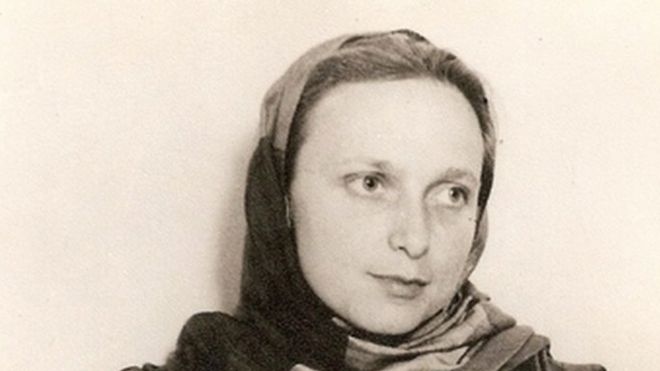
A portrait photo of Freda taken in Lahore in the early 1940
Image captionFreda Bedi’s is a remarkable story

Freda Bedi lived an unusual life. Born in a small town in England, she moved to India for love and ended up joining the independence movement. Her biographer, Andrew Whitehead, writes about her remarkable story.

“There are things deeper than labels and colour and prejudice, and love is one of them.”

These were the words of Freda Bedi, an English woman who overcame prejudice to marry an Indian Sikh and went on to challenge Indian notions about the role of a woman and a wife.

Freda and her boyfriend, Baba Pyare Lal Bedi (his friends called him BPL), met at Oxford where both were students.

This was the early 1930s and romances across the racial divide were rare – almost as rare as a girl from Freda’s background securing a spot at a top university. She was born, quite literally, above the shop in the city of Derby in England’s East Midlands, where her father ran a jewellery and watch repair business.

Freda could barely remember her father. He enlisted during the First World War and served in the Machine Gun Corps, where casualties were so high it was known as the “suicide club”. He died in northern France when his daughter was just seven years old. “This death shadowed my whole childhood,” she recalled – it shaped her political loyalties and prompted her lifelong spiritual quest.

Her years at Oxford were “the opening of the gates of the world”, as Freda once put it. She was part of “the Depression generation” – those who were students at a time of global crisis, mass unemployment and the rise of fascism.

She made firm friends at her college with young women who were rebellious by nature, and went with them to meetings of the Labour Club and the communist October Club.
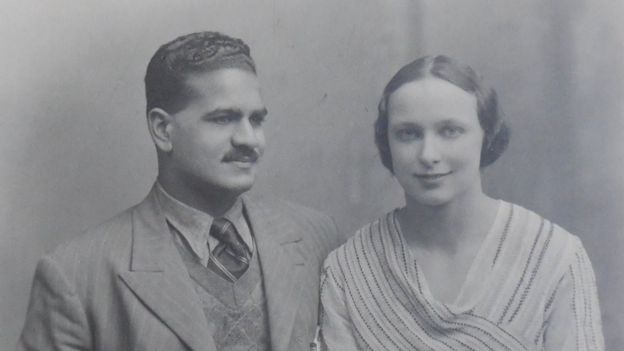
The engagement photo of Freda and BPL taken at Oxford in 1933
Image captionFreda and BPL met as students at Oxford University

Driven by curiosity and by sympathy with those struggling against the Empire, she also went along to the weekly meetings of the Oxford Majlis, where radicals among the university’s small number of Indian students asserted their country’s case for nationhood. BPL Bedi, a handsome and cheerful Punjabi, was a regular there. A friendship developed into intellectual collaboration and, within months, Freda and BPL were a couple.

In the early 1930s, women’s colleges at Oxford were obsessed with sex or rather with preventing it. If a male student came to have tea in a female student’s room, a chaperone had to be present, the door left wide open and the bed had to be taken into the corridor. Freda’s college did its best to derail her relationship – she was disciplined for visiting BPL without a chaperone in what she was convinced was a case of racial discrimination.

But she was fortunate in her student friends. Barbara Castle, who later became a commanding British woman politician of her era, was thrilled when Freda confided that she intended to marry her boyfriend. “Well, thank goodness”, Barbara exclaimed. “Now at least you won’t become a suburban housewife!” Freda’s mother didn’t see things that way though. Her family were sternly disapproving, until BPL made a visit to Derby and managed to charm them.

Freda commented that the engagement caused “a minor sensation” in Oxford. That was an understatement. She believed she was the first Oxford woman undergraduate to marry an Indian fellow student. Some didn’t hide their disapproval. The registrar who conducted the marriage ceremony pointedly refused to shake hands with the couple.

From the moment she married, Freda regarded herself as Indian and often wore Indian-style clothes. A year later, husband and wife and their four-month old baby, Ranga, set off by boat from Trieste, Italy, on the two-week journey to the western Indian city of Bombay (now Mumbai). “The nightmare was to get milk for myself to drink because I was feeding the baby”, Freda recalled. “And I remember the millions of cockroaches that used to come out at night in the ship’s kitchens – I used to go in and attempt to get milk.”

Presentational grey line

Read more stories by Andrew Whitehead

  • The forgotten English poet buried in India
  • Returning to Kashmir, where our parents were shot in front of us
  • Shujaat Bukhari: A man who epitomised the best of Kashmir
Presentational grey line

The couple had already been marked out by the British authorities as revolutionaries and potential trouble makers because of their student activism. When they disembarked in Bombay, their bags and cases were inspected for seven hours to check for left-wing propaganda. “Even Ranga’s little napkin was taken off and searched,” recalled Freda, “because they thought I might be carrying messages in it”.

The key test of Freda’s marriage was still to come – the first meeting with her Indian mother-in-law, a widow and matriarch known in the family as Bhabooji. From Bombay, the Bedis travelled non-stop for a couple of days to reach the small Punjabi city of Kapurthala, arriving at the family home close to midnight. Freda was wearing a white cotton sari – “not the ideal travelling dress, and nursing Ranga had not improved it”.

BPL bowed to touch his mother’s feet in the traditional expression of respect. “I copied him, feeling a little awkward,” Freda said, “but all my shyness disappeared when she smiled at us both with tears in her eyes, and embraced us and the child as if she could not hold us close enough.”

Although Freda was determined to fit in with her Indian extended family, her lifestyle was anything but conventional. BPL’s political stand extended to rejecting any share in his family’s wealth. They made their home in Lahore, one of the largest cities in Punjab, in a cluster of thatched huts without power or running water, keeping hens and a buffalo. It can’t have been the sort of life Freda had expected – nor would she have been used to the idea of sharing the household with her mother-in-law.

“Nowhere had I seen a white woman trying to be a typical Indian daughter-in-law”, commented Som Anand, a frequent visitor to the Bedis’ huts. “It surprised me to see Mrs Bedi coming to Bhabooji’s hut in the morning to touch her feet. In household matters she respected the old mother’s inhibitions. Her mother-in-law was an equally large hearted person; despite all her conservatism she had accepted a Christian into the family without a murmur.”
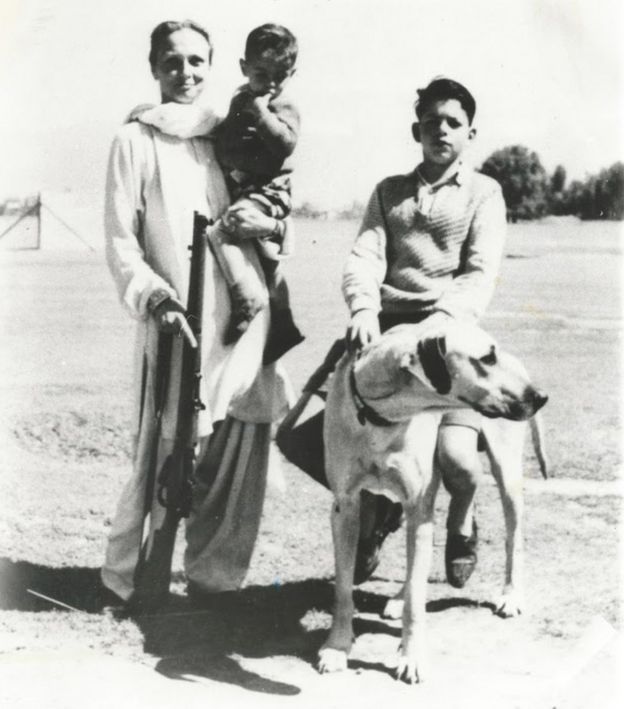
Freda with a rifle when she was living in Kashmir, probably 1948 - she is holding hr son, Kabir, while her older son, Ranga, is sitting on the family's pet dog.
Image captionFreda and BPL moved to Kashmir after 1947 and remained politically active

When World War Two broke out, both BPL and Freda were outraged that India was being dragged into supporting the British war effort. BPL was detained in a desert prison camp to stop him sabotaging military recruitment in Punjab. Freda decided to make her own stand against her motherland.

She volunteered as a satyagrahi, a seeker of truth, and was among those chosen by Indian independence leader Mahatma Gandhi to defy emergency wartime powers. She travelled to her husband’s home village of Dera Baba Nanak and announced that she would “break the law by asking the people not to support the military effort until India became democratic”. The authorities didn’t know how to respond to a white woman staging such a protest – they hurriedly sent an English police inspector to the village, deeming it inappropriate for an Indian policeman to arrest an Englishwoman.

Freda was brought before a visiting magistrate that same morning – she has left her own account of the trial:

It was finished in 15 minutes. The man on the other side of the table was quite young still, and looked as though he had been to Oxford. His face was red.

“I find this as unpleasant as you do,” he murmured.

“Don’t worry. I don’t find it unpleasant at all.”

“Do you want the privileges granted to an Englishwoman?”

“Treat me as an Indian woman and I shall be quite content.”

She was sentenced to six months in jail, which was fairly standard, and also to hard labour, which she regarded as vindictive.

  • How Shelley’s Indian ‘disciple’ changed copyright law
  • The woman who fought for the right to be a prostitute

That turned out to be no more onerous than supervising the prison gardens, where women imprisoned for criminal rather than political offences – many were locked up for killing their abusive husbands – did most of the work.

“It was my destiny to go to India,” Freda asserted. It was her destiny too to make history as an English woman who went willingly to jail in support of India’s demand for freedom.

The Bedis’ political prominence persisted after independence, when they moved to Kashmir – Freda joined a left-wing women’s militia and worked with the radical nationalists who gained power there. In the 1950s, her life changed utterly when, during a UN assignment in Burma, she encountered Buddhism for the first time and became an enthusiastic convert.
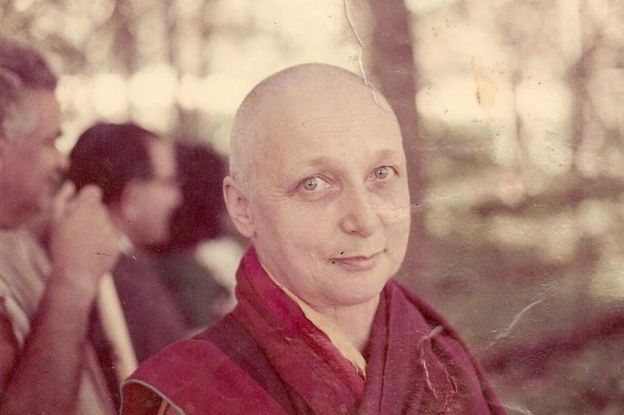
Freda as a nun, when she took the name Sister Palmo
Image captionFreda became a Buddhist nun in the 1950s

When thousands of Tibetans fled across the Himalayas in 1959 to escape Chinese oppression, Freda devoted herself to helping these “brave and wonderful” refugees. She became steeped in Tibetan spirituality. And once she felt that she had fulfilled her role as a mother (the film star Kabir Bedi is one of her three surviving children), she broke convention again by taking vows as a Tibetan Buddhist nun. In her sixties, she travelled relentlessly to spread the word about Buddhist teachings but never returned to live in the West.

“India is my womanhood and my wife-hood,” she once declared. “I too am ‘dust that England bore, shaped and made aware’. Yet I am living in an Indian way, with Indian clothes, with an Indian husband and child on Indian soil, and I cannot feel even the least barrier or difference in essentials between myself and the new country I have adopted.”

Throughout her life, Freda was determined not to be constrained by barriers of race, religion, nation or gender. She delighted in challenging convention and confounding expectations – that is what makes her story so beguiling.

Source: The BBC

Posted in 1959, Andrew Whitehead, Arrest, authorities, Baba Pyare Lal Bedi, Barbara Castle, Bhabooji, biographer, Bombay, BPL Bedi, break the law, British authorities, British woman, Buddhism, casualties, chaperone, Chinese oppression, Christian, communist October Club, convention, convert, curiosity, demand for freedom, democratic, Depression generation, Dera Baba Nanak, Derby, disembarked, East Midlands, emergency wartime powers, empire, England, English police inspector, Englishwoman, First World War, fought, Freda Bedi, global crisis, Himalayas, independence leader, independence movement, India alert, India's freedom, Indian policeman, Indian Sikh, Indian students, jewellery and watch repair business, Kabir Bedi, Kapurthala, Kashmir, Labour Club, left-wing propaganda, lifelong spiritual quest, Machine Gun Corps, mahatma gandhi, mass unemployment, midnight, mother-in-law, mumbai, northern France, Oxford, Oxford Majlis, prison gardens, privileges, Punjabi, racial discrimination, radicals, Ranga, revolutionaries, rise of fascism, satyagrahi, seeker of truth, student activism, suburban housewife, suicide club, sympathy, Tibetan Buddhist nun, Tibetans, trial, trouble makers, UN assignment in Burma, Uncategorized, woman politician, World War Two | Leave a Comment »

07/03/2019

Days after Pulwama, 1 killed, 29 injured in grenade blast inside bus in Jammu

The incident comes less than a month after over 44 CRPF personnel were killed and many injured on February 14 in Jammu and Kashmir’s Pulwama.

SNS Web | New Delhi | March 7, 2019 12:47 pm

Security personnel carry out investigation at the site where a blast took place after a grenade attack by militants at the busy main bus terminus in Jammu and Kashmir, on March 7, 2019. (Photo: IANS)

One person was killed and 29, including a woman injured in a blast after a grenade was tossed at a bus in the general bus stand in the heart of Jammu on Thursday. The condition of five injured is said to be serious.
The killed youth has been identified as a 17-year-old Mohammad Sharik of Haridwar in Uttrakhand.
Minister of State for Defence Subhash Bhamre said a local investigation has been initiated into the incident. He further said the government has given complete liberty to the forces to take all necessary steps.
The Jammu and Kashmir Police has been rushed to the site of the blast.
The Chinese grenade exploded in the bus at about 12 noon. The driver and conductor were among the injured rushed to the Government Medical College, Jammu. The injured include passengers belonging to Bihar, Punjab, Haryana, Uttrakhand, Jammu and the Kashmir valley.
Visuals from the blast site showed the damaged bus of the J&K Road Transport Corporation (JKSRTC) in which the grenade exploded.
The area has been cordoned off by the security personnel. Nature and the cause is being ascertained, police said.
Fifteen suspects have been rounded up for interrogation.
The grenade attack has coincided with the shifting of detained separatist Yasin Malik to the Jammu’s Kot-Bhalwal jail.
Police suspected the JeM outfit behind the attack. Some radicals had threatened of revenge during the recent communal tension here when about six cars were burnt.
K Vijay Kumar and KK Sharma,  both advisors to the Governor, visited the spot to take stock of the situation. The divisional commissioner, deputy commissioner and senior police and civil officers also visited the spot.
This is the third grenade attack in the bus stand during the past few months.
The blast comes at a time when Jammu and Kashmir is on a high alert following the heightened tensions between India and Pakistan in the wake of the Pulwama terror attack.
Former chief minister Mehbooba Mufti condemned the incident and called for unity to defeat terror elements in the state.
“I condemn this act of terror in the strongest possible terms. My prayers for speedy recovery of those injured. The perpetrators are out there to inflict pain and divide us. Our unity has to be our tool to defeat them,” Mufti tweeted.
The provincial president of National Conference, Devender Rana, visited the hospital to inquire about the wellbeing of injured persons.
The incident comes less than a month after over 44 CRPF personnel were killed and many injured on February 14 in one of the deadliest terror strikes in Jammu-Kashmir when a Jaish-e-Mohammad (JeM) suicide bomber blew up an explosive-laden vehicle near their bus in Pulwama district.
The bus was part of a convoy of 78 vehicles carrying around 2500 CRPF personnel from Jammu to Srinagar.
Read More
Source; The Statesman

Posted in advisors to the Governor, Bihar, Chief Minister, CRPF, deputy commissioner, Devender Rana, divisional commissioner, explosive-laden vehicle, Government Medical College, grenade blast, Haridwar, Haryana, Hospital, India alert, injured, inside bus, investigation, J&K Road Transport Corporation (JKSRTC), Jaish-e-Mohammad (JeM), Jammu, Jammu and Kashmir, Jammu and Kashmir Police, JeM, K Vijay Kumar, killed, KK Sharma, Kot-Bhalwal jail, main bus terminus, Mehbooba Mufti, Minister of State for Defence, Mohammad Sharik, national conference, Pakistan, provincial president, Pulwama, Punjab, radicals, revenge, security personnel, senior police and civil officers, Srinagar, Subhash Bhamre, suicide bomber, Uncategorized, Uttarkhand, Uttrakhand | Leave a Comment »

  |  

Tags

air pollution Asia Barack Obama Beijing Bharatiya Janata Party Business China Chinese language climate Communist Party communist party of china Delhi Economic growth economy Economy of the People's Republic of China environment European Union Government Gross domestic product Hong Kong Hu Jintao India Japan Li Keqiang manmohan singh Mao Zedong Modi mumbai Narendra Modi New Delhi Pakistan politics President of the People's Republic of China prime minister of india Russia Shanghai Sina Weibo South China Sea South Korea State Council of the People's Republic of China technology transportation United States Xi JinPing Xinjiang

Creative Commons

Chindia Alert: forewarned is forearmed by Chindia Alert Unlimited is licensed under a Creative Commons Attribution-NonCommercial-ShareAlike 3.0 Unported License.

Archives

  • October 2023
  • June 2022
  • May 2022
  • April 2022
  • March 2022
  • June 2021
  • September 2020
  • August 2020
  • July 2020
  • June 2020
  • May 2020
  • April 2020
  • March 2020
  • February 2020
  • January 2020
  • December 2019
  • November 2019
  • October 2019
  • September 2019
  • August 2019
  • July 2019
  • June 2019
  • May 2019
  • April 2019
  • March 2019
  • February 2019
  • January 2019
  • December 2018
  • February 2018
  • January 2018
  • December 2017
  • November 2017
  • October 2017
  • September 2017
  • August 2017
  • July 2017
  • June 2017
  • May 2017
  • April 2017
  • March 2017
  • February 2017
  • January 2017
  • December 2016
  • November 2016
  • October 2016
  • September 2016
  • August 2016
  • July 2016
  • June 2016
  • May 2016
  • April 2016
  • March 2016
  • February 2016
  • January 2016
  • December 2015
  • November 2015
  • October 2015
  • September 2015
  • August 2015
  • July 2015
  • June 2015
  • May 2015
  • April 2015
  • March 2015
  • February 2015
  • January 2015
  • December 2014
  • November 2014
  • October 2014
  • September 2014
  • August 2014
  • July 2014
  • June 2014
  • May 2014
  • April 2014
  • March 2014
  • February 2014
  • January 2014
  • December 2013
  • November 2013
  • October 2013
  • September 2013
  • August 2013
  • July 2013
  • June 2013
  • May 2013
  • April 2013
  • March 2013
  • February 2013
  • January 2013
  • December 2012
  • November 2012
  • October 2012
  • September 2012
  • August 2012
  • July 2012
  • June 2012
  • May 2012
  • April 2012
  • March 2012
  • February 2012
  • January 2012

Meta

  • Create account
  • Log in
  • Entries feed
  • Comments feed
  • WordPress.com

Blog Stats

  • 240,351 hits
Blog at WordPress.com.
CCChang

Law of Unintended Consequences

continuously updated blog about China & India

ChiaHou's Book Reviews

continuously updated blog about China & India

What's wrong with the world; and its economy

continuously updated blog about China & India

Privacy & Cookies: This site uses cookies. By continuing to use this website, you agree to their use.
To find out more, including how to control cookies, see here: Cookie Policy
  • Subscribe Subscribed
    • CHINDIA ALERT: You'll be living in their world, very soon
    • Join 846 other subscribers
    • Already have a WordPress.com account? Log in now.
    • CHINDIA ALERT: You'll be living in their world, very soon
    • Subscribe Subscribed
    • Sign up
    • Log in
    • Report this content
    • View site in Reader
    • Manage subscriptions
    • Collapse this bar