Chindia Alert: You’ll be Living in their World Very Soon
aims to alert you to the threats and opportunities that China and India present. China and India require serious attention; case of ‘hidden dragon and crouching tiger’.
Without this attention, governments, businesses and, indeed, individuals may find themselves at a great disadvantage sooner rather than later.
The POSTs (front webpages) are mainly 'cuttings' from reliable sources, updated continuously.
The PAGEs (see Tabs, above) attempt to make the information more meaningful by putting some structure to the information we have researched and assembled since 2006.
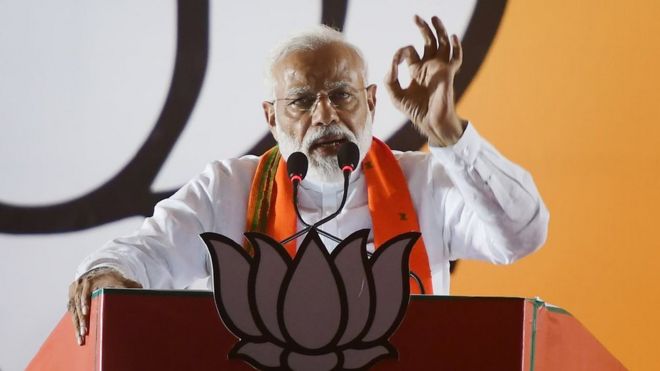
Image copyright STRDELImage caption Prime Minister Modi is the third most followed leader on Twitter after Donald Trump
The world’s second most popular leader – when it comes to social media, at least – sent shockwaves through the internet on Monday, after announcing he was considering leaving the platforms.
After all, Indian Prime Minister Narendra Modi is the only politician to even come close to challenging US President Donald Trump’s online dominance.
And so it was somewhat unsurprising that the hashtag #ModiQuitsSocialMedia began trending in India, with users quick to share a heady cocktail of conspiracy theories, memes and desperate pleas.
However, Mr Modi, who has 54 million followers on Twitter, 35.2 million followers on picture sharing platform Instagram and 44 million followers on Facebook, soon revealed the true reason behind his abandonment of social media.
On Tuesday, he said that he would “give away my social media accounts to women whose life & work inspire us”.
But the “big reveal” came only after his first tweet generated an absolute social media storm.
Some theories suggested he was quitting social media platforms as they were being controlled by his opponents. Others speculated that he would launch an indigenous social platform, to match Twitter and Facebook, something similar to social media platforms like WeChat and Weibo in China.
“Expect SM companies stock to crash,” wrote one confident user.
Apart from the theories, there were desperate pleas from his fans. One wrote: “Please Sir, You can’t leave social media now for the sake of your fans!” Another added: “Modi Ji if you leave social media , they will use it against you and nation interest.”
“For me he is not only PM of India but also emotion. You’re king of social media. Don’t go sir.”
Some users suggested that his account had been hacked.
Soon, #Iwillalsoleavetwitter started trending.
Arun Yadav, the head of Haryana state IT and social media for BJP, tweeted asking the PM to not quit the platform as it was one way Indians could communicate with him.
But there were also jokes.
“Spare a thought for Twitter, Facebook & their stocks. PM Modi is all set to demonetise social media,” wrote one user, referring to the overnight decision to ban high value currency notes in November.
One user suggested that the prime minister was quitting all other platforms in order to make his TikTok debut.
“Modi ji is a typical Indian boyfriend after breakup,” quipped one Twitter user.
“Modiji should be awarded Nobel Peace Prize for bringing peace in the digital world,” said another.
Image caption #NoModiNoTwitter was a India trend on Twitter after PM Modi’s tweet yesterday
There were political reactions too.
In a cheeky response, Rahul Gandhi, former president of the main opposition Congress party, tweeted: “Give up hatred, not social media accounts.”
Congress leader and MP Shashi Tharoor followed suit, writing: “The PM’s abrupt announcement has led many to worry whether it’s a prelude to banning these services throughout the country too.”
Mr Modi’s eventual tweet which clarified matters was seen by some as an anti-climax.
But for the millions who were pleading with him to reconsider, this is surely a big relief.
NEW DELHI/MUMBAI (Reuters) – India’s ruling Bharatiya Janata Party (BJP) is set to sweep two state polls next week, the first since Prime Minister Narendra Modi’s landslide win in a parliamentary election in May, a leading pollster said.
The BJP is set to comfortably win elections in the western state of Maharashtra and the northern state of Haryana, leaving the main opposition Congress party trailing, according to a survey by polling agency CVoter released on Friday.
CVoter estimates that a BJP-led alliance in Maharashtra will pick up 194 of the 288 seats on offer. In Haryana, the party is predicted to win 83 of the state’s 90 seats, leaving just three for Congress.
Voting in the elections will be held on Monday with the results expected to be announced on Thursday.
Several Congress party officials conceded they had all but given up hope of posing a serious challenge to Modi and the BJP.
In particular, the resignation of Congress chief Rahul Gandhi in July, after weeks of drama following the loss to the BJP in the general election, has sown internal confusion, triggering infighting and exits, two party officials in New Delhi said.
“It’s going to be a rout, and it will deflate morale even further,” one of the officials said, referring to the state elections. “It’s like a slow-moving disaster.”
They requested anonymity because they are not authorised to speak to the media.
Pranav Jha, the secretary in charge of Congress’s communication department, said the party was undergoing a period of “cleansing and churning” and remained committed to taking on the BJP.
“The people of India…can see through the diversionary drama of the ruling party, and realise that jobs, economy and issues of farmers can only be put on track by the Congress party,” Jha told Reuters.
Modi, analysts say, has moved decisively, including withdrawing special rights for Muslim-majority Jammu and Kashmir state, and consolidating the BJP’s hold over India’s Hindu-majority electorate.
INFIGHTING, INDIFFERENCE
In Maharashtra, one of India’s most industrialised states which includes Mumbai, two Congress officials said the top leadership’s relative indifference and infighting had hurt their already weak campaign.
Congress’s state wing had asked for Gandhi, his mother and current party chief Sonia Gandhi, and his charismatic sister Priyanka Gandhi Vadra to join the campaign, one of the two officials said.
But only Rahul Gandhi came and spoke at a handful of rallies.
“Senior leaders from BJP have covered every district. They have been visiting Maharashtra for the last two months to build momentum,” said one Congress official, who is contesting the upcoming poll.
“There wasn’t any concrete effort from Congress leaders in New Delhi to give energy to our cadre,” he said.
The list of recent resignations from the party include Ashok Tanwar, Congress’s former chief in Haryana who quit earlier this month and is now campaigning against his old party.
“The state of affairs in the Congress party is so dire that the decision makers can’t win an election themselves, while the soldiers on ground who stay in touch with the masses are neglected,” Tanwar wrote in his resignation letter.
The situation has even riled Congress allies. Two leaders from the Nationalist Congress Party, which is in alliance with the Congress in Maharashtra, said their partner was slack.
“It looks like Congress is not very serious about the state elections,” one of the leaders said. “Congress is not in the picture. Congress leaders are not attacking the ruling party the way we expected.”
In New Delhi, Congress officials said there was a sense of inertia at the party headquarters, without any understanding of who will become president after Sonia Gandhi, who is only holding charge temporarily.
“Without a clear leadership, nothing is going to change,” one of the officials said, “If it continues like this, the party will fade away.”
NEW DELHI/MUMBAI (Reuters) – India’s opposition Congress party selected past president Sonia Gandhi as its interim leader on Saturday, while it searches for a successor to her son Rahul Gandhi, who quit following a crushing election defeat by Prime Minister Narendra Modi.
The Congress Working Committee (CWC) unanimously decided to appoint Sonia Gandhi as “interim president pending the election of a regular president,” the party said in a statement late on Saturday night.
The committee wanted Rahul Gandhi to continue as its president but after he refused, they asked his mother to take over the reins instead, and she accepted, the statement said.
Sonia Gandhi is one of the most influential leaders of the Congress party and is credited with having brought the party back from the brink in 2004 with a surprise victory over the incumbent central government.
The widow of assassinated former Prime Minister Rajiv Gandhi, she was also the party’s longest serving president with 19 years at the helm, from 1998 to 2017, before handing over the baton to her son.
Congress, founded in 1885, is India’s oldest political party and dominated the country for decades after independence, led by generations of the Nehru-Gandhi family. The family produced three prime ministers: Jawaharlal Nehru, India’s first and longest-serving leader, his daughter Indira Gandhi and her son Rajiv.
However, Italian-born Sonia Gandhi faces a tall order to pull the party out of its worst crisis in decades and at the same time choose a worthy and dependable successor.
Party leaders and foot soldiers alike have been defecting to the ruling BJP. Remaining members have been dismayed at the party’s leadership vacuum following Modi’s re-election with a majority that surpassed his victory in 2014, and are questioning the party’s survival.
Rahul Gandhi, 49, announced his decision to quit as Congress leader in May, but the party leadership refused to accept it. They pressed him to reconsider, saying the party needed a unifying figure from the family to avoid splintering.
The party thanked Rahul Gandhi for his “exceptional leadership” during the state and general elections.
Last month in the southern state of Karnataka the defection of more than a dozen legislators from the ruling Congress-led coalition paved the way for Modi’s BJP to form a government.
Congress also appeared split in its response to Delhi’s decision to strip the state of Jammu and Kashmir of special constitutional status on Monday after putting the region on lockdown.
Some Congress members, including senior leader Jyotiraditya Scindia came out in support of the decision, and local media reported many in the party were supporting him.
Rahul Gandhi told reporters on Saturday night in New Delhi that considering there were reports of violence in Jammu and Kashmir, the government should provide transparent information about the actual situation on the ground.
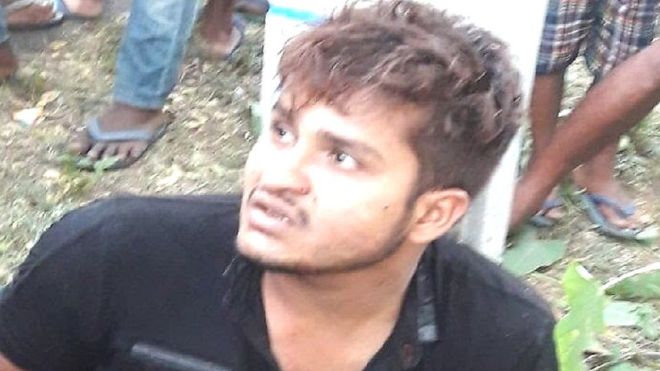
Image copyright BBC HINDIImage caption A video showing Tabrez Ansari pleading for his life was widely circulated on social media
In many parts of India, Hindus often invoke the popular god Ram’s name as a greeting. But in recent years, Hindu lynch mobs have turned Ram’s name into a murder cry, writes the BBC’s Geeta Pandey in Delhi.
Last month, a video that went viral on social media showed a terrified Muslim man tied to a pole being assaulted by a lynch mob made up of Hindu men in the eastern state of Jharkhand.
In the video, 24-year old Tabrez Ansari is seen pleading for his life, blood and tears streaming down his face.
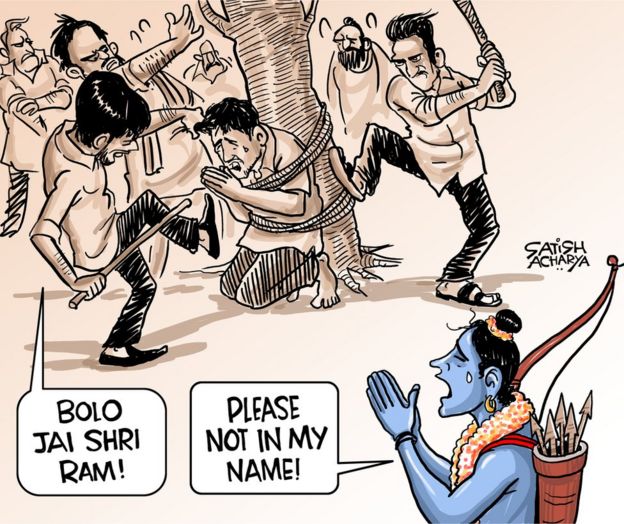
His attackers force him to repeatedly chant “Jai Shri Ram”, which translates from Hindi to “hail Lord Ram” or “victory to Lord Ram”.
Mr Ansari does as told, and when the mob is finished with him, he is handed over to the police.
The police lock him up and his family is not allowed to see him. He dies four days later from injuries sustained during the attack.
Mr Ansari is not the only one to have been singled out in this manner. June was a particularly bloody month for Indian Muslims, who were targeted in several such attacks.
In Barpeta district in the north-eastern state of Assam, a group of young Muslim men were assaulted and then made to chant slogans like “Jai Shri Ram”, “Bharat Mata ki Jai” (long live Mother India) and “Pakistan murdabad” (death to Pakistan).
In the commercial capital Mumbai, a 25-year-old Muslim taxi driver was abused, beaten up and told to chant “Jai Shri Ram” by a group of men. Faizal Usman Khan said he was attacked when his taxi broke down and he was trying to fix it. His attackers fled after a passenger called the police.
And in the eastern city of Kolkata, Hafeez Mohd Sahrukh Haldar, a 26-year-old Muslim teacher at a madrassa (religious seminary), was heckled while travelling on a train by a group of men chanting “Jai Shri Ram”.
He told reporters that they made fun of his clothes and beard, and then insisted that he also chant the slogans. When he refused, they pushed him out of the moving train. Mr Haldar was injured, but lived to tell the tale.
The slogan-shouting and heckling is no longer restricted to the mob and the streets. Worryingly, it has also entered parliament.
When the newly-elected lower house convened for the first time on 17 June, Muslim and opposition MPs were heckled by members of Prime Minister Narendra Modi’s Bharatiya Janata Party (BJP) when they stood up to take the oath.
The attacks on the minorities have been condemned by opposition politicians. Rahul Gandhi, before he resigned as leader of the main opposition Congress party, described the mob lynching of Tabrez Ansari as a “blot on humanity”.
Many critics, including cartoonist Satish Acharya, have also expressed alarm over the rising number of such incidents.
Image copyright COURTESY: SATISH ACHARYAImage caption Cartoonist Satish Acharya says using Ram’s name to unleash violence risks widening India’s religious divide
In villages across north India, devout Hindus have traditionally used “Ram Ram”, “Jai Siya Ram” (goddess Siya or Sita is Ram’s consort) or “Jai Ram Ji Ki” as a greeting.
And many feel a sense of unease that these attacks and killings are being carried out in the name of a god revered by millions for his sense of justice and benevolence.
But “Jai Shri Ram” has now been turned into a cry of attack, meant to intimidate and threaten those who worship differently.
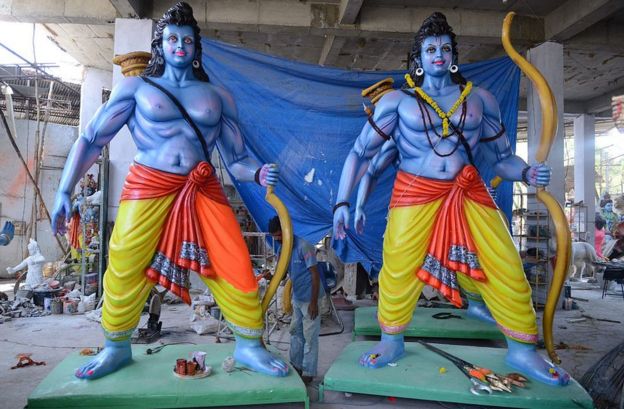
The party’s then president LK Advani launched a march supporting the construction of the temple and in December 1992 mobs chanting “Jai Shri Ram” marched upon the northern town and tore down the 16th Century Babri mosque.
The BJP believes the mosque was built after the destruction of a temple to Ram that once stood there.
The campaign galvanised Hindu voters in favour of the BJP and helped turn Ram from personal to political. Since then, the party has consistently invoked the deity during elections and the 2019 polls were no exception.
Critics say those who heckle minorities, inside parliament and outside it, see the BJP’s sweeping victory in the April/May elections as sanctioning their behaviour. The party won more than 300 seats in the 543-member lower house, propelling Mr Modi to a second term.
Mr Modi’s first term in power was marked by violence against minorities. There were numerous incidents of Muslims being attacked by so-called “cow vigilantes” over rumours that they had eaten beef, or that they were trying to smuggle cows – an animal many Hindus consider holy – for slaughter.
The prime minister did not condone such attacks, but was criticised for not condemning them either.
Image copyright GETTY IMAGESImage caption Millions of Hindus revere the god Ram for his sense of justice and benevolence
But right after the BJP’s stunning victory in May, Mr Modi expanded his earlier slogan of “sabka saath, sabka vikas” (development for all) to include “sabka vishwas” (to win the trust of everyone), giving rise to hopes that this term would be different.
A few days after Tabrez Ansari’s death, he told parliament that he was “pained” by the incident and that “the guilty must be severely punished”.
But many Indians doubt that any serious action will be taken against those who carry out such attacks.
Several dozen people have been killed and hundreds injured since 2014 in mob attacks, but there have been convictions in only a handful of cases.
In others, the accused remain free, often due to a lack of evidence, and some have been seen being feted by Mr Modi’s party’s colleagues.
BJP leaders often downplay such incidents, calling them “minor” and accusing the press of “maligning the image of the government”.
One BJP MP recently told a news website that the popularity of the slogan “Jai Shri Ram” was a sort of protest by Hindus “against a certain bias and tilt of the polity towards minorities”.
“They are also asserting that we are Hindus and we count as Hindus,” he said.
But critics say that there are other – better – ways of doing that.
The meeting between Priyanka and Rahul Gandhi comes in the backdrop of reports that the powerful working committee of the party may meet in the next three-four days to discuss the leadership issue.
INDIAUpdated: May 28, 2019 13:42 IST
HT Correspondent
Hindustan Times, New Delhi
Congress president Rahul Gandhi with his sister and AICC General Secretary Priyanka Gandhi. (ANI file photo)
Congress general secretary Priyanka Gandhi Vadra met her brother, Congress president Rahul Gandhi amid reports that he wants to quit after the crushing defeat in the Lok Sabha elections.
Priyanka Gandhi, Rajasthan chief minister Ashok Gehlot, his deputy Sachin Pilot and Congress spokesperson Randeep Surjewala arrived at Rahul Gandhi’s 12, Tughlaq Lane residence on Tuesday morning. The meeting between Rahul Gandhi and senior Congress leaders comes in the backdrop of reports that the powerful working committee of the party may meet in the next three-four days to discuss the leadership issue
Rajasthan’s ruling duo Ashok Gehlot and Sachin Pilot calling on him amid rumblings of discontent in the state and his insistence on quitting.
The Congress has denied that any such meeting has been scheduled in the near future. “These reports are baseless,” KC Venugopal, general secretary in-charge of organization who is responsible for convening Congress Working Committee meetings.
On Monday, Congress treasurer Ahmed Patel and KC Venugopal met Rahul Gandhi. But Patel insisted that he had gone to meet Rahul Gandhi for routine administrative work. “I had sought time before the CWC to meet the Congress President to discuss routine administrative work. The meeting today was in that context. All other speculation is incorrect and baseless,” Patel tweeted.
Three more state Congress chiefs resigned on Monday taking ‘moral responsibility’ for party’s poor performance in Lok Sabha elections. Other than Sunil Jakhar (Punjab) and Ajoy Kumar (Jharkhand) and Ripun Bora (Assam), HK Patil, who was tasked to oversee the Karnataka Congress campaign in December, also put in his papers.
ANI
✔@ANI
Delhi: Priyanka Gandhi Vadra and Randeep Singh Surjewala arrive at the residence of Congress President Rahul Gandhi. pic.twitter.com/WXmvlPMJv0
These resignations take the number of party unit chiefs who have resigned since the poll results to six — the others being UP party chief Raj Babbar, Odisha’s Niranjan Patnaik and Ashok Chavan of Maharashtra.
The Congress won just 52 seats in the Lok Sabha polls which saw Narendra Modi-led NDA come to power with a massive mandate winning 352 seats.
Rahul Gandhi, who had fronted the opposition campaign against Prime Minister Narendra Modi, has owned responsibility for the crushing defeat at the meeting.
LOK SABHA ELECTIONSUpdated: May 25, 2019 14:07 IST
HT Correspondent
Hindustan Times, NewDelhi
Seated next to Rahul Gandhi as he shared his brief analysis of the election is UPA chairperson Sonia Gandhi (Sanjeev Verma/ HT Photo)
Congress president Rahul Gandhi on Saturday is leading a review of his party’s devastating performance in the Lok Sabha elections at a meeting of the Congress Working Committee, or CWC.
Rahul Gandhi, who had fronted the opposition campaign against Prime Minister Narendra Modi, has owned responsibility for the crushing defeat at the meeting. Seated next to Rahul Gandhi as he shared his brief analysis of the election is UPA chairperson Sonia Gandhi and former Prime Minister Manmohan Singh. Sister Priyanka Gandhi Vadra, former minister P Chidambaram and Congress’s leader in the outgoing Lok Sabha Mallikarjun Kharge was also present.
Television channels initially said Rahul Gandhi had offered to resign at the CWC which was rejected by the top panel but later put out a clarification. Three senior Congress including Uttar Pradesh unit chief Raj Babbar, HK Patil, who was tasked to oversee the Karnataka Congress campaign and Odisha Congress chief Niranjan Patnaik have resigned after the election debacle.
The Congress won just about 52 seats in the Lok Sabha in this round of national elections, a shade better than its worst performance ever, in the 2014 elections, when it ended up with 44 seats.
Congress leaders have indicated that the CWC could go for a deeper analysis of the election outcome that goes beyond the obvious. Some drastic action could also follow.
Senior Congress leaders assembled at the party’s Working Committee meeting in New Delhi.
For now, the Congress’s top priority is to get the party fighting fit in Maharashtra, Haryana and Jharkhand that will head to assembly elections later this year. Assembly elections in Jammu and Kashmir are likely to be held anytime soon and Delhi will go to the polls in February next year.
The party chiefs in many states are likely to be replaced and new teams put in place within a week or two. This will be in line with a realisation in the Congress that a revival at the national level is possible only when the party resurrects itself in the states.
Some new general secretaries and in-charges of states are also expected to be appointed soon.
Gandhi had made it clear at an unusually brief news conference after the poll verdict came on Thursday that the party was determined to fight back. “Have faith and we will work and sort this out in the time to come,” Gandhi said, his message to party workers and supporters. “Love never loses, and I am certain that we will emerge stronger and work better… love will guide us.
The Congress which did not get the post of the Leader of Opposition in the Lok Sabha in 2014 may not get it this time also. A party should get 10 per cent, or 55 of the 543 Lok Sabha seats, to be entitled to the Leader of Opposition designation for its leader.
Rahul Gandhi has already taken responsibility for the party’s performance in the Lok Sabah elections but hasn’t elaborated on the next step yet.
Image copyright GETTY IMAGESImage caption Mr Modi said he will not forgive Pragya Thakur
India is in full election mode: voting began on 11 April, and the final ballot will be cast on 19 May with results out on 23 May. Every day, the BBC will be bringing you all the latest updates on the twists and turns of the world’s largest democracy.
What happened?
Indian Prime Minister Narendra Modi has attended first ever press conference at the Bharatiya Janata Party (BJP) head office in Delhi – days before Indians take part in the final stage of voting.
But journalists were left disappointed as he did not take any questions, and instead largely talked about his government’s achievements.
“I have come to thank the country for blessing me. I have seen a lot of ups and downs but the country stayed with me,” he said.
Mr Modi also spoke of his pride in India’s democratic process and said he needs to show the world “how diverse our democracy is”.
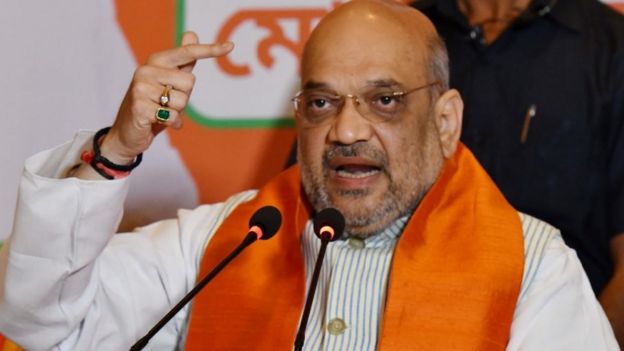
Mr Modi was seated next to party president Amit Shah. He said he would not take questions because the press conference was Mr Shah’s.
Earlier, the prime minister said he would “never be able to forgive” those who have “insulted” Mahatma Gandhi.
Mr Modi’s statement comes after controversial Bharatiya Janata Party (BJP) politician Pragya Thakur called Nathuram Godse – the man who assassinated Mahatma Gandhi – a “patriot”.
Ms Thakur apologised after several leaders, including those from the BJP, criticised her.
“Such statements should be condemned. There is no place in society for such comments. She [Ms Thakur] may have apologised, but I will never be able to forgive her,” he said in an interview to News24 TV channel.
Why does this matter?
This is the first time Mr Modi has attended a press conference as prime minister while in India. Most of his press conferences have been on state visits to other countries and often involved little more than reading out an official statement.
He has given some one-on-one interviews to Indian media, though critics say that these have largely been tightly controlled and given to journalists seen as sympathetic to him. However in recent weeks he has given a flurry of interviews to several leading publications and television channels, including those that have been critical of him.
But if people were expecting a complete about-turn in his media policy this time, they would have been disappointed.
This caused some frustration among journalists on Twitter.
Also on Friday, a BJP candidate apologised for calling Gandhi’s killer a patriot
Image copyright GETTY IMAGES
What is happening?
Bharatiya Janata Party (BJP) politician Pragya Thakur has apologised after calling Nathuram Godse – the man who assassinated Mahatma Gandhi – a “patriot”.
Several political parties had criticised her comment and her own party demanded that she should publicly apologise.
“It was my personal opinion. My intention was not to hurt anyone’s sentiments. If I’ve hurt anyone, I do apologise. What Gandhi Ji has done for the country cannot be forgotten. My statement has been twisted by the media,” Ms Thakur said on Thursday evening.
She made the comment after actor-turned politician Kamal Haasan said Godse was India’s first Hindu “extremist” earlier this week.
Why does this matter?
The BJP as well as opposition parties immediately reacted to her comment, which also caused a storm on social media.
BJP spokesperson GVL Narasimha Rao said that the party does not agree with her statement, and asked her to publicly apologise.
The main opposition Congress party demanded an apology from Prime Minister Narendra Modi and said that the BJP should take “punitive action” against Ms Thakur.
Congress spokesperson Randeep Surjewala said that “insulting martyrs is in the BJP DNA” and that the “soul of the nation” has been hurt by her remarks.
Congress party leader Priyanka Gandhi also lashed out at the BJP.
Political analysts also say that her comments have put the BJP in a tough spot, since Mr Modi and BJP president Amit Shah defended their decision to field her as a candidate despite terror charges against her.
Her candidature caused outrage as she is an accused of involvement in a blast that killed seven people and injured 100 others. Ms Thakur denies all charges against her.
However, Ms Thakur’s comments do reflect the views of some right-wing Hindus who support the BJP and have long seen Gandhi as too moderate.
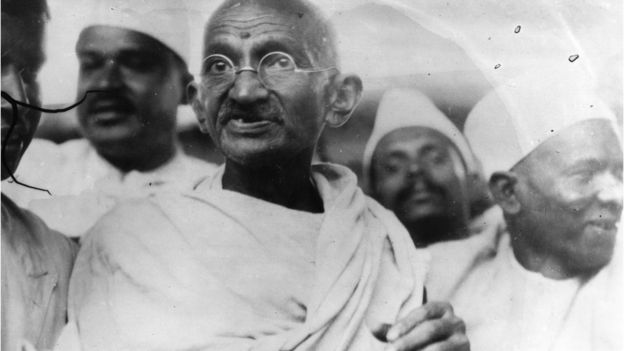
Godse, who shot Gandhi in the chest three times at point-blank range on 30 January 1948, was also an activist with nationalist right-wing groups, including those closely associated with the BJP.
Hindu hardliners in India accuse Gandhi of having betrayed Hindus by being too pro-Muslim, and even for the division of India and the bloodshed that marked Partition, which saw India and Pakistan created after independence from Britain in 1947.
On Thursday, a ruling party candidate called Gandhi’s killer a patriot
What happened?
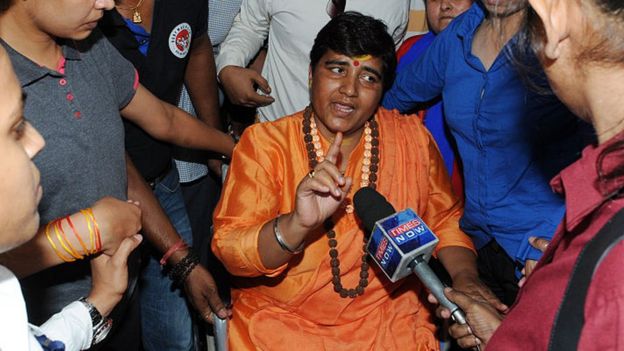
Controversial Bharatiya Janata Party (BJP) politician Pragya Thakur made headlines again. This time it was for calling Nathuram Godse – the man who assassinated Mahatma Gandhi – a “patriot”.
Her comment was made in response to a statement by southern actor-turned politician Kamal Haasan who had said India’s first “extremist” was a Hindu”, referring to Godse.
His statement, made on Monday, was heavily criticised by the BJP, which accused him of indulging in “divisive politics” and filed a complaint against him with the Election Commission of India.
Why does this matter?
The BJP responded by criticising Ms Thakur and asking her to publicly apologise.
“BJP does not agree with this statement, we condemn it. Party will ask her for clarification, she should apologise publicly for this statement,” party spokesperson GVL Narasimha Rao told reporters.
Image copyright GETTY IMAGES
Ms Thakur has seen her fair share of controversy. Her candidature caused outrage as she is an accused of involvement in a blast that killed seven people and injured 100 others. On 18 April, she said that police officer Hemant Karkare had died in the November 2008 Mumbai terror attacks because she had “cursed” him. She was then banned from campaigning for 72 hours as a result.
A team led by Mr Karkare had arrested her for questioning in connection with the Malegaon blast.
During her campaign, she also said she was “proud” of her part in the demolition of the 16th Century Babri mosque. In 1992, right-wing Hindu mobs razed the mosque to the ground, claiming it was built on the site of a temple destroyed by Muslim rulers. The site, which is in the city of Ayodhya, has been a religious flashpoint for Hindus and Muslims for decades.
Campaigning ended in West Bengal a day before deadline
What happened?
The Election Commission (EC) told political parties to end their campaigning in West Bengal state, a day before the deadline in the wake of poll-related violence.
The campaign will end on Thursday at 10pm local time, and voting will be held on Sunday.
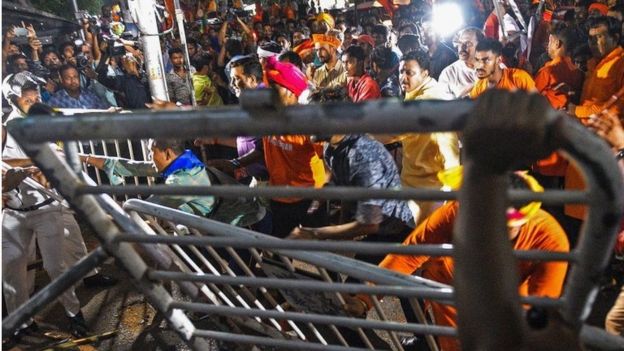
The decision comes after clashes broke out between the Bharatiya Janata Party (BJP) workers and protesters believed to be from the ruling Trinamool Congress (TMC) in Kolkata (formerly Calcutta) on Tuesday.
It happened during a roadshow of BJP chief Amit Shah. Several people were injured and vehicles were set on fire. A statue of renowned Bengali reformer Iswarchandra Vidyasagar was also vandalised in the clashes.
Both parties have accused each other of starting the violence.
Why does this matter?
Image copyright GETTY IMAGESImage caption Violence took place during BJP chief Amit Shah’s rally in Kolkata on Tuesday
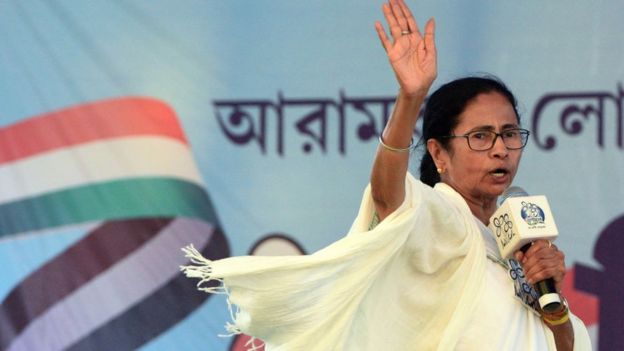
The BJP welcomed the decision, saying it validated their argument that the state had “descended into anarchy” under the leadership of chief minister Mamata Banerjee.
Ms Banerjee said that the move was “undemocratic” and “it had insulted the people of Bengal”.
“Tomorrow, [Prime Minister Narendra] Modi has two meetings in Bengal. When he finishes, the campaigning also ends… Instead of punishing Amit Shah, the Election Commission has given a gift to the BJP,” she said.
Image copyright AFPImage caption Several people were injured and vehicles were set on fire during the violence
Both parties are locked into a fierce election battle to win most out West Bengal’s 42 seats. Ms Banerjee has ambitions of becoming the prime minister in case a nationwide coalition of regional parties wins enough seats.
The state has also become crucial for the BJP as it’s trying to expand its reach in the eastern state. It won only two seats in the 2014 election.
The BJP performed well in northern states like Uttar Pradesh and Rajasthan in 2014, but this time it’s expected to suffer loses against a coalition of regional parties and the main opposition Congress.
So the party is trying to make up for the losses in West Bengal.
On Wednesday, the TMC and the BJP accused each other of poll violence
Image copyright GETTY IMAGES
What happened?
The war of words between West Bengal state chief minister Mamata Banerjee and the governing Bharatiya Janata Party (BJP) intensified ahead of voting on Sunday.
The latest verbal duel comes after violence was reported during BJP chief Amit Shah’s roadshow in Kolkata (formerly Calcutta) on Tuesday.
Clashes broke out between BJP supporters and protesters who were holding “Amit Shah go back” posters.
Some people suffered minor injuries and a few vehicles were set on fire.
The BJP said the protest was “orchestrated” and called it an “attempt to strangulate democracy”.
Why does this matter?
The eastern state has become politically crucial for the BJP as it has intensified campaigning in the past few days.
And that has sparked a feverish electoral battle between the BJP and Ms Banerjee’s Trinamool Congress (TMC).
“What does Amit Shah think of himself? Is he above everything? Is he god that no one can protest against him?” Ms Banerjee said.
In reply, Mr Shah accused the TMC of not following democratic norms during elections.
“Have faith in the people of Bengal that they’d face the TMC goons,” he said.
Prime Minister Narendra Modi is scheduled to hold more rallies in the coming days, so one can expect more verbal fireworks from the two leaders.
On Tuesday, the saga of the morphed Mamata meme continued
What happened?
India’s top court stepped in to release an activist belonging to India’s governing Bharatiya Janata Party (BJP) who was sent to prison for sharing a doctored image of West Bengal Chief Minister Mamata Banerjee.
Priyanka Sharma was sentenced to two weeks in prison on 10 May after she shared a picture of Bollywood star Priyanka Chopra and her husband Nick Jonas at the Met Gala – but with Ms Banerjee’s head superimposed on to Chopra’s body.
Earlier the court had said Ms Sharma could be released only if she apologised to Ms Banerjee, but later waived this condition.
Why does this matter?
The battle for West Bengal in this general election has been absolutely bruising.
The BJP, led by Prime Minister Narendra Modi himself, has been campaigning hard for votes in the state. This has brought them toe-to-toe with the state’s feisty chief minister. The fact that voting for West Bengal’s 42 seats has been split across all nine phases of voting has meant that the battle has been long and drawn-out.
And with just one phase to go before voting finally ends, the gloves are well and truly off. The two parties have traded insults on the campaign stage, their workers have attacked each other, and the violence on the ground has intensified. And now the battle has spread to cyberspace as well.
The country’s finance minister Arun Jaitley jumped at news of Ms Sharma’s release to call Ms Banerjee a dictator.
Analysts say that this political row is so bitter because the BJP has clearly identified West Bengal as one of the states where they may be able to make gains this election. This becomes more important for the party in the context of their fight in the politically crucial state of Uttar Pradesh, which sends the most number of MPs (80) to parliament.
They are up against a powerful coalition of regional parties there, and many expect them to lose seats as a result.
And PM Modi said Rahul Gandhi should be ashamed of 1984 riots
What happened?
Prime Minister Narendra Modi said that main opposition Congress party chief Rahul Gandhi should be “ashamed of himself” over his colleague’s remark on the 1984 anti-Sikh riots.
Mr Modi was replying to a controversial statement made by Sam Pitroda, who is a strategist of the Congress party.
In his reply to a question about the Congress’ role in the riots, Mr Pitroda had said “so what?”.
“I don’t think so, this is also another lie, and what about 1984? You speak about what you [Mr Modi] have done in five years. It [the riots] happened in 1984, so what?” he said.
Mr Gandhi said he was “ashamed” of Mr Pitroda’s statement, and asked him to apologise.
Mr Pitroda later said his statement was “twisted” and he did not mean to hurt sentiments.
But Mr Modi said the Congress chief “must apologise”.
“I was watching that naamdar [the dynast] told his guru that he should be ashamed of what he said. I want to ask naamdar, you pretended to scold your mentor for what? Because he exposed what was always in the Congress’s heart, and in the discussions of the naamdar family? Because he made public a family secret? Naamdar, it is you who should be ashamed,” Mr Modi said.
Why does this matter?
The controversy matters because it comes days ahead of voting for the 13 seats in the northern state of Punjab.
The BJP, which has formed a coalition with regional Shiromani Akali Dal, is locked in a bitter electoral battle with the ruling Congress in the state.
Sikhs are a majority in the state and the 1984 riots is still an emotional issue for many of them.
More than 3,000 Sikhs were killed in 1984 after the assassination of former prime minister Indira Gandhi by her Sikh bodyguards.
They were angry at her decision to send the army into the Golden Temple – Sikhism’s holiest shrine – to flush out militants earlier in the year.
The killing of Mrs Gandhi, who belonged to the Congress, saw mobs attack and murder members of the Sikh community across the country.
And both parties appear to be trying to come across as pro-Sikh ahead of the vote on 19 May.
On Sunday, Delhi voted but not enthusiastically
Image copyright GETTY IMAGESImage caption Delhi’s voter turnout was lower than in 2014
What happened?
Sunday saw India’s capital Delhi vote along with several other states in the polls – the penultimate phase of the country’s mammoth general election.
Voters turned out to vote, but in fewer numbers than they did in 2014. The election commission said that around 60% of the capital’s registered voters had actually cast ballots, which was about a five percent drop from 2014.
Delhi Chief Electoral Officer Ranbir Singh expressed disappointment, saying that the turnout did not match expectations.
Why does this matter?
The election commission is right to be disappointed – it had run a series of campaigns in the city, encouraging more people to vote.
But it was not as though polling in Delhi was an entirely smooth process. Some voters complained that their names were missing from electoral lists even though they had all the necessary documents. There were also reports that around 1,200 Electronic Voting Machines (EVMs) had malfunctioned across the city, delaying the polling process.
The fact that Delhi became a three-cornered contest after the main opposition Congress and the Aam Aadmi Party (AAP), which controls the Delhi state assembly, failed to stitch up an alliance may also have put voters off. Many analysts believe that this failure will only split voters who were against prime minister Narendra Modi’s Bharatiya Janata Party (BJP) and effectively hand them victory.
So they may have decided to just stay home, and not bother queuing up in the blistering heat – it touched 40C on Sunday.
India is in full election mode: voting began on 11 April, and the final ballot will be cast on 19 May with results out on 23 May. Every day, the BBC will be bringing you all the latest updates on the twists and turns of the world’s largest democracy.
Ruling party candidate calls Gandhi’s killer a patriot
What is happening?
Controversial Bharatiya Janata Party (BJP) politician Pragya Thakur has made headlines again. This time it was for calling Nathuram Godse – the man who assassinated Mahatma Gandhi – a “patriot”.
Her comment was made in response to a statement by southern actor-turned politician Kamal Haasan who had said India’s first “extremist” was a Hindu”, referring to Godse.
#WATCH BJP Bhopal Lok Sabha Candidate Pragya Singh Thakur says ‘Nathuram Godse was a ‘deshbhakt’, is a ‘deshbhakt’ and will remain a ‘deshbhakt’. People calling him a terrorist should instead look within, such people will be given a befitting reply in these elections
His statement, made on Monday, was heavily criticised by the BJP, which accused him of indulging in “divisive politics” and filed a complaint against him with the Election Commission of India.
Why does this matter?
The BJP has responded by criticising Ms Thakur and asking her to publicly apologise.
“BJP does not agree with this statement, we condemn it. Party will ask her for clarification, she should apologise publicly for this statement,” party spokesperson GVL Narasimha Rao told reporters.
However, Ms Thakur’s comments do reflect the views of some right-wing Hindus who support the BJP and have long seen Gandhi as too moderate.
Godse, who shot Gandhi in the chest three times at point-blank range on 30 January 1948, was also an activist with nationalist right-wing groups, including those closely associated with the BJP.
Hindu hardliners in India accuse Gandhi of having betrayed Hindus by being too pro-Muslim, and even for the division of India and the bloodshed that marked Partition, which saw India and Pakistan created after independence from Britain in 1947.
Ms Thakur has seen her fair share of controversy. Her candidature caused outrage as she is an accused of involvement in a blast that killed seven people and injured 100 others. On 18 April, she said that police officer Hemant Karkare had died in the November 2008 Mumbai terror attacks because she had “cursed” him. She was then banned from campaigning for 72 hours as a result.
A team led by Mr Karkare had arrested her for questioning in connection with the Malegaon blast.
During her campaign, she also said she was “proud” of her part in the demolition of the 16th Century Babri mosque. In 1992, right-wing Hindu mobs razed the mosque to the ground, claiming it was built on the site of a temple destroyed by Muslim rulers. The site, which is in the city of Ayodhya, has been a religious flashpoint for Hindus and Muslims for decades.
Campaigning ends in West Bengal a day before deadline
What happened?
The Election Commission (EC) has told political parties to end their campaigning in West Bengal state, a day before the deadline in the wake of poll-related violence.
The campaign will end on Thursday at 10pm local time, and voting will be held on Sunday.
The decision comes after clashes broke out between the Bharatiya Janata Party (BJP) workers and protesters believed to be from the ruling Trinamool Congress (TMC) in Kolkata (formerly Calcutta) on Tuesday.
It happened during a roadshow of BJP chief Amit Shah. Several people were injured and vehicles were set on fire. A statue of renowned Bengali reformer Iswarchandra Vidyasagar was also vandalised in the clashes.
Both parties have accused each other of starting the violence.
Why does this matter?
Image copyright GETTY IMAGESImage caption Violence took place during BJP chief Amit Shah’s rally in Kolkata on Tuesday
The BJP welcomed the decision, saying it validated their argument that the state had “descended into anarchy” under the leadership of chief minister Mamata Banerjee.
Ms Banerjee said that the move was “undemocratic” and “it had insulted the people of Bengal”.
“Tomorrow, [Prime Minister Narendra] Modi has two meetings in Bengal. When he finishes, the campaigning also ends… Instead of punishing Amit Shah, the Election Commission has given a gift to the BJP,” she said.
Image copyright AFPImage caption Several people were injured and vehicles were set on fire during the violence
Both parties are locked into a fierce election battle to win most out West Bengal’s 42 seats. Ms Banerjee has ambitions of becoming the prime minister in case a nationwide coalition of regional parties wins enough seats.
The state has also become crucial for the BJP as it’s trying to expand its reach in the eastern state. It won only two seats in the 2014 election.
The BJP performed well in northern states like Uttar Pradesh and Rajasthan in 2014, but this time it’s expected to suffer loses against a coalition of regional parties and the main opposition Congress.
So the party is trying to make up for the losses in West Bengal.
TMC, BJP accused each other of poll violence
Image copyright GETTY IMAGES
What happened?
The war of words between West Bengal state chief minister Mamata Banerjee and the governing Bharatiya Janata Party (BJP) intensified ahead of voting on Sunday.
The latest verbal duel comes after violence was reported during BJP chief Amit Shah’s roadshow in Kolkata (formerly Calcutta) on Tuesday.
Clashes broke out between BJP supporters and protesters who were holding “Amit Shah go back” posters.
Some people suffered minor injuries and a few vehicles were set on fire.
The BJP said the protest was “orchestrated” and called it an “attempt to strangulate democracy”.
Why does this matter?
The eastern state has become politically crucial for the BJP as it has intensified campaigning in the past few days.
And that has sparked a feverish electoral battle between the BJP and Ms Banerjee’s Trinamool Congress (TMC).
“What does Amit Shah think of himself? Is he above everything? Is he god that no one can protest against him?” Ms Banerjee said.
In reply, Mr Shah accused the TMC of not following democratic norms during elections.
“Have faith in the people of Bengal that they’d face the TMC goons,” he said.
Prime Minister Narendra Modi is scheduled to hold more rallies in the coming days, so one can expect more verbal fireworks from the two leaders.
On Tuesday, the saga of the morphed Mamata meme continued
What happened?
India’s top court stepped in to release an activist belonging to India’s governing Bharatiya Janata Party (BJP) who was sent to prison for sharing a doctored image of West Bengal Chief Minister Mamata Banerjee.
Priyanka Sharma was sentenced to two weeks in prison on 10 May after she shared a picture of Bollywood star Priyanka Chopra and her husband Nick Jonas at the Met Gala – but with Ms Banerjee’s head superimposed on to Chopra’s body.
Earlier the court had said Ms Sharma could be released only if she apologised to Ms Banerjee, but later waived this condition.
Why does this matter?
The battle for West Bengal in this general election has been absolutely bruising.
The BJP, led by Prime Minister Narendra Modi himself, has been campaigning hard for votes in the state. This has brought them toe-to-toe with the state’s feisty chief minister. The fact that voting for West Bengal’s 42 seats has been split across all nine phases of voting has meant that the battle has been long and drawn-out.
And with just one phase to go before voting finally ends, the gloves are well and truly off. The two parties have traded insults on the campaign stage, their workers have attacked each other, and the violence on the ground has intensified. And now the battle has spread to cyberspace as well.
The country’s finance minister Arun Jaitley jumped at news of Ms Sharma’s release to call Ms Banerjee a dictator.
Humour, wit, sarcasm survive in a free society. They have no place in autocracies. Dictators laugh at people. They don’t like people laughing at them. Bengal, today is a case in point.
Analysts say that this political row is so bitter because the BJP has clearly identified West Bengal as one of the states where they may be able to make gains this election. This becomes more important for the party in the context of their fight in the politically crucial state of Uttar Pradesh, which sends the most number of MPs (80) to parliament.
They are up against a powerful coalition of regional parties there, and many expect them to lose seats as a result.
And PM Modi said Rahul Gandhi should be ashamed of 1984 riots
What happened?
Prime Minister Narendra Modi said that main opposition Congress party chief Rahul Gandhi should be “ashamed of himself” over his colleague’s remark on the 1984 anti-Sikh riots.
Mr Modi was replying to a controversial statement made by Sam Pitroda, who is a strategist of the Congress party.
In his reply to a question about the Congress’ role in the riots, Mr Pitroda had said “so what?”.
“I don’t think so, this is also another lie, and what about 1984? You speak about what you [Mr Modi] have done in five years. It [the riots] happened in 1984, so what?” he said.
Mr Gandhi said he was “ashamed” of Mr Pitroda’s statement, and asked him to apologise.
Mr Pitroda later said his statement was “twisted” and he did not mean to hurt sentiments.
But Mr Modi said the Congress chief “must apologise”.
“I was watching that naamdar [the dynast] told his guru that he should be ashamed of what he said. I want to ask naamdar, you pretended to scold your mentor for what? Because he exposed what was always in the Congress’s heart, and in the discussions of the naamdar family? Because he made public a family secret? Naamdar, it is you who should be ashamed,” Mr Modi said.
Why does this matter?
The controversy matters because it comes days ahead of voting for the 13 seats in the northern state of Punjab.
The BJP, which has formed a coalition with regional Shiromani Akali Dal, is locked in a bitter electoral battle with the ruling Congress in the state.
Sikhs are a majority in the state and the 1984 riots is still an emotional issue for many of them.
More than 3,000 Sikhs were killed in 1984 after the assassination of former prime minister Indira Gandhi by her Sikh bodyguards.
They were angry at her decision to send the army into the Golden Temple – Sikhism’s holiest shrine – to flush out militants earlier in the year.
The killing of Mrs Gandhi, who belonged to the Congress, saw mobs attack and murder members of the Sikh community across the country.
And both parties appear to be trying to come across as pro-Sikh ahead of the vote on 19 May.
On Sunday, Delhi voted but not enthusiastically
Image copyright GETTY IMAGESImage caption Delhi’s voter turnout was lower than in 2014
What happened?
Sunday saw India’s capital Delhi vote along with several other states in the polls – the penultimate phase of the country’s mammoth general election.
Voters turned out to vote, but in fewer numbers than they did in 2014. The election commission said that around 60% of the capital’s registered voters had actually cast ballots, which was about a five percent drop from 2014.
Delhi Chief Electoral Officer Ranbir Singh expressed disappointment, saying that the turnout did not match expectations.
Why does this matter?
The election commission is right to be disappointed – it had run a series of campaigns in the city, encouraging more people to vote.
But it was not as though polling in Delhi was an entirely smooth process. Some voters complained that their names were missing from electoral lists even though they had all the necessary documents. There were also reports that around 1,200 Electronic Voting Machines (EVMs) had malfunctioned across the city, delaying the polling process.
The fact that Delhi became a three-cornered contest after the main opposition Congress and the Aam Aadmi Party (AAP), which controls the Delhi state assembly, failed to stitch up an alliance may also have put voters off. Many analysts believe that this failure will only split voters who were against prime minister Narendra Modi’s Bharatiya Janata Party (BJP) and effectively hand them victory.
So they may have decided to just stay home, and not bother queuing up in the blistering heat – it touched 40C on Sunday.
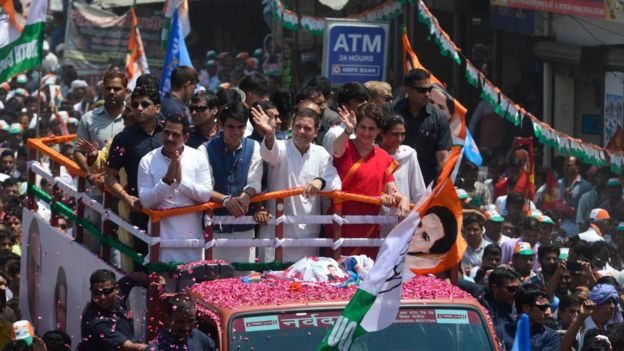
On Wednesday, Priyanka Gandhi is taking on Prime Minister Narendra Modi on his home turf – by holding a road show in his constituency Varanasi. Ever since she formally joined politics in February, she has been on a whirlwind tour, campaigning mostly in Uttar Pradesh where Varanasi is located. But will her efforts make any difference to the fortunes of the Congress party in the general elections?
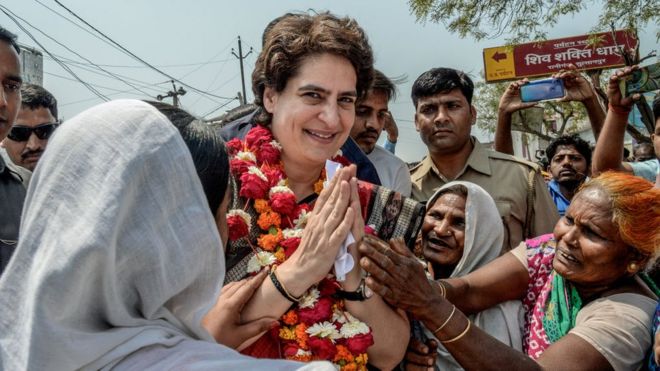
When Ms Gandhi, the charismatic sister of Congress party president Rahul Gandhi, walked up onto the stage at a rally in the town of Pratapgarh last week, she was greeted by shouts of “Priyanka Gandhi zindabad! [Long Live Priyanka Gandhi!]”. A massive garland of red roses was held up by local Congress leaders to frame her and a golden crown was placed on her head.
Ms Gandhi launched a direct attack on Mr Modi, accusing him of not fulfilling the promises he had made before the 2014 elections.
His government, she said, had failed to create jobs, his decision to scrap high denomination banknotes had broken the backs of poor people and small businesses, and she chided the prime minister for denying farmers their rights.
When the Congress is voted to power, she said, the job scheme for the poor would be extended, wages paid on time and high school education made free.
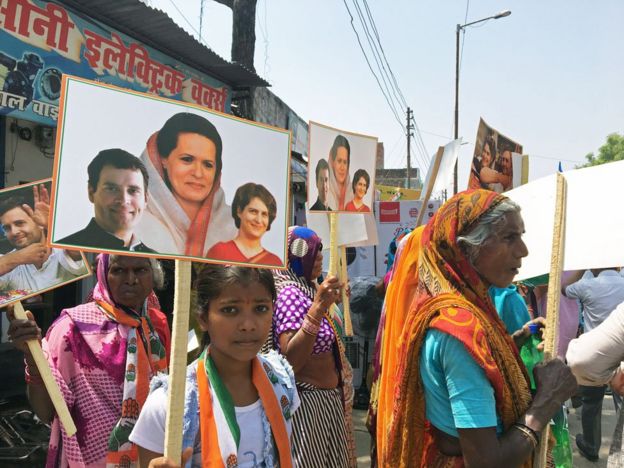
Image caption Ms Gandhi connects easily with people, especially women
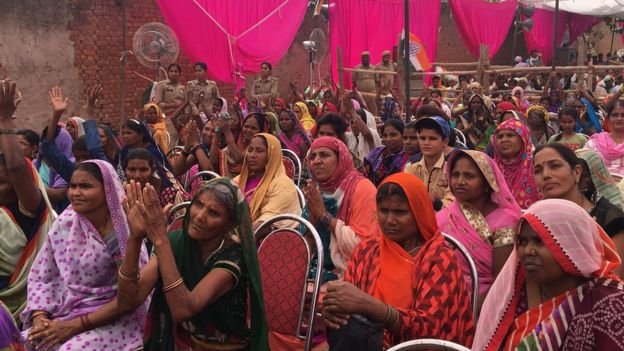
The rally was held in a small ground in the town centre and it was a small crowd, but the audience was responsive, clapping and cheering as she spoke in flawless Hindi. She ended her speech by appealing to them to vote for the Congress candidate, to vote in the change.
Mithilesh Kumar Yadav, a 21-year-old student in the audience, told me that as a young man, that’s what he wanted.
“Priyanka Gandhi wants to bring change here. As a young man I want change. Mr Modi’s policies have affected people adversely,” he said, adding that “the prime minister doesn’t talk about issues that are important. He’s trying to divert attention from his unkept promises.”
Congress spokesman Akhilesh Pratap Singh told me that Ms Gandhi had been brought in to strengthen her brother’s hands, help energise the party rank and file and counter Mr Modi’s Bharatiya Janata Party (BJP).
Since taking the plunge into active politics, Ms Gandhi has hit the ground running. In the past three months, I too have travelled extensively in this bellwether state that elects 80 MPs, talking to Congress party supporters to understand why they clamour for the Gandhis, especially her.
At her rallies and road shows, I have met people who are enthused by her presence, her decision for a more active political role, but I didn’t meet a single person who said they were going to vote for the Congress because of her.
Ms Gandhi has spent hours campaigning in cars, trucks and even a boat, participated in dozens of road shows and addressed scores of rallies, grinning and waving at supporters, often reaching out to shake hands.
In February, when she made her first public appearance as a full-time politician in the state capital, Lucknow, along with her brother, thousands of supporters thronged the streets to greet them. Party workers and supporters were charged up and many told me that the Congress was now on course to win the elections and form the next government.
Similar scenes were repeated later in Amethi, Mr Gandhi’s constituency, and in towns and cities across northern India.
Image copyright GETTY IMAGESImage caption The Gandhi siblings received a tumultuous welcome during their road show in Amethi
A natural politician, Ms Gandhi is extremely articulate in Hindi and English and connects easily with people, especially women. With her short hair and crisp cotton saris, she bears a striking resemblance to her grandmother, India’s tough and only female prime minister Indira Gandhi.
And even though she’s not running for parliament, there is obsessive media interest in everything she does – during her visit to a village of snake charmers in her mother’s constituency Rae Bareli, she’s photographed holding up snakes, and in central India, a sari-clad Priyanka Gandhi is seen scaling a fence to mingle with the crowd at a rally while her security men race to catch up with her.
Her visits to temples and shrines to woo the religious are streamed live on TV channels, her road shows get prime time, and her comments about PM Modi often make headlines. And increasingly, it’s her who’s taking on Mr Modi, countering his criticism of her family and his charge that the siblings are there not because of merit but their name.
Ms Gandhi is not exactly a newcomer to politics. For almost two decades now, she has managed campaigns for her brother and mother Sonia Gandhi, but been reluctant to take on a wider role.
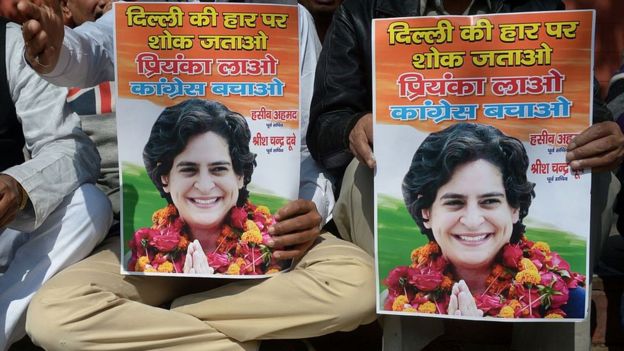
The 47-year-old mother-of-two has always been regarded as the more charismatic of the Gandhi siblings. And in recent years, as the Congress has suffered major electoral setbacks, the chorus for her to take on a larger role has been getting louder. In 2015, some party workers demonstrated outside the Congress headquarters in Delhi, holding placards that read, “Priyanka lao, Congress bachao [Bring Priyanka, Save Congress]”.
So when it was announced in January that she had been appointed as general secretary for the eastern part of Uttar Pradesh, supporters celebrated by setting off fireworks and dancing outside the party office. She was described as the “Brahmastra” – a mythical celestial weapon of last resort deployed by Hindu deities to annihilate the enemy.
In a recent interview with a Hindi-language newspaper, Ms Gandhi explained the reasons why she finally said yes.
“Democracy, constitution and our institutions are under attack and it would have been cowardly not to take the plunge now. In 2017, Rahul asked me to take on Uttar Pradesh but I didn’t. It was a mistake but people learn from their experiences, so this time when he asked, I agreed.”
The Gandhi siblings are the fourth generation of the Nehru-Gandhi dynasty, often described as India’s political royalty. Their great-grandfather, Jawaharlal Nehru, was the first prime minister of independent India, their grandmother and father also served as prime ministers, while their mother, Italian-born Sonia, was the Congress chief until poor health forced her to hand over the reins to her son.
Image copyright GETTY IMAGESImage caption In 2015, some party workers demonstrated outside Congress HQ in Delhi, holding placards that read “Bring Priyanka, Save Congress”
Mr Modi often mocks the siblings, saying they lead the Congress because of entitlement and not achievement.
Congress supporters, however, don’t seem unduly worried about the dynasty link – they talk about the fact that their grandmother and father were assassinated and the “sacrifices” the family has made for the country.
Spokesman Akhilesh Pratap Singh says Rahul – and now Priyanka – have re-energised the party. “BJP leaders, including PM Modi, are rattled, otherwise why would they call her names or say she won’t make any impact on the elections?”
Mr Singh says the most important thing is that “our workers are enthused and the public confidence in the party has grown”.
But will all this adulation really convert into votes and seats for the party?
“Definitely,” Mr Singh says. “When the votes are counted, you’ll see our voting percentage has gone up.”
Image caption Congress says Ms Gandhi has been brought in to help energise the party rank and file in Uttar Pradesh
Political analyst Neerja Chowdhury says Ms Gandhi has lots of charisma but she is a great example of its limits.
She “left it a bit too late” and should have come out a year ago and worked to galvanise the people, she says.
“The party organisation is decimated in the state and has to be built from scratch. She doesn’t have a magic wand.”
Ms Chowdhury says expecting Ms Gandhi to turn around the party in such a short time is asking her to do the impossible and it’s unfair on her because it will open her to being dismissed as a failure.
But in the absence of a strong party machinery or leadership in Uttar Pradesh, Ms Gandhi’s efforts can take Congress only so far and no further.
Ms Chowdhury says she would need to build the party base in the state brick-by-brick – that would require much more than charisma, and plenty of hard work.
But one thing, she says, she’s sure about is that “Ms Gandhi is here to stay”.
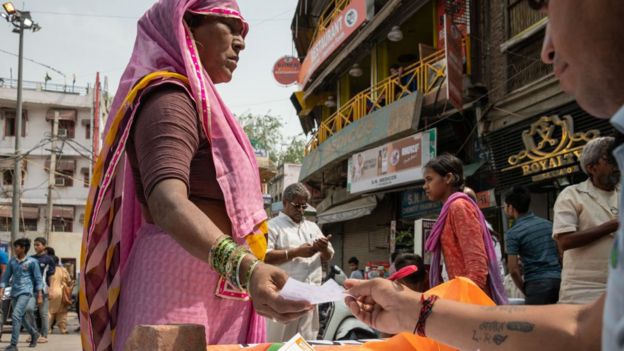
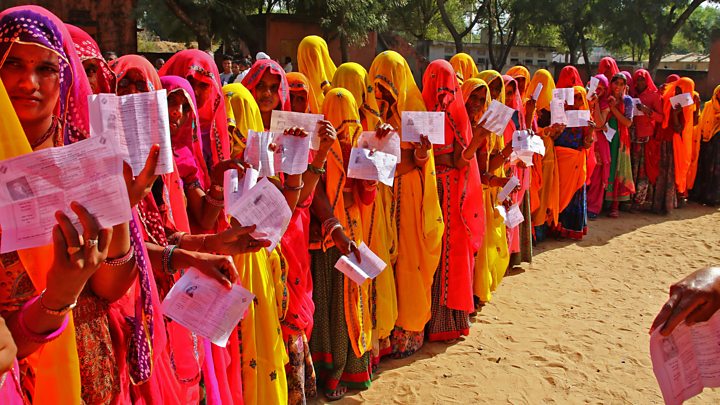
NEW DELHI (Reuters) – Voters in north India lined up early on Sunday to cast their ballots in the second-to-last round of a seven-phase general election, with Prime Minister Narendra Modi facing a diverse group of opposition parties seeking to deny him a second term.
More than 100 million people across seven states are eligible to vote in the sixth phase of the 39-day-long poll, which Modi began on April 11 as front-runner after an escalation of tension with neighbouring Pakistan.
But opposition parties have recently taken heart at what they see as signs Modi’s Hindu nationalist Bharatiya Janata Party (BJP) may be losing ground and have begun negotiations over a post-election alliance even before polling ends on May 19. Votes will be counted on May 23.
The president of the main opposition Congress party, Rahul Gandhi, said the main issues in the election were unemployment, distress in the countryside, the demonetisation of bank notes and a new sales tax.
“It was a good fight,” Gandhi said after he cast his vote.
“Narendra Modi used hatred, we used love. And I think love is going to win.”
A lack of new jobs – despite annual economic growth of about 7% – and the plight of farmers struggling with falling crop prices have been major worries for voters.
A new good and services tax (GST), as well as Modi’s shock ban on all high-value currency notes in 2016, hurt small and medium businesses.
Some voters in the capital, New Delhi, said they were backing Modi because they were won over by his tough stand on security.
Indian warplanes attacked what the government said was a terrorist training camp in Pakistan in February, soon after a suicide car bomb attack in the disputed Kashmir region killed 40 police officers.
BIG CHANCE FOR SMALL PARTIES?
The aggressive response stirred nationalist passions that pollsters said could favour Modi in the election.
“I have voted for Modi’s sound foreign policy and national security,” said a 36-year-old first-time voter who declined to be identified.
“The demonetisation has affected jobs growth but over time, the positive effects of GST and demonetisation would take care of jobs,” he said.
But concern about unemployment and crop prices have put the BJP on the back foot, and the opposition has in recent days felt more upbeat about its chances.
Political analysts say state-based and caste-driven parties could be decisive in determining the make-up of the next government.
“Regional parties will play a bigger role compared to the previous 5 years or even 15 years,” said K.C. Suri, a political science professor at the University of Hyderabad. “They will regain their importance in national politics.”
Recent weeks have also been marked by personal attacks between leaders, including comments from Modi about the family of Congress President Rahul Gandhi, the scion of the Nehru-Gandhi political dynasty.
At a recent rally Modi called Gandhi’s late father, former Prime Minister Rajiv Gandhi, “corrupt no. 1”. The BJP says Modi was reacting to Rahul Gandhi calling him a thief.
“The political vitriolic has become intense, and negatively intense,” said Ashok Acharya, a political science professor at the University of Delhi.
“It seems as if this particular election is all about a few political personalities. It is not about issues, any kind of an agenda.”


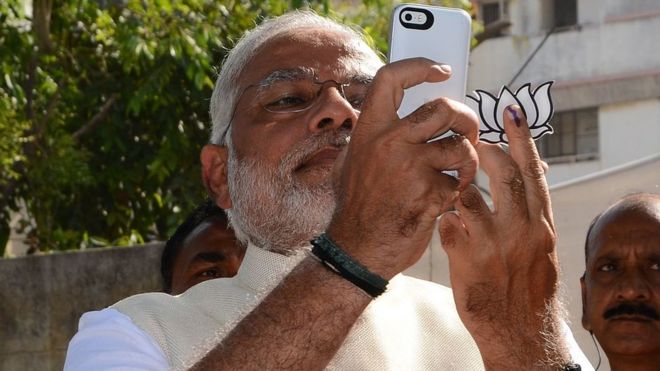 Image copyright STRDEL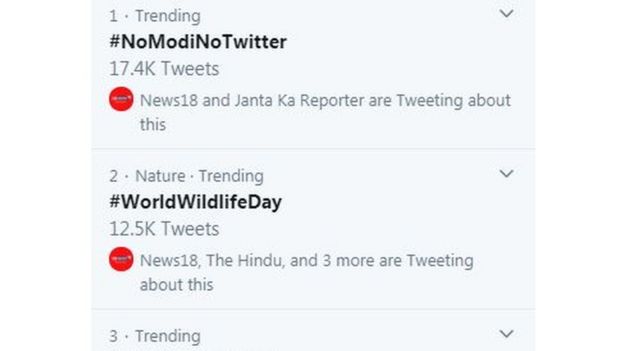







 CHINDIA ALERT: You'll be living in their world, very soon
Gandhi killer ‘patriot’ comment by BJP candidate draws outrage
India is in full election mode: voting began on 11 April, and the final ballot will be cast on 19 May with results out on 23 May. Every day, the BBC will be bringing you all the latest updates on the twists and turns of the world’s largest democracy.
Ruling party candidate calls Gandhi’s killer a patriot
What is happening?
Controversial Bharatiya Janata Party (BJP) politician Pragya Thakur has made headlines again. This time it was for calling Nathuram Godse – the man who assassinated Mahatma Gandhi – a “patriot”.
Her comment was made in response to a statement by southern actor-turned politician Kamal Haasan who had said India’s first “extremist” was a Hindu”, referring to Godse.
End of Twitter post by @ANI
His statement, made on Monday, was heavily criticised by the BJP, which accused him of indulging in “divisive politics” and filed a complaint against him with the Election Commission of India.
Why does this matter?
The BJP has responded by criticising Ms Thakur and asking her to publicly apologise.
“BJP does not agree with this statement, we condemn it. Party will ask her for clarification, she should apologise publicly for this statement,” party spokesperson GVL Narasimha Rao told reporters.
However, Ms Thakur’s comments do reflect the views of some right-wing Hindus who support the BJP and have long seen Gandhi as too moderate.
Godse, who shot Gandhi in the chest three times at point-blank range on 30 January 1948, was also an activist with nationalist right-wing groups, including those closely associated with the BJP.
Hindu hardliners in India accuse Gandhi of having betrayed Hindus by being too pro-Muslim, and even for the division of India and the bloodshed that marked Partition, which saw India and Pakistan created after independence from Britain in 1947.
Ms Thakur has seen her fair share of controversy. Her candidature caused outrage as she is an accused of involvement in a blast that killed seven people and injured 100 others. On 18 April, she said that police officer Hemant Karkare had died in the November 2008 Mumbai terror attacks because she had “cursed” him. She was then banned from campaigning for 72 hours as a result.
A team led by Mr Karkare had arrested her for questioning in connection with the Malegaon blast.
During her campaign, she also said she was “proud” of her part in the demolition of the 16th Century Babri mosque. In 1992, right-wing Hindu mobs razed the mosque to the ground, claiming it was built on the site of a temple destroyed by Muslim rulers. The site, which is in the city of Ayodhya, has been a religious flashpoint for Hindus and Muslims for decades.
Campaigning ends in West Bengal a day before deadline
What happened?
The Election Commission (EC) has told political parties to end their campaigning in West Bengal state, a day before the deadline in the wake of poll-related violence.
The campaign will end on Thursday at 10pm local time, and voting will be held on Sunday.
The decision comes after clashes broke out between the Bharatiya Janata Party (BJP) workers and protesters believed to be from the ruling Trinamool Congress (TMC) in Kolkata (formerly Calcutta) on Tuesday.
It happened during a roadshow of BJP chief Amit Shah. Several people were injured and vehicles were set on fire. A statue of renowned Bengali reformer Iswarchandra Vidyasagar was also vandalised in the clashes.
Both parties have accused each other of starting the violence.
Why does this matter?
The BJP welcomed the decision, saying it validated their argument that the state had “descended into anarchy” under the leadership of chief minister Mamata Banerjee.
Ms Banerjee said that the move was “undemocratic” and “it had insulted the people of Bengal”.
“Tomorrow, [Prime Minister Narendra] Modi has two meetings in Bengal. When he finishes, the campaigning also ends… Instead of punishing Amit Shah, the Election Commission has given a gift to the BJP,” she said.
Both parties are locked into a fierce election battle to win most out West Bengal’s 42 seats. Ms Banerjee has ambitions of becoming the prime minister in case a nationwide coalition of regional parties wins enough seats.
The state has also become crucial for the BJP as it’s trying to expand its reach in the eastern state. It won only two seats in the 2014 election.
The BJP performed well in northern states like Uttar Pradesh and Rajasthan in 2014, but this time it’s expected to suffer loses against a coalition of regional parties and the main opposition Congress.
So the party is trying to make up for the losses in West Bengal.
TMC, BJP accused each other of poll violence
What happened?
The war of words between West Bengal state chief minister Mamata Banerjee and the governing Bharatiya Janata Party (BJP) intensified ahead of voting on Sunday.
The latest verbal duel comes after violence was reported during BJP chief Amit Shah’s roadshow in Kolkata (formerly Calcutta) on Tuesday.
Clashes broke out between BJP supporters and protesters who were holding “Amit Shah go back” posters.
Some people suffered minor injuries and a few vehicles were set on fire.
The BJP said the protest was “orchestrated” and called it an “attempt to strangulate democracy”.
Why does this matter?
The eastern state has become politically crucial for the BJP as it has intensified campaigning in the past few days.
And that has sparked a feverish electoral battle between the BJP and Ms Banerjee’s Trinamool Congress (TMC).
“What does Amit Shah think of himself? Is he above everything? Is he god that no one can protest against him?” Ms Banerjee said.
In reply, Mr Shah accused the TMC of not following democratic norms during elections.
“Have faith in the people of Bengal that they’d face the TMC goons,” he said.
Prime Minister Narendra Modi is scheduled to hold more rallies in the coming days, so one can expect more verbal fireworks from the two leaders.
On Tuesday, the saga of the morphed Mamata meme continued
What happened?
India’s top court stepped in to release an activist belonging to India’s governing Bharatiya Janata Party (BJP) who was sent to prison for sharing a doctored image of West Bengal Chief Minister Mamata Banerjee.
Priyanka Sharma was sentenced to two weeks in prison on 10 May after she shared a picture of Bollywood star Priyanka Chopra and her husband Nick Jonas at the Met Gala – but with Ms Banerjee’s head superimposed on to Chopra’s body.
Earlier the court had said Ms Sharma could be released only if she apologised to Ms Banerjee, but later waived this condition.
Why does this matter?
The battle for West Bengal in this general election has been absolutely bruising.
The BJP, led by Prime Minister Narendra Modi himself, has been campaigning hard for votes in the state. This has brought them toe-to-toe with the state’s feisty chief minister. The fact that voting for West Bengal’s 42 seats has been split across all nine phases of voting has meant that the battle has been long and drawn-out.
And with just one phase to go before voting finally ends, the gloves are well and truly off. The two parties have traded insults on the campaign stage, their workers have attacked each other, and the violence on the ground has intensified. And now the battle has spread to cyberspace as well.
The country’s finance minister Arun Jaitley jumped at news of Ms Sharma’s release to call Ms Banerjee a dictator.
End of Twitter post by @arunjaitley
Analysts say that this political row is so bitter because the BJP has clearly identified West Bengal as one of the states where they may be able to make gains this election. This becomes more important for the party in the context of their fight in the politically crucial state of Uttar Pradesh, which sends the most number of MPs (80) to parliament.
They are up against a powerful coalition of regional parties there, and many expect them to lose seats as a result.
And PM Modi said Rahul Gandhi should be ashamed of 1984 riots
What happened?
Prime Minister Narendra Modi said that main opposition Congress party chief Rahul Gandhi should be “ashamed of himself” over his colleague’s remark on the 1984 anti-Sikh riots.
Mr Modi was replying to a controversial statement made by Sam Pitroda, who is a strategist of the Congress party.
In his reply to a question about the Congress’ role in the riots, Mr Pitroda had said “so what?”.
“I don’t think so, this is also another lie, and what about 1984? You speak about what you [Mr Modi] have done in five years. It [the riots] happened in 1984, so what?” he said.
Mr Gandhi said he was “ashamed” of Mr Pitroda’s statement, and asked him to apologise.
Mr Pitroda later said his statement was “twisted” and he did not mean to hurt sentiments.
But Mr Modi said the Congress chief “must apologise”.
“I was watching that naamdar [the dynast] told his guru that he should be ashamed of what he said. I want to ask naamdar, you pretended to scold your mentor for what? Because he exposed what was always in the Congress’s heart, and in the discussions of the naamdar family? Because he made public a family secret? Naamdar, it is you who should be ashamed,” Mr Modi said.
Why does this matter?
The controversy matters because it comes days ahead of voting for the 13 seats in the northern state of Punjab.
The BJP, which has formed a coalition with regional Shiromani Akali Dal, is locked in a bitter electoral battle with the ruling Congress in the state.
Sikhs are a majority in the state and the 1984 riots is still an emotional issue for many of them.
More than 3,000 Sikhs were killed in 1984 after the assassination of former prime minister Indira Gandhi by her Sikh bodyguards.
They were angry at her decision to send the army into the Golden Temple – Sikhism’s holiest shrine – to flush out militants earlier in the year.
The killing of Mrs Gandhi, who belonged to the Congress, saw mobs attack and murder members of the Sikh community across the country.
And both parties appear to be trying to come across as pro-Sikh ahead of the vote on 19 May.
On Sunday, Delhi voted but not enthusiastically
What happened?
Sunday saw India’s capital Delhi vote along with several other states in the polls – the penultimate phase of the country’s mammoth general election.
Voters turned out to vote, but in fewer numbers than they did in 2014. The election commission said that around 60% of the capital’s registered voters had actually cast ballots, which was about a five percent drop from 2014.
Delhi Chief Electoral Officer Ranbir Singh expressed disappointment, saying that the turnout did not match expectations.
Why does this matter?
The election commission is right to be disappointed – it had run a series of campaigns in the city, encouraging more people to vote.
But it was not as though polling in Delhi was an entirely smooth process. Some voters complained that their names were missing from electoral lists even though they had all the necessary documents. There were also reports that around 1,200 Electronic Voting Machines (EVMs) had malfunctioned across the city, delaying the polling process.
The fact that Delhi became a three-cornered contest after the main opposition Congress and the Aam Aadmi Party (AAP), which controls the Delhi state assembly, failed to stitch up an alliance may also have put voters off. Many analysts believe that this failure will only split voters who were against prime minister Narendra Modi’s Bharatiya Janata Party (BJP) and effectively hand them victory.
So they may have decided to just stay home, and not bother queuing up in the blistering heat – it touched 40C on Sunday.
Source: The BBC
Posted in Aam Aadmi Party (AAP), Amit Shah, Arun Jaitley, assassinated, Ayodhya, Babri mosque, Bharatiya Janata Party (BJP) politician, bjp candidate, Chief Minister, comment, Congress party chief, Delhi, Delhi Chief Electoral Officer, Election Commission, Election Commission (EC), Electronic Voting Machines (EVMs), extremist, finance minister, Gandhi killer, Hindu, Hindus, Indira Gandhi, Iswarchandra Vidyasagar, Kolkata, Kolkata / Calcutta, mahatma gandhi, Mamata Banerjee, Muslims, Nathuram Godse, outrage, patriot, PM Modi, Pragya Thakur, Priyanka Chopra, Priyanka Sharma, Punjab, rahul gandhi, Ranbir Singh, Sikh bodyguards, Trinamool Congress (TMC), Uncategorized, West Bengal | Leave a Comment »