Chindia Alert: You’ll be Living in their World Very Soon
aims to alert you to the threats and opportunities that China and India present. China and India require serious attention; case of ‘hidden dragon and crouching tiger’.
Without this attention, governments, businesses and, indeed, individuals may find themselves at a great disadvantage sooner rather than later.
The POSTs (front webpages) are mainly 'cuttings' from reliable sources, updated continuously.
The PAGEs (see Tabs, above) attempt to make the information more meaningful by putting some structure to the information we have researched and assembled since 2006.
It is an election like no other. Those eligible to vote in India’s upcoming polls represent more than 10% of the world’s population and they will take part in the largest democratic exercise in history.
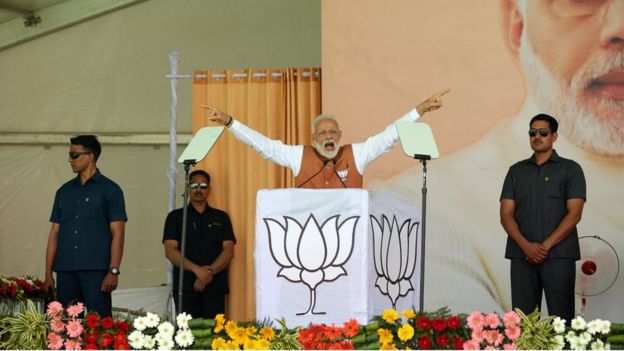
Voters will choose representatives for the Indian parliament, and in turn decide if Hindu nationalist Prime Minister Narendra Modi will run the country for another five years.
What is at stake?
Whoever wins these elections and forms a government will control the destiny of the world’s largest democracy.
While they are in charge, India’s economy is likely to overtake the UK’s and become the world’s fifth-largest.
Its population meanwhile – at more than 1.34bn people – is predicted to soon surpass China’s 1.39bn.
Hundreds of millions of Indians have escaped poverty since the turn of the millennium but huge challenges remain.
Unemployment is a major concern and is especially high among young people.
Millions of farmers are angry about low crop prices.
How the nuclear-armed country engages with the outside world – and manages a tricky relationship with its neighbour Pakistan – is also of immense importance to international security.
Who is being elected?
Indians are voting for members of parliament and the job of prime minister tends to go to the leader of the party or coalition with most seats. The current PM is Narendra Modi.
His main rival is opposition leader Rahul Gandhi.
Parliament has two houses: the Lok Sabha and the Rajya Sabha.
The lower house – Lok Sabha – is the one to watch.
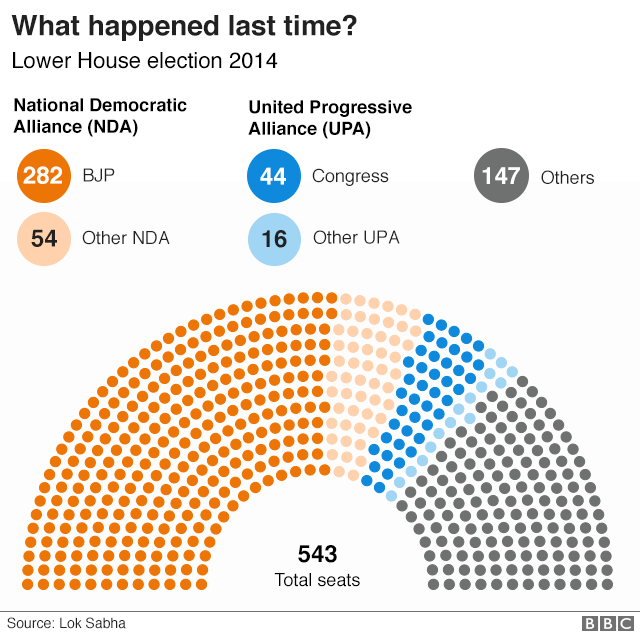
It has 543 elected seats and any party or coalition needs a minimum of 272 MPs to form a government.
At the last election in 2014, Mr Modi’s BJP won 282 seats.
Mr Gandhi’s Congress Party only took 44 seats in 2014 – down from 206 in 2009.
Why does voting take so long?
Because of the enormous number of election officials and security personnel involved, voting will take place in seven stages between 11 April and 19 May.
Different states will vote at different times.
Votes will be counted on 23 May and results are expected on the same day.
Who will win?
This election is being seen as a referendum on Mr Modi, a polarising figure adored by many but also accused of stoking divisions between India’s Hindu majority and the country’s 200 million Muslims.
Until a few months ago, Mr Modi and his BJP party were seen as the overwhelming favourites. But the loss of key states in December’s regional elections injected a sense of serious competition into the national vote.
Analysts are divided on whether Mr Modi will be able to win a simple majority again.
A recent escalation of tensions with Pakistan has given the BJP a new and popular issue to campaign on.
It will be hoping that a focus on patriotism will help the party to get past the serious challenge mounted by powerful regional parties and Congress.
BJP’s Meenakshi Lekhi had complaints to the Supreme Court that the words attributed by Rahul Gandhi to the Supreme Court in the Rafale case had been “made to appear something else”.
INDIAUpdated: Apr 15, 2019 14:06 IST
HT Correspondent
New Delhi
Supreme Court will next hear the case on April 23(AFP file photo)
Congress president Rahul Gandhi has been told by the Supreme Court to explain his remarks during the Lok Sabha campaign where he attributed comments to the top court which had ruled on the admissibility of three sets of documents in the Rafale review petition.
The bench said Gandhi had incorrectly attributed “views, observations and findings” in the Rafale case to the top court. Gandhi has been given till next Monday to come up with his explanation. The court, however, has not issued a formal notice to him yet.
“We also make it clear that this court had no occasion to record any such views or make observations in as much as what was decided by this court was the legal admissibility of certain document to which objections were raised,” the bench headed by Chief Justice of India Rajan Gogoi said.
BJP lawmaker Meenakshi Lekhi had last week filed a contempt petition against the Congress president for his attacks on Prime Minister Narendra Modi that she said, “replaced his personal statement as Supreme Court’s order “ and tried to create prejudice.
Watch: ‘Chowkidar chor’ vs ‘SC’s contempt’: Rahul, Nirmala face off on Rafale order
‘Chowkidar chor’ vs ‘SC’s contempt’: Rahul, Nirmala face off on Rafale order
Defence Minister Nirmala Sitharaman slammed Congress president Rahul Gandhi over his remarks on Supreme Court’s decision related to Rafale documents
Gandhi, who was in Amethi to file his nomination papers, had reacted to this setback to the government, saying: “Now the Supreme Court has made it clear that ‘chowkidarji’ (watchman) has committed a theft… I want to directly challenge that the Supreme Court has stated that you have indulged in corruption.”
The BJP and its top leaders had taken umbrage at the Congress president’s remarks, accusing him of wildly exaggerating and misquoting the court’s observations and the context. Defence Minister Nirmala Sitharaman had said Rahul Gandhi’s statement was contempt of contempt of court and was the Congress’s attempt to “perpetrate their own lies”.
Her party later filed a formal complaint against Gandhi with the Election Commission, charging him of lying. The Congress party wants to “perpetrate their own lies”. She further added that Gandhi’s comments are not based on the facts.
In her petition before the Supreme Court, Meenakshi Lekhi had complained that “the words used and attributed by him (Gandhi) to the Supreme Court in the Rafale case has been made to appear something else. He is replacing his personal statement as Supreme Court’s order and trying to create prejudice.”
The government’s April 2015 decision to buy 36 Rafale warplanes has been at the heart of the Congress-led opposition campaign against Prime Minister Narendra Modi and the ruling BJP-led national coalition. The $8.7 billion government-to-government deal replaced the previous United Progressive Alliance (UPA) regime’s decision to buy 126 Rafale aircraft, 108 of which were to be made in India by state-owned Hindustan Aeronautics Ltd (HAL).
The deal has become controversial with the Opposition, led by the Congress, claiming that the price at which India is buying Rafale aircraft now is Rs 1,670 crore for each, three times the Rs 526 crore, the initial bid by the company when the UPA was trying to buy the aircraft. It has also claimed the previous deal included a technology transfer agreement with HAL. The NDA has not disclosed details of the price.
NEW DELHI (Reuters) – Hundreds of people holding candles and the national flag marched through the northern Indian city of Amritsar on Friday, on the eve of the centenary of the colonial-era Jallianwala Bagh massacre that British Prime Minister Theresa May has called a “shameful scar.”
On April 13, 1919, some 50 British Indian army soldiers began shooting at unarmed civilians who were taking part in a peaceful protest against oppressive laws enforced in the Punjab region.
At least 379 Sikhs were killed, according to the official record, although local residents said in the past the toll was far higher. The massacre took place in the walled enclosure of Jallianwala Bagh, which is still pocked with bullet marks.
The massacre became a symbol of colonial cruelty and for decades Indians have demanded an apology from Britain, including during Queen Elizabeth’s visit to Amritsar in 1997.
On Wednesday, May told the British parliament that “the tragedy of Jallianwala Bagh in 1919 is a shameful scar on British Indian history”, but she did not issue a formal apology.
In 2013, then British Prime Minister David Cameron described the killings as a “deeply shameful event” in a visitor book at the site, now marked by a 46-foot (14-metre) high flame-shaped memorial.
“There are events in the histories of nations which are difficult to forget and they hold a very emotionally charged space in a nation’s memory,” Navtej Sarna, a Sikh who has served as India’s High Commissioner to the United Kingdom, told Reuters.
“We have an excellent relationship with the United Kingdom today but it’s a question of assuaging sentiments and healing a wound which has been festering as part of our shared history.” India gained independence from Britain in 1947.
Security in the city – also home to Sikhism’s holiest shrine the Golden Temple – has been stepped up as hundreds of visitors and groups are likely to arrive at the site, Amritsar Police Commissioner S.S. Srivastava said.
Residents of the city, tourists, visitors, top government officials and students took part in the candle lit evening march from a building called Townhall to the massacre site.
The march of about one kilometre was accompanied by loudspeakers playing patriotic songs and onlookers thronged the roadsides. At the end of the march, people observed a two-minute silence.
Punjab state’s Chief Minister Amarinder Singh and Governor V P Badnore took part in the march while Rahul Gandhi, president of the opposition Congress party, was expected to visit the city later in the evening.
Some observers have billed this as the most important election in decades and the tone of the campaign has been acrimonious.
Mr Modi’s Hindu nationalist Bharatiya Janata Party (BJP) won a historic landslide in the last elections in 2014. He stakes his claim to lead India on a tough image and remains the governing BJP’s main vote-getter.
But critics say his promises of economic growth and job creation haven’t met expectations and India has become more religiously polarised under his leadership.
The BJP faces challenges from strong regional parties and a resurgent Congress party, led by Rahul Gandhi. Mr Gandhi’s father, grandmother and great-grandfather are all former Indian prime ministers. His sister, Priyanka Gandhi, formally joined politics in January.
Image captionMr Modi has made national security a key election issue
How has voting gone so far?
The Lok Sabha, or lower house of parliament has 543 elected seats and any party or coalition needs a minimum of 272 MPs to form a government.
Hundreds of voters began to queue up outside polling centres early Thursday morning. In the north-eastern state of Assam, lines of voters began forming almost an hour before voting officially began.
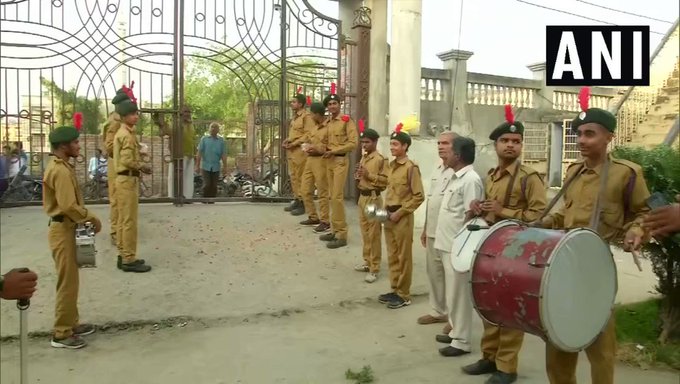
Voters at one polling booth in Baraut – in the northern state of Uttar Pradesh – got a royal welcome with people greeted by drums and a shower of flower petals.
But violence has flared in several places already. One person has died after clashes erupted at a polling station in Anantpur, in southern Andhra Pradesh state. Four others were critically injured in the fight that broke out between workers from two parties, BBC Telugu reports.
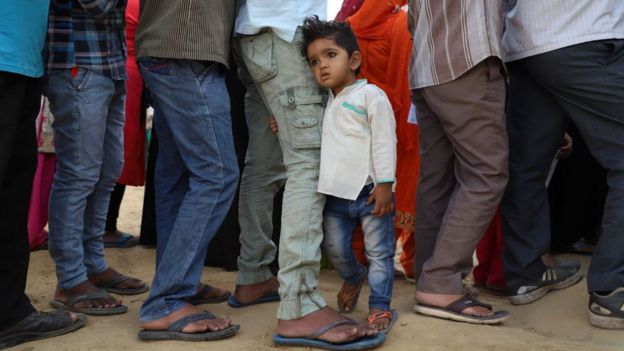
Image copyrightGETTY IMAGESImage caption A little boy clutches his father outside a polling booth in Ghaziabad in Uttar Pradesh state
In central Chhattisgarh state, suspected Maoists detonated an IED device near a polling booth at around 04:00 local time (23:30 BST) – no injuries were reported.
The mineral-rich state has witnessed an armed conflict for more than three decades and attacks by Maoist rebels on security forces are common. On Tuesday a state lawmaker was killed in a suspected rebel attack.
How big is this election?
It is mind-bogglingly vast – about 900 million people above the age of 18 will be eligible to cast their ballots at one million polling stations. At the last election, vote turn-out was around 66%.
More than 100 million people are eligible to vote in the first phase of the election on Thursday.
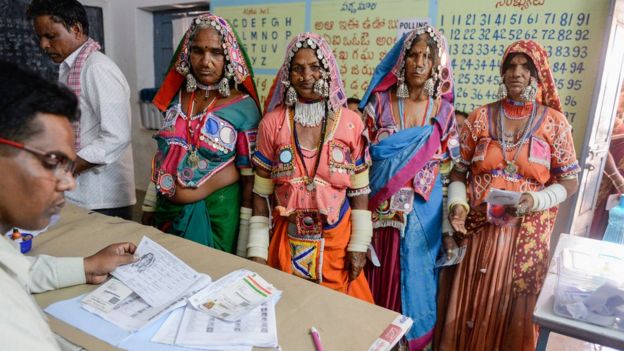
Image copyrightGETTY IMAGESImage caption Indian lambadi tribeswomen at a polling station in southern India
No voter is meant to have to travel more than 2km to reach a polling station. Because of the enormous number of election officials and security personnel involved, voting will take place in seven stages between 11 April and 19 May.
India’s historic first election in 1951-52 took three months to complete. Between 1962 and 1989, elections were completed in four to 10 days. The four-day elections in 1980 were the country’s shortest ever.
Rahul Ganghi at a rally in Sriganganagar, Rajastan, on Tuesday. (Congress/Twitter)
Congress president Rahul Gandhi on Tuesday said the promise of minimum income guarantee is his party’s “surgical strike on poverty” that will ensure there is no poor in the country after 2019. Gandhi said the Congress’s promise of minimum income guarantee is “an explosion”.
“It will set off a bomb…This is the Congress’s surgical strike on poverty. They (the BJP) tried to eliminate the poor. We will eliminate poverty,” said Gandhi at a public rally in Rajasthan’s Ganganagar.
‘Surgical strike on poverty’: Rahul Gandhi counters BJP on minimum income promise
A day after the Bharatiya Janata Party tried to discredit the Congress’ promise of a minimum income guarantee scheme in case it comes to power, Congress President Rahul Gandhi countered the BJP’s criticism.
Gandhi hit out at the Narendra Modi government in his speech alleging that the current regime has brought back people who were uplifted from the below poverty line by the Congress-led UPA rule. “The fact that 25 crore people are living in poverty in the 21st century India is a shame,” Gandhi said.
The Congress president said nowhere such a scheme has ever been implemented. “There should not be a single poor person in the country,” he said addressing the Congress’s Jan Sankalp Rally at Suratgarh in Ganganagar district.
On Monday, Gandhi promised that his party would, if it comes to power, guarantee an income of at least Rs 12,000 a month for 20 per cent of India’s poorest families by giving them Rs 6,000 a month. He said the minimum income guarantee scheme, named NYAY (standing for Nyuntam Aay Yojana) meaning justice, would cover 5 crore families or 25 crore people, who constitute the poorest 20 per cent of Indian households.
The scheme, if implemented, is expected to cost Rs 3.6 lakh crore, around 2 per cent of India’s GDP. Gandhi has insisted that it is fiscally prudent.
At his Rajasthan rally, Gandhi said Prime Minister Narendra Modi has tried to “create two Indias” in the last five years giving all the benefits of the government to select few rich people while insisting that if voted to power, the Congress will eradicate poverty completely.
“If Narendra Modi can give money to the rich, the Congress will give money to the poor,” said Gandhi, who also took a swipe at the prime minister’s chowkidar campaign. The Congress president said PM Modi is a chowkidar but “serves rich people like Anil Ambani instead of the poor”.
The BJP has rejected the minimum income guarantee promise of Gandhi with Union Finance Minister Arun Jaitley calling it a “bluff announcement” in his blog. Jaitley also said that the total promised by the Congress (Rs 72,000 a year) is just around two-thirds of what the NDA gives the poor.
NEW DELHI (Reuters) – India’s main opposition Congress party will reserve a third of federal government jobs for women if it comes into power, its chief Rahul Gandhi said on Wednesday, in a sign women’s rights are rising up the political agenda for next month’s election.
Over the last week, two powerful parties from eastern India said they would field women in a third of parliamentary races, putting pressure on Prime Minister Narendra Modi’s ruling Bharatiya Janata Party (BJP) and other big parties to follow suit.
India ranks at 149 out of 193 countries – worse than neighbouring Afghanistan, Bhutan, Bangladesh and Pakistan – for the percentage of women in national parliaments, according to the Inter-Parliamentary Union, an independent organisation promoting democracy.
“…Frankly, I don’t see enough women in leadership positions. I don’t see them leading enough companies, I don’t see them leading enough states, I don’t see enough of them in the Lok Sabha and the Vidhan Sabhas,” Gandhi said in the southern city of Chennai, referring to India’s lower house of parliament and state legislatures.
Federal government jobs in India are already subject to numerous quotas, including one passed in January that reserves 10 percent of openings for people outside high income brackets.
Gandhi also said that Congress would pass the Women’s Reservation Bill this year if it came to power. The bill, which reserves 33 percent of the seats in national and state assemblies for women, has been on hold for two decades despite being championed by Congress and the BJP at different points.
The BJP, which says it has empowered women through nationwide schemes including clean fuel and sanitation, questioned how the Congress jobs plan would be implemented.
“For how many generations have people talked about reservation in party positions, reservation for elections, reservation in jobs? But it doesn’t seem to happen,” BJP spokesperson Shaina N.C. said.
There are currently 66 women out of a total 543 elected members in India’s lower house of parliament. At 12 percent, this is the highest ever proportion of women in the Lok Sabha.
Women make up nearly half of all voters in the country of 1.3 billion people, according to the Election Commission of India. Based on recent state polls, women will likely head to voting stations in droves for the elections due by May, surpassing male turnout, analysts predict.
On Tuesday, Mamata Banerjee, chief minister of West Bengal state, said her All India Trinamool Congress party would field 17 women candidates across 42 seats.
Earlier, on Sunday, the Biju Janata Dal, which rules Odisha state in eastern India, said it would reserve seven of 21 seats it is contesting for women candidates.
“33% reservation in parliament will give them bigger role in highest policy making body,” Naveen Patnaik, leader of the BJD and Odisha’s chief minister, said in a tweet.
“Women of our nation rightfully deserve this from all of us.”
No other injuries reported following accident on southern island of Hainan
Military is currently intensifying training for pilots as it looks to strengthen capabilities
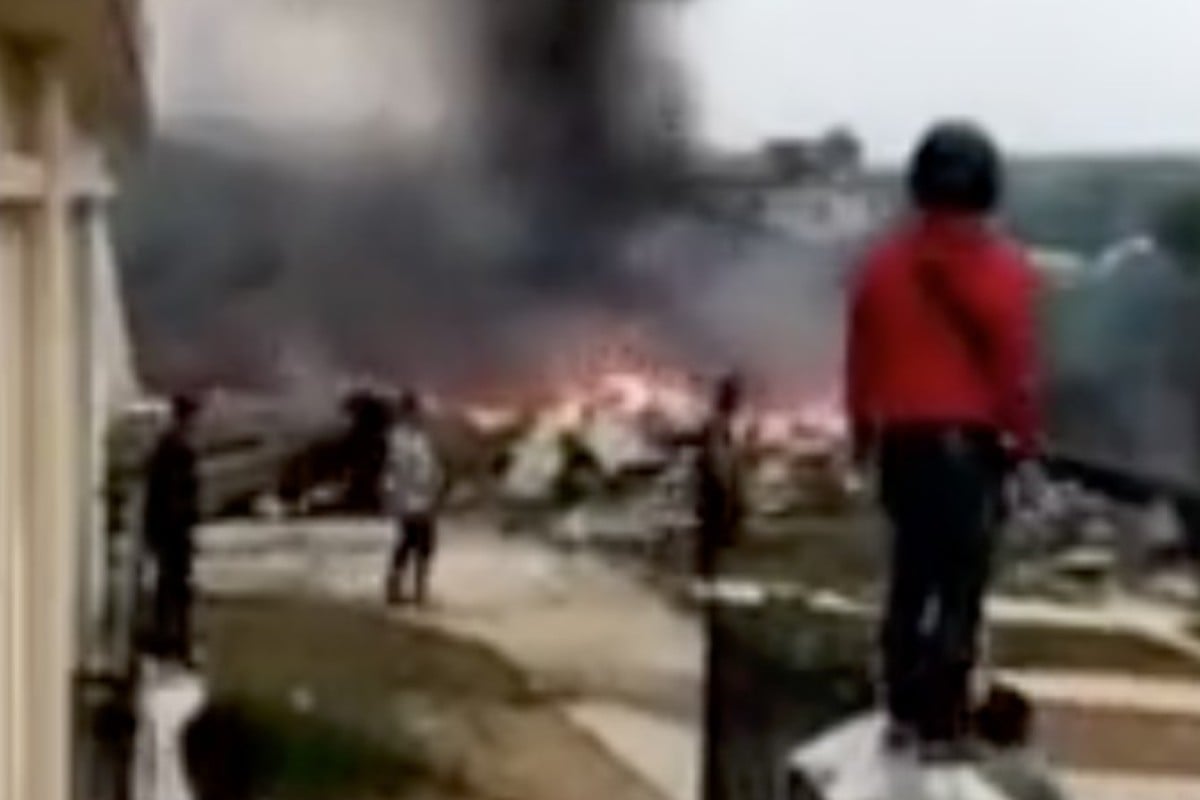
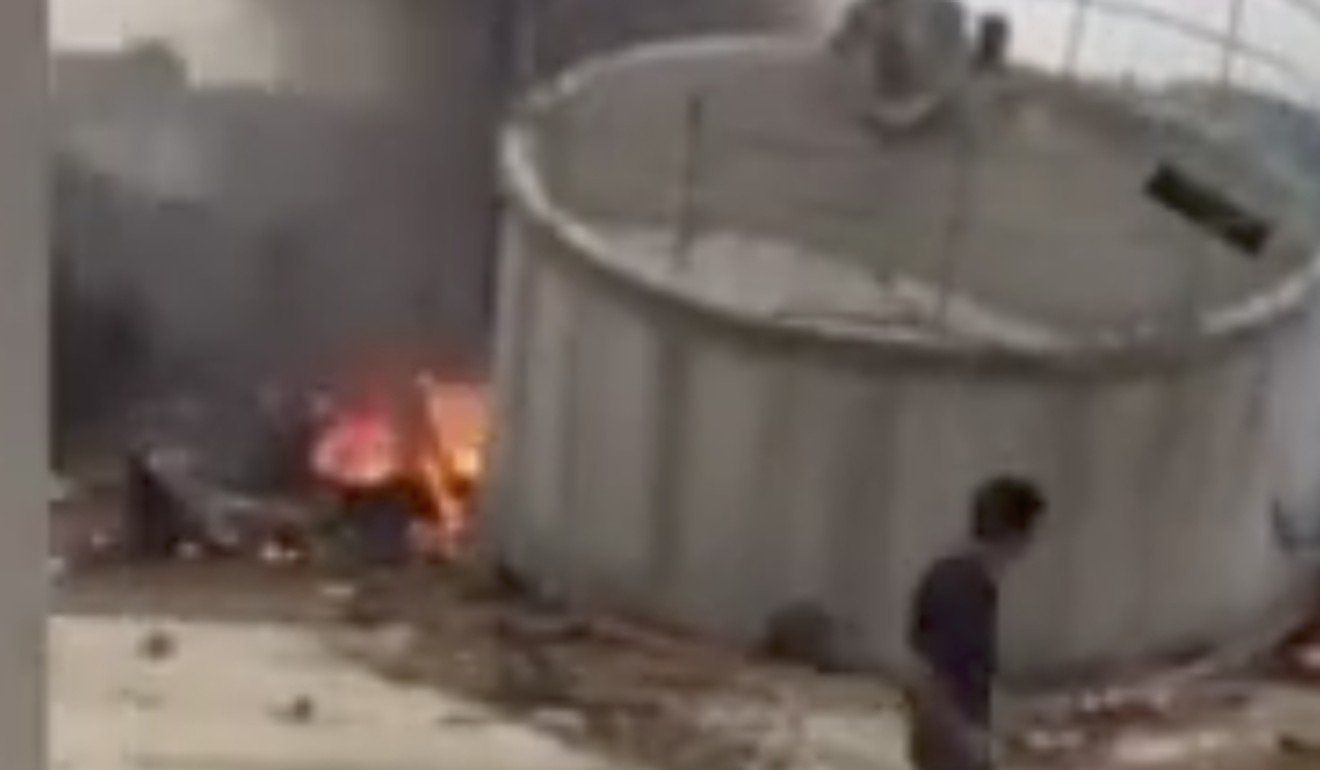
Mobile phone footage believed to be taken from the crash site. Photo: Handout
A Chinese navy plane crashed in Hainan province on Tuesday killing two crew members, the military said.
A short statement said the crash happened during a training exercise over rural Ledong county in the southern island province.
No one else was reported to have been injured after the plane hit the ground and the cause of the incident is being investigated.
Footage that purported to be taken from the crash site started circulating on social media after the accident.
The mobile phone footage, which news portal 163.com said was taken in Hainan, showed smoke rising from piles of wreckage next to a damaged water tower as bystanders gathered at the site.
Footage apparently taken at the crash site. Photo: Handout
The person who uploaded the footage said the plane had hit the water tower before crashing into the ground.
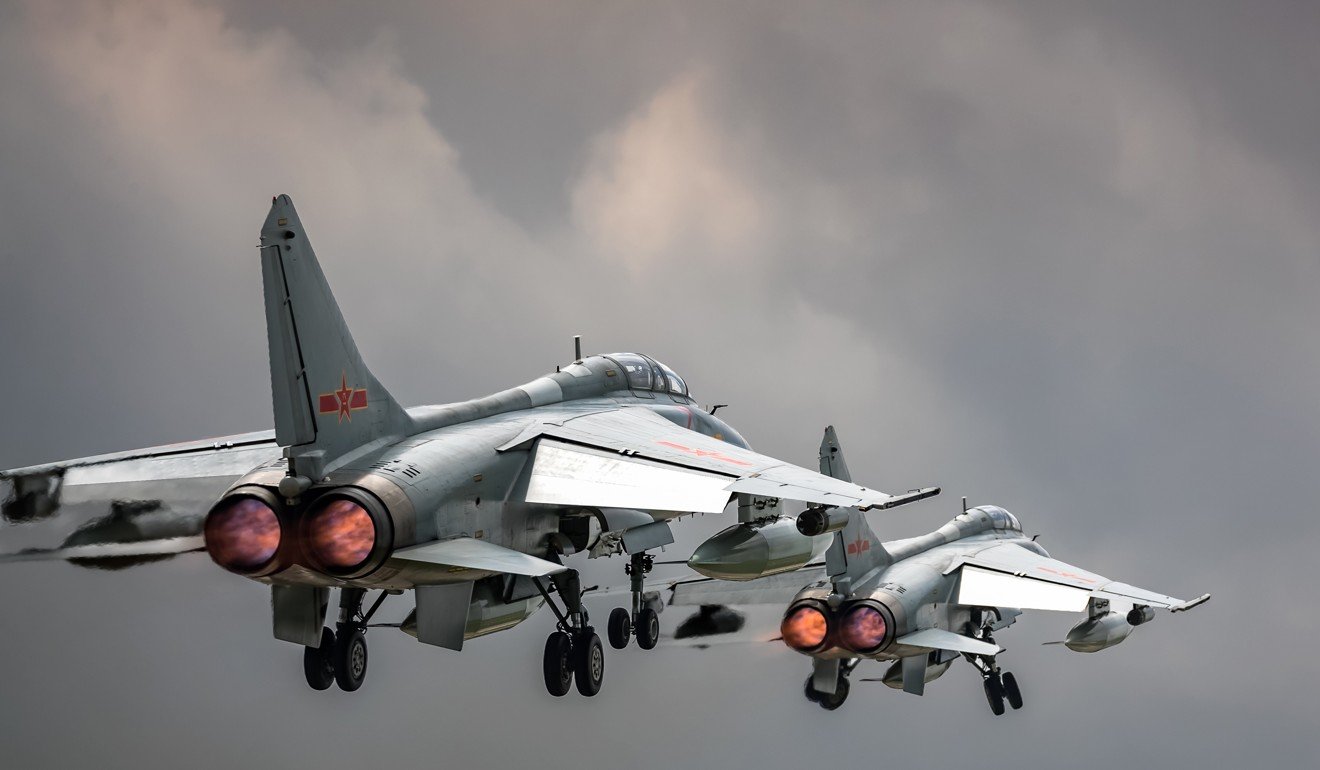
The PLA’s official statement did not specify the type plane that crashed, although unverified witness account online said it was a twin-seat Xian JH-7 “Flying Leopard”.
The JH-7, which entered service with the navy and air force in the 1990s, has been involved in a number of fatal accidents over the years.
The country’s worst military air accident in recent years happened in January 2018. At least 12 crew members died when a PLA Air Force plane, believed to be an electronic reconnaissance aircraft, crashed in Guizhou in the southwest of the country.
Between 2016 and 2017, there were at least four accidents involving the navy’s J-15 “Flying Sharks”, one of them resulting in the death of the pilot.
Military commentators have previously said that China’s drive to improve its combat readiness, which includes the building of new aircraft carriers and warplanes, has resulted in a serious shortage of qualified pilots.
To fill the vacancies the Chinese military has started a major recruitment drive and intensive training programme for pilot pilots.
One unverified report said the plane that crashed was a JH-7 “Flying Leopard”. Photo. Xinhua
Currently China has one aircraft carrier, the Liaoning, in service, which can carry a maximum of 24 J-15s as well as other aircraft.
Meanwhile, the new home-grown carrier Type 001A will soon be commissioned, which is designed to accommodate to carry eight more fighters.
In addition, construction is believed to have started on another carrier that will be able to carry heavier and more advanced warplanes.
According to figures from the end of 2016, there were only 25 pilots qualified to fly the J-15 while 12 others were in training.
Most of the Chinese navy’s pilots have been redeployed from the air force, which is itself in need of more trained pilots.
This year the navy for the first time began a nation-wide programme to scout out potential pilots.
Speaking on the sidelines of the ongoing legislative meeting in Beijing Feng Wei, a PLA pilot from the Western Theatre, said the military was currently intensifying its pilots’ training as increasing amounts of new equipment entered service.
“Personnel quality is the key to everything,” he added.
CWC meeting LIVE: Congress is launching its Lok Sabha election campaign from Ahmedabad in Gujarat, the home state of PM Narendra Modi and BJP president Amit Shah with a meeting of its top leaders, including Rahul Gandhi, Sonia Gandhi, Manmohan Singh.
The Congress is launching its Lok Sabha election campaign from Ahmedabad in Gujarat, the home state of Prime Minister Narendra Modi and BJP president Amit Shah with a meeting of its Congress Working Committee (CWC) and a public rally by its top leaders.
Congress president Rahul Gandhi, UPA chairperson Sonia Gandhi, former Prime Minister Manmohan Singh and party general secretaries, including Priyanka Gandhi, will be among the senior leaders of the party attending the meeting.
The Congress Working Committee, the highest decision-making arm of the party, would seek answers to failures and unfulfilled promises of the Modi government on governance, agrarian distress, economic issues, unemployment, national security and women’s safety, according to party leaders.
Hardik Patel, a prominent young leader of Patidars, who is leading a movement for reservation in jobs and education for their community, is likely to join Congress and contest the Lok Sabha elections on a party ticket, according to sources.
Image copyrightGETTY IMAGESImage captionAn Indian man watches the news broadcasting images of the released Indian pilot
As tensions between India and Pakistan escalated following a deadly suicide attack last month, there was another battle being played out on the airwaves. Television stations in both countries were accused of sensationalism and partiality. But how far did they take it? The BBC’s Rajini Vaidyanathan in Delhi and Secunder Kermani in Islamabad take a look.
It was drama that was almost made for television.
The relationship between India and Pakistan – tense at the best of times – came to a head on 26 February when India announced it had launched airstrikes on militant camps in Pakistan’s Balakot region as “retaliation” for a suicide attack that had killed 40 troops in Indian-administered Kashmir almost two weeks earlier.
A day later, on 27 February, Pakistan shot down an Indian jet fighter and captured its pilot.
Abhinandan Varthaman was freed as a “peace gesture”, and Pakistan PM Imran Khan warned that neither country could afford a miscalculation, with a nuclear arsenal on each side.
Suddenly people were hooked, India’s TV journalists included.
Image copyrightAFPImage captionIndian PM Narendra Modi is accused of exploiting India-Pakistan hostilities for political gain
So were they more patriots than journalists?
Rajini Vaidyanathan: Indian television networks showed no restraint when it came to their breathless coverage of the story. Rolling news was at fever pitch.
The coverage often fell into jingoism and nationalism, with headlines such as “Pakistan teaches India a lesson”, “Dastardly Pakistan”, and “Stay Calm and Back India” prominently displayed on screens.
Some reporters and commentators called for India to use missiles and strike back. One reporter in south India hosted an entire segment dressed in combat fatigues, holding a toy gun.
And while I was reporting on the return of the Indian pilot at the international border between the two countries in the northern city of Amritsar, I saw a woman getting an Indian flag painted on her cheek. “I’m a journalist too,” she said, as she smiled at me in slight embarrassment.
Print journalist Salil Tripathi wrote a scathing critique of the way reporters in both India and Pakistan covered the events, arguing they had lost all sense of impartiality and perspective. “Not one of the fulminating television-news anchors exhibited the criticality demanded of their profession,” she said.
Media captionIndia and Pakistan’s ‘war-mongering’ media
Secunder Kermani: Shortly after shooting down at least one Indian plane last week, the Pakistani military held a press conference.
As it ended, the journalists there began chanting “Pakistan Zindabad” (Long Live Pakistan). It wasn’t the only example of “journalistic patriotism” during the recent crisis.
Two anchors from private channel 92 News donned military uniforms as they presented the news – though other Pakistani journalists criticised their decision.
But on the whole, while Indian TV presenters angrily demanded military action, journalists in Pakistan were more restrained, with many mocking what they called the “war mongering and hysteria” across the border.
In response to Indian media reports about farmers refusing to export tomatoes to Pakistan anymore for instance, one popular presenter tweeted about a “Tomatical strike” – a reference to Indian claims they carried out a “surgical strike” in 2016 during another period of conflict between the countries.
Media analyst Adnan Rehmat noted that while the Pakistani media did play a “peace monger as opposed to a warmonger” role, in doing so, it was following the lead of Pakistani officials who warned against the risks of escalation, which “served as a cue for the media.”
What were they reporting?
Rajini Vaidyanathan: As TV networks furiously broadcast bulletins from makeshift “war rooms” complete with virtual reality missiles, questions were raised not just about the reporters but what they were reporting.
Indian channels were quick to swallow the government version of events, rather than question or challenge it, said Shailaja Bajpai, media editor at The Print. “The media has stopped asking any kind of legitimate questions, by and large,” she said. “There’s no pretence of objectiveness.”
In recent years in fact, a handful of commentators have complained about the lack of critical questioning in the Indian media.
Image copyrightAFPImage captionIndians celebrated news of the strikes
“For some in the Indian press corps the very thought of challenging the ‘official version’ of events is the equivalent of being anti-national”, said Ms Bajpai. “We know there have been intelligence lapses but nobody is questioning that.”
Senior defence and science reporter Pallava Bagla agreed. “The first casualty in a war is always factual information. Sometimes nationalistic fervour can make facts fade away,” he said.
This critique isn’t unique to India, or even this period in time. During the 2003 Iraq war, western journalists embedded with their country’s militaries were also, on many occasions, simply reporting the official narrative.
Secunder Kermani: In Pakistan, both media and public reacted with scepticism to Indian claims about the damage caused by the airstrikes in Balakot, which India claimed killed a large number of Jaish-e-Mohammad (JeM) militants in a training camp.
Hamid Mir, one of the most influential TV anchors in the country travelled to the area and proclaimed, “We haven’t seen any such (militant) infrastructure… we haven’t seen any bodies, any funerals.”
“Actually,” he paused, “We have found one body… this crow.” The camera panned down to a dead crow, while Mr Mir asked viewers if the crow “looks like a terrorist or not?”
There seems to be no evidence to substantiate Indian claims that a militant training camp was hit, but other journalists working for international outlets, including the BBC, found evidence of a madrassa, linked to JeM, near the site.
Image copyrightPLANET LABS INC./HANDOUT VIA REUTERSImage captionThe satellite image shows a close-up of a madrassa near Balakot in Pakistan’s Khyber Paktunkhwa
A photo of a signpost giving directions to the madrassa even surfaced on social media. It described the madrassa as being “under the supervision of Masood Azhar”. Mr Azhar is the founder of JeM.
The signpost’s existence was confirmed by a BBC reporter and Al Jazeera, though by the time Reuters visited it had apparently been removed. Despite this, the madrassa and its links received little to no coverage in the Pakistani press.
Media analyst Adnan Rehmat told the BBC that “there was no emphasis on investigating independently or thoroughly enough” the status of the madrassa.
In Pakistan, reporting on alleged links between the intelligence services and militant groups is often seen as a “red line”. Journalists fear for their physical safety, whilst editors know their newspapers or TV channels could face severe pressure if they publish anything that could be construed as “anti-state”.
Who did it better: Khan or Modi?
Rajini Vaidyanathan: With a general election due in a few months, PM Narendra Modi continued with his campaign schedule, mentioning the crisis in some of his stump speeches. But he never directly addressed the ongoing tensions through an address to the nation or a press conference.
This was not a surprise. Mr Modi rarely holds news conference or gives interviews to the media. When news of the suicide attack broke, Mr Modi was criticised for continuing with a photo shoot.
Image copyrightAFPImage captionImran Khan was praised for his measured approach
The leader of the main opposition Congress party, Rahul Gandhi, dubbed him a “Prime Time Minister” claiming the PM had carried on filming for three hours. PM Modi has also been accused of managing his military response as a way to court votes.
At a campaign rally in his home state of Gujarat he seemed unflustered by his critics, quipping “they’re busy with strikes on Modi, and Modi is launching strikes on terror.”
Secunder Kermani: Imran Khan won praise even from many of his critics in Pakistan, for his measured approach to the conflict. In two appearances on state TV, and one in parliament, he appeared firm, but also called for dialogue with India.
His stance helped set the comparatively more measured tone for Pakistani media coverage.
Officials in Islamabad, buoyed by Mr Khan’s decision to release the captured Indian pilot, have portrayed themselves as the more responsible side, which made overtures for peace.
On Twitter, a hashtag calling for Mr Khan to be awarded a Nobel Peace Prize was trending for a while. But his lack of specific references to JeM, mean internationally there is likely to be scepticism, at least initially, about his claims that Pakistan will no longer tolerate militant groups targeting India.
Rahul Gandhi renewed his attack on PM Modi over Rafale deal controversy during his public rally in Jharkhand
INDIAUpdated: Mar 02, 2019 15:58 IST
HT Correspondent
Hindustan Times, Ranchi
Congress president Rahul Gandhi addressing a public rally in Jharkhand on Saturday.(Photo: Twitter/INCIndia)
Congress president Rahul Gandhi on Saturday renewed his attack on Prime Minister Narendra Modi reiterating his charge that he misled the people on the issues of providing corruption-free government, job creation and addressing farm distress. Gandhi said PM Modi’s image has changed from a leader who promised to bring “achchhe din” (better time) to “chowkidar chor hai” (the watchman is a thief).
Speaking at the Congress’s Parivartan Ulgulan Maha Rally at the Morahbad in Jharkhand, Gandhi said, “One chowkidar has defamed all chowkidars of India…All the chowkidars of India are honest…Everyone knows that when someone says chowkidar chor hai, it refers to Narendra Modi.”
The Congress president alleged that PM Modi “snatched” Rs 30,000 crore from the Indian Air Force (IAF), which protects the country, and the Hindustan Aeronautics Limited (HAL) and gave it to industrialist Anil Ambani in Rafale deal.
Gandhi has been targeting PM Modi over Rs 58,000-crore Rafale deal with France that India signed in 2016 for the purchase of 36 fighter planes. A similar deal was being negotiated when the Congress-led United Progressive Alliance (UPA) was in power before 0214 for the purchase of 126 Rafale jets.
The Modi government renegotiated the deal with France terming the previous one unworkable. The Congress and other opposition parties have alleged that commercial favouritism was done in Rafale deal.
Gandhi on several occasions has alleged that PM Modi personally ensured that Ambani’s firm, Reliance Defence gets contract in Rafale deal. Both the government and the Reliance Defence have rejected the allegation as baseless. Reliance Defence is an off-set partner of the Dassault Aviation, the manufacturer of Rafale fighter jets.
Addressing his first rally in Jharkhand since 2014, the Congress president repeated his charge against PM Modi saying, “It is a matter of shame that Indian Air Force protects the country, air force pilots sacrifice their lives but the prime minister steals money from the air force and puts it in Anil Ambani’s pockets.”
He claimed that in the upcoming Lok Sabha elections, the “chowkidar” will be defeated. He promised that if voted to power the Congress government will implement a minimum income guarantee programme for the poor.


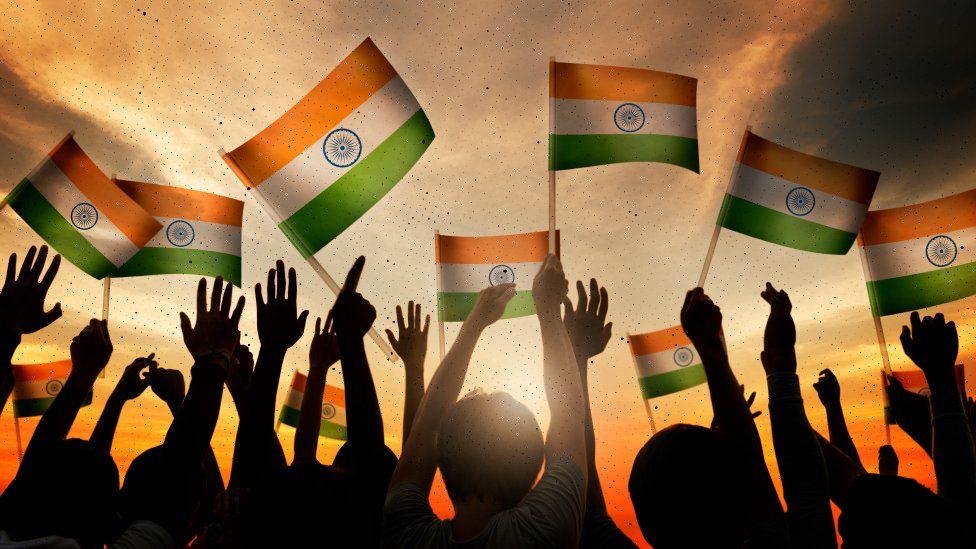 Image copyright GETTY IMAGES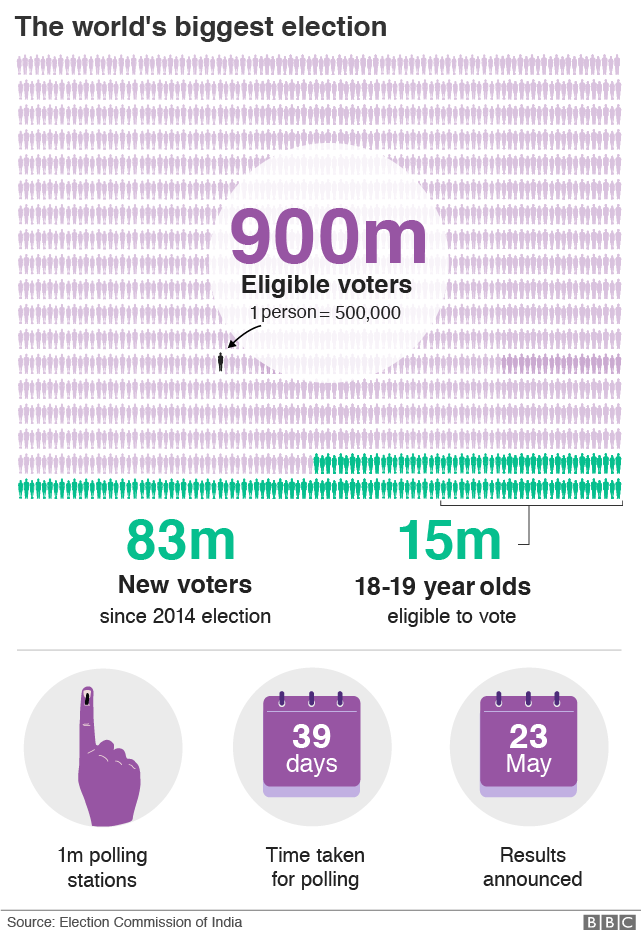





 CHINDIA ALERT: You'll be living in their world, very soon
India and Pakistan: How the war was fought in TV studios
As tensions between India and Pakistan escalated following a deadly suicide attack last month, there was another battle being played out on the airwaves. Television stations in both countries were accused of sensationalism and partiality. But how far did they take it? The BBC’s Rajini Vaidyanathan in Delhi and Secunder Kermani in Islamabad take a look.
It was drama that was almost made for television.
The relationship between India and Pakistan – tense at the best of times – came to a head on 26 February when India announced it had launched airstrikes on militant camps in Pakistan’s Balakot region as “retaliation” for a suicide attack that had killed 40 troops in Indian-administered Kashmir almost two weeks earlier.
A day later, on 27 February, Pakistan shot down an Indian jet fighter and captured its pilot.
Abhinandan Varthaman was freed as a “peace gesture”, and Pakistan PM Imran Khan warned that neither country could afford a miscalculation, with a nuclear arsenal on each side.
Suddenly people were hooked, India’s TV journalists included.
So were they more patriots than journalists?
Rajini Vaidyanathan: Indian television networks showed no restraint when it came to their breathless coverage of the story. Rolling news was at fever pitch.
The coverage often fell into jingoism and nationalism, with headlines such as “Pakistan teaches India a lesson”, “Dastardly Pakistan”, and “Stay Calm and Back India” prominently displayed on screens.
Some reporters and commentators called for India to use missiles and strike back. One reporter in south India hosted an entire segment dressed in combat fatigues, holding a toy gun.
And while I was reporting on the return of the Indian pilot at the international border between the two countries in the northern city of Amritsar, I saw a woman getting an Indian flag painted on her cheek. “I’m a journalist too,” she said, as she smiled at me in slight embarrassment.
Print journalist Salil Tripathi wrote a scathing critique of the way reporters in both India and Pakistan covered the events, arguing they had lost all sense of impartiality and perspective. “Not one of the fulminating television-news anchors exhibited the criticality demanded of their profession,” she said.
Secunder Kermani: Shortly after shooting down at least one Indian plane last week, the Pakistani military held a press conference.
As it ended, the journalists there began chanting “Pakistan Zindabad” (Long Live Pakistan). It wasn’t the only example of “journalistic patriotism” during the recent crisis.
Two anchors from private channel 92 News donned military uniforms as they presented the news – though other Pakistani journalists criticised their decision.
But on the whole, while Indian TV presenters angrily demanded military action, journalists in Pakistan were more restrained, with many mocking what they called the “war mongering and hysteria” across the border.
In response to Indian media reports about farmers refusing to export tomatoes to Pakistan anymore for instance, one popular presenter tweeted about a “Tomatical strike” – a reference to Indian claims they carried out a “surgical strike” in 2016 during another period of conflict between the countries.
Media analyst Adnan Rehmat noted that while the Pakistani media did play a “peace monger as opposed to a warmonger” role, in doing so, it was following the lead of Pakistani officials who warned against the risks of escalation, which “served as a cue for the media.”
What were they reporting?
Rajini Vaidyanathan: As TV networks furiously broadcast bulletins from makeshift “war rooms” complete with virtual reality missiles, questions were raised not just about the reporters but what they were reporting.
Indian channels were quick to swallow the government version of events, rather than question or challenge it, said Shailaja Bajpai, media editor at The Print. “The media has stopped asking any kind of legitimate questions, by and large,” she said. “There’s no pretence of objectiveness.”
In recent years in fact, a handful of commentators have complained about the lack of critical questioning in the Indian media.
“For some in the Indian press corps the very thought of challenging the ‘official version’ of events is the equivalent of being anti-national”, said Ms Bajpai. “We know there have been intelligence lapses but nobody is questioning that.”
Senior defence and science reporter Pallava Bagla agreed. “The first casualty in a war is always factual information. Sometimes nationalistic fervour can make facts fade away,” he said.
This critique isn’t unique to India, or even this period in time. During the 2003 Iraq war, western journalists embedded with their country’s militaries were also, on many occasions, simply reporting the official narrative.
Secunder Kermani: In Pakistan, both media and public reacted with scepticism to Indian claims about the damage caused by the airstrikes in Balakot, which India claimed killed a large number of Jaish-e-Mohammad (JeM) militants in a training camp.
Hamid Mir, one of the most influential TV anchors in the country travelled to the area and proclaimed, “We haven’t seen any such (militant) infrastructure… we haven’t seen any bodies, any funerals.”
“Actually,” he paused, “We have found one body… this crow.” The camera panned down to a dead crow, while Mr Mir asked viewers if the crow “looks like a terrorist or not?”
There seems to be no evidence to substantiate Indian claims that a militant training camp was hit, but other journalists working for international outlets, including the BBC, found evidence of a madrassa, linked to JeM, near the site.
A photo of a signpost giving directions to the madrassa even surfaced on social media. It described the madrassa as being “under the supervision of Masood Azhar”. Mr Azhar is the founder of JeM.
The signpost’s existence was confirmed by a BBC reporter and Al Jazeera, though by the time Reuters visited it had apparently been removed. Despite this, the madrassa and its links received little to no coverage in the Pakistani press.
Media analyst Adnan Rehmat told the BBC that “there was no emphasis on investigating independently or thoroughly enough” the status of the madrassa.
In Pakistan, reporting on alleged links between the intelligence services and militant groups is often seen as a “red line”. Journalists fear for their physical safety, whilst editors know their newspapers or TV channels could face severe pressure if they publish anything that could be construed as “anti-state”.
Who did it better: Khan or Modi?
Rajini Vaidyanathan: With a general election due in a few months, PM Narendra Modi continued with his campaign schedule, mentioning the crisis in some of his stump speeches. But he never directly addressed the ongoing tensions through an address to the nation or a press conference.
This was not a surprise. Mr Modi rarely holds news conference or gives interviews to the media. When news of the suicide attack broke, Mr Modi was criticised for continuing with a photo shoot.
The leader of the main opposition Congress party, Rahul Gandhi, dubbed him a “Prime Time Minister” claiming the PM had carried on filming for three hours. PM Modi has also been accused of managing his military response as a way to court votes.
At a campaign rally in his home state of Gujarat he seemed unflustered by his critics, quipping “they’re busy with strikes on Modi, and Modi is launching strikes on terror.”
Secunder Kermani: Imran Khan won praise even from many of his critics in Pakistan, for his measured approach to the conflict. In two appearances on state TV, and one in parliament, he appeared firm, but also called for dialogue with India.
His stance helped set the comparatively more measured tone for Pakistani media coverage.
Officials in Islamabad, buoyed by Mr Khan’s decision to release the captured Indian pilot, have portrayed themselves as the more responsible side, which made overtures for peace.
On Twitter, a hashtag calling for Mr Khan to be awarded a Nobel Peace Prize was trending for a while. But his lack of specific references to JeM, mean internationally there is likely to be scepticism, at least initially, about his claims that Pakistan will no longer tolerate militant groups targeting India.
Source: The BBC
Posted in Adnan Rehmat, airstrikes, airwaves, Al Jazeera, Balakot, BBC, BBC reporter, campaign schedule, casualty, combat fatigues, commentators, congress party, critical questioning, Dastardly Pakistan, Delhi, escalation, factual information, fought, general election, Hamid Mir, hashtag, Imran Khan, India alert, Indian jet fighter, international border, Islamabad, Islamist militant groups, Jaish-e-Mohammad (JeM), JeM, jingoism and nationalism, Journalist, Kashmir, madrassa, Masood Azhar, Media analyst, media editor, militant camps, militants, missiles, nationalistic fervour, Nobel Peace Prize, Pakistan, Pakistani, Pakistani military, Pallava Bagla, pilot, PM Narendra Modi, press, press conference, Prime Time Minister, rahul gandhi, Rajini Vaidyanathan, red line, retaliation, Reuters, Salil Tripathi, Secunder Kermani, Senior defence and science reporter, sensationalism and partiality, Shailaja Bajpai, signpost's, suicide attack, Surgical strike, The Print, Tomatical strike, toy gun, training camp, TV anchors, TV journalists, TV studios, Twitter, Uncategorized, war, war mongering and hysteria, warmonger, Wg Cdr Abhinandan Varthaman | Leave a Comment »