Chindia Alert: You’ll be Living in their World Very Soon
aims to alert you to the threats and opportunities that China and India present. China and India require serious attention; case of ‘hidden dragon and crouching tiger’.
Without this attention, governments, businesses and, indeed, individuals may find themselves at a great disadvantage sooner rather than later.
The POSTs (front webpages) are mainly 'cuttings' from reliable sources, updated continuously.
The PAGEs (see Tabs, above) attempt to make the information more meaningful by putting some structure to the information we have researched and assembled since 2006.
Xie Haifeng’s story is one of luck and resilience and he has made it his mission to help others through adversity
Professional dancer owes part of his success to the city of Hong Kong and one of its doctors who helped survivors through recovery
Xie Haifeng was 15 when he lost his leg in one of modern China’s most devastating disasters. Photo: Handout
When the rumbling began, Xie Haifeng thought someone was shaking his bed. Perhaps one of the other 800 children in the school dormitory was being naughty. Or maybe it was a small quake. Then came the unmistakable sound of screams.
Xie, then a 15-year-old pupil at Muyi Town Middle School in the southwestern Chinese province of Sichuan, started running. He fell as the dorm building collapsed around him. When he tried to stand up, he realised something was missing. His left leg was gone.
What Xie thought was a small quake turned out to be one of the most devastating disasters in modern Chinese history.
The Sichuan earthquake of May 2008 left at least 87,000 people dead and shook the country to its core. It was less than three month before Beijing would host its first Olympic Games, an opportunity to show the world its strength and ambition.
Instead, 7,444 schools had crumbled like tofu in an area known to be seismically active. Their rubble was a stark demonstration of the weak foundation of China’s progress and its tragic consequences. At Xie’s school, the shoddily built walls and ceilings crushed 600 children. Only 300 survived.
It still frightens me to recall the earthquake.Xie Haifeng, dancer
Xie considers himself lucky. “If I had run just one second more slowly, I would have been dead. If I had run one second faster, I would have been completely fine. But anyway, I am lucky to be alive,” he said. A dozen years later, his story is also one of resilience. Defying all the odds, Xie is now a professional dancer for a troupe in Sichuan and has made it his mission to help others through adversity.
The journey from his hospital bed to the stage was long and difficult and even though many years have passed, “it still frightens me to recall the earthquake”. But, he said: “I have forgiven fate and accepted the reality that I have only one leg.”
Xie’s trauma was a particularly difficult blow to his family. His older sister was already handicapped, after injuring her arm in an accident. When his mother, a migrant worker in the northwestern province of Gansu, arrived at the hospital a few days after the earthquake, she had no idea of the extent of Xie’s condition.
“When I woke up in the evening, I saw my mother weeping beside my bed. I told myself I should be strong,” Xie said, adding that his mother initially thought he had suffered only bruises. He was sent for treatment to a hospital in the prosperous southern city of Shenzhen, along with other survivors who had been left with disabilities by the earthquake.
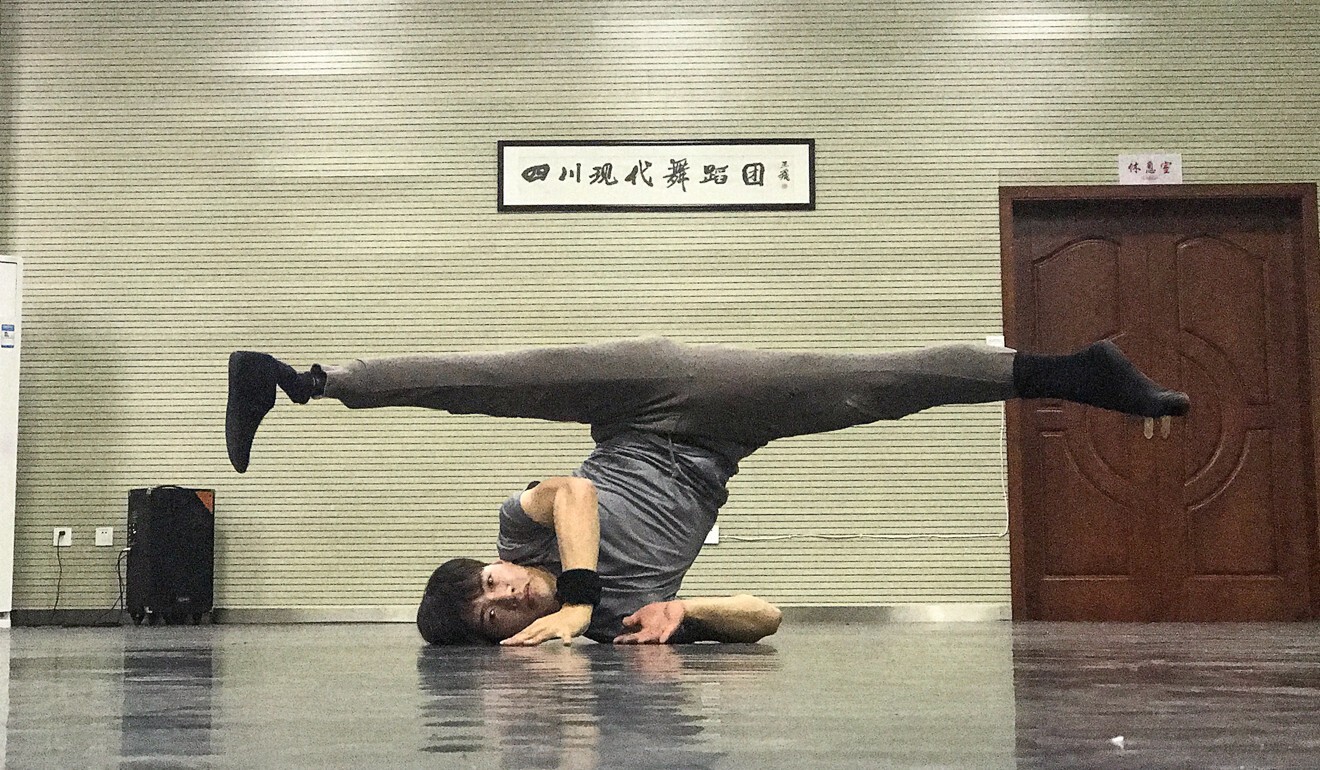
Defying all the odds, Xie Haifeng is now a professional dancer. Photo: Handout
It was there that Xie was inspired to make the most of his life. A team of athletes visited the hospital and he was shocked to see one of them, a volleyball player, walking on a prosthetic leg.
Xie began to wear a prosthesis and after rehabilitation training returned to his hometown in 2009 where he was admitted to Qingchuan High School. At first, he was self-conscious and felt inferior to his peers. He did not dare to wear shorts in summer and said he seldom talked to the other students.
The following year he was introduced to members of the Chengdu Disabled People’s Art Troupe, where he found a new and welcoming home. Xie quit school and joined the troupe, despite his parents’ opposition. They were convinced study was the only way for rural students like their son to get out of poverty.
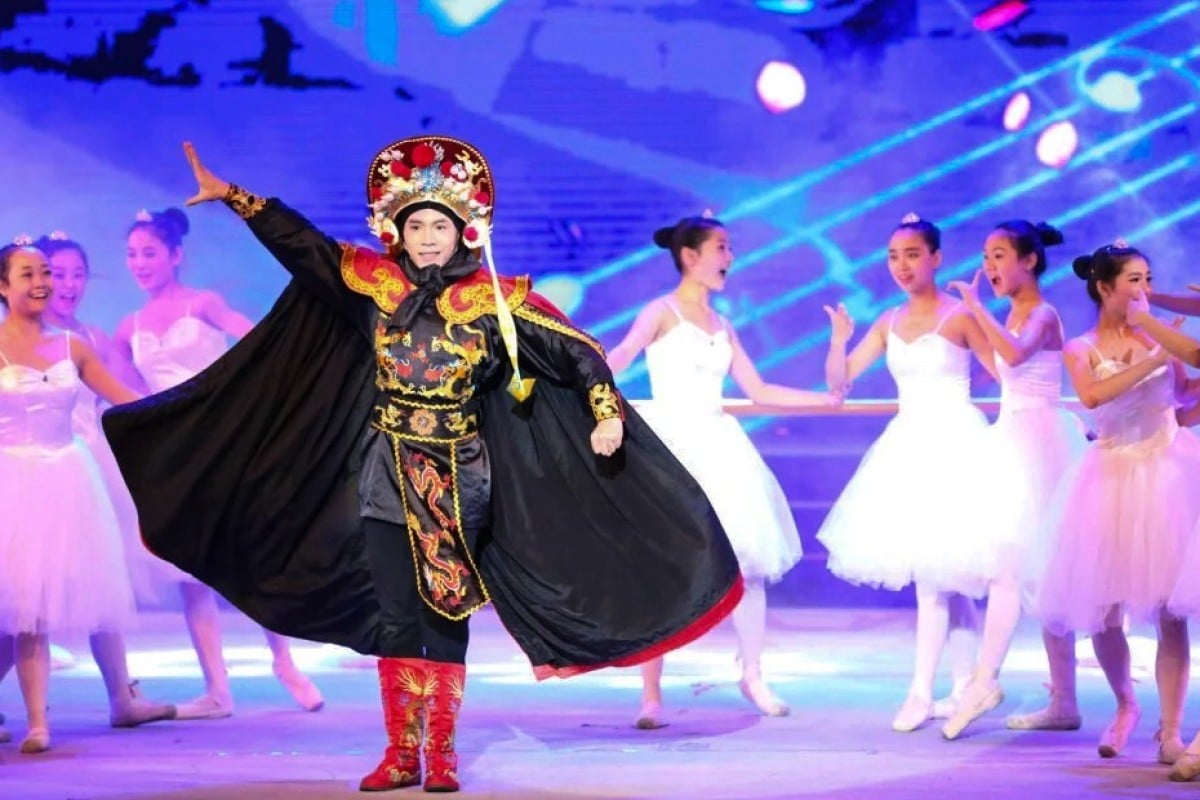
Xie learned Sichuan opera and was soon performing its art of bian lian, or
– a skill that requires rapid mask changes in a dazzling sleight of hand – on stage until the troupe was disbanded in 2011, leaving him unemployed for six months.
China marks 10-year anniversary of Sichuan earthquake
But the misfortune led to an improbable opportunity when he was hired by the Sichuan Provincial Disabled People’s Art Troupe and trained to dance. At 19, and with no experience, Xie found the training far more difficult than those who had started at the more usual age of five or six.
His body was too stiff, he said, and in the first months he spent 10 hours each day just stretching and building flexibility. It was just the beginning of a long and often arduous process.
“That agony is too much to be described,” Xie said about the pain of dancing on a prosthetic leg. “During the first six months’ training, I broke three artificial legs.”
More than once, he wondered whether he had chosen the right path. But, ultimately, his gruelling effort paid off and Xie has performed in Singapore, Hong Kong and Macau. In 2013, he won a gold medal at a national dancing competition for people with disabilities.
“My dances won me applause and recognition from the audience. I feel relieved and I think my heart belongs to the stage,” he said.
Xie broke three artificial legs during his first six months of dance training. Photo: Handout
Xie said he owed part of his success to Hong Kong which in 2008 donated HK$20 billion (US$2.5 billion) in aid to Sichuan and sent doctors to treat the injured. Among the volunteers was Poon Tak-lun, a Hong Kong orthopaedist who flew to Sichuan every two weeks from 2008 to 2013 to treat patients.
At a gala show in 2013 to express gratitude from the people of Sichuan to Hong Kong, Xie met Poon and the two became good friends, thanks to their common interest in the arts.
“Dr Poon promised to pay for all the costs of installing and repairing my artificial leg in the future. He told me to focus on dancing without worrying about the leg’s costs,” Xie said.
Xie Haifeng (pictured left with friend Poon Tak-lun) gives a speech to students in Hong Kong. Photo: Handout
Grateful for the help he received from Poon and Hong Kong, Xie has sought to return the favour by doing what he does best.
“I have no other skills except dancing and performing. So I thought of sharing my experience to encourage young students in Hong Kong,” he said.
Xie travels to Hong Kong about twice a year to perform and visit schools. In 2019, he visited the city four times, performing dances and Sichuan opera, and giving speeches at more than 10 primary and secondary schools.
“I encourage them to study hard. I said there are many people in this world who have more difficulties than them but still insist on pursuing their dreams, so they should not give up their dreams,” Xie said.
When he is not dancing and giving inspirational speeches, Xie said he lived a life like everyone else – climbing mountains, swimming and proudly walking on the leg he gained after almost losing everything in Sichuan’s deadly earthquake.
FUZHOU, Dec. 7 (Xinhua) — Chinese and foreign experts have marveled at the archaeological and anthropological value of the Wanshouyan Paleolithic Relics in east China’s Fujian Province.
Dozens of archaeological experts from China, Malaysia, Poland, Russia and Japan gathered in Sanming City on Friday and Saturday for a visit to the relics and academic exchanges.
“I have never seen such a thing,” said Lucyna Domanska, a professor with the Institute of Archaeology at the University of Lodz from Poland, pointing to a 120-square-meter space floored with pebbles inside a cavern.
The artificial floor, built about 40,000 years ago, is part of the Wanshouyan Paleolithic Relics, a habitat of human ancestors dating back as early as 200,000 years ago.
“This site is very exciting,” Domanska said. “It is important not only for Asia but for the whole world.”
Some of the relics are “unusual,” said Evgeny Rybin, a senior researcher at the Institute of Archaeology and Ethnography at the Siberian branch of the Russian Academy of Sciences, noting that “it could be a source of scientific advancements.”
Standing inside a cavern named Lingfeng where ancient stone choppers, scraping devices and hammering tools were unearthed, Rybin said the relics from this site broadened their understandings about the capabilities of ancient people.
“The relics show that ancient people not only used caves but also changed them to fit their lifestyles,” he said.
It is a contribution to the world, said Mohd Mokhtar Saidin, a professor and director of Malaysia’s Center for Global Archaeological Research.
“This is very important. Not every country has evidence of human activities 200,000 years ago, and not every region has this type of cave,” he added.
Inside the limestone hill of Wanshouyan, archaeological remains of the Paleolithic Age have been found in several caverns, which provide important evidence for studying human life as early as hundreds of thousands of years ago.
In 2000, the Wanshouyan Paleolithic Relics was listed as one of China’s top 10 archaeological discoveries of the year.
Anthony Edgar (L), chairman of the IOC Press Commission and director of the Media Operations Department, presents the certificate to Yan Wenbin, vice president of Xinhua News Agency, in Beijing, on April 12, 2019. The International Olympic Committee (IOC) officially awarded Xinhua News Agency a certificate in recognition of its status as an international news agency here on Friday. (Xinhua/Cao Can)
BEIJING, April 12 (Xinhua) — The International Olympic Committee (IOC) officially awarded Xinhua News Agency a certificate in recognition of its status as an international news agency here on Friday.
On behalf of IOC President Thomas Bach, Anthony Edgar, chairman of the IOC Press Commission and director of the Media Operations Department, presented the certificate to Yan Wenbin, vice president of Xinhua News Agency, at a ceremony held at Xinhua’s headquarters in Beijing.
Yan expressed appreciation to the IOC for its trust, saying Xinhua’s coverage of the Olympic Games has entered a new stage after becoming an international news agency recognized by the IOC.
“Xinhua will strengthen cooperation with the IOC more closely, report on the Olympic Movement more comprehensively, objectively and truthfully, and play a more important role in promoting the progress and development of the Olympic cause in China and the world,” said Yan.
Speaking at the handover ceremony, Edgar said that the IOC attaches great importance to Xinhua News Agency and has high expectations on Xinhua in promoting the Olympic Movement across the globe in the future.
“The designation of Xinhua as an IOC recognized international news agency is a recognition of the importance and global reach of Xinhua’s domestic, regional and global news and sports coverage. It is a recognition of the role Xinhua now plays – and will play in the future of producing the best possible coverage of the Olympic Games, the IOC and the Olympic Movement,” he said.






 CHINDIA ALERT: You'll be living in their world, very soon