Chindia Alert: You’ll be Living in their World Very Soon
aims to alert you to the threats and opportunities that China and India present. China and India require serious attention; case of ‘hidden dragon and crouching tiger’.
Without this attention, governments, businesses and, indeed, individuals may find themselves at a great disadvantage sooner rather than later.
The POSTs (front webpages) are mainly 'cuttings' from reliable sources, updated continuously.
The PAGEs (see Tabs, above) attempt to make the information more meaningful by putting some structure to the information we have researched and assembled since 2006.
But trade with partner countries might not be as badly affected as with countries elsewhere in the world, observers say
China’s trade with belt and road countries rose by 3.2 per cent in the January-March period, but second-quarter results will depend on how well they manage to contain the pathogen, academic says
China’s investment in foreign infrastructure as part of its Belt and Road Initiative has been curtailed because of the coronavirus pandemic. Photo: Xinhua
The coronavirus pandemic is set to cause a slump in Chinese investment in its signature
and a dip in trade with partner countries that could take a year to overcome, analysts say.
But the impact of the health crisis on China’s economic relations with nations involved in the ambitious infrastructure development programme might not be as great as on those that are not.
China’s total foreign trade in the first quarter of 2020 fell by 6.4 per cent year on year, according to official figures from Beijing.
Trade with the United States, Europe and Japan all dropped in the period, by 18.3, 10.4 and 8.1 per cent, respectively, the commerce ministry said.
By comparison, China’s trade with belt and road countries increased by 3.2 per cent in the first quarter, although the growth figure was lower than the 10.8 per cent reported for the whole of 2019.
China’s trade with 56 belt and road countries – located across Africa, Asia, Europe and South America – accounts for about 30 per cent of its total annual volume, according to the commerce ministry.
Despite the first-quarter growth, Tong Jiadong, a professor of international trade at Nankai University in Tianjin, said he expected China’s trade with belt and road countries to fall by between 2 and 5 per cent this year.
His predictions are less gloomy than the 13 to 32 per cent contraction in global trade forecast for this year by the World Trade Organisation.
“A drop in [China’s total] first-quarter trade was inevitable but it slowly started to recover as it resumed production, especially with Southeast Asian, Eastern European and Arab countries,” Tong said.
“The second quarter will really depend on how the epidemic is contained in belt and road countries.”
Nick Marro, Hong Kong-based head of global trade at the Economist Intelligence Unit, said he expected China’s total overseas direct investment to fall by about 30 per cent this year, which would be bad news for the belt and road plan.
“This will derive from a combination of growing domestic stress in China, enhanced regulatory scrutiny over Chinese investment in major international markets, and weakened global economic prospects that will naturally depress investment demand,” he said.
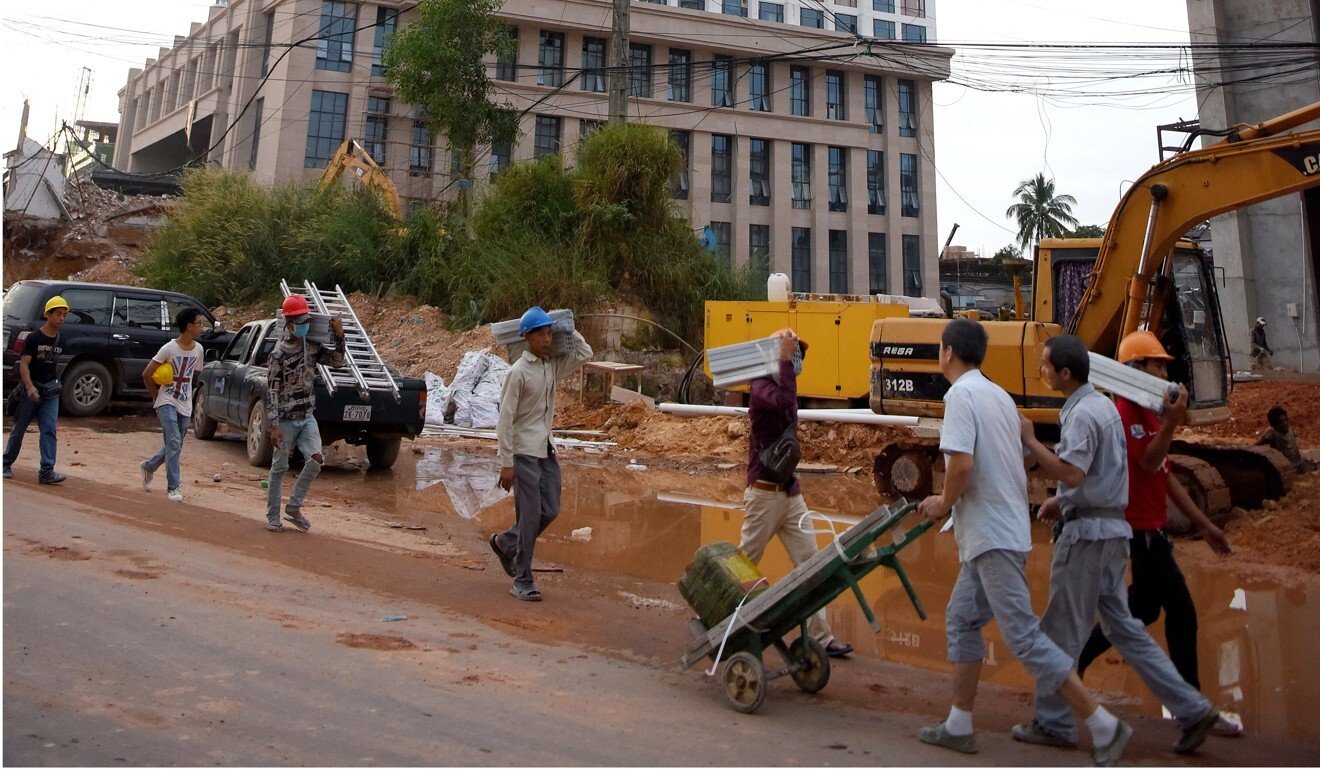
The development of the Chinese built and operated special economic zone in the Cambodian town of Sihanoukville is reported to have slowed, while infrastructure projects in Bangladesh, including the Payra coal-fired power plant, have been put on hold.
The development of the Chinese built and operated special economic zone in the Cambodian town of Sihanoukville is reported to have slowed. Photo: AFP
Marro said the reduction of capital and labour from China might complicate other projects for key belt and road partner, like Pakistan, which is home to infrastructure projects worth tens of billions of US dollars, and funded and built in large part by China.
“Pakistan looks concerning, particularly in terms of how we’ve assessed its sovereign and currency risk,” Marro said.
“Public debt is high compared to other emerging markets, while the coronavirus will push the budget deficit to expand to 10 per cent of GDP [gross domestic product] this year.”
Last week, Pakistan asked China for a 10-year extension to the repayment period on US$30 billion worth of loans used to fund the development of infrastructure projects, according to a report by local newspaper Dawn.
China’s overseas investment has been falling steadily from its peak in 2016, mostly as a result of Beijing’s curbs on capital outflows.
Last year, the direct investment by Chinese companies and organisations other than banks in belt and road countries fell 3.8 per cent from 2018 to US$15 billion, with most of the money going to South and Southeast Asian countries, including Singapore, Vietnam, Indonesia and Pakistan.
Tong said the pandemic had made Chinese investors nervous about putting their money in countries where disease control measures were becoming increasingly stringent, but added that the pause in activity would give all parties time to regroup.
“Investment in the second quarter will decline and allow time for the questions to be answered,” he said.
“Past experience along the belt and road has taught many lessons to both China and its partners, and forced them to think calmly about their own interests. The epidemic provides both parties with a good time for this.”
Dr Frans-Paul van der Putten, a senior research fellow at Clingendael Institute in the Netherlands, said China’s post-pandemic strategy for the belt and road in Europe
might include a shift away from investing in high-profile infrastructure projects like ports and airports.
Investors might instead cooperate with transport and logistics providers rather than invest directly, he said.
“Even though in the coming years the amount of money China loans and invests abroad may be lower than in the peak years around 2015-16, I expect it to maintain the belt and road plan as its overall strategic framework for its foreign economic relations,” he said.
China’s economy shrank for the first time in decades in the first quarter of the year, as the virus forced factories and businesses to close.
The world’s second biggest economy contracted 6.8% according to official data released on Friday.
The financial toll the coronavirus is having on the Chinese economy will be a huge concern to other countries.
China is an economic powerhouse as a major consumer and producer of goods and services.
This is the first time China has seen its economy shrink in the first three months of the year since it started recording quarterly figures in 1992.
“The GDP contraction in January-March will translate into permanent income losses, reflected in bankruptcies across small companies and job losses,” said Yue Su at the Economist Intelligence Unit.
Last year, China saw healthy economic growth of 6.4% in the first quarter, a period when it was locked in a trade war with the US.
In the last two decades, China has seen average economic growth of around 9% a year, although experts have regularly questioned the accuracy of its economic data.
Its economy had ground to a halt during the first three months of the year as it introduced large-scale shutdowns and quarantines to prevent the virus spread in late January.
As a result, economists had expected bleak figures, but the official data comes in slightly worse than expected.
Among other key figures released in Friday’s report:
Factory output was down 1.1% for March as China slowly starts manufacturing again.
Retail sales plummeted 15.8% last month as many of shoppers stayed at home.
Unemployment hit 5.9% in March, slightly better than February’s all-time high of 6.2%.
Analysis: A 6% expansion wiped out
Robin Brant, BBC News, Shanghai
The huge decline shows the profound impact that the virus outbreak, and the government’s draconian reaction to it, had on the world’s second largest economy. It wipes out the 6% expansion in China’s economy recorded in the last set of figures at the end of last year.
Beijing has signalled a significant economic stimulus is on the way as it tries to stabilise its economy and recover. Earlier this week the official mouthpiece of the ruling Communist Party, the People’s Daily, reported it would “expand domestic demand”.
But the slowdown in the rest of the global economy presents a significant problem as exports still play a major role in China’s economy. If it comes this will not be a quick recovery.
On Thursday the International Monetary Fund forecast China’s economy would avoid a recession but grow by just 1.2% this year. Job figures released recently showed the official government unemployment figure had risen sharply, with the number working in companies linked to export trade falling the most.
China has unveiled a range of financial support measures to cushion the impact of the slowdown, but not on the same scale as other major economies.
“We don’t expect large stimulus, given that that remains unpopular in Beijing. Instead, we think policymakers will accept low growth this year, given the prospects for a better 2021,” said Louis Kuijs, an analyst with Oxford Economics.
Since March, China has slowly started letting factories resume production and letting businesses reopen, but this is a gradual process to return to pre-lockdown levels.
Media caption Why does China’s economy matter to you?
China relies heavily on its factories and manufacturing plants for economic growth, and has been dubbed “the world’s factory”.
Stock markets in the region showed mixed reaction to the Chinese economic data, with China’s benchmark Shanghai Composite index up 0.9%.
Families appeal to city authorities and toy company for help to recover fees already paid for classes
Four outlets shut their doors in aftermath of contract dispute
Families in Shanghai are appealing to authorities for help to recover money paid for lessons at closed Lego Education Learning Centres. Photo: Weibo
Hundreds of Shanghai parents are appealing to Danish toy company Lego for help after four of its authorised learning centres suddenly closed their doors, leaving families tens of thousands of yuan out of pocket.
Shanghai Jixiao Information Science and Technology, which ran three Lego Education Learning Centres in the city, said in an online statement on Monday that it was left with no choice but to close the centres after Lego Education in China ended its agreement with its Chinese partner, Beijing-based Semia.
The closure of the centres – the Ruihong, Jinqiao and Haiwaitan branches – came just weeks after the Lego centre in Nanxiang shut down.
Semia was authorised by Lego Education to operate learning branches across mainland China and authorisation third parties to do as well, according to Shanghai-based Jfdaily.com.
Rachel Wang, a mother of a six-year-old boy, said that in various online forums about 650 families had reported losing a combined 5.2 million yuan (US$742,000) in prepaid classes at the three stores. Another 130 families whose children were enrolled at the Nanxiang store were seeking 900,000 yuan in refunds, she said.
Wang said the parents had appealed to the Shanghai municipal government to pressure Lego to look at the case.
“We are planning to sue the learning centre, and in the meantime we hope Lego Group can pay attention to this case and help us. Many of the parents chose these centres as we saw on Lego’s website they were listed as among the company’s authorised stores,” she said.
“We are angry and very disappointed with Lego.
“It made a lot of money in China because we trusted it.”
Lego and Tencent will develop games and videos for kids in China
20 Sep 2019
Tao Lina said everything appeared fine when he took his five-year-old daughter to the Haiwaitan centre on Sunday.
“But the next day, we were told that the store had closed. I was so surprised,” Tao said.
“We had never heard of Semia and we were not aware of its existence. We all thought that the learning centres was franchised directly by Lego.”
He said he had paid for 144 classes at the centre and his daughter had attended about 60 of them, each costing 160 yuan. Tao said he hoped his daughter could continue attending the classes – which use Lego products to teach children about subjects such as robotics – but had not been able to contact the centre’s managers.
Shanghai Jixiao said the termination of the Semia-Lego Education agreement had scared off parents, cutting cash flow and forcing it to close the centres.
In its online statement, the company said its troubles started in September, when it received a lawyer’s letter from both Semia and Lego Education.
“It required us to promise not to use the [Lego Education] logo after December 31, 2019 and to stop teaching Lego courses after August of next year,” Shanghai Jixiao said.
On October 11, Lego Education said on WeChat that it had terminated its cooperation with Semia. Most of the 137 Lego learning centres in China would be allowed to use the Lego brand until December 31 and continue teaching Lego courses until July 31 next year.
But after the announcement, many parents sought refunds, causing a cash-flow crisis for the Shanghai company.
Shanghai Jixiao also said that the lawyer’s letter sent in September required all learning centres to sign an agreement absolving Semia of all responsibility.
If it signed the agreement, it would have three months to change the brand and products, which Shanghai Jixiao said was impossible. If it did not sign it, it would have to stop using the Lego brand at once.
Shutting the centres down was the only option after their various efforts, including joint appeals with other mainland learning stores to Lego, visiting Lego headquarters in Denmark and calling Lego’s executives, were unsuccessful, the Shanghai company said.
Chinese teens put to the information age test in global Pisa education study
5 Dec 2019
It offered two mobile phone numbers for parents to contact them but the phones were powered off on Wednesday and Thursday.
Lego did not respond to a request for comment from the South China Morning Post.
But on Wednesday, Lego said it ended the contract with Semia to improve the company’s learning centres, adding that it had no business relations with the closed stores, Thepaper.cn reported.
A manager at Semia’s franchising department identified only as Wei was quoted by Jfdaily.com as saying that the authorisation contract for the three stores owned by Shanghai Jixiao actually ended between October 2018 and February this year.
“They were waiting for us to renew the authorisation contract with Lego, but we failed to reach an agreement with Lego. So these learning centres lost their authorisation,” she was quoted as saying.
Wei said all the authorised stores operated independently.
“Legally speaking, their problems should be solved by themselves,” she said, adding that she could not contact Shanghai Jixiao’s owner either.
There are 19 Lego Education branches across Shanghai, according to Lego Education’s WeChat account.
Market regulation authorities in Pudong and Huangpu districts had started to look at the case, Jfdaily.com reported.
Doctor who helped 13-year-old girl recover says demands on her to do well at school induced condition
Weibo poll reveals that 68 per cent of participants had hair loss in school
Studies and polls suggest stress leading to hair loss is a big health concern in China. Photo: Alamy
When the 13-year-old girl walked into the hospital in southern China around eight months ago, she was almost completely bald, and her eyebrows and eyelashes had gone.
“The patient came with a hat on and did not look very confident,” Shi Ge, a dermatologist at the Sixth Affiliated Hospital of Sun Yat-sen University in Guangzhou, told the Pear Video news portal.
The girl had done well in primary school but her grades dropped in middle school, Shi said.
Under parental pressure to do well, the girl pushed herself harder, but the stress resulted in severe hair loss.
With time and medical treatment, the teen’s hair grew back but her story left a lasting impression, raising awareness of the increasing number of young people in China seeking treatment for stress-induced hair loss, according to Chinese media reports.
Jia Lijun, a doctor at Shenzhen Traditional Chinese Medicine Hospital, told state-run Xinhua News Agency in May that aside from genetics, factors such as stress in work, study and life would result in endocrine imbalances which affected the cycle of hair growth.
And in January, a survey of 1,900 people by China Youth Daily found that 64.1 per cent of people aged between 18 and 35 said they had hair loss resulting from long and irregular working hours, insomnia, and mental stress.
Hits and myths: stress and hair loss
Shi said that an increasing number of young people had come to her for treatment of hair loss in recent years, and those working in information technology and white-collar jobs were the two biggest groups.
“They usually could not sleep well at night due to high pressure or had an irregular diet because of frequent business trips,” Shi said.
A Weibo poll on Wednesday revealed that 68 per cent out of 47,000 respondents said they had had serious hair loss when they were in school. About 22 per cent said they noticed after starting their careers, while only 5 per cent said it happened after they entered middle age.
More than half of the Chinese students who took part in a China Youth Daily survey said they had hair loss. Photo Shutterstock
Research published in 2017 by AliHealth, the health and medical unit of the Alibaba Group, found that 36.1 per cent of Chinese people born in the 1990s had hair loss, compared to the 38.5 per cent born in the 1980s. Alibaba is the parent company of the South China Morning Post.
The teenager’s experience sparked a heated discussion on Weibo, with users recounting similar cases and some voicing their panic.
“My niece’s hair was gone while she was in high school and has not recovered, even after she graduated from university. This makes her feel more and more inferior,” one user said.
Hong Kong’s schoolchildren are stressed out – and their parents are making matters worse
Another said: “I lost a small portion of my hair during the high school entrance exam, but that is already scary enough for a girl in her adolescence.”
“I had to quit my job and seek treatment,” said a third, who adding that he also suffered from very serious hair loss a few months ago because of high pressure.









 CHINDIA ALERT: You'll be living in their world, very soon