Archive for ‘research and development (R&D)’

01/11/2019

China’s Communist Party promotes man who shaped the fighting future of PLA Navy’s aircraft carriers

  • Rear Admiral Ma Weiming is seen as pioneer of electromagnetic aircraft launch system
  • Experts say Ma’s full membership of Central Committee shows how important sea power is to China’s strategic planning

An artist’s impression of China’s third aircraft carrier, the Type 002, which will incorporate an electromagnetic aircraft launch system developed by Rear Admiral Ma Weiming and his team. source: Photo: Handout

China’s Communist Party has elevated the senior naval engineer behind the development of a hi-tech launch system for the country’s next aircraft carriers, showing China’s ambition to increase its naval power.

Rear Admiral Ma Weiming, who is seen as the pioneer of China’s electromagnetic aircraft launch system (EMALS), was named as a full member, from alternate member, of the party’s Central Committee at the party plenary meeting which ended on Thursday.

The plenum sessions – attended by more than 300 full and alternate members of the Central Committee – provide an opportunity for the party’s most senior members to discuss and forge consensus on key policy issues.
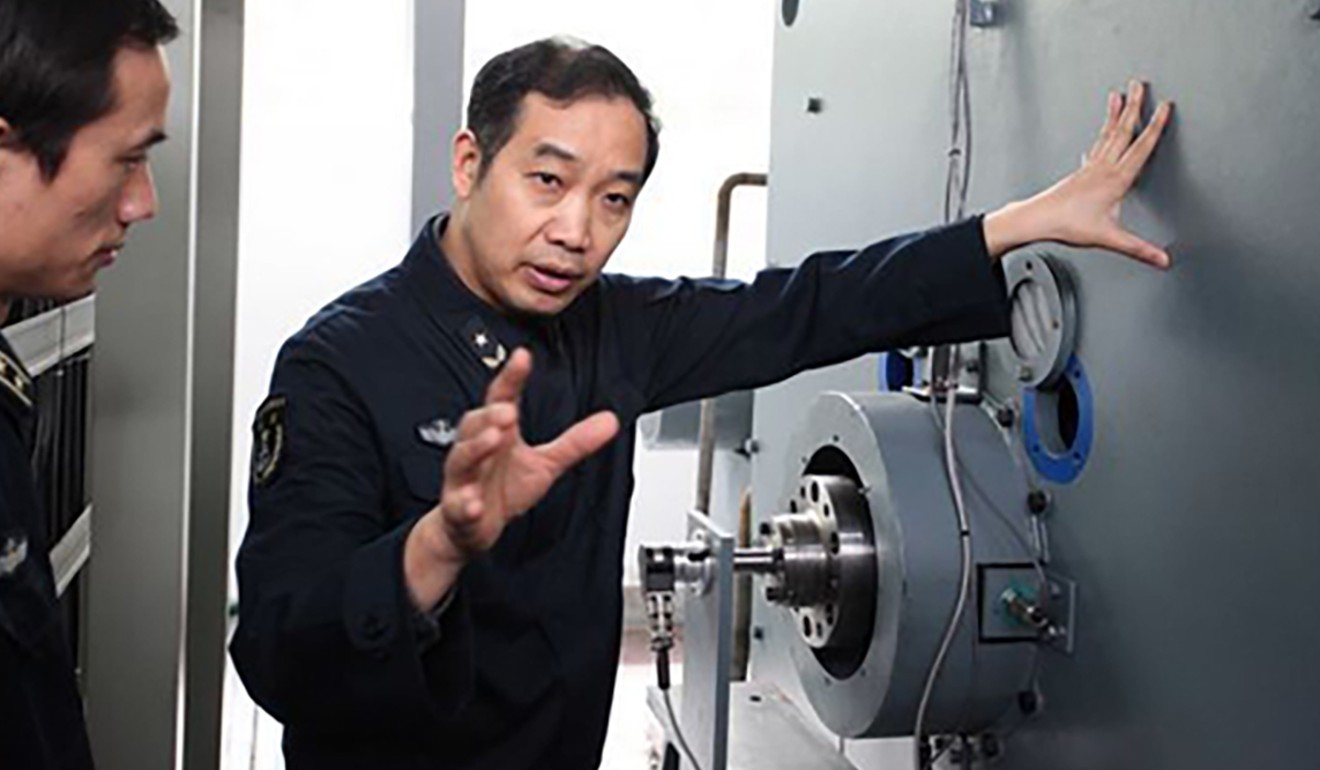
Real Admiral Ma Weiming (right) has been elevated to full membership of the Communist Party’s Central Committee. Photo: SCMP
Rear Admiral Ma Weiming (right) has been elevated to full membership of the Communist Party’s Central Committee. Photo: SCMP
Li Jie, a Beijing-based military specialist, said the move showed China’s ambition to continue expanding its naval military power.
“Ma’s promotion signals that Beijing will devote more resources to developing strategic military hardware like large warships and assault landing ships,” he said.

The EMALS is regarded as a breakthrough for the People’s Liberation Army, as it will enable China’s second home-grown aircraft carrier – known as the Type 002 – to launch larger jets with bigger payloads on longer missions.

The system could result in fuel savings of up to 40 per cent. With a higher launch energy capacity, it will also be more efficient than steam catapults, allowing for improvements in ease of maintenance, increased reliability, and more accurate end-speed control and smoother acceleration.

Why Chinese submarines could soon be quieter than US ones
Ma, who comes from Yangzhou in eastern Jiangsu province, graduated from the PLA Naval University of Engineering in Wuhan in 1987 and earned a PhD in electrical engineering from Beijing’s Tsinghua University in 1996.

A specialist in maritime propulsion, electrical engineering and related fields, he has mentored more than 400 masters and doctoral students at the naval university.

He and his team have often been recognised for their work as greater emphasis has been put on research and development amid the country’s military modernisation.

China’s first home-built carrier will use steam catapults and a ski-jump deck to launch aircraft. Photo: Handout

Ma has twice won the National Science and Technology Progress Award and in 2015 was awarded the science and technology achievement prize by the Hong Kong-based Ho Leung Ho Lee Foundation.

According to news reports, in the 1980s Ma spotted a potential flaw with an electrical component China planned to buy from overseas to use on its submarines that would have made the vessels easier to detect. Though the manufacturer denied any such problem, Ma spent five years tweaking the product so that submarines fitted with the part became harder to spot.

Three catapult launchers spotted in image of China’s new aircraft carrier

Beijing-based military expert Zhou Chenming said Ma’s promotion could be seen as a national endorsement of his work on EMALS.

“Ma was elected as a Central Committee member because the party and the country recognise the strategic importance of his work as China is expanding into a naval power with a huge maritime interest to protect,” he said.

Zhou, however, said Ma’s promotion was made two years ago, but he could not be formally made a full member until a vacancy opened up this year.

Source: SCMP

25/10/2019

Xi stresses role of traditional Chinese medicine for “Healthy China”

BEIJING, Oct. 25 (Xinhua) — Chinese President Xi Jinping has underlined the important role of traditional Chinese medicine (TCM) in building “Healthy China.”

The country should carry on fine elements in TCM and innovate them, Xi said in a recent instruction, stressing that traditional medicine is a treasure of Chinese civilization embodying the wisdom of the nation and its people.

Xi’s instruction was delivered at a national conference of TCM held Friday in Beijing.

Xi said that equal importance should be placed on traditional Chinese and Western medicines and efforts be made to enable them to supplement each other and prosper together.

He also underlined the efforts to promote TCM internationally and fully develop its unique strength in preventing and treating diseases.

In an instruction also delivered at the conference, Premier Li Keqiang called TCM a great creation of the Chinese nation.

Li stressed promoting talent training, scientific and technological innovation, and research and development of medicines.

He required efforts to promote preservation, innovation and high-quality development of TCM so that it will contribute to the improvement of people’s health and wellbeing.

Addressing the event, Vice Premier Sun Chunlan pledged to thoroughly implement the leaders’ instructions.

People who made outstanding contribution to TCM development were awarded at the conference.

Source: Xinhua

28/02/2019

HKSAR gov’t sees Greater Bay Area development as golden opportunity

HONG KONG, Feb. 27 (Xinhua) — The financial secretary of China’s Hong Kong Special Administrative Region (HKSAR) government delivered Hong Kong’s annual budget on Wednesday, saying the Guangdong-Hong Kong-Macao Greater Bay Area offers golden opportunities for Hong Kong to explore new directions and open up new horizons.

To support implementation of various measures, the budget, themed “supporting enterprises, safeguarding jobs, stabilizing the economy, strengthening livelihoods,” provides new resources ready for use of about 150 billion HK dollars (about 19.1 billion U.S. dollars), with additional resources earmarked for various purposes.

“This demonstrates our determination to enhance public services, support enterprises, relieve people’s burden and invest for the future,” Financial Secretary of the HKSAR government Paul Chan said.

Under mounting external pressures, Hong Kong’s economic growth moderated from 4.1 percent in the first half of 2018 to 2.1 percent in the second half of the year, with growth for the fourth quarter at a mere 1.3 percent, the lowest since the first quarter of 2016, he said.

Overall, Hong Kong’s economy grew by 3 percent in 2018, at the lower end of the range projected in last year’s Budget but still higher than the trend growth rate of 2.8 percent over the past decade, he added.

Chan forecast a surplus of 58.7 billion HK dollars for 2018-19. Fiscal reserves are expected to reach 1,161.6 billion HK dollars by March 31, 2019; economic growth of 2 to 3 percent in real terms for Hong Kong in 2019.

He said the development of innovation and technology (I&T) will bring huge economic benefits to Hong Kong, adding that sufficient resources, with a commitment of over 100 billion HK dollars has been allocated in this area so far.

More efforts will be made to support scientific research and I&T sectors by developing I&T infrastructure, promoting research and development (R&D), pooling talent, supporting enterprises and promoting reindustrialization.

Talking about national development strategy, Chan emphasized that the Greater Bay Area development and the Belt and Road Initiative are providing rare opportunities for Hong Kong.

Chan said that the outline development plan for the Greater Bay Area, promulgated last week, is a milestone setting out the development directions for the Greater Bay Area up to 2035.

Hong Kong, positioned as international financial, transportation and trade centers as well as an international aviation hub in the Greater Bay Area, will strengthen its roles as a global offshore Renminbi business hub and an international asset and risk management center; and will devote great efforts to develop I&T industries as well as international legal and dispute resolution services, the financial chief said.

Meanwhile, the Belt and Road Initiative will create greater room for Hong Kong’s economic and social development. There has been positive outcomes in areas such as supporting industries in exploring markets, establishing business matching platforms for enterprises and encouraging Hong Kong’s professional services sector to participate in Belt and Road projects.

As for land supply, Chan said, the HKSAR government will ensure that adequate resources are provided to support fully the short, medium and long-term measures to increase land and housing supply.

The estimated public housing production for the next five years is about 100,400 units and the supply of first-hand private residential units is expected to remain at a relatively high level in the coming three to four years at about 93,000 units, according to Chan. (1 U.S. dollar = 7.84 HK dollars)

Source: Xinhua

Law of Unintended Consequences

continuously updated blog about China & India

ChiaHou's Book Reviews

continuously updated blog about China & India

What's wrong with the world; and its economy

continuously updated blog about China & India