Chindia Alert: You’ll be Living in their World Very Soon
aims to alert you to the threats and opportunities that China and India present. China and India require serious attention; case of ‘hidden dragon and crouching tiger’.
Without this attention, governments, businesses and, indeed, individuals may find themselves at a great disadvantage sooner rather than later.
The POSTs (front webpages) are mainly 'cuttings' from reliable sources, updated continuously.
The PAGEs (see Tabs, above) attempt to make the information more meaningful by putting some structure to the information we have researched and assembled since 2006.
BEIJING (Reuters) – Tang Yue, a 27-year-old teacher from the city of Guilin in southwest China, steam-presses a blue dress and takes dozens of photographs before picking one to clinch her 200th online sale.
For a growing number of Chinese like Tang, hit by job losses, furloughs and salary cuts, the consumer economy has begun to spin in reverse. They are no longer buying – they are selling.
Instead of emerging from the coronavirus epidemic and returning to the shopping habits that helped drive the world’s second-largest economy, many young people are offloading possessions and embracing a new-found ethic for hard times: less is more.
With Tang’s monthly salary of about 7,000 yuan ($988), the self-described shopaholic said she has bought everything from Chanel lipsticks to Apple’s (AAPL.O) latest iPad in the past three years.
But the adrenaline rush that comes with binge-shopping is gone, said Tang, whose wages have been slashed with the suspension of all the classes on tourism management she usually teaches.
“The coronavirus outbreak was a wake-up call,” she said. “When I saw the collapse of so many industries, I realised I had no financial buffer should something unfortunate happen to me.”
There is no guarantee that the nascent minimalist trend will continue once the coronavirus crisis is fully over, but if it does, it could seriously damage China’s consumer sector and hurt thousands of businesses from big retailers to street-corner restaurants, gyms and beauty salons.
To be sure, there are signs that pent-up demand will drive a rush of spending as authorities reopen malls, leisure venues and tourist spots. In South Korea, the first major economy outside of China to be hit by the virus, people thronged malls this weekend to go “revenge shopping” to make up for time lost in lockdown.,
There are some signs that a similar trend will take hold in China, where some upscale malls are starting to get busy, although luxury firm Kering SA (PRTP.PA) – which owns Gucci, Balenciaga and other fashion brands – has said it is hard to predict how or when sales in China might come back.
A recent McKinsey & Co survey showed that between 20% and 30% of respondents in China said they would continue to be cautious, either consuming slightly less or, in a few cases, a lot less.
“The lockdown provided consumers with a lot of time and reasons to reflect and consider what is important to them,” said Mark Tanner, managing director at Shanghai-based research and marketing consultancy China Skinny.
“With much more of their days spent in their homes, consumers also have more time and reasons to sort through things they don’t feel they need – so they’re not living around clutter that is common in many apartments.”
#DITCHYOURSTUFF
Tang made a spreadsheet to keep track of her nearly 200 cosmetic products and hundreds of pieces of clothing. She then marked a few essentials in red that she wanted to keep. In the past two months, she has sold items worth nearly 5,000 yuan on second-hand marketplaces online.
Bargain-hunting online has become a new habit for some Chinese as the stigma that once hung over second-hand goods has begun to fade.
Idle Fish, China’s biggest online site for used goods, hit a record daily transaction volume in March, its parent company Alibaba (BABA.N) told Reuters.
Government researchers predict that transactions for used goods in China may top 1 trillion yuan ($141 billion) this year.
Posts with the hashtag #ditchyourstuff have trended on Chinese social media in recent weeks, garnering more than 140 million views.
Jiang Zhuoyue, 31, who works as an accountant at a traditional Chinese medicine company in Beijing – one of the few industries that may benefit from the health crisis – has also decided to turn to a simpler life.
“I used to shop too much and could be easily lured by discounts,” said Jiang. “One time Sephora offered 20% off for all goods, I then bought a lot of cosmetics because I feel I’m losing money if I don’t.”
Jiang, the mother of a 9-month-old baby, said she recently sold nearly 50 pieces of used clothing as the lockdown gave her the opportunity to clear things out. “It also offered me a chance to rethink what’s essential to me, and the importance of doing financial planning,” she said.
Eleven Li, a 23-year-old flight attendant, said she used to spend her money on all manner of celebrity-endorsed facial masks, snacks, concert tickets and social media activity, but now has no way to fund her spending.
“I just found a new job late last year, then COVID-19 came along, and I haven’t been able to fly once since I joined, and I’ve gotten no salary at all,” said Li, who said she was trying to sell her Kindle.
Some are even selling their pets, as they consider leaving big cities like Beijing and Shanghai where the high cost of living is finally catching up with them.
NO RETURN TO OLD WAYS?
As the coronavirus comes under control in China, the government is gradually releasing cities from lockdown, easing transport restrictions and encouraging consumers to venture back into malls and restaurants by giving out billions-worth of cash vouchers, worth between 10 yuan and 100 yuan.
But many people say they are still worried about job security and potential wage cuts because of the struggling economy. Nationwide retail sales have plunged every month so far this year.
Xu Chi, a Shanghai-based senior strategic analyst with Zhongtai Securities, said some Chinese consumers may prove the ‘21 Day Habit Theory,’ a popular scientific proposition that it only takes that long to establish new habits.
“We believe people’s spending patterns follow the well-known theory, which means most people in China, having been cooped-up at home for more than a month and not having binge-shopped, may break the habit and not return to their old ways,” Xu said.
Jiang said she was determined not to return to her free-spending ways and planned to cook more at home.
“I’ll turn to cheaper goods for some luxury brands,” she said. “I’ll choose Huawei’s smartphone, because (Apple’s) iPhone has too much brand premium.”
Tang, who has recently used 100 yuan of shopping coupons to stock up on food, is going to hold the purse strings even tighter.
“I’ve set my monthly budget at 1,000 yuan,” she said. “Including one – and just one – bottle of bubble tea.”
China’s economy shrank for the first time in decades in the first quarter of the year, as the virus forced factories and businesses to close.
The world’s second biggest economy contracted 6.8% according to official data released on Friday.
The financial toll the coronavirus is having on the Chinese economy will be a huge concern to other countries.
China is an economic powerhouse as a major consumer and producer of goods and services.
This is the first time China has seen its economy shrink in the first three months of the year since it started recording quarterly figures in 1992.
“The GDP contraction in January-March will translate into permanent income losses, reflected in bankruptcies across small companies and job losses,” said Yue Su at the Economist Intelligence Unit.
Last year, China saw healthy economic growth of 6.4% in the first quarter, a period when it was locked in a trade war with the US.
In the last two decades, China has seen average economic growth of around 9% a year, although experts have regularly questioned the accuracy of its economic data.
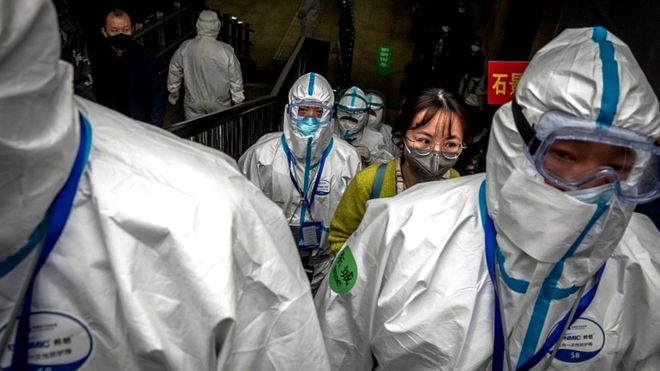
Its economy had ground to a halt during the first three months of the year as it introduced large-scale shutdowns and quarantines to prevent the virus spread in late January.
As a result, economists had expected bleak figures, but the official data comes in slightly worse than expected.
Among other key figures released in Friday’s report:
Factory output was down 1.1% for March as China slowly starts manufacturing again.
Retail sales plummeted 15.8% last month as many of shoppers stayed at home.
Unemployment hit 5.9% in March, slightly better than February’s all-time high of 6.2%.
Analysis: A 6% expansion wiped out
Robin Brant, BBC News, Shanghai
The huge decline shows the profound impact that the virus outbreak, and the government’s draconian reaction to it, had on the world’s second largest economy. It wipes out the 6% expansion in China’s economy recorded in the last set of figures at the end of last year.
Beijing has signalled a significant economic stimulus is on the way as it tries to stabilise its economy and recover. Earlier this week the official mouthpiece of the ruling Communist Party, the People’s Daily, reported it would “expand domestic demand”.
But the slowdown in the rest of the global economy presents a significant problem as exports still play a major role in China’s economy. If it comes this will not be a quick recovery.
On Thursday the International Monetary Fund forecast China’s economy would avoid a recession but grow by just 1.2% this year. Job figures released recently showed the official government unemployment figure had risen sharply, with the number working in companies linked to export trade falling the most.
China has unveiled a range of financial support measures to cushion the impact of the slowdown, but not on the same scale as other major economies.
“We don’t expect large stimulus, given that that remains unpopular in Beijing. Instead, we think policymakers will accept low growth this year, given the prospects for a better 2021,” said Louis Kuijs, an analyst with Oxford Economics.
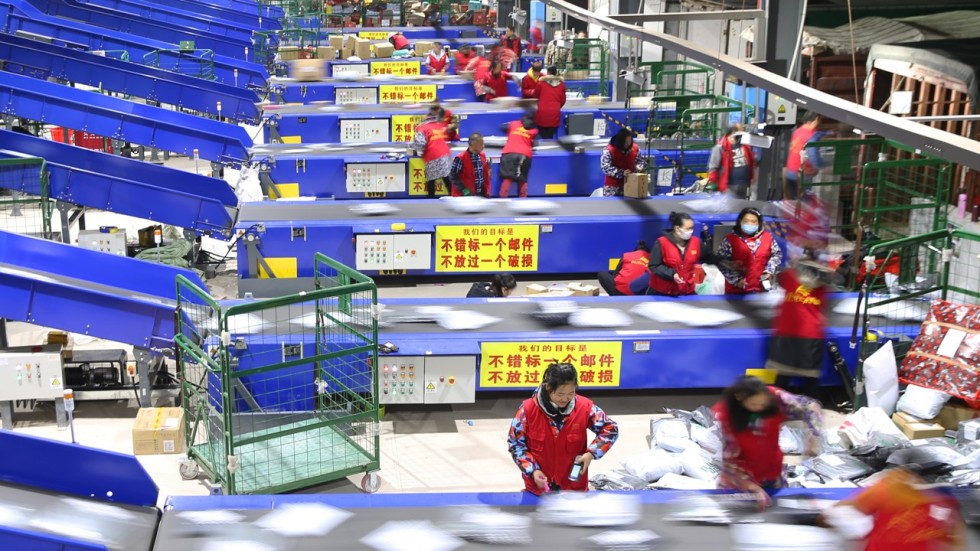
Since March, China has slowly started letting factories resume production and letting businesses reopen, but this is a gradual process to return to pre-lockdown levels.
Media caption Why does China’s economy matter to you?
China relies heavily on its factories and manufacturing plants for economic growth, and has been dubbed “the world’s factory”.
Stock markets in the region showed mixed reaction to the Chinese economic data, with China’s benchmark Shanghai Composite index up 0.9%.
Beijing had high hopes that tax cuts for individuals would lift consumer spending and boost an economy which is showing the effects of the trade war, but overall retail sales in November proved disappointing.
November’s retail sales, which covers both corporate and consumer spending, stood at 3.52 trillion yuan, down from 3.55 trillion yuan in October, according to data released by the National Bureau of Statistics on Friday.
The growth rate fell to 8.1 per cent compared to November 2017, below the 8.6 per cent rate in October. The figure was also below the 8.8 per cent growth forecast by a Bloomberg poll of economists. Adjusted for inflation, the growth was even lower, at 5.8 per cent.
As the US-China trade war continues to weigh on exports, Beijing is counting on households and companies to spend more to stabilise growth.
However, weak consumption underscores the difficulties the Chinese leadership is having in its efforts to keep the economy stable.
The government expected that its October move to raising the threshold for taxable personal income to 5,000 yuan per month would release unlock spending power equivalent to hundreds of billions of yuan.
It appears likely that some consumers saved their extra income for the November 11 shopping festival, when they can benefit from large discounts.
Shen Li, a physical therapist from Beijing, said his monthly after-tax income increased by 1,000 yuan due to the tax cut, which he used to purchase items such as household appliances on Singles’ Day.
Singles’ Day, China’s version of the US’ Black Friday, is often seen as a gauge of Chinese consumers’ spending power, but in the past it has not been able to drive up total retail sales figures.
This year’s Singles’ Day sales across Alibaba’s e-commerce platforms totalled US$30.8 billion, dwarfing the online sale numbers for Black Friday and Cyber Monday combined. But the growth rate of total transactions fell to 27 per cent, from last year’s 39 per cent.
The late October launch of Apple’s new iPhone XR, which is cheaper than the earlier iPhone XS series, did not boost telecom sales in China, which dropped 5.9 per cent in November year on year, to 48.5 billion yuan.
However, a plunge in car sales was the main culprit for weak consumption. Auto sales were down 10 per cent on a year earlier, to 345.9 billion yuan, according to the statistics bureau figures, as auto dealers struggled to clear their inventories.
This matched industry surveys from the China Passenger Car Association (CPCA), which reported this week that retail sales of sedans, multi-purpose vehicles and sport utility vehicles plunged 18 per cent to 2.05 million units last month, which makes a full-year decline very likely in the world’s largest auto markets.
Ding Shuang, chief China economist from Standard Chartered Bank, said weak auto sales were caused by the expiration of tax rebates for smaller cars, a slowdown in consumer loans partly due to the crackdown in online peer-to-peer lending platforms, and subdued property investment, since new homes are often sold together with garages.
Local commentators worried about ‘downgrading’ of consumption in 2018 as spending on premium goods slowed.
The growth of real estate investment from January to November remained stable at the 9.7 per cent rate seen in the January to October period.
“The decline of consumers’ abilities and willingness to spend is going to first cut down on big ticket items like cars,” said Jiang Chao, chief economist from Haitong Securities. “Auto accounts for two-thirds of China’s consumption of consumer durables.”
Rising household debt has given Chinese policymakers few options to boost spending other than cutting taxes. China’s household debt-to-GDP rose to 49.3 per cent in the first quarter, which was lower than in advanced economies but higher than the average 40 per cent among emerging economies, according to the Bank of International Settlements.
“Household debt will continue to rise and so debt service costs will remain a drag on consumption. But the debt service burden on households should not get much worse unless there is a big acceleration in credit growth (which we do not expect),” Ernan Cui, an analyst from research firm Gavekal Dragonomics, wrote in a report.
“Local commentators worried about ‘downgrading’ of consumption in 2018 as spending on premium goods slowed,” Cui said. “The biggest boom in products favoured by affluent households is probably over, but consumption upgrading will continue as long as income growth does.”
NBS spokesman Mao Shengyong said at a press conference on Friday that China still had the potential to maintain a stable and fast rate of consumption growth next year, given the rise in the number of middle class citizens.
Economists are eyeing new individual tax deductions that will go into effect next year and more tax relief for private companies to prevent the economy from slowing further.
A more complex tax deduction policy which takes in six types of expenses – from elderly care to medical costs- could inject an additional 80 billion yuan in consumers spend, according to Cui’s estimate.
Beijing has also indicated that it will tighten the collection of social insurance contributions that employers are required to pay, but analysts fear that this could negate the benefits of the tax deductions for employees.





 CHINDIA ALERT: You'll be living in their world, very soon
