22/05/2020
- The rhetoric towards the self-ruled island has hardened in Premier Li Keqiang’s annual work report
- Beijing regards Taiwan as one of its core national interests and says it ‘resolutely opposes’ any separatist activity
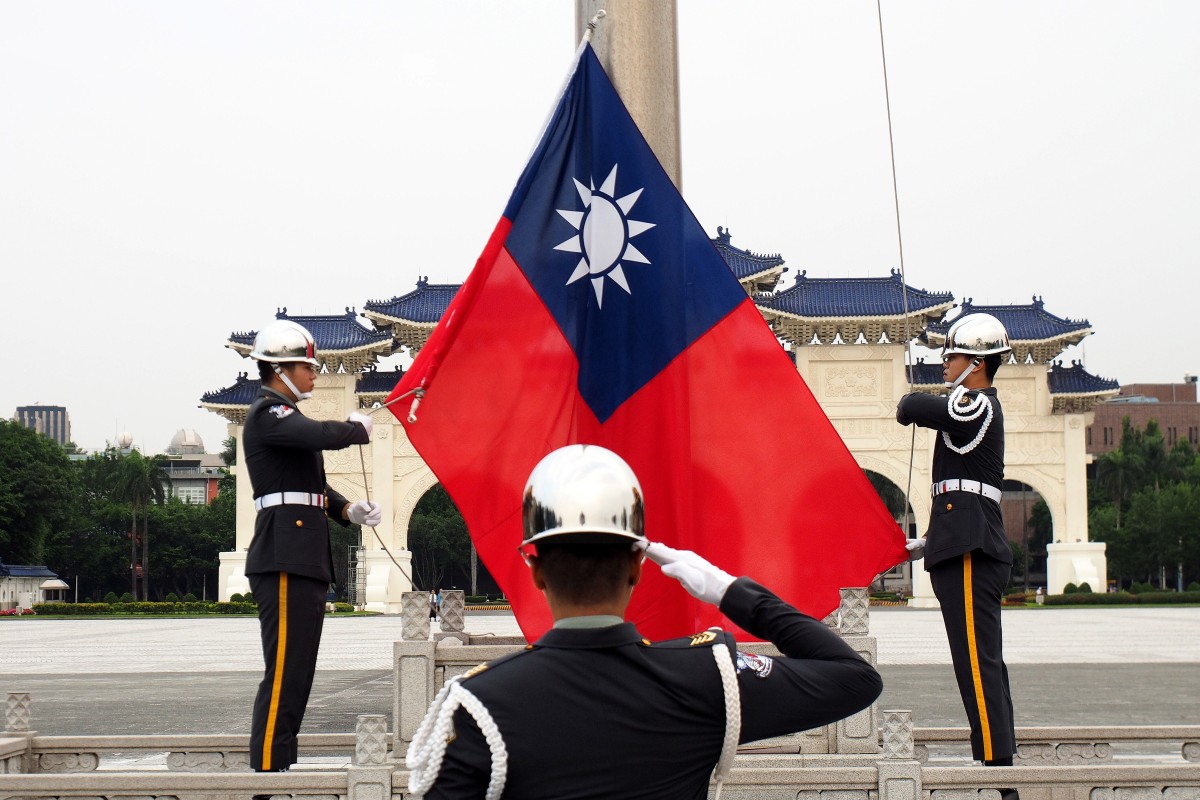
Beijing regards reunification with Taiwan as one of its core interests. Photo: EPA-EFE
Beijing has hardened its rhetoric towards Taiwan, removing references to “peaceful reunification”, in the government’s annual work report.
Observers said the change reflected the stronger stance Beijing would adopt in tackling the Taiwan issue, which it regards as one of its key national interests.
The past six work reports since President Xi Jinping took power in 2013 stressed peaceful reunification and the 1992 consensus – under which both sides tacitly agree there is only one China, but have different interpretations on what this means.
But the latest report from Premier Li Keqiang took a different tone, saying: “We will adhere to the major principles and policies on work related to Taiwan and resolutely oppose and deter any separatist activities seeking ‘Taiwan independence’.”
US to sell US$180 million worth of submarine-launched torpedoes to Taiwan
“We will improve institutional arrangements, policies, and measures to encourage exchanges and cooperation between the two sides of the Taiwan Strait, further cross-strait integrated development, and protect the well-being of our compatriots in Taiwan,” the report said.
“We will encourage them to join us in opposing ‘Taiwan independence’ and promoting China’s reunification.
“With these efforts, we can surely create a beautiful future for the rejuvenation of the Chinese nation,” it said, dropping a clause that described the process as “peaceful”.
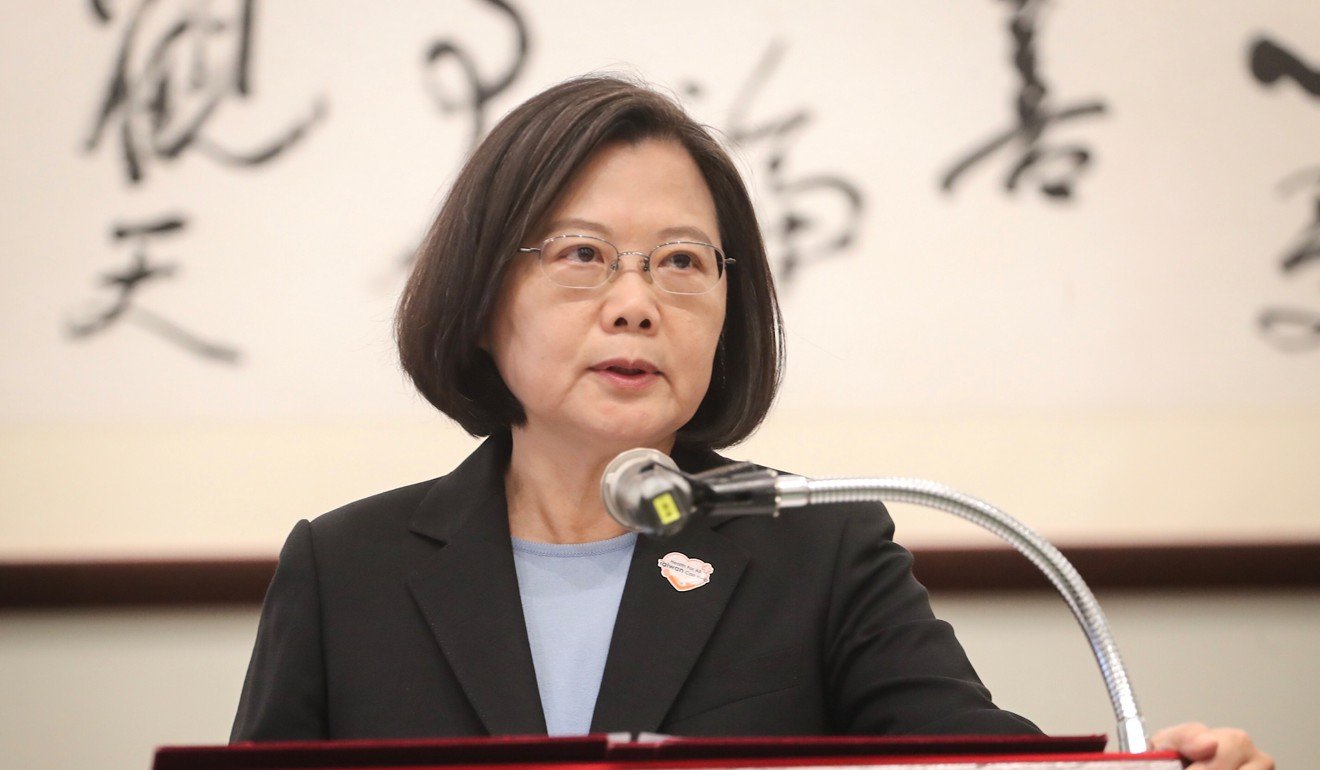
The 1992 consensus allows leeway for both parties to negotiate an agreement, but President Tsai Ing-wen has said the island would never accept it as the basis for cross-strait relations.
Taiwan’s Mainland Affairs Council said on Friday that the “one country, two systems” framework, touted by Beijing as a political basis for unification, had harmed cross-strait relations. It called for the two sides to work together to resolve their differences.
Tang Shao-cheng, an international relations specialist at Taiwan’s National Chengchi University, said the change in wording and tone of the Taiwan section of the work report could be seen as a warning to Tsai’s independence-leaning Democratic Progressive Party (DPP).
“Not mentioning ‘peace’ suggests Beijing is considering unification both by peaceful means and by force,” Tang said.
President Xi Jinping and Premier Li Keqiang at the National People’s Congress opening session on Friday. Photo: Kyodo
Derek Grossman, an analyst from US-based think tank Rand Corporation, said Beijing would continue to put pressure on the island using diplomatic, military, economic and psychological means.
“Beijing will continue to send military aircraft near the island … [it] could decide to end the Economic Cooperation Framework Agreement which has remained active in spite of Tsai’s election in 2016; Beijing could steal one or more diplomatic partners from Taipei. I would expect these types of actions to be on the table,” Grossman said.
How would mainland China attack Taiwan? A video outlines one scenario
Sun Yun, director of the China programme at the Stimson Centre think tank in the US, said Beijing faced a dilemma on whether to continue economic integration with Taiwan because that had not had the political effect it wanted.
“The obstacles to unification are not economic, but political. Taiwan is unwilling to pursue unification with an authoritarian mainland. To solve that issue, presumably the mainland could pursue political reform. But in reality, the Chinese Communist Party is unwilling,” she said.
“If the economic and political approach doesn’t work, what’s left is the military approach. But with US intervention, the mainland will not prevail.”
Beijing recently warned Washington it would respond after US Secretary of State
, and demanded that the US stop selling arms to the island.
Joshua Eisenman, a professor from the University of Notre Dame in Indiana, said Beijing was running out of countermeasures, since its actions had only hardened attitudes on the island and enhanced the sense of Taiwanese identity.
“As I see it, all that remains is for the [Chinese Communist Party[ to sit down and talk to the DPP without preconditions and establish a modus vivendi for cross-strait relations,” he said.
Source: SCMP
Posted in "Taiwan independence", activity, annual, ‘resolutely opposes’, “one country, two systems”, Beijing, chinese communist party, chinese government, compatriots, countermeasures, Cross-Strait relations, Democratic Progressive Party (DPP), diplomatic partners, drops, Economic Cooperation Framework Agreement, hardened, independence-leaning, Indiana, Mainland Affairs Council, Mainland China, Mike Pompeo, modus vivendi, national interests, National People’s Congress, peaceful, Premier Li Keqiang, Premier Li Keqiang’s, President Xi Jinping, RAND Corporation, references, reunification, self-ruled island, Separatist, Stimson Centre, Taipei, Taiwan, Taiwan Strait, Uncategorized, University of Notre Dame, US Secretary of State, work report |
Leave a Comment »
20/05/2020
TAIPEI (Reuters) – Taiwan cannot accept becoming part of China under its “one country, two systems” offer of autonomy , President Tsai Ing-wen said on Wednesday, strongly rejecting China’s sovereignty claims and likely setting the stage for an ever worsening of ties.
China responded that “reunification” was inevitable and that it would never tolerate Taiwan’s independence.
In a speech after being sworn in for her second and final term in office, Tsai said relations between Taiwan and China had reached an historical turning point.
“Both sides have a duty to find a way to coexist over the long term and prevent the intensification of antagonism and differences,” she said.
Tsai and her Democratic Progressive Party won January’s presidential and parliamentary elections by a landslide, vowing to stand up to China, which claims Taiwan as its own and says it would be brought under Beijing’s control by force if needed.
“Here, I want to reiterate the words ‘peace, parity, democracy, and dialogue’. We will not accept the Beijing authorities’ use of ‘one country, two systems’ to downgrade Taiwan and undermine the cross-strait status quo. We stand fast by this principle,” Tsai said.
China uses the “one country, two systems” policy, which is supposed to guarantee a high degree of autonomy, to run the former British colony of Hong Kong, which returned to Chinese rule in 1997. It has offered it to Taiwan, though all major Taiwanese parties have rejected it.
China’s Taiwan Affairs Office, responding to Tsai, said Beijing would stick to “one country, two systems” – a central tenet of Chinese President Xi Jinping’s Taiwan policy – and “not leave any space for Taiwan independence separatist activities”.
“Reunification is a historical inevitability of the great rejuvenation of the Chinese nation,” it said. “We have the firm will, full confidence, and sufficient ability to defend national sovereignty and territorial integrity.”
China views Tsai as a separatist bent on formal independence for Taiwan. Tsai says Taiwan is an independent state called the Republic of China, its official name, and does not want to be part of the People’s Republic of China governed by Beijing.
TAIWAN OPEN TO DIALOGUE
China has stepped up its military drills near Taiwan since Tsai’s re-election, flying fighter jets into the island’s air space and sailing warships around Taiwan.
Tsai said Taiwan has made the greatest effort to maintain peace and stability in the narrow Taiwan Strait that separates the democratic island from its autocratic neighbour China.
“We will continue these efforts, and we are willing to engage in dialogue with China and make more concrete contributions to regional security,” she added, speaking in the garden of the old Japanese governor’s house in Taipei, in front of a socially-distanced audience of officials and diplomats.
Taiwan has become a rising source of friction between China and the United States, with the Trump administration strongly backing Taiwan even in the absence of formal diplomatic ties.
U.S. Secretary of State Mike Pompeo sent his congratulations to Tsai on Tuesday, praising her “courage and vision in leading Taiwan’s vibrant democracy”, in a rare high-level message from Washington direct to Taiwan’s government.
China’s Foreign Ministry condemned Pompeo’s remarks, and said the government would take “necessary countermeasures”, though did not elaborate.
China cut off a formal talks mechanism with Taiwan in 2016 after Tsai first won election.
Yao Chia-wen, a senior adviser to Tsai, told Reuters the chance of talks with China were small given ongoing tensions.
“We are ready to engage with them any time, but China is unlikely to make concessions to Taiwan,” he said. “In the next four years there’s little chance for the cross-strait relationship to improve.”
Source: Reuters
Posted in antagonism, authorities, autocratic, autonomy, ‘peace, parity, democracy, and dialogue’, “necessary countermeasures”, Beijing, by force, central tenet, China, China’s Foreign Ministry, China’s sovereignty, Chinese President Xi Jinping’s, claims, coexist, condemned, congratulations, cross-strait, democratic island, Democratic Progressive Party, differences, downgrade, elaborate, Elections, former, former British colony, Government, guarantee, historical, Hong Kong, independence, inevitable, intensification, Japanese governor’s house, Landslide, Mike Pompeo, military drills, neighbour, parliamentary, People’s Republic of China, President, President Tsai Ing-wen, presidential, principle, rejects, rejuvenation, remarks, Republic of China, reunification, rule, status quo, Taipei, Taiwan, Taiwan Affairs Office, Taiwan Strait, Trump administration, turning point, U.S. Secretary of State, Uncategorized, undermine, United States, Washington |
Leave a Comment »
27/03/2020
- Legislation ‘blatantly obstructs other sovereignties from developing legitimate diplomatic relations with China’, foreign ministry says
- US president’s decision could damage efforts by Beijing and Washington to work together in the fight against Covid-19, observers say
The United States’ new Taipei Act aims to discourage Taiwan’s allies from cutting diplomatic ties with the island due to pressure from Beijing. Photo: EPA-EFE
Beijing has condemned
US President Donald Trump’s decision to sign into law an act designed to bolster Taiwan’s diplomatic standing in the world, describing it as an act of hegemony.
“China expresses its strong indignation and firmly opposes the bill,” foreign ministry spokesman Geng Shuang told a press conference on Friday.
The legislation, he said, “blatantly obstructs other sovereignties from developing legitimate diplomatic relations with China, which is an act of hegemony” adding that it also “seriously violated the one-China principle … [and] brutally interferes in Chinese domestic affairs”.
Trump signed the Taiwan Allies International Protection and Enhancement Initiative (Taipei) Act of 2019 on Thursday, just hours before speaking to Chinese President Xi Jinping over the telephone to discuss how the two countries can work together to tackle the coronavirus pandemic.
China calls for ‘concrete steps’ from US to cooperate on fighting Covid-19
27 Mar 2020
The legislation aims to discourage Taiwan’s diplomatic allies from cutting ties with the island due to pressure from Beijing. It also requires the US to supplement its own diplomatic presence in countries that support Taiwan and reduce its diplomatic footprint if they side with Beijing.
The bill was written by Republican senator for Colorado Cory Gardner and Democrat senator for Delaware Chris Coons, who said the US should support Taiwan in strengthening its alliances around the world amid increased pressure and “bullying tactics” from Beijing.
It was passed unanimously by the House of Representatives on March 4 after being reconciled with the Senate’s version that was approved in October.
Relations between Beijing and Taipei have been at a low ebb since
Tsai Ing-wen, from the independence-leaning Democratic Progressive Party, was elected president in 2016, and re-elected for a further four-year term in January.
Taiwan’s foreign ministry welcomed the legislation, thanking the United States for its support for the island’s “diplomatic space” and right to participate in world affairs.
In the coronavirus fog, tussling over Taiwan goes under the radar
27 Mar 2020
Observers said that while the new act would benefit Taipei on the world stage, it would also be detrimental to its relationship with Beijing, and could be damaging to the commitments made between Xi and Trump to work together to fight Covid-19.
“Given it has been suppressed by Beijing in recent years, the new act will help Taiwan to gain more support from the international community,” said Zheng Zhengqing, an expert on Taiwan affairs at Tsinghua University in Beijing.
He said that Xi believed Taipei’s international role should be decided by Beijing, not Washington.
“What Trump has done comes from the opposite direction … and could hinder engagement and cooperation between [mainland] China and the US amid the coronavirus outbreak and make matters worse,” he said.
Zhu Songling, a professor at the Institute of Taiwan Studies at Beijing Union University, said the Taipei Act had crossed a red line for Beijing and would bring further uncertainty to China-US relations, as well as relations across the Taiwan Strait.
Beijing considers
Taiwan part of its sovereign territory awaiting reunification with the mainland, by force if necessary.
Taipei-based political and military commentator Chi Le-yi said that while the new legislation was significant, it remained to be seen how it would affect Taiwan’s global standing or the stability of the Taiwan Strait amid the ongoing strategic gamesmanship between mainland China and the US.
“The bill itself is very meaningful, it has turned the US’s concerns about Taiwan issue into a legal issue,” he said.
“But its impact will depend on how it is implemented by America’s executive units.”
Source: SCMP
Posted in act, Beijing, Beijing Union University, blatantly, China, COVID-19, Democratic Progressive Party, describes, Donald Trump, Foreign Ministry, Institute of Taiwan Studies, legislation, legitimate diplomatic relations, mainland, obstructs, reunification, signing, sovereign territory, sovereignties, Taipei, Taipei Act, Taiwan, Taiwan Strait, Tsinghua University, Uncategorized, United States, Washington |
Leave a Comment »
21/01/2020

Chinese State Councilor and Foreign Minister Wang Yi addresses the 2020 new year reception of Chinese Foreign Ministry at the Diaoyutai State Guesthouse in Beijing, capital of China, Jan. 20, 2020. (Xinhua/Li Xiang)
BEIJING, Jan. 21 (Xinhua) — Chinese State Councilor and Foreign Minister Wang Yi on Monday reiterated China’s resolve on reunification.
The historical and legal fact that Taiwan is an inalienable part of China will not change no matter how the situation in Taiwan may evolve, Wang said when addressing the 2020 New Year reception hosted by the Chinese Foreign Ministry.
Nothing will shake the resolve and confidence of the Chinese government and people in advancing the reunification, he said.
The one-China principle has been a consensus shared by the international community and a universally recognized norm governing international relations, Wang said.
The annually reception was attended by nearly 400 diplomatic envoys and representatives of relevant Chinese departments.
Source: Xinhua
Posted in Chinese State Councilor and Foreign Minister Wang Yi, consensus, inalienable part of China, international community, New Year reception, one-China principle, reunification, Taiwan, Uncategorized |
Leave a Comment »
30/11/2019
- Zhuhai police, at the end of the world’s longest sea bridge, use body armour and tear gas in preparation for Macau’s 20th anniversary celebration
- Hong Kong is just an hour’s drive away from Macau using the bridge
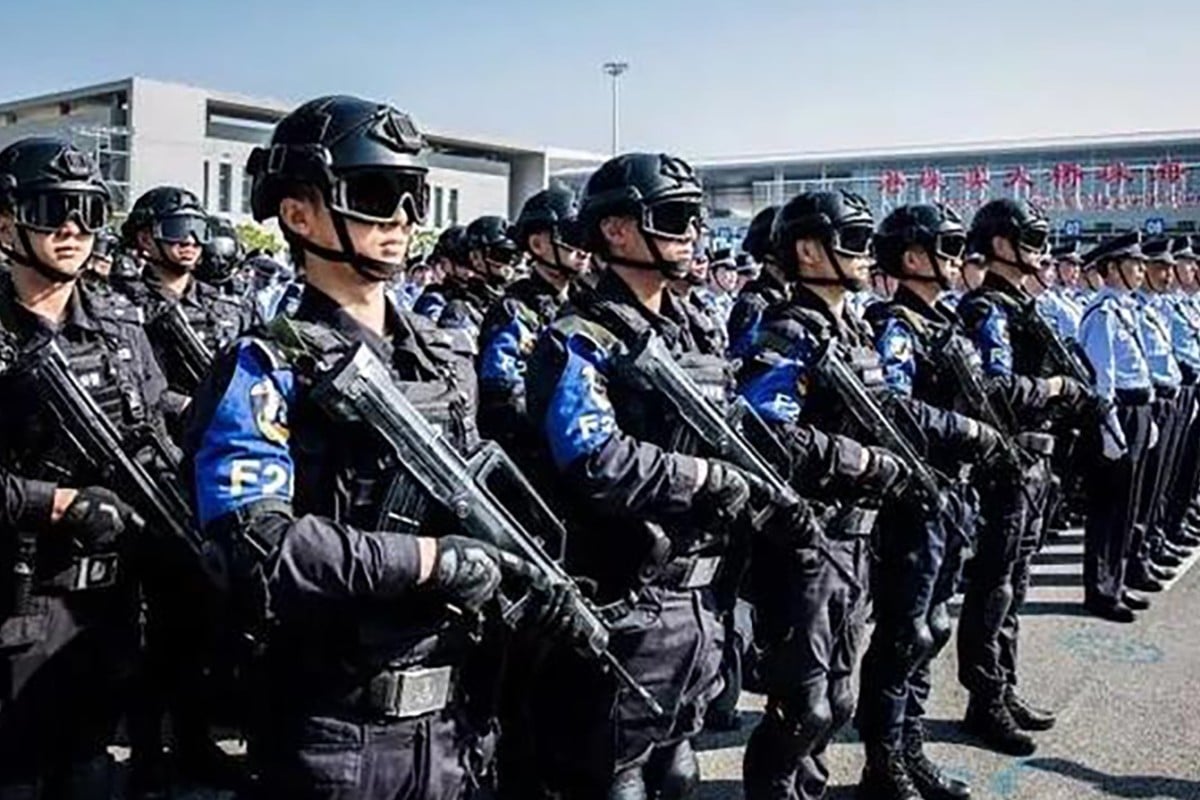
More than 1,000 police officers took part in the anti-terror drill in Zhuhai. Photo: Toutiao
Armed police in the southern Chinese city of Zhuhai held a massive anti-terror drill at its end of the Hong Kong-Zhuhai-Macau Bridge on Friday morning as part of its preparations for the 20th anniversary of the handover of Macau, when President Xi Jinping is expected to visit the city.
More than 1,000 police officers and 80 vehicles were involved in the exercise, amid
, according to local news portal Southcn.com.
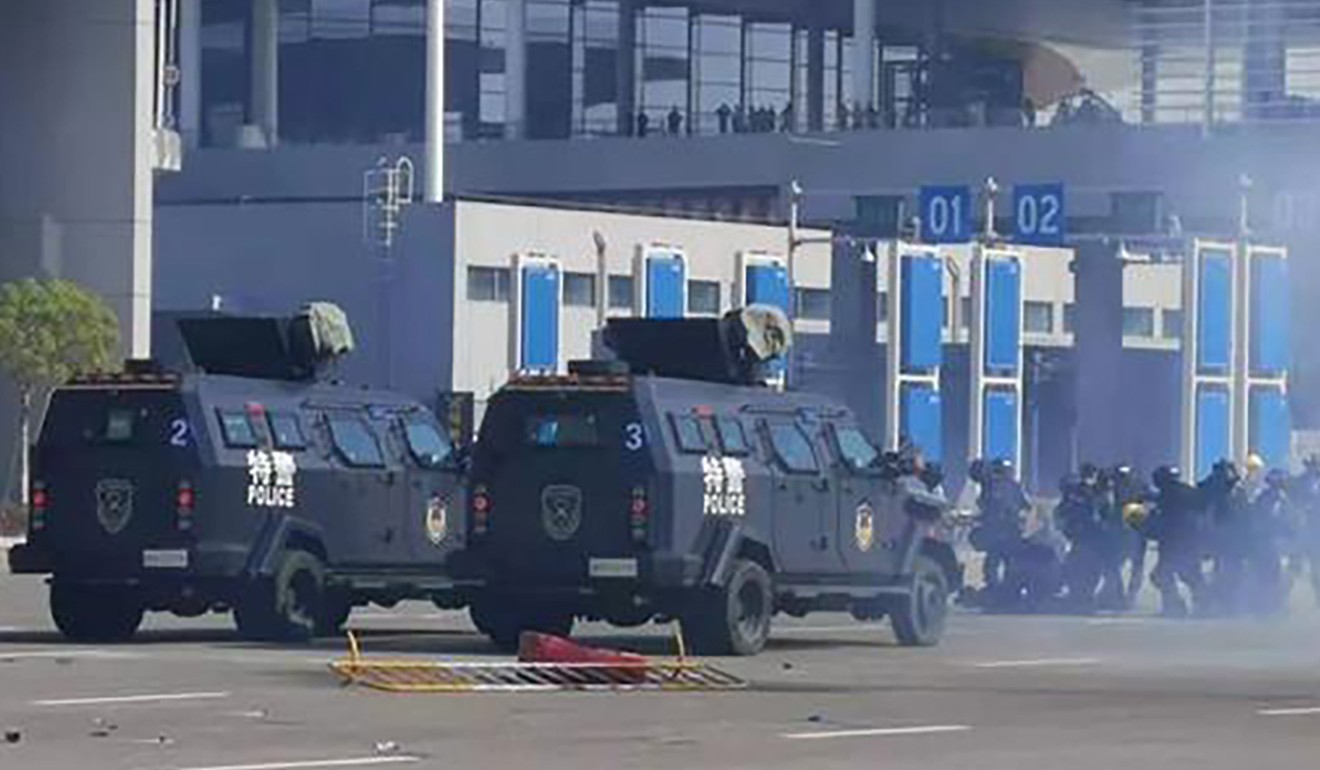
Photos circulated online showed officers in body armour, helmets and shields firing tear gas as they confronted a group of people carrying sticks and wearing black shirts and yellow helmets – attire associated with the protesters in Hong Kong, 60km (37 miles) away from Macau.
The drill was held three weeks before the 20th anniversary of Macau’s return to Chinese administration under the “one country, two systems” policy on December 20.
Police trucks and riot officers during Friday’s exercise at the Zhuhai end of the Hong Kong-Zhuhai-Macau Bridge. Photo: Toutiao
Security is expected to be tightened when Xi visits the city, in response to the violent clashes in Hong Kong over the past six months, which Beijing has repeatedly blamed on radical protesters.
The former Portuguese colony is connected to Hong Kong and its neighbouring city of Zhuhai, Guangdong province, by the world’s longest sea crossing bridge. It takes about an hour to drive from Hong Kong to Macau via the bridge.
Guo Yonghang, Zhuhai party chief, urged the local police to stay loyal to the party. “[Police] should be loyal and fulfil duty and mission to create a peaceful and stable political and social environment for the construction of the Guangdong-Hong Kong-Macau Greater Bay Area and the celebration of the 20th anniversary of Macau’s reunification to the motherland,” he said.
Macau was returned to China two years after Hong Kong and celebrations of its success under one country, two systems could be overshadowed by its neighbour’s anti-government protests which stemmed from opposition to proposed extradition legislation and have escalated into violence on the streets and in university campuses.
In August, two months after more than 2 million people in Hong Kong took to the streets to protest the now-suspended extradition bill, police in Shenzhen held at least three drills featuring anti-riot exercises involving tear gas, armoured vehicles and water cannon.
Source: SCMP
Posted in 20th anniversary, anniversary, anti-riot exercises, anti-terror, armoured vehicles, Beijing, body armour, celebration, chinese police, colony, connected, drill, extradition bill, former, guangdong province, Guangdong-Hong Kong-Macau Greater Bay Area, handover, helmets, Hong Kong, Hong Kong-Zhuhai-Macau Bridge, longest, longest sea crossing bridge, Macau, motherland, near, One country, two systems, policy, preparation, preparations, prepare, President Xi Jinping, reunification, sea bridge, Shenzhen, shields, Southcn.com, tear gas, Uncategorized, water cannon, world’s, Zhuhai police |
Leave a Comment »
30/05/2019
Wang Yang, a member of the Standing Committee of the Political Bureau of the Communist Party of China (CPC) Central Committee and chairman of the Chinese People’s Political Consultative Conference (CPPCC) National Committee, meets with a delegation from Taiwan led by New Party Chairman Yok Mu-ming in Beijing, capital of China, May 29, 2019. (Xinhua/Yao Dawei)
BEIJING, May 29 (Xinhua) — China’s top political advisor Wang Yang on Wednesday met with a delegation from Taiwan led by New Party Chairman Yok Mu-ming.
Wang, a member of the Standing Committee of the Political Bureau of the Communist Party of China Central Committee and chairman of the Chinese People’s Political Consultative Conference National Committee, stressed the greater national interests of pursuing reunification, which he said is an undeniable duty for every Chinese on both sides of the Taiwan Strait.
Wang expressed the mainland’s willingness to engage in talks and consultation with political parties, organizations and individuals from Taiwan on the basis of upholding the 1992 Consensus and opposing “Taiwan independence.”
He also pledged efforts to implement the consensus reached during consultations, deepen cross-Strait exchanges and integrated development, promote more favorable policies benefiting Taiwan, and encourage young people from Taiwan to study, work and start businesses on the mainland.
Noting that both sides of the Taiwan Strait belong to one China, Yok expressed hope for the two sides to cooperate more, and better understand each other, forging a strong common identity and the sense of mission to pursue peaceful reunification, so as to realize the rejuvenation of the Chinese nation at an early date.
Source: Xinhua
Posted in chairman of the Chinese People's Political Consultative Conference National Committee, China's top political advisor, New Party Chairman, rejuvenation, reunification, Standing Committee of the Political Bureau of the Communist Party of China Central Committee, Taiwan, Taiwan Strait, Uncategorized, wang yang, Yok Mu-ming |
Leave a Comment »
28/05/2019
- Coordination Council for North American Affairs becomes Taiwan Council for US Affairs, island’s foreign ministry says
- Move signifies ‘firm and close relationship between Taiwan and the US’, President Tsai Ing-wen says
Taiwan has changed the name of its de facto embassy in the United States to better reflect ever-improving ties between the sides. Photo: EPA
Taiwan has changed the name of its de facto embassy in the United States to better reflect relations between the sides, which are at their strongest in decades, Taipei said on Saturday.
Once the necessary formalities have been completed, the agency formerly known as the Coordination Council for North American Affairs will be called the Taiwan Council for US Affairs, the island’s foreign ministry said.
“The new name better reflects the [agency’s] role in coordinating US-Taiwan affairs. It also symbolises the close and amicable relations between Taiwan and the United States,” it said.
Observers said the name change was significant as it appeared to drop the pretence that the council was non-diplomatic or political in nature.
The name change was possible because of the consensus between Taiwan and the US. Photo: CNA
Although Washington severed formal diplomatic ties with Taipei in 1979 in favour of Beijing, the two sides retained unofficial relations that have grown ever-closer in recent years, including an increase in military exchanges and cooperation.
“The new name [was made possible] as a result of the consensus between Taiwan and the US,” the island’s President Tsai Ing-wen said in a Facebook post. “This is the first time the designations ‘Taiwan and the US’ have been used to refer to each other’s affairs office on an equal basis, signifying the firm and close relationship.”
Taiwan begins mass production of missile corvettes, minelayers
Taiwan had been forced to use the old title because of the “special historical background” related to the change in diplomatic allegiance 40 years ago, Tsai said.
Beijing, which considers Taiwan a wayward province awaiting reunification, by force if necessary, has demanded that Washington observe the one-China policy by not officially recognising Taiwan or allowing it to use either “Republic of China” – the island’s official name – or “Taiwan” in the title of its representative offices in the US.
Washington also enacted the Taiwan Relations Act in 1979 to prescribes relations with the island and includes a commitment to supply it with arms to protect itself.
“After continuous efforts and coordination by the two sides, and in 2019, the 40th anniversary of the Taiwan Relations Act, our office handling relations with the US is finally able to change its name,” Tsai said.
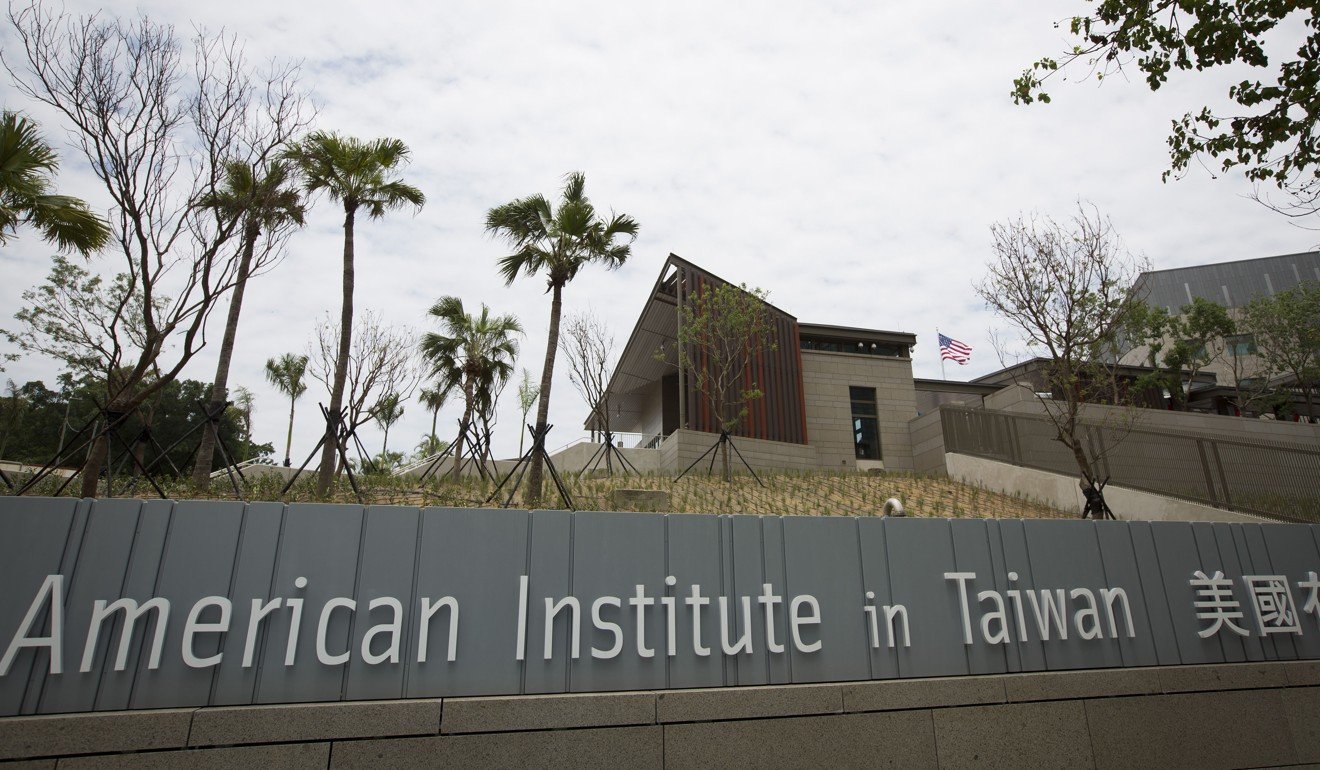
The American Institute in Taiwan relocated to a larger, purpose-built compound last month. Photo: Bloomberg
Presidential spokesman Alex Huang said the name change was due mainly to an improvement in relations between Taiwan and the US as a result of a greater cooperation on the promotion of regional peace and the Indo-Pacific security agenda.
“In the past few years, the US government has given Taiwan strong and firm support in terms of national security and participation in international events, as well as support from Congress and think tanks,” he said, referring to bills signed by US President Donald Trump that allow for exchanges between high-level officials and military personnel, and the approval of new sales of arms and logistical support to the island.
US official urges Pacific island nations to maintain diplomatic ties with Taiwan
Also, last week, Taiwan’s national security chief David Lee met US National Security Adviser John Bolton in Washington for the first talks of their kind since 1979, Taiwan’s Central News Agency reported on Saturday.
Last month, the American Institute in Taiwan – the United States’ unofficial embassy in Taipei – relocated to a significantly larger, purpose-built compound, in yet another sign of improving relations.
US support for Taiwan has increased under Trump’s leadership as he regards Beijing as a hostile competitor, not only on trade, but also in military and global influence terms.
Tensions between Taipei and Beijing have flared since Tsai became president in 2016 and refused to accept the one-China principle. The mainland subsequently halted all official exchanges with the island and embarked on a campaign to squeeze its diplomatic allies around the world.
Source: SCMP
Posted in American Institute in Taiwan, ‘reflect stronger ties’, Beijing, changes name, Congress, cooperation, Coordination Council for North American Affairs, de facto embassy, Foreign Ministry, Indo-Pacific security agenda, John Bolton, mass production, military exchanges, minelayers, missile corvettes, one-China policy, Pacific island nations, President Tsai Ing-wen, Republic of China, reunification, Taipei, Taiwan, Taiwan Council for US Affairs, Taiwan Relations Act, think tanks, Uncategorized, United States, US National Security Adviser, US President Donald Trump, Washington, wayward province |
Leave a Comment »
27/02/2019
BEIJING, Feb. 26 (Xinhua) — A senior Communist Party of China (CPC) official met with the 11th Panchen Lama Bainqen Erdini Qoigyijabu in Beijing Tuesday.
You Quan, a member of the Secretariat of the CPC Central Committee and head of the United Front Work Department of the CPC Central Committee, congratulated the Panchen Lama for the progress he made last year.
You expressed the hope that the Panchen Lama could make new achievements in maintaining China’s reunification and ethnic unity as well as in promoting Tibetan Buddhism to be more adaptable to the socialist society.
The Panchen Lama said he will closely follow the CPC Central Committee in terms of thinking, political orientation and actions.
He said he will keep his responsibilities in mind, serve the believers and further contribute to national reunification, ethnic unity, religious harmony, and people’s well-being.
Source: Xinhua
Posted in Bainqen Erdini Qoigyijabu, Beijing, Communist Party of China (CPC), ethnic unity, Panchen Lama, religious harmony, reunification, Secretariat of the CPC Central Committee, Uncategorized, United Front Work Department, well-being, You Quan |
Leave a Comment »






 CHINDIA ALERT: You'll be living in their world, very soon