Archive for ‘reveal’

08/05/2020

China ‘copycat’ buildings: Government clamps down on foreign imitations

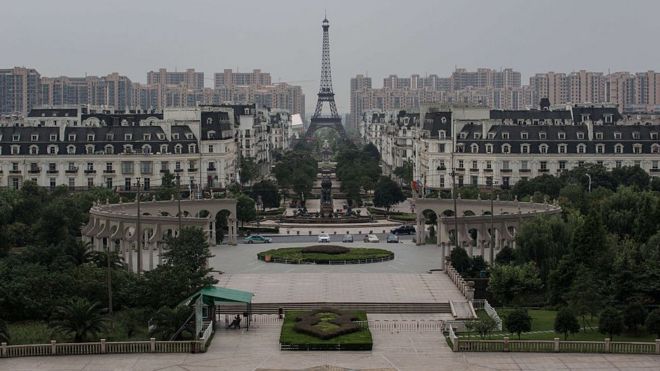
A replica of Paris in Tianducheng, Hangzhou, ZhejiangImage copyright GUILLAUME PAYEN / GETTY
Image caption – Paris? Actually a replica in Tianducheng, Hangzhou, Zhejiang province

From English towns, to Alpine villages, to the Eiffel Tower – copies of foreign architecture can be seen across China.

But now the government is clamping down, in order to promote local design.

A government statement says “plagiarising, imitating, and copycatting” designs is prohibited in new public facilities.

The statement says buildings “reveal a city’s culture” – and that “large, foreign, and weird” designs should be limited.

The guidelines also clamp down on new skyscrapers – limiting them, in general, to a maximum of 500 metres.
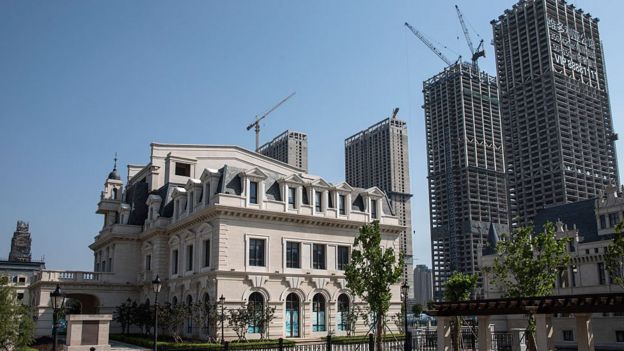
New European-style buildings in Dalian, ChinaImage copyright THIERRY FALISE / GETTY
Image caption New European-style buildings by tower blocks in Dalian, China

According to the Global Times, the “fake, shoddy versions” of foreign buildings appear in “many third and fourth-tier Chinese cities”.

The government did not say what will happen to existing “foreign” buildings, but does say there will be “city inspections” to check for problems.

The statement, issued on 27 April but only reported this week, singles out stadiums, exhibition centres, museums and theatres as public facilities where it’s especially important to ban plagiarism.

“City constructions are the combination of a city’s external image and internal spirit, revealing a city’s culture,” the government statement says.

It calls for a “new era” of architecture to “strengthen cultural confidence, show the city’s features, exhibit the contemporary spirit, and display the Chinese characteristics”.
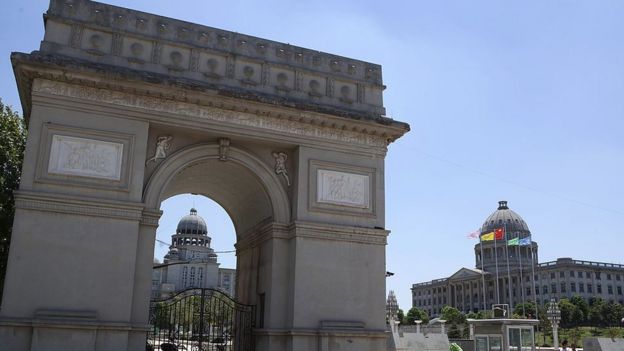
Not the Arc de Triomphe, but a college gate in WuhanImage copyright STR / AFP / GETTY
Image caption – Not the Arc de Triomphe, but a college gate in Wuhan

The guidelines on “foreign” architecture were mostly welcomed on Chinese social media.

“The ban is great,” wrote a Weibo user, according to state media the Global Times. “It’s much better to protect our historical architectures than build fake copycat ones.”

Another recalled seeing an imitation White House in Jiangsu province. “It burned my eyes,” she said.
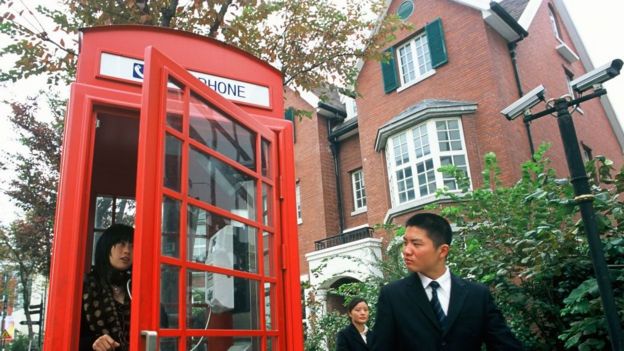
Thames Town, an English-themed town near ShanghaiImage copyright OLIVIER CHOUCHANA / GETTY
Image caption Thames Town, an English-themed town near Shanghai, pictured in 2008

In 2013, the BBC visited “Thames Town”, an imitation English town in Songjiang in Shanghai.

The town features cobbled streets, a medieval meeting hall – even a statue of Winston Churchill – and was a popular spot for wedding photos.

“Usually if you want to see foreign buildings, you have to go abroad,” said one person. “But if we import them to China, people can save money while experiencing foreign-style architecture.”
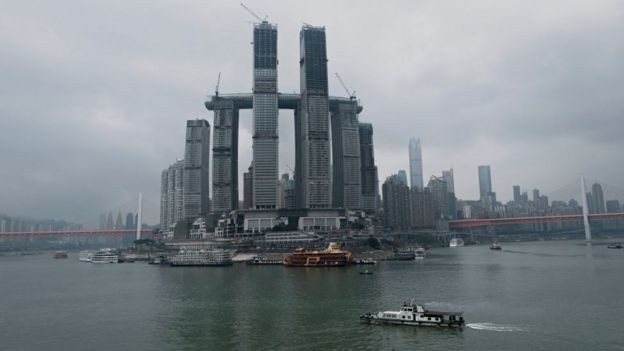
Raffles City, Chongqing, in 2019 - mimicking the Marina Bay Sands hotel in SingaporeImage copyright WANG ZHAO / GETTY
Image caption – Raffles City, Chongqing, in 2019 – mimicking the Marina Bay Sands hotel in Singapore

China, of course, is not the only country to borrow – or copy – other countries’ designs.

Las Vegas in the US revels in its imitations of iconic foreign architecture including the Eiffel Tower and Venetian canals.

Thailand also has developments that mimic the Italian countryside and charming English villages, mainly aimed at domestic tourists.

Source: The BBC
20/06/2019

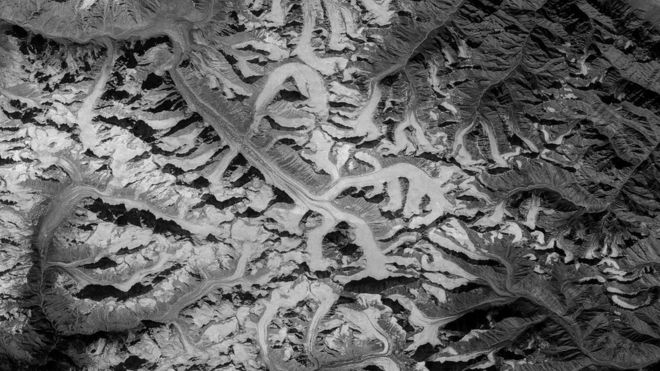
Spy satellites reveal extent of Himalayan glacier loss

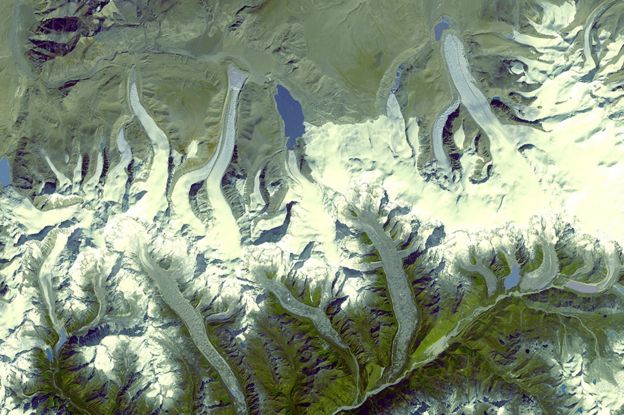
Himachal PradeshImage copyright NRO/USGS
Image caption The Hexagon images were declassified in 2011 and digitised for scientific study

Images from Cold War spy satellites have revealed the dramatic extent of ice loss in the Himalayan glaciers.

Scientists compared photographs taken by a US reconnaissance programme with recent spacecraft observations and found that melting in the region has doubled over the last 40 years.

The study shows that since 2000, glaciers heights have been shrinking by an average of 0.5m per year.

The researchers say that climate change is the main cause.

“From this study, we really see the clearest picture yet of how Himalayan glaciers have changed,” Joshua Maurer, from Columbia University’s Lamont-Doherty Earth Observatory in New York, told BBC News.

The research is published in the journal Science Advances.

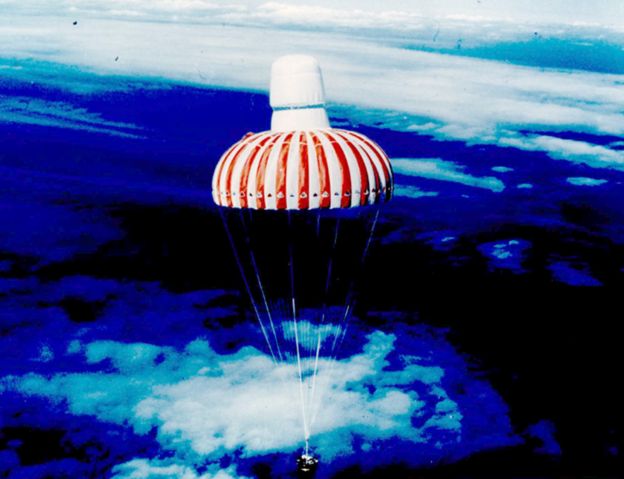
HexagonImage copyright NRO
Image caption The Hexagon satellites were a top secret American reconnaissance programme

During the 1970s and 1980s, a US spy programme – codenamed Hexagon – launched 20 satellites into orbit to secretly photograph the Earth.

The covert images were taken on rolls of film that were then dropped by the satellites into the atmosphere to be collected mid-air by passing military planes.

The material was declassified in 2011, and has been digitised by the US Geological Survey for scientists to use.

Among the spy photos are the Himalayas – an area for which historical data is scarce.

By comparing these pictures with more recent satellite data from Nasa and the Japanese space agency (Jaxa), the researchers have been able to see how the region has changed.

The Columbia University team looked at 650 glaciers in the Himalayas spanning 2,000km.

The group found that between 1975 and 2000, an average of 4bn tonnes of ice was being lost each year.

But between 2000 and 2016, the glaciers melted approximately twice as fast – losing about 8bn tonnes of ice each year on average.

BhutanImage copyright NASA
Image caption We now have a satellite record approaching nearly 50 years in length

Mr Maurer said: “For a sense of scale, 8bn tonnes of ice is enough to fill 3.2 million Olympic-sized swimming pools per year.”

And the ice loss was not uniform, he added.

“Glaciers lose most of their ice in the lower elevation portions of the glacier, and it’s there where most of the thinning is concentrated.

“Some of those zones have been thinning by as much as 5m per year.”

Among the scientific community, there has been some debate over the cause. Changes in rainfall in the region and soot deposited from industrial pollutants are thought to have hastened the melt.

However the Columbia team said that while these factors were contributing, rising temperatures in the Himalayas were the main cause.

“The fact we see such a similar spatial pattern of ice loss across so many glaciers across such a large and climatically complex region suggests there needs to be some kind of overall forcing affecting all of the glaciers similarly.”

Re-entry film canister capsulesImage copyright NRO
Image caption The Hexagon photographs would come down in a capsule from the satellites

Scientists say continued losses will have a huge impact.

In the short-term, the huge increase in meltwater could cause flooding.

In the longer term, millions of people in the region who depend on glacier meltwater during drought years could experience very real difficulties.

Commenting on the research, Dr Hamish Pritchard from the British Antarctic Survey, said: “What’s new here is being able to see how the melting of glaciers across the whole Himalayan range has increased due to climate change.

“Over one generation, the melt has doubled and these glaciers are now shrinking fast.

“Why does this matter? Because when the ice runs out, some of Asia’s most important rivers will lose a water supply that keeps them flowing through drought summers, just when water is at its most valuable.

“Without mountain glaciers, droughts will be worse for millions of water-stressed people living downstream.”

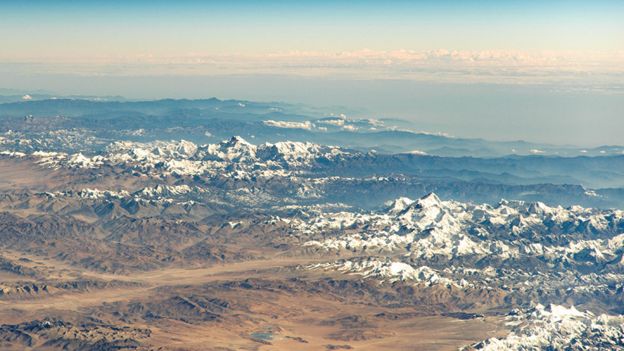
Himalayas from the ISSImage copyright NASA
Image caption The view of the Himalayas for the International Space station

Source: The BBC

Law of Unintended Consequences

continuously updated blog about China & India

ChiaHou's Book Reviews

continuously updated blog about China & India

What's wrong with the world; and its economy

continuously updated blog about China & India