Archive for ‘Robert Lighthizer’

23/02/2019

Trump says he’s inclined to extend China trade deadline and meet Xi soon

WASHINGTON (Reuters) – President Donald Trump said on Friday there was “a very good chance” the United States would strike a deal with China to end their trade war and that he was inclined to extend his March 1 tariff deadline and meet soon with Chinese President Xi Jinping.

“I think that we both feel there’s a very good chance a deal will happen,” Trump said.

Liu agreed there had been “great progress”.

“From China, we believe that (it) is very likely that it will happen and we hope that ultimately we’ll have a deal. And the Chinese side is ready to make our utmost effort,” he said at the White House.

The Republican president said he probably would meet with Xi in March in Florida to decide on the most important terms of a trade deal.


Optimism that the two sides will find a way to end the trade war lifted stocks, especially technology shares. The S&P 500 stock index reached its highest closing level since Nov. 8. Oil prices rose to their highest since mid-November, with Brent crude reaching a high of $67.73 a barrel. [.N] [O/R]

CURRENCY AGREEMENT

Trump and Treasury Secretary Steven Mnuchin said the two sides had reached an agreement on currency. Trump declined to provide details, but U.S. officials long have expressed concerns that China’s yuan is undervalued, giving China a trade advantage and partly offsetting U.S. tariffs.

Announcement of a pact aimed at limiting yuan depreciation was putting “the currency cart before the trade horse,” but would likely be positive for Asian emerging market currencies, said Alan Ruskin, global head of currency strategy at Deutsche Bank in New York.

“How can you agree to avoid excessive Chinese yuan depreciation or volatility if you have not made an agreement on trade that could have huge FX implications?” Ruskin asked in a note to clients.

In a letter to Trump read aloud by an aide to Liu at the White House, Xi called on negotiators to work hard to strike a deal that benefits both country.

Trump said a deal with China may extend beyond trade to encompass Chinese telecommunications companies Huawei Technologies and ZTE Corp.

The Justice Department has accused Huawei of conspiring to violate U.S. sanctions on Iran and of stealing robotic technology from T-Mobile US Inc.

Chinese peer ZTE was last year prevented from buying essential components from U.S. firms after pleading guilty to similar charges, crippling its operations.

MEMORANDUMS NO MORE

Trump appeared at odds with his top negotiator, U.S. Trade Representative Robert Lighthizer, on the preliminary terms that his team is outlining in memorandums of understanding for a deal with China. Trump said he did not like MOUs because they are short term, and he wanted a long-term deal.

“I don’t like MOUs because they don’t mean anything,” Trump said. “Either you are going to make a deal or you’re not.”

Lighthizer responded testily that MOUs were binding, but that he would never use the term again.

Reuters reported exclusively on Wednesday that the two sides were drafting the language for six MOUs covering the most difficult issues in the trade talks that would require structural economic change in China.

Negotiators have struggled this week to agree on specific language within those memorandums to address tough U.S. demands, according to sources familiar with the talks. The six memorandums include cyber theft, intellectual property rights, services, agriculture and non-tariff barriers to trade, including subsidies.

An industry source briefed on the talks said both sides have narrowed differences on intellectual property rights, market access and narrowing a nearly $400 billion U.S. trade deficit with China. But bigger differences remain on changes to China’s treatment of state-owned enterprises, subsidies, forced technology transfers and cyber theft of U.S. trade secrets.

Lighthizer pushed back when questioned on forced technology transfers, saying the two sides made “a lot of progress” on the issue, but did not elaborate.

The United States has said foreign firms in China are often coerced to transfer their technology to Chinese firms if they want to operate there. China denies this.

The U.S. Chamber of Commerce on Friday urged the U.S. government to ensure the deal was comprehensive and addressed core issues, rather than one based on more Chinese short-term purchases of goods.

China has pledged to increase purchases of agricultural produce, energy, semiconductors and industrial goods to reduce its trade surplus with the United States.

China committed to buying an additional 10 million tonnes of U.S. soybeans on Friday, U.S. Agriculture Secretary Sonny Perdue said on Twitter. China bought about 32 million tonnes of U.S. soybeans in 2017. The commitments are a “show of good faith by the Chinese” and “indications of more good news to come,” Perdue wrote.

China was the top buyer of U.S. soybeans before the trade war, but Beijing’s retaliatory tariffs on U.S. soybeans slashed business that had been worth $12 billion annually.

Source: Reuters
18/02/2019

China applauds ‘positive’ Donald Trump tweet, hopes for US trade war deal ahead of Washington talks

    • Opinion piece in major state media outlets is seen to be part of Beijing’s efforts to reassure its citizens that the tariff war with the United States will soon be over
    • A Chinese delegation led by Vice-Premier Liu He is expected to leave on Tuesday for the American capital after last week’s trade talks in Beijing produced ‘progress’

    China applauds ‘positive’ Donald Trump tweet ahead of Washington talks

    18 Feb 2019

    China and US make ‘progress’ but talks to head to Washington next week

    16 Feb 2019

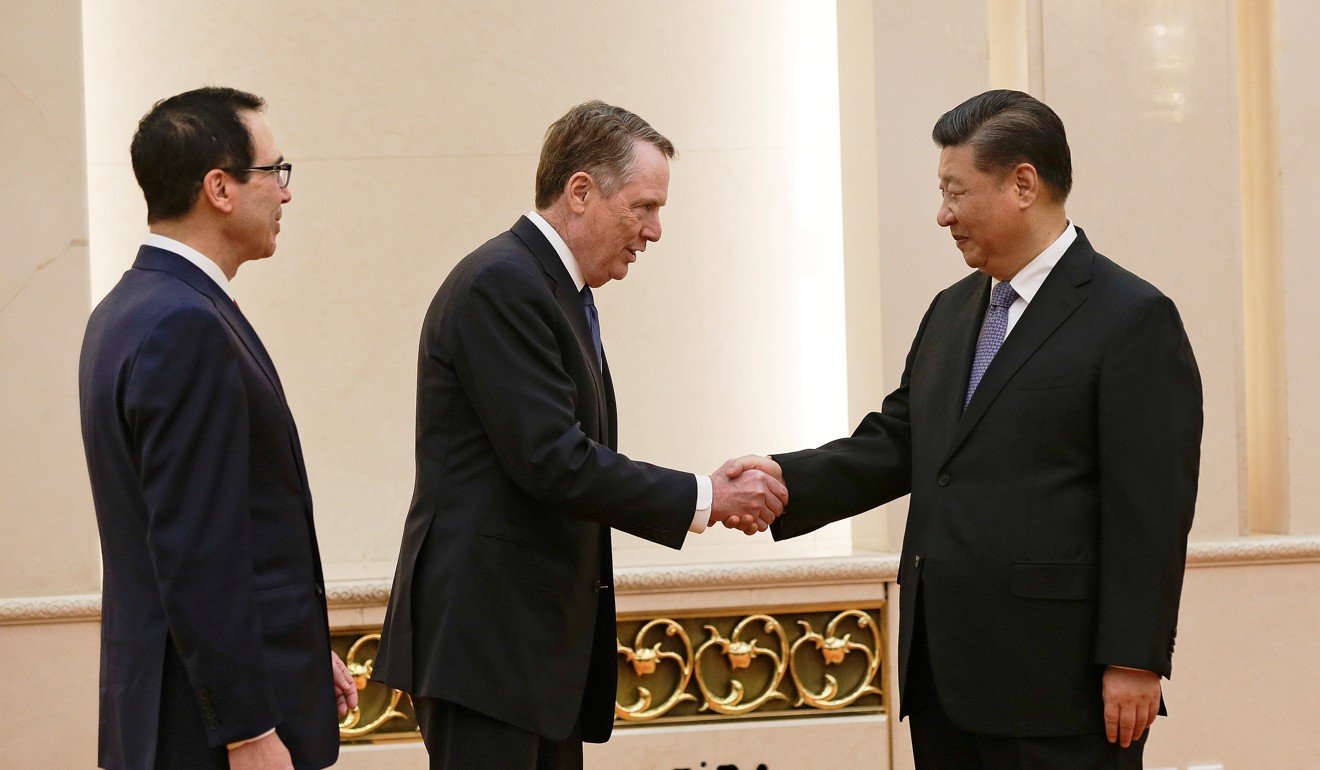
    Chinese President Xi Jinping urged for a “mutually beneficial” trade deal in this week’s talks when he met US trade representative Robert Lighthizer and US Treasury Secretary Steven Mnuchin in Beijing on Friday, according to Xinhua. Photo: Xinhua
    Chinese President Xi Jinping urged for a “mutually beneficial” trade deal in this week’s talks when he met US trade representative Robert Lighthizer and US Treasury Secretary Steven Mnuchin in Beijing on Friday, according to Xinhua. Photo: Xinhua

    A tweet by US President Donald Trump on the ongoing trade war is a “positive” signal, brightening prospects of a deal from this week’s talks in Washington, according to an opinion piece published by China’s major state media outlets on Monday.

    Monday’s opinion piece was published the day before a Chinese delegation led by Vice-Premier Liu He is expected to leave for talks in Washington.

    In the tweet on Sunday, Trump said: “Important meetings and calls on China trade deal, and more, today with my staff. Big progress being made on soooo many different fronts! Our country has such fantastic potential for future growth and greatness on an even higher level!”

    The opinion piece, which was published by the official Xinhua news agency, the People’s Daily and the Global Times under the pseudonym Niu Tanqin, is seen to be part of Beijing’s efforts to reassure its citizens that the trade war with the United States will soon be over.

    It did contrast previous columns on Trump by the same author, who in March last year argued that China dislikes the American president for his “insatiable demands, greediness and lack of trust worthiness”.

    Last week’s trade talks in Beijing produced “progress” ahead of the March 1 deadline, which could see tariffs on US$200 billion worth of Chinese products increased from 10 per cent to 25 per cent if the world’s two largest economies fail to reach a deal.

    The outcome of the talks in Washington, which are likely to be the last before March 1, will largely decide whether China and the United States can reach a pact, likely in the form of a memorandum of understanding, to suspend the tariff battle that has been roiling global markets and clouding growth prospects since last year.

    According to the opinion piece, Trump’s use of “soooo” instead of “so” indicated that the US president was excited when he heard reports from his trade envoys following the talks in Beijing, which Chinese President Xi Jinping attend on Friday.

    Donald J. Trump

    @realDonaldTrump

    Important meetings and calls on China Trade Deal, and more, today with my staff. Big progress being made on soooo many different fronts! Our Country has such fantastic potential for future growth and greatness on an even higher level!

    “The US side is attaching great importance [to the trade talks]. Although Trump is on vacation, he listened to relevant reports and he definitely will make specific instructions,” it added.

    Trump has been upbeat about the prospects of reaching a trade deal with China, and said on Friday at the White House: “It’s going extremely well.”

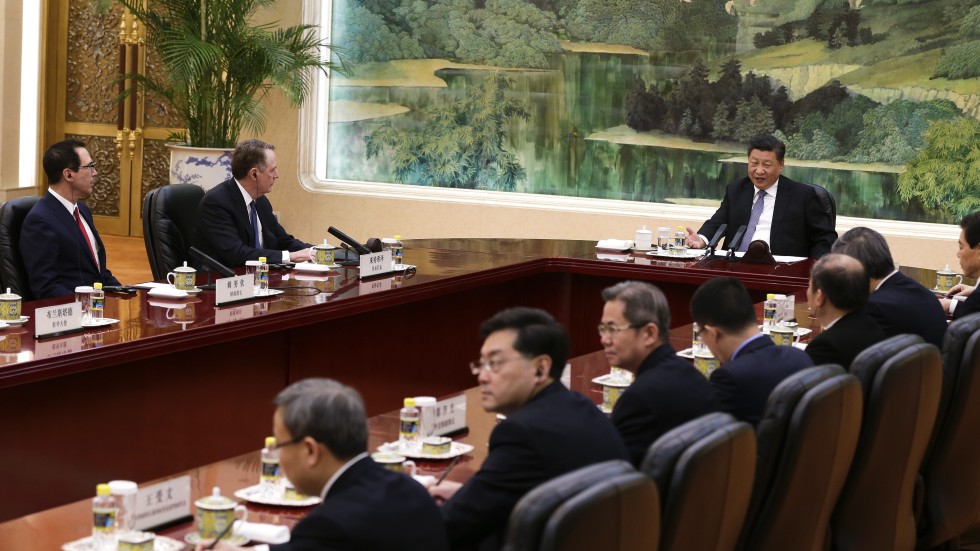
    Chinese President Xi urged for a “mutually beneficial” trade deal in this week’s talks when he met US trade representative Robert Lighthizer and US Treasury Secretary Steven Mnuchin in Beijing on Friday, according to Xinhua.

    Stocks in China and Hong Kong surged on Monday, partly bolstered by the increased likelihood of a trade deal between China and the United States.

    Monday’s opinion piece fits into the latest official line that an agreement is very likely to end the tariff war after the Global Times said over the weekend that the bilateral trade talks are “sprinting” towards a positive end.

    Donald Trump’s demands ‘good for China’, says economist Jin Keyu

    Meanwhile, reports in China suggest differences between Beijing and Washington still remain over forced technology transfer, intellectual property rights, cyber theft as well as a verification system to ensure China keeps its promises.

    Xi told the US trade envoys that China is willing to “cooperate” but “cooperation has principals”, a statement showing that Beijing will not entertain US demands if it finds such demands violate China’s principals.

    A White House statement on Friday said that “much work remains”, showing gaps still exist.

    Source: SCMP

16/02/2019

As the clock ticks, there’s a path to a ‘win-win’ outcome in US-China trade talks

  • Ankit Panda writes that a meeting between Donald Trump and Xi Jinping could result in a way out of the impasse, at least temporarily
PUBLISHED : Saturday, 16 February, 2019, 6:02pm
UPDATED : Saturday, 16 February, 2019, 6:04pm

The usual cast of characters were back at the negotiating table, trying to find a way to stem another round of US tariff increases that were stayed in December after the Buenos Aires G20 meeting between US President Donald Trump and Chinese President Xi Jinping.

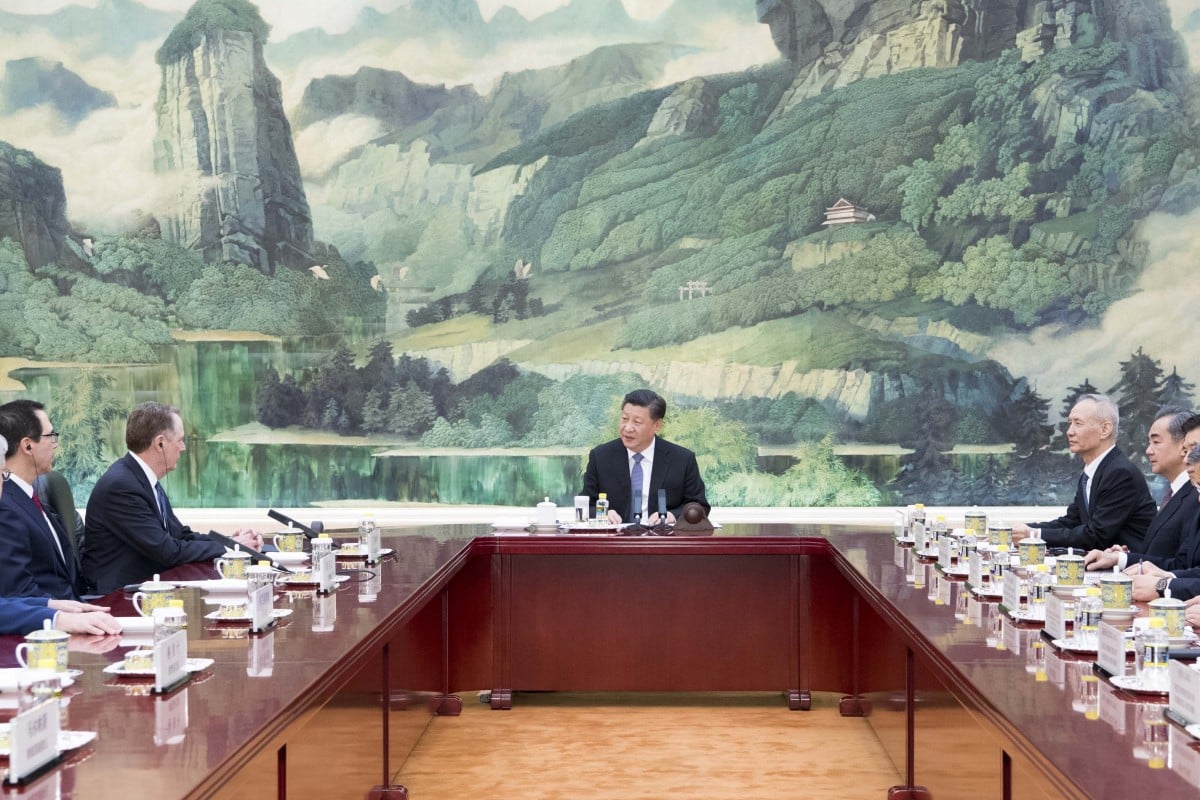
US Treasury Secretary Steven Mnuchin and Trade Representative Robert Lighthizer were back in Beijing, where they again sat across the table from Vice-Premier Liu He, China’s lead trade negotiator. The US delegation also met Xi himself at the end of the talks on Friday.

Both nations said they had made progress to settle their disputes, but admitted there were still difficult issues to deal with. Negotiators will continue the talks in Washington next week.

The stakes are clear and the clock is ticking. The two sides need to arrive at an understanding by March 2, the day on which Trump has said he will move forward with an increase in tariffs.

At least that was the idea. In recent days, Trump has made multiple remarks that suggest the March deadline is anything but absolute. He has hinted he would be open to pushing it back if he sensed that a deal was around the corner. Reports have even suggested the White House is considering another 60-day extension of the tariff truce.

“They’re showing us tremendous respect,” Trump said of China’s attitude in the negotiations, adding that talks were “going along very well”. With Trump slated to travel to Asia at the end of the month for a second summit with North Korean leader Kim Jong-un in Hanoi, the prospect of a second meeting between him and Xi – right before the anticipated deadline – is very real. What’s slowly slipping through the cracks in this process is a sustainable and long-term agreement on structural reform in China, which is what’s been at the centre of the Trump administration’s trade grievances.

Already articulated US concerns cover a broad range of Chinese practices. The ideal short-term measures the American side would like to see include unconditional market access for US firms in China; a less insulated environment for state-owned enterprise decision making; greater regulatory transparency; and fairer legal protections for American businesses in China.

As with so many aspects of the Trump administration’s foreign policy, the US president’s personality is taking over the process, leaving his deputies who are doing the negotiating in a disadvantageous position. For China, the obvious answer then becomes not to discuss the nuances of what kinds of structural reform might be necessary with Lighthizer, but to simply get Xi in the room with Trump.

This mirrors the lesson that North Korea’s Kim has taken away over the course of nearly a year of negotiations with the US. Instead of expending any serious diplomatic capital in a detail oriented negotiation with the secretary of state or the president’s special representative, the key is to simply meet Trump and work out high-level arrangements mano a mano.

In this climate, we can’t expect a real resolution on the core issues. Everything from American misgivings about Beijing’s interventionist industrial policies that protect Chinese enterprises to broader structural shifts in the nature of the US-China economic relationship since the turn of the century are on the table today – and they’ll stay there.

Xi and Trump may well find a temporary way out of the impasse, giving global investors the runway necessary to avert the panic that would likely ensue if the US pushed ahead with a tariff increase on US$200 billion in Chinese goods. Even if China doesn’t quite give the United States a down payment on structural reforms, Xi can promise Trump that he will chip away at the trade deficit while leaving untouched the issues that a more detail oriented negotiator like Lighthizer might zero in on.

If there is a “win-win” outcome here, it would be for Trump and Xi to find an agreeable arrangement that would allow the US president to walk away looking tough to his base while leaving China’s core, long-term industrial policy trajectory unharmed. That would strip away any remaining negotiating leverage the US side might have within the trade war, and it’s not unlikely.

Source: SCMP

Law of Unintended Consequences

continuously updated blog about China & India

ChiaHou's Book Reviews

continuously updated blog about China & India

What's wrong with the world; and its economy

continuously updated blog about China & India