Chindia Alert: You’ll be Living in their World Very Soon
aims to alert you to the threats and opportunities that China and India present. China and India require serious attention; case of ‘hidden dragon and crouching tiger’.
Without this attention, governments, businesses and, indeed, individuals may find themselves at a great disadvantage sooner rather than later.
The POSTs (front webpages) are mainly 'cuttings' from reliable sources, updated continuously.
The PAGEs (see Tabs, above) attempt to make the information more meaningful by putting some structure to the information we have researched and assembled since 2006.
Buffett’s Berkshire posted a record quarterly net loss of nearly US$50 billion
Company sells entire stakes in US airlines, Buffett says ‘world has changed’
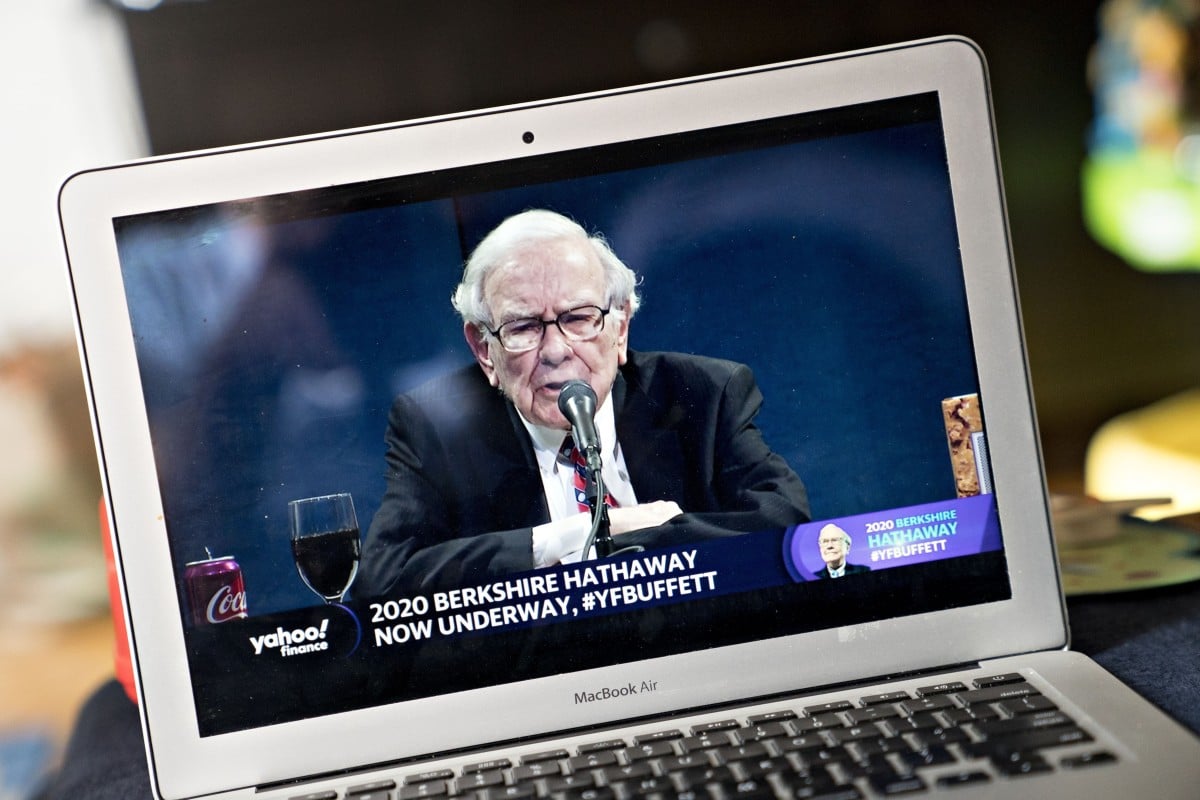
Warren Buffett speaks during the virtual Berkshire Hathaway annual shareholders meeting. Photo: Bloomberg
Billionaire investor Warren Buffett said Saturday he’s confident the US economy will bounce back from its pummelling by the coronavirus pandemic because “American magic has always prevailed”.
The 89-year-old made the sanguine prediction about the world’s largest economy as his holding company Berkshire Hathaway reported first-quarter net losses of nearly US$50 billion.
Buffett also announced Saturday that his company had sold all its stakes in four major US airlines last month, as the pandemic clobbered the travel industry.
“It turns out I was wrong,” he said of his acquisitions of 10 per cent stakes in American Airlines, Delta Air Lines, Southwest Airlines and United Airlines.
Berkshire Hathaway had paid US$7 billion to US$8 billion, and “we did not take out anything like that,” he said.
Between the purchases that took place over months, and the sale, “the airlines business I think changed in a very major way” and could no longer meet Berkshire criteria for profitability, he said.
Buffett’s announcement may further hurt airlines already pushed to the brink by coronavirus lockdown measures, now looking to the US government for US$25 billion in relief funds.
Berkshire Hathaway, based in Omaha, Nebraska, called its first-quarter setback “temporary” but said it could not reliably predict when its many businesses would return to normal or when consumers would resume their former buying habits.
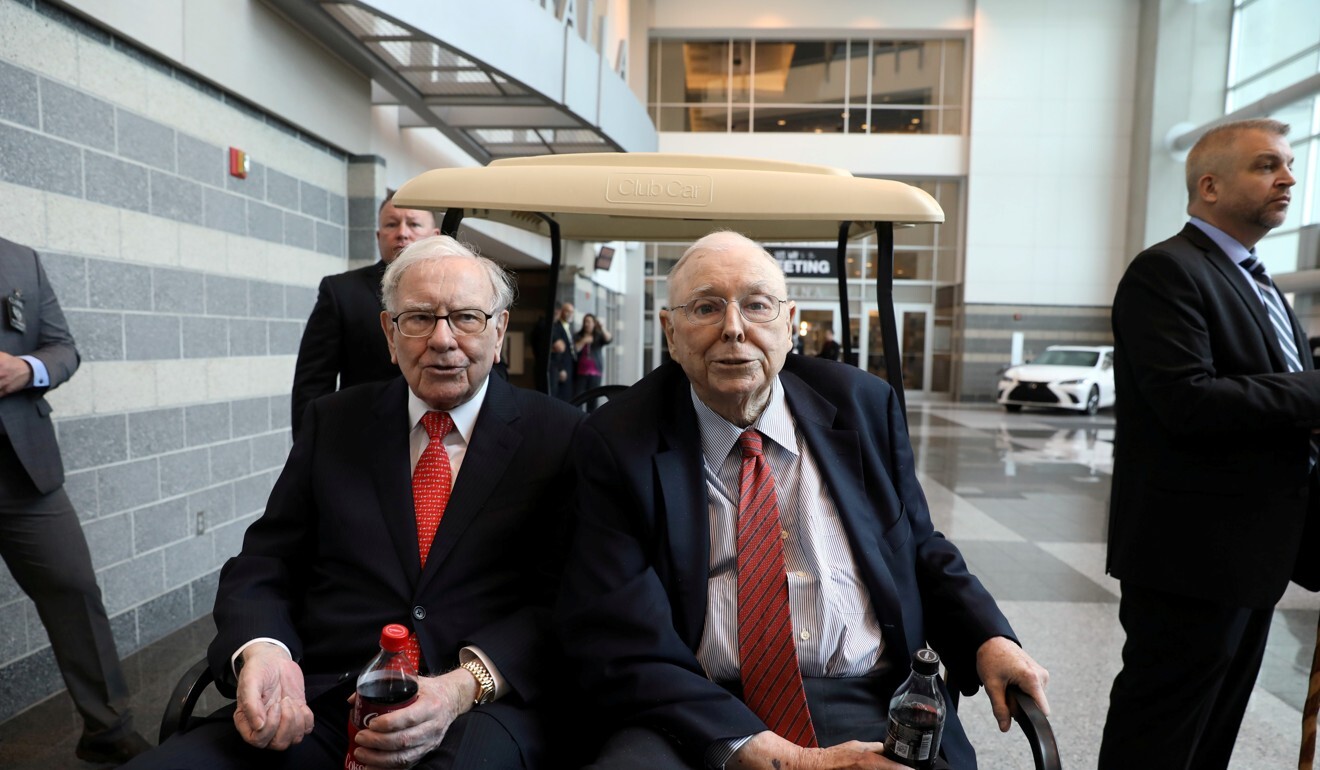
Warren Buffett (left) and vice-chairman Charlie Munger at the annual Berkshire shareholder shopping day in Omaha, Nebraska in 2019. Photo: Reuters
“We’ve faced great problems in the past, haven’t faced this exact problem – in fact we haven’t really faced anything that quite resembles this problem,” Buffett said in a lengthy speech on the country’s economic history.
“But we faced tougher problems, and the American miracles, American magic has always prevailed and it will do so again.”
“We are now a better country, as well as an incredibly more wealthy country, than we were in 1789 … We got a long ways to go but we moved in the right direction,” he said, referencing the abolition of slavery and women’s suffrage.
Warren Buffett has traded his old flip phone for Apple’s iPhone
25 Feb 2020
“Never bet against America.”
Buffett is considered one of the savviest investors anywhere. His fortune of US$72 billion is the fourth-largest in the world, according to Forbes, and in normal years, the company’s annual gathering in Omaha is a high-point of the calendar for investors, a “Woodstock for capitalists”.
But the devastating economic impact of the pandemic has hit hard at Berkshire Hathaway’s wide range of investments, and the need for social distancing forced it to hold the annual meeting online.
Buffett addressed his shareholders in a live-stream flanked only by Gregory Abel, who is in charge of Berkshire’s non-insurance operations.
His business partner for six decades, 96-year-old Charlie Munger, did not appear.
China’s first-quarter GDP shrinks for the first time since 1976 as coronavirus cripples economy
Buffett, in a statement, played down his company’s bleak-looking net figure. He said a better measure of the company’s performance was its operating earnings, which exclude investments and are less subject to sharp fluctuations.
By that measure, Berkshire Hathaway saw growth to US$5.9 billion from US$5.55 billion a year earlier.
The brutal drop in the net – to a loss of US$49.75 billion from a profit last year of US$21.7 billion – resulted primarily from the virus-related decline in value of its broad investment portfolio, which ranges from energy to transport to insurance and technology.
Chinese cryptocurrency billionaire finally sits down to eat with Warren Buffett
7 Feb 2020
The annual meeting often has an almost carnival atmosphere, as thousands of fans and investors flock to Nebraska to hear from the celebrated “Oracle of Omaha”. Buffett, famous for his relatively modest lifestyle, turns 90 on August 30.
In documents filed Saturday, Berkshire noted that until mid-March many of its companies were posting “comparative revenue and earnings increases” over the same 2019 period.
Many of its companies – including in rail transport, energy production and some manufacturing and service businesses – are deemed essential and are able to continue working amid the far-reaching confinement orders.
But their turnover slowed considerably in April, the company statement said.
Moves taken by those companies such as employee furloughs, salary cuts and reductions, and capital spending reductions are “necessary actions” and “temporary,” it said.
BEIJING (Reuters) – Tang Yue, a 27-year-old teacher from the city of Guilin in southwest China, steam-presses a blue dress and takes dozens of photographs before picking one to clinch her 200th online sale.
For a growing number of Chinese like Tang, hit by job losses, furloughs and salary cuts, the consumer economy has begun to spin in reverse. They are no longer buying – they are selling.
Instead of emerging from the coronavirus epidemic and returning to the shopping habits that helped drive the world’s second-largest economy, many young people are offloading possessions and embracing a new-found ethic for hard times: less is more.
With Tang’s monthly salary of about 7,000 yuan ($988), the self-described shopaholic said she has bought everything from Chanel lipsticks to Apple’s (AAPL.O) latest iPad in the past three years.
But the adrenaline rush that comes with binge-shopping is gone, said Tang, whose wages have been slashed with the suspension of all the classes on tourism management she usually teaches.
“The coronavirus outbreak was a wake-up call,” she said. “When I saw the collapse of so many industries, I realised I had no financial buffer should something unfortunate happen to me.”
There is no guarantee that the nascent minimalist trend will continue once the coronavirus crisis is fully over, but if it does, it could seriously damage China’s consumer sector and hurt thousands of businesses from big retailers to street-corner restaurants, gyms and beauty salons.
To be sure, there are signs that pent-up demand will drive a rush of spending as authorities reopen malls, leisure venues and tourist spots. In South Korea, the first major economy outside of China to be hit by the virus, people thronged malls this weekend to go “revenge shopping” to make up for time lost in lockdown.,
There are some signs that a similar trend will take hold in China, where some upscale malls are starting to get busy, although luxury firm Kering SA (PRTP.PA) – which owns Gucci, Balenciaga and other fashion brands – has said it is hard to predict how or when sales in China might come back.
A recent McKinsey & Co survey showed that between 20% and 30% of respondents in China said they would continue to be cautious, either consuming slightly less or, in a few cases, a lot less.
“The lockdown provided consumers with a lot of time and reasons to reflect and consider what is important to them,” said Mark Tanner, managing director at Shanghai-based research and marketing consultancy China Skinny.
“With much more of their days spent in their homes, consumers also have more time and reasons to sort through things they don’t feel they need – so they’re not living around clutter that is common in many apartments.”
#DITCHYOURSTUFF
Tang made a spreadsheet to keep track of her nearly 200 cosmetic products and hundreds of pieces of clothing. She then marked a few essentials in red that she wanted to keep. In the past two months, she has sold items worth nearly 5,000 yuan on second-hand marketplaces online.
Bargain-hunting online has become a new habit for some Chinese as the stigma that once hung over second-hand goods has begun to fade.
Idle Fish, China’s biggest online site for used goods, hit a record daily transaction volume in March, its parent company Alibaba (BABA.N) told Reuters.
Government researchers predict that transactions for used goods in China may top 1 trillion yuan ($141 billion) this year.
Posts with the hashtag #ditchyourstuff have trended on Chinese social media in recent weeks, garnering more than 140 million views.
Jiang Zhuoyue, 31, who works as an accountant at a traditional Chinese medicine company in Beijing – one of the few industries that may benefit from the health crisis – has also decided to turn to a simpler life.
“I used to shop too much and could be easily lured by discounts,” said Jiang. “One time Sephora offered 20% off for all goods, I then bought a lot of cosmetics because I feel I’m losing money if I don’t.”
Jiang, the mother of a 9-month-old baby, said she recently sold nearly 50 pieces of used clothing as the lockdown gave her the opportunity to clear things out. “It also offered me a chance to rethink what’s essential to me, and the importance of doing financial planning,” she said.
Eleven Li, a 23-year-old flight attendant, said she used to spend her money on all manner of celebrity-endorsed facial masks, snacks, concert tickets and social media activity, but now has no way to fund her spending.
“I just found a new job late last year, then COVID-19 came along, and I haven’t been able to fly once since I joined, and I’ve gotten no salary at all,” said Li, who said she was trying to sell her Kindle.
Some are even selling their pets, as they consider leaving big cities like Beijing and Shanghai where the high cost of living is finally catching up with them.
NO RETURN TO OLD WAYS?
As the coronavirus comes under control in China, the government is gradually releasing cities from lockdown, easing transport restrictions and encouraging consumers to venture back into malls and restaurants by giving out billions-worth of cash vouchers, worth between 10 yuan and 100 yuan.
But many people say they are still worried about job security and potential wage cuts because of the struggling economy. Nationwide retail sales have plunged every month so far this year.
Xu Chi, a Shanghai-based senior strategic analyst with Zhongtai Securities, said some Chinese consumers may prove the ‘21 Day Habit Theory,’ a popular scientific proposition that it only takes that long to establish new habits.
“We believe people’s spending patterns follow the well-known theory, which means most people in China, having been cooped-up at home for more than a month and not having binge-shopped, may break the habit and not return to their old ways,” Xu said.
Jiang said she was determined not to return to her free-spending ways and planned to cook more at home.
“I’ll turn to cheaper goods for some luxury brands,” she said. “I’ll choose Huawei’s smartphone, because (Apple’s) iPhone has too much brand premium.”
Tang, who has recently used 100 yuan of shopping coupons to stock up on food, is going to hold the purse strings even tighter.
“I’ve set my monthly budget at 1,000 yuan,” she said. “Including one – and just one – bottle of bubble tea.”




 CHINDIA ALERT: You'll be living in their world, very soon