Chindia Alert: You’ll be Living in their World Very Soon
aims to alert you to the threats and opportunities that China and India present. China and India require serious attention; case of ‘hidden dragon and crouching tiger’.
Without this attention, governments, businesses and, indeed, individuals may find themselves at a great disadvantage sooner rather than later.
The POSTs (front webpages) are mainly 'cuttings' from reliable sources, updated continuously.
The PAGEs (see Tabs, above) attempt to make the information more meaningful by putting some structure to the information we have researched and assembled since 2006.
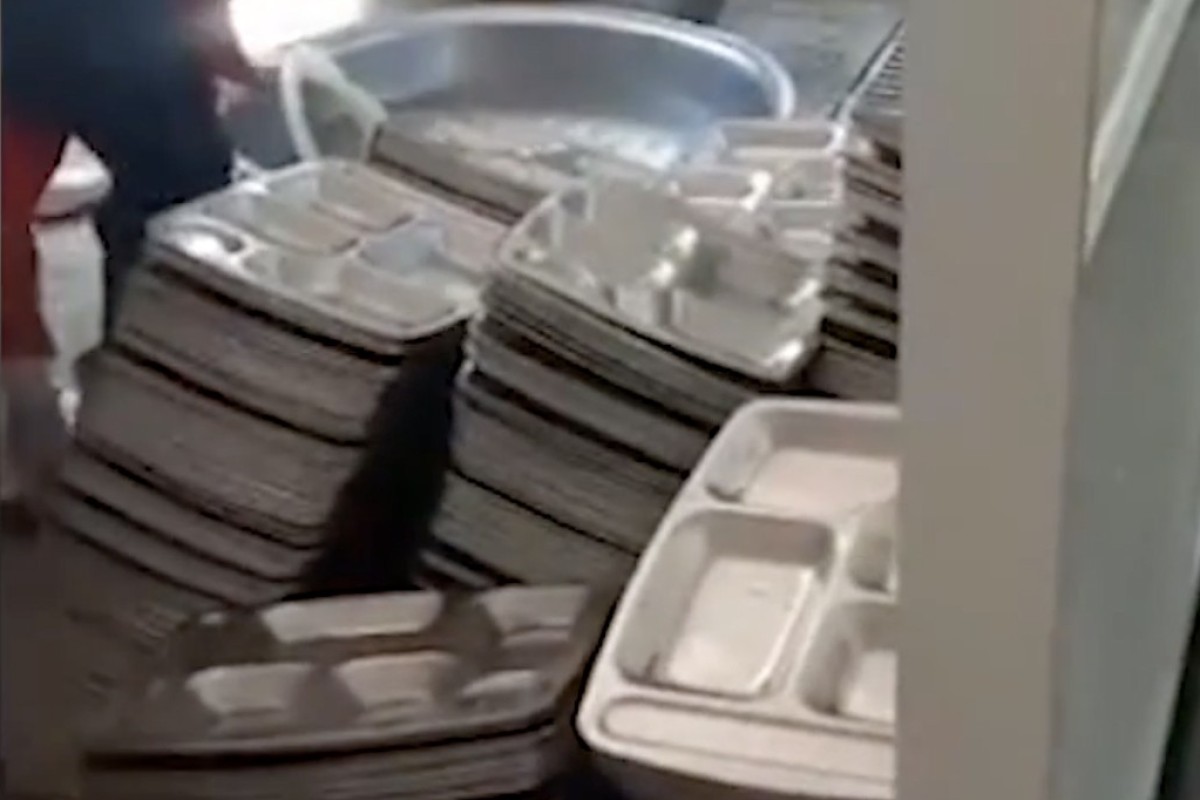
Video of staff washing tableware with laundry detergent goes viral
A primary school principal has been sacked after it emerged laundry detergent was used in the canteen to wash tableware. Photo: Thepaper.cn
The head of a primary school in northeastern China has been sacked and a government investigation is underway into the use of laundry washing powder to clean tableware in the school canteen.
The scandal came to light when a video of canteen staff washing up at Dongfeng Primary School in Zuanghe, Liaoning province, went viral on Chinese social media.
The video shows staff, wearing white uniforms and aprons, cleaning plates and bowls in basins containing water tainted with laundry detergent. It is unclear when the incident happened.
In a statement on Weibo, China’s version of Twitter, on Tuesday, the municipal government said the head of the school had been dismissed and representatives had been assigned by the authorities to take charge of the school’s daily operation. Due diligence investigations of the relevant department would begin “immediately”, the statement said.
Chinese school heads told to eat with pupils after string of scandals
The local administration for market regulation had also been ordered to speed up an examination of the food samples, tableware and washing products at the school, and the results would be made public in a timely manner, the authorities said.
Until the investigation is concluded, meals at the school, which has about 400 pupils, will be the responsibility of the municipal education department.
As an added precaution, food safety inspections would be carried out at all elementary and middle schools in the region.
The prompt action by the authorities reflects the wide public attention in China to any food safety scandal which involves children.
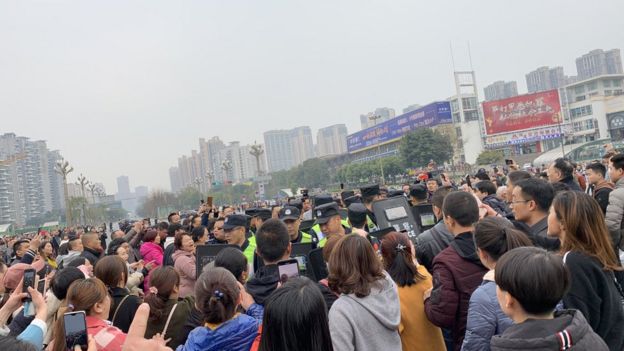
The principal of an international school in Shanghai was dismissed in October after parents of students found mouldy tomatoes and onions in a kitchen where food was prepared for pupils. In May, video footage showing mouldy food in the canteen of a middle school in Chengdu, Sichuan province, triggered angry parents to stage protests outside the school and the local government building.
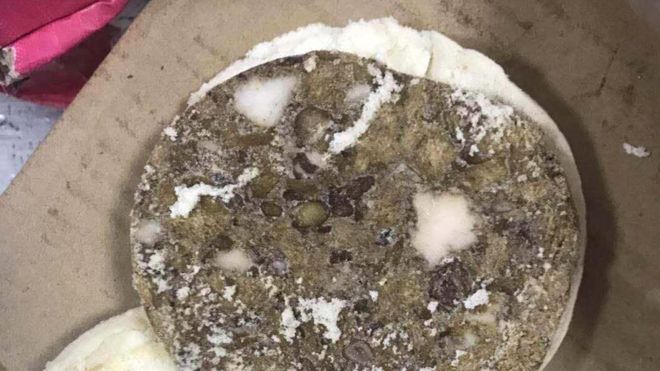
Image copyrightSUPPLIEDImage captionRotting bread was among the food found in the kitchen
One of China’s most prestigious high schools has been the target of public anger after piles of expired mouldy food were found in its canteen kitchen.
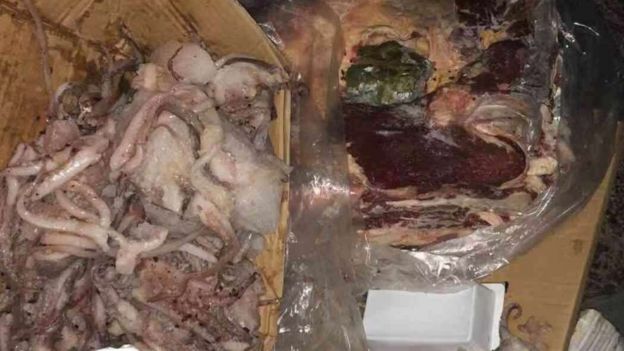
Mouldy bread, rotting meat and seafood were discovered at the Chengdu No 7 Experimental High School.
One parent told the BBC of his horror and disgust, saying the food was “stinky and disgusting” and compared it to pig slop.
The school has now apologised, saying it is deeply “embarrassed”.
Food safety scandals are not uncommon in China and they often leave authorities scrambling to defuse public outrage.
How did they discover the food?
The scandal first emerged when a small group of parents were on Monday invited to attend a tree planting event at the private high school in Chengdu, the capital city of China’s Sichuan province.
While at the school, a group of parents discovered mouldy bread, rotting meat and seafood items in the canteen kitchen canteen.
It is not clear why exactly they chose to stop by the kitchen, but one parent that the BBC’s Lulu Luo spoke to referenced an incident earlier last November where numerous school children came down with stomach-aches, constipation and various other ailments.
Image copyrightSUPPLIEDImage captionWhat looks like seafood and meat were seen in cardboard boxes
“[The items looked like they had] been in a freezer for years, [it looked] like zombie meat,” the father, who has a daughter and son enrolled in the school said.
“I smelled the pork, it was stinky. [There was] ginger, which looked disgusting too.”
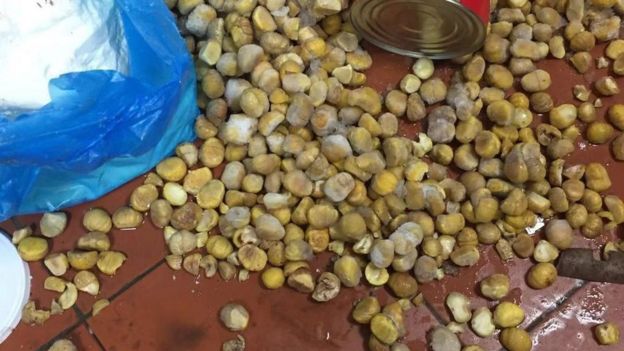
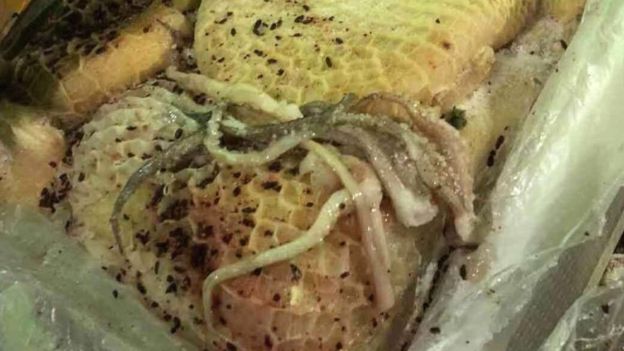
Image copyrightSUPPLIEDImage captionAnd chestnuts were seen strewn on the floorImage copyrightSUPPLIEDImage captionWhat appears to be tripe is also seen covered in dirt of some kind
According to the father, the private school costs 39,000 yuan (£4,380; $5,800) a year – about 20 times the amount a public school would cost.
“We don’t even let kids have leftover food at home… I spent tens of thousands of dollars and my kids are having pigwash there,” he said.
“I dare not tell my younger son… I’m worried he might not dare to eat canteen food after that. My daughter has been telling me she has a stomach-ache. I [told] her she might have just over exercised.
“It breaks my heart.”
How did parents react?
Horrified, the group of parents shared the pictures on social media, which were soon discovered by other parents.
According to the same parent, the school immediately transported the mouldy food away in two trucks.
One truck was intercepted and stopped by a swarm of angry parents who showed up at the school in protest, he said.
Image copyrightSUPPLIEDImage captionHundreds of parents stormed the school in protest
Videos that emerged on social media on Wednesday showed hundreds of parents angrily protesting outside the school gates.
Police were seen using brute force against them, with one video showing a group of policemen slamming a man against the ground.
In another video, parents can be seen clutching their eyes in pain, with some local news outlets saying police used pepper spray against them.
It said the parents had “severely disrupted” traffic and insulted the police. They were later released on the same day.
‘Why should they be trusted with anything?’
Stephen McDonell, BBC China correspondent
People overseas sometimes mistakenly think that there are not many protests in China. Actually, acts of dissent break out quite often and can erupt suddenly.
If family members are harmed, especially when under the care of a school or a kindergarten or a hospital, then orderly, calm communities can transform with scenes of anger spilling out onto the streets.
Faulty medicine, tainted milk powder, investment scams and perceived abuse of students under the care of teachers have all triggered public anger directed at the officials whose job it is to keep the community safe.
The school is one of the most prestigious in China and had in the past been named among China’s “Top 10 outstanding private schools”.
It said that those responsible would be dealt with by the law, saying it was “embarrassed” by the incident and that it would not happen again.
However, the parent the BBC spoke to said the case was not an “isolated incident”, saying that the same supplier catered to “over 100,000 students from across 20 schools”.
Wenjiang district government – the district in Chengdu that the school is in – issued a statement on Wednesday that said eight people responsible for food safety at the school were being investigated by authorities.
It said that 36 students from the school had been admitted into the local hospital for a check-up -all were later discharged.
The district government also said that the raw food would be sent for testing, adding that a “comprehensive and in-depth investigation” would be held into the matter.
Weeks after some of China’s upmarket hotels were exposed for using the same soiled towels to clean drinking cups and toilets, officials have uncovered another hygiene issue at a mid-price hotel in the country’s northern province of Shanxi.
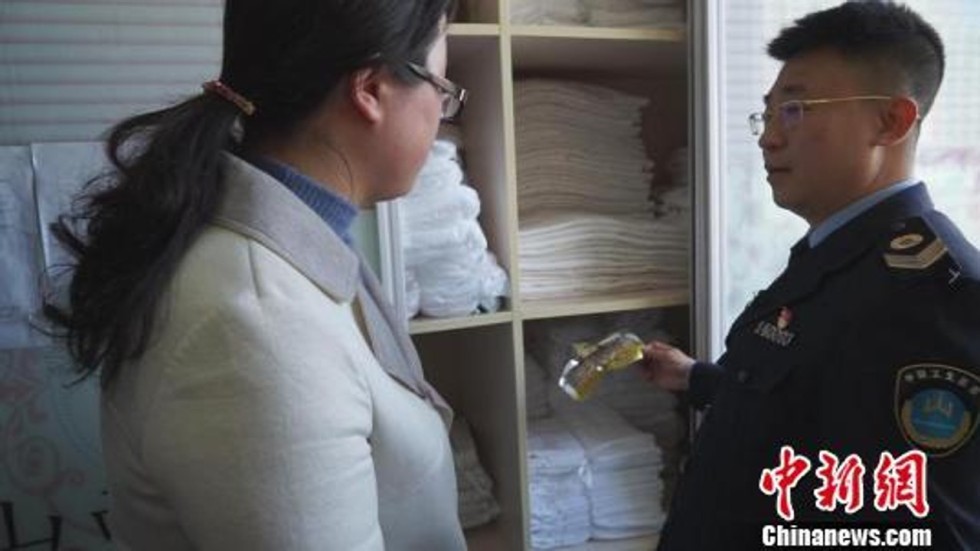
Health officials from the provincial capital of Taiyuan found disinfected towels stored with shoes and half-consumed snacks during an inspection on Tuesday.
According to the China News Service, the inspection found a number of hotels did not follow hygiene rules to sterilise customer utensils and were also not monitoring air, water, light and noise levels as required.
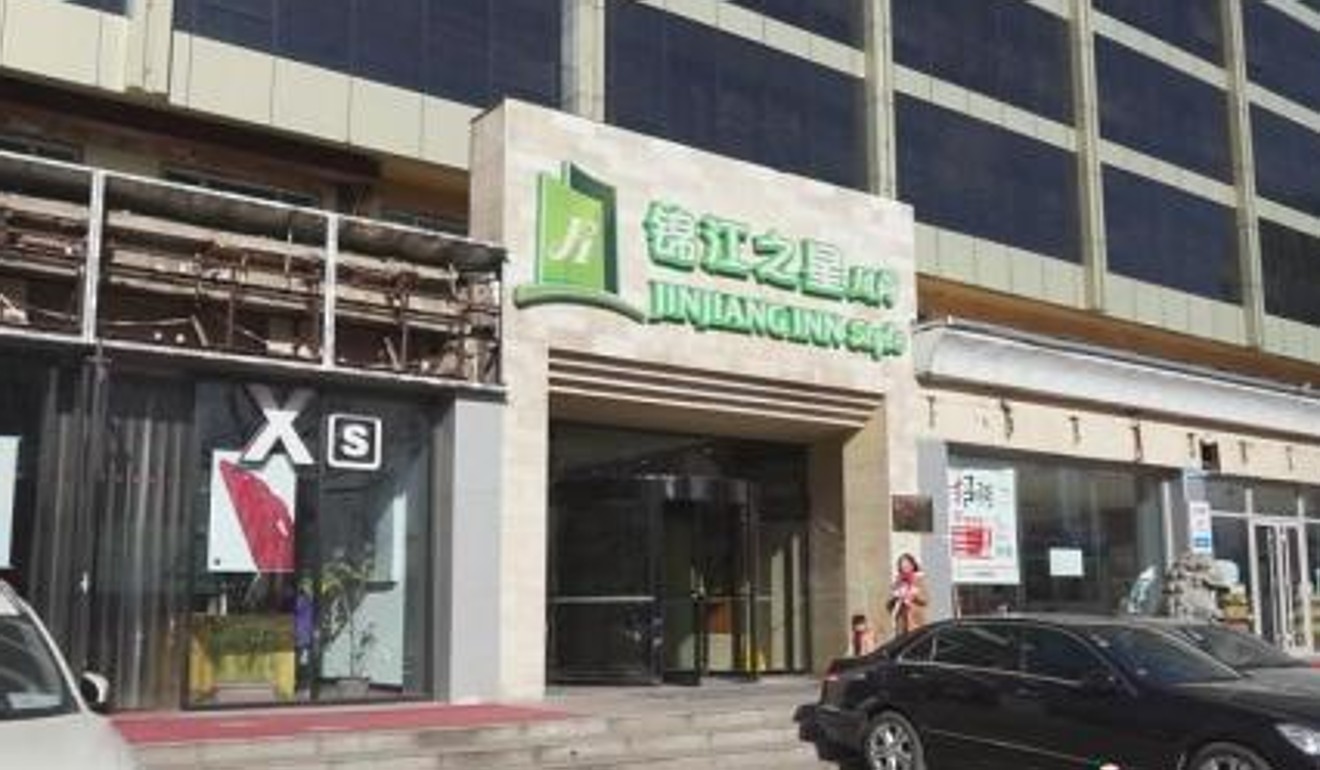
The health inspectors highlighted the case of one hotel in the downtown area, part of the Jinjiang Inn franchise, where clean towels were found stored in the same small room as the rubbish bins. Regulations require that towel cabinets are not placed with other items.
Inside the towel cabinet were a box of men’s shoes, half a pack of melon seeds and personal cosmetic products that belonged to hotel employees, the officials said.
“These items are probably not clean and can’t be stored with things that have already been cleaned; otherwise there will be cross-contamination,” an inspector was quoted as saying.
Officials also found items in the hotel’s sterilising room which should not have been there, and two employees working in the sterile area without the mandatory health certificate.
Last month Huazong, an online celebrity in China, uploaded a video in which some cleaners at five-star hotels were seen using the same towel to clean a bathroom mirror, basin, toilet and drinking cups.
Amid the uproar caused by the video, a commenter on Weibo, China’s Twitter-like service, wrote, “Hygiene problems exist in expensive hotels. I dare not imagine how bad the situation is in other hotels?”
Yu Delu’s highest finish at a ranking event was the semi-finals of the 2016 Scottish Open
China’s Yu Delu has been banned from snooker for 10 years and nine months after a major match-fixing inquiry.
His compatriot Cao Yupeng also pleaded guilty to fixing and was banned for six years, although three and a half years of his sentence are suspended.
Suspicious betting patterns in numerous matches were investigated over two years in one of the sport’s biggest corruption scandals.
Yu has been described as a “scourge to the game of snooker”.
As reported first by the BBC, the pair are the first Chinese players to be banned for cheating.
Yu, who manipulated the outcome of five matches over a two-and-a-half-year period, will serve the longest suspension since English player Stephen Lee was given a 12-year ban in 2013.
In one match, the stakes placed on the result totalled £65,000, which would have generated a profit of £86,000.
The 31-year-old reached the semi-finals of the 2016 Scottish Open and was ranked 43 in the world when he was charged.
Twenty-eight-year-old Cao, who fixed three matches, was runner-up in the Scottish event last year and world number 38 when initially suspended in May.
Both players were investigated by the World Professional Billiards and Snooker Association (WPBSA) before an independent tribunal ruled on their cases.
The tribunal, chaired by David Casement QC, found that Yu “engaged in deliberate and premeditated corruption to secure substantial financial gain for his friends/associates and himself.”
Yu also admitted lying to the investigator, failing to cooperate with the inquiry and betting on snooker when prohibited from doing so.
“It is very sad when talented players are attracted to the opportunity to make money from fixing matches,” said WPBSA chairman Jason Ferguson.
Cao Yupeng “expressed his sorrow” over match-fixing and said he had financial difficulties
The fixed matches
Yu Delu admitted fixing in five matches:
Indian Open qualifiers: WON 4-3 v Martin McCrudden – 12 February 2015
Paul Hunter Classic: LOST 4-1 v Dominic Dale in Germany – 29 August 2015
Welsh Open: WON 4-3 v Ian Glover – 15 February 2016
European Masters qualifiers: LOST 4-1 v Michael Georgiou – 4 August 2017
Shanghai Masters: LOST 5-3 v Kurt Maflin – 15 November 2017
He also failed to report approaches to fix matches, did not cooperate with the investigation and breached rules by betting on snooker.
The scandals involved betting on markets in the Far East.
Yu won two of the five fixed matches, but had arranged for the correct score to be 4-3 to either player.
There is no suggestion any of the opponents were aware of the match-fixing plan.
Cao Yupeng admitted fixing in three matches:
Welsh Open: LOST 4-1 v Ali Carter – 15 February 2016
Indian Open qualifiers: LOST 4-0 v Stuart Bingham – 30 June 2016
UK Championship: LOST 6-1 v Stephen Maguire – 24 November 2016
Cao also failed to provide material that was requested during the investigation.
He told investigators that he received £5,000 for each of the matches he fixed and he was initially given an eight-year ban, but this was reduced to six – three and a half of which were suspended – because of his co-operation with the inquiry.
“Cao Yupeng has shown true remorse and he will assist the WPBSA in player education and in its fight against corruption, which is reflected in his reduced sanction,” said Ferguson.
Yu was given a 12-year ban, to match the sanction imposed on Lee five years ago, but this was reduced to 10 years and nine months because of his late guilty plea.
These two players are well known in China, and this story will be headline news there.
Lengthy bans show that the sport’s world governing body, the WPBSA, has the capability and desire to investigate such cases all over the world, and not just in Europe.
Sanctions like this send out a clear message to any player tempted to get involved in match fixing that it’s not worth the risk of getting caught.










 CHINDIA ALERT: You'll be living in their world, very soon

3