10/08/2019
- Three-year-old security treaty between US and two key allies under threat as tensions between Seoul and Tokyo continue to escalate
- End of General Security of Military Information Agreement risks undermining Washington’s influence in the region
South Korean protesters hold signs saying “No Abe” during a rally demanding the abolition of the General Security of Military Information Agreement. Photo: AP
The possible termination of a military information-sharing pact between South Korea and Japan would be a symbolic victory for China, a security analyst has warned.
Recent tension between the two countries recently threatened to spill over into the sphere of intelligence after Seoul signalled that it may pull out of the General Security of Military Information Agreement (GSOMIA) pact.
The agreement signed in 2016 enables three-way intelligence gathering between the US and its two allies and provides a crucial framework for coping with North Korea’s nuclear and missile threats.
But the escalating trade dispute between Seoul and Tokyo, prompted by a dispute about Japan’s colonial legacy, has left the future of the deal in jeopardy as the annual deadline for its renewal looms.
Japan approves first hi-tech exports to South Korea since start of ‘trade war’ – but with a warning
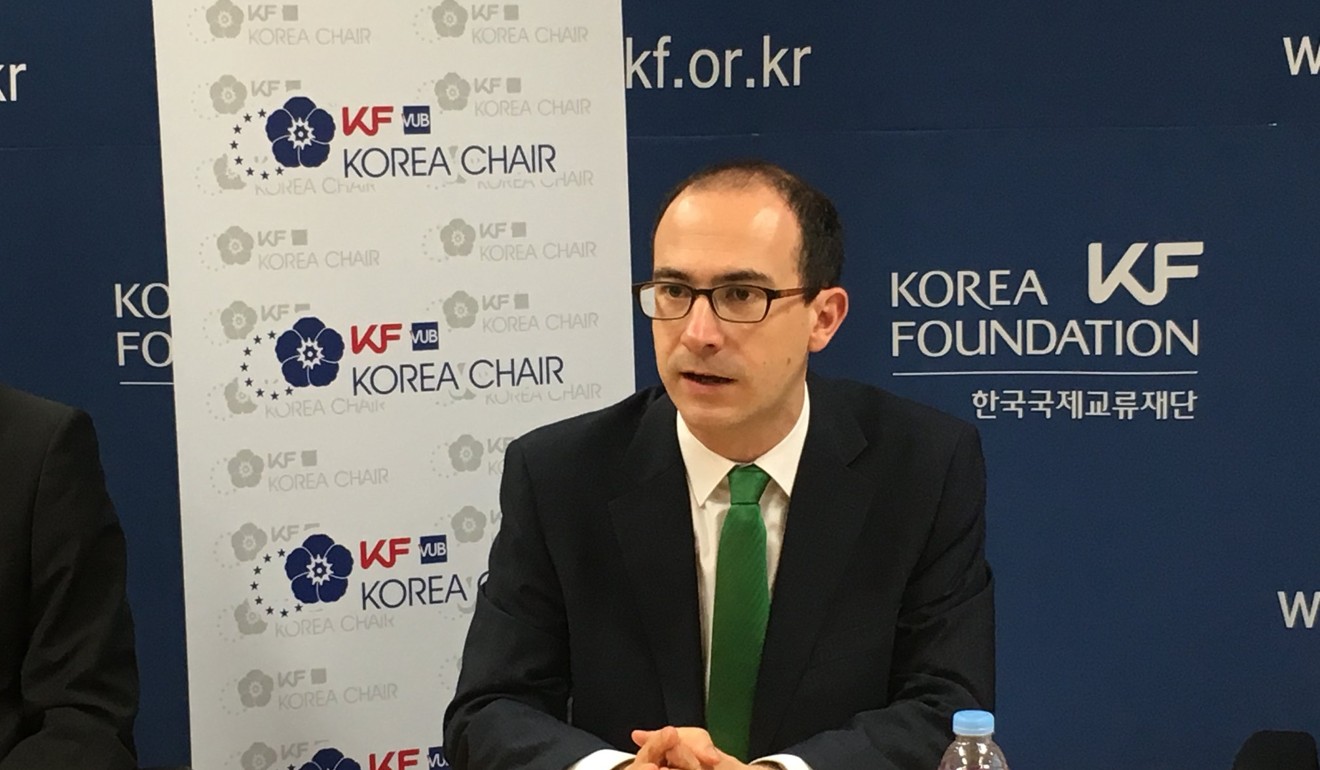
Ramon Pacheco Pardo, the first Korea chair at the Institute for European Studies at Vrije Universiteit Brussel in Belgium, said scrapping the pact would help strengthen China’s influence in the Asia-Pacific region at the expense of the US.
“It is undeniable that termination of GSOMIA would dent the US-South Korea-Japan alliance. The alliance system in northeast Asia will be weaker, strengthening China in relative terms in the process. “This could embolden China and Russia to strengthen their military cooperation in northeast Asia, said Pardo, a member of the non-governmental EU Council for Security Cooperation in the Asia-Pacific.
“Ending GSOMIA would signal that South Korea and Japan are not ready to follow Washington’s lead in the way the latter would like, given the political capital that successive US administrations spent in convincing both countries to share intelligence.”
Ramon Pacheco Pardo said the collapse of the pact would have a largely symbolic impact on China. Photo: Facebook
But Pardo also stressed that the intelligence alliance was not directly targeting China.
“While it is true that GSOMIA serves to connect the weakest link of the US-South Korea-Japan security triangle, ultimately South Korea’s security posture and the capabilities of each country independently mean that it is difficult to argue that the agreement is a concerted effort to contain China.”
“After all, Beijing does not share any significant information on North Korea’s nuclear and missile programmes with South Korea, Japan or the US.
“This is not going to change any time soon. So the good news for China would be symbolic rather than substantial.”
US missiles, jittery neighbours and South Korea’s big security dilemma
Beijing warned on Tuesday that it would take “countermeasures” if the US deployed ground-based missiles in either Japan or South Korea, and Pardo argued that scrapping the intelligence-sharing pact would expose the weaknesses in their co-ordinated approach towards China.
The security deal is automatically renewed every year unless one party decides to pull out. To do so, it must notify the others 90 days before its expiry – a deadline that falls on August 23.
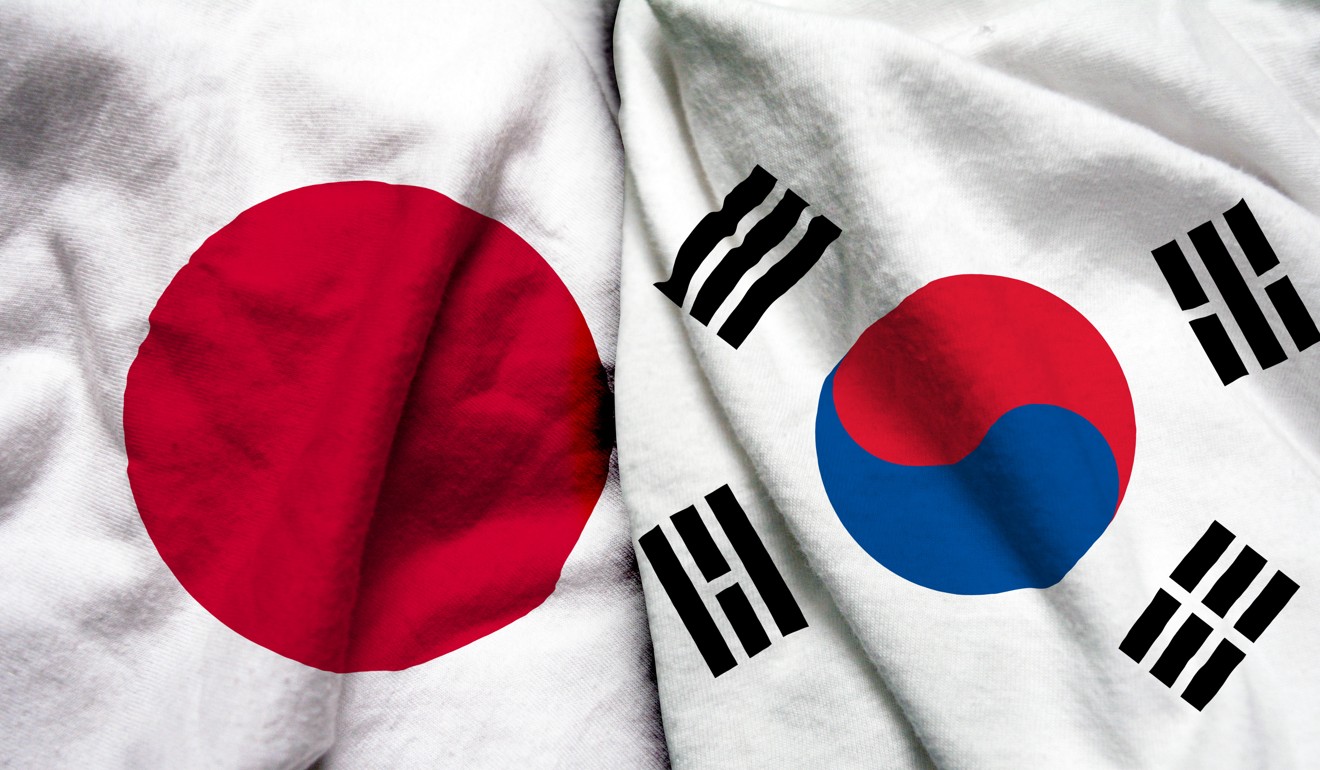
The trade row was sparked by a recent South Korean court ruling that Japanese should compensate individual victims of wartime forced labour. Tokyo believes it settled all necessary compensation under a treaty signed in 1965, but Seoul believes that individual victims’ right to file a claim has not expired.
Relations between South Korea and Japan have deteriorated following a court ruling over forced labour in the wartime era. Photo: Shutterstock
Last week Japan said it would remove South Korea from its “white list” of countries with preferential trade status. Seoul has threatened to respond in kind, but also warned that it may reconsider whether to renew the intelligence-sharing pact.
Both the US and Japan have said they want the arrangement to continue, but Pardo said the effect of the termination would remain largely symbolic.
South Korea has already been investing in its own satellite and anti-submarine programmes to monitor the North’s activities, while Japan has also been developing its own intelligence programmes.
“This shows that neither South Korea nor Japan wants to rely on each other or third parties, namely the US, when it comes to monitoring North Korea’s military activities,” Pardo said.
But he argued that this behaviour already indicated that the alliance was weakening and suggested that terminating the treaty would increase China’s room for manoeuvre.
South Korea buys helicopters worth US$800 million after Trump seeks contribution for US presence
Since the 1990s successive US administrations have pushed for intelligence-sharing arrangements with Japan and South Korea to help build a framework to check Chinese and Russian military expansion in the Pacific.
“Beijing and Moscow are clearly moving in the direction of closer cooperation anyway. GSOMIA or not, military cooperation will continue … as long as Xi Jinping and Vladimir Putin lead each country and most probably even beyond then,” Pardo said.
China and Russia flexed their muscles in the region last month as the trade dispute between the two key allies intensified.
Russian and Chinese long-range military aircraft conducted their first-ever joint air patrol over the Sea of Japan – also known as the East Sea – and the East China Sea.
“The East Asian security landscape would be reshaped insofar that China, North Korea and Russia would see that their main opponent in the region – the US – is unable to convince its two key allies, South Korea and Japan, to cooperate on a key issue,” Pardo said.
“The current dispute between South Korea and Japan will need a negotiated solution … In any case, Japan will have to learn to live with the fact that former colonisers will, from time to time, receive criticism by many of their former colonies, criticism that sometimes will escalate.
“It happens to former European colonial powers, for example, and it is only logical because the interpretation of the past is always in flux.”
Source: SCMP
Posted in anti-submarine programmes, Asia, Belgium, China alert, collapse, colonial legacy, countermeasures, escalate, EU Council for Security Cooperation in the Asia-Pacific, General Security of Military Information Agreement, General Security of Military Information Agreement (GSOMIA), GSOMIA, helicopters, hi-tech export, influence, Institute for European Studies, intelligence pact, Japan, jittery neighbours, military cooperation, missile threats, North Korea, nuclear threats, own intelligence programmes, President Trump, region, Russia, satellite programmes, security treaty, Seoul, South Korea, symbolic victory, Tokyo, trade war, Uncategorized, undermining, US, US missiles, Vrije Universiteit Brussel, Washington |
Leave a Comment »
23/06/2019
- Stalled denuclearisation talks also expected to be on the agenda when Chinese president meets Kim Jong-un this week
- Analysts say Korean peninsula has become intense diplomatic battleground between Beijing and Washington
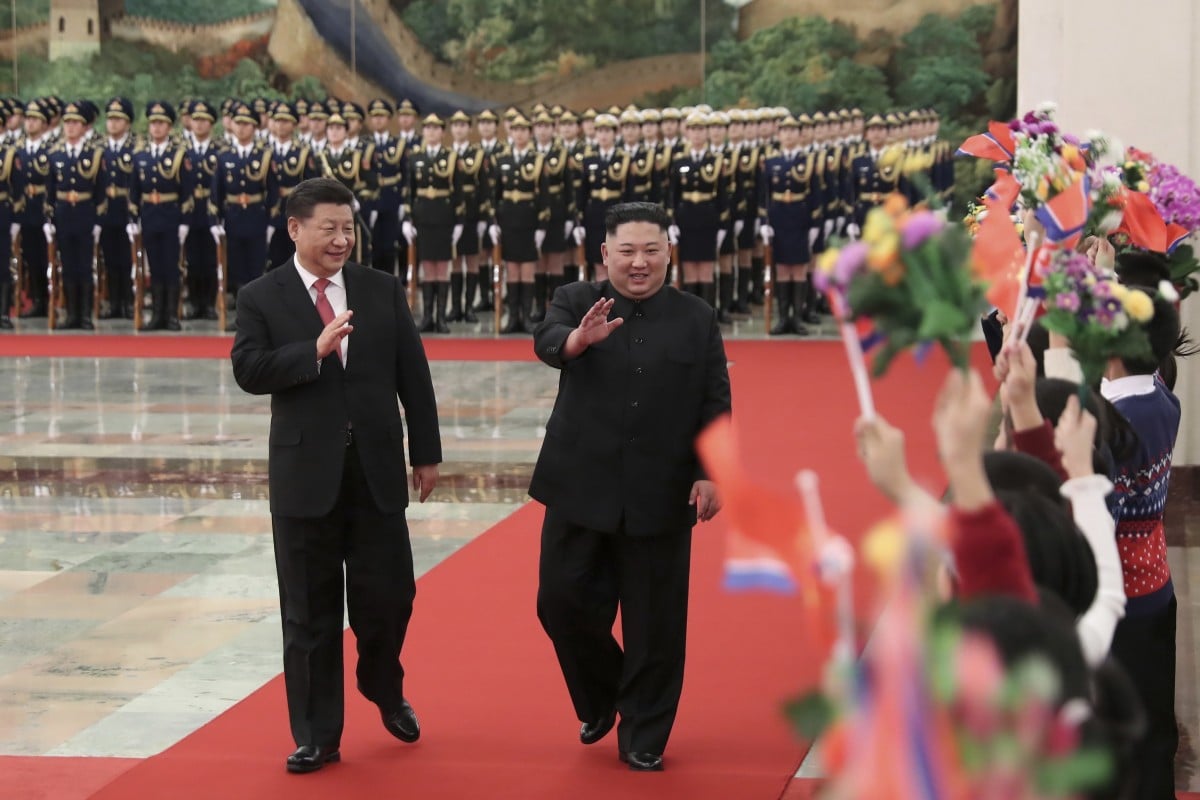
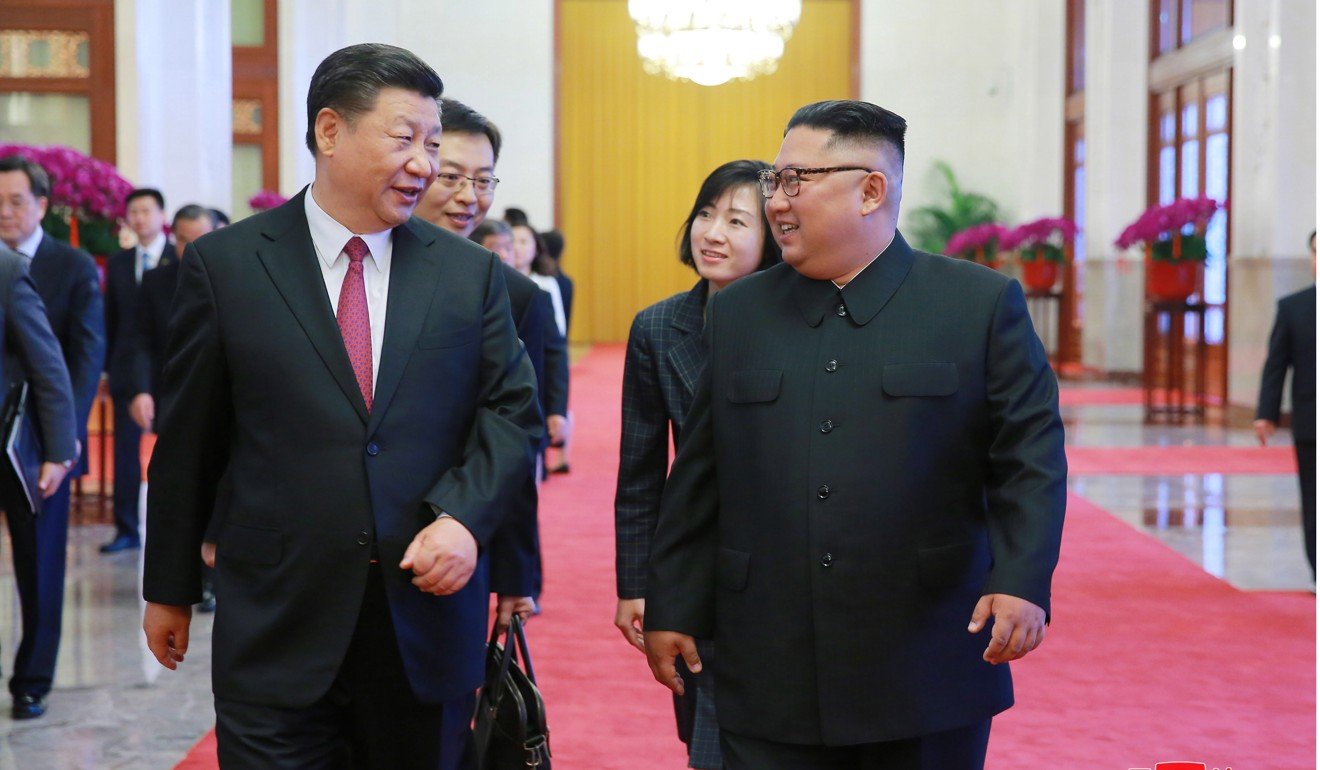
North Korean leader Kim Jong-un (right) attends a welcome ceremony in Beijing with Chinese President Xi Jinping in January. Xi will begin a visit to Pyongyang on Thursday. Photo: AP
Xi Jinping’s upcoming trip to
will be a state visit – a higher status than the last trip to the hermit kingdom by a Chinese president, highlighting the close bilateral ties between Beijing and Pyongyang.
Xi’s two-day trip, which
, is the first by a Chinese president to North Korea in 14 years and comes just a week before he is due to meet US President Donald Trump for talks on the sidelines of the Group of 20 summit in Japan.
“Leaders of the two countries will review the development of the bilateral relationship and carry out an in-depth exchange of opinions on the development of Sino-North Korean relations in the new era, and chart the future course of development,” state news agency Xinhua reported on Tuesday.
Xi’s predecessor, Hu Jintao, went to North Korea in October 2005 on a three-day trip described as an “official goodwill” visit.
Speaking at a regular press briefing in Beijing on Tuesday, foreign ministry spokesman Lu Kang said Xi’s visit aimed to “inject new impetus” into relations in the year the two countries marked the 70th anniversary of establishing diplomatic ties, and to give stalled denuclearisation talks a much needed push.
“Regarding the progress on denuclearisation, as I said, the result of the Hanoi leaders’ meeting in February was indeed a little unexpected. But after that, everyone actually looks forward to the resumption of dialogue in a good direction,” Lu said, referring to the failed talks between Trump and North Korean leader Kim Jong-un in the Vietnamese capital four months ago.
Trump hinted at the possibility of another meeting with Kim after receiving what he called “a beautiful letter” from the North Korean leader last week. On Tuesday, South Korea’s chief nuclear negotiator, Lee Do-hoon, said the US had been in contact with the North.
Life in North Korea the ‘admiration and envy’ of others, state media says
Washington will also send US Special Representative for North Korea Stephen Biegun to South Korea next week, days after Xi’s visit to Pyongyang, to fully align its position on North Korea with its ally.
Meanwhile, Trump confirmed he would meet Xi for talks in Osaka next week, saying in a tweet on Tuesday they had “a very good telephone conversation” and would hold “an extended meeting” at the G20 summit, where they are
over an almost year-long trade war.
Pyongyang has demanded the lifting of sanctions imposed on the regime following its nuclear and missile tests, while Beijing has said the livelihoods of North Koreans should not be affected. But Washington insists full sanctions should remain in place.
The US has also voiced scepticism about Chinese compliance with the sanctions. At a security summit in Singapore earlier this month, US acting Pentagon chief Patrick Shanahan – who on Wednesday stepped down from his role
– presented his Chinese counterpart Wei Fenghe with photographs and satellite images of North Korean ships transferring oil near China’s coast.
Analysts said Xi would seek to use the visit to boost China’s diplomatic leverage on the North Korean nuclear front, strengthening its hand in dealing with the US.
Exports from North Korea to China, which account for the bulk of its trade, plunged 87 per cent last year from 2017, and the country has faced other economic problems at a time when Kim has vowed to deliver on the economy.
A diplomatic source said China was expected to offer a large amount of humanitarian assistance, such as food and fertiliser, to North Korea, which could weaken the impact of sanctions.
China’s goal of denuclearisation on the Korean peninsula is unwavering and will not changeLu Chao, North Korean affairs expert at Liaoning Academy of Social Sciences
Communist Party mouthpiece People’s Daily on Tuesday said via its social media account that Xi would discuss economic and trade cooperation with Kim during the visit.
Quoting Zheng Jiyong, director of the Centre for Korean Studies at Fudan University in Shanghai, the newspaper said Pyongyang had taken steps to reform its economy and introduced China’s industrial manufacturing blueprint.
In September, Beijing proposed building a rail link from the city of Dandong, in China’s northeastern Liaoning province, to Pyongyang and then on to Seoul and Busan in the South, as well as a new road between Dandong and Pyongyang through Sinuiju.
Lu Chao, a North Korean affairs expert at the Liaoning Academy of Social Sciences, said large-scale economic cooperation between China and North Korea was unlikely because of the sanctions, but smaller moves were possible.
Chinese tourists flood North Korea as Beijing remains Pyongyang’s key ally
“For example, China may export daily necessities to North Korea. And if it’s needed, China is very likely to provide [food] assistance to North Korea,” Lu said. “I believe the UN sanctions on North Korea should change, because it has shown a more substantive approach to [achieving] denuclearisation.”
But analysts said Beijing remained firm on the need for Pyongyang to honour its pledges so that denuclearisation could be achieved.
“China’s goal of denuclearisation on the Korean peninsula is unwavering and will not change … China supports [North Korea] and the US continuing to hold talks,” Lu said.
Beijing also had an important part to play in the peace process, according to Boo Seung-chan, an adjunct professor at the Yonsei Institute for North Korean Studies in Seoul.
“China can have a positive role as a mediator to facilitate the peace process on the Korean peninsula,” Boo said.
Source: SCMP
Posted in aims, Asan Institute for Policy Studies, Beijing, Busan, Centre for Korean Studies, chinese tourists, Dandong, denuclearisation, diplomatic battleground, Fudan University, hermit kingdom, Hu Jintao, Kim Jong-un, Korean peninsula, Liaoning Academy of Social Sciences, Liaoning province, new impetus, North Korea, Patrick Shanahan, People’s Daily, President Donald Trump, President Xi Jinping, Pyongyang, Seoul, Shanghai, Singapore, Sino-North Korean relations, South Korea, State visit, ties, Uncategorized, US acting Pentagon chief, US Special Representative for North Korea, Washington, Wei Fenghe, Xinhua, Yonsei Institute for North Korean Studies |
Leave a Comment »
19/06/2019
- ‘Traditional friendship’ between two nations will continue whatever the future brings, Xi says ahead of two-day trip to Pyongyang
- Visit comes amid rising tensions between Beijing and Washington, and stalled negotiations on the denuclearisation of the Korean peninsula
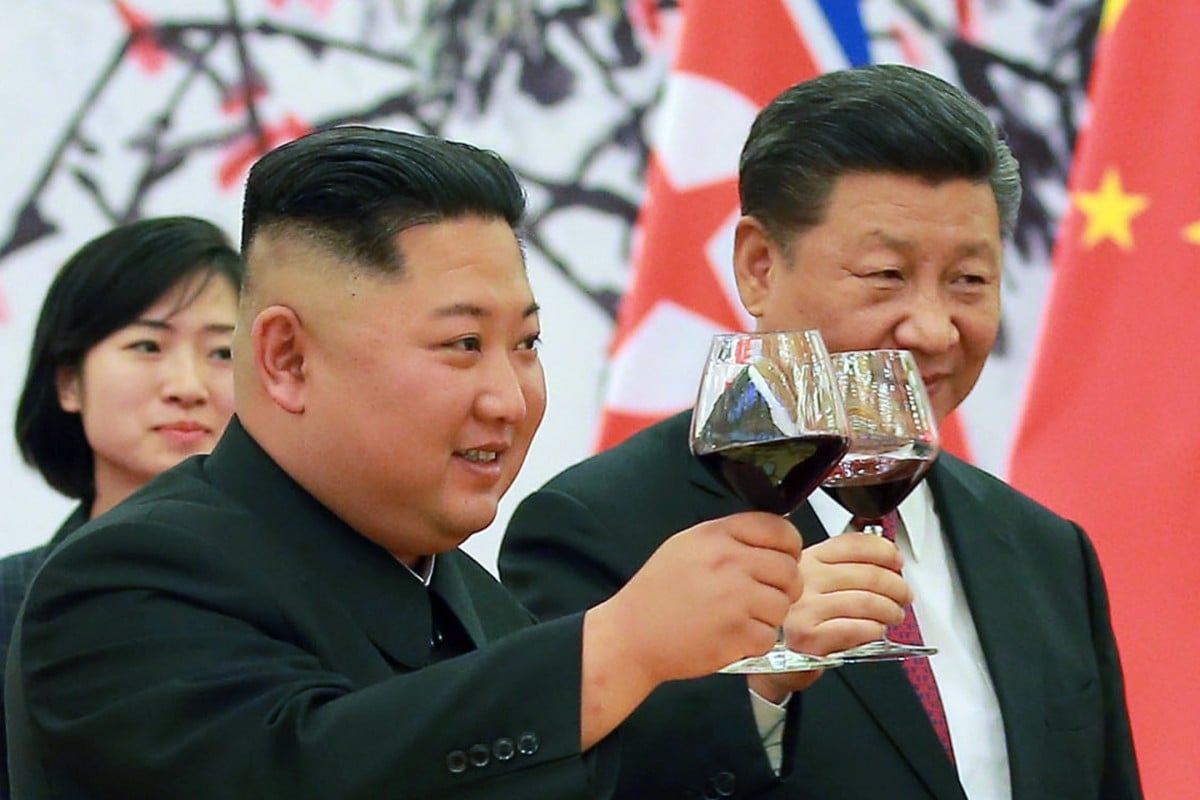
Chinese President Xi Jinping says China will continue to “firmly support” North Korean leader Kim Jong-un. Photo: AP
Chinese President Xi Jinping has pledged his full support for North Korean leader Kim Jong-un and promised to play an active role in efforts to bring peace and stability to the region, a day ahead of his
Xi’s comments, in an editorial published by North Korean newspaper Rodong Sinmunon Wednesday, come as China remains locked in a trade and technology war with the United States, and after a second summit between US President Donald Trump and Kim in Hanoi in February failed to achieve any progress on the denuclearisation of the Korean peninsula.
“No matter how the international situation changes”, China would “firmly support Chairman Kim Jong-un to lead the North Korean party and people to implement the new strategic line”, the article said.
As well as expressing the two sides’ desire to strengthen “strategic communication and exchanges”, Xi said Beijing would continue to support Pyongyang in its negotiations with other countries.
Xi Jinping (left) says China will “contribute to peace, stability, development and prosperity in the region”. Photo: EPA-EFE
“We will actively contribute to peace, stability, development and prosperity in the region by strengthening communication and coordination with the Democratic People’s Republic of Korea,” he said, referring to the country by its official name.
China would also engage with other stakeholders “by jointly expediting progress on dialogue and negotiations on the issues of the Korean peninsula”, he said.
Xi’s state visit to North Korea aims for ‘new impetus’ in ties
Speaking ahead of Xi’s two-day trip to Pyongyang, which starts on Thursday, Chinese foreign ministry spokesman Lu Kang said on Tuesday that the outcome of the Trump-Kim summit in Hanoi was “a little unexpected” and that China was encouraging both sides to continue their dialogue.
Trump said last week that he had received a “
” from Kim that had “reset” the tone between the two countries. In May, he said Pyongyang was “not ready to negotiate”.
One of the major stumbling blocks in the negotiation process has been the United Nations sanctions. Pyongyang has stipulated that they should be lifted as a precondition of the denuclearisation process while Washington has insisted they should remain in place until North Korea provides clear evidence the process is under way.
China, meanwhile, has been accused of providing large amounts of humanitarian aid to its neighbour to help offset the impact of the sanctions.
Xi said China would continue to support North Korea in raising “legitimate concerns through dialogue”.
“No matter how the wind and clouds of the international situation change, our two parties and two peoples inherit and carry forward the traditional friendship between China and the DPRK,” he said.
Zhao Tong, a fellow at the Carnegie-Tsinghua Centre for Global Policy, said that while the main aim of Xi’s visit was to reaffirm ties, its timing, amid the US-China dispute, was designed to show Beijing still had a role to play in the negotiations.
“As China-US strategic rivalry grows, China wants to maintain its geopolitical influence on the Korean peninsula. By demonstrating its unique relations with the DPRK at a time when neither Washington nor Seoul is able to resume high-level engagements with Pyongyang, Beijing is signalling to Washington that it is still a helpful, constructive and indispensable partner to resolve important regional problems,” he said.
Xi’s visit to North Korea will be the first by a Chinese leader since Hu Jintao in 2005.
Source: SCMP
Posted in Beijing, Carnegie-Tsinghua Centre for Global Policy, Chinese President Xi Jinping, Democratic People’s Republic of Korea, denuclearisation, full support, Hu Jintao, Kim Jong-un, Korean peninsula, North Korean leader, Pyongyang, Rodong Sinmunon, Seoul, Uncategorized, Washington |
Leave a Comment »
29/05/2019
- The Asian security forum in Singapore had been seen as an ideal venue for a breakthrough in the growing diplomatic spat – but Tokyo has got cold feet
- That will ease the pressure on Beijing in the South China Sea, analysts say
Hopes are fading for a breakthrough in Japan-South Korea relations at the Shangri-La Dialogue in Singapore. Photo: Kyodo
Hopes that
and
could use the Shangri-La Dialogue in
to address their growing diplomatic spat are receding.
The three-day Asian security forum, which begins on Friday, had been seen as an ideal neutral venue for the two countries’ defence ministers to hold formal talks on issues including Tokyo’s claim that in January a
onto a Japanese reconnaissance aircraft.
The issue is one of the biggest deviling the bilateral relationship, alongside Japan’s perception that Seoul has backtracked on a promise to draw a line under Japan’s use of
– euphemistically known as “comfort women” – in military-run brothels during World War Two.
However, Tokyo appears to have concluded that formal talks on the sidelines of the Shangri-La Dialogue would be premature. The Yomiuri newspaper has reported that a formal meeting will no longer take place and that Takeshi Iwaya and Jeong Kyeong-doo, his South Korean opposite number, will now be restricted to a brief, stand-up exchange of their positions.
Despite the report, South Korean officials were guarded when asked whether the meeting had been shelved. “A detailed plan [on the bilateral talks] has yet to be fixed. Consultations are still underway between authorities of the two countries,” said the South Korean defence ministry spokesperson Choi Hyun-soo on Tuesday.
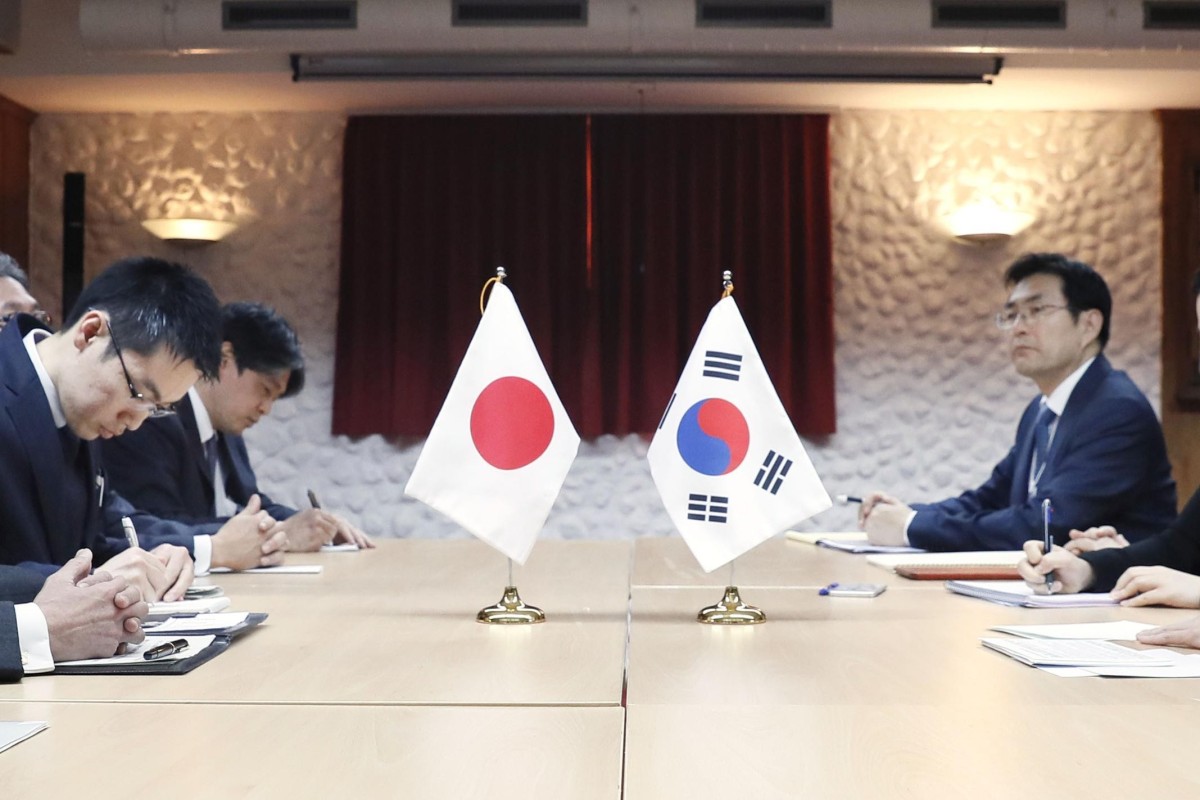
Analysts suggested Japan had run out of patience with South Korea and that the biggest winner in the stand off between two US allies would be China.
Japanese Defence Minister Takeshi Iwaya. Photo: Kyodo
“My sense is that Japan sees South Korea as not engaging in negotiations on a number of issues and not adhering in good faith to agreements that it has already signed,” said Stephen Nagy, a senior associate professor of international relations at Tokyo’s International Christian University.
Tokyo has been incensed that the administration of
has gone back on a 2015 agreement that was meant to draw a final line under the “comfort women” issue. Its anger deepened when Seoul said it would not intervene in a South Korean Supreme Court ruling, which ordered Japanese companies to pay up to 120 million won (US$100,000) to each of a dozen
of the Korean peninsula from 1910-1945.
Like its stance on “comfort women”, Japan believed a line had been drawn under the issue, this time in a 1965 pact that normalised relations between the two countries. Seoul argues that the 1965 treaty, which it signed after receiving US$800 million in grants and soft loans from Tokyo as compensation, does not cover individual victims of colonial-era atrocities.
As rift between Japan, South Korea deepens, how hard can Seoul afford to push?
“Japan is not ready to get into any more agreements because it fears that Seoul will not follow through or that they will become politicised in the future,” Nagy said.
“Tokyo wants binding, long-lasting agreements rather than having to renegotiate something each time a new Korean government comes in,” he said.
“The biggest winner in this stand-off between the US’ two most important allies in the region is, of course, China,” he added. “They must be delighted to see this playing out because it means the US is not able to exert nearly as much pressure in areas such as the
A long-standing strategic aim in US foreign policy circles has been to form a trilateral alliance with South Korea and Japan to present a united front against common security concerns, including China’s growing influence. However, the seeming inability of the two countries to get along has long thwarted this ambition.
“If Japan, South Korea and the US could find a way to cooperate, imagine the influence they could exert over the South China Sea or over
,” Nagy said. “If Japan and Korea could find a way to put their differences aside and with their security capacity, it would be a powerful deterrent to Beijing and Pyongyang.”
South Korean protesters demonstrate against Japan’s use of sex slaves – euphemistically termed ‘comfort women’ in World War II. Photo: AFP
Toshimitsu Shigemura, a professor of international relations at Tokyo’s Waseda University, agreed that the schism between Seoul and Tokyo would be of serious concern to Washington, but he believed that US pressure had already been brought to bear on the two neighbours.
“By avoiding talks in Singapore, Japan is doing its best to avoid public problems between the two sides and I believe that talks are already taking place between the two governments on these issues,” he said.
US wants Japan and South Korea to tag team China. But history is in the way
“The US will have told Tokyo and Seoul that it does not want to see more disagreements and that it is very important that they cooperate and calm things down a bit,” he said.
“I am sure that Washington knows exactly what happened when the Korean warship locked onto the Japanese aircraft in January, but they’re not publicly taking sides and instead they’re telling both governments to put the dispute behind them and to move on,” he added.
Other analysts were more pessimistic.
“The dynamics in domestic politics in both countries are currently overwhelming any diplomatic motives to improve bilateral ties,” said Bong Young-sik, a researcher at the Asan Institute for Policy Studies in Seoul.
Japanese Prime Minister Shinzo Abe. Photo: AFP
“For President Moon Jae-in, Japan-bashing is a useful political card to appeal to his supporters while for
, giving the impression that South Korea is going too far in pressing Japan is also beneficial for his own political gains.”
Professor Ha Jong-moon at Hansin University said there were “no solutions in sight” to resolve the differences over forced labour and wartime sex slavery, but said there would be a chance to “smooth ruffled feathers” at the G20 summit in Osaka, which takes place at the end of June.
The last time the defence ministers of the two countries met was in October last year, when they held talks on the sidelines of the Asean Defence Ministers’ Meeting in Singapore.
Source: SCMP
Posted in Asian security forum, associate professor of international relations, ‘win for China’, “comfort women”, Beijing, China alert, cold feet, fire control radar, hopes fade, Japan-South Korea talks, Japan’s colonial rul, Japan’s colonial rule, Japanese, Jeong Kyeong-doo, Korean sex slaves, military-run brothels, President Moon Jae-in, professor of international relations, Pyongyang, reconnaissance aircraft, Seoul, Shangri-La Dialogue, Singapore, South China Sea, South Korea, South Korean Supreme Court, South Korean warship, Stephen Nagy, Takeshi Iwaya, Tokyo, Tokyo’s International Christian University., Tokyo’s Waseda University, Toshimitsu Shigemura, Uncategorized, US allies, World War Two, Yomiuri |
Leave a Comment »
07/04/2019
HANGZHOU, April 6 (Xinhua) — The city of Ningbo in east China’s Zhejiang Province will launch direct flights to Tokyo and Seoul this year, the city’s Lishe International Airport said.
Sources with the airport said it would also increase flights to domestic cities like Beijing and Qingdao in 2019.
Ningbo has one of the busiest ports in the world.
The airport is expanding its terminal facilities amid a surging passenger volume. The airport handled 11.7 million passengers in 2018, a yearly increase of 24.8 percent.
Source: Xinhua
Posted in Beijing, direct flights, East China city, Ningbo, Qingdao, Seoul, Tokyo, Uncategorized, zhejiang province |
Leave a Comment »
23/02/2019
- Middle-aged man seen taking a nap mid-flight said to be senior pilot with the Taiwanese carrier
- His co-pilot who took the video has also been reprimanded
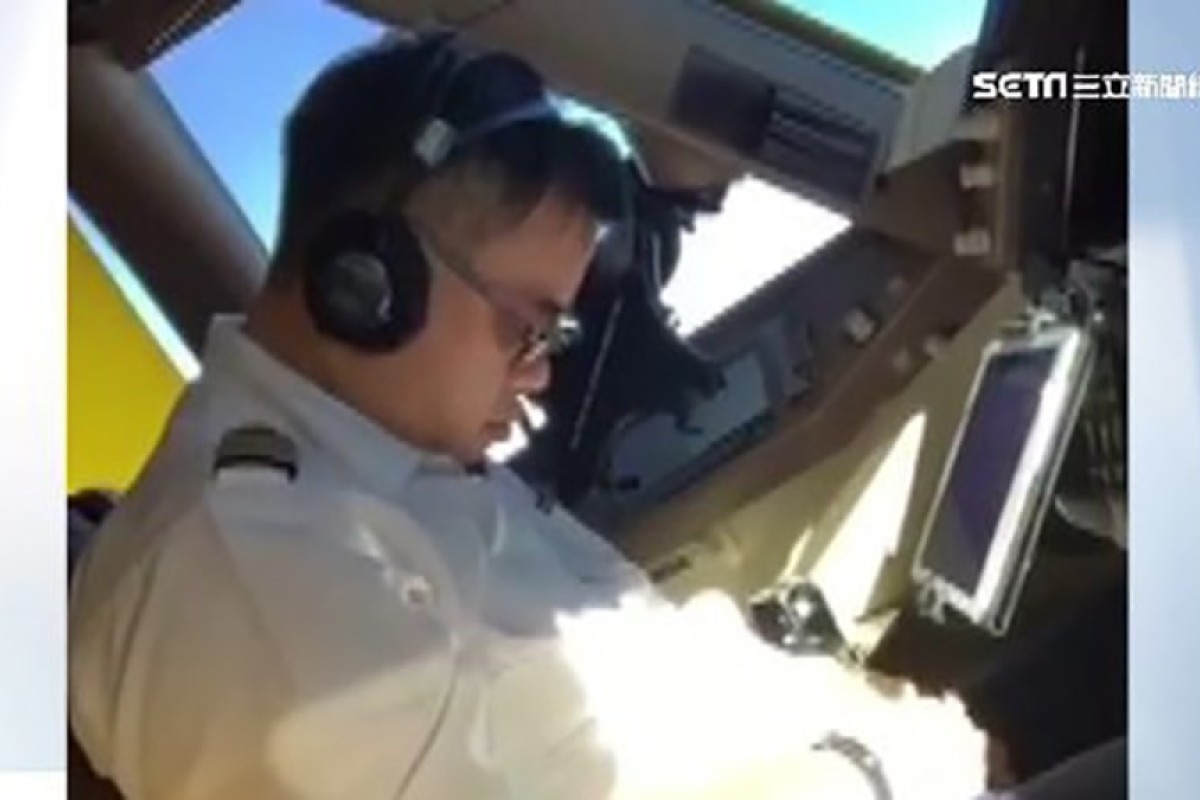
The video shows the pilot in the cockpit with his head down and eyes closed. Photo: setn.com
China Airlines, Taiwan’s biggest carrier, says it has punished a pilot after a video of him taking a nap in the cockpit mid-flight was posted online.
His co-pilot, who filmed the incident, has also been reprimanded, local television station SETN reported.
In the video, a middle-aged man in a pilot uniform and headphones appears to be asleep with his head down and eyes closed while in the cockpit of a Boeing 747.
The footage drew attention after it was shown in a report on Taiwanese TV network EBC on Wednesday. The man was identified as Weng Jiaqi, a senior pilot with almost 20 years of experience who was promoted to chief pilot last year.
Chinese airline Donghai suspends and fines pilot for allowing wife in cockpit
It was unclear when or on which flight the video was filmed, but the airline confirmed that Weng had reported his behaviour and been punished while his co-pilot had been reprimanded for “improper behaviour”, SETN reported.
Weng, who also supervises training, is a short-haul pilot to cities including Hong Kong, Shanghai, Beijing, Guangzhou, Tokyo, Okinawa and Seoul, according to the EBC report.
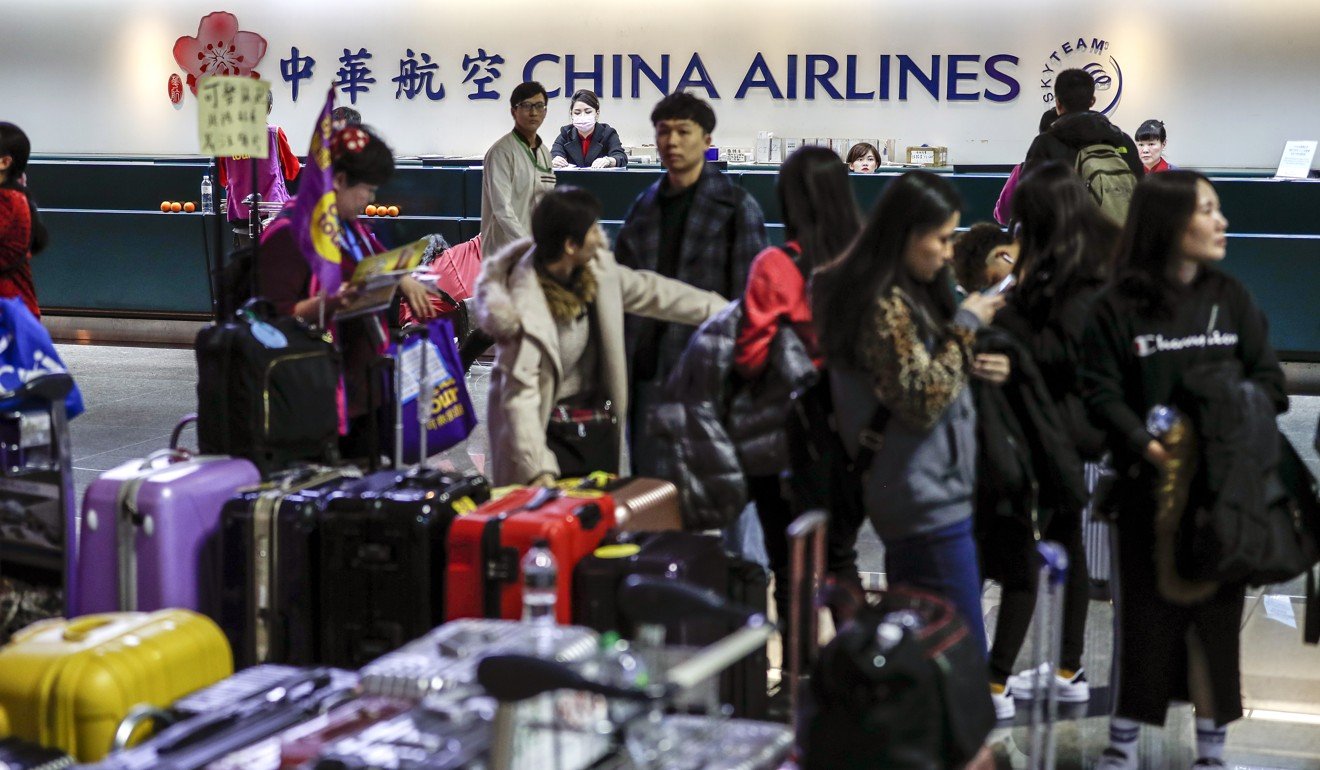
The China Airlines pilots went on strike on February 8, during the Lunar New Year holiday season. Photo: EPA-EFE
Share:
The incident comes after the airline last week reached a deal with the pilots’ union to
over working conditions and benefits that forced the cancellation of more than 200 flights.
But China Airlines told EBC that the video was filmed before the pilots walked off the job.
The Taoyuan Union of Pilots began the industrial action on February 8, stranding close to 50,000 passengers and inflicting over NT$500 million (US$16.2 million) in losses on the carrier.
Under a deal signed on February 14, the union agreed not to strike again in the next 3½ years. In return, China Airlines agreed to the union’s main demand to increase the number of pilots on various flights to combat fatigue and improve safety.
Chinese pilots, cabin crew told no more smoking in cockpits on domestic flights
The carrier will roster three pilots on flights of more than eight hours – up from the present two – and will have four pilots on flights over 12 hours, up from three.
China Airlines president Hsieh Shih-chien said the staffing increases were expected to sharply add to the cost of the company’s operations, but the carrier agreed to the terms in the interest of safety.
Source: SCMP
Posted in Beijing, China Airlines, China Airlines president, China alert, Donghai, Guangzhou, Hong Kong, Hsieh Shih-chien, lunar new year, Okinawa, pilot, Seoul, Shanghai, sleeping in cockpit, Taiwan’s biggest carrier, Tokyo, Uncategorized, Weng Jiaqi, working conditions and benefits |
Leave a Comment »






 CHINDIA ALERT: You'll be living in their world, very soon