05/08/2019
- Analysts say mood is shifting in mainland China as demonstrators ‘cross a line’ with national symbols
Staff and students from Pui Kiu Middle School in North Point hold flag-raising ceremony on campus on Monday. Photo: Nora Tam
A Hong Kong protester’s decision to tear down a Chinese flag and throw it in Victoria Harbour on Saturday set off an outpouring of criticism, from Chinese internet users and celebrities to pro-Beijing businesses and schools in the city.
Then on Monday at about 7pm, a group of protesters went to the same flagstaff in Tsim Sha Tsui, tore down the flag again and threw it into the harbour, the second such incident in three days. In both cases, the protesters escaped.
In North Point, the Pui Kiu Middle School organised a flag-raising ceremony at the campus on Monday even though the school was officially on summer holidays.
Principal Ng Wun-kit said teachers and students were called back on short notice to take part.
“We saw [on the news] that some rioters in helmets threw the Chinese national flag in the harbour and we strongly condemn such behaviour. It was disrespectful,” Ng said.
“We wanted to show that we are one of the 1.4 billion Chinese people who want to protect the national flag. We hope that the students, teachers, and [Hong Kong] citizens who love the country and the Chinese Communist Party can respect the Chinese flag.”
Other Hong Kong businesses and organisations flying the Chinese flag on Monday included international hotel chain Courtyard by Marriott Hong Kong, Chinese engineering firm Shanghai Zhenhua Heavy Industries and Chinese pharmaceutical giant Beijing Tong Ren Tang.
Beijing’s Hong Kong affairs office condemns protesters who threw Chinese flag in the sea
A spokeswoman from the hotel chain said it had flown the flag for many years and Monday was no exception.
“We display the flag because we are a Chinese-funded company. We do not have plans to take it down any time soon,” she said.
On Sunday, a group of Beijing supporters sang the national anthem and raised the Chinese flag in Tsim Sha Tsui to replace the one taken down.
On microblogging site Weibo, mainland Chinese and Hong Kong celebrities were among those forwarding pictures of the flag or salutes to it, adding the hashtag “the Chinese national flag has 1.4 billion flag bearers”, a topic started by China Central Television (CCTV) on Sunday. As of Monday night, the trending topic had been read more than 2 billion times, with more than 8 million posts and support from Hong Kong actors Jackie Chan, Jordan Chan Siu-chun and Hawick Lau Hoi-Wai.
In a commentary published online on Sunday, CCTV said the topic had attracted a strong response because patriotism ran deep among the Chinese people.
“We protect the flag, the national emblem, our country, and we protect our country like we protect our own homes,” it said.
Hong Kong Chief Executive Carrie Lam blasts violence at Yuen Long and liaison office, amid further extradition bill unrest
Analysts said the mood on Chinese social media had changed as protesters in Hong Kong vandalised symbols of the central government, crossing a line for most mainland Chinese.
Wang Jiangyu, an associate law professor at the National University of Singapore, said that although many mainlanders had admired Hong Kong and sympathised with its civil movements in the past, the situation had changed.
“The Chinese flag being insulted is on the top of a list of things mainlanders dislike, and for state media, which represent the central government’s position, focusing on such issues can frame the protesters as enemies of the Chinese nation or the people,” Wang said.
“It can increase the hatred of mainlanders towards the Hong Kong protesters and gain support for the central government to take action in the future.”
Ma Ngok, a political scientist at Chinese University of Hong Kong, said mainland media were using the incident to achieve their own propaganda purposes.
“Mainland media made it seem like [the flag protest was] the theme for the whole movement … but it does not represent the main demands of the anti-extradition movement. They are turning single actions into broad propaganda, and biasing mainland sentiment about Hong Kong,” Ma said.
Source: SCMP
Posted in Beijing Tong Ren Tang, businesses, campus, Carrie Lam, celebrities, Central government, China Central Television (CCTV), chinese communist party, Chinese flag, Chinese University of Hong Kong, Courtyard, flag-raising ceremony, Hong Kong, Hong Kong Chief Executive, Jackie Chan, mainland media, Marriott Hong Kong, National University of Singapore, North Point district, patriotic stand, propaganda purposes, Protest, Pui Kiu Middle School, school, Shanghai Zhenhua Heavy Industries, Tsim Sha Tsui, Uncategorized, vandalised symbols, Victoria Harbour, Weibo |
Leave a Comment »
13/04/2019
- Shanghai Zhenhua Heavy Industries now exports quay cranes, gantry cranes to more than 300 ports in 100 countries, with 70 per cent of the global market
- China International Marine Containers Group (CIMC), took a little more than a decade to become the world’s largest maker of shipping containers
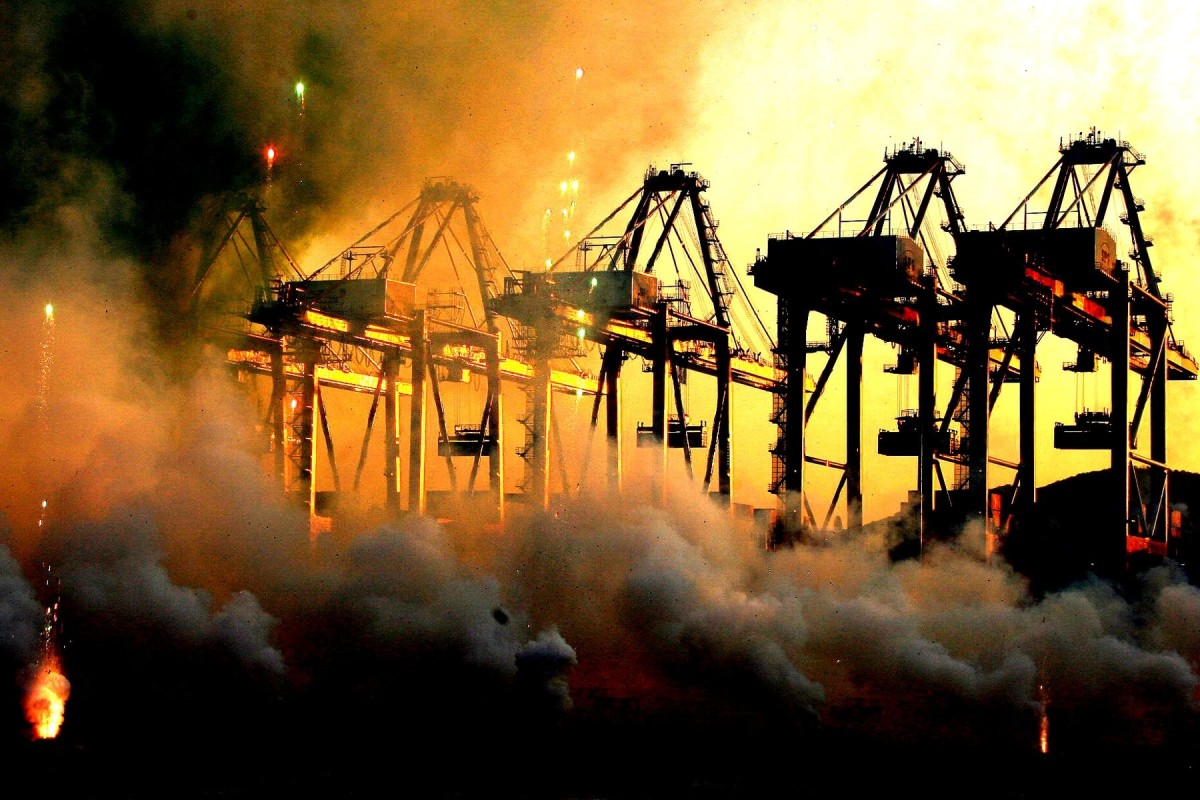
Quay cranes along a berth at the Yangshan deep-water port in Shanghai on September 14, 2011. Shanghai Zhenhua Heavy Machineries, established in 1992, has grown along with the explosive development of China’s ports to control 70 per cent of the global market for cranes, loaders and lifting equipment used in ports. Photo: Xinhua
The explosive growth of China’s container ports has turned one of the most important vendors in shipping into a best-in-class industry leader, whose cranes can now be found in 300 wharves in 100 countries, with 70 per cent of the global market share.
Shanghai Zhenhua Heavy Industries, a unit of China’s state-run construction behemoth China Communications Construction Company, makes quay cranes, gantry cranes, loaders and stackers used for loading and unloading shipping containers. It also developed the infrastructure for the automated berths in Phase IV of Shanghai’s Yangshan port, and in Qingdao.
Its net profit jumped 47.6 per cent last year to 443 million yuan, while sales was little changed at 21.8 billion yuan (US$3.25 billion).
“It is a major showcase of China’s manufacturing capability,” said Sun Can, a Chuancai Securities analyst. “The company has its own technologies and is a powerful player in the global port machinery industry.”
Why China now has six of the world’s 10 busiest container ports
Established in 1992, the company was formerly known as Zhenhua Port Machinery for its speciality in making lifting equipment on the harbourfront. Taking advantage of China’s low wages, Zhenhua quickly carved out a big chunk of the global market share by selling machines at lower prices than its competitors.
The company’s former chief executive Guan Tongxian, a confessed workaholic known for his hard-driving working ethic, retired at the age of 76 in 2009, the same year that the company renamed itself to reflect its forays into marine transport and installations, as well as the construction of special steel structures including the Las Vegas Ferris wheel, the San Francisco-Oakland Bay Bridge and Norway’s Hardangerfjord bridge.
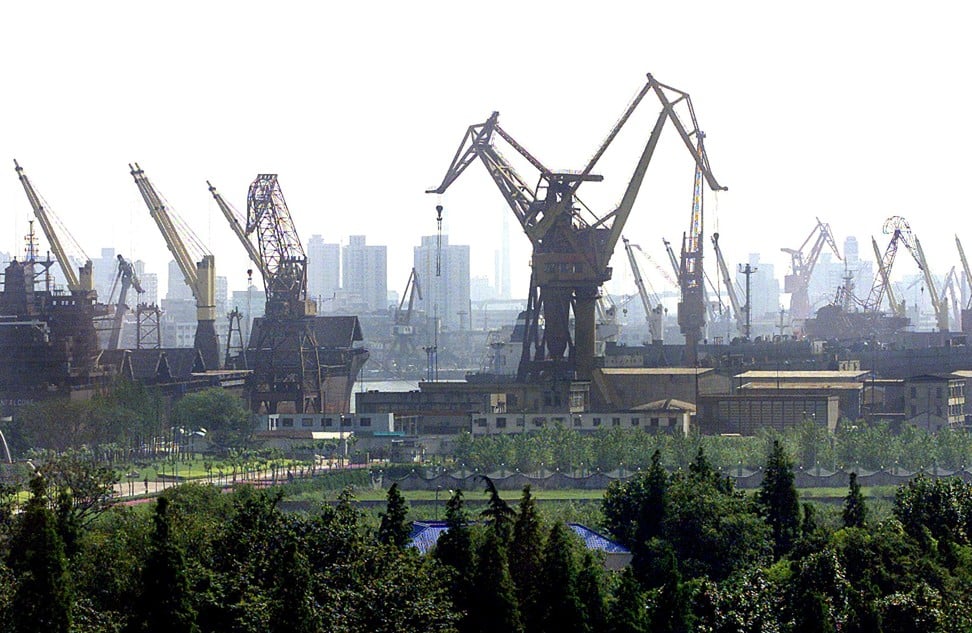
Rows of gantry cranes standing along the Huangpu River in Shanghai on 26 June 2002. A consortium of Chinese domestic banks provided a 17 billion yuan (US$2 billion) credit line toward the construction of Shanghai’s Yangshan deep-sea container port. Photo: AFP
Share:
Listed on the Shanghai exchange in 1997, Zhenhua’s shares have risen 41 per cent in the past 12 months, ending 2.1 per cent lower at 4.46 yuan on Friday. All three analysts who cover the stock recommend their clients either “buy” or “accumulate” the stock, expecting Zhenhua to be a major winner in China’s megaplan to build infrastructure along the old Silk Road in its Belt and Road Initiative (BRI).
Another major company that has emerged with China’s rising tide was China International Marine Containers (Group), or CIMC, a unit of the state-run conglomerate China Merchants Group. Established in 1980, the company took a little more than a decade to dominate the global industry, becoming the world’s largest maker of shipping containers since 1996.
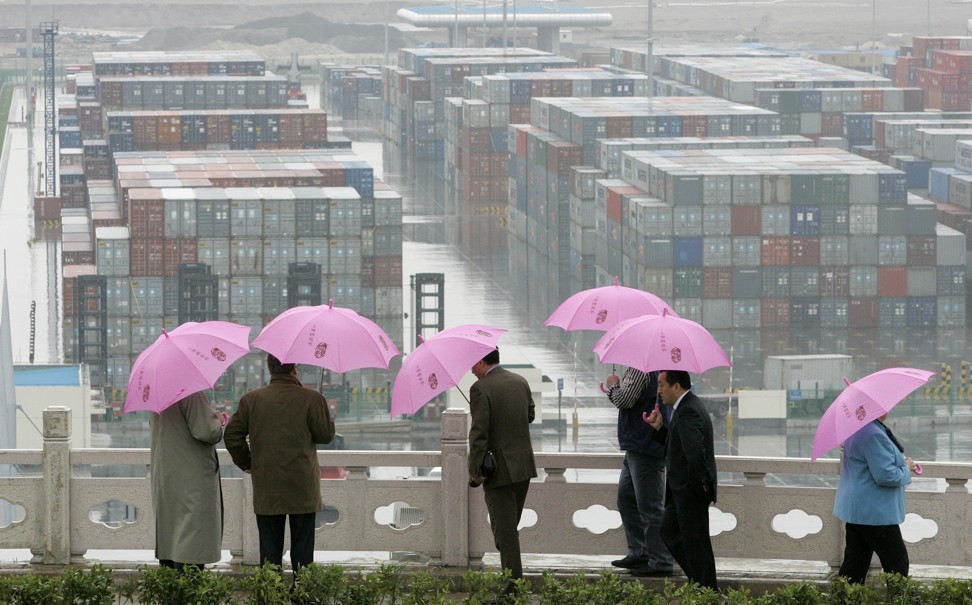
Visitors look at rows of containers at the Yangshan deep water port in Shanghai on April 6, 2006. Photo: AP
Share:
Net profit jumped 34.7 per cent to 3.38 billion yuan last year, while sales rose 22.5 per cent to 93.5 billion yuan.
The company has also diversified into land transport and vehicles, boarding bridges used in 200 airports around the world and even the development of industrial parks.
Guosen Securities said in a research report that CIMC would face lower profit margin this year amid rising raw material costs and fiercer competition from global rivals.
Its shares have risen 43.7 per cent in the past 12 months on the Shenzhen exchange to 15.20 yuan as of Friday.
Source: SCMP
Posted in Belt and Road Initiative (BRI), building frenzy, Chief Executive, China alert, China International Marine Containers Group (CIMC), containers, cranes, gantry cranes, Guan Tongxian, Hardangerfjord bridge, Huangpu River, International Marine Containers (Group), Las Vegas Ferris wheel, Norway, ports, Qingdao, quay cranes, San Francisco-Oakland Bay Bridge, Shanghai, Shanghai Zhenhua Heavy Industries, Shenzhen exchange, shipping containers, Silk Road, trade boom, Uncategorized, wharves, workaholic, world market, Yangshan deep-water port, Yangshan port, Zhenhua Port Machinery |
Leave a Comment »



 CHINDIA ALERT: You'll be living in their world, very soon