Chindia Alert: You’ll be Living in their World Very Soon
aims to alert you to the threats and opportunities that China and India present. China and India require serious attention; case of ‘hidden dragon and crouching tiger’.
Without this attention, governments, businesses and, indeed, individuals may find themselves at a great disadvantage sooner rather than later.
The POSTs (front webpages) are mainly 'cuttings' from reliable sources, updated continuously.
The PAGEs (see Tabs, above) attempt to make the information more meaningful by putting some structure to the information we have researched and assembled since 2006.
Pou Chen makes footwear for the likes of Nike and Adidas, but says it has suffered from a lack of orders as global value chains strain under the impact from the virus
Chinese workers moved to Vietnam to help set-up new factories as the company expand its production, but have now become expendable
With the likes of Nike and Adidas closing retail stores around the world to comply with social distancing requirements, analysts also said orders plummeted 50 per cent in the second quarter, although the company declined to comment on the media reports. Photo: Bloomberg
A group of 150 Chinese workers believe the world’s largest maker of trainers used the coronavirus as an excuse to fire them, having helped Taiwanese firm Pou Chen successfully expand its production into Vietnam for more than a decade.
Pou Chen, which makes footwear for the likes of Nike and Adidas, informed the group in late April that they would no longer be needed as they were unable to return to
from their hometowns in China due to the coronavirus lockdowns.
“We believe we contributed greatly to the firm’s relocation process, copying the production line management experience and successful model of China’s factories to Vietnamese factories,” said Dave Zhang, who started working for Pou Chen in Vietnam in 2003.
“Now, when the factories over there have matured, and there is a higher automation level in production, our value has faded in the management’s eyes and we got laid off, in the name of the automation level.”
Rush hour chaos returns to Vietnam’s streets as coronavirus lockdown lifted
The group claims the firm began to fire Chinese employees several years ago, with the total number dropping from over 1,000 at its peak to around 400 last year.
“We 150 employees were the first batch of Chinese employees to be laid off this year. We are all pessimistic and expect more will be cut,” added Zhang.
In its email on April 27, Pou Chen said it was forced to terminate the contracts of the Chinese employees across five of its factories due to an unprecedented decline in orders and financial losses.
The Chinese employees, many of whom have been working for the shoemaker for decades, said the compensation offered was unfair and below the levels required by labour law in both Vietnam and China.
In a further statement to the South China Morning Post, Pou Chen stood by the move as the coronavirus pandemic had reduced demand for footwear products and so required an “adjustment of manpower.”
“[The dismissals were] in accordance with the relevant labour laws of the country of employment … and employee labour contracts,” added the statement from Pou Chen, which employs around 350,000 people worldwide.
Company data showed Pou Chen’s first quarter revenues tumbled 22.4 per cent year-on-year to NT$59.46 billion (US$1.99 billion), the weakest in six years.
With the likes of Nike and Adidas closing retail stores around the world to comply with social distancing requirements, analysts also said orders plummeted 50 per cent in the second quarter, although the company declined to comment on the media reports.
Last month, the company was also mulling pay cuts and furloughs that would affect 3,000 employees in Taiwan and officials based in its overseas factories, according to the Taipei Times.
Andy Zeng, who had worked for the firm since 1995, said the group were “very upset” when they received the news last month as the impact of the coronavirus pandemic began to reverberate around the world, disrupting global value chains.
“Most of us joined Pou Chen in the 1990s when we were in our late teens or early 20s, when the Taiwan-invested company started investing and setting up factories in mainland China. Now more than two decades have passed,” he said.
Zeng was among the first generation of skilled workers in China as Pou Chen developed rapidly, enjoying the benefits of cheap labour, although the workers themselves were rewarded with regular pay rises.
The company needed a group of skilled Chinese workers to go to its new factories in Vietnam. I said yes because I thought it was a good opportunity to see the outside world – Andy Zeng
“I worked at the Dongguan branch of Pou Chen for 11 years from 1995.” Zeng added “In the 1990s and early 2000s, the company expanded rapidly in Dongguan with a growing number of large orders, and every worker had to work hard around the clock. I remember I earned 300 yuan (US$42) a month in 1995, and my monthly salary rose to 1,000 yuan (US$141) in 1998.”
Zeng’s salary eventually rose to over 3,000 yuan in 2005 as China’s economy boomed, leading Pou Chen to seek alternative production sites in Vietnam and Indonesia where labour and land were even cheaper. However, in the early 2000s, the new locations lacked skilled shoe manufacturing workers like Zeng.
“The company needed a group of skilled Chinese workers to go to its new factories in Vietnam. I said yes because I thought it was a good opportunity to see the outside world and the offer of US$700 per month was not bad.” Zeng said.
“We actively cooperated with their plans. Over the past decade, we have been away from our families and hometowns, and followed the company’s strategy to work hard in Vietnam.
With no deaths and cases limited to the hundreds, Vietnam’s Covid-19 response appears to be working
“In 2005, the company sent me to its newly-built factory in Vietnam. This year was my 14th year in Dong Nai in Vietnam. I have witnessed the company’s production capacity in Vietnam become larger and larger. When I arrived, there were only a few production lines, and now there are at least dozens of them, employing more than 10,000 workers in each factory.”
According to a report in the Taipei Times on April 14, citing both Reuters and Bloomberg, Pou Chen was ordered to temporarily shut down one of its units in Vietnam over coronavirus concerns, according to Vietnamese state media.
The company was forced to suspend production for two days after failing to meet local rules on social distancing, Tuoi Tre newspaper reported.
“We Chinese employees actually were pathfinders for the company’s relocation from China to Vietnam,” said Zhang, who was in charge of a 1,700-worker factory producing 1.7 million shoe soles per month.
What our Chinese employees have done in Vietnam for more than a decade can be said to be very simple but very difficult – Dave Zhang
“We were sent to resolve any ‘bottlenecks’ in the production lines that were slowing down the rest of the plant, because during the launch of every new production line, Vietnamese workers would strike and get into disputes. As far as I know, there were over a thousand Chinese employees managing various aspects of the production lines in the company’s Vietnamese factories.
“In fact, what our Chinese employees have done in Vietnam for more than a decade can be said to be very simple but very difficult. That is to teach Vietnamese workers our experience of working on a production line, improve the productivity of the Vietnamese workers, and help the factories become localised.”
Overall, Pou Chen says it produces more than 300 million pairs of shoes per year, accounting for around 20 per cent of the combined wholesale value of the global branded athletic and casual footwear market.
“Because of cultural shock and great pressure to expedite orders, Vietnamese workers were not used to the management style of Taiwan factories,” Zhang added.
“Many of our Chinese employees were beaten by Vietnamese workers [due to cultural differences about work]. During anti-China protests in Vietnam, we were still under great pressure to keep the local production lines operating.”
NEW DELHI (Reuters) – Violent clashes erupted in Delhi between police and hundreds of university students on Friday over the enactment of a new citizenship law that critics say undermines India’s secular foundations.
The unrest has already led Japanese Prime Minister Shinzo Abe to cancel a planned visit to India from Sunday.
The new law offers a way to Indian citizenship for six minority religious groups from neighbouring Bangladesh, Pakistan and Afghanistan including Hindus and Christians, but not Muslims.
RELATED COVERAGE
Explainer: What does India’s new citizenship law mean?
Clashes erupt in New Delhi between students, police over citizenship law
See more stories
Police fired tear gas and used baton charges to disperse scores of students demonstrating at Jamia Millia Islamia university in the heart of Delhi over the law.
Protesters attacked cars in the capital, and several people were injured and taken to hospital.
Zakir Riyaz, a PhD student in social work, said the new law made a mockery of India’s religious openness.
“It goes against the whole idea of a secular India,” he said, speaking by phone from the Holy Family Hospital in New Delhi where 15 of his fellow students were admitted after being injured in a police baton charge.
Police barricades were knocked down and streets were strewn with shoes and broken bricks. An official at the university dispensary said that more than 100 students had been brought in with injuries but all had been discharged.
Parvez Hashmi, a local politician who went to the protest site to speak to police, said about 50 students had been detained.
Students said it was meant to be a peaceful protest, with them trying to go from Jamia University to Parliament Street to show their opposition to the legislation. But police pushed them back, leading to clashes.
Critics of Prime Minister Narendra Modi’s government say it is promoting a Hindu-first agenda for India and that the citizenship law excluding Muslims showed a deep-seated bias against India’s 170 million Muslims.
Imran Chowdhury, a researcher, said “either give citizenship to refugees of all religions or none at all. The constitution is being tampered with in the name of religion.”
Modi’s ruling Bharatiya Janata Party denies any religious bias but says it is opposed to the appeasement of one community. It says the new law is meant to help minority groups facing persecution in the three nearby Muslim countries.
ABE CANCELS
The United Nations human rights office voiced concern that the new law is “fundamentally discriminatory in nature”, and called for it to be reviewed.
Two people were killed in India’s Assam state on Thursday when police opened fire on mobs torching buildings and attacking railway stations in protest at the new citizenship rules signed into law on Thursday.
Japan’s Prime Minister Shinzo Abe cancelled a trip to Assam for a summit with his Indian counterpart Narendra Modi that had been due to begin on Sunday.
Japan has stepped up infrastructure development work in Assam in recent years, which the two sides were expected to highlight during the summit. Abe had also planned to visit a memorial in the nearby state of Manipur where Japanese soldiers were killed in World War Two.
“With reference to the proposed visit of Japanese PM Abe Shinzo to India, both sides have decided to defer the visit to a mutually convenient date in the near future,” Indian foreign ministry spokesman Raveesh Kumar said in a tweet.
Japan’s Chief Cabinet Secretary Yoshihide Suga said both countries would decide on the appropriate timing for the visit although nothing has been decided yet.
A movement against immigrants from Bangladesh has raged in Assam for decades. Protesters there say granting Indian nationality to more people will further strain the state’s resources and lead to the marginalisation of indigenous communities.
After two decades of inaction, Chinese President Xi Jinping has set a deadline for the nation
Small, local successes show education is the key
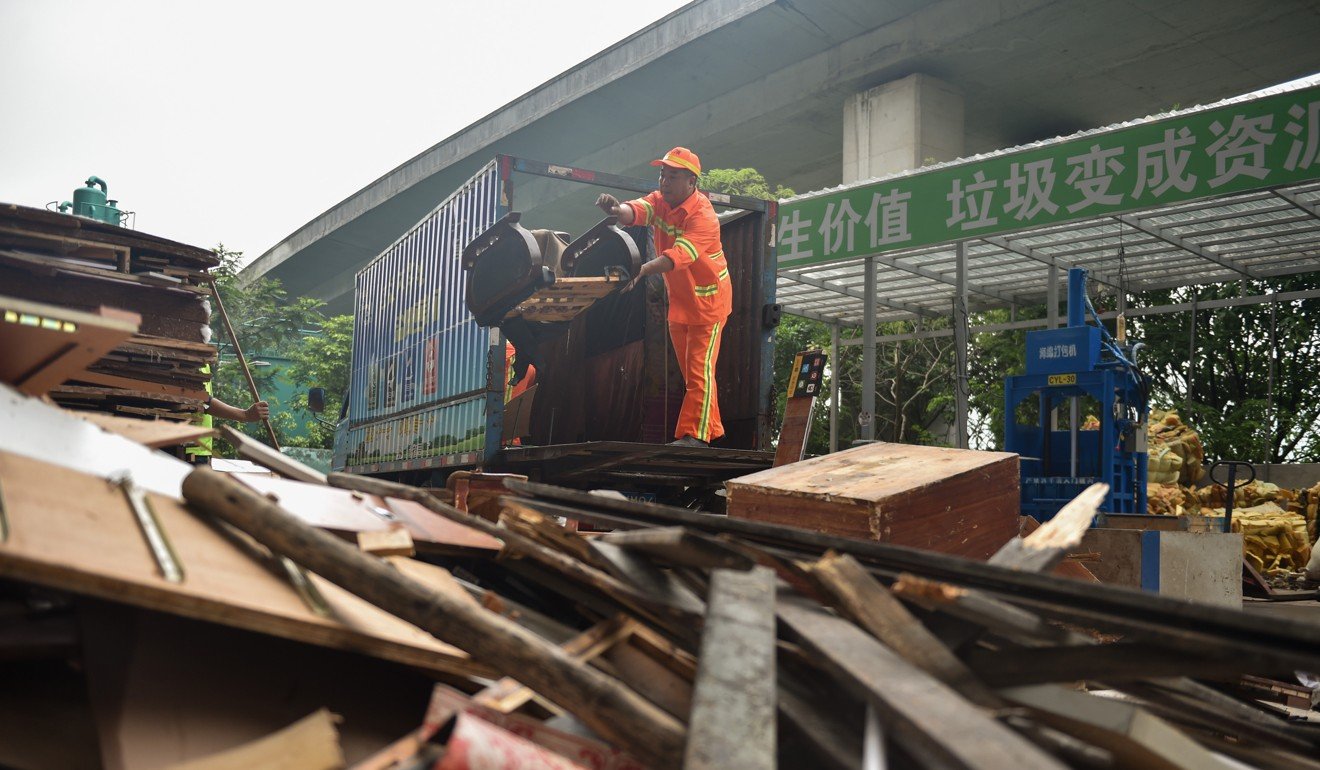
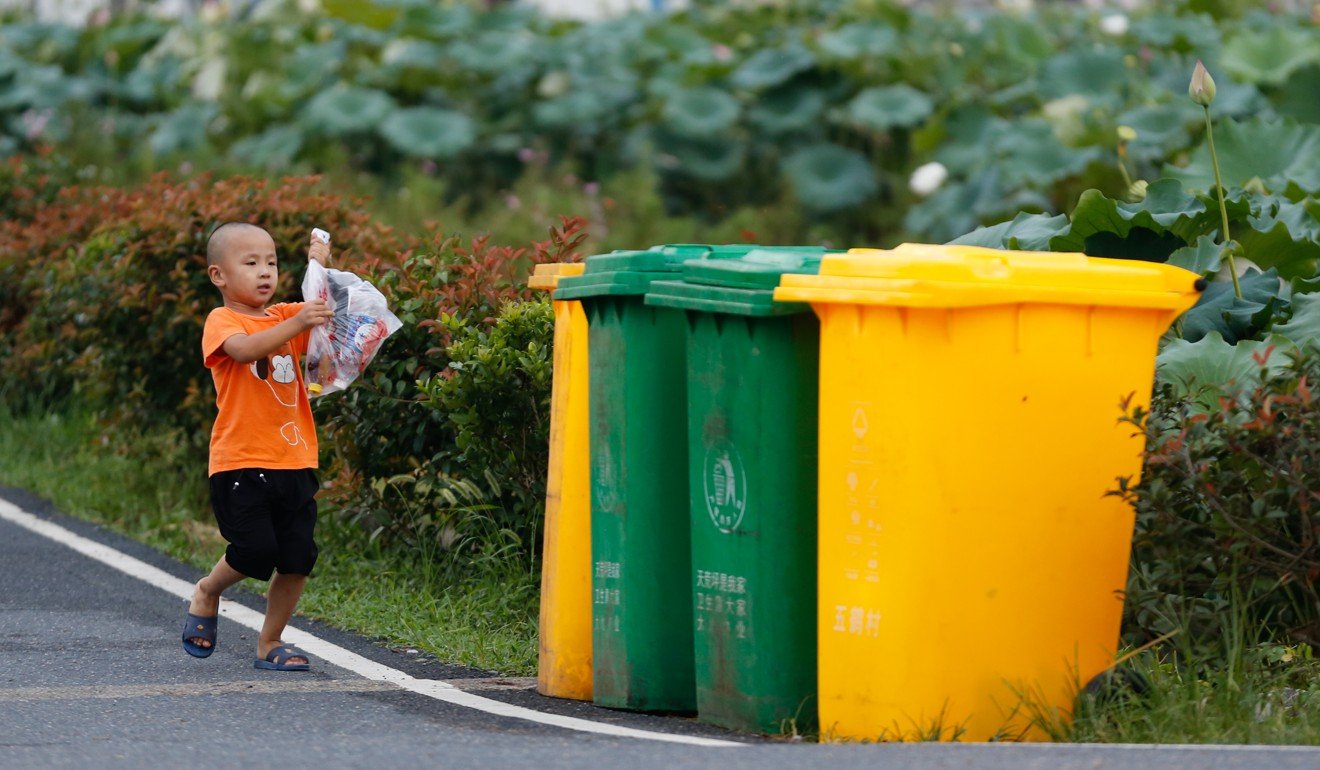
The sorting of household waste is more of a novelty than the norm in China. Photo: Xinhua
As 60-year-old Xu Mingan hurried to the rubbish bins on her Beijing estate, she saw an abandoned aluminium clothes rack.
Standing in front of several bins labelled “recyclables”, “kitchen waste” and “other waste”, she tore apart the rack, packed the aluminium parts together for selling to the recycling men who drop by occasionally, and threw the remaining plastics randomly into the bins.
“People don’t sort their waste here. We can’t even tell the difference between these bins,” she said.
But unlike other residents of the estate, Xu likes to rummage through the bins, picking up recyclables and selling them, as well as sharing discarded clothes, shoes, quilts and blankets that are still in good condition to the janitors.
The concept of sorting waste is still new in China. Photo: Xinhua
Xu, who has lived in Beijing for 10 years, admitted her family never sorted its household waste, despite two decades of encouragement from the government to do so. Her attitude may be about to change.
As part of the three major tasks Chinese President Xi Jinping has set the nation to achieve by 2020, China has adopted a new plan which aims to build a standard waste sorting system.
China must heed Xi’s call on tackling waste
In 2000, the government chose eight cities, including Beijing, Shanghai and Guangzhou, as pilots for the waste sorting plan, but the slogans fell on deaf ears and there have been few signs of progress.
But Xi appears to have given the grass-roots environmental policy his attention once more, delivering a long statement on June 3 about how the country needs to do better on sorting its waste.
“[We should have] extensive education and guidance, to let people realise the importance and necessity of waste sorting; through effective supervision and guidance, [we should] let more people take action and form a good habit on waste sorting,” he said.
In 2000 the Chinese government chose eight cities to pilot a waste sorting plan but it made little progress. Photo: Xinhua
In March 2017, the government set out a plan to formalise a standard system and regulations for rubbish sorting by 2020, with a target for 46 major cities – including Beijing – to recycle 35 per cent of their waste by that year. Three months later, the housing ministry published a notice requiring the cities to classify their waste and build a basic sorting system.
The recent attention from the top leaders has seen a spike in activity among local officials. Shanghai’s Communist Party chief Li Qiang was among the first to release local plans to implement household waste sorting in February, going in front of television cameras to demonstrate how to recycle plastic bottles.
“Waste sorting is a now a political task for local officials, and they might lose their jobs if they can’t do the job well,” said Zhang Yi, an expert with the ministry, which has primary responsibility for waste management.
G20 set to agree on ways to reduce problem of plastics in oceans
But the political will still needs time to translate into actual sorting and recycling, with environmental activists pointing out that little has been done in the two years since the plan was published.
“The vast majority of cities are still at the same level they were two years ago. They just change one bin into two or three bins in the community, but in the end, they are emptied into a single garbage truck,” said Chen Liwen, co-founder of Zero-Waste Villages, a non-government environmental organisation.
Waste classification should be done systematically, she said, with residents, government and sorting companies working together, “but we don’t have that at all”.
“The government should do a vast amount of work on education in the early stages, as well as change the sorting system in the later stage,” she said.
The recent attention from the top leaders has seen a spike in activity among local officials. Photo: Handout
Build the system
There are four main processes in the sorting of waste: dumping, collection, transport and treatment, Chen said. But currently, “not even one city has got the first step, trash sorting, sorted out”.
On May 31, China’s environment ministry published a report into its citizens’ thoughts on green issues and found a large gap between people’s recognition of the problem and their actions.
According to the study, 92 per cent of respondents believe rubbish sorting is important for environmental protection, but only 30 per cent said they were doing it “very well” or “fairly well”.
More than half gave their reasons for not sorting waste as “no classification bins in the community” and “no classification for the garbage truck, so no need to sort in the dumping process”. More than 30 per cent said they did not know how to classify their rubbish.
A government report found a large gap between people’s recognition of environmental problems and their actions. Photo: Handout
Wang Xi, a 29-year-old Beijing resident, said she did not know the standards for “recyclables” and “non-recyclables” so had never sorted her household waste. She only began to understand when she spent some time in Japan.
The difference there, she said, was that there was a guide in every home that showed how to sort waste into the different types – kitchen waste, plastic, paper – and designated collection days for each kind.
“If you mix the garbage, like put plastic in with the kitchen waste, the garbage company will send it back to you,” she said.
“But in China, all the bins are emptied into one garbage truck, so I don’t know what the point is for us to sort it in the first place.”
I don’t know what the point is for us to sort it in the first place – Beijing resident Wang Xi
Chen said the government needed to take the lead in waste sorting as a matter of public interest instead of only paying lip service to the issue.
Zhang said waste classification was a social issue but local officials had so far not paid enough attention to it. Most of the targeted 46 cities now had a plan on paper and had established offices with specific targets but, at the moment, waste sorting remained on paper too, he said.
How China’s ban on plastic waste imports threw recycling efforts into turmoil
Pilot projects in rural areas
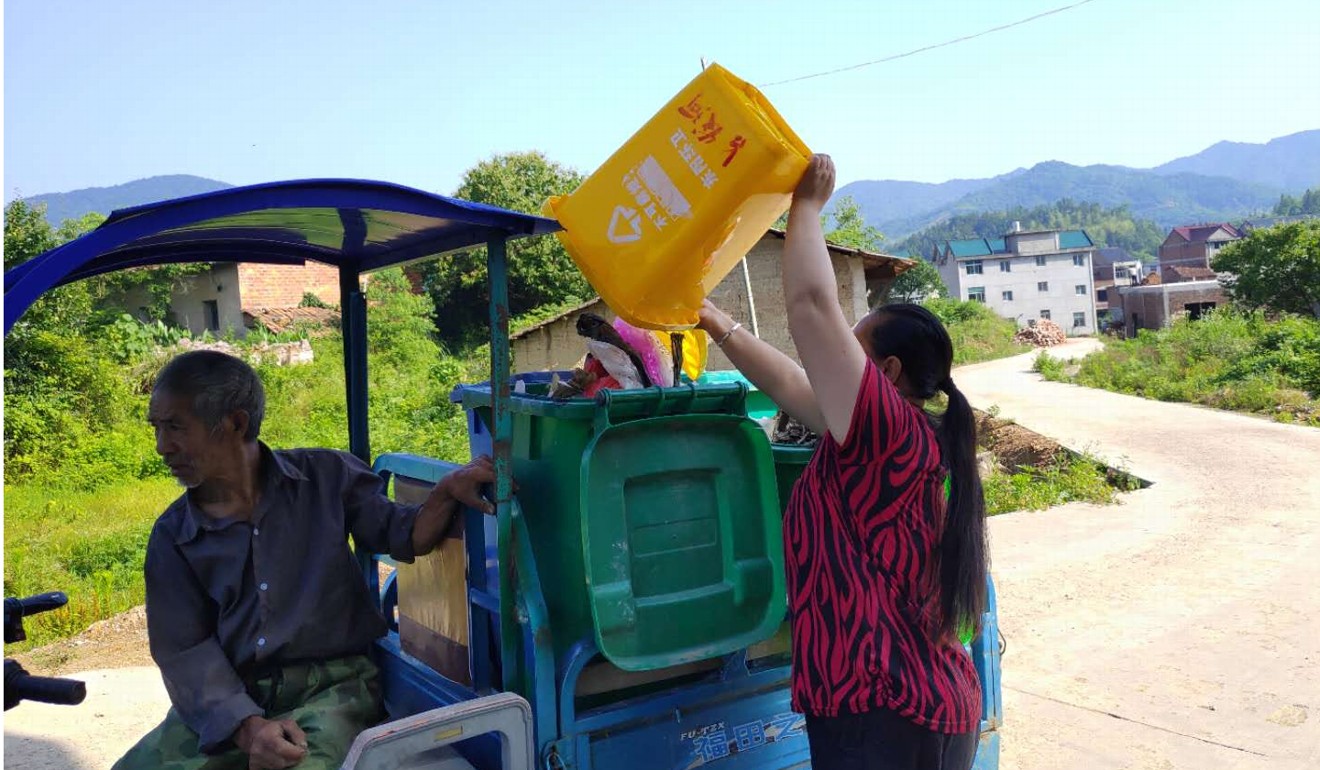
Despite the challenges ahead, some projects have shown promising results. Chen has been classifying waste in rural areas since 2017 and today her pilot projects have been replicated across more than 20 villages.
The greatest success has been in Jiangxi province, where 12 villages have been sorting their rubbish since December.
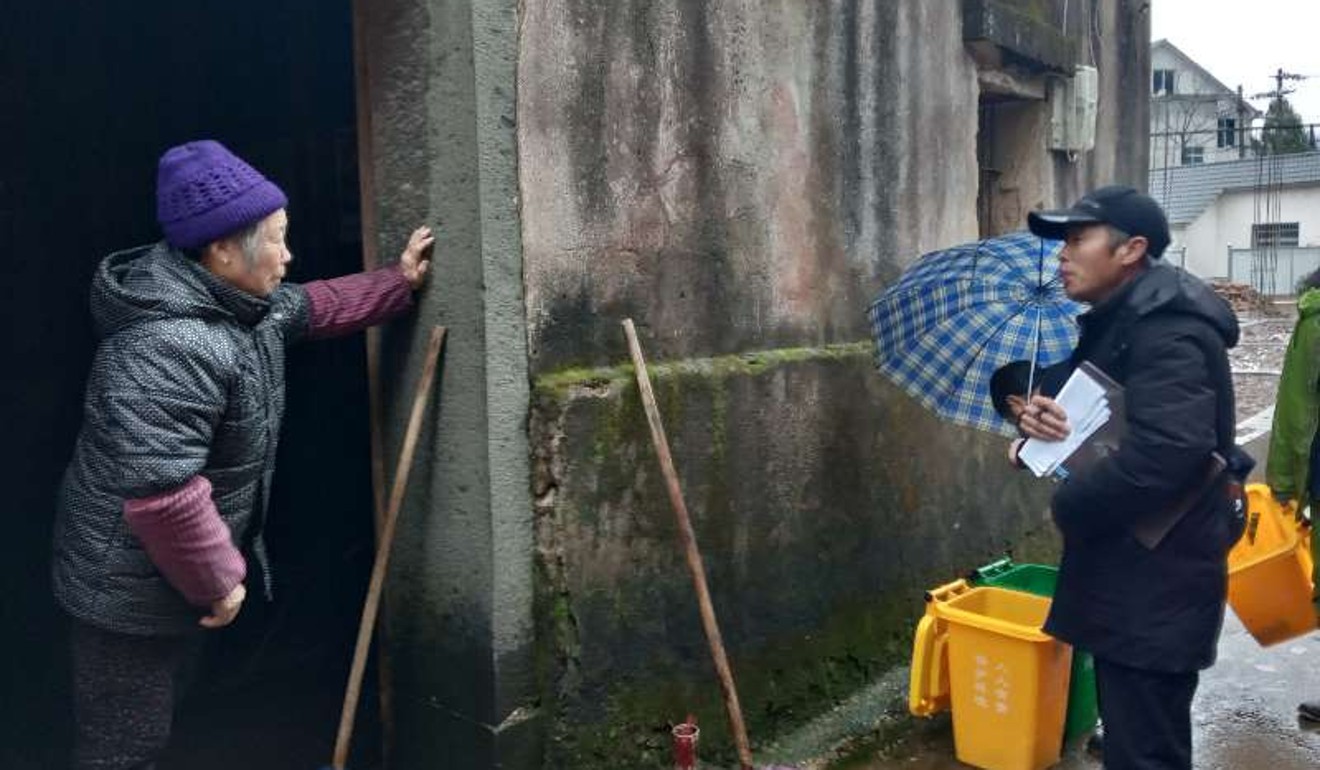
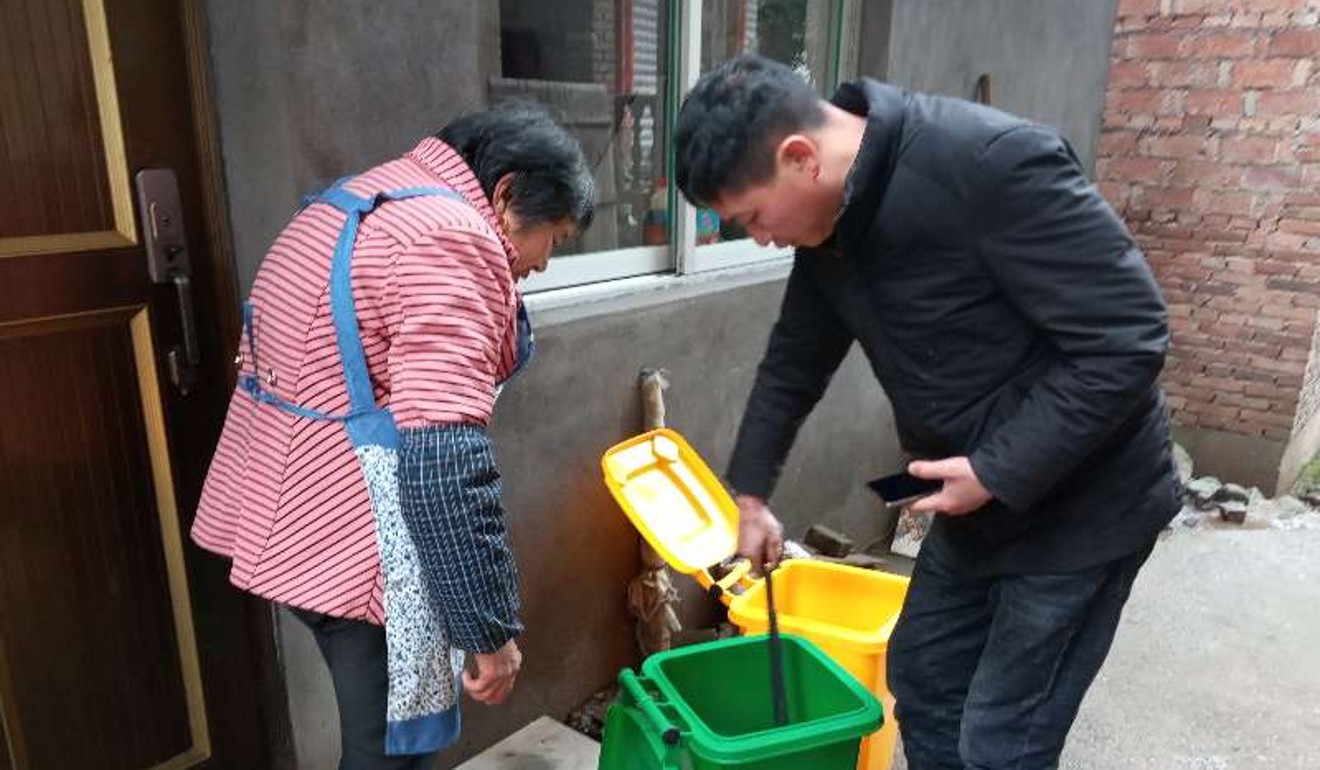
A government official in Dongyang county checks if a woman has correctly sorted her rubbish. Photo: Handout
Wang Qinghai, party chief of Dongyang county in the northeastern part of the province, said preparation work began last June.
“We investigated the scale of household residents in our county, and the number of hotels, restaurants and schools, to estimate the garbage production per capita and how much we could reduce after sorting,” he said.
The hardest part was educating the public, he said. “We organised training and meetings and sent materials, we also guided people when they dumped their garbage.”
Wang said the effect had been very good and people’s understanding of environmental protection and their cooperation with the government had been beyond his expectations.
Beijing struggling to contain its growing garbage problem
According to his estimates, after the introduction of classification system the amount of waste had decreased by 50 per cent. Now, the amount of waste being classified correctly in Dongyang county was over 99 per cent.
A successful waste programme needed the government’s lead and the cooperation of the relevant departments, Wang said. In Dongyang, the agricultural, water resources and urban-rural development departments had all taken part.
As for investment, Zhang estimated China needed to double its financing to introduce sorting facilities and build treatment systems but, speaking from his experience, Wang said waste sorting had not required any extra money.
Zhang remains optimistic that the 46 cities named in the latest waste management plan can achieve their goal by 2020.
“Waste sorting was a big problem in China that hadn’t been solved for nearly two decades, but as our ‘big boss’ pays attention to this, it will be solved,” he said.
MUMBAI (Reuters) – Amazon.com faced a social media backlash in India on Thursday after toilet seat covers and other items emblazoned with images of Hindu gods were spotted on its website.
Thousands of Twitter users backed a call for a boycott of the U.S. retailer, making #BoycottAmazon India’s top trending topic on Twitter. Some tagged Indian Foreign Minister Sushma Swaraj, urging her to take action against the company.
Amazon, the world’s biggest online retailer, said it was removing the products from its online store.
“All sellers must follow our selling guidelines and those who do not will be subject to action including potential removal of their account,” the company said in a statement.
The episode is reminiscent of an incident in 2017 when the Indian government took Amazon to task after its Canadian website was spotted selling doormats resembling India’s flag.
Swaraj at the time threatened to rescind visas of Amazon employees if the doormats were not removed from its site.
Reuters found several listings of toilet seat covers, yoga mats, sneakers, rugs and other items depicting Hindu gods, or sacred Hindu symbols, on Amazon’s U.S. website.
Some of the items were no longer available for purchase.
“Until you hit these Hinduphobics Business hard they will keep on insulting your gods, your beliefs & your entire civilization,” tweeted Sumit Kandel, whose profile describes him as a film trade analyst.



 CHINDIA ALERT: You'll be living in their world, very soon
Coronavirus: Chinese workers in Vietnam cry foul after being fired by Taiwanese firm making shoes for Nike, Adidas
A group of 150 Chinese workers believe the world’s largest maker of trainers used the coronavirus as an excuse to fire them, having helped Taiwanese firm Pou Chen successfully expand its production into Vietnam for more than a decade.
Pou Chen, which makes footwear for the likes of Nike and Adidas, informed the group in late April that they would no longer be needed as they were unable to return to
from their hometowns in China due to the coronavirus lockdowns.
“We 150 employees were the first batch of Chinese employees to be laid off this year. We are all pessimistic and expect more will be cut,” added Zhang.
In its email on April 27, Pou Chen said it was forced to terminate the contracts of the Chinese employees across five of its factories due to an unprecedented decline in orders and financial losses.
The Chinese employees, many of whom have been working for the shoemaker for decades, said the compensation offered was unfair and below the levels required by labour law in both Vietnam and China.
“[The dismissals were] in accordance with the relevant labour laws of the country of employment … and employee labour contracts,” added the statement from Pou Chen, which employs around 350,000 people worldwide.
Company data showed Pou Chen’s first quarter revenues tumbled 22.4 per cent year-on-year to NT$59.46 billion (US$1.99 billion), the weakest in six years.
With the likes of Nike and Adidas closing retail stores around the world to comply with social distancing requirements, analysts also said orders plummeted 50 per cent in the second quarter, although the company declined to comment on the media reports.
Andy Zeng, who had worked for the firm since 1995, said the group were “very upset” when they received the news last month as the impact of the coronavirus pandemic began to reverberate around the world, disrupting global value chains.
“Most of us joined Pou Chen in the 1990s when we were in our late teens or early 20s, when the Taiwan-invested company started investing and setting up factories in mainland China. Now more than two decades have passed,” he said.
Zeng was among the first generation of skilled workers in China as Pou Chen developed rapidly, enjoying the benefits of cheap labour, although the workers themselves were rewarded with regular pay rises.
The company needed a group of skilled Chinese workers to go to its new factories in Vietnam. I said yes because I thought it was a good opportunity to see the outside world – Andy Zeng
What our Chinese employees have done in Vietnam for more than a decade can be said to be very simple but very difficult – Dave Zhang
Posted in 50 per cent, accordance, Adidas, adjustment of manpower, around the world, automation level, below the levels, Bloomberg, boomed, bottlenecks, Chaos, cheaper, China, China’s economy, Chinese employees, Chinese workers, closing, comment, Company, compensation, comply, contributed, cooperated, coronavirus, coronavirus lockdowns, Covid-19 response, cry foul, cultural shock, deaths, decade, decline, declined, dismissals, disputes, Dong Nai, Dongguan, employee labour contracts,, expand, expendable, factories, families, financial losses, fired, footwear, furloughs, higher, hometowns, impact, Indonesia, Labour law, lack of orders, land, Mainland China, making, management experience, management style, media reports, Nike, opportunity, orders, pay cuts, pessimistic, plans, plummeted, Pou Chen, production, production line, relocation process, requirements, retail stores, returns, Reuters, Rush hour, second quarter, set up, shoe manufacturing, shoes, skilled, Social distancing, south china morning post, strain under, streets, strike, Taipei Times, Taiwan, Taiwan-invested, Taiwanese firm, Uncategorized, unfair, unprecedented, Vietnam, Vietnamese, Virus, workers, world’s largest maker of trainers | Leave a Comment »